Prevalence of self-reported constipation in adults from the general population
1 WOC nurse, Santa Casa de Misericórdia de Passos - Regional Cancer Hospital, Passos, MG, Brazil.
2 Associate Professor, Department of Medical-Surgical Nursing, School of Nursing, University of Sao Paulo, Sao Paulo, SP, Brazil.
3 PhD in Sciences, School of Nursing, University of Sao Paulo, Sao Paulo, SP, Brazil.
4 Nurse of the Servidor Público Estadual Hospital – HSPE, Sao Paulo, SP, Brazil.
5 Technical Consulting Nurse of Smith & Nephew, Sao Paulo, SP, Brazil.
6 Oncologist nurse, Onofre Lopes Teaching Hospital, University of Rio Grande do Norte, Natal, RN, Brazil.
7 Associate Professor, Departament of
Gastroenterology, School of Medicine, University of Sao Paulo, Sao Paulo, SP, Brazil.
ABSTRACT
Objective: To estimate the prevalence of self-reported constipation and associated factors in the general population of a Brazilian city. Method: Secondary analysis of an epidemiological study, population-based, cross-sectional study, about bowel habits of Brazilian population. A total of 2,162 individuals were interviewed using two instruments: sociodemographic data and the adapted and validated Brazilian version of the “Bowel Function in the Community” tool. Results: here was a prevalence of 25.2% for the self-reported constipation, 37.2% among women and 10.2% among men. Stroke and old age were associated with constipation in the three statistical models used. Conclusion: he prevalence found showed to be similar to the indings in the literature, although some associated factors obtained here have never been investigated.
DESCRIPTORS
Constipation; Prevalence; Epidemiology; Nursing; Cross-Sectional Studies.
Prevalence of self-reported constipation in
adults from the general population
Prevalência de constipação intestinal autorreferida em adultos da população geral Prevalencia de constipación autorreferido en adultos de la población general
Fernanda Mateus Queiroz Schmidt1, Vera Lúcia Conceição de Gouveia Santos2, Rita de Cássia Domansky3, Elaine Barros4, Mariana Alves Bandeira5, Mariana Alves de Melo Tenório6, José Marcio Neves Jorge7
Received: 10/20/2014 Approved: 03/02/2015
ORIgInAl ARTIClE DOI: 10.1590/S0080-623420150000300012
Corresponding author:
INTRODUCTION
Chronic Constipation (CC) is a syndrome based on symptoms deined as unsatisfactory defecation that results from diicult stool passage or infrequent stools, hard stools, or feeling of incomplete defecation, which can occur indi-vidually or secondarily to an underlying disease(1). According
to self-reported, it is characterized by subjective complaint inluenced by cultural habits(2). According to the Rome III
criteria(³), CC is deined as the presence of two or more
of the following symptoms for the last three months, with onset at least 6 months before diagnosis: straining during at least 25% of defecations, lumpy or hard stools in at least 25% of defecations, sensation of incomplete evacuation for at least 25% of defecations, sensation of anorectal obstruc-tion/blockage for at least 25% of defecations, manual ma-neuvers to facilitate at least 25% of defecations (e.g., digital evacuation and support of the pelvic loor), and lesser than three defecations per week. In addition to these, two more symptoms of constipation are considered: stools that occur rarely without the use of laxatives, and non-fulillment of the criteria for irritable bowel syndrome.
CC prevalence ranges between 2.6% and 30.7%, as in-dicated by some studies(4-8), highlighting the female and old
age as associated factors(4).
In order to provide recommendations for assessment, diagnosis and treatment of CC, and from a systematic review of literature conducted by experts from across the region, the Latin American Consensus of Chronic Consti-pation was published in November 2005, which points out that there are few epidemiological studies on the subject in Latin America(6).
A complete history, including surgery, diet and medica-tions taken, is part of the evaluation of patients with CC performed by nurses(9). Proper understanding of the
symp-toms of functional gastrointestinal disorders (FGIDs) or not, is needed by health professionals to recognize the im-pact on patients and a rational basis for knowing diagnose and treat them(10).
It is necessary to consider that CC can cause serious complications such as fecaloma, pseudo-diarrhea, stercoral ulcer, volvulus and gastrointestinal perforation, especially in patients with megacolon and megarectum. herefore, recog-nition of the symptom and an early treatment are necessary to prevent complications and improve the quality of life of patients(11)
. Moreover, within the specialized area of Wound,
Ostomy and Continence Nursing (WOCN), incontinence include constipation as one of its sub-areas of expertise. he care of people with constipation - which can occur in any health care setting, particularly in hospitals and long-term institutions and in the end of life – it is relevant for Nursing area, specialized or not.
Given the above and considering the lack of epide-miological studies in Latin America, speciically in Brazil, the aim of this study is to estimate the prevalence of self-reported CC and identify the factors associated with this occurrence in adults from the general population.
METHOD
his is a secondary analysis, developed from an epi-demiological population-based, descriptive, exploratory and cross-sectional study, with quantitative approach, conducted between 2008 and 2009 in the urban area of Londrina - Parana, on the bowel habits of this popu-lation(12). At the time of data collection, the city had a
population of 447,065 inhabitants, of which 305,695 in-dividuals were over 18 years old, according to the census of the Brazilian Institute of Geography and Statistics - IBGE 2000. he study population was composed by all inhabitants residing in the urban area of this city, di-vided into 390 census sectors, grouped into ive regions (north, south, east, west and center). he population was stratiied by gender and age. he study sample consisted of all residents present in households, selected through cluster probabilistic sampling and who met the follow-ing inclusion criteria: age equal or above 18 years old, to be able to respond to interview questions and to accept to participate in the study. As we had access to the city map, containing all addresses and 390 census sectors ac-cording to IBGE; information on the general population by census sectors; and the number of elements in each region, depending on the age and gender, the calculation of the sample obtained consisted of 2,000 inhabitants. hen, the selection of clusters was performed through a draft, being irst drawn the census sectors of each region, followed by the draw for the street to be visited, that is the cluster. Finally, the sample consisted of 2,162 indi-viduals, most were women (1203 - 56%); white (1591 - 73.6%); people in stable relationships (59.7% - 1290); literate (97.5% - 2108), with 0 to 33 years of education (mean 9.4, SD=4.5 years); 809 (37.4%) participants had no deined occupation. he age ranged from 18 to 93 years (mean 40.6, SD = 16.4 years); the mean monthly family income of participants was 3.8 (SD = 3.3) mini-mum wagesa; and the number of dependents monthly
household income ranged from 1 to 13 people (mean 3.1, SD = 1.4).
he research project of the primary study was approved by the Research Ethics Committee of the School of Nurs-ing of the Universidade de Sao Paulo (No. 485/2005/ CEPEEUSP) and received inancial support from the Sao Paulo Research Foundation (FAPESP), process 2006/50006-1.
Data collection was conducted from April to May 2008, by ten undergraduate Nursing students from the Universi-dade Estadual de Londrina - UEL, they were previously submitted to a process of training involving the objec-tives and procedures of the study, with emphasis on data collection, through the interview technique. During data collection, all residents occupants of households were in-terviewed. Study participants were informed about the re-search objectives, expressing their consent to participate by signing the consent form.
Prevalence of self-reported constipation in adults from the general population
Two instruments were used for data collection. he irst consisted of the subjects' demographic data (name, age and date of birth, gender, skin color, education, pro-fession and occupation, marital status, monthly family income and number of dependents of this income). he second instrument, Bowel Function in the Community, in its adapted and validated version to Brazil(13), intended to
assess the sample’s bowel function. his instrument con-tains 68 questions, of which 67 are multiple choice (2 to 9 response alternatives). he latest question included 17 general symptoms unrelated to bowel habits. Although the instrument has no scores, each response alternative receives a score ranging from 0 to 9. he questions are divided into: general bowel habits; fecal incontinence; uri-nary symptoms; anal-rectal diseases and surgical history; medical care utilization and potential contributing medi-cal disorders. Considering that the present study aimed to determine the prevalence of CC (question 14) and its associated factors, we used the items contained in the clus-ters general bowel habits, anal-rectal diseases and surgical history (questions 46 to 50 and 53 to 59).
he data from both instruments were analyzed using the software R 3.1.1, R Core Team (2013).
he prevalence of CC was assessed by self-report, sidering constipated people who responded 1 (I had con-stipation often, more than 25% of the time) or responded 2 (I sometimes had constipation, less than 25 % of the time), and question number 14 of the speciic instrument, which deals with how regular or how often the person evacuated last year.
For the study of associated factors (independent vari-ables), the data were subjected to univariate analysis us-ing the Pearson chi-square test (X²), with 5% signiicance level. For the univariate analysis, we presented as mea-sures of efect, the crude odds ratio (OR). A multivari-ate logistic regression was held to further elucidmultivari-ate these relationships and analyze the efect of each variable ad-justed for the efect of the other. Final associations were measured by adjusted Odds Ratio (ORadj), with respec-tive 95% conidence intervals (95% CI). hree models of multivariate analysis were developed to establish the relationship between demographic and clinical variables and of all signiicant variables: a general model, with all constipated individuals and two models stratiied by gen-der. In the general model, the following variables were tested: radiotherapy, abscess or infection, istula, anal is-sure, surgery in the rectum or anus, stroke, rectal pro-lapse, hemorrhoids, trauma or wound around the anus, diabetes mellitus, reduced or pushed hemorrhoids and nervous system disorders. In the model for women, we also included: women delivery history, presence of injury or laceration of the anus during delivery and antecedent or rectocele hysterectomy, in addition to the other vari-ables also included in the other two models. he p value was set at 5%.
he quality and the discriminating power of the ad-justed models were analyzed using the Receiver Operating Characteristic curve (ROC)(14) for each of the three models.
he ROC curve measures the accuracy of the estimated probabilities to predict CC.
RESULTS
Of the 2,162 participants, 546 were considered consti-pated according to self-reported; 340 (62.3% / 15.7%) of whom had already had CC frequently and 206 (37.7% / 9.5%) sometimes.
he estimated prevalence of CC was 25.2% (CI 23.4% - 27.1%), with 37.2% for women and 10.2% among men.
Figure 1 shows that CC increases with age in both males and for the entire sample, from 60 years. For all groups, CC shows the highest prevalence among the oldest participants (75 to 100 years old).
Figure 1 – CC prevalence according to age and gender -
Lond-rina, PR, Brazil, 2008.
C
onstipa
tion pr
ev
alenc
e (%)
40
30
20
10
0
Age (years)
(14.45] (45.60] (60.75] (75.100]
Gender
Male Female Total
Table 1 – Unadjusted and adjusted odds Ratio (OR) with 95% CI for the association between self-reported CC and sociodemographic and clinical variables - Londrina, PR, Brazil, 2008.
Variable
Unadjusted OR Adjusted OR
OR IC (95%) OR IC (95%)
lower limit Upper limit lower limit Upper limit
Sociodemographic variables
Ethnicity
White 1.0 1,0 -
-Yellow 0.3 0,1 0,8 0,2 0,0 0,7
Brown 0.9 0,6 1,2 1,0 0,7 1,4
Black 1.0 0,6 1,4 1,1 0,7 1,7
Other 1.0 0,6 1,4 1,2 0,8 1,8
literacy
No 1.0
NS
Yes 0.7 0,4 1,4
gender
Male 1.0 1,0 -
-Female 5.2 4,1 6,6 4,8 3,7 6,1
Education
Illiterate 1.0
Literate 0.9 0,5 1,7
Primary school completed 0.8 0,4 1,5 NS
Secondary school completed 0.7 0,3 1,2
Higher education 0.6 0,3 1,3
Occupation
Level 0 1.0
Level 1 0.7 0,4 1,0
Level 2 0.6 0,4 0,7 NS
Level 3 0.6 0,5 0,9
Level 4 0.5 0,3 0,7
Level 5 0.6 0,4 0,8
Marital status
Single 1.0
Separated/Divorced 1.2 0,8 1,8
Stable union 1.3 1,0 1,6 NS
Widow(er) 1.8 1,2 2,7
Age
(14,45] 1.0 1,0 -
-(45,60] 0.8 0,6 1,0 0,6 0,5 0,8
(60,75] 1.1 0,8 1,6 0,9 0,6 1,3
(75,100] 1.9 1,1 3,2 1,8 1,0 3,2
Income in minimum wages1
(2,15] 1.0
(1,5,2] 0.8 0,6 1,3
(1,1,5] 0.8 0,6 1,2 NS
(0,5,1] 0.9 0,7 1,3
Prevalence of self-reported constipation in adults from the general population
Variable
Unadjusted OR Adjusted OR
OR IC (95%) OR IC (95%)
lower limit Upper limit lower limit Upper limit
Clinical variables
Abscess/infection
No 1.0
NS
Yes 1.4 0.7 2.5
Fistula
No 1.0 1.0 -
-Yes 5.2 2.2 12.6 2.8 1.1 7.8
Anal issure
No 1.0 1.0 -
-Yes 3.0 1.9 4.7 1.8 1.1 3.0
Rectum or anal surgery
No 1.0 1.0 -
-Yes 2.4 1.4 4.1 2.1 1.1 3.9
Trauma and injury in the rectum or anus
No 1.0 1.0 -
-Yes 3.9 1.9 8.2 2.6 1.1 5.9
Rectal prolapse
No 1.0
NS
Yes 3.6 1.5 8.9
Hemorrhoids
No 1.0 1.0 -
-Yes 2.5 1.9 3.4 1.8 1.3 2.5
Reduced/pushed the hemorrhoids
No, it came back on its own 1,0
Yes, I pushed it 1,1 0,5 2,3 NS
No, it has always been out 1,4 0,7 3,0
Radiotherapy
No 1,0
NS
Yes 1,3 0,6 2,8
Diabetes Mellitus
No 1,0
NS
Yes 1,5 1,0 2,1
nervous system disorder
No 1,0 1,0 -
-Yes 2,0 1,5 2,6 1,5 1,1 2,0
Stroke
No 1,0 1,0 -
-Yes 4,2 2,0 9,0 3,9 1,6 9,6
NS = Not signiicant R² = 0.020; C= 0.743.
8 he minimum wage per month in Brazil corresponds to R$ 788,00 reais or U$ 255,18 dollars according to the Central Bank of Brazil on April 14th, 2015.
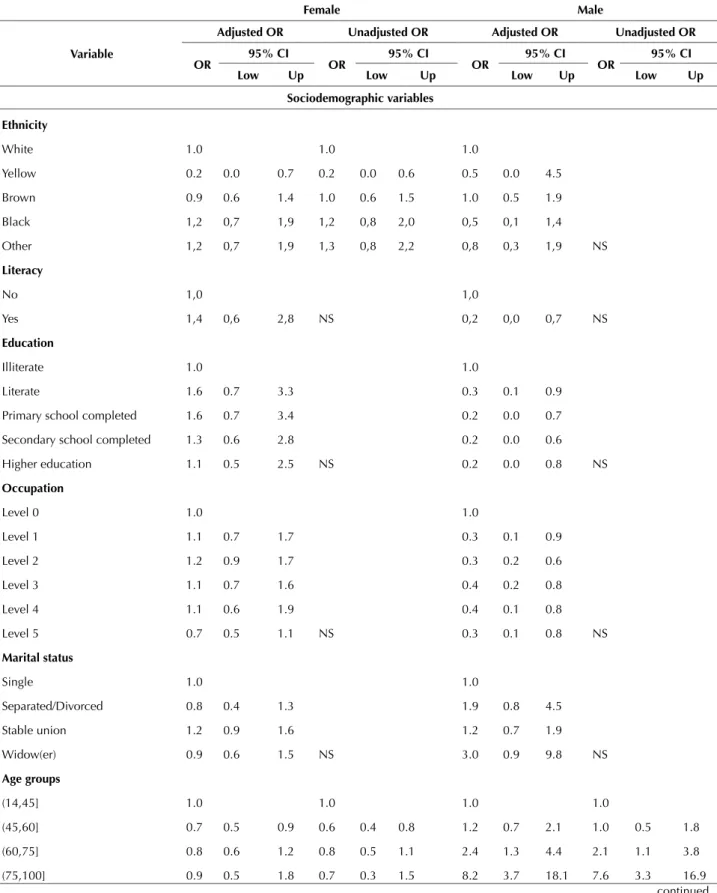
Table 2 shows that the black ethnicity (OR = 1.3 / 95% CI 0.8 - 2.1) and the age group between 75 and 100 years (OR = 0.8 / 95% CI 0.4 - 1 5) highlight the demo-graphic factors associated with CC among women and the age group between 75 and 100 years (OR = 7.6 / 95% CI 3.3 - 17.0) among men. Concerning to clinical variables,
only stroke remained showing statistically signiicant as-sociation for both genders. Anal issure, anal or rectum surgery, trauma or wound around the anus, rectocele and hemorrhoids stand out among women and for men, nervous system disorder and stroke. he variables age and stroke were repeated in the three models.
Table 2 – Unadjusted and adjusted odds Ratio (OR) with 95% CI for associations between the presence of CC and the
sociodemo-graphic and clinical variables according to gender - Londrina, PR, Brazil, 2008.
Female Male
Variable
Adjusted OR Unadjusted OR Adjusted OR Unadjusted OR
OR 95% CI OR 95% CI OR 95% CI OR 95% CI
low Up low Up low Up low Up
Sociodemographic variables
Ethnicity
White 1.0 1.0 1.0
NS
Yellow 0.2 0.0 0.7 0.2 0.0 0.6 0.5 0.0 4.5
Brown 0.9 0.6 1.4 1.0 0.6 1.5 1.0 0.5 1.9
Black 1,2 0,7 1,9 1,2 0,8 2,0 0,5 0,1 1,4
Other 1,2 0,7 1,9 1,3 0,8 2,2 0,8 0,3 1,9
literacy
No 1,0
NS
1,0
NS
Yes 1,4 0,6 2,8 0,2 0,0 0,7
Education
Illiterate 1.0
NS
1.0
NS
Literate 1.6 0.7 3.3 0.3 0.1 0.9
Primary school completed 1.6 0.7 3.4 0.2 0.0 0.7
Secondary school completed 1.3 0.6 2.8 0.2 0.0 0.6
Higher education 1.1 0.5 2.5 0.2 0.0 0.8
Occupation
Level 0 1.0
NS
1.0
NS
Level 1 1.1 0.7 1.7 0.3 0.1 0.9
Level 2 1.2 0.9 1.7 0.3 0.2 0.6
Level 3 1.1 0.7 1.6 0.4 0.2 0.8
Level 4 1.1 0.6 1.9 0.4 0.1 0.8
Level 5 0.7 0.5 1.1 0.3 0.1 0.8
Marital status
Single 1.0
NS
1.0
NS
Separated/Divorced 0.8 0.4 1.3 1.9 0.8 4.5
Stable union 1.2 0.9 1.6 1.2 0.7 1.9
Widow(er) 0.9 0.6 1.5 3.0 0.9 9.8
Age groups
(14,45] 1.0 1.0 1.0 1.0
(45,60] 0.7 0.5 0.9 0.6 0.4 0.8 1.2 0.7 2.1 1.0 0.5 1.8
(60,75] 0.8 0.6 1.2 0.8 0.5 1.1 2.4 1.3 4.4 2.1 1.1 3.8
Prevalence of self-reported constipation in adults from the general population
...continuation
Female Male
Variable
Adjusted OR Unadjusted OR Adjusted OR Unadjusted OR
OR 95% CI OR 95% CI OR 95% CI OR 95% CI
low Up low Up low Up low Up
Income in minimum wages
(2,15] 1.0
NS
1.0
NS
(1,5,2] 0.8 0.5 1.3 0.8 0.4 1.7
(1,1,5] 0.9 0.5 1.4 0.5 0.2 1.1
(0,5,1] 0.8 0.6 1.3 0.7 0.4 1.4
(0,0,5] 1.1 0.7 1.8 1.1 0.5 2.2
Clinical variables
Abscess/infection
No 1.0
NS
1.0
NS
Yes 1.3 0.6 2.6 1.0 0.2 4.5
Fistula
No 1.0
NS
1.0
NS
Yes 4.1 1.4 11.8 5.9 0.9 36.1
Anal issure
No 1.0 1.0 1.0
NS
Yes 2.7 1.6 4.6 2.5 1.5 4.4 0.5 0.0 4.1
Rectum or anal surgery
No 1.0 1.0 1.0
NS
Yes 2.6 1.3 5.1 2.7 1.3 5.7 2.5 0.9 6.9
Trauma and injury in the rectum or anus
No 1.0 1.0 1.0
NS
Yes 3.7 1.5 9.1 3.3 1.3 9.2 2.9 0.5 14.9
Child-birth
No 1.0
NS NA
Yes 0.9 0.741 1.2
Injury/tear during childbirth
No 1.0
NS NA
Yes 0.9 0.4 1.8
I never gave birth 0.904 0.4 1.8
Hysterectomy
No 1.0
NS NA
Yes 0.9 0.6 1.4
Rectocele
No 1.0 1.0
NA
Yes 11.9 1.4 97.6 10.4 1.7 195.3
Rectal prolapse
No 1.0
NS
1.0
NS
Yes 3.8 1.1 12.5 3.5 0.6 18.6
Female Male
Variable
Adjusted OR Unadjusted OR Adjusted OR Unadjusted OR
OR 95% CI OR 95% CI OR 95% CI OR 95% CI
low Up low Up low Up low Up
Hemorrhoids
No 1.0 1.0 1.0
NS
Yes 2.0 1.4 2.8 2.0 1.4 2.8 2.0 0.9 4.1
Reduced/pushed the hemorrhoids
No, it came back on its own 1.0 1.0
NS
Yes, I pushed it 0.9 0.4 2.0 0.9 0.1 9.2
No, it has always been out 1.1 0.5 2.3 NS 1.5 0.1 17.2
Radiotherapy
No 1.0 1.0
NS
Yes 2.1 0.8 5.9 NS 1.0 0.2 4.5
Diabetes Mellitus
No 1.0 1.0
NS
Yes 1.1 0.7 1.7 NS 2.6 1.3 5.3
nervous system disorder
No 1.0 1.0 1.0
Yes 1.4 1.1 1.9 NS 2.7 1.6 4.6 2.7 1.5 4.6
Stroke
No 1.0 1.0 1.0 1.0
Yes 3.7 1.4 9.8 4.3 1.5 13.1 6.0 1.6 21.8 6.0 1.4 22.9
NS= Not signiicant. NA= Not applicable. Lo = Lower limit. Up=Upper limit. Adjustable model for female gender: R²: 0.093; C: 0.632.
Adjustable model for male gender: R²: 0.091; C: 0.642.
...continuation
he models demonstrated accuracy when obtaining CC values ranging from 0.74 (for the general model) at 0.64 and 0.63, respectively, for the models in male and female, featuring very good accuracy and good accuracy respectively.
DISCUSSION
Epidemiological population-based studies are extremely important, since it is from them we can study the occurrence and the mapping of diseases in human populations and de-ine prevention and control strategies, providing thus great contribution to improving the health of populations(15).
In the present study, the prevalence obtained from CC (25.2%) is similar to the rates found in the literature on the subject when using the self-report.
American prospective cohort study, population-based, on chronic constipation in the community, used the ques-tionnaire he Talley Bowel Disease Quesques-tionnaire, sent to the participants at diferent times (1988 to 1994, 2003, 2004, 2008 and 2009). A total of 2853 subjects responded to at least two questionnaires sent in two diferent periods, showing persistent constipation in 3%, non-persistent con-stipation for 21% and without CC for 76%(16). In a
Brazil-ian population study(17), with a systematic sample of 2,946
participants (age ≥ 20 years), the prevalence of self-reported CC (25.6%) was very similar to that obtained in the present study. Prevalence slightly higher (29.5% for self-report) the
results of both studies was found in a Spanish publication (N=349)(18).
Some literature reviews have addressed the epidemiol-ogy of CC. In a literature review, including 100 studies of population-based cohort, case control studies, cross-sec-tional and randomized clinical trials, extracted from MED-LINE, EMBASE and classical EMBASE, from 1947 to 2010, using Rome I, II and III criteria or medical diagnosis for deining CC; the authors(5) estimated that the overall
prevalence of CC is 14% for people aged ≥ 15 years. In other integrative review(4), which included only
population-based studies (2005-2011), in CINAHL, MEDLINE and LILACS databases, the authors found CC prevalence rates ranging from 2.6% to 26.9%.
he variation in the results of prevalence studies is di-rectly related to the criteria used in the deinition of CC, through self-report or Rome Criteria(3).
Several factors were associated with the occurrence of CC in this study, for the entire sample, for both women and men. he female gender was strongly associated with CC, which is corroborated by numerous other epidemiological studies(8-9,18) and literature reviews(4-7,19-20). CC in women
seems to be more common for reasons such as pregnancy and childbirth(4). Women’s hormonal changes as well as
Prevalence of self-reported constipation in adults from the general population
Another important demographic variable in the epi-demiology of CC is age, which was higher among the el-derly(4,19,21-22). Not only the physiological changes of aging
such as reduced mobility, health conditions and medica-tions seems to predispose the elderly to the development of
CC(23-24), demanding more accurate diagnosis and speciic
CC treatment in this population(10,25)..
Diseases, changes or previous anorectal surgery also showed statistically signiicant associations with the pres-ence of CC, in the general sample of constipated as among women. Similarly to those found in a retrospective cohort study(26), the hemorrhoids were a prevalent condition in
constipated patients. Associations with issures, istulae and traumas were not found in other CC epidemiological population-based studies. Pain and fear result in more dif-iculties for evacuation. Diseases such as hemorrhoids and anal issure, when in less advanced stages, can be clinically treated with changes in diet, iber and luid intake and prop-er cleaning of the anal region, which are basic care for the good prognosis as well as the use of topical medications(27).
Associations between CC and stroke, obtained in the three regression models conducted in this study, have also been documented in other publications; in rehabilitation (22.9%)(28) or in hospitals (7%)(29). One study(30) found CC
in 30% of patients with dementia.
Contributions and limitations of the study
his research is one of the few epidemiological popu-lation-based studies designed with this speciic purpose in our country. hus, besides the contribution of the actual assessment of the prevalence of CC in Brazilian population sample, some of the association of factors analyzed here (anorectal and nervous system diseases) are not usually tested in the general population, but only in speciic groups.
As this is a secondary study, which used a standardized instrument for data collection (he Bowel Function in the
Community Tool), there were no relevant items to the spe-ciic evaluation of the CC, such as lifestyle, including food, inluencing bowel function.
Given the contributions and limitations of the study, the large variation in the prevalence of CC found in the general population as well as the gaps identiied in the Latin American Consensus on Chronic Constipation, they may be recommendations highlighting the need to conduct further CC epidemiological studies in Latin America and especially in Brazil, in regions other besides the south and southeast. Indeed, the epidemiological characterization of bowel habits of the population, including disorders such as CC, will enable the development of public policies related to early diagnosis of these conditions, as well as the control of the factors associated with them.
We highlight the importance of nurses in the devel-opment of epidemiological studies and the formulation of public policies related to gastrointestinal disorders. Nurse is the professional who makes the irst contact with the patient through clinical history and physical examination should be able to recognize and raise the factors associated with CC, developing a fundamental role in addressing pa-tients and symptom relief. hus, the study and knowledge of CC is essential, knowing its causes and associated fac-tors, by the nursing staf, as well for the early detection of symptoms, proper treatment and prevention of complica-tions, having a positive impact on the control of symptoms and the quality of life of people afected by this condition.
CONCLUSION
In the present study, the prevalence of CC in the general population of Londrina city, in the state of Parana, accord-ing to self-report, was 25.2%, beaccord-ing 37.2% for women and 10.2% for men, showing an increase rate with age advance. Stroke and age were associated with CC in the three sta-tistical models used.
RESUMO
Objetivo: Estimar a prevalência de constipação intestinal autorreferida e os fatores associados na população geral de uma cidade brasileira. Método: Análise secundária de um estudo epidemiológico, de base populacional e transversal, sobre o hábito intestinal na população brasileira. Foram entrevistados 2.162 indivíduos utilizando-se dois instrumentos: dados sociodemográicos e hábito intestinal na população. Resultados: Obteve-se prevalência de 25,2% para a constipação autorreferida, sendo 37,2% para mulheres e 10,2% entre homens. Acidente Vascular Encefálico e idade avançada apresentaram associação com constipação nos três modelos estatísticos utilizados. Conclusão: A prevalência encontrada mostrou-se similar aos achados na literatura internacional, embora alguns fatores associados aqui obtidos nunca tenham sido investigados.
DESCRITORES
Constipação Intestinal; Prevalência; Epidemiologia; Enfermagem; Estudos Transversais.
RESUMEn
Objetivo: Estimar la prevalencia de estreñimiento autorreferido y los factores asociados en la población general de una ciudad brasileña. Método: Análisis secundario de un estudio epidemiológico, de base poblacional y transversal, acerca del hábito intestinal en la población brasileña. Fueron entrevistados 2.162 individuos utilizándose dos instrumentos: datos sociodemográicos y hábito intestinal en la población. Resultados: Se logró prevalencia del 25,2% para el estreñimiento autorreferido, siendo el 37,2% para mujeres y el 10,2% entre los hombres. Accidente Vascular Encefálico y edad avanzada presentaron asociación con constipación en los tres modelos estadísticos utilizados. Conclusión: La prevalencia encontrada se mostró similar a los hallazgos de la literatura internacional, aunque algunos factores asociados aquí obtenidos nunca se hayan investigado.
DESCRIPTORES
REFERENCES
1. Bharucha A, Pemberton J, Locke G. American Gastroenterological Association technical review on constipation. Gastroenterology. 2013;144(1):218-38.
2. Sanchez MI, Bercik P. Epidemiology and burden of chronic constipation. Can J Gastroenterol. 2011;25(Suppl B):11B-15B.
3. Longstreth GF, Thompson WG, Chey WD, Houghton LA, Mearin F, Spiller RC. Functional bowel disorders. Gastroenterology. 2006;130(5):1480-91.
4. Schmidt FMQ, Santos VLCG. Prevalence of constipation in the general adult population: an integrative review. J Wound Ostomy Conti-nence Nurs. 2014;41(1):70-6.
5. Suares NC, Ford AC. Prevalence of, and risk factors for, chronic idiopathic constipation in the community: systematic review and meta-analysis. AmJ Gastroenterol. 2011;106(9):1582-91.
6. Wasserman MS, Francisconi C, Olden K, Paíz LA, Bustos-Fernández L, Cohen H, Passos MC et al. The Latin-American Consensus on Chronic Constipation. Gastroenterol Hepatol. 2008;31(2):59-74.
7. Peppas G, Alexiou VG, Mourtzoukou E, Falagas ME. Epidemiology of constipation in Europe and Oceania: a systematic review. BMC Gastroenterol. 2008;8:5.
8. Jun DW, Park HY, Lee OY, Lee HL, Yoon BC, Choi HS, et al. A population-based study on bowel habits in a Korean community: prevalence of functional constipation and self-reported constipation. Dig Dis Sci. 2006;51(8):1471-7.
9. Woodward S. Assessment and management of constipation in older people. Nurs Older People. 2012;24(5):21-6.
10. Drossman DA. The functional gastrointestinal disorders and the Rome III process. Gastroenterology. 2006;130(5):1377-90.
11. Chehter L. Constipação intestinal funcional crônica. RBM Rev Bras Med. 2012;69 (12):121-24.
12. Domansky RC. Avaliação do hábito instestinal e fatores de risco para incontinência anal na população geral [tese doutorado]. São Paulo: Escola de Enfermagem, Universidade de São Paulo; 2009.
13. Domansky R, Santos VLCG. Cross cultural adaptation and validation of The Bowel Function in the Community toll to Brazil. Rev Esc Enferm USP [Internet]. 2009 [cited 2014 Oct 13];43(n.spe):1114-29. Available from: http://www.scielo.br/pdf/reeusp/v43nspe/en_a16v43ns.pdf
14. Hosmer DW, Lemeshow S. Applied logistic regression. New York: John Wiley & Sons; 1989.
15. Bonita R, Beaglehole R, Kjellstrom T. Epidemiologia básica. São Paulo: Santos; 2012.
16. Choung RS, Locke GR, Rey E, Schleck CD, Baum C, Zinsmeister AR, et al. Factors associated with persistant and non-persistant chronic constipation, over 20 years. Clin Gastroenterol Hepatol. 2012;10(5):494-500.
17. Collete VL, Araújo CL, Madruga SW. Prevalência e fatores associados à constipação intestinal: um estudo de base populacional em Pelotas, Rio Grande do Sul, Brasil. Cad Saúde Pública. 2010;26(7):1391-402.
18. Garrigues V, Galvez C, Ortiz V, Ponce M, Nos P, Ponce J. Prevalence of constipation: agreement among several criteria and evaluation
of the diagnostic accuracy of qualifying symptoms and self-reported deinition in a population-based survey in Spain. Am J Epidemiol.
2004;159(5):520-6.
19. Higgins PD, Johanson JF. Epidemiology of constipation in North America: a systematic review. Am J Gastroenterol. 2004;99(4):750-9.
20. Nellesen D, Yee K, Chawla A, Lewis BE, Carson RT. A systematic review of the economic and humanistic burden of illness in irritable bowel syndrome and chronic constipation. J Manag Care Pharm. 2013;19(09):755-64.
21. Costilla VC, Foxx-Orenstein AE. Constipation: understanding mechanisms and management. Clin Geriatr Med. 2014;30(1):107-15.
22. Ebling B, Gulić S, Jurcić D, Martinac M, Gmajnić R, Bilić A, et al. Demographic, anthropometric and socioeconomic characteristics of functional constipation in Eastern Croatia. Coll Antropol. 2014;38(2):539-46.
23. Gardner A. Constipation: causes, assessment and mana gemer. Nurs Resid Care. 2013;15(6):410-15.
24. McCrea L, Miaskowski C, Stotts N, Macera L, Varma MG. Pathophysiology of constipation in the older adult. World J Gastroenterol. 2008;14(17):2631-8.
25. Roger J. Management of constipation in the community. J Community Nur. 2013;27(2):20-4.
26. Arora G, Mannalithara A, Mithal A, Triadailopoulos G, Singh G. Concurrent conditions in patients with chronic constipation: a popula
-tion–based study. PLoS One. 2012;7(10):e42910.
27. Sobrado CW. Tratamento tópico das doenças anorretais. RBM Rev Bras Med. 2013; 71(1):34-42
28. Doshi VS, Say JH, Young SH, Doraisamy P. Complications in stroke patients: a study carried out at the Rehabilitation Medicine Service, Changai General Hospital. Singapore Med J. 2003;44(12):643-52.
29. Ingeman A, Andersen G, Hundborg H, Svendsen M, Johnsen S.Processes of care and medical complications in patients with stroke. Stroke. 2011;42(1):167-72.