Literature Reviews 239
-EFFECTIVENESS OF TELEPHONE INTERVENTIONS AS A STRATEGY
FOR GLYCEMIC CONTROL: AN INTEGRATIVE LITERATURE REVIEW
Hérica Cristina Alves de Vasconcelos1,Roberto Wagner Júnior Freire de Freitas2,Niciane Bandeira Pessoa
Marinho3,Francisca Elisângela Teixeira Lima4,Thelma Leite de Araújo5,Marta Maria Coelho Damasceno6
1 Ph.D. candidate - Graduate Nursing Program, Universidade Federal do Ceará (UFC). Professor, Faculdade Católica Rainha do Sertão. Ceará, Brazil. Email: [email protected]
2 Ph.D. candidate - Graduate Nursing Program, UFC. Assistant Professor I, Universidade Federal do Piaui, Amílcar Ferreira Sobral Campus. Piaui, Brazil. Email: [email protected]
3 Ph.D. candidate - Graduate Nursing Program, UFC. Nurse in the Family Health Strategy. Ceará, Brazil. Email: nicianebpm@ yahoo.com.br
4 Ph.D. in Nursing. Professor, Graduate Nursing Program, UFC. Ceará, Brazil. Email: [email protected] 5 Ph.D. in Nursing. Professor, Graduate Nursing Program, UFC. Ceará, Brazil. Email: [email protected] 6 Ph.D. in Nursing. Professor, Graduate Nursing Program, UFC. Ceará, Brazil. Email: [email protected]
ABSTRACT: The objective of this study was to analyze the effectiveness of telephone interventions as a strategy for glycemic control in adult Type 2 Diabetes Mellitus patients. An integrative literature review was undertaken in April and May 2011 through surveys in the Cochrane, PubMed/Medline, Lilacs and Cinahl databases. Nine studies complied with the inclusion criteria, mainly randomized controlled clinical trials. Concerning the time period analyzed in each study, it varied from eight weeks to twelve months. 1294 patients participated in the study, being 671 randomized to telephone follow-ups and 479 to usual care. In eight studies analyzed, glycemic control was based on the levels of glycated hemoglobin (HbA1c). The information found showed that the interventions are effective for glycemic control in patients who have type 2 Diabetes. Self-management was improved and possible complications of the disease were reduced.
DESCRIPTORS: Diabetes mellitus, type 2. Telephone interventions. Intervention-related studies. Nursing.
EFICÁCIA DE INTERVENÇÕES QUE UTILIZAM O TELEFONE
COMO ESTRATÉGIA PARA O CONTROLE GLICÊMICO: REVISÃO
INTEGRATIVA DA LITERATURA
RESUMO: Objetivou-se analisar a eicácia de intervenções que utilizam o telefone como estratégia para o controle glicêmico de adultos
portadores de Diabetes Mellitus tipo 2. Trata-se de uma revisão integrativa da literatura realizada nos meses de abril e maio de 2011
através da busca nas bases de dados Cochrane, Pubmed/Medline, Lilacs e Cinahl. Nove estudos atenderam aos critérios de inclusão, prevalecendo dentre eles os ensaios clínicos randomizados controlados. Em relação ao tempo de acompanhamento houve variação
de oito semanas a doze meses. Participaram dos estudos 1294 pacientes, sendo 671 randomizados para acompanhamento telefônico
e 479 para os cuidados habituais. O controle glicêmico foi determinado por níveis de hemoglobina glicada (HbA1c) em oito estudos analisados. As informações encontradas demonstraram que as intervenções são eicazes no controle glicêmico dos pacientes que possuem Diabetes tipo 2. O autocontrole esteve melhorado e a diminuição das possíveis complicações da doença esteve potencializada.
DESCRITORES: Diabetes mellitus tipo 2. Telefone. Estudos de intervenção. Enfermagem.
EFICACIA DE INTERVENCIONES QUE UTILIZAN EL TELÉFONO
COMO ESTRATEGIA PARA EL CONTROL GLUCÉMICO: REVISIÓN
INTEGRADORA DE LA LITERATURA
RESUMEN: El objetivo fue analizar la eicacia de intervenciones que usan el teléfono como estrategia para el control glucémico de
adultos con Diabetes Mellitus tipo 2. Se trata de una revisión integradora llevada a cabo de abril a mayo de 2011 a través de la búsqueda en las bases de datos Cochrane, PubMed/Medline, Lilacs y Cinahl. Nueve estudios cumplieron los criterios de inclusión, prevaleciendo entre ellos los ensayos aleatorios y controlados. Mientras al seguimiento, hubo variación de ocho semanas a doce meses. Participaron 1.294 pacientes, 671 aleatorios para seguimiento telefónico y 479 con atención habitual. El control de la glucemia fue determinado por
niveles de hemoglobina glucosilada (HbA1c) en ocho estudios analizados. Las informaciones que se encontraron señalaron que las intervenciones son efectivas en el control glucémico de pacientes con Diabetes tipo 2. El autocontrol estuvo mejorado y la reducción
de las posibles complicaciones de la enfermedad fue potencializada.
INTRODUCTION
Due to its chronicity and potential for other complications, Type 2 Diabetes Mellitus (DM2) needs to be continuously managed by patients and health care professionals in order to reach ideal glycemic control.
The main strategies to manage DM2 have focused on patient education through both indi-vidual1 and group2-3 consultations.
Although satisfactory results have been achieved through the abovementioned strategies, the literature shows the use of new methods,4-12 such
as the use of telephone, internet, text messages (Short Messaging System - SMS) and video-conferencing, which reiterate the need for special approaches.
The telephone as an intervention strategy has been used in the health care scope since 1970,
particularly in the medical ield, both in relation to
screening and monitoring of patients with chronic diseases such as DM2 and in providing health
care advice. In this context, a number of beneits
results from telephone interventions as a method,
as follows: patients’ quick access to health care
professionals, the reduction of waiting periods for consultations, the reduction of time and costs related to patient transportation, as well as the chances of increased communication and assisting with the return of patients.13
In clinical nursing, telephone interventions appears as a potential tool for holistic care, which means an extension of health care action and represents an evolution of the traditional way of caring. Studies4,10 show that nurses are involved in
this strategy and perform activities varying from calling patients and supervising calls to patients to training people for this purpose.
Based on this, telephone interventions for DM2 patient care management may be an effective
alternative to promote health, improving quality
of life and reducing the risks of complications for these patients.14
Some academics,15-16 however, have not
found satisfactory results in relation to the impact of these interventions on clinical cases. As a result, new studies should be carried out with the aim of evaluating the real effectiveness of these strategies, in particular telephone interventions as an incen-tive method for glycemic control.
As a consequence, the purpose of this study
is to analyze the effectiveness of telephone inter-ventions as a strategy for glycemic control in adults suffering from DM2.
METHOD
In view of the proposed objective, an integra-tive review of the literature was chosen, which con-sists in developing a broad analysis of publications that contribute to discussions about the methods and research results, as well as in setting up ideas for carrying out further studies.17
Six stages were undertaken17-19 for the
devel-opment of this review and were based on: 1-
selec-tion of hypothetical scenarios or guiding quesselec-tions
for the review; 2- selection of the studies to be part
of the sample; 3- deinition of the characteristics
of the studies; 4- critical analysis of the included studies; 5- interpretation and discussion of the results; and 6- presentation of the review.
The guiding question of the research was the
following: What is the effectiveness of telephone interventions as a strategy for glycemic control in adults suffering from DM2?
The selection of the studies was indepen-dently and concomitantly carried out by three authors in April and May 2011, through online access of important databases in the health care field: Cochrane, PubMed/MEDLINE, LILACS and CINAHL.
The following controlled descriptors were crossed, which are present in DeCS/Mesh (Medi-cal Subject Headings): Diabetes Mellitus; Type 2 Diabetes Mellitus; Telephone; Intervention Stud-ies. The search for the studies was done through
access of iles available online.
In the Cochrane database, two descriptors were crossed: “diabetes mellitus” and “telephone”, resulting in 172 matches. Further, the new descrip-tor “intervention studies” was included and this resulted in a total of 18 matches.
In the PubMed/MEDLINE database, the crossing between the descriptors “diabetes mel-litus, type 2”, “telephone” and “intervention studies” was done, totaling 46 studies, of which only 17 were fully available online. The crossing used in LILACS was of the descriptors “diabetes mellitus type 2” and “telephone”, which resulted in the selection of seven studies.
In relation to CINAHL, the crossed descrip-tors were the following: “diabetes mellitus type 2” and “telephone”, and 408 studies were initially found. Amongst them, 251 were available in full.
After reining the search by topic/main title, using
As for the sample selection, the following
in-clusion criteria were established: scientiic articles related to the guiding question, written in English,
Portuguese and Spanish. On the other hand, the following items were excluded: statements of informal cases, book chapters, dissertations,
theses, reports, news, editorials, non-scientiic articles, and the scientiic articles that were not
fully available online and were shown in more than one database.
Based on the publications selected during the search and strictly following the inclusion and exclusion criteria, each article’s title and summary
were read in order to select the inal sample, which
resulted in nine publications, two found in the Co-chrane database, one in Pubmed/MEDLINE and six in CINAHL. No articles matched the inclusion criteria in the LILACS database.
In order to obtain the information about the selected articles, an instrument was used to ensure that all relevant information was extracted, there-fore reducing the risk of errors in the transcription and guaranteeing precision during information checking. For that, the following aspects were considered: journal, title, author, year/country, objective, method, results and conclusion.20
Aiming to critically analyze the selected studies, the authors used their professional experi-ences to check the validity of the methods used.21,22
The articles were also divided into categories ac-cording to the evidence levels and recommenda-tion degrees23, as follows:
Evidence levels: 1- Systematic review with meta-analysis; 2- Large trial (>1000 patients); 3- Randomized clinical trial (<1000 patients); 4- Cohort (non-randomized); 5- Control case; 6- Case series; and 7- Expert opinion.
Recommendation levels: A - Sufficiently strong evidence to obtain a consensus; B -
Non-permanent evidence; and C - Suficiently strong
evidence to contradict the conduct.
For the summary and discussion of the anal-ysis resulting from the selected studies, a synoptic table was used to consider the criteria established in the abovementioned instrument. The presenta-tion and discussion of the results were done in a descriptive way, so as to evaluate the applicability of the results found.
RESULTS
Nine scientiic articles were analyzed in this
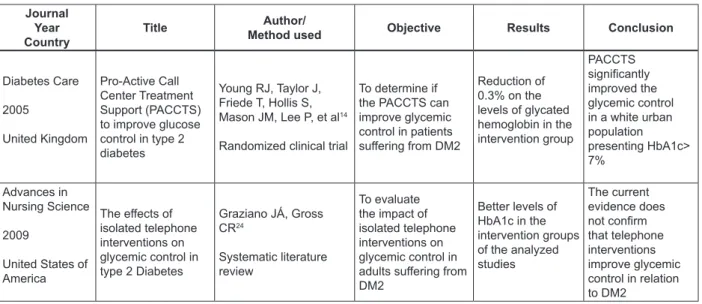
integrative review which strictly followed the sample selection previously established, and a synoptic table of these selected articles is presented below, according to their journal, year/country, title, author, method used, objectives, results and conclusion (Table 1).
Table 1 – Presentation of the sample, according to journal, year, country, title, author, method, objective, results and conclusion. Fortaleza-CE, 2011
Journal Year Country
Title Author/
Method used Objective Results Conclusion
Diabetes Care
2005
United Kingdom
Pro-Active Call Center Treatment Support (PACCTS) to improve glucose control in type 2 diabetes
Young RJ, Taylor J, Friede T, Hollis S, Mason JM, Lee P, et al14
Randomized clinical trial
To determine if the PACCTS can improve glycemic control in patients suffering from DM2
Reduction of 0.3% on the levels of glycated hemoglobin in the intervention group
PACCTS
signiicantly
improved the glycemic control in a white urban population presenting HbA1c> 7%
Advances in Nursing Science
2009
United States of America
The effects of isolated telephone interventions on glycemic control in type 2 Diabetes
Graziano JÁ, Gross CR24
Systematic literature review
To evaluate the impact of isolated telephone interventions on glycemic control in adults suffering from DM2
Better levels of HbA1c in the intervention groups of the analyzed studies
The current evidence does
not conirm
Journal Year Country
Title Author/
Method used Objective Results Conclusion
Journal of Advanced Nursing 2003 Korea Adherence to Diabetes control recommendations: impact of nurse telephone calls
Kim H, Oh J25
Randomized clinical trial
To investigate the effect of telephone interventions in reducing HbA1c levels
Reduction in the levels of HbA1c
Telephone interventions carried out by nurses can improve HbA1c levels
Journal of Clinical Nursing
2007
Korea
Effect of the Diabetes
outpatient intensive management program on glycemic control for type 2 Diabetic patients
Song MS, Kim HS26
Randomized clinical trial
To examine the effect of an intensive outpatient management program (DOIMP) on glycemic control in patients suffering from DM2
The intervention group showed reduction in the levels of HbA1c and of fasting and postprandial glucose
The DOIMP can be effective in glycemic control
Advances in Nursing Science
2009
United States of America
A randomized controlled trial of an automated telephone intervention to improve glycemic control in type 2 Diabetes
Graziano JÁ, Gross CR4
Randomized clinical trial
To evaluate the impact of automated telephone
interventions to improve glycemic control in adults suffering from DM2
There was no statistically
signiicant
reduction in the levels of HbA1c in the intervention group Regular telephone contact in between clinical consultations improves self-management behavior, reducing the levels of HbA1c
Diabetes Care 2003 United Kingdom Evaluation of a nurse-care management system to improve outcomes in patients with complicated Diabetes
Taylor CB, Miller NH, Reilly KR, Greenwald G, Cunning D, Deeter A, et al27
Randomized clinical trial
To evaluate the effectiveness of a system using telephone interventions as strategy to control the metabolism of patients suffering from Diabetes
Signiicant
reduction in HbA1c levels in patients subject to interventions A nurse-care management system can signiicantly improve metabolic control in patients suffering from Diabetes
MEDSURG- Nursing
2010
United States of America
Evidence-based practice protocol to improve glucose control in individuals with type 2 Diabetes Mellitus
Evans MM28
Randomized clinical trial
To verify the effectiveness of telephone interventions on glycemic control in adults suffering from DM2
There was reduction of glycemic levels in patients subject to interventions
Telephone interventions were effective in reducing glycemic levels
Diabetes Care
2009
United States of America
Effects of self-management support on structure, process, and outcomes among vulnerable patients With Diabetes
Schillinger D, Handley M, Wang F, Hammer H29
Randomized clinical trial
To compare the effects of self-management support on patients suffering from Type 2 Diabetes
Improvement of glycemic control in the group subject to telephone interventions
Telephone interventions carried out by nurses had a positive effect on self-management in patients suffering from Diabetes J Behav Med
2009
United States of America
Effect of a brief, regular telephone intervention
by paraprofessionals for type 2 Diabetes
Sacco WP, Malone JI, Morrison AD, Friedman A, Wells K30
Randomized clinical trial
To evaluate the effects of telephone interventions on glycemic control in patients with Diabetes
Reduction of glycemic levels in the group subject to interventions
Improvement of diet, increase of physical activity, feet inspection and reduction of clinical symptoms
It can be noted that, from the selected studies, two were undertaken in the United Kingdom, two
in Korea and ive in the United States. In relation to the type of journal, ive were published in general
nursing magazines and four in medical magazines. Concerning the research method, eight were randomized clinical trials and one was a
system-atic review. As for the evidence levels, one article belonged to level one, due to the fact that it was a systematic literature review, and eight were level three, due to their being randomized clinical trials with more than 1000 patients. Three publications
The duration of each intervention, it varied from eight weeks to twelve months. The sample size of the selected studies varied from 12 to 508 people. In total, 1294 patients participated in the studies, being 671 randomized for telephone follow-ups and 479 for usual care, which was regularly provided by doctors and/or nurses in the health care centers the patients attended.
Glycemic control was determined by the levels of glycated hemoglobin (HbA1c) in eight studies, and the average variation of levels was compared between the intervention and control
groups and/or inal averages of HbA1c after the
intervention.
The irst study14 evaluated the effectiveness
of the program Pro-Active Call Centre Treat-ment Support, in which duly trained telephone operators contacted patients with diabetes once every three months when the HbA1c levels were
below or equal to 7.0%, every seven weeks when the HbA1c levels were between 7.1% and 9.0%
and monthly when the HbA1c levels were above
9.0%. Each call lasted twenty minutes and the
advice provided included weight control, healthy diet, physical activity, stress and smoke control, preparation for change, adjustment to medication and blood glucose control. A target average
reduc-tion in HbA1c levels of 1% was established for
the intervention group, but this was not achieved after twelve months. There was, however, an
improvement of 0.3% in HbA1c levels in the in -tervention group when compared to the control group (p=0.003).
Seeking to evaluate the effect of telephone interventions on glycemic control in 119 patients suffering from DM2 for three months, research-ers4 used automated telephone messages, aimed
at affecting their beliefs and attitudes in relation to self-management of DM2. The contents of the messages were focused on the severity of the disease, on the relation between hyperglycemia
and other complications and on the beneits of
self-managing glycemic control. Control group participants were provided with the usual care.
There was a reduction of 1.13% in HbA1c levels in
the intervention group (p=0.89). In the same year, through a systematic literature review24 about the
effects of telephone interventions on glycemic control, the same researchers found that, accord-ing to eight studies, HbA1c levels improved in intervention groups.
In another research,25 the effect of telephone
interventions on the reduction of HbA1c levels and
on Diabetes control was studied. The intervention consisted of continuous health education for 12 weeks, focused on diet, exercises and adjustment
to medication, as well as frequent monitoring of
blood glucose levels. At the end of the process,
a signiicant change in the percentage of HbA1c
levels was observed in the intervention group
(p<0.05), with an average variation of 1.2%.
Aiming to examine the effect of an intensive outpatient management program for Diabetes (DOIMP) which used telephone interventions as a strategy to improve glycemic control, research-ers26 carried out a clinical trial with 49 people who
suffer from DM2. The randomized patients for the intervention group were included in the DOIMP and received information about Diabetes, which was provided by the multidisciplinary team, monitoring of other complications resulting from the disease and telephone advice during 12 weeks. At the end of the process, it was evidenced that the
HbA1c levels decreased by 2.3% in the interven -tion group (p=0.001).
In a clinical trial,27 the effectiveness of a
health care management system carried out by nurses and directed at improving the clinical conditions of patients suffering from Diabetes was evaluated. 169 patients participated in the study and were divided into two groups. The in-tervention program included telephone calls as a strategy to provide information to patients. After twelve months, the researchers concluded that
there was a reduction of 1.14% in HbA1c levels in the intervention group and 0.35% in relation to
the control group (p=0.01).
Another clinical trial28 carried out for a
period of eight weeks involved 12 patients. The telephone calls lasted an average 15 to 20 minutes and provided information based on the American Diabetes Association.31 Amongst the nine studies
that were part of this review, this was the only one that did not use HbA1c as a parameter for glycemic control. Instead, fasting blood glucose was used and it was observed that the intervention group presented better levels of glucose when compared to the control group.
The effects of a Self-Management Support29
(SMS) strategy for behavioral change were tested in 339 patients who were monitored for a period of 12 months. Metabolic control was evaluated through the measurement of HbA1c levels before and after the intervention, with a reduction of
group subject to telephone interventions presented consistent improvement, which suggests that this type of SMS is particularly effective for vulnerable populations.
Lastly, another research30 used an
interven-tion based on “coaching” sessions, with the pur-pose of ensuring patients’ understanding about the recommendations made in relation to their treat-ment and about adjusttreat-ment monitoring, amongst others. The intervention included 62 patients who were provided with telephone sessions for a pe-riod of six months. Concerning glycemic control,
a reduction from 8.4% to 7.4% was found in the
intervention group.
DISCUSSION
Studies based on the use of telephone in-terventions as a strategy to promote continuous
care of Diabetes patients have shown signiicant
reductions in HbA1c levels.13,32 In relation to this
evidence, all studies that are part of this integrative review have shown reduction in HbA1c levels,
four of them with statistical signiicance.14,25-27
Over the years, prolonged hyperglycemia can cause extensive and irreversible organic wounds, affecting the eyes, kidney, nerves, large and small vessels, as well as blood coagulation.33
Findings from the United Kingdom Prospective Diabetes Study (UKPDS) conirm that the ideal glycemic control in patients with DM2 reduces the development and advancement of a large number of complications resulting from the disease.34
Differently from glycemic tests, which relect
the glycemic levels at the exact moment of mea-surement, the HbA1c tests indicate the average glucose levels from the last two to four months.35
It could be noted, therefore, that most of the stud-ies4,14,24-27,29-30 in this integrative review used HbA1c
to evaluate the glycemic control of the participants. Although hemoglobin glycation occurs across the life span of the red blood cells, which is approximately 120 days, the most recent glucose
levels most strongly inluence the HbA1c levels
within this period.33 Therefore, the last two to three
months need to be considered when measuring it, and this is an important recommendation when testing treatment effectiveness.35
Taking into consideration the measurement of HbA1c levels at the end of the interventions carried out in each of the analyzed studies in the present research, eight of them4,24-30 complied with
the recommendations of the Brazilian Diabetes
Society (SBD) and measured the HbA1c levels after two,28 three to six4,25-26,30 and twelve months
of intervention.14,27,29
The levels of HbA1c after the interventions
conirm the lack of uniformity in the studies when
associating the reduction of these levels with the monitoring period, which did not allow a gen-eral time period recommendation. Similarly, in a systematic review of the literature,24 in which
the period of interventions varied from three to
twelve months, there was a signiicant reduction
in HbA1c levels in half of the studies.
Amongst those researches with a monitor-ing period of only three months, two of them had
a signiicant reduction in HbA1c levels.25-26 The
only research with a monitoring period of six
months did not show a signiicant reduction,30
and of the three others with a monitoring period of twelve months, two of them presented a
sta-tistically signiicant reduction in HbA1c levels14,27
It is important to mention that the monitoring period was appointed as a limitation in some of the studies.14,28-30
Based on the UKPDS study,34 it was estab-lished that HbA1c levels above 7.0% are associated
to a greater risk of chronic complications, therefore being subject to more intensive treatments. In the present review, eight studies4,14,24-27,29-30 included patients who had HbA1c levels above 7.0% at the
beginning of the interventions. At the end of the interventions, however, and although there had been reduction of hemoglobin in all these patients,
none of them achieved levels below 6.5%, as rec -ommended.35
Telephone information was not provided by a professional nurse in only two of the analyzed studies. In one of them,27 the telephone call was
carried out by people duly trained by nurses and, in the other,30 the telephone calls were done by
psychology students, who were also duly trained. As for the way telephone interventions were performed, in two studies,4,29 the telephone
calls were automated, and this reduced real-time contact with the patients. It is important to note that, in one of them,29 in addition to the automated
CONCLUSION
The information found showed that there
was a mostly signiicant reduction in glycated
hemoglobin and fasting blood glucose levels in patients included in the intervention group, lead-ing to the conclusion that telephone intervention is an effective strategy in glycemic control of patients suffering from DM2. As a result, self-management
by patients was improved, which consequently
increased the reduction of potential complications resulting from the disease.
It is important to mention that the use of an integrative review as a research method in this study provided the nursing professionals with grounded and uniform knowledge to support de-cision making and clinical practice improvement, thus assisting in the implementation of effective
interventions in the health care ield.
One of the limitations of the present study is the fact that only four databases were consulted. Therefore, the inclusion of new databases is suggested to seek further studies on this theme. Therefore, new studies should be undertaken to achieve higher reliability levels as regards the actual effectiveness of programs using telephone intervention strategies.
The use of an integrative review as a method was considered relevant to achieve the proposed
objective. Furthermore, gaps could be identiied,
indicating the need for further research.
REFERENCES
1. Brasil. Ministério da Saúde. Departamento de
Atenção Básica. Cadernos de Atenção Básica. Normas e Manuais técnicos. Diabetes Mellitus. Brasília (DF); 2006.
2. Adolfsson ET, Walker-Engström ML, Smide B, Wikblad K. Patient education in type 2 diabetes: a randomized controlled 1-year follow-up study. Diabetes Res Clin Pract. 2007 Jun;76(3):341-50. Epub 2006 Oct 27.
3. Torres HC, Franco LJ, Stradioto MA, Hortalel VA, Schall VT. Evaluation of group and individual strategies in a diabetes education program. Rev.
Saúde Pública.2009 Apr; 43 (2):291-8. Epub 2009
Feb 13.
4. Graziano JA, Gross CR. A randomized controlled trial of an automated telephone intervention to improve glycemic control in type 2 diabetes. ANS Adv Nurs Sci. 2009 Jul-Sep; 32(3):42-57.
5. Sacco WP, Malone JI, Morrison AD, Friedman A, Wells K. Effect of a brief, regular telephone intervention by paraprofessionals for type 2
diabetes. J Behav Med. 2009 Aug; 32(4):349-59. Epub 2009 Apr 14.
6. Fonseca-Guedes CHF. Suporte telefônico como uma intervenção para promover o incentivo à prática de caminhada em pacientes diabéticos tipo 2: inluência do peril de personalidade nesta resposta [tese]. São Paulo: Faculdade de Medicina, Universidade de São Paulo; 2009.
7. Kim HS, Yoo YS, Shim HS. Effectes of an Internet-based intervention on plasma glucose levels in patients with type 2 diabetes. J Nurs Care Qual. 2005 Oct-Dec; 20(4):335-40.
8. Richter H, Kraft K, Kleinwechter H, Demandt N, Meincke G, Dabelstein A, et al. Effects of a telephone intervention in patients with type 2 diabetes. Dtsch Med Wochenschr. 2008 Oct; 133(43):2203-8. Epub 2008 Oct 15.
9. Faridi Z, Liberti L, Shuval K, Northrup V, Ali A, Katz DL. Evaluating the impact of mobile telephone technology on type 2 diabetic patients’ self-management: the NICHE pilot study. J Eval Clin Pract. 2008 Jun; 14(3):465-9. Epub 2008 Mar 24. 10. Kim HS, Jeong HS. A nurse short message service
by cellular phone in type-2 diabetic patients for six months. J Clin Nurs. 2007 Jun; 16(6):1082-7. 11. Kim HS, Song MS. Effect of the diabetes outpatient
intensive management programme on glycaemic control for type 2 diabetic patients. J Clin Nurs.2007 Jul; 16(7):1367-73.
12. Yoon KH, Kim HS. A short message service by cellular phone in type 2 diabetic patients for 12 months. Diabetes Res Clin Pract. 2008 Feb; 79(2):256-61. Epub 2007 Nov 7.
13. Piette JD, Weinberger M, Kraemer FB, McPhee SJ. Impact of automated calls with nurse follow-up on diabetes treatment outcomes in a Department of Veterans Affairs Health Care System: a randomized controlled trial. Diabetes Care. 2001 Feb; 24(2):202-8. 14. Young RJ, Taylor J, Friede T, Hollis S, Mason JM,
Lee P, et al. Pro-active call center treattment support (PACCTS) to improve glucose control in type 2 diabetes. Diabetes Care. 2005 Feb; 28(2):278-82. 15. Piette JD, Weinberger M, McPhee SJ. The effect of
automated calls with telephone nurse follow-up on patient-centered outcomes of diabetes care: a randomized, controlled trial. Med Care. 2000 Feb; 38(2):218-30.
16. Klein S, Sheard NF, Pi-Sunyer X, Daly A, Wylie-Rosett J, Kulkarni K, et al. Weight management trought lifestyle modiication for the prevention and management of type 2 diabetes: rationale and strategies: a statement of the American Diabetes Association, the North American Association for the Study of Obesity, and the American Society for Clinical Nutrition. Diabetes Care. 2004 Aug; 27(8):2067-73.
integrativa: método de pesquisa para a incorporação de evidências na saúde e na enfermagem. Texto Context Enferm. 2008; 17(4):758-64.
18. Ganong LH. Integrative reviews of nursing research. Res Nurs Health. 1987 Feb; 10(1):1-11.
19. Whittemore R, Knal K. The integrative review: updated methodology. J Adv Nurs. 2005 Dec; 52(2):546-53.
20. Teixeira CRS, Zanetti ML, Landim CAP, Becker TAC, Santos ECB, Franco RC, et al. Automonitorização da glicemia capilar no domicílio: revisão integrativa da literatura. Rev Eletr Enf [Internet]. 2009 [citado 2011 jun. 14];11(4):1006-17. Disponível em: http://www. fen.ufg.br/revista/v11/n4/v11n4a27.htm.
21. Silveira RCCP. O cuidado de enfermagem e o cateter de Hickman: a busca de evidências [dissertação]. Ribeirão Preto: Escola de Enfermagem de Ribeirão Preto, Universidade de São Paulo; 2005.
22. Ursi ES. Prevenção de lesões de pele no perioperatório: revisão integrativa da literatura [dissertação]. Ribeirão Preto: Escola de Enfermagem de Ribeirão Preto, Universidade de São Paulo; 2005. 23. Atallah NA, Trevisani VFM, Valente O. O príncipio
para tomadas de decisões terapêuticas com base em evidências cientíicas. In: Prado FC, Ramos J, Valle JR. Atualização terapêutica. 21 ed. Porto Alegre (RS): Artes Médicas; 2003. p. 1704-06.
24. Graziano JA, Gross CR. The effects of isolated telephone interventions on glycemic control in type 2 diabetes a literature review. ANS Adv Nurs Sci. 2009 Jul-Sep; 32(3):E28-41.
25. Kim H, Oh J. Adherence to diabetes control recommendations: impact of nurse telephone calls. J Adv Nurs. 2003 Nov; 44(3):256-61.
26. Song MS, Kim HS. Effect of the diabetes outpatient intensive management programme on glycaemic control for type 2 diabetic patients J Clin Nurs. 2007 Jul; 16(7):1367-73.
27. Taylor CB, Miller NH, Reilly KR, Greenwald G, Cunning D, Deeter A, et al. Evaluation of a nurse-care management system to improve outcomes in
patients eith complicated diabetes. Diabetes Care. 2003 Apr; 26(4):1058-63.
28. Evans MM. Evidence-based practice protocol to improve glucose control in individuals with type 2 diabetes mellitus. Medsurg Nurs. 2010 Nov-Dec; 19(6):317-22.
29. Schillinger D, Handley M, Wang F, Hammer H. Effects of self-management support on structure, process, and outcomes among vulnerable patients with Diabetes: a three-arm practical clinical trial. Diabetes Care. 2009 Apr; 32(4):559-66. Epub 2009 Jan 8.
30. Sacco WP, Malone JI, Morrison AD, Friedman A, Wells K. Effect of a brief, regular telephone intervention by paraprofessionals for type 2 diabetes. J Behav Med. 2009 Aug; 32(4):349-59. Epub 2009 Apr 14.
31. American Diabetes Association (ADA). Standards of medical care in diabetes-2007. Diabetes Care. 2007 Jan; 30 (Suppl 1):S4-41.
32. Aubert RE, Herman WH, Waters J, Moore W, Sutton D, Peterson BL, et al. Nurse case management to improve glycemic control in diabetic patients in a health maintenance organization: a randomized, controlled trial. Ann Intern Med. 1998 Oct; 129(8):605-12.
33. Pimazoni Netto A, Andriolo A, Fraige Filho F, Tambascia M, Gomes MB, Melo M, et al. Atualização sobre hemoglobina glicada (HbA1C) para avaliação do controle glicêmico e para o diagnóstico do diabetes: aspectos clínicos e laboratoriais. J Bras Patol Med Lab. 2009 Fev; 45(1):31-48.
34. UK Prospective Diabetes Study Group: intensive blood glucose control with sulphonylureas or insulin compared with conventional treatment and risk of complications in patients with type 2 diabetes. Lancet. 1998 Sep; 352(9):837-53.
35. Sociedade Brasileira de Diabetes. Novas diretrizes da SBD para o controle glicêmico do diabetes tipo 2. Posicionamento Oicial SBD nº 4. RBM. 2007 Set; Suppl 4: 3-22.
Correspondence: Hérica Cristina Alves de Vasconcelos
Federal University of Ceará- Nursing Department Rua Zuca Acioly, 633, ap. 201, Bl H.
60191-335 – Dunas, Fortaleza, Ceara, Brasil Email: [email protected]