einstein. 2011; 9(2 Pt 1):184-9
ORIGINAL ARTICLE
Molecular and cytogenetic abnormalities in acute myeloid
leukemia: review and case studies
Alterações citogenéticas e moleculares em leucemia mieloide aguda:
revisão e descrição de casos
Elvira Deolinda Rodrigues Pereira Velloso1, Carlos Henrique Ares Silveira da Motta2, Juliana Braga Furtado2,
Nydia Strachman Bacal3, Paulo Augusto Achucarro Silveira1, Cynthia Bachir Moyses4,
Roberta Sitnik4, João Renato Rebello Pinho4
ABSTRACT
Objective: To study the frequency of mutations that may lead to a good or bad prognosis, as well as their relation with the karyotype and immunophenotype in patients with acute myeloid leukemia. Methods: Thirty samples of patients with acute myeloid leukemia were studied, in which ITD, FLT3-TKD and NPM1 mutations were investigated. All samples were submitted to immunophenotyping and 25 to karyotyping. Results: An occurrence of 33.3% NPM1 mutation and an equal number
of FLT3-ITD mutation were observed. When only the cases with
normal karyotype were studied, this figures increased to 50 and 40%, respectively. Eight percent of cases with normal karyotype and genotype NPM1+/FLT3- were included in the group of acute myeloid leukemia with good prognosis. The typical phenotype of acute myeloid leukemia with normal karyotype and mutated NPM1 (HLA-DR and CD34 negative) was not observed in this small series. Conclusion: Good prognosis cases were identified in this series, emphasizing the need to include new genetic markers in the diagnostic routine for the correct classification of acute myeloid leukemia, to more properly estimate prognosis and determine treatment.
Keywords: Leukemia, myeloid, acute/genetics; Cytogenetics; Genetic makers; Chromosome aberrations
RESUMO
Objetivo: Estudar a frequência de mutações, que podem configurar
bom ou mau prognóstico, bem como sua relação com estudo de cariótipo e imunofenotípico, em portadores de leucemias mieloides agudas. Métodos: Foram estudadas 30 amostras de portadores de leucemias mieloides agudas, que foram submetidas à pesquisa das mutações FLT3-ITD, FLT3-TKD e NPM1. Todas as amostras foram submetidas a estudo imunofenotípico e 25 delas foram submetidas a estudo cariotípico. Resultados: Pudemos observar frequência de 33,3% de mutação NPM1 e igual número em FLT3-ITD, frequência que se elevou para 50 e 40% quando se estudaram apenas os casos com cariótipo normal. Dos casos com cariótipo normal, 8% apresentaram o genótipo NPM1+/FLT3-, migrando para o grupo de leucemia mieloide aguda de bom prognóstico. Não observamos o fenótipo típico das leucemias mieloides agudas com cariótipo normal e NPM1 mutado (HLA-DR e CD34 negativos) nesta pequena casuística. Conclusão: O presente estudo foi capaz de identificar casos de bom prognóstico, enfatizando que há necessidade de se incorporarem à rotina diagnóstica novos marcadores genéticos, para a correta estratificação prognóstica e orientação terapêutica das leucemia mieloide aguda.
Descritores: Leucemia mieloide aguda/genética; Citogenética; Marcadores genéticos; Aberrações cromossômicas
INTRODUCTION
Acute myeloid leukemia (AML) is a heterogeneous group of neoplastic diseases with a large variability in regard to the clinical course and response to
Study carried out at Special Technical Laboratory (LATE), Hospital Israelita Albert Einstein – HIAE, Sao Paulo (SP), Brazil.
1 Hematology, Department of Clinical Pathology, Hospital Israelita Albert Einstein - HIAE, São Paulo (SP), Brazil.
2 Graduate Program in Citogenetics and Molecular Biology, Special Techniques Laboratory (LATE), Hospital Israelita Albert Eisntein - HIAE - São Paulo (SP), Brazil. 3 Division of Flow Cytometry, Department of Clinical Pathology, Hospital Israelita Albert Einstein - HIAE, São Paulo (SP), Brazil.
4 Special Technical Laboratory (LATE), Hospital Israelita Albert Eisntein - HIAE - São Paulo (SP), Brazil.
Corresponding author: Elvira Deolinda Rodrigues Pereira Velloso – Laboratório de Técnicas Especiais do Hospital Israelita Albert Einstein – Avenida Albert Einstein, 627/701 – Morumbi – CEP 05651-901 – São Paulo (SP), Brasil – Tel.: (11) 2151-5555 – Fax: (11) 2151-2122 – e-mail: [email protected]
Received: Jan 11, 2011 - Accepted: May 10, 2011
treatment, as well as in their genetic and molecular basis (more than 300 chromosomal translocations and genetic mutations have been described). More than one mutagenic event is probably necessary to give origin to the disease, encompassing cell proliferation
mechanisms (class I mutations, such as BCR-ABL,
FLT3, RAS, c-Kit, PTPN11, NF1, TEL-PDGRß) and
differentiation block (class II mutations, such as
CBFß-MYH11, AML1-ETO, TEL-AML1, PML-RARA, MLL,
NUP98-HOXA9, PU.1, C/CEPα, AML1, AML-AMP19,
CEBPA, NPM1)(1,2).
In addition to age, cytogenetic and molecular changes present upon diagnosis are the main variables associated to AML prognosis. Until five years ago, cytogenetic abnormalities defined three risk groups for AML patients younger than 60 years. Approximately 25% of patients belonged to the low risk group, with t(15;17), t(8;21) and inv(16); 25 to 30% of the unfavorable risk, with the following gene
rearrangement: MLL, t(6;9), t(9;22), monosomy/
deletions of chromosomes 5 and 7, inv(3)(q21q26) and complex karyotypes. Finally, 50 to 60% of patients had intermediate risk with t(9;11), +8, -Y and normal karyotype, the latter accounting for
up to 50% of the cases(3-5). The estimated five-year
survival for those with cytogenetic subtypes for low, intermediate and high risk was 55, 38 and 11%, respectively, in a series of 609 AML patients aged
under 60 years(4).
Elderly patients traditionally have a higher percentage of cytogenetic abnormalities related to bad prognosis (up to 51%) and a lower percentage
of good prognosis (about 4%)(6). There is a drop in
the survival curves of those aged over 60 years for the same cytogenetic subtype, with the exception of acute promyelocytic leukemia (APL), according to a study of
1225 AML patients (5). Farag et al. also demonstrated
that for the population older than 60 and treated with classic chemotherapeutic regimens, only 6% were alive after 5 years(7,8).
In the last few years, many genetic abnormalities were discovered in normal karyotype AML, especially
mutations in the NPM1 (nucleophosmin), FLT3
(fms-related tyrosine kinase 3); CEPBA (CCAAT/enhancer
binding protein α); MLL PTD (myeloid-lymphoid
or mixed-lineage leukemia), NRAS- (neuroblastoma
RAS viral oncogen), BAALC (brain and acute
leukemia gene), ERG (v-ets erythroblastosisvirus E26
oncogene-like) genes, among others(9). Approximately
45% of AML cases have normal karyotype; in that,
the mutations of NPM1 and FLT3 genes are the most
prevalent, corresponding to 45 to 55% and 35 to 45%
of the cases, respectively(10).
FLT3 gene, in chromosome 13q12, encodes a receptor with tyrosine-kinase activity related to the activation of the cell proliferation signaling pathways, which is intensely expressed in the initial phases of
myeloid precursor cells. Mutations like FLT3-ITD
consist of in-tandem insertions of variable length in the region that encodes the receptor juxtamembrane
domain. On the other hand, the FLT3-TKD mutation
is punctual and affects the tyrosine-kinase domain.
Both result in constant tyrosine-kinase activity.
FLT3-ITD mutation appears in 35 to 45% of AML cases with
normal karyotype, while the FLT3-TKD mutation is
found in less than 5%(10).
The NPM1 gene, in chromosome 5q35, encodes a nucleolar phosphoprotein that makes the transportation between nucleus and cytoplasm, and is directly involved in the regulation and stability of nuclear proteins. The most frequent mutation is the duplication of four pairs of bases in exon 12 (85% of cases), but other types of insertion of four pairs of bases can also occur in the same region. This mutation causes the aberrant location of protein
NPM1 in cytoplasm(11).
It has been demonstrated that normal karyotype
AML with mutation in the NPM1 and CEBPA genes
or in both have favorable prognosis, whilst mutations
in gene FLT3 bear unfavorable prognosis. The cases
with simultaneous mutations in genes FLT3 and
NPM1 correlate to intermediate prognosis(12).
Based on such knowledge, the World Health Organization (WHO), in 2008, classified AML into different groups, including AML with recurrent genetic abnormalities that comprise nine subtypes,
two of them being temporary entities (Chart 1)(13,14).
AML with recurrent genetic abnormalities AML with t(8;21)(q22;q22)- RUNX1T1-RUNX1
AML with inv(16)(p13.1q22) or t(16;16)(p13.1;q22)- CBFß-MYH11
Acute promyelocitic leukemia witht(15;17)(q22;q21)- PML-RARA
AML with t(9;11)(p22;q23)- MLLT3-MLL
AML with t(6;9)(p23;q34)- DEK-NUP214
AML with inv(3)(q21;q26.2) or t(3;3)(q21;q26.3) RPN1-EVI1
AML (megakaryoblastic) with t(1;22)(p13;q13)- RBM15-MKL1
AML with NPM1 mutation – temporary entity AML with CEBPAmutation - temporary entity AML with alterations related to myelodysplasia Myeloid neoplasms related to therapy Non specified AML
Myeloid sarcoma
Myeloid proliferations related to Down syndrome Blastic plasmacytoid dendritic cell neoplasm
Chart 1. Classification of the World Health Organization, 2008, for acute myeloid leukemias.
einstein. 2011; 9(2 Pt 1):184-9
186 Velloso EDRP, Motta CHAS, Furtado JB, Bacal NS, Silveira PAA, Moyses CB, Sitnik R, Pinho JRR
Therefore, new groups of genetic risk have been recently defined for AML, as depicted in chart 2.
METHODS
The Special Technique Laboratory of the Hospital Israelita Albert Einstein (HIAE) receives samples of AML patients from different treatment centers for immunophenotyping, cytogenetic and molecular studies. As from 2009, after signing the informed consent, 30 bone marrow samples from newly diagnosed or relapsed
AML patients were submitted to study of FLT3-ITD,
FLT3-TKD and NPM1 mutations. All samples were submitted to immunophenotypic study and 25 of them to kariotyping.
The immunophenotyping study was performed using cells labeled with monoclonal antibodies for proliferative panel (CD2, CD4, CD7, CD10, CD11b, CD11c, CD13, CD14, CD15, CD19, CD20, CD22, CD33, CD38, CD34, CD56, CD64, CD71, CD117, HLA-DR, glycophorin A, CD3 c, MPOc, TdT and CD79a). After preparing with ammonium chloride (hemolytic buffer), flow cytometry was performed (Epics XL-MCL or FC-500 – Beckman Coulter).
Cytogenetic study was carried out in 24- and 48-hour cultures, with no stimulating agents, submitted to G-banding and described according to the international nomenclature (ISCN 2009).
For analysis of the mutations in FLT3 and NPM1
genes, the DNA of the samples was extracted using the QIAmp DNA Blood Mini Kit (Quiagen), purified (EXOSAP) and submitted to PCR for amplification,
using specific primers and labeled for the
FLT3-ITD (exon 14/15) and NPM1 mutations. Capillary
electrophoresis was utilized for analyses of FLT3-ITD
and NPM1 per fragment size. To investigate
FLT3-TKD mutations, a new PCR reaction was performed
with specific primers for the Nested-PCR, followed by
sequencing. The analysis of the FLT3-ITD and NPM1
mutations were performed by means of the software GeneMapper, and the sequencing, by SeqScape.
RESULTS
The description of the immunophenotypical, molecular, and karyotypicl findings is depicted on chart 3.
In the cases studied, NPM1 gene mutation was
found in 10 out of 30 samples (33.3%), the same been
observed for the FLT3-ITD mutation. The coexistence
of both occurred in six cases. No sample was positive for the FLT3-TKD mutation.
Of the 25 samples with karyotypes analyzed, 10 had normal karyotypes (40%). When only normal karyotypes were analyzed, 50% presented the
mutation in NPM1 gene and 40% FLT3-ITD mutation.
The concurrent presence of both was diagnosed in 30% of the cases.
Favorable t(15;17)(q22;q21)-
PML-RARA-t(8;21)(q22;q22)- RUNX1T1-RUNX1
inv(16)(p13.1q22) or t(16;16)(p13.1;q22)- CBFß-MYH11
Mutated NPM1 and with no FLT3-ITD (normal karyotype) Mutated CEBPA (normal karyotype)
Intermediate I Mutated NPM1 and with FLT3-ITD (normal karyotype) Wild-type NPM1 and with FLT3-ITD (normal karyotype) Wild-type NPM1 and with no FLT3-ITD (normal karyotype) Intermediate II t(9;11)(p22;q23)- MLLT3-MLL
Unfavorable or favorable cytogenetic abnormalities Unfavorable inv(3)(q21;q26.2) or t(3;3)(q21;q26.3) -RPN1-EVI1
t(6;9)(p23;q34)- DEK-NUP214
t(v;11)(v;q23)- MLL rearrangement -5/5q-,
-7/7q-Complex karyotype
Chart 2. Classification of acute myeloid leukemia, in 2010, per cytogenetic and molecular subtype (14).
Other genetic abnormalities not listed in chart 2
also seem to predict survival. Mutations in c-Kit gene
seem to be associated to a worse prognosis in AML with t(8;21) or inv(16), also called CBF-AML (core binding
factor)(2,15). Monosomic karyotype, defined as the
karyotype with two or more autosomal monosomies or one autosomal monosomy associated to the structural anomaly, has also been associated to the worst risk group(16,17).
Multiparametric flow cytometry is essential to characterize myeloid neoplasias and analyze a large number of cells in a short period of time, characterizing many antigens per cell. The identification of leukocyte differentiation antigens in the membrane and cytoplasm, allows for the detection of mixed, aberrant phenotypes, and the follow-up of minimal residual disease. The expression of certain antigens, such as CD7, CD11b, CD14, CD56 and CD34 may be associated to adverse prognosis. Aberrant phenotypes are found in at least
75% of AML(13). Immunophenotyping demonstrated
peculiar features for AML with mutated NPM1, that
is, antigen expression of CD13, CD33 and MPO concurrent with the expression of monocytic antigenes CD14 and CD11b, and the absence of the expression of CD34(13).
OBJECTIVE
einstein. 2011; 9(2 Pt 1):184-9
Molecular and cytogenetic abnormalities in acute myeloid leuk
emia
187
Prognostic genetic
classification (CD)
ITD 13 33 117 MPO 11b 11c 15 14 15/64 4 34 TdT 38 HLA-DR 71 19 20 22 79a 2 7 56
1 FEM 65 POS POS 46,XX[20] intermediate-1 POS POS POS NEG POS NEG POS NEG - POS NEG NEG POS POS NEG NEG - - NEG POS POS NEG
2 FEM 34 POS POS 46,XX[20] intermediate-1 POS POS NEG - POS POS POS NEG - - NEG - POS NEG POS - - - - NEG NEG NEG
3 FEM 30 POS POS 46,XX[20] intermediate-1 POS POS POS POS NEG POS POS NEG - POS NEG - POS POS POS NEG - - NEG NEG NEG NEG
4 MALE 80 POS NEG 46,XY[20] favorable POS POS POS POS NEG POS POS NEG - POS NEG - POS NEG POS NEG - - NEG NEG NEG NEG
5 FEM 48 POS NEG 46,XY[20] favorable POS POS POS POS NEG POS POS NEG - NEG POS - POS POS NEG NEG - - NEG NEG POS NEG
6 FEM 72 NEG POS 46,XX[20] intermediate-1 POS POS POS POS - POS POS NEG - NEG POS - POS POS POS NEG - - NEG NEG NEG NEG
7 FEM 57 NEG NEG 46,XX[20] intermediate-1 POS POS POS POS NEG POS POS NEG - NEG POS - POS POS POS - - - NEG NEG NEG NEG
8 FEM 32 NEG NEG 46,XX[20] intermediate-1 POS POS POS POS POS POS POS NEG - POS NEG - POS POS POS NEG - - NEG NEG NEG NEG
9 MALE 73 NEG NEG 46,XY[20] intermediate-1 POS POS POS POS POS NEG POS NEG - POS NEG - POS POS POS NEG - - NEG NEG POS NEG
10 FEM 44 NEG NEG 46,XX,inv(9)(p12q13)[20] intermediate-1(normal variantl) POS POS POS POS NEG NEG NEG NEG - NEG POS NEG POS NEG POS NEG - - NEG NEG NEG NEG
11 FEM 30 NEG POS 46,XX,t(15;17)(q22;q21)
[14] favorable (LPA) POS POS POS POS
NEG NEG POS NEG - NEG POS NEG POS NEG POS NEG - - NEG POS NEG NEG
12 FEM 11 NEG POS 46,XX,t(15;17)(q22;q21)
[16]/46,XX[4] favorable (LPA) POS POS POS POS
NEG NEG NEG NEG - NEG NEG - POS NEG POS POS NEG NEG NEG NEG NEG NEG
13 FEM 39 NEG NEG 46,XX,t(15;17)(q22;q21)
[7],46,XX[13] favorable (LPA) POS POS POS POS
NEG NEG NEG NEG - NEG NEG - POS NEG NEG NEG - - NEG NEG NEG NEG
14 FEM 27 NEG NEG 46,XX,t(15;17)(q22;q21)
[20] favorable (LPA) POS POS POS POS
NEG NEG NEG NEG - NEG NEG - POS NEG NEG NEG - - NEG NEG NEG NEG
15 FEM 66 NEG NEG 46,X,del(X)(q24),t(4;21;8)
(q21;q22;q22)[21] favorable (variant t(8;21)) NEG POS POS NEG
NEG POS POS NEG - POS NEG - POS POS NEG NEG - - NEG NEG NEG POS
16 MALE 11 NEG NEG 46,XY,del(16)(q22)[20] intermediate-2 POS POS POS POS NEG NEG NEG NEG - NEG POS - POS POS POS NEG - - NEG NEG NEG NEG
17 FEM 6 NEG NEG 46,XX,add(2)(q37)[20] intermediate-2 POS POS POS POS NEG NEG NEG NEG - NEG POS - POS POS NEG NEG - - NEG NEG NEG POS
18 MALE 59 NEG NEG 46,XY,del(3)(p21)[18] intermediate-2 NEG POS NEG - NEG NEG NEG NEG - NEG NEG - POS NEG POS NEG - - - POS POS NEG
19 FEM 48 POS POS 47,XX,+5[3]/46,XX[17] intermediate-2 POS POS POS POS NEG NEG NEG NEG - POS POS - POS POS POS NEG - - NEG NEG NEG NEG
20 FEM 68 NEG NEG 46,XX,t(6;19)(q16;p12)
[5]/46,XX[15] intermediate-2 POS POS POS NEG
NEG POS NEG NEG - NEG NEG - POS POS POS NEG - - NEG NEG POS NEG
21 MALE 61 NEG NEG 46,XY,t(3;3)(q21;q26)
[19]/46,XY[1] unfavorable POS POS POS NEG
POS NEG NEG NEG - NEG POS POS POS POS POS NEG - - NEG NEG POS NEG
22 MALE 15 NEG NEG 46,XY,t(6;9)(p23;q34)[20] unfavorable POS POS NEG - POS POS POS NEG - POS NEG - POS POS NEG NEG - - - NEG NEG NEG
23 MALE 9 NEG NEG
46,XY,inv(9) (p21q13),t(11;?)(q23;?)
[19]
unfavorable POS POS POS NEG
NEG NEG NEG NEG - NEG POS - POS POS POS NEG - - NEG NEG NEG NEG
24 FEM 61 NEG NEG 46,XX,del(7)(q21)
[7]/46,XX[13] unfavorable POS POS POS POS
NEG NEG NEG NEG - POS POS - POS NEG NEG NEG - - NEG NEG NEG POS
25 MALE 20 NEG NEG
46,XY,t(9;18) (q34;q22),t(13;20) (q12;q13.2)[15]/46,XY[5]
unfavorable POS POS POS
-- POS POS NEG - POS POS - POS POS POS NEG - - - NEG NEG POS
26 MALE 61 POS POS - POS POS NEG POS NEG NEG NEG NEG - NEG NEG - NEG NEG NEG NEG - - NEG NEG NEG POS
27 FEM 89 POS POS - POS POS POS NEG NEG NEG NEG NEG - NEG POS - POS POS POS NEG - - NEG NEG POS NEG
28 FEM 51 POS NEG - POS POS POS POS POS POS POS NEG - POS NEG - POS POS POS NEG - - NEG NEG POS NEG
29 FEM 94 POS NEG - POS POS POS NEG NEG NEG NEG NEG - NEG POS - POS POS POS NEG - - NEG NEG POS NEG
einstein. 2011; 9(2 Pt 1):184-9
188 Velloso EDRP, Motta CHAS, Furtado JB, Bacal NS, Silveira PAA, Moyses CB, Sitnik R, Pinho JRR
karyotype, 1 abnormal, 2 with no karyotype study), four had no expression of CD34. Only one of 4 cases of
wild-type FLT3-ITD and NPM1 (1 with normal karyotype, 2
with t(15;17) and 1 with no karyotype study) had absent CD34 expression.
DISCUSSION
Although a small number of samples from AML
patients was studied, the rates observed for FLT3 and
NPM1 mutations were similar to those found in the
literature, for all subtypes of AML, as well as for AML with normal karyotypes.
In a publication with a national series, a total of 43.7%
in NPM1 mutations were observed in AML subtype with
normal karyotype, a rate similar to the one observed in
the present study (18). The incidence of 33.3% FLT3-ITD
mutation was slightly higher that reported by Lucena-Araujo (23.6%), being found in the many subtypes of AML, including APL, these data being consonant to the
international and national literature (18,19).
Mutation type TKD was not detected, corroborating the less prevalent finding of this mutation in Brazilian series when compared to American or European ones
(18-20).
In regard to immunophenotype, the small series hindered comparison with data found in the literature, such as smaller expression of CD56 in the subtype
with mutated FLT3 and absence of CD34 expression
and HLA-DR in the AML with mutated NPM1. In this study, the rate of expression of CD56 was similar
to the one observed in AML with FLT3 mutation and
also one of the patients with NPM1+/FLT3- AML
presented blast cells with the expression of CD34 and HLA-DR.
Considering the above, it may be inferred that the diagnostic routine should encompass new genetic markers for correct prognostic stratification and treatment option in AML.
CONCLUSION
The rate of FLT3 and NPM1 mutations found in this series was similar to that found in the literature, and it was possible to identify a subgroup with normal
karyotype NPM1+/FLT3-, currently recognized as of
good prognosis.
ACKNOWLEDGEMENT
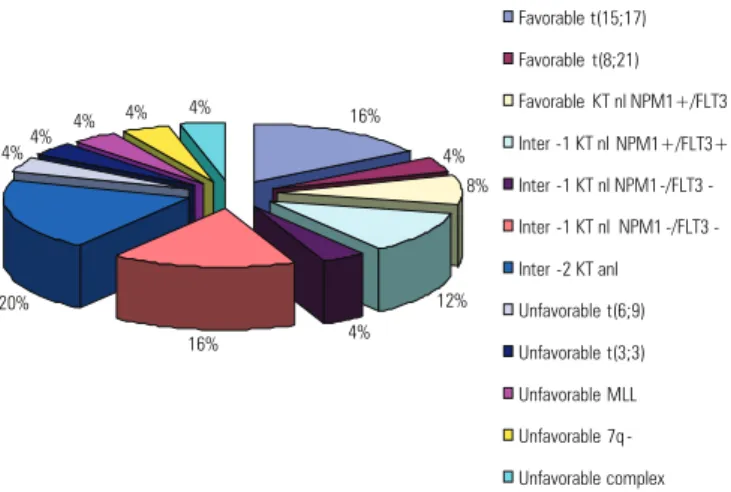
Molecular Biology Technical Team: Diogo P Marquezoni, Gregório TF Tastoli, Juliana NM Rodrigues, Letícia Figure 1. Frequency of prognosis as per the classification of acute myeloid
leukemias according to cytogenetic and molecular subtypes . 16%
4% 8%
12% 4% 16%
20% 4%4%
4% 4% 4%
Favorable t(15;17)
Favorable t(8;21)
Favorable KT nl NPM1+/FLT3 -
Inter -1 KT nl NPM1+/FLT3+
Inter -1 KT nl NPM1 -/FLT3 -
Inter -1 KT nl NPM1 -/FLT3 -
Inter -2 KT anl
Unfavorable t(6;9)
Unfavorable t(3;3)
Unfavorable MLL
Unfavorable 7q -
Unfavorable complex
Among the 15 samples diagnosed with abnormal karyotype, 4 presented karyotypes with t(15;17) and one with the variant t(8;21), considered of good prognosis. Five samples presented karyotypes of unfavorable prognosis, t(3;3), t(6;9), del(7)(q21), 11q23 rearrangement and one complex. Five other cases considered of intermediate prognosis such as del(16)(q22), add(2)(q37), del(3)(p21), 5 trisomy and t(6;19) were also found.
Three cases of abnormal karyotypes also presented
molecular alterations, two with t(15;17) and FLT3-ITD
mutation, and one 5 trisomy with mutated FLT3-ITD
and NPM1.
According to our study, of the 25 cases with karyotype study, 28% were classified as favorable prognosis, among which 8% had normal karyotype
and mutated NPM1, and 20% had abnormal karyotype
(16% t(15;17), and 4% t(8;21). Thirty-two percent were classified as intermediate-1, all with normal
karyotype and 12% mutated NPM1 and FLT3-ITD,
4% FLT3-ITD and 16% wild for both mutations. The remaining cases, all with abnormal karyotype, were stratified as intermediate-2 (20%) and unfavorable (20%) (Figure 1).
The immunophenotype study demonstrated that 18 cases (60%) expressed non-myeloid lineage-associated antigens: CD7 in 10 cases, CD56 in 5 cases and CD11b in 7 cases; in that, four cases having concurrence of CD7 and CD11b. The expression of CD56 was detected in 16.6% of AML cases and 20% of cases with FLT3 mutation.
The immunophenotype study of four cases with
wild-type NPM1 and FLT3 mutation (2 with normal karyotype
and 2 with no karyotype study) demonstrated, in two of them, absence of CD34 expression. Of the 6 cases with
Oyakawa, Ozires PS Ramos, Roberta Sitnik, Roberta C Petroni, Rubia AF Santana, Vanessa FD Castro.
Cytogenetics Technical Team: Andréa BM Castro, Cláudia IEC Fabris, Cristina A Ratis, Daniel A Oliveira, Daniela Borri, Priscila F Fernandes, Renata C Elias, Renata K Kishimoto, Silvia HA Figueira.
Cytometry Technical Team: Ana Carolina Apelle, Rodolfo P Correia, Ruth H Kanayama, Sonia T Nozawa.
REFERENCES
1. Reilly JT. Pathogenesis of acute myeloid leukaemia and inv(16)(p13;q22): a paradigm for understanding leukaemogenesis? Br J Haematol. 2005;128(1):18-34.
2. Renneville A, Roumier C, Biggio V, Nibourel O, Boissel N, Fenaux P, et al. Cooperating gene mutations in acute myeloid leukemia: a review of the literature. Leukemia. 2008;22(5):915-31.
3. Mrózek K, Bloomfield CD. Chromosome aberrations, gene mutations and expression changes, and prognosis in adult acute myeloid leukemia. Hematology Am Soc Hematol Educ Program. 2006:169-77.
4. Slovak ML, Kopecky KJ, Cassileth PA, Harrington DH, Theil KS, Mohamed A, et al. Karyotypic analysis predicts outcome of preremission and postremission therapy in adult acute myeloid leukemia: a Southwest Oncology Group/Eastern Cooperative Oncology Group Study. Blood. 2000;96(13):4075-83.
5. Schoch C, Kern W, Schnittger S, Büchner T, Hiddemann W, Haferlach T. The influence of age on prognosis of de novo acute myeloid leukemia differs according to cytogenetic subgroups. Haematologica. 2004;89(9):1082-90. 6. Appelbaum FR, Gundacker H, Head DR, Slovak ML, Willman CL, Godwin JE, et
al. Age and acute myeloid leukemia. Blood. 2006;107(9):3481-5.
7. Cancer and Leukemia Group B 8461, Farag SS, Archer KJ, Mrózek K, Ruppert AS, Carroll AJ, Vardiman JW, Pettenati MJ, Baer MR, Qumsiyeh MB, Koduru PR, Ning Y, Mayer RJ, Stone RM, Larsson RA, Bloomfield CD. Pretreatment cytogenetics add to other prognostic factors predicting complete remission and long-term outcome in patients 60 years of age or older with acute myeloid leukemia: results from Cancer and Leukemia Group B 8461. Blood. 2006;108(1):63-73.8. Mrózek K, Marcucci G, Paschka P, Whitman SP, Bloomfield CD. Clinical relevance of mutations and gene-expression changes in adult acute myeloid leukemia with normal cytogenetics: are we ready for a prognostically prioritized molecular classification? Blood. 2007;109(2):431-48.
8. Mrózek K, Marcucci G, Paschka P, Whitman SP, Bloomfield CD. Clinical relevance of mutations and gene-expression changes in adult acute myeloid leukemia with normal cytogenetics: are we ready for a prognostically prioritized molecular classification? Blood. 2007;109(2):431-48.
9. Gulley ML, Shea TC, Fedoriw Y. Genetic tests to evaluate prognosis and predict therapeutic response in acute myeloid leukemia. J Mol Diagn. 2010;12(1):3-16. 10. Bacher U, Schnittger S, Haferlach T. Molecular genetics in acute myeloid
leukemia. Curr Opin Oncol. 2010;22(6):646-55.Review.
11. Falini B, Bolli N, Liso A, Martelli MP, Mannucci R, Pileri S, et al. Altered nucleophosmin transport in acute myeloid leukaemia with mutated NPM1: molecular basis and clinical implications. Leukemia. 2009;23(10):1731-43. 12. Schlenk RF, Döhner K, Krauter J, Fröhling S, Corbacioglu A, Bullinger L, Habdank
M, Späth D, Morgan M, Benner A, Schlegelberger B, Heil G, Ganser A, Döhner H; German-Austrian Acute Myeloid Leukemia Study Group. Mutations and treatment outcome in cytogenetically normal acute myeloid leukemia. N Engl J Med. 2008;358(18):1909-18.
13. Vardiman JW, Bruning RD, Arber DA, Le Beau MM, Porwit A, Tefferi A, et al. Introduction and overview of the classification of the myeloid neoplasms. In: Swerdlow SH, Campo E, Harris NL, Jaffe ES, Pileri SA, Stein H, et al. WHO classification of tumours of haematopoietic and lymphoid tissues. 4th ed. Lyon: IARC, 2008. p. 18-30.
14. Döhner H, Estey EH, Amadori S, Appelbaum FR, Büchner T, Burnett AK, Dombret H, Fenaux P, Grimwade D, Larson RA, Lo-Coco F, Naoe T, Niederwieser D, Ossenkoppele GJ, Sanz MA, Sierra J, Tallman MS, Löwenberg B, Bloomfield CD; European LeukemiaNet. Diagnosis and management of acute myeloid leukemia in adults: recommendations from an international expert panel, on behalf of the European LeukemiaNet. Blood. 2010;115(3):453-74.
15. Paschka P, Marcucci G, Ruppert AS, Mrózek K, Chen H, Kittles RA, Vukosavljevic T, Perrotti D, Vardiman JW, Carroll AJ, Kolitz JE, Larson RA, Bloomfield CD; Cancer and Leukemia Group B. Adverse prognostic significance of KIT mutations in adult acute myeloid leukemia with inv(16) and t(8;21): a Cancer and Leukemia Group B Study. J Clin Oncol. 2006;24(24):3904-11.
16. Breems DA, Van Putten WL, De Greef GE, Van Zelderen-Bhola SL, Gerssen-Schoorl KB, Mellink CH, et al. Monosomal karyotype in acute myeloid leukemia: a better indicator of poor prognosis than a complex karyotype. J Clin Oncol. 2008;26(29):4791-7.
17. Foran JM. New prognostic markers in acute myeloid leukemia: Perspective from the Clinic. Hematology Am Soc Hematol Educ Program. 2010;2010:47-55. 18. Lucena-Araujo AR, Souza DL, Morato de Oliveira F, Benicio MT, Figueiredo-Pontes
LL, Santana-Lemos BA, et al Results of FLT3 mutation screening and correlations with immunophenotyping in 169 Brazilian patients with acute myeloid leukemia. Ann Hematol. 2010;89(2):225-8.
19. Emerenciano M, Menezes J, Vasquez ML, Zalcberg I, Thuler LC, Pombo-de-Oliveira MS; Brazilian Collaborative Study Group of Infant Acute Leukemia. Clinical relevance of FLT3 gene abnormalities in Brazilian patients with infant leukemia. Leuk Lymphoma. 2008;49(12):2291-7.