ORIGINAL ARTICLE
einstein. 2010; 8(4 Pt 1):419-22
Physical activity and stress coping in the elderly
A atividade física e o enfrentamento do estresse em idosos
Fernando de Andréa1, Fernanda Varkala Lanuez2, Adriana Nunes Machado3, Wilson Jacob Filho4
ABSTRACT
Objective: To analyze the value of a physical activity program on stress coping of the elderly. Methods: Intervention study with a group of 18 elderly people referred by the Geriatric Service of Hospital das Clínicas of the Universidade de São Paulo, who attended a supervised exercise program, evaluated by the human activity profile and the coping questionnaire. Results: In the coping and functional performance scales, increased stress coping capacity and improvement of daily activities were found after exposure to a physical activity program. Conclusions: The practice of supervised and regular physical activity, combining aerobic, resistance, stretching, and respiratory exercises, yields positive effects in the coping capacity and in the accomplishment of the daily activities.
Keywords: Aged; Motor activity; Stress, psychological; Questionnaires
RESUMO
Objetivo: Analisar o valor de um programa de atividade física no enfrentamento do estresse em idosos. Métodos: Estudo de intervenção em um grupo de 18 idosos encaminhados do ambulatório do Serviço de Geriatria do Hospital das Clínicas da Faculdade de Medicina da Universidade de São Paulo, aderentes a um programa de atividade física supervisionado e avaliados pelo perfil da atividade humana e pelo questionário de coping. Resultados: Nas escalas de avaliação de coping e de desempenho funcional, foi verificado um incremento da capacidade de enfrentamento do estresse e melhora nas atividades cotidianas após a prática do programa de atividade física. Conclusões: A prática de atividade física regular e orientada, mesclando trabalho aeróbio, de resistência, de alongamento e respiratório produz efeitos positivos na capacidade de coping e na de realização das suas atividades cotidianas.
Descritores: Idoso; Atividade motora; Estresse psicológico; Questionários
INTRODUCTION
According to the publications of the World Health Organization (WHO), people aged 60 years or more are considered elderly in some countries of Eastern Europe and in developing countries like Brazil. In these regions, when people reach old age, they will have their anatomical and physiological characteristics associated to social, economic and cultural factors, although this age limit has been increasingly more recognized to identify elderly populations in all countries, regardless
of their level of development(1).
In 2000, the Brazilian Institute of Geography and Statistics (IBGE) detected that people aged 60 years or more totaled 14,512,803 inhabitants. The growth of this population will be so important, that it is estimated that, by 2025, this number will more than double, leading Brazil to become the sixth country in the world
in number of elderly people(2).
The aging process is characterized by the progressive reduction of homeostatic reserves of the many body systems. This decline starts around the fifth decade of life, and is influenced by factors such as genetics, diet, environment, and life style. Some of these factors can be changed, improving or attenuating this process; but they cannot interrupt this process. Today, much more important than chronologically-determined aging is successful aging. The latter is defined as the maintenance of physical and mental functioning and involvement with social and relationship activities. Some recommendations aiming at this objective include orientations about diet
and the practice of exercise to improve quality of life(3,4).
Quality of life is influenced by individual life styles and a healthy life style includes regular exercise, considered one of the most important components.
Study carried out at Hospital das Clínicas of Faculdade de Medicina of the Universidade de São Paulo – USP, São Paulo (SP), Brazil.
1 Post-graduate student (Master’s degree) of Department of Geriatrics of Hospital das Clínicas of Faculdade de Medicina of the Universidade de São Paulo – USP, São Paulo (SP), Brazil. 2 Master’s degree of Department of Geriatrics of Hospital das Clínicas of Faculdade de Medicina of the Universidade de São Paulo – USP, Sao Paulo (SP), Brazil.
3 Geriatrician; MD of the Medical Staff of Instituto de Ortopedia e Traumatologia of Faculdade de Medicina of the Universidade de São Paulo – USP. Sao Paulo (SP), Brazil. 4 Post-doctorate degree; Full professor at Faculdade de Medicina of the Universidade de São Paulo – USP, São Paulo (SP), Brazil.
einstein. 2010; 8(4 Pt 1):419-22
420 Andréa F, Lanuez FV, Machado AN, Jacob Filho W
Good eating habits, adequate sleep, weight control, and limited consumption of alcohol and smoking are also
included(5). Regular exercise is considered an important
component for the development of a healthy lifestyle, because there is convincing evidence that it may benefit
both physical and mental health(6).
Researches comparing groups of adults and elderly, as well as longitudinal researches following up aging of a group of people, indicate that regular physical exercise favors physical capacity, resistance and flexibility, increase psychomotor speed, and neuropsychological performance. There is also evidence that being involved in physical and social activities can prevent and/or
reduce stress and increase resistance to diseases(7).
Physical well-being is relevant to deal with almost all stressful events, and elderly people feel they have more physical resources (such as health, energy, and higher functioning); they also feel more competent and confident, in this manner having more serenity to cope with events, whether they are stressful or not, that occur
in their everyday lives(8).
The term stress derives from the Latin stringere and
means to draw tight, narrow, compress(9). Its concept
was first described by Hans Seyle, in 1956, who defined it as “a degree of total burnout caused by life events”. Stress can be defined as the state of tension that causes a rupture in internal bodily balance, that is, a state of tension that is pathogenic for the body.
The imbalance takes place when the person needs to respond to some demand that exceeds their adaptive
ability(10). The functional difficulty and the need for help
in basic daily life activities and in instrumental activities may represent a stressful factor in the aging process. The progressive emergence of diseases and functional difficulties are determining factors, among others, for
the increase of stress in senior age(11).
According to Lazarus and Folkman, stress is the result of the relation between the person and environment. These authors introduced the term “coping” referring to the set of cognitive and behavioral efforts that people use with the objective of coping with specific demands to avoid aspects considered threatening to well-being. Coping, therefore, is a dynamic condition that may be constantly changing, depending on its relevance for the stressful event, and which may have as a consequence
better or worse results in relation to the initial status(12).
In this study, exercise was assessed as a coping strategy for the elderly.
OBJECTIVE
To assess the effect of an exercise program for the elderly on their capacity to cope with stress and perform daily life activities.
METHODS
This is an interventional study, with no control group, from March 2007 to March 2008, approved by the Research Ethics Committee of Hospital das Clínicas of Faculdade de Medicina of the Universidade de São Paulo. The elderly were referred from the outpatient clinic of the Geriatrics Department of Hospital das Clínicas of Faculdade de Medicina of the Universidade de São Paulo, whether they exercised irregularly or were totally sedentary.
The group, originally formed by 22 people, was then reduced to the 18 elderly that completed all phases of the research. All participants signed an informed consent form. The activities took place at a university sports center (Associação Atlética Acadêmica Osvaldo Cruz – AAAOC), using the gymnasium and running track, three times a week (Monday, Wednesday and Friday) for 50 minutes/ session, for 12 months.
Activities were conducted and supervised by this researcher. Each session included: 1. stretching and warm up with specific exercises performed for about ten minutes; 2. exercises using specific materials for localized muscular resistance such as rubber extensors, rubber balls, ropes, and rods. This practice lasted for 15 minutes; 3. monitored walking on the 400-meter track, for 20 minutes; 4. breathing exercise and relaxation for five minutes. Two data-collection inventories were used, being applied at baseline (T0), 6 months (T1) and at the end of 12 months (T2):
- Folkman and Lazarus coping strategies inventory, a questionnaire with 66 items, focusing on thoughts and/or actions used to cope with external and internal
demands to face a specific stressful event(12). This
inventory is formed by eight factors (confrontation, withdrawal, self-control, social support, acceptance of responsibility, escape and avoidance, problem solving, and positive re-evaluation), which denote the type of strategy used by the individual to cope with stress. This instrument was translated, adapted
and validated in Brazil(13);
einstein. 2010; 8(4 Pt 1):419-22
Physical activity and stress coping in the elderly 421
The age of the18 elderly people varied from 60 to 89 years, mean 74.5 years.
Statistical analysis used the MINITAB program.
RESULTS
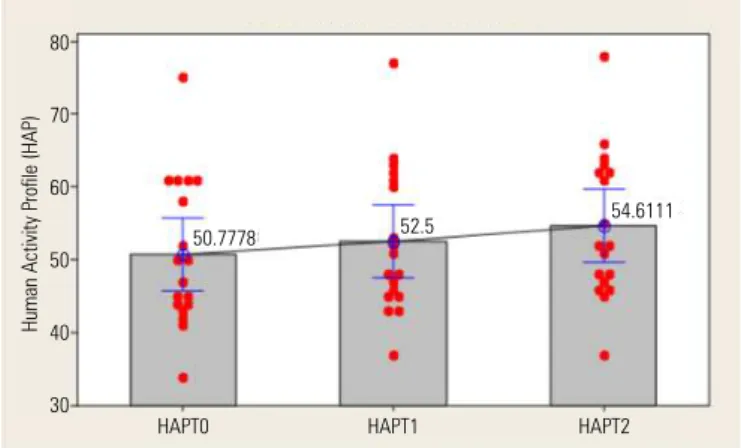
We found a significant increase in HAP values at 6 months (T1) and 12 months (T2) in relation to baseline scores (T0), that is, during the entire period of the study (period T0 to T1 p = 0.000; period T0 to T2 p = 0.018).
As to coping, there was a signiicant increase in the irst 6 months of activity, which remained stable until the end of the study (period T0 to T1 p = 0.000); but non signiicant from T1 to T2 (p = 0.143). There was a directly proportional correlation between the HAP increase and coping at T0, T1
and T2, (p ≤ 0.05.)
The distribution of the inventories can be seen in igures 1 and 2.
- people who already practiced exercise before (10; 55.6%): in HAP, we found a significant increase, p= 0.000, between baseline and 6 months and then a stabilization in the last 6 months. In terms of
coping,there was a significant increase, p = 0.007,
in the first 6 months of activities, also followed by stabilization;
- people who did not exercise before (8; 44.4%): in HAP, there was a significant increase in the first 6 months of study, p = 0.000, and also in the last 6
months of the study, p = 0.009. As to coping, we
found a significant increase only in the first 6 months, p = 0.032, followed by a stabilization in the last 6 months.
Older people presented a proportionally smaller physical capacity (HAP) throughout the study; however,
it is interesting to note that coping strategies did not
show any changes with aging.
Dividing the elderly into two age groups, the first with people under 75 years (10; 55.6%) and the second with people aged 75 years or older (8; 44.4%), a progressive increase in HAP at 6 and 12 months of study was observed in the latter, while among the less elderly, the initial elevation up to 6 months was followed by a stabilization until the end.
DISCUSSION
This study assessed the influence of exercise over some aspects of the relation between elderly people and their stress coping strategies.
To that end, it was decided to not just determine the evolution of the stress coping capacity, as assessed by the
Coping Strategies Inventory(12),but also to combine an
assessment of the reflex of this capacity on the evaluated daily activities. As to the Coping Strategies Inventory, it demonstrated a significant increase in the first six months of activity, and then tended toward stabilization in the second period, leading us to believe that exercise, in terms of stress coping, shows its most evident effects at the initial phase of the process, remaining effective as intervention continues.
As to the HAP, it demonstrated an increase in functional performance in the evaluation times (6 and 12 months), thus indicating that the improvement in everyday activities of the group along the program was progressive during the intervention period.
This study found a significant relation between the regular practice of exercise and stress coping as reported
in previous studies(15-17).
One of our objectives was also to compare two age groups, considering that our elderly population ranged widely in terms of age, but it was not possible
Figure 1. Human activity profile at time periods: baseline, 6 and 12 months 80
70
60
50
40
30
Human Activity P
rofile (HAP)
HAPT0 HAPT1 HAPT2
50.7778
54.6111 52.5
T0: initial time; T1: 6 months; T2: 12 months. Confidence interval (95%CI) of the Mean. (T0 versus T1 – p = 0,000; T1 versus T2 – p = 0.018 and T0 versus T2 – p = 0.001).
110
100
90
80
70
60
50
40
Coping values
copingT0 copingT1 copingT2
65
71.1111 67.7778
T0: initial time; T1: 6 months; T2: 12 months. Confidence interval (95%CI) of the Mean. (T0 versus T1 – p = 0,000; T1 versus T2 – p = 0.143 and T0 versus T2 – p = 0.010).
Figure 2. Coping strategies inventory
einstein. 2010; 8(4 Pt 1):419-22
422 Andréa F, Lanuez FV, Machado AN, Jacob Filho W
to identify a significant difference between groups in none of the studied variables. This makes it possible for us to say that, at least for this population, the effects arising from a supervised exercise program are not affected by aging, and it occurred with similar intensity among the so-called “young elderly” and the “very elderly”.
Likewise, we aimed to demonstrate the existence of a different behavior in the group that previously practiced physical activities and those considered sedentary. The main aspect that is worth highlighting is that the group that exercised before had evident effects, in both variables, in the first semester, remaining them unchanged in the second phase, whereas sedentary subjects showed continued functional evolution also in the second phase of the research.
CONCLUSIONS
The regular and oriented practice of exercise increases the level of stress coping in elderly people, and also enhances their physical performance in everyday life activities. There is no difference in the obtained benefits, both in stress coping and in daily activities of life, in the different age groups among the elderly. The previously sedentary group had progressive benefits from the implementation of daily activities throughout the period of the study.
REFERENCES
1. World Health Organization. Active ageing: a policy framework. Geneva: WHO; 2002.
2. Mazo GZ, Lopes MA, Benedetti TB. Atividade física e o idoso: concepção gerontológica. São Paulo: Sulina; 2001.
3. Johnston B, Lyons WL, Covinsky KE. Geriatric medicine. In: Tierney LM Jr, McPhee SJ, MA Papadakis MA, editors. Current medical: diagnosis & treatment. New York: McGraw-Hill; 2004. Chapter 4.
4. Drewnowski A, Monsen E, Birkett D, Gunther S, Vendeland S, Su J, et al. Health screening and health promotion programs for the elderly. Disease Management & Health Outcomes. 2003;11(5):299-309.
5. Sharkey BJ. Fitness and health. 5th ed. Cham paign (IL): Human Kinetics; 2001. 6. Pate RR. Recent statements and initiatives on physical activity and health.
Quest. 1995;47(3):304-10.
7. Vitta A. Atividade física e bem-estar na velhice. In: Neri A, Freire SA, organizadores. E por falar em boa velhice. Campinas: Papirus; 2000. p. 81-90. 8. Okuma SS. O idoso e a atividade física: fundamentos e pesquisa. Campinas:
Papirus; 1998.
9. Houaiss A, Villar MS, Franco FM. Dicionário Houaiss da língua portuguesa. Rio de Janeiro: Objetiva; 2001.
10. Everly GS. A clinical guide to the treatment of the human stress response. New York: Plenum; 1990.
11. Pereira A, Freitas C, Mendonça C, Marçal F, Souza J, Noronha JP, et al. Envelhecimento, estresse e sociedade: uma visão psiconeuroendocrinológica. Ciências & Cognição. 2004;1:34-53.
12. Lazarus R, Folkman S. Stress, appraisal and coping. New York: Springer; 1984.
13. Savóia MG, Santana PR, Mejias NP. Adaptação do inventário de estratégias de coping de Folkman e Lazarus para o português. Psicol USP. 1996;7(1/2):183-201. 14. Fix A, Daghton D. Human activity profile professional manual. Odessa (FL):
Psychological Assessment Resources; 1988.
15. Atlantis E, Chow CM, Kirby A, Singh MF. An effective exercise-based intervention for improving mental health and quality of life measures: a randomized controlled trial. Prev Med. 2004;39(2):424-34.
16. Harris AH, Cronkite R, Moos R. Physical activity, exercise coping, and depression in a 10-year cohort study of depressed patients. J Affect Disord. 2006;93(1-3):79-85.