RBCCV 44205-1630
DOI 10.5935/1678-9741.20150008
Predictors of mortality in cardiac surgery: brain
natriuretic peptide type B
Preditores de mortalidade em cirurgia cardíaca: peptídeo natriurético cerebral tipo B
Jamil Alli Murad Junior
1, MD; Marcelo Arruda Nakazone
1, MD; Mauricio de Nassau Machado
1,
PhD; Moacir Fernandes de Godoy
2, PhD
1Hospital de Base (HB)/Faculdade de Medicina de São José do Rio Preto (FAMERP), São José do Rio Preto, SP, Brazil and specialist in cardiology by Brazilian Society of Cardiology/Brazilian Medical Association
2Division of Cardiology and Post Graduation in Health Sciences of Faculdade de Medicina de São José do Rio Preto, SP, Brazil.
This work was performed at Faculdade de Medicina de São José do Rio Preto (FAMERP), São José do Rio Preto, SP, Brazil.
No inancial support.
Correspondence address: Jamil Alli Murad Junior
Hospital de Base de S. José do Rio Preto
Av. Brigadeiro Faria Lima, 5544 – São José do Rio Preto, SP, Brazil Zip code: 15090-000
E-mail: [email protected]
Article received on September 9th, 2013 Article accepted on February 2nd, 2015 Abstract
Objective: We evaluated whether the preoperative serum concentration of brain natriuretic peptide (BNP) is a predictor of in-hospital mortality in patients that underwent cardiac sur-gery.
Methods: We continuously evaluated 488 patients that un-derwent cardiac valve surgery or coronary artery bypass graft-ing (CABG) between January of 2009 and July of 2012. Follow up of these patients were done prospectively for 30 days post-operatively.
Results: Data analysis showed that the overall mortality rate was equal to 9.6%, Receiver Operating Charactheristic (ROC) curve analysis found the optimal cut-off value of BNP equal to 382 pg/mL for overall mortality (AUC=0.73, 95% CI=0.66 to 0.81, P<0.001). Multivariate analysis showed that the value of BNP higher than 382 pg/mL (P=0.033, HR=2.05, 95% CI=1.6 to 3.98) was an independent predictor of overall mortality at 30 days postoperatively.
Conclusion: We concluded that the preoperative serum con-centration of BNP is an independent predictor of mortality in patients undergoing valve surgery or coronary artery bypass graft.
Descriptors: Natriuretic Peptides. Hospital Mortality. Car-diovascular Surgery Procedures. Prospective Studies.
Resumo
Objetivo: Avaliar se a concentração sérica pré-operatória de peptídeo natriurético cerebral tipo B (BNP) é preditora de mortalidade intra-hospitalar em pacientes submetidos à cirur-gia cardíaca.
Métodos: Foram avaliados 488 pacientes consecutivamente submetidos à cirurgia cardíaca valvar ou à cirurgia de revascu-larização do miocárdio no período de janeiro de 2009 a julho de 2012. Estes foram seguidos, prospectivamente, por 30 dias de pós-operatório.
Resultados: Em nossa casuística, a mortalidade geral foi igual a 9,6% e 52% dos pacientes foram submetidos a cirur-gia de revascularização do miocárdio. Análise de curva ROC (Receiver Operating Charactheristic) encontrou o valor de cor-te ótimo de BNP igual a 382 pg/mL para mortalidade geral (AUC=0,73, IC95%=0.66 a 0,81, P<0.001). Análise multivariada mostrou que o valor de BNP > 382 pg/mL (P=0,033, HR=2,05, IC 95%=1,06 a 3,98) foi preditor independente de mortalidade geral em 30 dias de pós-operatório.
Conclusão: A concentração sérica pré-operatória do BNP é um preditor independente de mortalidade em pacientes subme-tidos à cirurgia valvar ou de revascularização do miocárdio.
INTRODUCTION
In the last decade, the interest in the use of brain natriuretic
peptide (BNP) levels as a risk stratiication tool in patients un -dergoing cardiac surgery has increased[1-3]. In the clinical setting,
risk scoring systems are widely validated and used as the gold standard method of evaluation of risk of perioperative mortality. On the other hand, these systems were proved to be complex with limited accuracy for certain cohorts of patients[4,5].
Con-sequently, new markers able to stratify risk and predict higher mortality rate in cardiac surgery are being investigated.
In addition to be used as a parameter to assess and val-idate the prognosis in several clinical situations, the mea-surement of BNP serum concentration has low cost, is easily performed and highly available, and has good reproducibili-ty[6-8]. Up to this the moment, few studies have evaluated the
serum concentration of preoperative BNP as a predictor of mortality in cardiac surgery, mainly due to the heterogeneity of small sample size, making it impossible to consistently as-sess its relation to mortality[1-3]. Thus, additional studies have
become necessary to demonstrate the correlations between BNP levels and mortality in cardiac surgery. In this study, the aim was to assess whether the preoperative BNP can be used as an independent predictor of mortality in cardiac surgery.
METHODS
The study evaluated 488 patients admitted to the Postoper-ative Cardiac Intensive Care Unit in the Medical School of Sao Jose do Rio Preto/Hospital of Base for heart valve surgery or coronary artery bypass grafting between January of 2009 and June of 2012. Exclusion criteria included patients younger than 18 years old, with advanced malignancy or who had undergone combined cardiac procedures. Data were collected prospective-ly by consulting the computerized database Hospital de Base of São José do Rio Preto - SP - Brazil. This hospital is a reference center for the treatment of cardiovascular diseases and serves a region of about 1.5 million people. The study was approved by the Ethics Committee of the Medical School of São José do Rio Preto (Protocol Number 6079/2010) and due to the nature of the study,no informed consent was required.
The data included demographic, comorbidities, degree of left ventricular systolic dysfunction, intraoperative variables and
mor-Abbreviations, acronyms & symbols
AUC Area under ROC curve
BNP Brain natriuretic peptide CABG Coronary artery bypass grafting CI Conidence interval
HR Hazard ratio
LV Left ventricle
ROC Receiver Operating Charactheristic
tality from all causes within 30 days postoperatively. All variables
were deined according to the latest guidelines published by the
American Heart Association and European Society of Cardiology. The serum concentration of BNP was measured in the preoperative period immediately before all operations, by the method of electrochemiluminescence using the Siemens AD-VIA Centaur equipment (Siemens Medical).
Categorical variables were presented as absolute numbers (percentages) and continuous variables as median and inter-quartile range.
Statistical analysis was performed with SPSS software (version 20.0). The discriminating power of the value of pre-operative serum concentration of BNP to predict mortality from all causes in 30 days after surgery was determined with the aid of statistical C by calculating the area under the ROC curve (“Receiver Operating Characteristic”), with the value > 0.60 considered not determined by chance.
In this study, proportional regression risk analysis of Cox was used to establish the relationship between the dependent variable (mortality from all causes) and the exploratory vari-ables. Single variables associated with mortality (P value
≤0.05) were considered for multivariate regression analysis.
The Spearman test was used to correlate continuous variables when two or more variables were closely correlated, the one with the highest statistical value of Wald was selected for mul-tivariate analysis. Independent predictors of mortality were established for variables with P≤0.05 in multivariate analysis.
The stepwise logistic regression method with likelihood ratio was used to determine independent predictors of mor-tality from all causes in the multivariate analysis. The prob-ability of survival, as well as risk functions were estimated by the Kaplan-Meier method. The log rank test was used to compare the probability of survival between groups.
Values with P ≤ 0.05 were considered statistically signiicant. RESULTS
Baseline characteristics of patients
From January of 2009 to June of 2012, 488 consecutive patients undergoing coronary artery bypass grafting or iso-lated valve surgery were included in the study.
The baseline characteristics evaluated in this study are sum-marized in Table 1. The median age was 57 (49-65) years and 58% were men. From the 488 patients, 92 (19%) were diabet-ic, 328 (67%) had systemic arterial hypertension. One hundred twenty-six patients (26%) had emergency surgery, 70 patients (14%) had at least one previous cardiac surgery and 80 patients (16%) had left moderate or severe ventricular dysfunction, the preoperative serum creatinine concentration and the preopera-tive clearance of creatinine were 1.1 mg/dl (0.9 to 1.3) and 68.5 mL/min/1.73 m2 (52.6 to 87.4), respectively. Isolated valve
(94%) performed with cardiopulmonary bypass, with the medi-an of cardiopulmonary bypass time equal to 98 (81-120) min-utes. The median value of addictive EuroSCORE was 3 (2-5).
Mortality from all causes at 30 days postoperatively
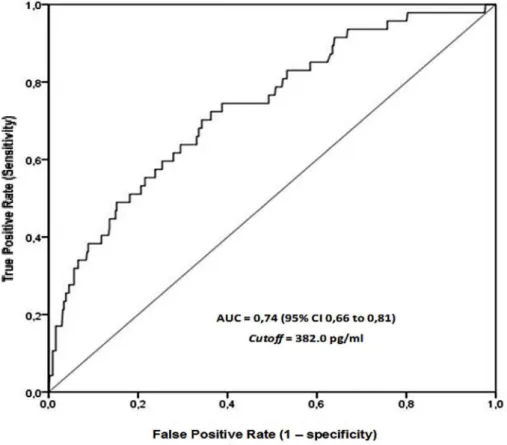
The area under the ROC curve was 0.74 (95% CI 0.66 to 0.81) for preoperative serum BNP with a cut-off value of 382 pg/mL,
with a sensitivity of 72% and speciicity equal to 64% for predict -ing death from all causes in 30 days after surgery (Figure 1).
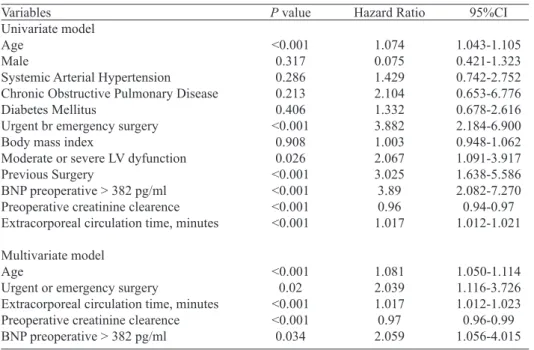
In univariate analysis, age (P<0.001), urgency or emer-gency surgery (P<0.001), left moderate or severe ventric-ular dysfunction (P=0.026), previous surgery (P<0.001), preoperative serum BNP>382 pg/mL (P<0.001), clearance of preoperative creatinine (P<0.001) and cardiopulmonary bypass time (P<0.001) were retained to multivariate analy-sis. The age (P<0.001, HR = 1.05; 95% CI 1.02 to 1.09), ur-gent or emergency surgery (P=0.027, HR=1.98, 95% CI 1.08 to 3.64), preoperative serum BNP> 382 pg/mL (P=0.033, HR=2.05, 95% CI 1.06 to 3.98), clearance of preoperative creatinine (P<0.001, HR=0.97; 95% CI 0.96 to 0.99) and car-diopulmonary bypass time (P<0.001, HR=1.02, 95% CI 1.01 to 1.02) variables were retained as predictors independent of death from all causes after multivariate Cox regression analysis (Table 2).
Table 1. Baseline characteristics of patients included in the study (n = 488).
Variables
Age, years, median (Q1-Q3) Male, n (%)
Systemic Arterial Hypertension, n (%) Chronic Obstructive Pulmonary Disease Diabetes Mellitus, n (%)
Urgent or emergency surgery, n (%) Body mass index, median (Q1-Q3) Moderate or severe LV dysfunction, n (%) Previous Surgery, n (%)
Preoperative serum creatinine (mg/dl) Preoperative creatinine clearence (ml/ min/1.73m2)
Preoperative BNP, pg/ml, median (Q1-Q3) Additive EuroSCORE, median (Q1-Q3) Coronary Artery Bypass Surgery, n (%) Valve surgery, n (%)
Preparative troponin I, median (Q1-Q3) Use of intra-aotic balloon, n (%)
Number of coronary grafts, median (Q1-Q3) Use of extracorporeal circulation, n (%) Extracorporeal circulation time, min, median (Q1-Q3)
Values 57 (49-65)
284 (58) 328 (67) 16 (3.3) 92 (19) 126 (26) 26 (23-29)
80 (16) 70 (14) 1.1 (0.9-1.3)
68.5 (52.6-87.4) 239 (80-786)
3 (2-5) 252 (52) 236 (48) 0.1 (0.01-1.1)
31 (6.4) 3 (2-3) 457 (94)
98 (81-120)
Fig. 1 - ROC (Receiver Operating Characteristic) curve relating preoperative serum brain natriuretic peptide (BNP) and mortality from all causes.
Figure 2 illustrates the 30-day survival probability of pa-tients who were divided into groups according to the BNP values being lower than or equal to 382 pg/ml or greater than 382 pg/ml, respectively, with the values being 95.6% and 82.5 % at 30 days after surgery (P<0.001).
Fig. 2 - Kaplan-Meier’s curve for survival at 30 days postoperatively. BNP=brain natriuretc peptide Table 2. Uni and multivariate analysis of the variables in relation to mortality.
95%CI
1.043-1.105 0.421-1.323 0.742-2.752 0.653-6.776 0.678-2.616 2.184-6.900 0.948-1.062 1.091-3.917 1.638-5.586 2.082-7.270 0.94-0.97 1.012-1.021
1.050-1.114 1.116-3.726 1.012-1.023 0.96-0.99 1.056-4.015 Variables
Univariate model Age
Male
Systemic Arterial Hypertension Chronic Obstructive Pulmonary Disease Diabetes Mellitus
Urgent br emergency surgery Body mass index
Moderate or severe LV dyfunction Previous Surgery
BNP preoperative > 382 pg/ml Preoperative creatinine clearence Extracorporeal circulation time, minutes
Multivariate model Age
Urgent or emergency surgery
Extracorporeal circulation time, minutes Preoperative creatinine clearence BNP preoperative > 382 pg/ml
P value
<0.001 0.317 0.286 0.213 0.406 <0.001
0.908 0.026 <0.001 <0.001 <0.001 <0.001
<0.001 0.02 <0.001 <0.001 0.034
Hazard Ratio
1.074 0.075 1.429 2.104 1.332 3.882 1.003 2.067 3.025 3.89 0.96 1.017
1.081 2.039 1.017 0.97 2.059
DISCUSSION
In this prospective and contemporary study of patients undergoing cardiac surgery the preoperative serum concen-tration of BNP was correlated to postoperative mortality.
Authors’ roles & responsibilities
JAMJ Analysis and/or interpretation of data; statistical analysis; inal approval of the manuscript; study design; operations and/or experiments conduct; writing of the manuscript or critical review of its content
MAN Analysis and/or interpretation of data; study design MNM Analysis and/or interpretation of data; statistical analysis; i
-nal approval of the manuscript; study design; writing of the manuscript or critical review of its content
MFG Analysis and/or interpretation of data; statistical analysis; inal approval of the manuscript; study design; writing of the manuscript or critical review of its content
REFERENCES
1. Litton E, Ho KM. The use of pre-operative brain natriuretic peptides as a predictor of adverse outcomes after cardiac surgery: a systematic review and meta-analysis. Eur J Cardiothorac Surg. 2012;41(3):525-34.
though there are several known risk factors of mortality in cardiac surgery, the association between preoperative BNP and mortality in cardiac surgery is still under investigation[1].
We found that preoperative BNP is an independent predictor of postoperative mortality in cardiac surgery. This assertion is based on the P value obtained by Cox regression analysis,
in addition to the signiicant difference in the probability of survival between the groups stratiied according to BNP. This inding demonstrates a role for BNP regarding the evaluation
of preoperative risk in cardiac surgery.
Few studies have described the prognostic signiicance
of preoperative BNP in the heart surgery setting[1-3]. In a
meta-analysis recently published the preoperative BNP was evaluated as a predictor of adverse outcomes in cardiac
sur-gery, among 819 relevant studies identiied in the literature,
only four associated preoperative serum BNP with mortality and of these, only one has examined this relationship with the help of multivariate analysis[1]. In this small study mentioned
(n=209), BNP was an independent predictor of adverse cardi-ac events, described as combined event of death and non-fatal events (malignant ventricular arrhythmia, myocardial infarc-tion and heart failure)[9]. In the present study, we found that
preoperative BNP was an independent predictor of mortality
from all causes with methodology speciically geared to this
goal to become a pioneering study in relation to its results. Our group believes that the prognostic value of preopera-tive BNP is due to its ability to measure ventricularhemody-namic changes even in asymptomatic patients[10]. Discovered
in 1988, only in 1994 a study was performed to assess the site and mechanism of secretion of BNP, showing that higher
BNP levels were signiicantly correlated with increased pul -monary capillary wedge pressure, increased diastolic and end systolic ventricular volume of the left ventricle, lower left ventricular ejection fraction and a lower cardiac index[11-14].
Consequently, it was concluded that secretion is stimulated by increased ventricular wall stress and correlates with in-creased cardiovascular risk variables[10,11,15]. Our group
be-lieves that this pathophysiological mechanism intrinsically related to secretion of BNP is the explanation for the high-er levels of preophigh-erative BNP are independently associated with increased mortality in cardiac surgery.
Score systems are widely used in preoperative risk
strati-ication with emphasis on choosing the best method of treat -ment according to the risk found, and performed an uniform comparative analysis between different surgeons and centers specialized in heart surgery[16,17]. However, conducts
aim-ing to reduce perioperative risk are rarely adopted based on these risk scores because they are made up of a large number of variables, and do not have a progressive nature to assess pre-surgical procedures[18]. Therapies guided by BNP levels
have been effective in reducing hospitalization and death in patients with heart failure[19]. Therefore, BNP can provide
a noninvasive indicator to evaluate the effectiveness of
perioperative hemodynamic reductions in stress related to blood
volume status of these patients aiming at better risk stratiication
and optimization of surgical outcomes.
This study was designed to assess the association between the value of preoperative serum BNP and mortality in patients undergoing valve replacement surgery or coronary artery by-pass graft surgery. Compared to the other existing studies in this area, this study has the highest number of participants with clinically relevant result to demonstrate that preoperative BNP was an independent predictor of the outcome of isolated post-operative mortality in cardiac surgery. However, our study has limitations, such as the fact that it was performed at a single medical center with short-term follow-up.
Further studies are needed to assess the association be-tween preoperative serum BNP and mortality in cardiac sur-gery, because the data are limited regarding this issue. Our study adds information to the limited literature and suggests that the BNP preoperative serum concentration should be in-cluded in all future studies that assess mortality in cardiac surgery as a clinical outcome.
CONCLUSION
It was demonstrated that the high levels of preoperative BNP were an independent predictor of 30-day mortality after surgery for patients undergoing heart valve surgery or
coro-nary artery bypass graft. This inding raises the possibility
2. Patel UD, Garg AX, Krumholz HM, Shlipak MG, Coca SG, Sint K, et al; Translational Research Investigating Biomarker Endpoints in Acute Kidney Injury (TRIBE-AKI) Consortium. Preoperative serum brain natriuretic peptide and risk of acute kidney injury after cardiac surgery. Circulation. 2012;125(11):1347-55.
3. Mitchell J, Webb ST. Is brain natriuretic peptide marker for adverse postoperative outcomes in patients undergoing cardiac surgery? Interact Cardiovasc Thorac Surg. 2011;12(3):467-72.
4. Nashef SA, Roques F, Michel P, Gauducheau E, Lemeshow S, Salamon R. European system for cardiac operative risk evaluation (EuroSCORE). Eur J Cardiothorac Surg. 1999;16(1):9-13.
5. Geissler HJ, Hölzl P, Marohl S, Kuhn-Régnier F, Mehlhorn U,
Südkamp M, et al. Risk stratiication in heart surgery: comparison
of six score systems. Eur J Cardiothorac Surg. 2000;17(4):400-6.
6. Struthers AD. Ten years of natriuretic peptide research: a new dawn for their diagnostic and therapeutic use? BMJ. 1994;308(6944):1615-9.
7. Suzuki S, Yoshimura M, Nakayama M, Mizuno Y, Harada E, Ito T, et al. Plasma level of B-type natriuretic peptide prognostic marker after the acute myocardial infarction: a long-term follow-up analysis. Circulation. 2004;110(11):1387-91.
8. Hartmann F, Packer M, Coats AJ, Fowler MB, Krum H, Mohacsi P, Rouleau JL, et al. Prognostic impact of plasma N-terminal pro-brain natriuretic peptide in severe chronic congestive heart failure: a substudy of the Carvedilol Prospective Randomized Cumulative Survival (COPERNICUS) trial. Circulation. 2004;110(13):1780-6.
9. Fellahi JL, Daccache G, Rubes D, Massetti M, Gerard JL, Hanouz JL. Does preoperative B-type natriuretic peptide better predict adverse outcome and prolonged length of stay than the standard European System for Cardiac Operative Risk Evaluation after cardiac surgery? J Cardiothorac Vasc Anesth 2011;25(2):256-62.
10. Daniels LB, Maisel AS. Natriuretic peptides. J Am Coll Cardiol. 2007;50(25):2357-68.
11. Yasue H, Yoshimura M, Sumida H, Kikuta K, Kugiyama K, Jougasaki M, et al. Localization and mechanism of secretion of B-type natriuretic peptide in comparison with those of A-type natriuretic peptide in normal subjects and patients with heart failure. Circulation. 1994;90(1):195-203.
12. Sudoh T, Kangawa K, Minamino N, Matsuo H. A new natriuretic peptide in porcine brain. Nature. 1988;332(6159):78-81.
13. Ferreira CA, Vicente WV, Evora PR, Rodrigues AJ, Klamt JG, Carlotti AP, et al. High-dose aprotinin does not affect troponin I, N-Terminal pro-B-type natriuretic peptide and renal function in children submitted to surgical correction with extracorporeal circulation. Rev Bras Cir Cardiovasc. 2009;24(4):519-532.
14. Gabriel EA, Locali RF, Matsuoka PK, Almeida LS, Silva PS, Ishigai MM, et al. Pulmonary artery perfusion does not improve brain natriuretic peptide (BNP) levels in suine experimental research. Rev Bras Cardiovasc. 2010;25(4):516-26.
15. Mukoyama M, Naka K, Hosoda K, Suga S, Saito Y, Ogawa Y, et al. Brain natriuretic peptide as a novel cardiac hormone in humans. Evidence for an exquisite dual natriuretic peptide system, atrial natriuretic peptide and brain natriuretic peptide. J Clin Invest. 1991;87(4):1402-12.
16. Ranucci M, Castelvecchio S, Menicanti L, Frigiola A, Pelissero G. Risk of assessing mortality risk in elective cardiac operations: age, creatinine, ejection fraction, and the law of parsimony. Circulation. 2009;119(24):3053-61.
17. Parsonnet V, Dean D, Bernstein AD. The method of uniform
stratiication of risk factors for evaluating the results of surgery in
acquired adult heart disease. Circulation. 1989;79(6 Pt 2):I3-12.
18. Tu JV, Sykora K, Naylor CD. Assessing the outcomes of coronary artery bypass graft surgery: how many risk factors are enough? Steering Committee of the Cardiac Care Network of Ontario. J Am Coll Cardiol. 1997;30(5):1317-23.