Juliana de Oliveira Freitas Miranda
I,II, Climene Laura de Camargo
I, Carlito Lopes Nascimento Sobrinho
I,II,
Daniel Sales Portela
III, Alan Monaghan
IV, Katia Santana Freitas
II, Renata Fonseca Mendoza
II,VI Universidade Federal da Bahia, School of Nursing, Portgraduate Program in Nursing. Salvador, Bahia, Brazil. II Universidade Estadual de Feira de Santana, Department of Health. Feira de Santana, Bahia, Brazil. III Universidade Federal do Recôncavo da Bahia, Medical Course. Santo Antônio de Jesus, Bahia, Brazil.
IV University of Brighton, School of Nursing. Willingdon, United Kingdom.
V Governo do Estado da Bahia, Health Secretariat, Children’s State Hospital. Feira de Santana, Bahia, Brazil.
How to cite this article:
Miranda JOF, Camargo CL, Sobrinho CLN, Portela DS, Monaghan A, Freitas KS, et al.
Translation and adaptation of a pediatric early warning score. Rev Bras Enferm [Internet]. 2016;69(5):833-41. DOI: http://dx.doi.org/10.1590/0034-7167-2015-0096
Submission: 06-07-2016 Approval: 06-23-2016
ABSTRACT
The Brighton Paediatric Early Warning Score (BPEWS) is an instrument developed to identify warning signs for clinical deterioration in hospitalized children. Objective: to translate and adapt the BPEWS for the Portuguese language, with the purpose of verifying its applicability in the Brazilian context studied. Method: methodological study guided by international and nationally accepted recommendations for translation and adaptation of health measurement instruments. Stages of conceptual, item, semantic, operational and pre-test equivalence are described for obtaining the BPEWS Portuguese version to be used in Brazil. Results: the BPEWS version translated and adapted for Brazilian Portuguese (BPEWS-Br) identifi ed, in the pilot study, that 26.6% of children were presenting warning signs for clinical deterioration. Conclusion: the BPEWS-Br seems to be applicable for the context studied, and its use might help nurses in the recognition and documentation of warning signs for clinical deterioration in hospitalized Brazilian children.
Descriptors: Translating; Alert; Hospitalized Child; Patient Acuity; Pediatric Nursing.
RESUMO
O Brighton Paediatric Early Warning Score (BPEWS) é um instrumento construído para identifi car sinais de alerta para deterioração clínica em crianças hospitalizadas. Objetivo: traduzir e adaptar o BPEWS para o português a fi m de verifi car sua aplicabilidade no contexto brasileiro estudado. Método: estudo metodológico guiado por recomendações internacional e nacionalmente aceitas para tradução e adaptação de instrumentos de medida em saúde. Descreve-se as etapas de equivalências conceitual, de itens, semântica, operacional e pré-testagem para obtenção da versão em português do BPEWS para uso no Brasil. Resultados: o BPEWS na sua versão traduzida e adaptada para o português brasileiro (BPEWS-Br) identifi cou no estudo-piloto que 26,6% das crianças estavam apresentando sinais de alerta para deterioração clínica. Conclusão: o BPEWS-Br parece ser aplicável ao contexto estudado, e seu uso poderá ajudar o enfermeiro no reconhecimento e documentação de sinais de alerta para deterioração clínica em crianças brasileiras hospitalizadas.
Descritores: Tradução; Alerta; Criança Hospitalizada; Gravidade do Paciente; Enfermagem Pediátrica.
RESUMEN
El Brighton Paediatric Early Warning Score (BPEWS) es un instrumento construido para identifi car señales de alerta de deterioro clínico en niños hospitalizados. Objetivo: traducir y adaptar el BPEWS al portugués, a fi n de verifi car su aplicabilidad en el ámbito brasileño estudiado. Método: estudio metodológico orientado por recomendaciones nacional e internacionalmente aceptadas de traducción y adaptación de instrumentos de medición en salud. Se describen las etapas de equivalencias: conceptual, de ítems, semántica, operativa y pre-testeo para obtención de versión en portugués del BPEWS para utilización en Brasil. Resultados: el BPEWS en su versión traducida y adaptada al portugués brasileño (BPEWS-Br) identifi có en su estudio piloto que el 26,6% de los niños estaba presentando señales de
Translation and adaptation of a pediatric early warning score
INTRODUCTION
Clinical deterioration can be described as the manifestation of signs and symptoms that translate physiological instabili-ty. In children, warning signs for clinical deterioration might be already present or emerge suddenly. The identification of these signs and early care might prevent the evolution of the current clinical condition worsening, shock, respiratory failure, or cardiorespiratory arrest. Public expending with its treatment can be reduced, as well as the possibility of compli-cations and sequelae(1-3). However, sometimes, clinical
condi-tions of patients deteriorate before health teams are able to recognize and respond to the warning signs(4).
In this scenario, Pediatric Early Warning Score (PEWS) in-struments have been developed and validated(5-9) for the last
10 years, for early identification of warning signs in hospital-ized children’s bedside. Their objective is to signal the team regarding the need for providing urgent care to patients at risk for serious events, by means of regular monitoring of clinical signs and pre-established criteria(10).
Published in 2005, the Brighton Paediatric Early Warning Score (BPEWS) or Monaghan PEWS is among the PEWS in-struments. It was developed by a nurse of the University of Brighton and it basically uses three evaluation components: neurological, cardiovascular, and respiratory, with score from 0 to 13. From three points up, the higher the score, the higher the risk of clinical deterioration(5).
At the time of its conception, there was a strong indicator that a warning score for clinical deterioration had a place in the pe-diatric scenario; however, there was a shortage of publications, as it seemed to be a relatively new concept. In this perspective, a multidisciplinary group was created to discuss severity markers in children, thus deciding to develop a score based on available systems for adults. In this process, children’s specificities, need for implementation of an instrument of easy application, and quick evaluation that would not cause extra work for the nursing team were taken into consideration(5).
The BPEWS was chosen for translation and adaptation to our context because it was pointed as a valid and reliable in-dicator of warning signs for clinical deterioration in children, which uses clinical evaluation without the need for mea-surement devices of vital parameters(5,11-14). Moreover, in the
searched health databases (PubMed, CINAHL, Capes Portal, Virtual Health Library), there were no studies that translated and adapted scores to the Portuguese language, with the pur-pose of use in Brazil. In addition, the BPEWS was not adapted to other languages, but English.
In this respect, the objective of this study was to translate and adapt the BPEWS for the Portuguese language, with the purpose of verifying its applicability in the Brazilian context
studied.
METHOD
This was a methodological study guided by international and nationally accepted recommendations for the process of translation and adaptation of health measurement instru-ments(15-19). In the literature, there is no consensus regarding
the best method for translation and adaptation of instruments; however, studies in this topic affirm that some procedures must be followed. Scholars suggest a combination between the translation of words and phrases from a language into an-other, and a systematic process that includes the context of the target population who will use the adapted version(16-18,20-21).
For the translation and cross-cultural adaptation process, it is recommended that operational stages be followed to achieve equivalence between the original version and the translated /adapted version. This equivalence is didactically subdivided in conceptual, item, semantic, operational, mea-surement, and functional equivalences(16-18).
In this study, stages of conceptual, item, semantic, opera-tional, and pre-test equivalences are described for obtaining the BPEWS version in Portuguese and applying it in a Brazilian context. This process was authorized by the author of the score.
The stages described above were developed at a large-sized pediatric hospital with 280 beds, located in a city in the state of Bahia, Brazil. Thirty children aged 0 to 10 years who were hospitalized in emergency stabilization and clinical-surgical hospitalization units were included in the pre-test or pilot test. Children with a heart disease diagnosis described in their medical record were excluded, since in the literature there is an adapted score for children with heart diseases.
This research is part of a thesis project developed at the School of Nursing of the Federal University of the Bahia and approved by its research ethics committee.
Conceptual and item equivalences
In this stage, a review on publications of the original instru-ment and discussion with specialists and the target population are recommended(16,18). The procedures for the BPEWS
develop-ment were searched in the literature, as well as in studies that applied it in the clinical practice and evaluated its psychometric properties (validity and reliability). The authors also studied the event that the BPEWS was intended to measure (warning signs for clinical deterioration in children). It was followed by discus-sion with a group made up of two doctors and four specialist nurses in pediatrics, about the relevance and pertinence of the components of the score for evaluation of the phenomenon in question, in addition to its applicability and use in the clinical practice of the context experienced by professionals.
Juliana de Oliveira Freitas Miranda E-mail: [email protected]
CORRESPONDING AUTHOR
alerta de deterioro clínico. Conclusión: el BPEWS-Br parece ser aplicable en el contexto estudiado, y su uso ayudará al enfermero en el reconocimiento y documentación de señales de alerta de deterioro clínico en niños brasileños hospitalizados.
An integrative review was developed(22) whose search was
carried out in the databases of PubMed, CINAHL, and the Virtual Health Library of Brazil. Eleven studies that used the BPEWS in their design were found, and the psychometric properties already tested and the instrument’s application in the hospital scenario of other contexts were verified.
Semantic equivalence
Semantic equivalence involves transferring the meaning of words in the original instrument to a new version, aiming at achieving a similar effect in respondents of both cultures(16,18).
This stage started in the initial translation of the original ver-sion and goes up to the pre-test of the new verver-sion, with a slight variation according to the literature adopted.
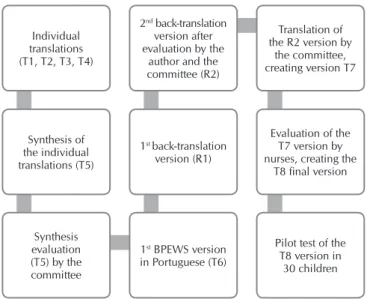
In this study, the translation and adaptation of the BPEWS for the Portuguese language followed stages of translation, back-translation, panel of specialists, evaluation by the author of the score and a pilot test (Figure 1).
Figure 1 – Flowchart ofthe Brighton Paediatric Early
Warn-ing Score translation and adaptation
Because it is a score composed of clinical components, the initial stage of the translation was done individually by a committee made up of four health professionals, obtaining the translated versions (T1, T2, T3, and T4). The commit-tee members were two nurses and two pediatricians, with proficiency in English language and knowledge of the top-ic, considering the need for understanding the concerned phenomenon.
After the individual translation, synthesis of the four translations was carried out (T5). This was reassessed by the panel of specialists and, after discussion about consensuses and dissentions of the initial translations, the first version of the Portuguese score was achieved (T6). This was submit-ted to back-translation (R1) into the English language by a Brazilian doctor with American citizenship and fluency in both languages.
The back-translation version (R1) was evaluated on-line by the author of the score. Aspects discussed between the author and the committee were related to specificities of the Portu-guese language and use of mean values as references for heart and respiratory frequencies. The second back-translation ver-sion (R2) was obtained after discusver-sion of these aspects.
The second back-translation version (R2) was submitted again to translation (T7) into Portuguese language by the pan-el of specialists and it was evaluated by two pediatric nurses who worked in the clinical practice of a large-sized pediatric hospital. The nurses exposed their questions, understood the BPEWS evaluation components and, after training on its use, each one of them applied it to five children. After this applica-tion, they suggested two alterations for a better understanding of the instrument, creating the adapted version of the score (T8) for pilot test application.
Operational equivalence
This equivalence refers to the evaluation regarding the ve-hicle’s relevance and adequacy, and format of the instrument, its instructions, its context, and methods of application and cat-egorization(18). In this study, the following topics were discussed
between the committee and nurses: layout, instructions, viable time for use, and units indicated for application, in order to achieve acceptance among the team and better results.
Pilot test
The BPEWS in its final version (T8) was applied in a pi-lot study with 30 children, aiming at undertaking necessary adjustments. No component of the T8 version was modified.
RESULTS
Conceptual and item equivalences
From analysis and discussion about singularities of clini-cal deterioration in children and the BPEWS components to measure this event, the committee judged that, for the context studied, the instrument could be relevant and pertinent to the nursing practice in the care provided to children.
For contemplating neurological, cardiovascular, and respi-ratory manifestations considered universal and that might ap-pear in face of deterioration, the BPEWS components could help in the early recognition of this phenomenon. Therefore, for its use, some adaptations should be made for improving its understanding and applicability in the context studied.
In the integrative review conducted, five of the 11 studies that used the BPEWS in their design described it as a valid and reliable instrument for the identification of warning signs for clinical deterioration in children hospitalized in the contexts researched.
Semantic equivalence
Box 1 presents the synthesis of modifications made in the BPEWS, from the original version in English language up to the final version in Portuguese language. Modifications judged necessary for the translation and adaptation of the score are described based on its components.
Individual translations (T1, T2, T3, T4)
Synthesis of the individual translations (T5)
Synthesis evaluation (T5) by the committee
2nd back-translation
version after evaluation by the
author and the committee (R2)
1st back-translation
version (R1)
1st BPEWS version
in Portuguese (T6)
Translation of the R2 version by
the committee, creating version T7
Evaluation of the T7 version by nurses, creating the
T8 final version
Pilot test of the T8 version in
Box 1 – Description of the synthesis of the Brighton Paediatric Early Warning Score modifications in the translation and adaptation process
Neurological component
Versions Description Score
0 1 2 3
Original Behaviour appropriatePlaying/ Sleeping Irritable reduced response to painLethargic/confused or
T6 neurológicoEstado Ativo Sonolento Irritado
Letárgico/ obnubilado ou resposta
reduzida à dor
R2 Neurological state Active Sleepy Irritable
Lethargic/ obtunded or reduced
response to pain
T8 neurológicoEstado Ativo Sonolento/hipoativo Irritado
Letárgico/ obnubilado ou resposta
reduzida à dor
Cardiovascular component
Versions Description Score
1 2 3
Original Cardiovascular capillary refill Pink or 1–2 seconds
Pale or capillary refill 3 seconds
Grey or capillary refill 4 seconds. Tachycardia of 20 above normal rate
Grey and mottled or capillary refill 5 seconds or above. Tachycardia of 30 above normal
rate or bradycardia
T6 Cardiovascular
Corada ou TEC* 1–2
segundos
Pálido ou TEC 3 segundos
Moteado ou TEC 4 segundos ou FC** ≥ 20
bpm*** acima do limite
superior para a idade
Acinzentado/ cianótico ou TEC ≥ 5 seg ou FC ≥ 30 bpm
acima do limite superior para a idade ou bradicardia para a
idade R2 Cardiovascular Normal color or capillary refill 1–2 seconds
Pale or capillary refill 3 seconds
Patchy skin or capillary refill 4 seconds or HR ≥ 20 bpm above the upper
limit for the age
Grey/cyanotic or capillary refill ≥ 5 seconds or HR ≥ 30 bpm above the upper limit for the age
or bradycardia for the age
T8 Cardiovascular Corado ou TEC 1–2 seg
Pálido ou TEC de 3 seg ou FC acima do limite
superior para a idade
Moteado ou TEC 4 seg ou FC ≥ 20 bpm acima do limite superior para a idade
Acinzentado/ cianótico ou TEC ≥ 5 seg ou FC ≥ 30 bpm acima
do limite superior para a idade ou bradicardia para a idade
Respiratory component
Versions Description Score
1 2 3
Original Respiratory
Within normal parameters, no recession or tracheal tug
>10 above normal parameters, using accessory muscles, 30+%
FiO2 or 4+ litres/min
>20 above normal parameters, recessing tracheal tug, 40+% FiO2
or 6+ litres/min
5 below normal parameters with sternal recession, tracheal
tug or grunting, 50% FiO2 or 8+ litres/min
T6 Respiratório
FR**** normal
para a idade, sem retração.
FR acima do limite superior para a idade, uso
de musculatura acessória ou FiO2*****≥ 30% ou 4
litros/min de O2******
FR ≥ 20 rpm******* acima
do limite superior para a idade; retrações subcostais, intercostais e de fúrcula ou FiO2 ≥ 40% ou 6 litros/
min de O2
FR ≤5 rpm abaixo do limite inferior para a idade; retrações
subcostais, intercostais, de fúrcula, de esterno e gemência
ou FiO2 ≥ 50% ou 8 litros/ min de O2
R2 Respiratory
RR normal for the age, no retractions.
RR above the upper limit for the age, use of accessory muscles or FiO2 ≥ 30% or
4 liters/min of O2.
RR ≥ 20 bpm above upper limit for the age;
subcostal retractions, intercostal retractions and suprasternal retractions or FiO2 ≥ 40% or 6 liters/
min of O2
RR ≥ 5 bpm below the lower limit for the age; subcostal
retractions, intercostal retractions, suprasternal retractions, sternal retractions and grunting or FiO2 ≥ 50%
or 8 liters/min of O2
T8 Respiratório
FR normal para a idade, sem retração
FR acima do limite superior para a idade, uso
de musculatura acessória ou FiO2≥ 30% ou 4
litros/min de O2
FR ≥ 20 rpm acima do limite superior para a idade; retrações subcostais, intercostais e de fúrcula ou FiO2 ≥ 40% ou 6 litros/min de O2
FR ≤5 rpm abaixo do limite inferior para a idade; retrações
subcostais, intercostais, de fúrcula, de esterno e gemência
ou FiO2 ≥ 50% ou 8 litros/ min de O2
receive score 1 if they are using accessory musculature in isola-tion, increasing this score to 2 or 3 when there are retractions and/or grunting. In the translation and adaptation, the commit-tee judged necessary to describe the musculature used in the respiratory effort according to the difficulty to breathe, in order to make the evaluation objective, based on the guidelines of the American Heart Association (AHA)(23).
The AHA classifies the degree of respiratory difficulty as mild to moderate, and severe, according to the retraction’s location. Nevertheless, grunting may follow the response to pain or fever, but it can also be a progression sign of discom-fort for respiratory failure, indicating greater severity(23).
Considering the increase in the effort, and the higher the effort, the higher the severity, score 1 was attributed to “ mús-culos acessórios” (“accessory muscles”) isolated; score 2 to “retrações subcostais, intercostais e de fúrcula” (“subcostal retractions, intercostal retractions, and suprasternal retrac-tions”); and score 3 to “retrações subcostais, intercostais, de fúrcula, de esterno e gemência” (“subcostal retractions, inter-costal retractions, suprasternal retractions, and grunting”).
Extra points
In the BPEWS development, the author added 2 extra points: if children received nebulization therapy in the past fifteen minutes before the evaluation; or if children presented persistent vomiting following surgery (more than three epi-sodes). Initially, the committee considered these observations unnecessary; however, they were maintained, considering that recent nebulization may simulate a momentary improve-ment of the respiratory condition, suggesting the need for re-assessment. In addition, persistent vomiting might aggravate children’s condition in the postoperative period.
Operational equivalence
Regarding the score layout, the committee judged nec-essary the addition of the terms “Escore Parcial” (“Partial score”) for the record of each component’s score and “Escore Final” (“Final score”) for the record of the sum of the partial scores. Furthermore, nurses requested the inclusion of a gap for the record of values measured and used in patients’ eval-uation (Age, HR, CRT, RR, and FiO2). According to them, this measure would facilitate the score’s filling and would strengthen the records’ reliability. After the adjustments, the Portuguese version of the final BPEWS layout was obtained for pilot application.
Neurological component
The BPEWS neurological component did not undergo signif-icant adaptations. Most terms were understood and translated in a similar way. The term “Behaviour” in the original version was translated and adapted as “Estado Neurológico” (“Neu-rologic status”) in the final version. The term “Sleeping” was translated as “Sonolento” (“Sleepy”); however, after evaluation of nurses, the addition of the term “Hipoativo” (“Hypoactive”) was suggested, since this term is often used to refer to children with a slight neurological alteration with verbal response.
Cardiovascular component
In this component, in the evaluation of score 0, the author of the score suggested the use of the term “Normal color” in-stead of “Pink”. In the Portuguese language, these terms were translated as “Corado” (“Pink”), which was considered an ap-propriate skin color for a pediatric patient. In the evaluation of score 1, nurses suggested the addition of “ou FC acima do limite superior para a idade” (“or HR above the upper limit for the age”), due to an existing gap between the upper limit of the normal HR and HR ≥ 20 bpm (evaluation of score 2).
In the evaluation of scores 2 and 3, the terms “Grey and mottled” were widely discussed by the committee based on what is found in the literature. The cutaneous findings that may indicate inadequate transference of oxygen to fabrics are pallor/colorlessness, mottling and cyanosis. Mottling may be normal or result from serious conditions (hypoxemia, hypovolemia and shock) and central cyanosis usually indi-cates the need for immediate intervention, such as oxygen therapy and ventilatory support23. Therefore, using the term
“Moteado” (“Mottled”) with score 2 and the terms “ Acinzen-tado/cianótico” (“Grey/cyanotic”) with score 3 were consid-ered appropriate.
Respiratory component
In the respiratory component, score 1 was attributed to “> 10 above normal parameters”, that is, a RR above 10 bpm of the normal parameters used as reference. The committee understood that this way, there would be a gap between the upper limit of the normal RR up to the value of 10 bpm, re-placing with “FR acima do limite superior para a idade” (“RR above the upper limit for the age”).
Regarding the respiratory effort, the evaluation of retractions and/or grunting is described as “recessing tracheal tug” or “ster-nal recession, tracheal tug or grunting”. In this case, children
Extra points of the score
Versions Description
Original Score 2 extra for ¼ hourly nebulisers or persistent vomiting following surgery
T6 Adicionar 02 pontos extras se recebeu nebulização até há 15 minutos ou vômitos persistentes após cirurgia
R2 Add 2 extrapoints if received nebulization therapy in the past 15 minuts or if persistent vomitting post surgery. T8 Adicionar 02 pontos extras se recebeu nebulização até há 15 minutos ou vômitos persistentes após cirurgia
Notes: *TEC (CRT): Tempo de Enchimento Capilar (Capillary refill time), **FC (HR): Frequência Cardíaca (Heart rate), ***bpm: Batimentos/minuto (beats per min-ute) ****FR (RR): Frequência Respiratória (Respiratory rate), *****FiO2: Fração Inspirada de Oxigênio (Fraction of inspired oxygen), ******O2: Oxigênio (Oxygen), *******rpm (bpm): respirações /minuto (breaths per minute).
An important guidance for the BPEWS application is that, during an evaluation, if children present warning signs in two scores, they must receive the highest score.
The sectors considered appropriate for the application of the score were the clinical-surgical and observation hospital-ization units of the emergency department, where demand of nursing care is higher, and its application would direct care to children in risk of deterioration.
Reference values adopted for respiratory and heart rates
The BPEWS author suggested the adoption of mean val-ues of respiratory rate (RR) and heart rate (HR), considering that pediatric vital parameters described in the literature are wide and diverse, and there is no consensus on their values. Nonetheless, after search in the literature, it was opted for merging the intervals recommended by the AHA(23) with the
Brazilian guidelines for community-acquired pneumonia in pediatrics(24), and the World Health Organization
consen-sus for clinical classification of severity of pneumonias in children from two months to five years(25). Box 2 presents
pediatric parameters adopted in this study for the BPEWS application.
Regarding values of reference, the committee opted for chang-ing the signals “>” and “<”, used in the original score, to “≥” and “≤”, aiming at making values more accurate, since this al-teration would not impact on the interpretation of values, would bring lesser risk of bias and would improve standardization.
Pilot test
After the translation and adaptation stages of the Brigh-ton Paediatric Early Warning Score for Brazilian Portuguese (BPEWS - BR), the score was applied to 30 children in the clinical-surgical and observation hospitalization units of emergency. The mean time for the BPEWS application was 3.9 minutes. Table 1 presents the results of this application.
DISCUSSION
The early recognition of signs and symptoms that show severity in pediatric patients is a decisive factor for survival and good prognosis. Quick assessment is the first impression of health professionals about patients, and it consists on the evaluation of their general appearance, respiratory pattern, and manifestations associated with circulation(1-2).
Recognizing warning signs that may indicate clinical de-terioration in hospitalized children must be a daily exercise of nurses. With the purpose of helping them in this practice and contributing for the reduction of complications, pediat-ric early warning scores were developed on the international scene, such as the BPEWS.
Regarding the BPEWS validity for detection of clinical dete-rioration in hospitalized children, the score presented sensitivity of 90.2%, specificity of 74.4%, positive predictive value (PPV) of 58%, and negative predictive value (NPV) of 99.8% for score 3(11). As an early indicator of deterioration leading to the call
of the rapid response team or code blue, the BPEWS showed sensitivity of 85.5% for score ≥ 4(12). For ICU transference, the
sensitivity and specificity of a BPEWS modified version were of 62% and 89%, respectively(14). In the prediction of the need for
transference to the ICU in 24 hours from admission, the BPEWS presented sensitivity of 68.4% and specificity of 81.6%(26).
Regarding interrater reliability, two studies calculated the intraclass correlation coefficient, showing high reliable values of 0.92 and 0.91(11,27).
Based on the BPEWS evidence of validity and reliability, the committee of experts considered this instrument relevant and per-tinent to alert health professionals regarding the event of pediatric practice deterioration, since its evaluation components properly represent the main neurological, respiratory and cardiovascular warning signs described in the literature(1-2,23,28).
Regarding the BPEWS-Br neurological component, pediatric patients may be active, sleepy/hypoactive, irritable, lethargic/ obtunded or with reduced response to pain. Quick neurological assessment of children must search for identification of altered conscience level. These can be manifested by no recognition of parents, mental confusion, somnolence, irritability, prostration(2).
Quick analysis of the main components of the central nervous system (cerebral cortex and brainstem) involves the monitoring of children’s neurological state alterations(28). Level of consciousness,
Box 2 – Respiratory and heart rates for pediatric patients
Age RR/minute
Age
HR/minute during
vigil
HR/minute during
sleep
< 2 months 30–60
2 months -
< 1 year 30–50
Newborn to
3 months 85–205 80–160
1–3 years 24–40 3 months-2
years 100–190 75–160
4–5 years 22–34 2–10 years 60–140 60–90
6–12 years 18–30 > 10 years 60–100 50–90
Source: adapted from the American Heart Association (2012), the Brazilian Guidelines of Community-Acquired Pneumonia in Pediatrics (2007), and the World Health Organization (2013).
Note: RR = respiratory rate; HR = heart rate.
Table 1 – Distribution of age groups and the BPEWS-BR
fi-nal score in hospitalized children from 0 to 10 years, Feira de Santana, Bahia, Brazil, June, 2015
Criteria n (N=30) %
Age
6–10 anos 1–5 anos < 1 ano
06 18 14
20.0 33.4 46.6 Final score
0–2
≥ 3 2208 73.426.6
muscle tone, and pupillary response must be checked for the quick assessment of neurological functions. Conventional assess-ments of neurological functions comprise the AVPU scale (Alert, Verbal response, response to Pain or Unresponsive), the Pediatric Glasgow Coma Scale and the pupillary light reflex(23).
In this context, the AVPU scale quickly evaluates the pa-tient’s state of consciousness, and its indicators are correlated to the BPEWS neurological component indicators (Alert = active; Verbal response = sleepy/hypoactive or irritable; re-sponse to Pain or Unresponsive = lethargic/obtunded or with reduced response to pain). Using the Pediatric Glasgow Coma Scale and the pupillary light reflex would demand more time and, therefore, it would avoid the objectivity and rapidity cri-teria recommended for warning scores.
For the cardiovascular component evaluation, the BPEWS uses three indicators: skin color, capillary refill time, and heart rate; the Pediatric Assessment Triangle, used for initial impres-sion of children, only observes the skin color(29); whereas the
AHA, for primary clinical evaluation of seriously ill children, adopts heart rates and rhythms, flow of peripheral and central pulses, capillary refill time, skin color and temperature, blood pressure measurement, and urine output as indicators of car-diovascular evaluation(23). It is believed that an early warning
score should include summary indicators of quick application that may indicate risk of clinical deterioration. After this, more detailed evaluation must be undertaken.
Regarding the use of blood pressure as an evaluation cri-terion of early warning signs in children, further discussion is necessary. Different from adults, whose hypotension is con-sidered a predictor of deterioration, hypotension in children is characterized as a sign of shock out of control, thus being a late rather than early sign of clinical deterioration(3,5).
In the BPEWS respiratory component, RR, oxygen support, and use of accessory muscle are evaluated.The recognition of warn-ing respiratory signs in children involves the evaluation of airway permeability and breathing quality. These can be evaluated from respiratory rates and effort, chest expansion, air movement, lungs and airway sounds, and oxygen saturation by means of oximetry(23).
Depending on the context, the use of any type of device to apply a warning score could make its use difficult. In the Brazilian reality, for example, monitoring in wards is an unusual practice, except when it is indicated. Moreover, it is worth mentioning that it is possible to identify warning signs in children only by observ-ing apparent clinical signs. Nonetheless, after this initial recogni-tion, the patient must be fully evaluated, according to recommen-dations from advanced life support courses in pediatrics.
The World Health Organization suggests that, for the approach of sick children, certain clinical aspects must be initially observed before touching them unnecessarily. The orientation is to keep children in the arms of their mother or guardian, observing the highest number of possible signs: the children’s neurological state (if they can speak, cry, emit sounds, if they are alert, sleepy, irri-table, if they present vomiting, if they are able to breastfeed), skin color (cyanosis or pallor), and signs of respiratory discomfort (use of accessory muscles, presence of retractions, tachypnea)(25).
The BPEWS does not require the use of devices for its appli-cation, consisting of a merely clinical evaluation. This score’s
profile makes its application quick and easy, especially in ser-vices with excessive demand and that do not have resources for individual monitoring in units of lesser complexity, which is a common reality in pediatric public hospitals in Brazil.
According to the BPEWS-Br assessment regarding data of the pilot study, 26.6% of the children had a score ≥ 3, thus presenting warning signs for clinical deterioration. These cases were signaled and the team on duty reassessed the chil-dren, proceeding with proper care. Considering a BPEWS ≥ 3 to unchain the risk warning for clinical deterioration, the ratio found was close to percentages of other studies.
A prospective study conducted with 2,979 hospitalized pa-tients from 0 to 22 years calculated the BPEWS every 4 hours and considered the highest score for analysis. The result showed that 73.2% presented a score ≤ 2; 8% had score 3; 8%, had score 4; 7% had score 5; and 1.2% presented a score ≥ 7(11).
Comparing children with BPEWS ≥ 3 and BPEWS ≤ 2 re-garding age, diagnosis, and severity indicators, a retrospective study with 761 patients from 0 to 18 years found that 16.2% had BPEWS ≥ 3 and 83.8% had BPEWS ≤ 2(30).
Considering BPEWS ≥ 4 a critical score or a single partial score with 3 points, another retrospective study conducted with 186 patients from 0 to 21 years, with 170 who had tried a call of the rapid response team, and 16 who presented a code blue, found that 73.1% of the patients had a critical BPEWS shortly before the call of the team or the code blue. The mean time of a critical score, shortly before the event was 30 minutes(12).
To validate a BPEWS modified version, a retrospective study conducted with 100 patients in a case group (transferred from the medical-surgical ward to the ICU) and 250 in a control group (not transferred to the ICU) from 0 to 14 years, found that the maxi-mum BPEWS score was significantly higher in the case group (case: 2.95 ± 1.5 versus control: 1.4 ± 0.8, p > 0.0001)(14).
After the translation and adaptation process for obtaining the BPEWS-Br, the need for a more consistent validation study from the application of the score in the reality experienced by the nurses and doctors in the Brazilian hospital context is highlighted. The BPEWS-Br might help healthcare teams in detecting children at risk of clinical deterioration, in a rapid and early way, seeking for immediate actions, reduction of complications and hospitalization in the ICU.
CONCLUSION
The BPEWS was already described in the international lit-erature as a valid and reliable instrument in some contexts to identify warning signs for clinical deterioration in children in the hospital environment; however, up to the moment this study was developed, there was no version translated and adapted for the Portuguese language and use in Brazil.
Considering evidence presented by previous studies that used the BPEWS as a clinical deterioration indicator, as well as the reality experienced by nurses in Brazilian pediatric hospitals, this score seems to be applicable for the context studied.
The present study translated and adapted the BPEWS for the Portuguese language, verifying its initial validity. Later, the authors conducted a validation study with 271 children, applying the BPEWS-Br for data collection.Nonetheless, this instrument, as well as others with the same purpose, must be tested regarding its validity and reliability in other Brazilian pediatric services, with the aim of helping nurses in the bed-side daily evaluation of children in the hospital environment.
The use of the BPEWS-Br might contribute to the work of nurses in the recognition and documentation of warning signs for clinical deterioration in hospitalized children, and along with the healthcare team, act in early risk situations, prevent-ing associated complications.
REFERENCES
1. Melo MCB, Vasconcellos MC. Reconhecimento e pri-meiro atendimento ao paciente gravemente enfermo. IN: Brasil. Ministério da Saúde. Atenção às urgências e emergências em pediatria [Internet]. Belo Horizonte: Es-cola de Saúde Pública de Minas Gerais; 2005 [cited 2013 Nov 23];p. 13–26. Available from: https://www.nescon. medicina.ufmg.br/biblioteca/imagem/4642.pdf
2. Melo MCB, Ferreira AR, Vasconcellos MC, Gresta MM, Silva NLC, Ferri PM. Novas recomendações para o atendimento ao paciente pediátrico gravemente enfermo. Rev Med Minas Gerais [Internet]. 2011 [cited 2013 Nov 23];21(4 Supl 1):S12–2 1. Available from: http://rmmg.org/artigo/detalhes/803
3. Melo MCB, Silva NLC. Reconhecimento do paciente grave-mente enfermo. IN: Urgência em Atenção Básica em Saúde [Internet]. Belo Horizonte: Nescon; 2011 [cited 2013 Nov 24];p. 39–42. Available from: https://www.nescon.medicina. ufmg.br/biblioteca/imagem/3046.pdf
4. National Patient Safety Agency. Recognising and respond-ing appropriately to early signs of deterioration in hos-pitalised patients [Internet]. London: NPSA; 2007 [cited 2013 Dec 12];21 p. Available from: http://www.nrls.npsa. nhs.uk/resources/?entryid45=59834
5. Monaghan A. Detecting and managing deterioration in children. Paediatr Nurs [Internet]. 2005 [cited 2013 Dec 12];17(1):32–5. Available from: http://journals.rcni.com/ doi/abs/10.7748/paed2005.02.17.1.32.c964
6. Haines C, Perrott M, Weir P. Promoting care for acutely ill children: development and evaluation of a Paediatric Early Warning Tool. Intensive Crit Care Nurs [Internet]. 2006 [cited 2014 Dec 12];22(2):73–81. Available from: http://www.ncbi.nlm.nih.gov/pubmed/16271295
7. Duncan H, Hutchison J, Parshuram CS. The Pediatric Early Warning System score: a severity of illness score to predict urgent medical need in hospitalized children. J Crit Care [In-ternet]. 2006 Sep [cited 2015 Feb 26];21(3):271–8. Available from: http://www.ncbi.nlm.nih.gov/pubmed/16990097
8. Parshuram CS, Duncan HP, Joffe AR, Farrell CA, Lacroix JR, Middaugh KL, et al. Multicentre validation of the bedside paediatric early warning system score: a sever-ity of illness score to detect evolving critical illness in
hospitalised children [Internet]. Critical Care. 2011 [cited 2014 Dec 12];p. R184. Available from: http://www.ncbi. nlm.nih.gov/pmc/articles/PMC3387627/pdf/cc10337.pdf
9. Egdell P, Finlay L, Pedley DK. The PAWS score: validation of an early warning scoring system for the initial assessment of children in the emergency department. Emerg Med J [In-ternet]. 2008 [cited 2015 Mar 24];25(11):745–9. Available from: http://www.ncbi.nlm.nih.gov/pubmed/18955610 10. Chapman SM, Grocott MPW, Franck LS. Systematic review
of paediatric alert criteria for identifying hospitalised children at risk of critical deterioration. Intensive Care Med [Internet]. 2010 [cited 2014 Dec 14];36(4):600–11. Available from: http://link.springer.com/article/10.1007/s00134-009-1715-x
11. Tucker KM, Brewer TL, Baker RB, Demeritt B, Vossmeyer MT. Prospective evaluation of a pediatric inpatient early warning scoring system. J Spec Pediatr Nurs [Internet]. 2009 Apr [cited 2015 Apr 13];14(2):79–85. Available from: http://onlinelibr ary.wiley.com/doi/10.1111/j.1744-6155.2008.00178.x/ abstract
12. Akre M, Finkelstein M, Erickson M, Liu M, Vanderbilt L, Billman G. Sensitivity of the pediatric early warning score to identify patient deterioration. Pediatrics [Internet]. 2010 [cited 2015 Mar 22];125(4):e763–9. Available from: http://pediatrics.aappublications.org/content/125/4/e763
13. Randhawa S, Roberts-Turner R, Woronick K, DuVal J. Imple-menting and sustaining evidence-based nursing practice to reduce pediatric cardiopulmonary arrest. West J Nurs Res [Internet]. 2011 [cited 2014 Apr 13];33(3):443–56. Available from: http://wjn.sagepub.com/content/33/3/443.
14. Skaletzky SM, Raszynski A, Totapally BR. Validation of a modified pediatric early warning system score: a retrospec-tive case-control study. Clin Pediatr (Phila) [Internet]. 2012 [cited 2015 Mar 24];51(5):431–5. Available from: http://cpj. sagepub.com/content/51/5/431.long
15. Beaton DE, Bombardier C, Guillemin F, Ferraz MB. Guide-lines for the process of cross-cultural adaptation of self-report measures. Spine[Internet]. 2000 [cited 2014 Mar 13];25(24):3186–91. Available from: http://www.spoerges kemaer.dk/sites/default/files/files/articles/beaton.pdf
in the cultural adaptation of HRQoL instruments: the uni-verrsalist approach. Qual life Res [Internet]. 1998 [cited 2014 Mar 13];7:323–35. Available from: http://www.ncbi. nlm.nih.gov/pubmed/9610216
17. Guillemin F, Bombardier C, Beaton D. Cross-cultural ad-aptation of health-related quality of life measures: literature review and proposed guidelines. J Clin Epidemiol [Inter-net]. 1993 [cited 2014 Mar 13];46(12):1417–32. Available from: http://www.sciencedirect.com/science/article/pii/089 543569390142N
18. Reichenheim ME, Moraes CL. Operacionalização de adaptação transcultural de instrumentos de aferição usados em epidemiologia. Rev Saúde Pública [Internet]. 2007 [cited 2014 Mar 13];41(4):665–73. Available from: http://www.scielo.br/pdf/rsp/v41n4/en_6294.pdf
19. World Health Organization. Management of substance abuse: process of translation and adaptation of instruments [Internet]. 2014 [cited 2014 Mar 13]. Available from: http://www.who. int/substance_abuse/research_tools/translation/en/
20. Cha ES, Kim KH, Erlen JA. Translation of scales in cross-cul-tural research: issues and techniques. J Adv Nurs [Internet]. 2007 [cited 2014 Mar 13];58(4):386–95. Available from: http://onlinelibrary.wiley.com/doi/10.1111/j.1365-2648.2 007.04242.x/epdf
21. Behling O, Law KS. Translating questionnaires and other research instruments: problems and solutions. 133rd ed. Thousand Oaks-CA: Sage; 2000. 1-70 p.
22. Miranda J, Camargo C, Sobrinho C, Portela D, Monaghan A. Deterioração clínica em crianças hospitalizadas: revisão inte-grativa de um escore pediátrico de alerta precoce. Rev Enferm UFPE[Internet]. 2016 [cited 2016 May 30];10(3):1128–36. Available from: http://www.revista.ufpe.br/revistaenfermag em/index.php/revista/article/view/8994/pdf_9897
23. American Heart Association. Abordagem sistemática à criança gravemente doente ou ferida. American Heart As-sociation Suporte avançado de vida em pediatria manual do profissional. 2012. p. 7–29.
24. Sociedade Brasileira de Pneumologia. Diretrizes brasileiras
em pneumonia adquirida na comunidade em pediatria. J Bras Pneumol [Internet]. 2007 [cited 2014 Mar 13];33(S1):S31–50. Available from: http://www.scielo.br/pdf/jbpneu/v33s1/02. pdf
25. World Health Organization. Pocket Book of Hospital Care for Children: Guidelines for the Management of Com-mon Childhood Illnesses [Internet]. 2013 [cited 2015 Out 3];1-414 p. Available from: http://apps.who.int/iris/bitstre am/10665/81170/1/9789241548373_eng.pdf
26. Zhai H, Brady P, Li Q, Lingren T, Ni Y, Wheeler DS, et al. Developing and evaluating a machine learning based al-gorithm to predict the need of pediatric intensive care unit transfer for newly hospitalized children. Resuscitation [Inter-net]. 2014 Aug [cited 2015 Apr 13];85(8):1065–71. Available from: http://www.resuscitationjournal.com/article/S0300-95 72(14)00477-8/abstract
27. Gold DL, Mihalov LK, Cohen DM. Evaluating the Pediatric Early Warning Score (PEWS) system for admitted patients in the pediatric emergency department. Acad Emerg Med [Internet]. 2014 [cited 2015 Mar 12];21(11):1249–56. Available from: http://www.ncbi.nlm.nih.gov/pmc/ar-ticles/PMC4300231/pdf/nihms-654089.pdf
28. Matsuno AK. Reconhecimento das situações de emergên-cia: avaliação pediátrica. Medicina (Ribeirão Preto) [Inter-net]. 2012 [cited 2014 Mar 13];45(2):158–67. Available from: http://revista.fmrp.usp.br/2012/vol45n2/Simp1_Re-conhecimento%20das%20Situa%E7%F5es%20de%20 Emerg%EAncia_Avalia%E7%E3o%20Pedi%E1trica.pdf
29. Dieckmann RA, Brownstein D, Gausche-Hill M. The pe-diatric assessment triangle: a novel approach for the rapid evaluation of children. Pediatr Emerg Care [Internet]. 2010 [cited 2014 Mar 13];26(4):312–5. Available from: http:// www.nwhrn.org/media/Dieckmann-et-al-the-PAT.pdf