Original article (short paper)
Resistance training attenuates the effects of aging
in the aorta of Wistar rats
Romeu Rodrigues de Souza Sarah Martins dos Santos Laura Beatriz Mesiano Maifrino
Eliane Florencio Gama Erico Chagas Caperuto
Universidade São Judas Tadeu, São Paulo, Brazil
Diogo Correa Maldonado
Universidade Nove de Julho, São Paulo, Brazil
Abstract––The objective of the present study was to follow the structural modiications of the aortic wall in middle-aged rats submitted to a resistance training protocol for a period of four months. Three groups of 8 animals per group were considered:
middle-aged group (MA), old control group (OC) and old trained group (OT). Training consisted in to climb a 1.1-m vertical (80° incline) ladder with weights tied to their tail. Aortic wall structural modiications were studied through light and electron
microscopy and morphometry. The mean arterial blood pressure at rest was similar in the three experimental groups (p = .07).
At the beginning of the experiment, the OC and OT groups had similar repetition maximums, ranging from 1.6-fold to 1.9-fold the body weight. At the end of the experiment, the repetition maximum of the OT group was 5-1.9-fold greater than the body
weight (p = .03). The LV weight was 15% larger in the OT group than in the MA group and 12% larger than in the OC group (p = .02). The LV wall thickness of the OT group was signiicantly larger than that of both, the MA group and the OC group (p = .03). The LV internal diameter in the OT group was signiicantly smaller than that observed in the MA and OC groups (p = .02). Resistance training diminished the alterations associated with aging improving aortic wall structure by reducing the thickness, normalising the elastic material, the collagen and the smooth muscle cells. Resistance training seems to be a potential treatment for reducing the deleterious effects of aging on the aortic wall.
Keywords: aortic structure, anaerobic training, remodeling, stereology
Resumo––“O treinamento resistido atenua os efeitos do envelhecimento na aorta de ratos Wistar.” Este estudo teve por
objetivo avaliar as modiicações da parede da aorta de ratos Wistar de meia-idade, submetidos a treinamento resistido por 4
meses. Foram utilizados 3 grupos de animais com oito animais por grupo: meia idade (MI), idoso controle (IC) e idoso treinado
(IT). Os ratos subiam uma escada vertical inclinada (80°) com pesos atrelados à cauda. A parede da aorta foi avaliada através de microscopia de luz e eletrônica e morfometria. A pressão arterial média no repouso foi similar nos três grupos experimentais
(p = 0,07). No início, os grupos IC e IT tiveram treinamento de repetições máximas semelhantes, variando de 1,6 a 1,9 vezes
o valor do peso corporal. No inal o treinamento de repetição maxima do grupo IT foi 5 vezes maior que o peso corporal
(p = 0,03). O peso do ventrículo esquerdo do grupo IT foi 15% maior do que o do grupo MI e 12% maior do que o do grupo IC (p = 0,02). A espessura da parede do ventrículo no grupo IT foi signiicantemente maior do que nos grupos MI e IC (p = 0,03).
O diâmetro interno da cavidade do ventrículo foi signiicantemente menor no grupo IT do que nos demais grupos (p = 0,02).
O treinamento diminuiu as alterações associadas com o envelhecimento melhorando a estrutura da parede da aorta através da redução da sua espessura, normalização quantitativa do material elástico, colágeno e das ibras musculares lisas. O treinamento
resistido parece ser um tratamento potencial para reduzir os efeitos deletérios do envelhecimento na parede da artéria aorta.
Palavras-chave: estrutura aórtica, treinamento anaeróbio, remodelação, estereologia
Resumen––“El entrenamiento de resistencia minimiza los efectos del envejecimiento en la aorta del ratón.” El objetivo fue evaluar, por morfometria, los cambios estructurales de la aorta de ratones (Wistar) en la mitad de la vida, cuando se someten a entrenamiento de resistencia. Se utilizaron 3 grupos de animales con ocho animales por grupo: de edad media (EM), de viejos
control (VC) y de viejos entrenados (VEn). Los animales subieron una escalera vertical inclinada (80°) con pesos atados a la cola. Al comienzo del experimento, los grupos de VC y VEn tenían entrenamientos de repetición máximos similares, que van desde 1,6 hasta 1,9 veces el peso corporal. Al inal del experimento, el entrenamiento de repetición máxima en el grupo
VEn era 5 veces mayor que el peso del cuerpo (p = 0,03). El peso del ventrículo izquierdo del grupo de VEn fue de 15% mayor que en el grupo EM y 12% mayor que en el grupo VC (p = 0,02). El espesor de la pared ventricular en el grupo de VEn fue mayor que en los grupos, EM y VC (p = 0,03). El diámetro de la cavidad del ventrículo fue signiicativamente menor
con el envejecimiento, mediante la mejora de la estructura de la pared de la aorta, mediante la reducción de su espesor, normalización cuantitativa del material elástico, colágeno y de las ibras musculares lisas. El entrenamiento de resistencia
parece ser un tratamiento potencial para reducir los efectos perjudiciales del envejecimiento en la pared de la aorta.
Palabras claves: estructura de la aorta, entrenamiento anaeróbico, remodelación, estereología
Introduction
The collagen and elastic ibers are important components of the
aortic wall for maintenance of the aortic functioning. Elastic
ibers confer elasticity, while collagen acts in the wall stiffening, limiting its extensibility (Horta, Carvalho, & Mandarim-de-Lacerda, 2005). The density of both, collagen and elastic ibers
is important in conferring adequate mechanical properties to the
aortic wall (Bruel & Oxlund, 2002). The increase of collagen-elas -tic ratio characterizes the hardening of the artery wall (Robert, 1999), resulting in loss of elasticity of the vessel wall, promoting
myocardial ibrosis and heart failure in the elderly (Besse et al., 1993). This is because it affects the so called ‘secondary heart’ that is an important mechanism which is closely dependent on the elastic aortic enlargement at every systole and the energy-less recoil during diastole pumping the blood volume ejected into the aorta (Robert, 1996).
The aging process in the aortic wall brings about a number of morphological changes, such as the deposition of collagen and elastic material and loss of smooth muscle cells (Gaballa et al.,
1998; Matsuda, Nosaka, Sato, & Oshima, 1993). These alterations
characterize the arterial stiffness. When examined with the electron microscope, important changes were found mainly in the tunica media (Kojimahara, 1985). These changes can ultimately result in aortic stiffening, which impairs the buffering capacity in relation
to arterial pressure and low, contributing to systolic hypertension
and an increased cardiac after load (Belz, 1995; Kass, Saeki, Tunin,
& Recchia, 1996). On the other hand, several studies have shown that arterial stiffening may be favorably modiied through exercise
training (Mourot et al., 2009; Naka et al., 2003).
Several studies conirm the beneicial effects of habitual aer -obic training to minimize the effects of aging on the
cardiovas-cular system (Horta, Carvalho, & Mandarim-de-Lacerda, 2005; Kokkinos, Narayan, & Papademetriou, 2001; Pinheiro, Cunha,
Aguila, & Mandarim-de-Lacerda, 2007; Marques, Fernanda,
Nascimento, Mandarim-de-Lacerda & Aguila, 2006; Mourot et al., 2009; Naka et al., 2003; Tanaka, Dinenno & Monahan, 2000; Tsai et al., 2004; Wallace, 2003). However, nothing is known
about the inluence of resistance training on the effects of aging
on the aortic wall. Therefore, the aim of the present investigation was to determine if resistance training would attenuate the aortic changes normally seen with aging in Wistar rats.
Methods
Sample and procedures
Twenty four male Wistar rats 12 months of age were
obtained from São Judas Tadeu University (São Paulo) and
randomly divided among one of the three groups: (1) mid-dle-aged group (MA, n = 8), sacriiced at the beginning of
the experiment; (2) old control group (OC, n = 8), or (3) old
trained group (OT, n = 8). The rats in groups OC and OT were sacriiced at 16 months of age. Rats were housed three to a cage and provided standard laboratory chow and water ad libitum throughout the investigation. The animal room
was maintained at 21±1°C and had an artiicial 12: 12 light
and dark cycle.
Resistance training
After a period of adaptation (1 week) to the motorized
devices, the rats in the OT group were trained to climb a
1.1 m vertical (80 degree incline) ladder with weights tied to their tails (Heyward, 1998; Hornberger & Farrar, 2004).
The rats were trained once a day throughout ive days per
week during 16 weeks. Each training session consisted of six
climbs. Over the course of 16 weeks, the amount of weight
carried by each rat was equivalent to 60% of its body weight (BW). The BW was measured at the beginning of each week of the experiment and the new weight to be carried by the animals during that week was adjusted according to their BW
(Hornberger & Farrar, 2004). No external stimulus was nec -essary so that the animals conduct the training. The animals
from OC group were also trained once a day throughout ive
days per week during 16 weeks, but each training session consisted of just one climb. The animals’ handling was ap-proved by our University Ethics Committee, in adherence to the International Guiding Principles for Biomedical Research involving animals.
Assessments of aortic remodelling
At the end of the experiment, each animal was anesthetized with Pentobarbital sodium (3 mg/100 g body weight, intra peritoneal) and, then, killed by exsanguination. The ascending aorta was excised after thoracotomy, and an arterial ring (5 mm long) was immediately isolated and cleaned from adipose and connective tissue.
Light microscopy. Eight pieces from each group were
im-mersed in the ixative (freshly prepared 4% w/v formaldehyde in 0.1M phosphate buffer, pH 7.2 for 48 h (Carson, Martin, & Lynn, 1973). The arterial rings were sectioned according to
the vertical sections method (Baddeley & Cruz-Orive, 1986)
Quantitative study
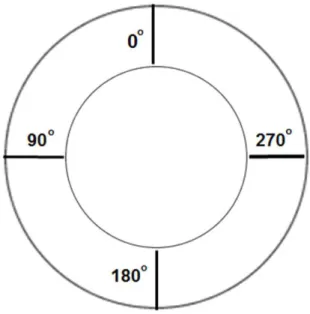
The thickness of the aorta wallin four ields, located at 0°,
90°, 180°, 270°, was measured in ive non consecutive sections
stained with haematoxylin and eosin (Figure 1).
Figure 1. Schematic representation of a cross section of the aorta showing the locations where measurements of the wall thickness were taken.
The numerical density of smooth muscle cell nuclei per area (QA[nuc]) was obtained by counting the number of the myocyte nuclei in a two dimensional 1225 µm2 frame in ive non consecutive histological sections per animal. The number of elastic lamellae of the aorta wall was counted in sections stained with Verhöff. The lamellae surface area per volume (Sv[lam])
was quantiied according to the stereological method described by Horta, Carvalho, and Mandarim-de-Lacerda (2005). A test
system with 16 cycloids arcs was put upon the monitor screen and calibrated (Zeiss micrometer 1mm/100). The minor axes of
the cycloids were arranged parallel with the deined vertical axis.
The number of elastic lamellae intersections with the cycloid arcs (IL) was counted, allowing to estimate the lamellae surface area per volume (Sv[lam]) according to the formula (Sv[lam]) =2· IL.
The collagen content was determined in four ields of 5 his -tological non serial sections of 5 µm stained with the Picrosirius technique and examined under polarised light. When studied
with this method, tissues containing collagen ibres show in
-tensely birefringent thick and thin ibres (Junqueira, Bignolas,
& Brentani, 1979). To determine the collagen content range in the three groups, histological sections were entered into a
KS-400 digital analysing computer program (Zeiss, Germany), which quantiied the area percentage (of 12,000 µm2) of the
collagen ibres. The sections were analysed using a microscope
equipped with appropriate polarisation lenses. In each section,
4 randomised ields were selected, and the area percentage of collagen ibres was quantiied in each ield.
The maximum and minimum diameters of collagen ibrils
were determined in ten electron micrographs of each aorta at a
inal magniication of x130, 000 obtained from regions where the ibrils were transversely sectioned. The diameters of each ibril
were measured using the image analyser program. By
commenc-ing at one corner of each ield and radiatcommenc-ing outward in an arc, the diameters of the ibrils present in the ield were determined. A total of 1 500 ibrils were measured in the three groups.
Statistical analysis
Computer program InStat was used for data analysis. Descriptive statistics were given as mean ± standard error mean (SEM). All data were not normally distributed. The aortic parameters of three groups of rats were compared using
the ANOVA and Tukey’s test. When not speciied, p < .05 was
considered signiicant.
Results
No signiicant difference was observed between groups for
body weight during the period of experiment (Table 1)
One repetition maximum
Figure 1 shows an increase in the absolute values for weight lifted by the trained group obtained during the repetition
maximum test. The OC and the OT rats had similar values for
repetition maximum at the beginning of the experiment (day
0). After 8 weeks, the load lifted by the OT group was higher than that of the OC group and 55% higher than that lifted in the irst repetition test. At the end of 16 weeks, OT rats lifted 1250 ± 45 g which represents 3.1 fold the body weight for 16 weeks.
Effects of training on cardiac growth
Results from cardiac growth in MA, OC and OT groups of
rats are showed in Table 1. The LVW, LV wall thickness and
LV internal diameter of the OT group were signiicantly higher than that of the MA and OC groups. These results may indicate the development of concentric hypertrophy by hearts from OT
group of rats.
Table 1. Body weight, LV weight, LV wall thickness and LV internal
diameter of MA, OC and OT groups of rats.
Parameter/Groups MA OC OT
BW (g) 399 ± 43 434 ± 20 388 ± 14
LVW (g) 0.81 ± 0.02 0.84 ± 0.01 0.93 ± 0.03*
LV wall thickness (mm)
1.42 ± 0.04 1.51 ± 0.03 1.83 ± 0.06*
LV internal diameter
0.74 ± 0.06 0.75 ± 0.06 0.68 ± 0.04*
Results are presented as mean ± SEM. *p < .05, OT vs. OC and vs. MA.
Aorta morphometry
Resistance training attenuated the effects of aging in all parameters studied. The aortic wall thickness was larger in
OC group than in MA and OT groups and it was larger in OT
group than in MA group (in both cases, p < .05) (Figure 3).
N[lam]and SV[lam] was greater in OC group than in MA and
OT groups (p < .05), and it was greater in OT group than in MA group (p < .05) (Table 2 and Figure 4). MA group showed more than 38 % greater QA[nuc] than OC group and more than 9 % greater than OT group (Table 2, Figure 5). The amount
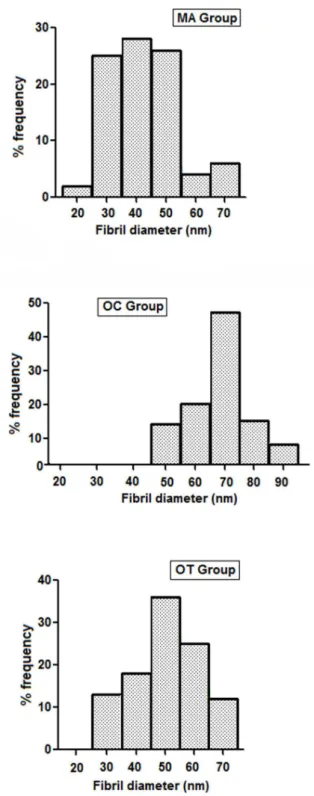
of collagen was higher in the OC group compared with the MA group but it was lower in the OT group compared with the OC group (Figure 6). In the MA group aortas, collagen ibres were composed by ibrils of small, medium and large
diameter predominating that of small diameter (Figure 7A).
In the OC group the collagen ibres were composed mainly by ibrils of large diameter (Figure 7B). In the OT group aortas, the collagen ibres were formed by small, medium
and large diameter, predominating that of medium diameter
(Figure 7C). Histograms showing collagen ibril diameter distribution in MA, OC and OT aortas are presented in Figure
8. It was observed a clear deviation of the values to the right
in the OC group.
Figure 3. Photomicrographs of aortic wall sections from MA (A), OC (B) and OT (C) groups of rats stained with haematoxylin and eosin and taken with the same magniication. he OC group of rats (B) presented the highest aorta thickness, followed by the OT group (C).
Table 2. Aortic structure of the MA, OC and OT groups of rats during the 4 month training period.
Parameter/
Groups MA OC OT
Thickness
(µm) 121.31 ± 1.25 204.94 ± 2.65* 167.08 ± 2.05** N[lam] 11.71 ± 0.24 14.06 ± 0.24* 12.20 ± 0.23** Sv[lam] 36.44 ± 0.77 40.4 ± 0.77* 38.32 ± 0.78**
QA[nu] 3260 ± 73 1993 ± 139* 2943 ± 95**
*Signiicant vs. MA and OT (p < .05) ; **Signiicant vs. MA (p < .05. N[lam]:
number of elastic lamellae per ield; SV[lam]: Surface density of lamellae.
QA[nu]: Numerical density of nuclei per area; Values are means±SEM.
Figure 4. Photomicrographs of the ascending aorta cross-sections showing elastic lamellae (Verhöf stain). he number and thickness of elastic lamellae (arrows) in OC group (B) was greater than in MA (A) and OT (C) groups. he endothelium is on the right side.
Figure 5. Photomicrographs of the aortic wall sections stained with hematoxilyn-eosin. he numbers of cell nuclei (arrows) in OC (B) and OT (C) groups are greater than in MA group (A).
Figure 6. Cross-sections of rat aorta stained in Picrosirius and photo-graphed with crossed polarizing ilters. he amount of collagen (ar-rows) is higher in the OC group (B) compared with the MA group (A) and it is lower in the OT group (C) compared with the OC group (B).
Figure 8. Histograms showing collagen ibril diameter distribution in the aorta of the MA, OC and OT groups.Observe deviation of the values to the right in the OC group.
Discussion
There are two major indings in the present study. First, the
changes associated with aging include a decrease in the number of nuclei of smooth muscle cells, the increasing in tunica media
thickness, increase in the number and density of elastic lamellae
and increase in collagen content and diameter of collagen ibrils.
These alterations characterize the aorta stiffness which is a ma-jor contributor to cardiovascular disease. Second, the model of resistance training used in this experiment has been proved to
be successful in producing an exercise response (Hornberger & Farrar, 2004; Lee, Barton, Sweeney & Farrar, ,2004) in heart
and aorta of aging rats.
In the present study, age-related changes were characterized as degenerative changes in the smooth muscle cells of the tunica media. The decreasing cellularity of the media with aging could be attributed in part to the increasing cell degeneration and
necrosis identiied with age (Gaballa et al., 1998; Niederhoffer et al., 2000). Degenerative changes involving both nucleus and
cytoplasm of the cells were identiied. The cytoplasm changes
involved accumulation of lipids with foam-cell appearances developing at times. In addition, various granular and vesicu-lar forms of cytoplasm degeneration occurred and resulted in similar debris being liberated into the extracellular space where it remained without producing any detectable reaction (Cliff, 1970). As aging occurs, smooth muscle cells progressively migrate from the tunica media and accumulate into the tunica intima. Aging also associates with changes of smooth muscle cells proliferative and apoptotic behavior and response to growth
factors, such as transforming growth factor-β1 (Yildiz, 2007).
The present work demonstrated the increasing in tunica media thickness with aging. The exaggerated deposition of collagen, elastin, and proteoglycans could explain the thickening observed in arterial wall from aged sedentary animals (Virmani et al., 1991). Furthermore, numerous substances involved in
inlammatory and/or atherosclerotic processes such as adhesion
molecules, matrix metalloproteinases, transforming growth
factor-β, and others, such as pro inlammatory cytokines, are
also abundant in aging arterial intimae (Challat et al., 1997; Li, Frölich, Galis, & Lakatta, 1999).
In the present study, the number and density of elastic
lamel-lae increased signiicantly with aging. Despite of the increase in the number and thickness of the elastic ibers with aging, there
is a reduction in their elasticity since there is a diminution of the
elastic material (elastin) due to calciication and fragmentation of the elastic ibers with aging (Lakatta, 2003).
The present study demonstrated that the percent aortic col-lagen increased with age. These results imply reduced colcol-lagen turnover with aging, with degradation rates falling faster than simultaneously declining synthesis rates (Bishop & Laurent,
1995; Laurent, 1987). This is consistent with the inding of im -pairment of distensibility, the fundamental age-related change in
aortic function (Van der Heijden, Fagard, Hoeks Boudier, & Van
collagen. The factor responsible for collagen increase is unknown. The loss of muscle cells could be one cause and another cause could be an inhibition of collagen degradation (Eghbali, 1990).
The present study showed that the changes of aortic wall structure observed with aging were attenuated in rats subject-ed to resistance training for 16 week comparsubject-ed to ssubject-edentary controls, indicating that resistance training had an effect in the changes of aortic wall observed with aging.
The LVW, LV wall thickness but not LV internal diameter of
the OT group was signiicantly higher than that of the MA and OC groups. These results indicate the development of concentric hypertrophy by hearts from OT group (Pluim, Zwinderman,
Van der Laarse, & Van der Wall, 2000) providing a consistent evidence of an increase of myocardial aging tissue associated with resistance training. The results also suggest a continuous response of cardiac tissue to training, beyond the adult life. The improvement in cardiac structure was associated with a reduc-tion in aortic resistance promoted by training. The increasing rigidity and changes in the mechanical properties of the aorta wall which is related to the elastic/collagen changes (Lévy, 1992; Quiu et al., 2007) was attenuated by resistance training.
In the present study animals receiving resistance training
exhibited a signiicant reduction in aortic wall thickening,
in the number of elastic lamellae, lamellae surface area per volume, the collagen content and in the diameter of collagen
ibrils compared with the matched sedentary. This suggests
that exercise training was eficient in preventing adverse aortic
wall remodeling (Tanaka, Dinenno & Monahan, 2000; Thomas,
Schlatemann, Facc, & Becker, 1977; Toda, Tsuda, Nishimori,
& Kummerow, 1980).
The present study demonstrated that animals receiving
resis-tance training showed a signiicant enhancement in the number of
smooth muscle cells compared with sedentary controls. The 38% reduction in the number of smooth muscle cells that was detected
in OC rats was not observed in the OT animals indicating that
training could prevent the effect of aging in smooth muscle cells. The effects of resistance training on expression of message for collagens seem to be of preserving the decline in expression
of mRNAs for collagen seen with aging (Thomas, Zimmerman, Hansen, Martin, & McCormick, 2000). Whether the alterations
in hemodynamic load on the aorta provided the stimulus for the
observed decline in collagen mRNA in trained compared with
sedentary rats in the older age group is a question requiring further investigation. The issue of collagen degradation process and its regulation during resistance training is not known. It is possible that it is related to the increase of systolic blood pressure during resistance training. Then, the increase of aortic collagen may represent a response to increased loading conditions imposed by resistance training in the aortic wall. Alternatively, it is possible
that TGF-ᵝ1 increases with pressure overload, which could ex -plain the increase of collagen transcription in the trained aorta.
Conclusion
Resistance-trained displayed improved aortic structure in rats, decreasing the adverse age-related remodeling in the aorta.
The aortic adaptation to resistance training was associated with reduction of smooth muscle cell loss, and collagen and elastic increasing in the aortic wall.
References
Baddeley, A.J., & Cruz-Orive, J. (1986). Estimation of surface area
from vertical sections. Journal of Microscopy, 142, 259-276. Belz, G.G. (1995). Elastic properties and Windkessel function in the
human aorta. Cardiovascular Drugs Therapy, 9,73-83.
Besse, S., Assayag, P., Delcayre, C., Carre, F., Cheav, S.L., Lecarpentier,
Y., & Swynghedawn, B. (1993). Normal and hypertrophied senes -cent rat heart: mechanical and molecular characteristics. American Journal of Physiology, 265, H183-190.
Bishop, J.E., & Laurent, G.J. (1995). Collagen turnover and its reg-ulation in the normal and hypertrophying heart. European Heart Journal, 16, 38-44.
Bruel, A., Oxlund, H., Nyengaard, J.R. (2005). The total length of
myocytes and capillaries, and total number of myocyte nuclei in the rat heart are time-dependently increased by growth hormone. Growth Hormone and IGF Research, 15, 256-264.
Carson, F.L., Martin, J.H., & Lynn, J.A. (1973) Formalin ixation for
electron microscopy: a re-evaluation. American Journal of Clinical Pathology, 59, 365-373.
Challah, M., Nadaud, S., Philipe, M., Battle, T., Soubrier, F., Corman,
B., & Michel, J.B. (1997). Circutating and cellular markers of endothelial dysfunction with aging rats. American Journal of Physiology: Heart and Circulatory Physiology, 273, H1941-H1948. Clif, W.J. (1970). The aortic tunica media in aging rats. Experimental
Molecular Pathology, 13, 172-189.
Dobrin, P.B. (1978). Mechanical properties of arteries. Physiologycal Reviews, 58, 397-421.
Eghbali, M. (1990). Collagen gene expression and molecular basis of
ibrosis in the myocardium. Heart Failure, 6, 125-128.
Ferrari, A.U., Radaelli, A., & Centola, M. (2003) Invited review: aging and the cardiovascular system. Journal of Applied Physiology, 95, 2591-2597.
Gaballa, M.A., Jacob, C.T., Raya, T.E., Liu, J., Simon, B. & Goldman, S. (1998). Large Artery Remodeling During Aging .Biaxial Passive and Active Stiffness. Hypertension, 32, 437- 443.
Heyward, V.H. (1998). Designing resistance-training programs. In: Vivian H. Heyward. Advanced itness assessment and exercise prescription (3rd edition) (pp.121-144). Champaing: Illinois, Human Kinetics. Hornberger, T.A. Jr., & Farrar, R.P. (2004). Physiological hypertrophy
of the FHL muscle following 8 weeks of progressive resistance ex -ercise in the rat. Canadian Journal of Applied Physiology, 29,16-31.
Horta, P.P., Carvalho., J.J., & Mandarim–de-Lacerda, C. (2005)
Exercise training attenuates blood pressure elevation and adverse remodeling in the aorta of spontaneously hypertensive rats. Life Sciences, 77, 3336-3343.
Junqueira, L.C., Bignolas, G., & Brentani, R.R. (1979). Picrosirius
staining plus polarization microscopy, a speciic method for collagen
detection in tissue sections. The Histochemical Journal, 11, 447-455. Kass, D.A., Saeki, A., Tunin, R.S., & Recchia, F.A. (1996) Adverse
inluence of systemic vascular stiffening on cardiac dysfunction and
Kojimahara, M. (1985). Age-induced changes in the aortas of rats. Experimental Pathology, 28, 191-195.
Kokkinos, P.F., Narayan, P., & Papademetriou, V. (2001). Exercise as
hypertension therapy. Cardiology Clinics, 19, 507-516.
Lakatta, E.G. (2003). Arterial and cardiac aging: major shareholders in cardiovascular disease enterprises: part III: cellular and molecular clues to heart and arterial aging. Circulation, 107,490-497. Laurent, G.J. (1987). Dynamic state of collagen: pathways of collagen
degradation in vivo and their possible role in regulation of collagen mass. American Journal Physiology Cell Physiology, 252, C1-C9.
Lee, S., Barton, E.R., Sweeney, H., & Farrar, R.P. (2004). Viral expres -sion of insulin-like growth factor-I enhances muscle hypertrophy in resistance-trained rats. Journal Applied Physiology, 96, 1097-1104. Lévy, B.I. (1992). Aging of the arterial system. La Presse Medicale,
21, 1200-1203.
Li, Z., Frölich, J., Galis., Z.S., & Lakatta., E. (1999) Increaed expression of matrix metalloproteinase-2 in the thickened intima of aged rats. Hypertension, 33,116-123.
Marques, C.M.M., Fernanda, A.M., Nascimento, R.D.,
Mandarim-de-Lacerda, C.A., & Aguila, M.B. (2006). Exercise training attenuates cardiovascular adverse remodeling in adult ovariectomized spon-taneously hypertensive rats. Menopause, 13,87-95.
Matsuda , M., Nosaka T., Sato, M., & Ohshima, N. (1993). Effects of
physical exercise on the elasticity and elastic components of the rat aorta. European Journal Applied Physiology, 66, 122- 126. Mourot, L., Boussuges, A., Campo, P., Maunier,. S, Debusche, X., &
Blanc, P. (2009). Cardiovascular rehabilitation increase arterial compliance in type 2 diabetic patients with coronary artery disease. Diabetes Research and Clinical Practice, 84-138-144.
Naka, K.K., Tweddel, A.C., Pathimos, D., Henderson, A., Goodfellow,
J., & Frenneaux, M.P.(2003). Arterial distensibility: acute changes following dynamic exercise in normal subjects. American Journal of Physiology: Heart and Circulatory, 284, H970-H978. Niederhoffer, N., Kieffer, P., Desplanches,D., Lartaud-Idjouadiene,
I., Sornay, M.H., & Atkinson, J.(2000). Physical Exercise, Aortic
Blood Pressure, and Aortic Wall Elasticity and Composition in Rats. Hypertension, 35,919-924.
Pinheiro, A.R., Cunha, A.R., Aguila, M.B., & Mandarim-de-Lacerda,
C.A. (2007). Beneicial effects of physical exercise on hypertension
and cardiovascular adverse remodeling of diet-induced obese rats. Nutrition, Metabolism & Cardiovascular Diseases, 17, 365-375.
Pluim B.M., Zwinderman, A.H., van der Laarse, A., & van der Wall,
E.E. (2000). The athlete’s heart. A meta-analysis of cardiac struc-ture and function. Circulation, 101, 336-344.
Robert L. (1996). Aging of the vascular wall and atherogenesis: role of the elastin-laminin receptor. Atherosclerosis, 123,169-179.
Tanaka, H., Dinenno, F.A., & Monahan, K.D. (2000). Aging habit -ual exercise and dynamic arterial compliance. Circulation, 102, 1270-1275.
Thomas, M.D., Schlatmann, J.M., & Facc, M.D., & Becker, A.E.
(1977). Histologic changes in the normal aging aorta: Implications
for dissecting aortic aneurysm. The American Journal of Cardiology, 39, 13-20.
Thomas, D.P, Zimmerman, S.D., Hansen, T.R., Martin, D.T., &
McCormick, R.J. (2000). Collagen gene expression in rat left ventricle: interactive effect of age and exercise training. Journal of Applied Physiology, 89, 1462-1468.
Toda, T., Tsuda, N., Nishimori, I., & Kummerow F.A. (1980).
Morphometrical analysis of the aging process in human arteries and aorta. Acta Anatomica (Basel),106, 35-44.
Tsai, J.C., Yang, H.Y., Wang, W.H., Hsieh, M.H., Chen, P.T., Kao, C.C., …Chan, P. (2004). Beneicial effect of regular endurance exercise
training on blood pressure and quality of life in patients with hy-pertension. Clinical and Experimental Hypertension, 26, 255-265.
Van der Heijden-Spek Staessen, J.A., Fagard, R.H., Hoeks., A.P., Boudier, H.A., &Van Bortel, L.M. (2000). Effect of age on brachial
artery wall properties defers from the aorta and is gender dependent: a population study. Hypertension, 35, 637-642.
Virmani, R., Avolio, A.P., Mergner, W.J., Robinovitz, M., Herderick, E.E., Cornhill, J.F., …O’Rourke, M. (1991). Effect of aging on
aortic morphology in populations with high and low prevalence of hypertension and atherosclerosis: comparison between occidental and Chinese communities. American Journal of Pathology, 139, 1119-1129.
Wallace, J.P. (2003) Exercise in hypertension. A clinical review. Sports Medicine, 33, 585-598.
Yildiz, O. (2007). Vascular Smooth Muscle and Endothelial Functions
in Aging. Annals of the New York Academy of Sciences, 1100, 353–360.
Authors’ note
Romeu Rodrigues de Souza is afiliated with the Universidade São Judas Tadeu, São Paulo, Brazil and the Universidade de São Paulo,
São Paulo, Brazil
Sarah Martins dos Santos, Laura Beatriz Mesiano Maifrino, Eliane
Florencio Gama, and Erico Chagas Caperuto are afiliated with the Universidade São Judas Tadeu, São Paulo, Brazil
Diogo Correa Maldonado is afiliated with the Universidade Nove de Julho, São Paulo, Brazil, and with the Department of Morphology
and Genetics, Universidade Federal de São Paulo, São Paulo, Brazil.
Corresponding author
Romeu Rodrigues de Souza
Rua Afonso de Freitas, 451, ap. 122, Paraiso, São Paulo, Brasil
Manuscript received on May 4, 2014 Manuscript accepted on August 25, 2015
,