392
Revisão
ISSN 0102-695X * E-mail: [email protected], Tel. + 55-83-32167364
America with hypoglycemic activity
José M. Barbosa-Filho*, Tereza H.C. Vasconcelos, Adriana A. Alencar, Leônia M. Batista,
Rinalda A.G. Oliveira, Diego N. Guedes, Heloina de S. Falcão, Marcelo D. Moura, Margareth
F.F.M. Diniz, João Modesto-Filho
Laboratório de Tecnologia Farmacêutica “Delby Fernandes de Medeiros”, Universidade Federal da Paraíba,
Caixa Postal 5009, 58051-970, João Pessoa, PB, Brazil
ABSTRACT: There has been marked interest in recent years in the use of plants for the treatment of diabetes. Plants have been found in many countries which have been indicated as having hypoglycemic activity. The present work is an up-to-date review with 178 references of crude plant extracts and chemically defi ned molecules with hypoglycemic activity from South, Central and North America. The review refers to 224 plants with their families, parts used and type of extract, organism tested and activity. It also includes 40 compounds isolated from those plants. Some aspects of recent research with natural products from plants directed to the treatment of diabetes are discussed.
Keywords: Diabetes, hypoglycemic activity, medicinal plants, natural products.
INTRODUCTION
Diabetes is a disease in which the body does not
produce insulin or use it properly. Insulin is a hormone
needed to convert sugar, starch and other food into energy
needed for daily life. The cause of diabetes continues to
be a mystery, althought both genetic and environmental
factors such as obesity and lack of exercise appear to play
a part.
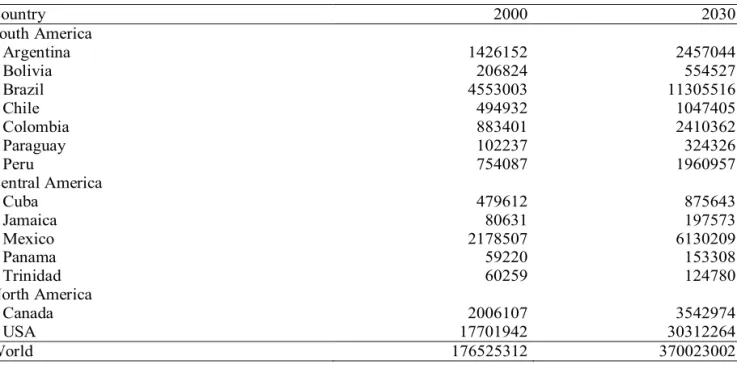
Worldwide 177 million people suffer from
diabetes. This
fi
gure is likely to more than double by
2030 (See Table 1). The greater part of the increase is
likely to occur in developing countries, which can least
afford it.
The annual number of deaths in 2000 caused by
diabetes mellitus in Latin America and the Caribbean has
been estimated as 339035. This represents a loss of 757096
years of productive life among persons younger than 65
years (Barceló et al 2003). Diabetes is the third leading
cause of death in the United States after heart disease
and cancer (Acessed from http://www.medicinenet.com/
Diabetes_Mellitus/article.htm in 01/21/2004).
Plants have always been an important source of
drugs and many of the currently available drugs have been
derived directly or indirectly from them. Ethnobotanical
reports indicate about 1200 plants in the world with
anti-diabetic potential (Alarcon-Aguilara et al 2002c),
of which more than three hundred have been reported
in the literature (Perez et al 1984; Almeida et al 1986;
Bailey et al 1989; Handa et al 1989; Ivorra et al 1989;
Oliveira et al 1989; Rahman et al 1989; Marles et al 1995;
Ernest 1997; Pereira 1997; Perez et al 1998b; Volpato et
al 2002; Grover et al 2002), referring to a large variety of
identi
fi
ed chemical substances (Ivorra et al 1989; Rahman
et al 1989; Marles et al 1995; Perez et al 1998b; Lamba et
al 2000). The discovery of the widely used hypoglycemic
drug, metformin (
N,N
-dimethylguanylguanidine) came
from the traditional approach through the use of
Galega
of
fi
cinalis
(Grover et al 2002).
In a previous paper this research group has
reviewed crude plant extracts and chemically de
fi
ned
molecules with potential antitumor activity for mammary
(Moura et al 2001), cervical (Moura et al, 2002) and
ovarian neoplasias (Silva et al 2003), as inhibitors of HMG
CoA reductase (Gonçalves et al, 2000), central analgesic
activity (Almeida et al, 2001), employed in prevention
of osteoporosis (Pereira et al, 2002), for the treatment of
Parkinson’s disease (Morais, 2004) and antileishmanial
activity (Rocha et al, 2005).
The present work reviews the literature on plants
and plant-derived compounds from South, Central, and
North America with hypoglycemic activity. Those plants
which are used in the indigenous system of medicine have
not been included, except for those whose hypoglycemic
activity has been scienti
fi
cally established.
The search was carred out on Chemical Abstracts,
Biological Abstracts, Web of Sciences, LILACS (Latin
American and Caribbean literature in Health Sciences)
and the data bank of The University of Illinois in Chicago
– NAPRALERT (Acronym for Natural Products ALERT),
updated to December 2003, using hypoglycemic activity
plus anti-diabetic as search terms. The references found
in the search were consulted.
to the elaboration of a list of natural products, evaluated
speci
fi
cally for hypoglycemic effect, of several plants and
plant-derived compounds, used as anti-diabetic remedies
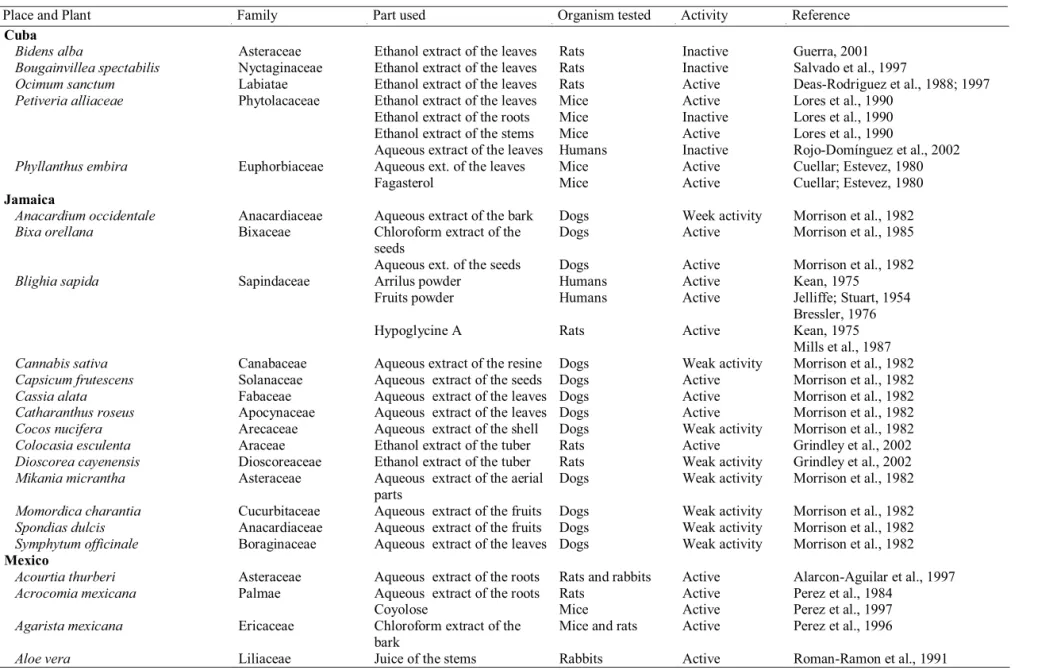
from South, Central and North America (Tables 2-4). It
should be noted that most of the references cited are not
fi
rst hand observations, but compilations copied from
other sources. The original references should be consulted
for details on the models or mechanism based bioassays
used for testing plant extracts and pure compounds for
hypoglycemic activity.
Plants and plant-derived compounds with
hypoglicemic activity
In the Americas many plants are used popularly
to control diabetes mellitus. This has caused an increase
in the number of experimental and clinical investigations
directed toward the validation of the anti-diabetic
properties, which have been empirically attributed to
these remedies.
In Brazil, around 200 plants are used empirically
to control diabetes mellitus. Of these,
fi
fty two have
been experimentally studied and hypoglycaemic activity
detected in most of them (See Table 2).
Bauhinia
for
fi
cata
known popularly as “pata-de-vaca” (cows
hoof) is the most studied species. Some studies con
fi
rm
the activity and others do not. This controversy may be
related to the model employed in the experiments. More
recently, Pepato et al. (2002) analysed the effects of a leaf
decoction as a driking-water substitute for about 1 month
on streptozotocin-diabetes (STZ-diabetes) in male Wistar
rats. The STZ-diabetic rats treated with the decoction
glucose as compared with the STZ-diabetic control, no
difference being seen between decoctiontreated and
-untreated non-diabetic rats.
In Venezuela, the aqueous extract of
B.
megalandra
has been used for diabetes mellitus. It
was shown to inhibit intestinal glucose absorption in a
concentration-dependent way and additive to phlorizine
(Gonzalez-Mujica et al., 2003). In addition, the Chilean
species
B. candicans
also used for diabetes, presented a
signi
fi
cant decrease of glycaemia in alloxan diabetic rats
(Lemus et al., 1999).
Phyllanthus sellowianus
is a plant used in folk
medicine in Argentina as a hypoglycemic and diuretic
agent. The aqueous and butanolic extract of this plant,
administered at a dose of 200 mg/kg p.o., caused a
signi
fi
cant reduction in blood glucose concentration
after 6 and 9 h in mice, similar to that observed with
glibenclamide (10 mg/kg) which was used as a reference,
while the dichloromethane extract of the same plant was
ineffective (Hnatyszyn et al., 2002).
Aproximately 150 plants are used in traditional
folk medicine in the treatment of diabetes in Mexico
(Alarcon-Aguilar et al., 1998). However, only a small
number of them have been studied scienti
fi
cally. The
plants most extensively studied are “nopal”
Opuntia
streptacantha
, “tronadora”
Tecoma stans,
“Guarumbo”
Cecropia obtusifolia
and “Matarique”
Psacalium
decompositum
, (see Table 3). The aqueous extract of the
latter species signi
fi
cantly reduced blood glucose in a
dose-dependent manner in normal mice after intraperitoneal
administration (
P
< 0.05) (Alarcon-Aguilar et al., 2000).
A menu which includes common culinary herbs
Country 2000
2030
South America
Argentina
Bolivia
Brazil
Chile
Colombia
Paraguay
Peru
1426152
206824
4553003
494932
883401
102237
754087
2457044
554527
11305516
1047405
2410362
324326
1960957
Central America
Cuba
Jamaica
Mexico
Panama
Trinidad
479612
80631
2178507
59220
60259
875643
197573
6130209
153308
124780
North America
Canada
USA
2006107
17701942
3542974
30312264
World 176525312
370023002
394
Rev. Bras. Farmacogn.Braz J. Pharmacogn. 15(4):out/dez. 20051
2
3
4
5
6
7
8
9
10
COOHH
HO
COOH H
HO HO
HO
O
H O
O
H
H O
COOH H
H
OH
O
OMe
OH
O
OMe MeO
HO
OH
O
OH
OH
O HO
OH O
OH HO
HO HO
N
N
O H H
MeOOC
MeO N
N
OAc COOMe H
Me HO
N
N H
H MeOOC
HO
COOH
NH
2and prevention of diabetes mellitus was utilized by
Broadhurst et al. (2000). To evaluate the possible effects
on insulin function, 49 herb, spice, and medicinal plant
extracts were tested in the insulin-dependent utilization
of glucose using the rat epididymal adipocyte assay.
“Cinnamon”
Cinnamomum cassia
was the most bioactive
product followed by witch hazel
Hamamelis virginiana
,
green and black teas
Camellia sinensis
, allspice
Pimenta
of
fi
cinalis
, bay leaves
Laurus nobilis
, nutmeg
Myristica
fragans
, and cloves
Syzigium aromaticum
(see Table 4).
A survey of the literature has shown that a large
variety of compounds obtained from several plants of
South, Central and North America were found to possess
hypoglycemic action. For instance, the triterpenes
oleanolic acid (
1
) and bassic acid (
2
) from
Bouvardia
terni
fl
ora
(Perez et al., 1998) and
Bumelia sartorum
(Naik
et al., 1991) respectively lowered blood sugar in test
animals. Similarly the diterpenes
trans
-dehydrocrotonin
(
3
) from
Croton cajucara
(Farias et al., 1997) and
steviol (
4
) from
Stevia rebaudiana
(Ishii; Bracht, 1985)
exhibited similar activity. Certain
fl
avonoids
eg
.
5,7,3-trihydroxy-3,6-4’-trimethoxy
fl
avone (
5
) from
Brickellia
veronicaefolia
(Perez et al., 2000a) and the glycoside
isoorientin (
6
) from
Cecropia obtusifolia
(Andrade-Cetto et al., 2001) also showed hypoglycaemic effects.
A number of alkaloids isolated from
Vinca rosea
(
Catharanthus rosea
) with antitumor activity (Svoboda
et al., 1964) were submitted for assay for hypoglycemic
effects. The results indicated that catharantine, leurosine
(
7
), lochnerine, tetrahydroalstonine, vindoline and
vindolinine (
8
) produce varying degrees of blood-sugar
reduction. For
Otholobium pubescens
this property was
attributed to a phenolic compound bakuchiol (
9
). The
amino acid hypoglycine A (
10
) isolated from
Blighia
sapida
was particularly effective against diabetes (Kean,
1975; Mills et al., 1987) (Figure 1). The great variety of
chemical classes indicate that a variety of mechanisms of
action are involved in reduction of the glucose level in
blood.
The information recorded in Tables 2-4, has
been assembled by continent (South, Central and
North America), with the name of the country, plant in
alphabetical order, scienti
fi
c name, family, part used,
organism tested, activity and reference. This study has
enumerated 224 plants and 40 compounds for which
hypoglycemic activity has been reported, as a result of
pharmacological studies carried out in various research
centers in Argentina, Brazil, Canada, Chile Colombia,
Cuba, Jamaica, Mexico, Panama, Paraguay, Peru, Puerto
Rico Trinidad and the USA. The ten principal families
in which such activity has been reported are Fabaceae
(25), Asteraceae (25), Myrtaceae (11), Labiatae (10),
Cucurbitaceae (8), Solanaceae (7), Anacardiaceae (6),
Euphorbiaceae (6), Rubiaceae (6), and Liliaceae (5).
CONCLUSION
This literature review adds more data to that
previously published, since there are many plants in South,
Central and North America, which present hypoglycemic
effects.
The number of plants described in the literature
as having hypoglycemic activity is more or less the same
in the three continents. Among the 224 plants studied
73 (33%) are found in South America, 77 (34%) in
Central America and 74 (33%) in North America. The
countries in each continent with the largest contribution
are: Brazil with 52 (23%) of the plants studied, Mexico
with 54 (24%) and the USA with 70 (31%). None of
the plants with hypoglycemic activity was found in all
three continents. The following species stood out for the
number of citations reported in the scienti
fi
c literature
in each continent:
Bauhinia for
fi
cata
with 8 citations
(Brazil),
Opuntia streptacantha
with 5 citations (Mexico)
and,
Avena sativa
(USA) with 3 citations.
Of an estimated 250.000 higher plants, less than
1% have been screened pharmacologycally and very few
in regard to diabetes mellitus. Therefore, it is prudent to
look for options in herbal medicine for diabetes mainly
in developing countries because it is a pathological
condition associated with high morbidity, mortality and
economic impact. None of the plants used in traditional
medicine, should be used until safety studies have been
completed.
ACKNOWLEDGEMENTS
Place and Plant Family Part used Organism tested Activity Reference Argentina
Bauhinia candicans Fabaceae Aqueous extract of the leaves Dogs Active Gallo, 1941
Morus insignis Moraceae Aqueous extract of the leaves Rats Inactive Basnet, 1993
Butanol extract of the leaves Rats Active Basnet, 1993
Phyllanthus sellowianus Euphorbiaceae Aqueous extract of the bark Rats Active Gonalons et al., 1926
Aqueous extract of the stem bark
Rats Active Hnatyszyn et al., 1997
Aqueous and butanol extract of the stem bark
Mice Active Hnatyszyn et al., 2002
Dichloromethane extract of the stem bark
Mice Inactive Hnatyszyn et al., 2002
Smallanthus sonchifolius Asteraceae Aqueous extract of the leaves Rats Active Aybar et al., 2001
Brazil
Allium cepa Liliaceae Bulb powder Humans Active Oliveira; Saiko, 1989
Anacardium occidentale Anacardiaceae Tincture of the bark Humans Active Arduino; Soares 1951;
Oliveira; Saito, 1989
Tincture of the bark Rats Active De Aguiar; Lins, 1958
Annona muricata Annonaceae Part used and type of extract
not stated
Mice Active Neves et al., 2002
Averrhoa carambola Oxalidaceae Ethanol extract of the leaves Rats Inactive Provasi et al., 2001
Aqueous extract of the leaves Rats Inactive Damasceno et al., 2002ª
Baccharis trimera Asteraceae Aqueous extract of the aerial
parts
Humans Active Oliveira; Saito, 1989
Bauhinia forficata Fabaceae Aqueous extract of the leaves Humans Active Juliant, 1931
Oliveira; Saito, 1989
Aqueous extract of the leaves Humans Inactive Russo et al., 1990
Aqueous extract of the leaves Rats Active Pepato et al., 2002
Ethanol extract of the leaves Rats Inactive Almeida; Agra, 1986
Aqueous extract of the leaves Rats Inactive Volpato et al., 1999
Butanol extract of the leaves Rats Inactive Silva et al., 2002
Kaempferol-3,7-O -dirhamnoside
Rats Active Sousa et al., 2002a
America with hypoglycemic activity
Rev
. Bras. Farmacogn.
Braz J. Pharmacogn.
15(4):out/dez. 2005
Bauhinia ungulata Fabaceae Aqueous extract of the leaves Rats Active Vale et al., 2001
Bidens pilosa Asteraceae Aqueous and methanol extract
of the aerial parts
In vitro α-glucosidase
Inactive Carvalho et a., 2002
Bowdichia virgilioides Fabaceae Aqueous extract of the bark Humans Active Oliveira; Saito, 1989
Brosimum acutifolium Moraceae Ethanol extract of the bark Rats Inactive Manrique et al., 2002
Bumelia sartorum Sapotaceae Ethanol extract of the stem
bark
Rats Active Almeida et al., 1985
Bassic acid Rats Active Naik et al., 1990
Caesalpinea ferrea Fabaceae Ethanol extract of the stems Rats Inactive Almeida; Agra, 1986
Aqueous extract of the bark Humans Active Oliveira; Saito, 1989
Canavalia ensiformis Fabaceae Canatoxin Rats Active Ribeiro da Silva et al., 1986
Ribeiro-da-Silva et al., 1990 Ribeiro-da-Silva; Prado, 1993
Protein Mice Active Oliveira et al., 1999
Chrysobalanus icaco Chrysobalanaceae Aqueous extract of the leaves Mice Active Presta; Pereira, 1987
Citrullus vulgaris Cucurbitaceae Pulp of the fruits Humans Active Araújo, 1999
Cissus sicyoides Vitaceae Leaves - Type of extract not
stated
Rats Active Mori, 2001
Aqueous extract of the leaves Rats Active Beltrame et al., 2001
Pepato et al., 2003
Cissus verticillata Vitaceae Aqueous extract of the leaves Rats Active Barbosa et al., 2002
Citrus spp Rutaceae Soluber fiber pectin Rats Active Derivi et al., 1987
Coffea arabica Rubiaceae Seed powder Mice Active Sampaio, 1979
β-Sitosterol Mice Active Sampaio, 1979
Croton cajucara Euphorbiaceae Part used and type of extract
not stated
Rats Active Cardoso et al., 2002
Trans-dehydrocrotonin Rats Active Farias et al., 1997
Cymbopogon citratus Poaceae Aqueous extract of the leaves Rats Inactive Souza et al., 1986
Dalbergia subynosa Fabaceae Part used and type of extract
not stated
Guinea pigs Active Cardoso et al., 2002
Echinodorus macrophyllys Alismataceae Ethanol extract of the leaves Rats Active Camargo et al., 2002
Epidendrum nonsenii Orchidaceae Aqueous extract Rats Active Novaes et al., 2001
Eugenia jambolana Myrtaceae Ethanol extract of the seeds Humans Active Oliveira; Saito, 1989
Aqueous extract of the leaves Rats Inactive Pepato et al., 2001
Aqueous extract of the leaves Rats Inactive Damasceno et al., 2002a
Sapogenin Rats Inactive Damasceno et al., 2002b
Glechoma hederaceae Labiatae Ethanol extract of the leaves Humans Active Oliveira; Saito, 1989
Licania rigida Chrysobalanaceae Aqueous extract of the leaves and stems
Rats Inactive Almeida; Agra, 1986
Mangifera indica Anacardiaceae Aqueous extract of the leaves Rats Inactive Teixeira et al., 1998
Aqueous extract of the leaves Humans Inactive Teixeira et al., 1998
Marrubium vulgare Labiatae Aqueous extract Rats Active Novaes et al., 2001
Myrcia sphaerocarpa Myrtaceae Aqueous extract of the leaves Humans Active Oliveira; Saito, 1989
Myrcia uniflora Myrtaceae Aqueous extract of the leaves Humans Inactive Russo et al., 1990
Aqueous extract of the leaves Rats Active Pepato et al., 1993
Nastutium officinale Cruciferae Aqueous extract of the entire
plant
Humans Active Oliveira; Saito, 1989
Periandra mediterranea Fabaceae Ethanol extract of the roots Humans Active Oliveira; Saito, 1989
Phrygilanthus acutifolius Loranthaceae Aqueous extract of the leaves
and stems
Rats Active Gomez et al., 2000
Phyllanthus niruri Euphorbiaceae Ethanol extract of the aerial
parts
Humans Active Oliveira; Saito, 1989
Polymnia sonchifolia Asteraceae Ethanol extract of the leaves Mice Active Longhi et al., 2003
Punica granatum Punicaceae Ethanol extract of the fruits Mice Active Pereira, 1997
Rheedia gardneriana Cyperaceae Aqueous extract Rats Inactive Novaes et al., 2001
Ricinus communis Euphorbiaceae Aqueous extract of the leaves Humans Active Oliveira; Saito, 1989
Rubus imperialis Rosaceae Aqueous extract Rats Active Novaes et al., 2001
Methanol extract of the roots Rats Active Kanegusuku et al., 2002
Rudgea viburnioides Rubiaceae Ethanol extract of the leaves Rats Inactive Silveira et al., 2001
Salvia officinalis Labiatae Aqueous extract of the leaves Humans Active Oliveira; Saito, 1989
Solanum lycocarpum Solanaceae Starch from the unripe fruits
powder
Mice Inactive Oliveira et al., 2003
Stevia rebaudiana Asteraceae Aqueous extract of the aerial
parts
Human Active Alvares et al., 1981
Oliveira; Saito, 1989
Aqueous extract of the leaves Rats Inactive Von Schmeling, 1977
Steviol and isoesteviol Rats Active Ishii; Bracht, 1985
Syzygium cumini Myrtaceae Aqueous extract of the bark Rats Inactive Miron et al., 2002
Aqueous extract of the leaves Humans Inactive Teixeira et al., 2000
Syzygium jambos Myrtaceae Aqueous extract of the leaves Humans Inactive Teixeira, 1990
Syzygium malaccense Myrtaceae Part used and type of extract
not stated
Mice Active Neves et al., 2002
Talauma ovata Magnoliaceae Ethanol extract of the leaves Rats Inactive Morato, 1989
Vatairea macrocarpa Fabaceae Aqueous extract of the bark Rats Inactive Reis et al., 2002
Vitex megapotamica Verbenaceae Ethanol extract of the leaves Rats Active Sousa et al., 2002b
America with hypoglycemic activity
Rev
. Bras. Farmacogn.
Braz J. Pharmacogn.
15(4):out/dez. 2005
Bauhinia candicans Fabaceae Aqueous extract of the leaves Rats Active Lemus et al., 1999
Galega officinalis Fabaceae Aqueous extract of the leaves Rats Active Lemus et al., 1999
Geranium core-core Geraniaceae Ethanol extract of the whole
plant
Rat Active Rodriguez et al., 1994
Lupinuse hilli Fabaceae Part used and type of extract
not stated
Humans Equivocal Diaz et al., 1990
Morus alba Moraceae Aqueous extract of the leaves Rats Active Lemus et al., 1999
Oxalis rosea Oxalidaceae Ethanol extract of the whole
plant
Rats Inactive Rodriguez et al., 1994
Plantago major Plantaginaceae Ethanol extract of the whole
plant
Rats Inactive Rodriguez et al., 1994
Rubus ulmifolius Rosaceae Aqueous extract of the leaves Rats Active Lemus et al., 1999
Colombia
Curatella americana Anacardiaceae Chloroform extract of the
bark
Rats Active Ospina et al., 1995
Paraguay
Eugenia uniflora Myrtaceae Aqueous extract of the leaves Mice Active Matsumura et al., 2000
Aqueous extract of the leaves Monkeys Inactive Ferro et al., 1988
Hexachlamys edulis Myrtaceae Ethanol extract of the leaves
and stems
Rats Active Rodriguez et al., 1992
Stevia rebaudiana Asteraceae Aqueous extract of the leaves Humans Active Oviedo et al., 1970
Peru
Aloe vera Liliaceae Juice of the leaves Rats Active Valencia et al., 1994
Cyclanthera pedata Cucurbitaceae Aqueous extract of the leaves Rats Active Valencia et al., 1994
Gentianella thyrsoides Gentianaceae Aqueous extract of the roots
and stems
Rats Active Tomas et al., 1999
Dichloromethane extract of
the roots and stems
Rats Active Tomas et al., 1999
Methanol extract of the roots and stems
Rats Equivocal Tomas et al., 1999
Otholobium pubescens Fabaceae Bakuchiol Rats Active Krenisky et al., 1999
Venezuela
Bauhinia megalandra Fabaceae Aqueous extract of the leaves Rats Active Gonzalez-Mujica et al., 2003
Table 3.
Plant and plant-derived compounds with hypoglycemic activity from Central America.
Cuba
Bidens alba Asteraceae Ethanol extract of the leaves Rats Inactive Guerra, 2001
Bougainvillea spectabilis Nyctaginaceae Ethanol extract of the leaves Rats Inactive Salvado et al., 1997
Ocimum sanctum Labiatae Ethanol extract of the leaves Rats Active Deas-Rodriguez et al., 1988; 1997
Petiveria alliaceae Phytolacaceae Ethanol extract of the leaves Mice Active Lores et al., 1990
Ethanol extract of the roots Mice Inactive Lores et al., 1990
Ethanol extract of the stems Mice Active Lores et al., 1990
Aqueous extract of the leaves Humans Inactive Rojo-Domínguez et al., 2002
Phyllanthus embira Euphorbiaceae Aqueous ext. of the leaves Mice Active Cuellar; Estevez, 1980
Fagasterol Mice Active Cuellar; Estevez, 1980
Jamaica
Anacardium occidentale Anacardiaceae Aqueous extract of the bark Dogs Week activity Morrison et al., 1982
Bixa orellana Bixaceae Chloroform extract of the
seeds
Dogs Active Morrison et al., 1985
Aqueous ext. of the seeds Dogs Active Morrison et al., 1982
Blighia sapida Sapindaceae Arrilus powder Humans Active Kean, 1975
Fruits powder Humans Active Jelliffe; Stuart, 1954
Bressler, 1976
Hypoglycine A Rats Active Kean, 1975
Mills et al., 1987
Cannabis sativa Canabaceae Aqueous extract of the resine Dogs Weak activity Morrison et al., 1982
Capsicum frutescens Solanaceae Aqueous extract of the seeds Dogs Active Morrison et al., 1982
Cassia alata Fabaceae Aqueous extract of the leaves Dogs Active Morrison et al., 1982
Catharanthus roseus Apocynaceae Aqueous extract of the leaves Dogs Active Morrison et al., 1982
Cocos nucifera Arecaceae Aqueous extract of the shell Dogs Weak activity Morrison et al., 1982
Colocasia esculenta Araceae Ethanol extract of the tuber Rats Active Grindley et al., 2002
Dioscorea cayenensis Dioscoreaceae Ethanol extract of the tuber Rats Weak activity Grindley et al., 2002
Mikania micrantha Asteraceae Aqueous extract of the aerial
parts
Dogs Weak activity Morrison et al., 1982
Momordica charantia Cucurbitaceae Aqueous extract of the fruits Dogs Weak activity Morrison et al., 1982
Spondias dulcis Anacardiaceae Aqueous extract of the fruits Dogs Weak activity Morrison et al., 1982
Symphytum officinale Boraginaceae Aqueous extract of the leaves Dogs Weak activity Morrison et al., 1982
Mexico
Acourtia thurberi Asteraceae Aqueous extract of the roots Rats and rabbits Active Alarcon-Aguilar et al., 1997
Acrocomia mexicana Palmae Aqueous extract of the roots Rats Active Perez et al., 1984
Coyolose Mice Active Perez et al., 1997
Agarista mexicana Ericaceae Chloroform extract of the
bark
Mice and rats Active Perez et al., 1996
Aloe vera Liliaceae Juice of the stems Rabbits Active Roman-Ramon et al., 1991
America with hypoglycemic activity
Rev
. Bras. Farmacogn.
Braz J. Pharmacogn.
15(4):out/dez. 2005
Arachis hypogaea Fabaceae Seeds powder Humans Inactive Frati-Munari et al., 1991
Argemone mexicana Papaveraceae Aqueous extract of the flowers Dogs Inactive Meckes-Lozoya et al., 1986
Bidens leucantha Asteraceae Aqueous extractof entire plant Mice Active Perez et al., 1984
Bidens pilosa Asteraceae Aqueous extract of entire plant Mice Active Perez et al., 1984
Bouvardia terniflora Rubiaceae Chloroform extract of the stems Mice Active Perez et al., 1998a
Oleanolic acid Mice Active Perez et al., 1998a
Ursolic acid Mice Active Perez et al., 1998a
Brickellia veronicaefolia Asteraceae
5,7,3´-trihydroxy-3,6,4´-trimethoxyflavone
Mice Active Perez et al., 2000a
Cacalia decomposita Asteraceae Aqueous extract of the roots Mice Active Perez et al., 1984
Calamintha macrostema Labiatae Aqueous extract of the roots Mice Active Perez et al., 1984
Capraria biflora Srophulariaceae Aqueous extract of the leaves Mice Active Perez et al., 1984
Cecropia obtusifolia Cecropiaceae Aqueous extract of the leaves Mice Active Mellado et al., 1984
Aqueous extract of the leaves Rabbits Weak actitity Roman-Ramos et al., 1991
Aqueous extract of the leaves Mice Active Perez et al., 1984
Aqueous and butanol extract of the leaves
Rats Active Andrade-Cet; Wiedenfel, 2001
Chlorogenic acid Rats Active Andrade-Cet; Wiedenfel, 2001
Isoorientin Rats Active Andrade-Cet; Wiedenfel, 2001
Cirsium pascuarense Asteraceae Hexane extract of the leaves Mice Active Perez et al., 2001
Chloroform and methanol
extract of the leaves
Mice Inactive Perez et al., 2001
Coutarea latiflora Rubiaceae Part used and type of extract
not stated
Rabbits Inactive Guerra, 1947
Aqueous ext. of the leaves Mice Active Perez et al., 1984
Cucurbita ficifolia Cucurbitaceae Juice of the fruits Rabbits Active Roman-Ramos et al., 1991
Juice of the fruits Mice Active Alarcon-Aguilar et al., 2002a
Juice of the fruits Humans Active Acosta-Patino et al., 2001
Equisetum myriochaetum Equisetaceae Aqueous extract of the aerial
parts
Humans Active Revilla et al., 2002
Aqueous and butanol extract of the aerial parts
Rats Active Andrade-Cetto et al., 2000
Kaempferol-3-O-sophoroside-4’-O-β-D-glucoside
Rats Active Andrade-Cetto et al., 2000
Eriobotrya japonica Rosaceae Aqueous extract of the leaves Rabbits Weak activity Roman-Ramos et al., 1991
Eucalyptus globulus Myrtaceae Aqueous extract of the leaves Mice Active Perez et al., 1984
Euphorbia prostata Euphorbiaceae Aqueous extract of the entire
plant
Eysenhardtia polystachya Lotoidaceae Aqueous extract of the entire plant
Mice Activa Perez et al., 1984
Gnaphalium semiamplexicaule Asteraceae Aqueous extract of the flowers Dogs Weak activity Meckes-Lozoya et al., 1986
Guazuma ulmifolia Sterculiaceae Aqueous extract of the leaves Rabbits Active Alarcon-Aguilar et al., 1998
Ibervillea sonorae Cucurbitaceae Aqueous extract of the roots Mice and rats Active Alarcon-Aguilar et al., 2002b
Lepechinia caulescens Lamiaceae Aqueous and methanol extract
of the aerial parts
Mice Active Roman-Ramos et al., 1991
Hexane, methylene chloride,
methanol and aqueous ext of the flowers
Mice Inactive Roman-Ramos et al., 2001
Aqueous ext of the leaves Rabbits Active Alarcon-Aguilar et al., 1998
Loeselia mexicana Polemoniaceae Aqueous extract of the entire
plant
Mice Active Perez et al., 1984
Musa sapientum Musaceae Aqueous ext of the leaves Rabbits Active Alarcon-Aguilara et al., 1998
Opuntia ficus-indica Cactaceae Leaves powder Humans Active Frati-Munari et al., 1991
Opuntia sp Cactaceae Stem powder Humans Inactive Frati-Munari et al., 1987
Opuntia streptacantha Cactaceae Aqueous extract of the aerial
parts
Humans Active Frati-Munari et al., 1989
Stem powder Humans Inactive Frati-Munari et al., 1990
Juice of the stems Rabbits Active Roman-Ramos et al., 1991
Sap powder of the stems Dogs Active Ibanez-Camacho et al., 1983
Leaves powder Rats Active Ibanez-Camacho et al., 1979
Oryza sativa Poaceae Seed powder Humans Inactive Frati-Munari et al., 1991
Parmantiera edulis Bignoniaceae Aqueous ext. of the roots Mice Inactive Perez et al., 1984
Lactucin-8-O-methylacrylate Rats Active Perez et al., 2000b
Phaseolus vulgaris Fabaceae Aqueous extract of the pods Rabbits Weak activity Roman-Ramos et al., 1991
Plantago psyllium Plantaginaceae Mucilage Humans Active Frati-Munari et al., 1985
Psacalium decompositum Asteraceae Chromatographic fraction of
the roots
Mice Active Alarcon-Aguilar et al., 2000
Aqueous extract of the roots Rats and rabbits Active Alarcon-Aguilar et al., 1997
Aqueous extract of the roots Mice Active Alarcon-Aguilar et al., 2000
Hexane extract of the roots Mice Inactive Alarcon-Aguilar et al., 2000
Cacalol, cacalone and maturin Mice Inactive Alarcon-Aguilar et al., 2000
Psacalium peltatum Asteraceae Aqueous ext. of the roots Rats and rabbits Active Alarcon-Aguilar et al., 1997
Aqueous ext. of the roots Rabbits Active Roman-Ramos et al., 1991
Psittacanthus calyculatus Loranthaceae Aqueous extract of the flowers Mice Active Perez et al., 1984
Rhizophora mangle Rizophoraceae Aqueous extract of the leaves Rabbits Active Alarcon-Aguilar et al., 1998
America with hypoglycemic activity
Rev
. Bras. Farmacogn.
Braz J. Pharmacogn.
15(4):out/dez. 2005
Salpianthus macrodontus Nyctaginaceae Leaves and stems - Type of
extract not stated
Rabbits Weak activity Roman-Ramos et al., 1991
Sambucus mexicana Caprifoliaceae Aqueous extract of the flowers Dogs Inactive Meckes-Lozoya et al., 1986
Solanum tuberosum Solanaceae Tuber powder Humans Inactive Frati-Munari et al., 1991
Solanumm verbascifolium Solanaceae Aqueous extract of the leaves
and stems
Rabbits Active Roman-Ramos et al., 1991
Tecoma stans Bignoniaceae Aqueous extract of the leaves
and stems
Rabbits Weak activity Roman-Ramos et al., 1991
Aqueous extract of the leaves Rats Active Aguilar et al., 1993
Part used and type of extract not stated
Rabbits Inactive Guerra, 1946
Aqueous extract of the entire plant
Mice Active Perez et al., 1984
Teucrium cubense Lamiaceae Aqueous extract of the leaves
and stems
Rabbits Weak activity Roman-Ramos et al., 1991
Tournefortia hirsutissima Boraginaceae Aqueous extract of the leaves Rabbits Active Alarcon-Aguilar et al., 1998
Trigonella foenum-graceum Fabaceae Aqueous extract of the leaves Rabbits Active Alarcon-Aguilar et al., 1998
Turnera diffusa Turneraceae Aqueous extract of the leaves Mice Active Perez et al., 1984
Aqueous extract of the leaves Rabbits Active Alarcon-Aguilar et al., 1998
Valeriana officinalis Valerianaceae Aqueous extract of the roots Mice Active Perez et al., 1984
Valeriana edulis ssp. procera Valerianaceae Aqueous extract of the roots Mice Active Perez et al., 1984
Verbesina crocata Asteraceae Aqueous extract of the flowers Mice Active Perez et al., 1984
Verbesina persicifolia Asteraceae Aqueous extract of the leaves Mice Active Perez et al., 1984
Chloroform extract of the bark Mice and rats Active Perez et al., 1996
Zea mays Poaceae Seed powder Humans Inactive Frati-Munari et al., 1991
Panama
Cajanus cajan Fabaceae Aqueous extract of the leaves Rats Active Avellar et al., 1991
Cassia fistula Fabaceae Aqueous extract of the leaves Rats Active Avellar et al., 1991
Neurolaena lobata Asteraceae Ethanol extract of the leaves Mice Active Gupta et al., 1984
Momordica charantia Cucurbitaceae Aqueous extract of the vine Rabbits Active Rivera, 1942
Alkaloid fraction Rabbits Inactive Rivera, 1942
Trinidad
Momordica charantia Cucurbitaceae Aqueous extract of the leaves,
flowers and stems
Place and Plant Family Part used Organism tested Activity Reference Canada
Avena sativa Poaceae Gum powder Humans Active Braaten et al., 1991
Fatsia horrida Araliaceae Aqueous extract of the
rootbark
Rabbits Active Large et al., 1938
Panax quinquefolius Araliaceae Saponin fraction of the roots Rats Weak activity Martinez et al., 1984
Aqueous extract of the roots Humans Active Vuksan et al., 2000
Ginsenoside Humans Inactive Sievenpiper et al., 2003
Rhus typhina Anacardiaceae Aqueous extract Rats and dogs Active Fortier, 1949
USA
Abutilon theophrasti Malvaceae Seeds powder in ration Rats Active Dugan et al., 1990a
Allium sativum Liliaceae Bulb powder in ration Rats Inactive Chi et al., 1982
Part used and type of extract not stated
In vitro cells Inactive Broadhurst et al., 2000
Aloe vera Liliaceae Leaves powder Rats Inactive Herlihy et al., 1998
Anethum graveolens Umbelliferae Part used and type of extract
not stated
In vitro cells Inactive Broadhurst et al., 2000
Apium graveolens Umbelliferae Part used and type of extract
not stated
In vitro cells Inactive Broadhurst et al., 2000
Arachis hypogaea Fabaceae Part used and type of extract
not stated
In vitro cells Week activity Broadhurst et al., 2000
Astragalus membranaceus Fabaceae Part used and type of extract
not stated
In vitro cells Week activity Broadhurst et al., 2000
Atriplex halimus Chenopodiaceae Part used and type of extract
not stated
In vitro cells Inactive Broadhurst et al., 2000
Avena sativa Poaceae Brun powder Pigs Active Knudsen et al., 1995
Brun powder Humans Active Hopewell et al., 1993
Part used and type of extract not stated
In vitro cells Weak activity Broadhurst et al., 2000
Brassica nigra Cruciferae Part used and type of extract
not stated
In vitro cells Inactive Broadhurst et al., 2000
Brassica oleraceae Brassicaceae Ethanol extract of the aerial
parts
Rats Active Dubin et al., 1928
Camellia sinensis Theaceae Part used and type of extract
not stated
In vitro cells Active Broadhurst et al., 2000
Cannabis sativa Cannabaceae Leaves - Smoking Humans Inactive Podolsky et al., 1971
Capsicum annum Solanaceae Part used and type of extract
not stated
America with hypoglycemic activity
Rev
. Bras. Farmacogn.
Braz J. Pharmacogn.
15(4):out/dez. 2005
Carica papaya Caricaceae Fruits powder Rabbits Inactive Bischoff et al., 1929
Carya illinoensis Juglandaceae Part used and type of extract
not stated
In vitro cells Inactive Broadhurst et al., 2000
Chimaphila umbellata Pyrolaceae Buthanol extract of the leaves Rats Inactive Williams et al., 1959
Cystine Rats Inactive Williams et al., 1959
Indole-3-acetic acid Rats Inactive Williams et al., 1959
Cinchona sp. Rubiaceae Quinine Humans Inactive Taylor et al., 1988
Cinnamomum cassia Lauraceae Part used and type of extract
not stated
In vitro cells Active Broadhurst et al., 2000
Cinnamomum verum Lauraceae Part used and type of extract
not stated
In vitro cells Active Broadhurst et al., 2000
Coffea arabica Rubiaceae Part used and type of extract
not stated
In vitro cells Inactive Broadhurst et al., 2000
Caffeine Humans Active Kerr et al., 1993
Curcuma longa Zingiberaceae Part used and type of extract
not stated
In vitro cells Week activity Broadhurst et al., 2000
Echinaceae purpurea Asteraceae Part used and type of extract
not stated
In vitro cells Inactive Broadhurst et al., 2000
Elettaria cardamomum Zingiberaceae Part used and type of extract
not stated
In vitro cells Inactive Broadhurst et al., 2000
Eleutherococcus senticosus Araliaceae Part used and type of extract
not stated
In vitro cells Inactive Broadhurst et al., 2000
Eupatorium urticaefolium Asteraceae Fluid extact of the aerial parts Dogs Inactive Cartland et al., 1931
Fatsia horrida Araliaceae Aqueous extract of the bark Humans Active Smith, 1983
Aqueous extract Rats Inactive Williams et al., 1959
Ginkgo biloba Ginkgoaceae Aqueous extract Humans Active Kudolo, 2001
Grifola frondosa Basidiomycete Polysaccharide caplets Humans Active Konno et al., 2002
Glycine max Fabaceae Part used and type of extract
not stated
In vitro cells Week activity Broadhurst et al., 2000
Gossypium herbaceum Malvaceae Pulp powder of the seeds Ewes Active Menaul, 1923
Gymnema sylvestre Asclepiadaceae Part used and type of extract
not stated
In vitro cells Inactive Broadhurst et al., 2000
Hamamelis virginiana Hamamelidaceae Part used and type of extract
not stated
Humulus lupulus Cannabaceae Colupulone Mice Active Mannering et al., 1994
Ipomoea hederaceae Convolvulaceae Seeds powder Rats Active Dugan et al., 1990
Ipomoea lacunosa Convolvulaceae Seeds powder Rats Active Dugan et al., 1990
Laurus nobilis Lauraceae Part used and type of extract
not stated
In vitro cells Active Broadhurst et al 2000
Linum usitatissimum Linaceae Part used and type of extract
not stated
In vitro cells Week activity Broadhurst et al., 2000
Lupinus sp Fabaceae Aqueous extract of the seeds Humans Inactive Tsiodras et al., 1999
Medicago sativa Fabaceae Aqueous extract of the entire
plant
Rats Inactive Williams et al., 1959
Momordica charantia Cucurbitaceae Fraction peptide MC-6 Rats Active Nag, 2000
Fraction peptide MC-6.1 Rats Active Nag, 2000
Fraction peptide MC-6.2 Rats Active Nag, 2000
Fraction peptide MC-6.3 Rats Active Nag, 2000
Morus indica Moraceae Aqueous extract of the leaves Humans Active Andallu et al., 2001
Myristica fragans Myristicaceae Part used and type of extract
not stated
In vitro cells Active Broadhurst et al., 2000
Nepeta cataria Labiatae Part used and type of extract
not stated
In vitro cells Inactive Broadhurst et al., 2000
Ocimum basilicum Labiatae Part used and type of extract
not stated
In vitro cells Active Broadhurst et al., 2000
Ocimum sanctum Labiatae Aqueous extr. of the entire
plant
Organism not stated
Active Luthy; Martinez 1964
Origanum vulgare Labiatae Part used and type of extract
not stated
In vitro cells Active Broadhurst et al., 2000
Panax ginseng Araliaceae Part used and type of extract
not stated
In vitro cells Week activity Broadhurst et al., 2000
Panax quinquefolius Araliaceae Saponin fraction of the roots Rats Weak activity Martinez et al., 1984
Part used and type of extract not stated
In vitro cells Weak activity Broadhurst et al., 2000
Petroselinum crispum Umbelliferae Part used and type of extract
not stated
In vitro cells Inactive Broadhurst et al., 2000
Pimenta officinalis Myrtaceae Part used and type of extract
not stated
In vitro cells Active Broadhurst et al., 2000
Pimpinella anisum Umbelliferae Part used and type of extract
not stated
In vitro cells Inactive Broadhurst et al., 2000
Piper nigrum Piperaceae Part used and type of extract
not stated
America with hypoglycemic activity
Rev
. Bras. Farmacogn.
Braz J. Pharmacogn.
15(4):out/dez. 2005
Plantago ovata Plantaginaceae Seed husks in ration Mice Inactive Watters et al., 1989
Prunus dulcis Rosaceae Part used and type of extract
not stated
In vitro cells Inactive Broadhurst et al., 2000
Rosmarinus officinalis Labiatae Part used and type of extract
not stated
In vitro cells Inactive Broadhurst et al., 2000
Salvia officinalis Labiatae Part used and type of extract
not stated
In vitro cells Week activity Broadhurst et al., 2000
Solanum nigrum Solanaceae Seeds powder Rats Active Dugan et al., 1990a
Stevia rebaudiana Asteraceae Leaves - Type of extract not
stated
Dogs Inactive White jr et al., 1994
Syzigium aromaticum Myrtaceae Part used and type of extract
not stated
In vitro cells Active Broadhurst et al., 2000
Tecoma stans Bignoniaceae Aqueous extract Mice Inactive Nash, 1958
Tillandsia usneoides Bromeliaceae Aqueous extract of the entire
plant
Mice Active Keller et al., 1981
3-Hydroxy-3-methyl-glutaric acid
Mice Active Witherup; McLaughlin, 1995
Succinic acid Mice Inactive Witherup; McLaughlin, 1995
4’,5,7-Trihydroxy-3,3’,5’,6-tetramethoxy-7-O-β -D-glucoside
Mice Inactive Witherup; McLaughlin, 1995
Vaccinium corymbosum Ericaceae Ethanol extract of the leaves Dogs Inactive Allen, 1927
Vaccinium myrtillus Ericaceae Ethanol ext. of the leaves Dogs Inactive Allen, 1927
Vaccinium pennsylvanicum Ericaceae Aqueous extrac of the leaves Dogs Inactive Allen, 1927
Vanilla planifolia Orchidaceae Part used and type of extract
not stated
In vitro cells Week activity Broadhurst et al., 2000
Vinca rosea Apocynaceae Ajmalicine Rats Inactive Svoboda et al., 1964
Catharantine Rats Questionable Svoboda et al., 1964
Leurosine Rats Moderated act. Svoboda et al., 1964
Lochnerine Rats Slight activity Svoboda et al., 1964
Perivine Rats Inactive Svoboda et al., 1964
Sitsirikine Rats Inactive Svoboda et al., 1964
Tetrahydroalstonine Rats Questionable Svoboda et al., 1964
Vincathicine Rats Inactive Svoboda et al., 1964
Vindoline Rats Slight activity Svoboda et al., 1964
Vindolinine Rats Moderated act. Svoboda et al., 1964
Withania somnifera Solanaceae Part used and type of extract
not stated
In vitro cells Inactive Broadhurst et al., 2000
Xanthium strumarium Asteraceae Ethanol extract of the entire
plant
Rabbits Active Turner et al., 1974
408
Rev. Bras. Farmacogn.Braz J. Pharmacogn. 15(4):out/dez. 2005Diaz-Zagoya JC 2001. Hypoglycemic action of Cucurbita fi cifolia on Type 2 diabetic patients with moderately high blood glucose levels. J Ethnopharmacol 77: 99-101.
Aguilar LC, Macias S, Chagoya A, Cardenas A, Diaz P, Cantu JM 1993. Antidiabetic activity of Tecoma stans in rats Fitoterapia 64: 304.
Alarcon-Aguilar FJ, Roman-Ramos R, Jimenez-Estrada M, Reyes-Chilpa B, Gonzalez-Paredes, Flores-Saenz JL 1997. Effects of three Mexican medicinal plants (Asteraceae) on blood glucose levels in healthy mice and rabbits. J Ethnopharmacol 55: 171-77. Alarcon-Aguilar FJ, Roman-Ramos R, Perez-Gutierrez S,
Aguilar-Contreras A, Contreras-Weber CC, Flores-Saenz JL 1998. Study of the anti-hyperglycemic effect of plants used as antidiabetics. J Ethnopharmacol 61: 101-110.
Alarcon-Aguilar FJ, Jimenez-Estrada M, Reyes-Chilpa R, Roman-Ramos R 2000. Hypoglycemic effect of extracts and fractions from Psacalium decompositum in healthy and alloxan-diabetic mice. J Ethnopharmacol 72: 21-27
Alarcon-Aguilar FJ, Hernández-Galicia E, Campos-Sepulveda AE, Xolalpa-Molina S, Rivas-Vilchis JF, Vasquez-Carrillo LI, Roman-Ramos R 2002a. Evaluation of the hypoglycemic effect of Cucurbita fi cifolia Bouche (Curcurbitaceae) in different experimental models. J Ethnopharmacol 82: 185-189.
Alarcon-Aguilar FJ, Campos-Sepulveda AE, Xolalpa-Molina S, Hernández-Galicia E, Roman-Ramos R 2002b. Hypoglycaemic activity of Ibervillea sonorae roots in healthy and diabetic mice and rats. Pharma Biol 40: 570-575.
Alarcon-Aguilar FJ, Roman-Ramos R, Flores-Saenz JL, Aguirre-Garcia F 2002c. Investigation on the hypoglycaemic effects of extracts of four Mexican medicinal plants in normal and alloxan-diabetic mice Phytother Res 16: 383-386.
Allen FM 1927. Blueberry leaf extract physiologic and clinical properties in relation to carbohydrate metabolism. J Am Med Ass 89: 1577-1581.
Almeida RN, Barbosa-Filho JM, Naik SR 1985. Chemistry and pharmacology of an ethanol extract of Bumelia sartorum.J Ethnopharmacol 14: 173-185.
Almeida RN, Agra MF 1986. Levantamento bibliográfi co da fl ora medicinal de uso no tratamento da diabetes e alguns resultados experimentais. Rev Bras Farm 67: 105-110.
Almeida RN, Navarro DS, Barbosa-Filho JM 2001. Plants with central analgesic activity Phytomedicine 8: 310-322.
Alvares M, Bazzone RB, Godoy GL, Cury R, Botion LM 1981. Hypoglycemic effect of Stevia rebaudiana Bertoni I Brazilian Seminar on Stevia rebaudiana 25-26. Andallu B, Suryakantham V, Srikanthi BL,. Reddy GK 2001.
Effect of mulberry (Morus indica L.) therapy on plasma and erythrocyte membrane lipids in patients with type 2 diabetes. Clin Chim Acta 314: 47-53. Andrade-Cetto A, Wiedenfeld H, Revilla MC, Sergio IA 2000.
Hypoglycemic effect of Equisetum myriochaetum
Cecropia obtusifolia on streptozotocin diabetic rats. J Ethnopharmacol 78: 145-149.
Arduino F, Soares MLNG 1951. Hypoglycemic action of Anacardium occidentale (Cashew) in normal individuals Brazil Med 65: 305-308.
Araújo IML 1999. Avaliação do efeito hipoglicemiante da Citrullus vulgaris Schrad (Melancia) em indivíduos diabéticos tipo 2 e normais. João Pessoa, 188p. Dissertação de Mestrado. Universidade Federal da Paraíba.
Avellar ME, Díaz A, Garcia I 1991. Evaluation de la medicina tradicional: efectos de Cajanus cajan L. (Guandu) y de Cassia fi stula L. (Canafi stula) en el metabolismo de los carbohidratos en el ratón. Rev Méd Panamá 16: 39-45.
Aybar MJ, Riera ANS, Grau A, Sanchez SS 2001. Hypoglycemic effect of the water extract of Smallantus sonchifolius (yacon) leaves in normal and diabetic rats. J Ethnopharmacol 74: 125-132.
Bailey CJ, Day C 1989. Traditional plant medicines as treatments for diabetes. Diabetes Care 12: 553-564.
Bailey CJ, Day C, Turner SL, Leatherdale BA 1985. Cerasee, a traditional treatment for diabetes. Studies in normal and streptozotocin duabetic mice. Diabetes Res 2: 81-84.
Barbosa WLR, Santos WRA, Pinto LN, Tavares ICC 2002. Flavonóides de Cissus verticillata e a atividade hipoglicemiante do chá de suas folhas. Rev Bras Farmacogn 12(Supl 1): 13-15.
Barceló A, Aedo C, Rajpathak S, Robles S 2003. The cost of diabetes in Latin America and the Caribbean. Bull WHO 81: 19-27.
Basnet P, Kadota S, Terashima S, Shimizu M, Namba T 1993. Two new 2-arylbenzofuran derivatives from hypoglycemic activity-bearing fractions of Morus insignis. Chem Pharm Bull. 41: 1238-1243. Beltrame FL, Sartoretto JL, Bazotte RB, Cuman RN, Cortez
DAG 2001. Phytochemical study and evaluation of the antidiabetic potential of Cissus sicydides L. (Vitaceae). Quím Nova 24: 783-785.
Bischoff F, Long ML, Sahyun M 1929. Investigations of the hypoglucemic properties of reglykol pancreapatine and papaw. J Pharmacol Exp Ther 36: 311-312. Braaten JT, Wood PJ, Scott FW, Riedel KD, Poste LM, Collins
MW 1991. Oat gum lowers glucose and insulin after an oral glucose load. Amer J Clin Nutr 53: 1425-1430.
Bresciani LFV, Yunes RA, Burger C, De Oliveira LE, Bof KL, Cechinel V 2004. Seasonal variation of kaurenoic acid, a hypoglycemic diterpene present in Wedelia paludosa (Acmela brasiliensis) (Asteraceae). Z. Naturforschung C 59: 229-232.
Bressler R 1976. The unripe akee - forbidden fruit. N Engl J Med 295: 500-501.
Broadhurst CL, Polansky MM, Anderson RA 2000. Insulin-like biological activity of culinary and medicinal plant aqueous extracts in vitro.J Agric Food Chem 48: 849-852.
diabéticas com extrato bruto da planta Echinodorus macrophyllys Micheli (Chapéu-de-couro). XVII Simpósio de Plantas Medicinais do Brasil, Cuiabá, MT, Brazil.
Cardoso FV, Andrade NED, Lima ACSF, Longhi DT, Brigido AO, Marcucci MC,.Scremin A, Paulino NI 2002. Avaliação da atividade dos extratos de plantas utilizadas na medicina popular para o tratamento da diabetes, sobre os canais de potássio modulados por ATP (KATA). XXXIV Congresso Brasileiro de Farmacologia e Terapêutica Experimental, Águas de Lindóia, SP, Brazil, p.215.
Cartland, GF, Heyl FW,.Neupert EF 1931. The hypoglycemic properties of white snakeroot (Eupatorium urticaefolium). J Amer Pharm Ass 20: 448-449. Carvalho ES, Araújo KGL, Rocha L, Lúcio EMRA, Sharapin N,
Kaplan MAC 2002. Efeito dos extratos metanólico e aquoso das partes aéreas de Bidens pilosa L. em alfa-glicosidase. XVII Simpósio de Plantas Medicinais do Brasil, Cuiabá, MT, Brazil, FT.136. Chi MS, Koh ET, Stewart TJ 1982. Effects of garlic on lipid
metabolism in rats fed cholesterol or lard. J Nutr 112: 241-248.
Cuellar A, Estévez P 1980. A phytochemical study of Cuban plants. Rev Cubana Farm 14: 63-68.
Damasceno DC, Volpato GT, Calderon I.MP, Rudge MVC 2002a. Estudos dos extratos de folhas de Averrhoa carambola e Eugenia jambolana, obtidas em farmácia de manipulaçäo, sobre o diabete experimental. Rev Bras Toxicol 15: 9-14.
Damasceno DC, Lima PHO, Galhiane MS, Volpato GT, Rudge MVC 2002b. Avaliação do efeito hipoglicemiante da sapogenina extraida de sementes de Eugenia jambolana Lam. Rev Bras Pl Med 4: 46-54. De Aguiar JC, Lins LJC 1958. Hypoglycemic action of inner
bark (bast) of cashew tree (Anacardium occidentale). I. Action of a decoction on normal rats. Anais Fac Med Univ Recife 18: 193-197.
Deas-Rodriguez M, Menéndez R, Alvarez A, González R (1988) Efecto hipoglicemiante de la albahaca morada / Hypoglycemic effect of Ocymun Sanctum L Rev Cuba Invest Bioméd 7: 53-9
Deas-Rodriguez M, Seuc-Jo A, González-Suárez RM 1997. Estudio del efecto hipoglicemiante del Ocimun sanctum L. (albahaca-morada) con el uso de un ensayo biológico en ratones. Rev Cuba Plantas Med 2: 15-18.
Derivi SCN, Mendez MHM, Rodrigues MCR, Fernandes ML, Silva MF 1987. Ação da fi bra solúvel - pectina sobre os níveis glicêmicos em ratos. Rev Bras Farm 68: 1-7.
Diaz J, Durruty P, Tapia JC, Carrasco E, Riesco V, Durruty G, Garcia-de-los-Rios M 1990. Effect of dietary fi ber in patients with noninsulin dependent diabetes-mellitus. Rev Med Chil 118: 24-32.
Dubin HE, Corbitt HB 1928. Hypoglucemia-producing substance. Patent US 1,653,452.
Dugan GM, Gumbmann MR 1990a. Toxicological evaluation of sicklepod and black nightshade seeds in short-term feeding studies in rats. Food Chem Toxicol28: 101-107.
Dugan GM, Gumbmann MR 1990b. Toxicological evaluation
study. Food Chem Toxicol 28: 553-559.
Dugan GM, Gumbmann MR 1990a. Toxicological and nutritional evaluation of velvetleaf seed: subchronic 90-day feeding study and protein effi ciency ratio assay. Food Chem Toxicol 28: 95-99.
Ernest E 1997. Plants with hypoglycemic activity in humans. Phytomedicine 4: 73-78.
Farias RAF, Rao VSN, Viana GSB, Silveira ER, Maciel MAM, Pinto AC 1997. Hypoglycemic effect of trans -dehydrocrotonin, a nor-clerodane diterpene from Croton cajucara.Planta Med 63: 558-560.
Ferro E, Schinini A, Maldonado M, Rosner J, Schmeda-Hirschmann G 1988. Eugenia unifl ora leaf extract and lipid metabolism in cebus apella monkeys. J Ethnopharmacol 24: 321-325.
Fortier G 1949. Antidiabetic properties of Rhus typhina.Naval Med 14: 477-506.
Frati-Munari AC, Castillo-Insunza MR, Riva-Pinal H, Ariza-Andraca CR, Banales-Ham M 1985. Effect of Plantago psyllium mucilage on the glucose tolerance test. Arch Invest Med (Mex) 16: 191-197.
Frati-Munari AC, Yever-Garces A, Islas-Andrade S, Ariza-Andraca CR, Chavez-Negrete A 1987. Studies on the mechanism of hypoglycemic effect of nopal (Opunita sp.). Arch Invest Med (Mex) 18: 7-12. Frati-Munari, AC, Altamirano BE, Rodriguez-Barcenas
N, Ariza-Andraca R, Lopez-Ledesma R 1989. Hypoglucemic effect of Opuntia streptacantha Lemaire: research with crude extracts. Rev Archiv Invest Med (Mex) 20: 321-322.
Frati-Munari, AC, Gordillo BE, Altamirano P, Ariza CR, Cortes-Franco R, Chavez-Negrete A 1990. Acute hypoglycemic effect of Opuntia streptacantha Lemaire in niddm. Diabetes Care 13: 455-456. Frati-Munari AC, Roca-Vides R, Lopez-Perez RJ, De-Vivero I,
Ruiz-Velazco M 1991. Glycemia index of several foods in Mexico. Gac Med Mex 127: 163-171. Galletto R, Siqueira VLD, Silva GEC, Nascimento KF,
Bazotte RB 2003. XXXV Congresso Brasileiro de Farmacologia e Terapêutica Experimental, Águas de Lindóia, SP, Brazil, p. 203.
Gallo FN 1941. Action of extract of Bauhinia candicans on normal blood sugar and experimental diabetes of dogs. Rev Soc Argent Biol 17: 128.
Gómez R, Cervi FL, Guntzel C, Maslinkiewicz A, Barros HMT 2000. Curva glicêmica e variação de peso pelo extrato de erva de passarinho (Phrygilanthus acutifolius) em ratos. XV Reunião Anual da Federação de Sociedades de Biologia Experimental, Caxambu, MG, Brazil, p. 217.
Gonalons GP, Fontana A 1926. Effect of Phyllanthus sellowianus on blood-sugar concentration. Arch Argent Enferm Apar Digest Nutr 993.
Gonçalves MCR, Moura LSA, Rabelo LA, Barbosa-Filho JM, Cruz HMM, Cruz J 2000. Produtos naturais inibidores da enzima HMG CoA redutase. Rev Bras Farm 81: 63-71.
410
Rev. Bras. Farmacogn.Braz J. Pharmacogn. 15(4):out/dez. 2005esculenta). Nutri Res 22: 333-341.
Grover JK, Yadav S, Vats V 2002.Medicinal plants of India with anti-diabetic potential. J Ethnopharmacol81: 81-100.
Guerra F 1946. The pharmacology of mexican antidiabetic plants. I. Action of Tecoma mollis on normal and diabetic blood sugar levels. Rev Inst Salubridad y Enfermedad Trop (Mex)7: 237-248.
Guerra F 1947. The pharmacology of Mexican antidiabetic plants. II. Action of Coutarea latifl ora on normal and diabetic blood-sugar levels. Rev Inst Salubridad y Enfermedad Trop (Mex) 8: 29-38.
Guerra RLL, Padton MCV, Rivas R, Blanco JCC, Parets MH, Gallardo AIA 2001. Efectos de un extracto hidroalcoholico de Bidens alba en ratas normales y con diabetes aloxanica. Acta Farm Bonaerense 20: 89-93.
Gupta MP, Solis NG, Esposito-Avella M, Sanchez C 1984. Hypoglycemic activity of Neurolaena lobata (l.) R.Br. J Ethnopharmacol 10: 323-327.
Handa SS, Chawla AS 1989. Hypoglycaemic plants – A review. Fitoterapia 60: 195-224.
Herlihy JT, Kim JD, Kalu DN, Nelson JF, Ward WF, Ikeno Y, Yu BP 1998. Effects of Aloe vera ingestion in the rat. II. Hormonal and metabolic characteristics. Phytother Res 12: 355-360.
Hnatysyzn O, Mino J, Gorzalczany S, Ferraro G, Coussio J, Acevedo C 1997. Antidiabetic activity of Phyllanthus sellowianus in streptozotocin-induced diabetic rats. Phytomedicine 4: 251-253.
Hnatyszyn O, Mino J, Ferraro G, Acevedo C 2002. The hypoglycemic effect of Phyllanthus sellowianus fractions in streptozotocin-induced diabetic mice. Phytomedicine 9: 556-559.
Hopewell R, Yeater R, Ullirich I 1993. Soluble fi ber: effect on carbohydrate and lipid metabolism. Progress Food Nutr Sci 17: 159-182.
Ibanez-Camacho R, Meckes-Lozoya M, Mellado-Campos V 1983. The hypoglucemic effect of Opuntia streptacantha studied in different animal experimental models. J Ethnopharmacol 7: 175-181.
Ibanez-Camacho R, Roman-Ramos R 1979. Hypoglycemic effect of Opuntia cactus. Arch Invest Med (Mex) 10: 223-230.
Ishii EL, Bracht A 1985. Açäo do isosteviol e do steviol sobre o metabolismo de carboidratos em fígado de rato perfundido isoladamente. Rev Unimar 7: 97-121 Ivorra MD, Paya M, Villar A 1989. A review of natural products
and plants as potential anti-diabetic drugs. J Ethnopharmacol 27: 243-275.
Jelliffe DB, Stuart KL 1954. Acute toxic hypoglycaemia in the vomiting sickness of Jamaica. Brit Med J 1: 75-77. Juliant C. 1931. The hypoglucemic action of unha de vacca
(Bauhinia fortifi cats). Rev Sud Amer Endocrinol Immunol Quimioter 14: 325-327.
Kanegusuku M, Benassi JC, Pedrosa RC, Yunes RA, Cechinel-Filho V, Maia AA, .Souza MM, Delle-Monache F, Niero R 2002. Cytotoxic, hypoglycemic activity and phytochemical analysis of Rubus imperialis
diabetes mellitus. Q J Crude Drug Res 19: 49-51. Kerr D, Sherwin RS, Pavalkis F, Fayad PB, Sikorski L, Rife F,
Tamborlane WV, During MJ 1993. Effect of caffeine on the recognition of and responses to hypoglycemia in humans. Ann Intern Med 119: 799-804.
Knudsen KEB, Johansen HN 1995. Mode of action of oat bran in the gastrointestinal tract. Eur J Clin Nutr 49: S163-S169.
Kono S, Aynehchi S, Dolin DJ, Schwartz AM, Choudhury MS, Tazaki H 2002. Anticancer and hypoglycemic effects of polysaccharides in edible and medicinal maitake mushroom (Grifola frondosa (Dicks.: Fr.) S. F. Gray). Inter J Med Mushrooms 4: 185-195. Krenisky JM, Luo J, Reed MJ, Carney JR 1999. Isolation
and antihyperglycemic activity of bakuchiol from Otholobium pubescens (Fabaceae), a peruvian medicinal plant used for the treatment of diabetes. Biol Pharm Bull 22: 1137-1140.
Kudolo GB 2001. The effect of 3-month ingestion of Ginkgo biloba extract (EGb 761) on pancreatic beta-cell function in response to glucose loading in individuals with non-insulin-dependent diabetes mellitus. J Clin Pharmacol 41: 600-611.
Lamba SS, Buch KY, Lewis H, Lamba HJ 2000. Phytochemicals as potential hypoglycemic agents. Studies in Natural Products Chemistry, 21: 457-495.
Large RG, Brocklesby HN 1938. A hypoglycemic substance from the roots of the devil’s club (Fatsia horrida). Can Med Ass J 39: 32-35.
Lemus I, Garcia R, Jabsa Z, Erazo S, Garcia H 1986. Hypoglycemic activity of an extract of Bauhinia candicans B. Plant Med Phytother 20: 8-17. Lemus I, Garcia R, Delvillar E, Knop G 1999. Hypoglycaemic
activity of four plants used in Chilean popular medicine. Phytother Res 13: 91-94.
Longhi DT, Ballmann JD, Brigido AO, Marcucci MC, Scremin A, Paulino N 2003. Mechanisms involved in the hypoglicemic effect of ethanolic extract of Polymnia sonchifolia Poepp. & Endl. XXXV Congresso Brasileiro de Farmacologia e Terapêutica Experimental, Águas de Lindóia, SP, Brazil, p. 226.
Lores RI, Pujol MC 1990. Petiveria alliaceae L. (Anamu). Study of the hypoglycemic effect. Med Interne 28: 347-352.
Luthy N, Martinez-Fortun O 1964. A possible oral hypoglycemic factor in abahaca morada (Ocimum sanctum). Ohio J. Sci. 64: 223-224.
Mannering GJ, Shoeman JA, Shoeman DW 1994. Effects of colupulone, a component of hops and brewers-yeast, and chromium on glucose-tolerance and hepatic cytochrome-P450 in nondiabetic and spontaneously diabetic mice. Bioch Biophys Res Comm 200: 1455-1462.