279
Artigo
ISSN 0102-695X Revista Brasileira de Farmacognosia Brazilian Journal of Pharmacognosy 15(4): 279-282, Out./Dez. 2005 Received 09/27/05. Accepted 11/17/05
* E-mail: [email protected], Tel. +44 (0)28 7032 4302
Chenoalbuside: an antioxidant phenolic glycoside from the seeds of
Chenopodium album
L. (Chenopodiaceae)
L. Nahar
1, S. D. Sarker
2*1Department of Chemistry, University of Aberdeen, Aberdeen AB24 3UE, Scotland, UK 2School of Biomedical Sciences, University of Ulster at Coleraine, Cromore Road,
Coleraine BT52 1SA, Co. Londonderry, Northern Ireland, UK
ABSTRACT: In addition to three known phytoecdysteroids, a new phenolic glycoside (named, chenoalbuside) was isolated from the methanol extract of the seeds of Chenopodium album. While the structures of all phytoecdysteroids were elucidated by direct comparison of their spectroscopic data with published data, the structure of chenoalbuside was determined unequivocally by a combination of UV, MS and 1D and 2D NMR spectroscopic analyses. The antioxidant potential of the new compound was assessed by the DPPH assay, and the RC50 value was found to be 1.4 x 10⁻⁴ mg/mL.
Keywords: Chenopodium album, Chenopodiaceae, phytoecdysteroids, phenolic glycoside, chenoalbuside, anti-oxidant, NMR.
INTRODUCTION
Chenopodium album L., commonly known as ‘pigweed’, ‘fat hen’ or ‘lambs-quarters’ belongs to the family Chenopodiaceae. It is a woody annual, widely distributed in Europe, North America and Asia (Bailey, 1977; GRIN Database, 2005). Previous phytochemical studies on this plant furnished the presence of aldehyde (Tahara et al., 1994; Maruta et al., 1995), alkaloids (Horio et al., 1993; Cutillo et al., 2004), apocarotenoids (DellaGreca et al., 2004), fl avonoids (Gohar; Elmazar, 1997), phytoecdysteroids (Dinan, 1992, Dinan et al., 1998; DellaGreca et al., 2005a), and an unusual xyloside (DellaGreca et al., 2005b). Various bioactivities, including antifungal (Tahara et al., 1994; Maruta et al., 1995), antipruritic, antinociceptive (Dai et al., 2002) and hypotensive (Gohar; Elmazar, 1997) properties, of crude extracts or isolated compounds from this plant were reported. As part of our on-going search for plant-derived antioxidants (Delazar et al., 2005; Delazar et al., 2004; Nahar et al., 2005; Sarker et al., 2005a,b; Sarker et al., 2003; Uddin et al., 2004), we now report on the isolation, structure elucidation and antioxidant activity of a new phenolic glycoside, named chenoalbuside (1), from the methanol extract of the seeds of C. album.
MATERIAL AND METHODS
General
UV spectra were obtained in MeOH using a Hewlett-Packard 8453 UV-Vis spectrometer (Agilent, Waldbron, Germany). CIMS (Chemical Ionisation Mass Spectrometry) analyses were performed in EPSRC
Central Mass Spectroscopy Facility in Swansea, UK, on a Micromass Quattro II triple quadrupole instrument (Waters, Manchester, UK) in chemical desorption mode using ammonia as CI gas; mass accuracy was within 0.4 Da; CI source temperature 170 oC and electron energy
59eV. NMR spectra were obtained in CD3OD using a Varian Unity INOVA 400 MHz NMR spectrometer. HMBC (Heteronuclear Multiple Bond Coherence) spectra were optimised for a long-range JH-C of 7Hz. Preparative reversed-phase HPLC was carried out in a Dionex 580 HPLC system coupled with a UVD340S photo-diode-array detector and Gina50 autosampler (Gynkotek). A Luna C18 preparative column (21.2 x 250 mm, 10 μm) from Phenomenex (UK) was used. Sep-Pak Vac (Waters, USA) 10 g cartridge was used for pre-HPLC fractionation of the MeOH extract. 2,2-Diphenyl-1-picrylhydrazyl (DPPH) was purchased from Fluka (UK).
Plant material
The seeds of Chenopodium album L. were purchased from B and T World Seeds, Sarl, Paguignan, France. A voucher specimen (PH005001 SDS) has been deposited in the herbarium of Plant and Soil Science Department, University of Aberdeen, Scotland, UK.
Extraction and isolation
The ground seeds (50 g) of C. album were Soxhlet-extracted, successively, with n-hexane, dichloromethane and methanol (1.1 L each). All three extracts were concentrated using a rotary evaporator at a temperature not exceeding 50 oC. From the preliminary
280
L. Nahar, S.D. Sarker
Rev. Bras. Farmacogn. Braz J. Pharmacogn. 15(4):out/dez. 2005
the n-hexane and DCM extracts contained predominantly long-chain alkanes, and fatty alcohols, acids and esters, and therefore were not subjected to further phytochemical purifi cation. The MeOH extract was subjected to pre-HPLC fractionation on a Sep-Pak cartridge eluted with a step gradient using 30, 60, 80 and 100% MeOH in water (250 mL each). Preparative reversed-phase HPLC (mobile phase: 0-50 min, linear gradient from 30 to 100% MeOH in water; 20 mL/min, detection at 220 nm) of the SepPak fraction, which resulted from the elution with 60% MeOH in water, produced previously reported phytoecdysteroids, hydroxyecdysone (37 mg), 20-hydroxy-24-methylen-ecdysone (2.3 mg) and 20, 26-dihydroxyecdysone (5.1 mg; 25R:25S = 4:1) (Lafont and Wilson, 1996), and the structures of these compounds were determined by spectroscopic means. A similar reversed-phase preparative HPLC purifi cation (mobile phase: 0-40 min, linear gradient from 25 to 55% MeOH in water; 20 mL/min, detection at 220 nm) of another SepPak fraction (30% MeOH in water) yielded the novel compound, chenoalbuside (1,6.1 mg). The structure of this compound was determined conclusively by a series of spectroscopic data analyses.
Chenoalbuside (1):Brown amorphous;UV λmax (MeOH) nm: 234, 296; CIMS m/z: 514 [M+NH4]+; 1H
and 13C NMR: Table 1.
DPPH assay
2,2-Diphenyl-1-picrylhydrazyl (DPPH), molecular formula C18H12N5O6, was used in this assay to assess the free radical scavenging (antioxidant) property of 1 (Kumarasamy et al., 2002; Takao et al., 1994). Quercetin, a well-known natural antioxidant, was used as a positive control. DPPH (4 mg) was dissolved in MeOH (50 mL) to obtain a concentration of 80 μg/mL.
Qualitative Assay: Test compound (1) was applied on a TLC plate and sprayed with DPPH solution using an atomiser. It was allowed to develop for 30 min. The white spots against a pink background indicated the antioxidant activity.
Quantitative Assay: For the quantitative assay, the stock solution of compound (1) was prepared in MeOH to achieve a concentration of 1 mg/mL. Dilutions
1
H-13C HMBC long-range correlations
2J 3J
C-2, C-4 C-1, C-5
C-3, C-5 C-2, C-6
C-2 C-6
C-1’, C-3’ C-4’, C-6’, C-7’
C-4’, C-6’ C-1’, C-3’
C-1’, C-5’ C-2’, C-4’, C-7’
C-1’ C-1’’, C-2’, C-6’
C-3’
C-2’’ C-7’, C-3’’, C-5’’
C-5’’
C-7, C-4’’
116.9 154.7 108.1 111.0 145.6 150.1 164.8 55.8 62.1 129.0 113.0 147.0 148.9 115.6 121.9 70.1
56.2 101.9 73.1 77.0 71.0 75.7 64.9
Chemical shifts δ in ppm
Carbons
1
H 13C
1 - 2 -
3 6.87 d (8.5)
4 6.67 d (8.5)
5 - 6 - 7 -
2-OMe 3.88 s
6-OMe 3.85 s
1’ -
2’ 7.18 d (1.8)
3’ - 4’ -
5’ 7.21 d (8.7)
6’ 7.07 dd (8.7, 1.8)
7’ 6.05 d (10.0)
4.80 d (10.0)
3’-OMe 3.89 s
1’’ 4.92 d (7.8)
2’’ 2.95 – 4.30*
3’’ 2.95 – 4.30*
4’’ 2.95 – 4.30*
5’’ 2.95 – 4.30*
6’’ 4.58 dd (12.1, 2.3)
4.38 dd (12.1, 5.4)
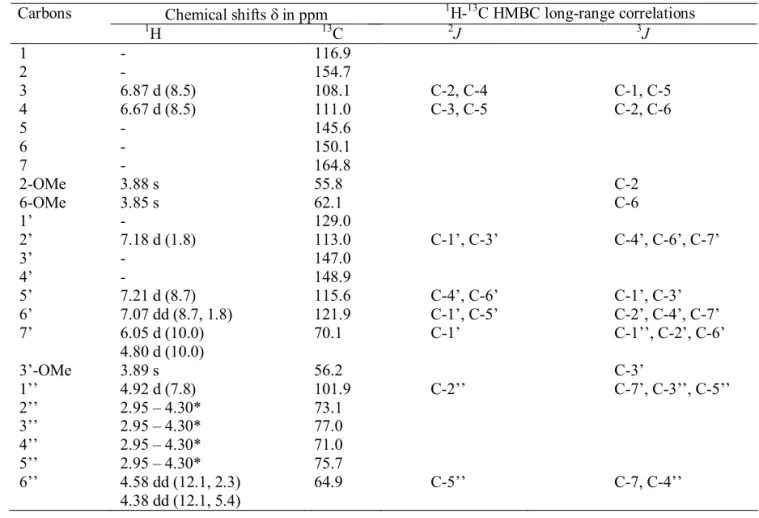
Table 1.1H NMR (400 MHz, coupling constant J in Hz in parentheses), 13C NMR (100 MHz) and 1H-13C HMBC long-range
correlations of chenoalbuside (1)
281 Chenoalbuside: an antioxidant phenolic glycoside from the seeds of Chenopodium album L. (Chenopodiaceae)
Rev. Bras. Farmacogn. Braz J. Pharmacogn. 15(4):out/dez. 2005
were made to obtain concentrations of 5x10⁻², 5x10⁻³,
5x10⁻⁴, 5x10⁻⁵, 5x10⁻⁶ 5x10⁻⁷, 5x10⁻⁸, 5x10⁻⁹, 5x10⁻¹⁰ mg/
mL. Diluted solutions (1.00 mL each) were mixed with DPPH (1.00 mL) and allowed to stand for 30 min for any reaction to occur. The UV absorbance of these solutions was recorded at 517 nm. The experiment was performed in triplicate and the average absorption was noted for each concentration. The same procedure was followed for the positive control (quercetin).
RESULTS AND DISCUSSION
Reversed-phase preparative HPLC purifi cation of the SepPak fractions obtained from the methanol extract of the seeds of C. album afforded three known phytoecdysteroids, 20-hydroxyecdysone, 20-hydroxy-24-methylen-ecdysone and 20, 26-dihydroxyecdysone (25R:25S = 4:1), and a novel phenolic glycoside, chenoalbuside (1). While the structures of the phytoecdysteroids were determined readily by direct comparison of their spectroscopic data with published data (Lafont; Wilson, 1996), the structure of 1 was elucidated by comprehensive spectroscopic data analyses, including UV, MS, 1D and 2D NMR.
The UV absorption maxima at 234 and 296 nm indicated the presence of a benzenoid structure with a conjugated carbonyl functionality. The CIMS analysis revealed the pseudomolecular ion, [M+NH4]+ at m/z
514, conducive to the molecular formula C23H28O12. The
1H and 13C NMR spectra (Table 1) displayed signals,
which could be attributed to a tetra- and a tri-substituted benzene rings, an ester carbonyl, an oxymethylene, three
methoxyl groups, and a glucosyl unit. The 1H and 13C
NMR data of 1 were similar to those for obtusaside, isolated from Hypoxis obtusa (Msonthi et al., 1990), with some striking differences in the signals associated with the tri-substituted benzene ring and the oxymethylene group. The 1H-13C HSQC experiment helped the identi
fi cation of all carbons directly linked to the methane, methylene and methyl protons. The 1H-13C HMBC analysis (Table 1)
provided information on the 2J and 3J1H-13C long-range
correlations. In this analysis, a 3J correlation form H 2-6’’
(δH 4.58 and 4.38) to the carbonyl (C-7, δC 164.8) of the 3-hydroxy-2,6-dimethoxybenzoate moiety. Similarly, a
3J correlation from the oxymethyle H
2-7’ (δH 6.05 and
4.80) of the 4-hydroxy-3-methoxy benzylalcohol moiety, to the glucose anomeric carbon (C-1’’, δC 101.9), and a 3J
correlation from the glucose anomeric proton (δH 4.92) to the oxymethylene carbon (δC 70.1) confi rmed the ether formation between C-1’ and C-1’’. While the position of all three methoxyl groups on the benzene rings were confi rmed by the detailed 1H-13C HMBC analysis (Table
1), further confi rmation on the placement of 2-OMe and 3’-OMe was obtained from the nOe interactions observed in the 1H-1H NOESY spectrum (Figure 1), respectively,
between 2-OMe (δH 3.88) and H-3 (δH 6.87), and 3’-OMe (δH 3.89) and H-2 (δH 7.18). Thus the structure of this phenolic glycoside was determined conclusively as chenoalbuside (1). It is noteworthy that unlike obtusaside, where the oxygenations are at C-2’ and C-5’, the oxygenation on the benzyl alcohol moiety in 1 were at C-3’ and C-4’. To our knowledge, chenoalbuside (1) is a novel natural product.
In the DPPH assay, chenoalbuside (1) showed
O
O OH
OMe OMe
O O
H OH
O
OH OMe
O H
1 2 3 4
5 6
7
1' 2'
3'
4' 5' 6' 7' 1'' 2'' 3''
4'' 6''
1
O
O OH
OMe OMe
O
O
H OH
O
OH OMe
O H
H H H
H H H
H H H
H
H H H
H
282
L. Nahar, S.D. Sarker
Rev. Bras. Farmacogn. Braz J. Pharmacogn. 15(4):out/dez. 2005
signifi cant levels of free radical scavenging (antioxidant) activity compared to that of the positive control, quercetin. The RC50 values for 1 and quercetin were found to be 1.4 x 10⁻⁴ and 2.88 x 10⁻⁵ mg/mL, respectively. The antioxidant
activity of 1, like other natural phenolic antioxidants, e.g.
fl avonoids (Kumarasamy et al., 2004), is a consequence of the presence of the phenolic moieties in the structures. The antioxidant activity of phenolic natural products is predominantly owing to their redox properties, i.e. the ability to act as reducing agents, hydrogen donors and singlet oxygen quenchers, and to some extent, could also be due to their metal chelation potential (Kumarasamy et al., 2004).
ACKNOWLEDGEMENTS
We thank the EPSRC National Mass Spectrometry Service Centre (Department of Chemistry, University of Wales Swansea, Swansea, Wales, UK) for CIMS analyses.
REFERENCES
Bailey LH 1977. Manual of cultivated plants. MacMillan Publishing Co. Inc., New York.
Cutillo F, D’Abrosca B, DellaGreca M, Zarrelli A 2004. Chenoalbicin, a novel cinnamic acid amide alkaloid from Chenopodium album. Chemistry and Biodiversity 1: 1579-1583.
Dai Y, Ye WC, Wang ZT, Matsuda H, Kubo M, But PPH 2002. Antipruritic and antinociceptive effects of Chenopodium album L. in mice. J Ethnopharmacol 81: 245-250.
Delazar A, Celik S, Yucel E, Nahar L, Sarker SD 2005. Two acylated fl avonoids from Stachys bombycina and their free radical scavenging activity. Die Pharmazie (in press).
Delazar A, Shoeb M, Kumarasamy Y, Byres M, Nahar L, Modarresi M, Sarker SD 2004. Two bioactive ferulic acid derivatives from Eremostachys glabra. DARU 12: 49-53.
DellaGreca M, D’Abrosca B, Fiorentino A, Previtera L, Zarrelli A 2005a. Structure elucidation and phytotoxicity of ecdysteroids from Chenopodium album. Chemistry and Biodiversity 2:457-462.
DellaGreca M, Previtera L, Zarrelli A 2005b. A new xyloside from Chenopodium album. Nat Prod Res 19: 87-90.
DellaGreca M, Di Mariono C, Zarrelli A, D’Abrosca B 2004. Isolation and phytotoxicity of apocarotenoids from Chenopodium album. J Nat Prod 67:1492-1495. Dinan L 1992. The analysis of phytoecdysteroids in single
(preflowering stage) specimens of fat hen, Chenipodium album. Phytochem Analysis 3: 132-138.
Dinan L, Whting P, Scott AJ 1998. Taxonomic distribution of phytoecdysteroids in seeds of members of the Chenopodiaceae. Biochem Syst Ecol 26: 553-576. Gohar AA, Elmazar MMA 1997. Isolation of hypotensive
fl avonoids from Chenopodium species growing in
Egypt. Phytother Res11: 564-567.
GRIN Database 2005. USDA, ARS, National Genetic Resources Program, Germplasm Resources Information Network (GRIN), National Germplasm Resources Laboratory, Beltsville, Maryland.. Available on-line at, http://www.ars-grin.gov2/cgi-bin/npgs/html/ genform.pl
Horio T, Yoshida K, Kikuchi H, Kawabata J, Mizutani J 1993. A phenolic amide from roots of Chenopodium album. Phytochemistry 33: 807-808.
Kumarasamy Y, Byres M, Cox PJ, Delazar A, Jaspars M, Nahar L, Shoeb M, Sarker SD 2004.Isolation, structure elucidation and biological activity of fl avone C-glycosides from the seeds of Alliaria petiolata. Chem Nat Comp 40:122-128.
Kumarasamy Y, Fergusson M, Nahar L, Sarker SD 2002. Biological activity of moschamindole from Centaurea moschata. Pharm Biol40: 307-310. Lafont R, Wilsin I 1996. The ecdysone handbook,
Chromatographic Society, Nottigham.
Maruta Y, Fukushi Y, Ohkawa K, Nakanishi Y, Tahara S, Mizutani J 1995. Antimicrobial stress compounds from Hypochoeris radicata. Phytochemistry 38: 1169-1173.
Msonthi JD, Toyota M, Marston A, Hostettmann K 1990. A phenolic glycoside from Hypoxis obtusa. Phytochemistry 29: 3977-3979.
Nahar L, Russell WR, Middleton M, Shoeb M, Sarker SD 2005. Antioxidant phenylacetic acid derivatives from the seeds of Ilex aquifolium. Acta Pharmaceutica 55: 187-193.
Sarker SD, Shaheen EM, Eynon E, Nahar L 2005a. Caffeic acid decyl ester: an antioxidant principle from Phleum pratense (Poaceae). Chem Nat Comp 41: 293-296. Sarker SD, Kumarasamy Y, Shoeb M, Celik S, Yucel E,
Middleton M, Nahar L 2005b. Antibacterial and antioxidant activities of three Turkish species of the genus Centaurea, Oriental Pharmacy and Experimental Medicine5: 246-250.
Sarker SD, Eynon E, Fok K, Kumarasamy Y, Murphy EM, Nahar L, Shaheen EM, Shaw NM, Siakalima M 2003. Screening the extracts of the seeds of Achillea millefolium, Angelica sylvestris and Phleum pratense for antibacterial, antioxidant activities and general toxicity, Oriental Pharmacy and Experimental Medicine 3: 157-162.
Tahara S, Kasai S, Inoue M, Kawabata J, Mizutani J 1994. Identifi cation of mucondialdehyde as a novel stress metabolite. Experientia 50:137-141.
Takao T, Watanabe N, Yagi I, Sakata K 1994. A simple screening method for antioxidants and isolation of several antioxidants produced by marine bacteria from fi sh and shellfi sh. Biosci Biotech Biochem 58: 1780-1783.