Evaluaion of the knowledge of intensive care
doctors in Teresina concerning brain death
Juliana Veloso Magalhães 1, Kelson Nobre Veras 2, Cínia Maria de Melo Mendes3Abstract
A descripive study was carried out based on a quesionnaire answered by 90 doctors working in the intensive care units of Teresina, Piaui, Brazil. The aim of the study was to evaluate intensive care knowledge on brain death and correlate it with ime spent working in the medical profession, ime spent working in intensive care units, type of unit in which the medical professional spent their Medical Residency course and whether the medical professional had the itle of specialist in Intensive Care. The majority of paricipants demonstrated knowledge of the deiniion of brain death, and awareness was greater among those who had spent less ime working in the medical profession. They demonstrated knowledge of the requirement for addiional tests to diagnose brain death and described themselves as conident or very conident when explaining brain death to the relaives of paients. The doctors, in general, had diiculies in determining the legal ime of death of paients with brain death who were classed as organ donors.
Keywords: Brain death. Intensive care units. Physicians. Knowledge. Resumen
Evaluación del conocimiento de los médicos intensivistas de Teresina respecto a la muerte cerebral Este es un estudio transversal y descripivo, realizado a través de un cuesionario del que pariciparon 90 médicos que actúan en las unidades de terapia intensiva de Teresina. Se realizó con el objeivo de evaluar el conocimiento de los médicos intensivistas sobre la muerte cerebral y correlacionarlo con el iempo de ejerci
-cio de la profesión médica, iempo de actuación en unidades de terapia intensiva, ipo de Unidad en la cual el profesional trabaja, carrera de Residencia Médica y posesión del ítulo de especialidad en Terapia Intensiva. En general, los paricipantes demostraron conocer la deinición de muerte cerebral, siendo este conocimiento mayor entre aquellos con menor iempo de ejercicio de la profesión médica. Demostraron conocer la obliga
-toriedad de los exámenes complementarios para diagnosicar la muerte cerebral y se describieron a sí mismos como seguros o muy seguros al momento de explicar la muerte cerebral a los familiares de los pacientes. De un modo general, estos médicos presentaron diicultades para determinar el horario legal del óbito en paci
-entes con muerte cerebral cuando se trata de donantes de órganos.
Palabras-clave: Muerte encefálica. Unidades de cuidados intensivos. Médicos. Conocimiento. Resumo
Avaliação do conhecimento de médicos intensivistas de Teresina sobre morte encefálica
Trata-se de estudo transversal e descriivo, realizado a parir de quesionário respondido por 90 médicos atuantes em unidades de terapia intensiva (UTI) de Teresina. Teve o objeivo de avaliar o conhecimento dos médicos intensivistas sobre morte encefálica e correlacionar esse dado com tempo de exercício da proissão, tempo de atuação em UTI, ipo de unidade em que o proissional trabalha, curso de residência médica e pos
-se de ítulo de especialista em terapia intensiva. Os paricipantes demonstraram, em sua maioria, conhecer a deinição de morte encefálica, com melhores resultados entre aqueles com menor tempo de exercício da proissão médica. Demonstraram saber da obrigatoriedade de exames complementares para o diagnósico de morte encefálica e descreveram-se como seguros ou muito seguros para explicar morte encefálica a familiares de pacientes. Os médicos, de modo geral, demonstraram diiculdades em determinar o horário legal do óbito por morte encefálica de paciente considerado doador de órgãos.
Palavras-chave: Morte encefálica. Unidades de terapia intensiva. Médicos. Conhecimento. Aprovação CEP Uninovafapi 24176713.7.0000.5210
1.Graduada [email protected] – Centro Universitário Uninovafapi, Teresina/PI. 2.Mestre[email protected] – Hospital de Urgências de Teresina/PI. 3. Mestre[email protected] – Curso de Medicina do Centro Universitário Uninovafapi, Teresina/PI.
Correspondência
Juliana Veloso Magalhães – Rua Bento Clarindo Bastos, 1997 Bairro dos Noivos CEP 64045-120. Teresina/PI, Brasil. Declaram não haver conlitos de interesse.
R
e
s
e
a
r
c
h
a
r
t
ic
le
Brain death is deined as the irreversible cessa
-ion of the corical and brainstem func-ions. In Brazil, it is synonymous with death as individuals in such a situaion are unable to regain full control of their vital funcions 1,2. It is essenial for the post mortem removal of issues and organs for transplant, as reg
-ulated by Law 9,434/97, which also determines that the deiniion of clinical and technological criteria for the diagnosis of brain death is the responsibility of the Conselho Federal de Medicina (Federal Coun
-cil of Medicine – CFM) 3.
It is essenial that the intensive care doctor is fully informed of the concept of brain death and is able to idenify it correctly and treat the paient appropriately, according to the medical and legal provisions in force in Brazil. The main causes of brain death are traumaic brain injury, cerebrovascular disease, primary brain tumor and anoxic enceph
-alopathy, and those with such illnesses are oten treated in intensive care units (ICUs) 2,4.
The aim of this study was to evaluate the knowledge of intensive care doctors from Teresina (considered here to be all doctors working in ICUs, regardless of whether or not they hold the itle of specialist or served their residency in the area of intensive care) of brain death and the criteria for its diagnosis. Speciically, it atempts to discover how much these medical professionals know about the deiniion of brain death and the requirement for addiional diagnosic tests, how conident they feel when explaining brain death to a paient’s family, including their conduct when faced with a hypotheical situaion of evaluaing a paient with suspected brain death. It also especially aims to as
-sess their knowledge of determining the legal ime of death of paients, disinguishing those with brain death from organ donors. Furthermore, we tried to correlate these variables with length of ime prac
-icing medicine, length of ime working in the ICH, the type of ICU in which the doctor predominant
-ly worked (adult or pediatric), course of residency and whether or not the doctor is a specialist in in
-tensive care.
Method
A cross-secional, descripive study was per
-formed, using ield research for data collecion. The design of the study sample populaion was based on a survey of data held by the Sociedade de Terapia Intensiva do Piauí (the Piaui Intensive Care Society – Soipi), which provided a report of hospitals in
Teresina where there is an adult or pediatric ICU and the informaion of the doctors who worked there.
To calculate the size of the sample, a maximum sampling error of 5.5% was established, with a con
-idence interval of 95% and maximum variance (p) of 0.05. Under these condiions, for a inite popula
-ion of 168 profess-ionals, it was determined that a sample of 110 doctors should be assessed. Simple random type probability sampling was adopted to choose the sample. Professionals which appeared on the list were numbered and randomly drawn using the BioEstat 2.0 program. Data collecion was carried out between January 6 and March 31, 2014, and all medical paricipants signed free and informed consent forms.
The data collecion instrument was a ques
-ionnaire with closed quesions, adapted from two previous studies 4,5, and divided into two secions. The irst was to idenify the professional proile of the paricipaing doctors, and the second was com
-posed of six closed muliple choice quesions, to analyze understanding of brain death and its diag
-nosic criteria. Each quesion had only one correct answer. This secion asked quesions about the dei
-niion of brain death, if there is a legal requirement for addiional tests to conirm the diagnosis, how conident the doctor feels to explain brain death to the paient’s family, the conduct of the professional when faced with a hypotheical clinical case dealing with evaluaing a paient according to the Brazilian protocols for brain death, and determining the legal ime of death of an organ donor paient where there is no conirmed diagnosis of brain death.
A maximum no-response rate of 20% was considered, moivated by refusal to paricipate, the doctor not being found or the absence of an intensive care doctor during the research period. The completed quesionnaires were recorded in a Microsot Excel spreadsheet and exported to the IBMSPSS 20.0 program, which provided the results in tables and graphs. Descripive staisical analysis was performed, so that the quanitaive variables were described by measures of posiion (mean) and dispersion (standard deviaion), and the qualitaive measures by absolute and relaive frequencies (per
-centages).
For comparison of the groups in relaion to the qualitaive variables, the data was grouped into 2x2 type tables, and the Chi-squared test with Yates cor
-recion and Fisher’s exact test were used, both with a signiicance level of 5%.
R
e
s
e
a
r
c
h
a
r
t
ic
le
Results
Among the 110 intensive care physicians se
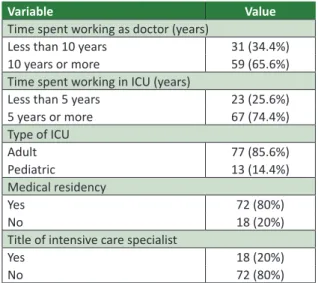
-lected in the draw, 11 were not located, 9 did not agree to paricipate and 90 paricipated in the study as volunteers, resuling in a non-response rate of approximately 18.2%, within the maximum limit of 20%. If the doctor worked in more than one ICU, he or she informed researchers in which he spent most of his or her ime. If the doctor worked in a mixed ICU he or she should indicate whether the unit was adult or pediatric, based on the largest number of paients seen. Table 1 shows the results for the pro
-fessional proile of the study paricipants.
Table 1. Characterizaion of professional proile of doctors interviewed. Teresina, 2014
Variable Value
Time spent working as doctor (years)
Less than 10 years 31 (34.4%)
10 years or more 59 (65.6%)
Time spent working in ICU (years)
Less than 5 years 23 (25.6%)
5 years or more 67 (74.4%)
Type of ICU
Adult 77 (85.6%)
Pediatric 13 (14.4%)
Medical residency
Yes 72 (80%)
No 18 (20%)
Title of intensive care specialist
Yes 18 (20%)
No 72 (80%)
There was a predominance of professionals with over ten years of experience of pracicing medicine (65.6%). Most doctors had spent more than ive years working in an ICU (74.4%), especially in adult type ICUs (85.6%). Most respondents (80%) reported having completed a medical residency, with clinical medicine most prevalent (34.4%), followed by general surgery (17.8%) and pediatrics (14.4%). Only 20% of the physi
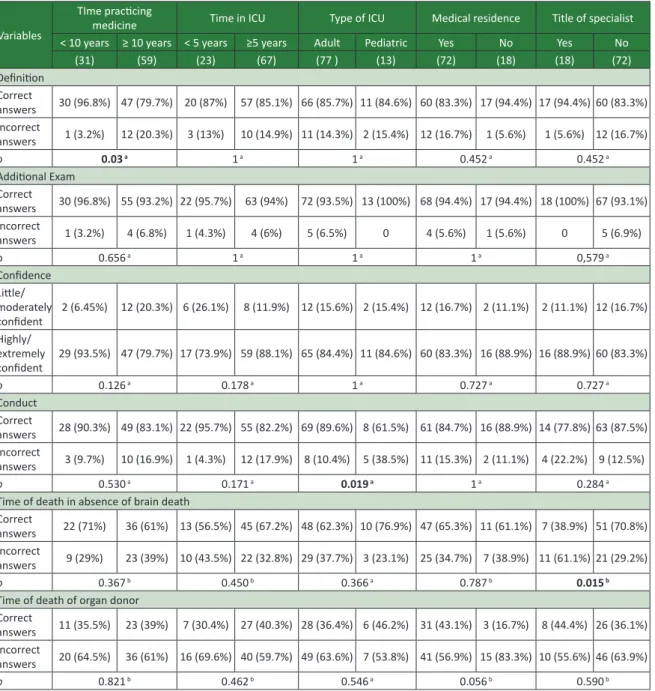
-cians held the itle of specialist in intensive care. Table 2 shows the responses of the intensive care doctors to the second part of the quesionnaire, and Table 3 presents the correlaions between the statements of the professionals and some variables. Most (85.6%) of the doctors surveyed correct
-ly deined the concept of brain death, data which posiively correlated with length of ime pracicing medicine (p = 0.03), with a higher proporion of
correct answers among intensive care doctors who had less than ten years of medical pracice (96.8%).
However there was no associaion between correct answers on understanding of brain death and length of ime spent working in the ICU or the type of ICU in which the doctor worked. There was also no correla
-ion between knowledge of the deini-ion of brain death and the fact that the medical professional had atended a medical residency and whether he or she held the itle of intensive care specialist.
Table 2. Responses of intensive care doctors to second part of quesionnaire. Teresina, 2014
Quesions Responses
Deiniion of brain death
Irreversible loss of all corical cerebral
funcion 13 (14.4%)
Irreversible loss of all corical and brain
-stem funcion 77 (85.6%)
Depends, according to the Law 0
Did not know 0
Requirement of addiional exam
Yes 85 (94.4%)
No 5 (5.6%)
Self-declared conidence about explaining brain death
1 (not conident) 40
2 (litle conident) 41 (1.1%)
3 (moderately conident) 13 (14.4%)
4 (conident) 40 (44.4%)
5 (very conident) 36 (40%)
Conduct
Following explanaion to relaives and their agreement, withdraw life support, as
paient is terminal 1 (1.1%)
Request computerized tomographic
conirmaion 10 (11.1%)
Repeat clinical exam ater a minimum of
6 hours 77 (85.6%)
Declare the paient clinically brain dead 2 (2.2%) Time of death in the absence of brain death
From the irst clinical exam 2 (2.2%) From the second clinical exam 30 (33.3%)
From cardiac arrest 58 (64.4%)
Time of death for organ donors
From the irst clinical exam or the opening
of the protocol (12 h from 10/08) 43 (3.3%)
From second clinical exam of closure of
the protocol (18 h from 10/08) 34 (37.8%)
From addiional examinaion showing no
blood low to brain 45 (50%)
From removal of organs 48 (8.9%)
Note: the answers considered correct are shown in italics.
With regard to the requirement for addiional tests, most intensive care doctors (94.4%) respond
-ed appropriately. There was no associaion between
R
e
s
e
a
r
c
h
a
r
t
ic
le
Table 3. Correlaions of knowledge of intensive care doctors with selected study variables. Teresina, 2014
Variables
TIme pracicing
medicine Time in ICU Type of ICU Medical residence Title of specialist < 10 years ≥ 10 years < 5 years ≥5 years Adult Pediatric Yes No Yes No
(31) (59) (23) (67) (77 ) (13) (72) (18) (18) (72) Deiniion
Correct
answers 30 (96.8%) 47 (79.7%) 20 (87%) 57 (85.1%) 66 (85.7%) 11 (84.6%) 60 (83.3%) 17 (94.4%) 17 (94.4%) 60 (83.3%) Incorrect
answers 1 (3.2%) 12 (20.3%) 3 (13%) 10 (14.9%) 11 (14.3%) 2 (15.4%) 12 (16.7%) 1 (5.6%) 1 (5.6%) 12 (16.7%)
p 0.03 a 1 a 1 a 0.452a 0.452a
Addiional Exam Correct
answers 30 (96.8%) 55 (93.2%) 22 (95.7%) 63 (94%) 72 (93.5%) 13 (100%) 68 (94.4%) 17 (94.4%) 18 (100%) 67 (93.1%) Incorrect
answers 1 (3.2%) 4 (6.8%) 1 (4.3%) 4 (6%) 5 (6.5%) 0 4 (5.6%) 1 (5.6%) 0 5 (6.9%)
p 0.656 a 1 a 1 a 1 a 0,579a
Conidence Litle/ moderately
conident 2 (6.45%) 12 (20.3%) 6 (26.1%) 8 (11.9%) 12 (15.6%) 2 (15.4%) 12 (16.7%) 2 (11.1%) 2 (11.1%) 12 (16.7%) Highly/
extremely
conident 29 (93.5%) 47 (79.7%) 17 (73.9%) 59 (88.1%) 65 (84.4%) 11 (84.6%) 60 (83.3%) 16 (88.9%) 16 (88.9%) 60 (83.3%)
p 0.126 a 0.178 a 1 a 0.727a 0.727a
Conduct Correct
answers 28 (90.3%) 49 (83.1%) 22 (95.7%) 55 (82.2%) 69 (89.6%) 8 (61.5%) 61 (84.7%) 16 (88.9%) 14 (77.8%) 63 (87.5%) Incorrect
answers 3 (9.7%) 10 (16.9%) 1 (4.3%) 12 (17.9%) 8 (10.4%) 5 (38.5%) 11 (15.3%) 2 (11.1%) 4 (22.2%) 9 (12.5%)
p 0.530a 0.171a 0.019 a 1a 0.284a
Time of death in absence of brain death Correct
answers 22 (71%) 36 (61%) 13 (56.5%) 45 (67.2%) 48 (62.3%) 10 (76.9%) 47 (65.3%) 11 (61.1%) 7 (38.9%) 51 (70.8%) Incorrect
answers 9 (29%) 23 (39%) 10 (43.5%) 22 (32.8%) 29 (37.7%) 3 (23.1%) 25 (34.7%) 7 (38.9%) 11 (61.1%) 21 (29.2%)
p 0.367b 0.450b 0.366a 0.787b 0.015 b
Time of death of organ donor Correct
answers 11 (35.5%) 23 (39%) 7 (30.4%) 27 (40.3%) 28 (36.4%) 6 (46.2%) 31 (43.1%) 3 (16.7%) 8 (44.4%) 26 (36.1%) Incorrect
answers 20 (64.5%) 36 (61%) 16 (69.6%) 40 (59.7%) 49 (63.6%) 7 (53.8%) 41 (56.9%) 15 (83.3%) 10 (55.6%) 46 (63.9%)
p 0.821b 0.462b 0.546a 0.056b 0.590b
a Fisher’s exact test; b Chi-squared test with Yates correcion (χ²Yates).
this data and the variables analyzed. When asked about their conidence in explaining brain death to the families of paients, the majority (84.4%) of doctors considered themselves to be within the two highest groups, with 40% very conident and 44.4% conident. There was also no correlaion between this factor and the variables studied.
Most intensive care doctors (85.6%) adopted the correct behavior when faced with cases involv
-ing the evaluaion of a paient with suspected brain death, saying they would repeat the clinical exam
-inaion of the paient. Intensive care doctors who
worked predominantly in adult ICUs had a high
-er proporion of correct answ-ers than those who worked in pediatric ICUs (p = 0.019), but there was no correlaion between the conduct of the medical professional and the other variables.
In situaions where the paient presented symptoms suggesive of brain death in two posi
-ive clinical exams, but progressed to irreversible cardiac arrest without closure of the protocol, due to no addiional examinaion being carried out, most intensive care doctors (64.4%) considered the ime of death as the ime of cardiac arrest, and so
R
e
s
e
a
r
c
h
a
r
t
ic
le
responded correctly to the quesion. There was a higher proporion of correct answers among profes
-sionals who were not intensive care specialists (p =
0.015) and no correlaion with the other variables analyzed.
The last issue asked doctors about determina
-ion of ime of death where the hypotheical paient was an organ donor. As shown in Table 2, only 37.8% said ime of death would be the ime of the second clinical examinaion or the closure of the protocol, the most appropriate response in such a case. There was a tendency of correct answers among those who said they had atended a medical residency (p = 0.056) and no correlaion with the other variables.
Discussion
The criteria for brain death diagnosis used in Brazil were deined by the Conselho Federal de Medicina (the Federal Medical Council) in Resolu
-ion 1,480/97 6, which states that brain death must be the result of an irreversible process and cause known as appercepive coma, with apnea and an absence of supraspinal motor acivity. Thus, brain death is deined as the irreversible cessaion of cere
-bral corical and brain stem funcions, and, in Brazil and in other countries, this condiion represents hu
-man death. To conirm the diagnosis requires two clinical evaluaions performed by diferent doctors, and laboratory tests, which provide unquesionable evidence of the absence of electrical or metabolic acivity or cerebral blood perfusion.
Most (85.6%) of the paricipants in this study demonstrated knowledge of the concept of brain death, corroboraing the results of other studies. Harrison and Botkin 5, in a survey conducted in the United States, using the original version of the quesionnaire applied here, evaluated the ability of pediatricians to deine and apply the concept of brain death. Of the 118 pediatric residents and 112 pediatricians surveyed, 12 were intensive care doc
-tors (all of whom deined brain death correctly). Another study 4 evaluated the knowledge of 246 intensive care physicians who worked in adult and/or pediatric ICUs in Porto Alegre and noted that 83% of paricipants displayed knowledge of the concept of brain death. A study in Recife 7 using a modiied version of the quesionnaire from studies by Harrison and Botkin 5 and Schein 4, surveyed 54 intensive care physicians and 54 ICU nurses from ive diferent hospitals, of whom 70.4% correct
-ly deined the concept of brain death. The speciic
proporion of physicians with such knowledge, how
-ever, was not described.
In our study, we observed a higher proporion of correct deiniions of brain death by intensive care doctors who had been pracicing medicine for a shorter ime. No one knows for sure the reason for this, however, the deiniion of brain death currently accepted in Brazil is recent, and discussions about the issue have gained more prominence in the last two decades, moivated by Law 10,211/01 8 which exinguished presumed organ donaion in Brazil and CFM Resoluion 1,826/07 9, authorizing the suspen -sion of life support for paients with brain death whose family had not authorized organ donaion. The growing demand for organs for transplant and ICU beds in Brazil should also be menioned. For these reasons, the issue has been discussed more frequently in medical schools in recent years, which may have contributed to the superior knowledge of intensive care doctors with less professional prac
-ice ime.
Among the intensive care doctors interviewed in Teresina, 94.4% knew about the legal require
-ment for addiional tests for the diagnosis of brain death. In the study conducted in Porto Alegre 4, 80.5% of physicians answered correctly. In the Re
-cife study 7, the proporion of correct answers was 89.8%, a noteworthy igure. However, this study ad
-dressed doctors and nurses, without specifying the number of doctors who responded correctly. In the original study by Harrison and Botkin 5, all the inten -sive care doctors answered correctly, but unlike in Brazil, in the United States, the country where the study was conducted, there is no requirement for addiional tests to conirm diagnosis, which is based on the overall clinical evaluaion 4,10.
The suspicion of brain death should be as
-sessed and conirmed in each and every paient as part of the care provided for him or her and his or her family 2,11. The family is an element of paramount importance, as in Brazil it is they who can currently authorize or refuse organ donaion, as established by Law 10,211 8. The majority (84.4%) of the doctors who paricipated in the study considered them
-selves to have the two highest levels of conidence when explaining brain death to relaives – agreeing with the indings of the study by Schein 4, in which 78.9% also considered themselves to have the two highest levels of conidence.
The diagnosis of brain death is based on con
-ducing clinical and laboratory tests, the quanity and frequency of which vary according to the age of the paient. As established in CFM Resoluion
R
e
s
e
a
r
c
h
a
r
t
ic
le
CFM 1,480/97 6, the protocol for children aged over 2 years is the same as for the adult populaion, consising of two clinical trials separated by a min
-imum interval of six hours, and an addiional test to demonstrate unquesionably the absence of elec
-trical, metabolic or blood-brain acivity. The clinical tests should idenify appercepive coma, absence of supraspinal motor acivity (ixed and dilated pupils, absence of corneal-palpebral, oculocephalic and cough relexes and lack of responses to caloric tests) and apnea proven by exams.
Brain death is deined clinically and technically as human death and, according to CFM Resoluion 1,826/07 9, ime of death is considered that as re -corded in the brain death declaraion form, duly completed and with the addiional exam atached. This exam can be performed between the two clini
-cal exams, provided the irst assessment is consistent with brain death 12. It is not acceptable to begin pro -cedures with the addiional examinaion, but if the irst clinical evaluaion has been performed, nothing prevents the addiional exam being performed be
-fore the second.
One of the quesions to the intensive care doctors aimed to analyze their knowledge of the Brazilian procedure for the diagnosis of brain death, by asking them to indicate their conduct with re
-spect to the paient – a 5 years old child – under evaluaion. In the proposed case, while performing the apnea test, the paient presented a proile of la
-bored breathing, which is equivalent to the absence of apnea and therefore did not meet the clinical criteria for brain death. Most respondents (85.6%) opted for the behavior which is considered correct, elecing to repeat the clinical exam of the child. In this situaion, a further examinaion was not jusi
-ied as the clinical evaluaion did not suggest brain death. It would also not be permissible to suspend the child’s life support – a procedure authorized by CFM Resoluion 1,826/07 9 only for paients with brain death whose family did not authorize organ donaion.
Diseases prevalent in Brazil, such as strokes and traumaic brain injury, are largely responsible for occurrences of brain death, corresponding to about 86% of cases 13,14. While the irst cause is more frequent in the populaion aged 45 years or over, trauma is more prevalent among younger groups, mainly due to external reasons. Both causes pre
-dominantly afect the adult populaion, which could explain the higher proporion of correct answers among physicians who performed more opera
-ions in adult ICUs, even though the hypotheical
case featured a child. In addiion, studies of death in pediatric ICUs are lower due to the relaively low mortality in these units, ranging between 7% and 15%, and the high expectaion of a cure, so that the deiniion of irreversibility in children is a more com
-plex and ime-consuming process 15.
Approximately 64.5% of intensive care doc
-tors correctly set the ime of the death of paients without conirmaion of brain death as the ime of cardiac arrest. In the proposed situaion, the paient had two compaible clinical exams, but died due to cardiac arrest before the performance of the addi
-ional exam and closure of the diagnosic protocol of brain death. In this situaion, the ime of the irst or second clinical examinaion cannot be considered as ime of death. There was a lower proporion of correct answers among the physicians who said they held the itle of specialist in intensive care medicine. Since such inding has staisic limitaions due to dealing with analysis of a subgroup, an assessment of this speciic populaion is suggested.
Paients with brain death should become or
-gan donors or have their life support disconinued by the atending physician following the agreement of the family, as determined by the CFM 12. There -fore, in including in the last quesion the fact that the paient was an organ donor, it was hoped that intensive care doctors would understand that the protocol of diagnosing brain death had already been completed through clinical and addiional ex
-aminaions, and therefore the ime of death would correspond to the closure of the protocol. Howev
-er, only 37.8% of professionals said that the ime of death would be the second clinical examinaion or closure of the protocol. Similar results were ob
-served in other studies in which the same quesion was applied 4,7. As suggested by Schein 4, we believe that the diferent interpretaion by intensive care doctors is the result of a well-established – and probably dominant – culture of performing the ad
-diional exam ater the two clinical trials, making it the inal step. This would explain why 50% of the study paricipants considered the ime of death as the ime of the addiional examinaion.
Despite the limitaions noted in the quesion above, it is unacceptable to consider that the ime of death of an organ donor paient is the opening of the protocol of brain death or the removal of or
-gans, as responded 3.3% and 8.9% of respondents, respecively. In the Porto Alegre study 4, 4.9% of doctors considered the opening of the protocol as ime of death, and 24%, the ime of organ removal. In Recife 7, the removal of organs was considered as
R
e
s
e
a
r
c
h
a
r
t
ic
le
ime of death for 28.7% of the professionals, and the opening of the protocol for 11%.
The results of the study suggest that there is a need for professionals to bring their knowledge up to date, as it was observed that despite the high rate of correct answers, there are sill inten
-sive care doctors who do not know the deiniion of brain death, ignore the legal need for addiion
-al tests for diagnosis and have diiculies regarding the implementaion of the protocol in paients and the deiniion of legal ime of death. If death is a concrete physiological process and there are param
-eters to deine what brain death is, professionals must have knowledge of such parameters to guar
-antee the safety of their paients.
Final consideraions
The majority of the intensive care doctors from Teresina knew about the deiniion of brain death, especially those with less professional pracice ime. They also displayed knowledge of the requirement for addiional tests for the diagnosis of brain death and described themselves as conident or very conident in explaining the situaion to relaives of paients. Most of the professionals presented ade
-quate knowledge of current procedures in Brazil, by
adoping conduct considered correct in the assess
-ment of paients with suspected brain death, with intensive care doctors who predominantly worked in adult ICUs having a higher proporion of correct answers in this situaion. It was also observed that doctors generally had diiculty in determining the paient’s legal ime of death in organ donors.
Medicine is a science in constant renewal, whose concepts can be modiied, and the quesion
-naire, as an ariicial instrument, may not relect the aitudes of doctors when faced with real life situ
-aions. However, the procedures described in this study for the diagnosis of brain death are consid
-ered correct from the current medical, scieniic or legal perspecive.
In addiion to being essenial for the donaion of organs from the deceased, the precise diagnosis of brain death has implicaions for the exercise of professional ethics, as it allows improved care for pa
-ients and families and contributes to more eicient uilizaion of ICU beds by prevening them from be
-ing used inappropriately. It is therefore crucial that teams of health professionals, especially intensive care doctors, learn about concepts relaing to brain death and are able to idenify and deal with the con
-diion according to the medical and legal regulaions currently in force in Brazil.
References
1. Morato EG. Morte encefálica: conceitos essenciais, diagnósico e atualização. Rev Med Minas Gerais. [Internet]. 2009 [acesso 1 nov 2013]. 19(3):227-36.
Disponível: htp://www.isfar.ufc.br/petmedicina/images/stories/arigo_-_morte_encelica.pdf 2. Santos MJ, Moraes EL, Massarollo MCKB. Comunicação de más noícias: dilemas éicos frente à
situação de morte encefálica. Mundo Saúde. [Internet]. 2012 [acesso 30 out 2013]. 36(1):34-40. Disponível: htp://www.saocamilo-sp.br/pdf/mundo_saude/90/03.pdf
3. Brasil. Lei nº 9.434, de 4 de fevereiro de 1997. Dispõe sobre a remoção de órgãos, tecidos e partes do corpo humano para ins de transplante e tratamento e dá outras providências. [Internet]. 1997 [acesso 30 out 2013]. Disponível: htp://www.planalto.gov.br/ccivil_03/leis/L9434compilado.htm 4. Schein AE. Avaliação do conhecimento dos intensivistas de Porto Alegre sobre morte encefálica [dissertação]. Porto Alegre: Universidade Federal do Rio Grande do Sul; 2006 [acesso 20 set 2013]. Disponível: htp://www.lume.ufrgs.br/bitstream/handle/10183/8541/000579571.pdf?sequence=1 5. Harrison AM, Botkin JR. Can pediatricians deine and apply the concept of brain death? Pediatrics.
1999;103(6):e82.
6. Conselho Federal de Medicina. Resolução CFM 1.480, de 8 de agosto de 1997. [Internet]. A morte encefálica será caracterizada através da realização de exames clínicos e complementares durante intervalos de tempo variáveis, próprios para determinadas faixas etárias. Brasília: CFM; 1997 [acesso 17 set 2013]. Disponível: htp://www.portalmedico.org.br/resolucoes/cfm/1997/1480_1997.htm 7. Ramos VP, Marins MC, Silva JRF, Silva MHM. Avaliação do conhecimento de médicos e
enfermeiros intensivistas sobre os critérios diagnósicos da morte encefálica. In: Ramos, VP. Conhecimento técnico-cieníico dos proissionais de saúde sobre critérios diagnósicos de morte encefálica [tese]. [Internet]. Recife: UFPE; 2010 [acesso 1 ago 2014]. p. 65-82. Disponível: htp://www.livrosgrais.com.br/arquivos_livros/cp144908.pdf
8. Brasil. Lei nº 10.211, de 23 de março de 2001. Altera os disposiivos da Lei nº 9.434, de 4 de fevereiro de 1997, que dispõe sobre a remoção de órgãos, tecidos e partes do corpo humano para ins de transplante e tratamento. Diário Oicial da União. 24 mar 2001; (edição extra):Seção I, p. 6.
R
e
s
e
a
r
c
h
a
r
t
ic
le
Recebido: 21.10.2015 Revisado: 20. 2.2016 Aprovado: 25. 2.2016
9. Conselho Federal de Medicina. Resolução 1.826, de 24 de outubro de 2007. [Internet]. Dispõe sobre a legalidade e o caráter éico da suspensão dos procedimentos de suportes terapêuicos quando da determinação de morte encefálica de indivíduo não-doador. Brasília: CFM; 2007 [acesso 22 set 2013]. Disponível: htp://www.portalmedico.org.br/resolucoes/cfm/2007/1826_2007.htm 10. Jofe AR, Anton NR, Duf JP, DeCaen A. A survey of american neurologists about brain death:
understanding the conceptual basis and diagnosic tests for brain death. Ann Intensive Care. 2012;2:4.
11. Meneses EA, Souza MFB, Baruzzi RM, Prado MM, Garrafa V. Análise bioéica do diagnósico de morte encefálica e da doação de órgãos em hospital público de referência do Distrito Federal. Rev. bioét. (Impr.). 2010;18(2):397-412.
12. Conselho Federal de Medicina. Parecer Consulta nº 42/2001. [Internet]. O diagnósico de morte encefálica deverá ser feito baseado no inteiro teor da Resolução CFM nº 1480/97, considerando-se a hora do óbito aquela registrada no Termo de Declaração de morte encefálica, devidamente preenchido e com o exame complementar anexado. Pacientes em morte encefálica devem se tornar doadores de órgãos ou terem seus suportes desconinuados por seu médico assistente. Brasília: CFM; 2001 [acesso 3 out 2013].
Disponível: htp://www.portalmedico.org.br/pareceres/CFM/2001/42_2001.htm
13. Sallum AMC, Rossato LM, Silva SF. Morte encefálica em criança: subsídios para a práica clínica. Rev Bras Enferm. 2011;64(3):600-4.
14. Associação Brasileira de Transplante de Órgãos. Dimensionamento dos transplantes no Brasil e em cada estado (2007-2014). Registro Brasileiro de Transplantes. [Internet]. 2014 [acesso 3 mar 2016];20(4). Disponível: htp://www.abto.org.br/abtov03/Upload/ile/RBT/2014/rbt2014-lib.pdf 15. Lago PM. Intervenções médicas nas úlimas 48 horas de vida de pacientes internados em UTIP em
três regiões do Brasil [tese]. Porto Alegre: Poniícia Universidade Católica do Rio Grande do Sul; 2007 [acesso 3 jul 2014]. Disponível: htp://tede.pucrs.br/tde_busca/arquivo.php?codArquivo=702
Paricipaion of the authors
The authors worked together on the inial idea and planning of the project. Kelson Nobre Veras and Juliana Veloso Magalhães systemized and analyzed the results, Juliana retyped the text, which was revised by Kelson and Cínia Maria de Melo Mendes.
R
e
s
e
a
r
c
h
a
r
t
ic
le
I. Characterizaion of Professional proile 1. Gender: ( ) Male ( ) Female
2. Age: ______ years. 3. Year of graduaion: ______.
4. Time spent working in ICU: ______ years 5. Predominantly work in:
( ) adult ICU ( ) pediatric ICU
(Where doctor works in more than one ICU, indicate where he or she spends the majority of his ime.
Where doctor works in a mixed ICU, indicate wheth
-er the majority of paients atended are children or adults)
6. Did you work in an ICU in a training hospital? ( ) Yes ( ) No
7. Did you complete a medical residence? ( ) Yes ( ) No
7.1. If Yes, in what area? __________________ 8. Do you hold the itle of intensive care specialist? ( ) Yes ( ) No
9. Have you paricipated in the performance of a protocol of brain death diagnosis?
( ) Yes ( ) No
II. Evaluaion of knowledge of brain death and its diagnosic criteria (mark only the opion you think is most correct)
10. What brain funcions must be absent for a person to be declared brain-dead?
a) Irreversible loss of all corical cerebral funcion. b) Irreversible loss of all corical and brainstem funcion. c) Varies according to the law.
d) Don’t know.
11. Is there a legal requirement for addiional exams to establish diagnosis of brain death? ( ) Yes ( ) No
12. How would you evaluate your level of conidence about explaining brain death to the family of a paient? (not conident at all) (extremely conident) 1 2 3 4 5 13. A 5-year-old girl is found in the botom of a swimming pool. She iniially presents apnea and no pulse and is exhausively resuscitated. Ater a week in the ICU, she has no corneal, coughing or choking relexes and is unresponsive to pain simuli. There is no nystagmus in response to caloric tests. Two minutes of apnea tesing shows weak respiratory movement. Based on these indings, would your choice of acion be:
a) Following explanaion to her parents and their agreement, remove life support, as the paient is in a terminal state.
b) Request a conirmatory graphical method. c) Repeat the clinical exam ater a minimum of six hours.
d) Declare her clinically brain dead.
14. The results of the irst clinical examinaion of an adult paient at 12.00 on August 10 are consis
-tent with brain death. The second clinical test is performed at 18.00 of the same day and shows the same results. The paient is kept on life support un
-il sufering irreversible cardiac arrest at 20.00 on August 11. What ime would you put on the death ceriicate?
a) Of the irst clinical exam (12.00 on 10/8). b) Of the second clinical exam (18.00 on 10/8). c) Of the cardiac arrest (20.00 on 11/8).
15. If the aforemenioned paient was an organ do
-nor, what would be the ime of death?
a) Of the irst clinical exam or the opening of the protocol (12.00 on 10/8).
b) Of the second clinical exam or the closure of the protocol (18.00 on 10/8).
c) Of the addiional exam showing absence of blood low to brain.
d) Of the removal of the organs.
Annex
Quesionnaire