313
SIMPLIFIED NUTRITIONAL APPETITE QUESTIONNAIRE
(SNAQ) FOR CARDIOPULMONARY AND METABOLIC
REHABILITATION PROGRAM
Sabrina Weiss Sties1,
Ana Inês Gonzáles1,
Maick da Silveira Viana2,
Ricardo Brandt2,
Renata Labronici Bertin3,
Ricardo Goldfeder1,
Anderson Zampier Ulbrich1,
Alexandro Andrade2,
Tales de Carvalho1
1. Cardiology and Sports Medicine Center – State University of Santa Catarina (UDESC) – Florianópolis, SC – Brazil. 2. Laboratory of Sports and Exercise Psychology – State University of Santa Catarina (UDESC) – Florianópolis, SC – Brazil.
3. Pharmaceutical Sciences Department – Regional University of Blumenau (FURB) – Blumenau, SC – Brazil.
Mailing address:
Centro de Ciências da Saúde e do Esporte – CEFID
Rua: Paschoal Simone, 358. Coqueiros, Florianópolis/SC. Cep: 88.080-350. E-mail: [email protected].
ABSTRACT
This study aimed to translate and validate a Brazilian version of the Simplified Nutritional Appetite Questionnaire (SNAQ), checking its clarity and validity for the participants of the Cardiopulmonary and Metabolic Rehabilitation Program (CPMR). One hundred and forty-six subjects were interviewed: 79 males, mean age of 63 years (±10) and 67 women, mean age of 66 years (±11). Descriptive analy-sis was presented as mean, standard deviation and frequency. The internal conanaly-sistency of the scale was assessed using Cronbach’s alpha coefficient and factor analysis by the method of extraction of principal components analysis using Kaiser’s criteria (eigenvalues > 1). All questions of the instrument showed positive results regarding clarity. The questionnaire items presented factor loadings above 0.40, (ranging from 0.40 to 0.81). Except for the issue related to the amount of daily meals, all others showed high correlation with the total score of the Brazilian version. Regarding the analysis of internal consistency, the result of 0.61 was reached. In conclusion, the Brazilian Version of SNAQ proved to be valid for use in CPMR program participants, thus becoming an important tool in assessing the appetite of the Brazilian population.
Keywords: validation studies, malnutrition, heart diseases, metabolic diseases.
INTRODUCTION
In Brazil as well as worldwide, the cardiovascular diseases (CVD) represent the main cause of incapacity and morbimortality1,2. Ap-proximately one third of the total deaths and 65% of the deaths between 30 and 69 years of age occur due to CVD, which are res-ponsible for a great number of hospital submissions and high costs3.
Patients with heart diseases who present diabetes4, anxiety5, depression5,6 and risk factors such as smoking7 may present altera-tions in the nutritional status. The consequences of bad nutrition are related to serious harm to health8, contributing to increase of morbimortality and making them prone to a series of complications, among which decrease of functional capacity and compromising of the immunological system9,10.Additionally, these individuals fre-quently make concomitant use of many drugs which, associated with the aging process, may influence on appetite, taste, digestion, absorption, use of many nutrients and weight loss11,12.
It is important to focus on the nutritional aspects of individuals submitted to physical exercise programs13, such as participants of metabolic and cardiopulmonary rehabilitation program (MCRP), who must keep a balanced diet for health maintenance and good physical performance14.
Early detection and appetite loss treatment may avoid weight loss, improve health and reduce mortality15. In this context, in the last 20 years instruments for evaluation of the nutritional risk such
as the Malnutrition Universal Screening Tool, the Nutrition Screening Initiative (NSI) and the Risk Evaluation for Eating and Nutrition (SCREEN I and SCREEN II)16 have been developed. However, these instruments are extensive and include many interdependent nutritional domains. An option for evaluation of the nutritional risk is the Simplified Nutri-tional Appetite Questionnaire (SNAQ)15, which has been simpler and of faster application than the other instruments. Recently, the SNAQ has been used in important studies17-19, including in the cardiology field20.
Considering the need for appetite evaluation in individuals with CVD and the lack of instruments in Portuguese which are able to fulfill this need, the present study had the aim to translate and validate for the Portuguese language the SNAQ, verifying its clari-ty and validiclari-ty for participants of metabolic and cardiopulmonary rehabilitation program (MCRP).
METHODS
It is a descriptive study of transversal cohort with non-proba-bilistic sample.
Participants
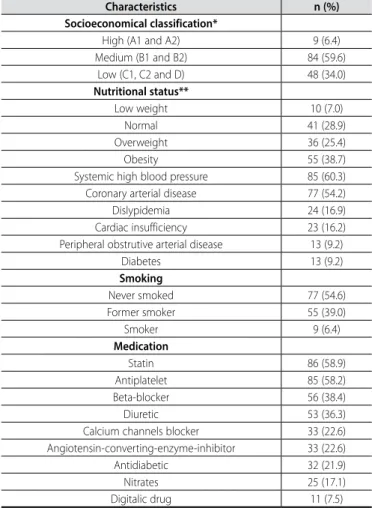
Individuals participants in a MCRP in the South of Brazil com-posed this study. One hundred and forty-six individuals from both genders participated in the study: 79 (54.1%) men, mean age of 63 years (± 10) and 67 (45.9%) women, mean age of 66 years (± 11). Table 1 presents the characteristics of the participants in the study.
ORIGINAL ARTICLE
314
INSTRUMENTS
Clinical and sociodemographic characterization
A questionnaire semi structured with questions which approached aspects related to aspects of cardiovascular risks (HAS/ diabetes/hypercholesterolemia/obesity/smoking) and the medical diagnosis was initially used.
The Standard Criterion of Economical Classification Brazil/2008 of the Brazilian Association of the Research Companies was used for socioeconomical classification21.Tis questionnaire evaluates existing items in the participant’s household and the educational level of the family head. The questionnaire presents high relation with family income (r = 0.78 and r2 = 62%).
Nutritional status
Nutritional status was verified through the body mass index (BMI), which was obtained by the body mass and stature ratio to the square (kg/m2)24. Nutritional status of the individuals up to 60 years old was classified with the use of the reference values proposed by the World Health Organization22 and for patients older than 60 years the reference values adopted were the ones proposed by the Pan-American Health Organization23.
Simplified Nutritional Appetite Questionnaire (SNAQ)
The Simplified Nutritional Appetite Questionnaire (SNAQ) is the short version of the Council of Nutrition Appetite Questionnaire (CNAQ). The validation study of the questionnaires15 indicated that
due to its short nature and reliability, the SNAQ is more recommen-ded for clinical use.
The SNAQ is composed of four items, grouped in a dingle do-main. Each question presents five options for answer which are represented by the letters from A to E. The questions are punctuated based on the following scale: A = 1, B = 2, C = 3, D = 4 and E = 5. When summed up, they give the total score of the questionnaire, which may range from 4 to 20. The lower it is, the higher the risk for weight loss. In the original instrument, indices lower or equal to 14 indicate risk for loss of at least 5% of weight in six months.
Procedures
After explanation about the aims of the study, all participants signed the Free and Clarified Consent Form approved by the Ethics in Research Committee (legal opinion 149/2011), according to the resolution 196/96 of the National Health Board. The researchers set a time which best fit to the participants’ routine. The collection was careful so that no external interferences would occur and each participant was individually evaluated by researchers who act in the MCRP under consideration. The questionnaire was applied as an in-terview and the application time was of approximately two minutes.
Translation, reverse translation and cultural adaptation
The items of the original version of the SNAQ were initially trans-lated to Portuguese by two Brazilian skilled independent translators who were aware of the aim of the research. The two translations were compared by the translators and the researcher, and in case of divergence, alterations were made to reach a consensus compared with the initial translation.
The translation was then changed to English (back-translation) by two bilingual English teachers, one British and the other American, who did not participate in the previous phase. The two versions were compared with the original instrument in English and the existing discrepancies were analyzed by a team composed of two nutritionists, two physiotherapists, three physical education professors and one cardiologist, all researchers and with experience in the field. The Portuguese questionnaire was rewritten until a consensus for the final version was reached (appendix 1).
STATISTICAL ANALYSIS
The data were analyzed in the Statistical Package for the Social Sciences – SPSS® package, version 18.0 for Windows®. The descriptive
analysis was presented in mean, standard deviation and frequency.
Clarity
The clarity evaluation of the instrument occurred through scales ranging from 0 to 10, in which 0 corresponded to no clarity and 10 to total clarity. Each one of the four questions of the Brazilian version of the Simplified Nutritional Appetite Questionnaire was evaluated through the scale, and the mean attributed to each question of the instrument was verified.
Factorial analysis
Factorial analysis of the Brazilian version of the SNAQ was perfor-med through analysis extraction method of the main components using the Kaiser criteria (self-values > 1). Minimum load was set at 0.4 so that the question could be part of the factor. Previous
Table 1. Socioeconomical and clinical characterization.
Characteristics n (%)
Socioeconomical classification*
High (A1 and A2) 9 (6.4)
Medium (B1 and B2) 84 (59.6)
Low (C1, C2 and D) 48 (34.0)
Nutritional status**
Low weight 10 (7.0)
Normal 41 (28.9)
Overweight 36 (25.4)
Obesity 55 (38.7)
Systemic high blood pressure 85 (60.3)
Coronary arterial disease 77 (54.2)
Dislypidemia 24 (16.9)
Cardiac insufficiency 23 (16.2)
Peripheral obstrutive arterial disease 13 (9.2)
Diabetes 13 (9.2)
Smoking
Never smoked 77 (54.6)
Former smoker 55 (39.0)
Smoker 9 (6.4)
Medication
Statin 86 (58.9)
Antiplatelet 85 (58.2)
Beta-blocker 56 (38.4)
Diuretic 53 (36.3)
Calcium channels blocker 33 (22.6)
Angiotensin-converting-enzyme-inhibitor 33 (22.6)
Antidiabetic 32 (21.9)
Nitrates 25 (17.1)
Digitalic drug 11 (7.5)
315 to the factorial analysis, the Bartlett sphericity and
Kaiser-Meyer--Olkin (KMO) tests were performed, with the purpose to verify the correlations between the questions of the instrument and the use viability of the factorial analysis.
Inner consistency
In order to verify the inner consistency of the Brazilian version of the SNAQ, the Cronbach alpha coefficient value was obtained. Both analyses of the complete scale and of it with the exclusion of items were performed.
RESULTS
All questions of the Brazilian version of the SNAQ presented po-sitive results concerning its clarity. The mean attributed to questions 1, 2, 3 and 4 were, respectively 9.9, 9.8, 9.8 and 9.9. Only one partici-pant (0.7%) negatively evaluated the clarity of the questions (< 7.0).
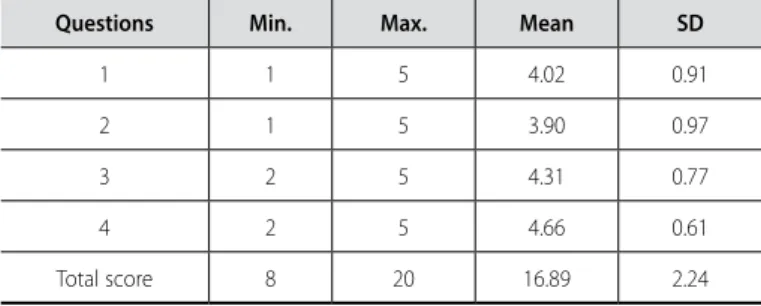
The descriptive results of each question of the Brazilian version of the SNAQ as well as the general results of the scale are presented in table 2. It could be seen that questions 3 and 4 did not receive more negative evaluations (1), resulting in higher means compared with questions 1 and 2. Eleven participants presented results lower than 14; that is to say, risk of weight loss.
Intercorrelation of the variables was confirmed (X2 = 76.45; p < 0.001), indicating that the data matrix is suitable to carry on with the factorial analysis. The KMO test obtained result of 0.62, which is also considered suitable for performance of factorial analysis.
Factorial analysis evidenced that the questionnaire has only main component, indicating a unifactorial structure. This component ex-plains for 47.0% of the total variation of the instrument (table 3). The items of the questionnaire presented factorial load above 0.40, with variation of 0.40 (question 4) to 0.82 (question 1). Except for question 4, all the other questions presented high correlation with the total score of the Brazilian version of the SNAQ (table 4).
The inner consistency analysis of the Brazilian version of the SNAQ obtained result of 0.61. When items exclusion was perfor-med, it was observed that the highest variations in the sum of the scale and in its variance occurred when question 4 was excluded. The inner consistency tends to reduce when any item is excluded, except for question 4, which leads to more positive results (table 5).
DISCUSSION
The present study demonstrated that there was not difficulty in application of the Brazilian version of the Simplified Nutritional Appetite Questionnaire and in its understanding by the patients, which demonstrates its applicability and clarity.
The questionnaire items presented factorial load higher than 0.40. Except for question 4, all the remaining questions presented high correlation with the total score of the Brazilian version of the SNAQ. The results of the factorial analysis concerning questions 1 and 3 presented values higher than the ones obtained by Wilson et al.15 in the original validation of the questionnaire. The inner consis-tency obtained with the Brazilian version of the SNAQ (0.61) is lower than the one presented by the original version of the instrument (0.70); however, since it is an instrument with few questions, this result may be considered sufficient. It is suggested that the ques-tions of the Brazilian version of the SNAQ receive a punctuation, just
Table 2. Descriptive results of each question and general of the Simplified Nutritional Appetite Questionnaire (SNAQ).
Questions Min. Max. Mean SD
1 1 5 4.02 0.91
2 1 5 3.90 0.97
3 2 5 4.31 0.77
4 2 5 4.66 0.61
Total score 8 20 16.89 2.24
Table 3. Self-values and explained variance of the components of the Simplified
Nutritional Appetite Questionnaire (SNAQ).
Component
Initial self-values
Total Variance % Cumulative %
1 1.882 47.05 47.05
2 0.972 24.31 71.36
3 0.702 17.56 88.92
4 0.443 11.09 100.00
Extraction method: analysis of the main components.
Table 4. Factorial loads for the main component and total item correlation of the
Simplified Nutritional Appetite Questionnaire (SNAQ).
Questions Component 1 Total item correlation
1 0.82 0.790**
2 0.64 0.702**
3 0.80 0.745**
4 0.40 0.440**
**Significant correlation with level p < 0.01.
Table 5. Sum, variance and Cronbach alpha of the Simplified Nutritional Appetite
Questionnaire (SNAQ) when items are excluded.
Questions Sum of the scale if
the itme is excluded
Variance of the scale if the item is excluded
Cronbach alpha if the item is excluded
1 -23.80% 2.63 0.41
2 -23.09% 2.92 0.58
3 -25.52% 3.06 0.45
4 -27.59% 4.20 0.65
like the versions from other countries, keeping the interpretation of the original version; that is to say, the lower the total score, the higher the weight loss risk, with indices lower or equal 14 indica-ting risk of loss of at least 5% of weight in six months. However, it is imperative that research using the translated questionnaire are followed by evidence in the Brazilian population, some action will be taken after the validation of the present study.
316
intervention25, being relevant to the monitoring of the individuals in nursing homes, patients admitted to hospitals19 or during health intervention in community programs26. It is recommended that it can occur in the systematic evaluation of MCRP participants.
The use of this instrument is important since appetite loss and its consequent weight loss are frequent conditions and constitute important events in adult and elderly individuals15,27,28, which requires simple procedures to identify alterations in the nutritional status29.
The Brazilian version of the SNAQ was clear and valid to be used in MCRP participants. Having the presented translation and factorial validation as starting points, further studies are encouraged with the aim to verify their sensitivity and specificity for indication of nutritional risk.
All authors have declared there is not any potential conflict of interests concerning this article.
REFERENCES
1. World Health Organization. The World Health Report 2005: health systems: improving performance. Geneva: WHO: 2005.
2. Ministério da Saúde. [site na Internet]. Indicadores de saúde Brasil/2010. http://www.datasus.gov. br. Acesso: 01/03/2010.
3. Godoy MF, de Lucena JM, Miquelin AR, Paiva FF, Oliveira DLQ, Augustin Junior JL, et al. Mortalidade por doenças cardiovasculares e níveis socioeconômicos na população de São José do Rio Preto, Estado de São Paulo, Brasil. Arq Bras Cardiol 2007;88:200-6.
4. Lee A, Morley JE. Metformin decreases food consumption and induces weight loss in subjects with obesity with type II non-insulin-dependent diabetes. Obes Res 1998;6:47-53.
5. Schilp J, Wijnhoven HA, Deeg DJ, Visser M. Early determinants for the development of undernutrition in an older general population: Longitudinal Aging Study Amsterdam. Br J Nutr 2011;106:708-17. 6. Torres SJ, McCabe M, Nowson CA. Depression, nutritional risk and eating behavior in older caregivers.
J Nutr Health Aging 2010;14:442-8.
7. Gregersen NT, Moller BK, Raben A, Kristensen ST, Holm L, Flint A, et al. Determinants of appetite ratings: the role of age, gender, BMI, physical activity, smoking habits, and diet/weight concern. Food Nutr Res 2011;55:7028;1-10.
8. Acuña K, Cruz T. Avaliação do estado nutricional de adultos e idosos e situação nutricional da popu-lação brasileira. Arq Bras Endocrinol Metabol 2004;48:345-61.
9. Ferrari R. The importance of cachexia in the syndrome of heart failure. Eur Heart J 1997;18:187-9. 10. Morley JE. Anorexia and weight loss in older persons. J Gerontol A Biol Sci Med Sci 2003;58:131-7. 11. Marchini JS, Ferrioli E, Moriguti JC. Suporte nutricional no paciente idoso: definição, diagnóstico,
avaliação e intervenção. Medicina (Ribeirão Preto) 1998;31: 54-61.
12. Messinger-Rapport BJ, Thomas DR, Gammack JK, Morley JE. Clinical update on nursing home medicine 2008. J Am Med Dir Assoc 2008;9:460-75.
13. Martins C, Morgan LM, Bloom SR, Robertson MD. Effects of exercise on gut peptides, energy intake and appetite. J Endocrinol 2007;193,251-8.
14. Carvalho T, Mara LS. Hidratação e nutrição no esporte. Rev Bras Med Esporte 2010;16:144-8. 15. Wilson MMG, Thomas DR, Rubenstein LZ, Chibnall JT, Anderson S, Baxi A, et al. Appetite assessment:
simple appetite questionnaire predicts weight loss in community-dwelling adults and nursing home residents. Am J Clin Nutr 2005;82:1074-81.
16. Phillips MB, Foley AL, Barnard R, Isenring EA, Miller MD. Nutritional screening in community dwelling older adults: a systematic literature review. Asia Pac J Clin Nutr 2010;19:440-9.
17. Kruizenga HM, de Vet HC, Van Marissing CM, Stassen EE, Strijk JE, Van Bokhorst-de Van der Schueren MA, et al. The SNAQ (RC), an easy traffic light system as a first step in the recognition of undernutri-tion in residential care. J Nutr Health Aging 2010;14:83-9.
18. Neelemaat F, Kruizenga HM, de Vet HC, Seidell JC, Butterman M, van Bokhorst-de van der Schueren MA. Screening malnutrition in hospital outpatients. Can the SNAQ malnutrition screening tool also be applied to this population? Clin Nutr 2008;27:439-46.
19. Kruizenga HM, de Jonge P, Seidell JC, Neelemaat F, van Bodegraven AA, Wierdsma NJ, et al. Are mal-nourished patients complex patients? Health status and care complexity of malmal-nourished patients detected by the Short Nutritional Assessment Questionnaire (SNAQ). Eur J Intern Med 2006;17:189-94. 20. van Venrooij LM, van Leeuwen PA, Hopmans W, Borgmeijer-Hoelen MM, de Vos R, De Mol BA. Ac-curacy of quick and easy undernutrition screening tools-Short Nutritional Assessment Questionnaire, Malnutrition Universal Screening Tool, and modified Malnutrition Universal Screening Tool-in Patients Undergoing Cardiac Surgery.J Am Diet Assoc 2011;111:1924-30.
21. Associação Brasileira de Empresas de Pesquisa (ABEP) [site na Internet]. Critério Padrão de Classifi-cação Econômica Brasil/2008. http://www.abep.org/novo/Content.aspx?ContentID=301. Acesso: 02/01/2012.
22. World Health Organization. The problem of overweight and obesity. In: Obesity: preventing and managing the global epidemic. WHO Techinical Report Series, 894. Geneva: WHO, 2000. 23. Organização Pan-americana. [site na Internet]. XXXVI Reunión Del Comitê Asesor de Investigaciones
em Salud – Encuestra Multicêntrica – Salud Beinestar y Envejecimento (SABE) em América Latina e el Caribe – Informe preliminar/2001. http://www.paho.org/Spanish/HDP/HDR/CAIS-01-05.PDF. Acesso: 02/01/2012.
24. Tritschler K. Medida e avaliação em educação física e esportes. São Paulo: Manole: 2003. 25. Rolland Y, Perrin A, Gardette V, Filhol G,Vellas B. Screening older people at risk of malnutrition or
malnourished using the Simplified Nutritional Appetite Questionnaire (SNAQ): a comparison with the Mini-Nutritional Assessment (MNA) Tool. J Am Med Dir Assoc 2012;13:31-4.
26. Sharkey JR. Diet and health outcomes in vulnerable populations. Ann N Y Acad Sci 2008;1136:210-7. 27. Kaur S, Miller MD, Halbert J, Giles LC, Crotty M. Nutritional status of adults participating in ambulatory
rehabilitation. Asia Pac J Clin Nutr 2008;17:199-207.
28. Rolland Y, Kim MJ, Gammack JK, Wilson MM, Thomas DR, Morley JE. Office management of weight loss in older persons. Am J Med 2006;119:1019-26.
317