ABSTRACT
Motor, linguistic, personal and social aspects of
children with Down syndrome
Amanda Tragueta FERREIRA-VASQUES, Dionísia Aparecida Cusin LAMÔNICA
Department of Speech-Language Pathology and Audiology, Bauru School of Dentistry, University of São Paulo, Brazil.
Corresponding address: Dionísia Aparecida Cusin Lamônica - Al. Dr. Octávio Pinheiro Brisolla, 9-75 - Bauru - SP - Brazil - 17012-901 - Phone: 55 014 997717903 - 55 014 32358232 - e-mail: [email protected]
6XEPLWWHG0DUFK0RGL¿FDWLRQ-XQH$FFHSWHG-XQH
A
global developmental delay is expected from Down syndrome, affecting motor, cognitive, different conditions occur due to several intrinsic and extrinsic variables that must be controlled to form groups of greater homogeneity. Objective: To enhance personal-social, and compare them with typically developing children, matched for gender, socioeconomic status and mental age, while controlling some variables that interfere with the global ! "#$%&'&()&&*+!" inclusion criteria were considered: participants without a history of prematurity, very low / / of Autism Spectrum Disorder. After the inclusion criteria were considered, 40 children participated in the study, of which 20 had Down syndrome (experimental group - EG), these being of both genders and with chronological ages ranging from 38 to 63 months, and the other 20 being typically developing children (control group - CG), matching the EG in terms of gender, socioeconomic status and mental age, with this age ranging from 13 to 50 months. The evaluation consisted in applying the Denver Developmental Screening !;; and gross motor development. The results were subjected to statistical analysis using <= > ? "" / "$ $ " ! "" motor and personal-social areas. It is worth mentioning the importance of controlling the variables to deal with more homogeneous groups.Keywords: Child. Down syndrome. Child language. Evaluation. Development.
INTRODUCTION
Down syndrome (DS) is a type of chromosomal abnormality that causes a range of physical, intellectual and clinical symptoms affecting individuals of different races, ethnic groups, and socioeconomic classes. Although the clinical presentation may vary, it is possible to predict structural alterations in the central nervous system, congenital heart disease, immunodeficiency, metabolic disorders, gastrointestinal problems, and also the characteristic physical phenotype, among others21.
It is striking due to global alterations in the development process, involving motor, language, cognitive, self-care and personal-social
dimensions11
behavioral phenotypes26. The alterations found in different development areas are not always @ @ /5,6,11,15,16,20,26-28.
Such alterations directly interfere with exploitation of the environment, causing a reduction of crucial stimuli and experiences for the development of language, cognition and socialization22,29.
The cognitive development of children with DS seems to be characterized by differences between
individuals26
/ @ processing of information, thus causing alterations in attention, memory, language acquisition and other development skills4,7.
In the personal-social and self-care areas, @ " " environment in which the children are inserted, is outstanding, considering the stimulation input they receive1,13,20,23 added to the opportunities for acting autonomously and independently throughout the different growth stages. The performance of children with DS tends to be backward in these areas.
The development of language occurs with delay and tends to follow the stages of typically developing children, despite the heterogeneity verified in the language performance of children with DS. Alterations in semantic, phonological, syntactic and pragmatic aspects are expected9,24,28,31. In this case, social development is closely related to the language development, and both are prone @ 16. Although literature @ other, there are gaps concerning the understanding of alterations and transformations that characterize these children’s development26.
The literature shows that the performance of children with DS is not homogeneous2,14,19,21,30. This performance may be related to different variables that interfere with development such as, for instance, anatomophysiological conditions of the central nervous system, congenital hypothyroidism, hearing and vision losses, presence of behavior patterns in the autism spectrum, prematurity and low weight, among others.
Considering what has been mentioned, the objective of this study was to verify personal-social, skills of children with Down syndrome, and compare them with typically developing children matched for gender, socioeconomic status and mental age, controlling some variables that affect overall development such as congenital hypothyroidism, / and vision problems and characteristics of the Autism Spectrum Disorder.
METHODS
Before its execution, this study was submitted for the appraisal and approval of the Research Ethics
Committee of the Institution where the study was conducted (Process No 040/2009).
The criteria for inclusion in the Experimental Group (EG) were the following: to have been diagnosed with Down syndrome, for trisomy 21, /" " / / / / results indicative of normality in hearing and metabolism neonatal screenings (for congenital + " have attended rehabilitation procedures since the " " / school.
The criteria for inclusion in the Control Group (CG) were the following: to have typical development #!+/// / of normality in hearing and metabolism neonatal #" + vision skills that do not hinder the accomplishment " / matched for gender, mental age and socioeconomic status with the EG.
The participants’ mental age was established after evaluation through the New Version of the Stanford-Binet Method, adapted by Terman and Merril25 (1960).
!QU$"W $ (CCEB, 2011)3 was used to check socioeconomic status. This instrument considers the family ownership of items (material assets) and the level of education of the person responsible for the family.
The Childhood Autism Rating Scale (CARS), of Brazilian standardization17, was used to verify the symptoms of Autism Spectrum Disorder.
After the inclusion criteria were applied, 40 children participated in the study, 20 with Down syndrome (Experimental Group - EG), of both genders and chronological age from three years and two months to six years (mean of four years and + )& (Control Group - CG), matched to the EG for gender, socioeconomic status and mental age, aged from one year and one month to four years and two months (mean of two years and six months). Some children did not qualify for the inclusion criteria: in the EG, there were two children who had been born preterm, three children who had been born severely underweight, two with congenital hypothyroidism, one with signs indicative of Autism Spectrum Disorder, one who had failed in the neonatal hearing screening, two who did not attend regular school, and one who had initiated rehabilitation procedures after the sixth month of life.
protocol with information about the early life of the participant.
The birth weight of EG participants ranged from 1850 g to 3880 g, with a mean of 2706 g, while the weights of the CG participants ranged from 2500 g to 3850 g, with a mean of 3187 g. Regarding aspects of general health, as reported in the anamnesis, the EG participants showed one or more of the following health problems: heart disease (30%), alterations to the stomach and duodenum (10%), myopia (10%) and jaundice (10%). EG children that had myopia used corrective lenses. In the CG, no alterations were reported.
The studied participants were classified in classes A (10%), B (60%), and C (30%) for the socioeconomic status.
Regarding the participant´s education, the EG children were distributed in Nursery (50%) and Kindergarten (50%) classes, while the CG children attended Mini-Nursery (50%), Nursery (45%) and Kindergarten (5%) classes.
The evaluation consisted in applying the Denver Development Screening Test II10 that considers four
motor-adaptive, language and gross motor.
The statistical analysis was performed by
applying the Student’s t-test for each area of the Denver II test. The Student’s t-test is a parametric statistical test used to compare the mean of two groups, applied in two independent samples.
RESULTS
Characterization of casuistry
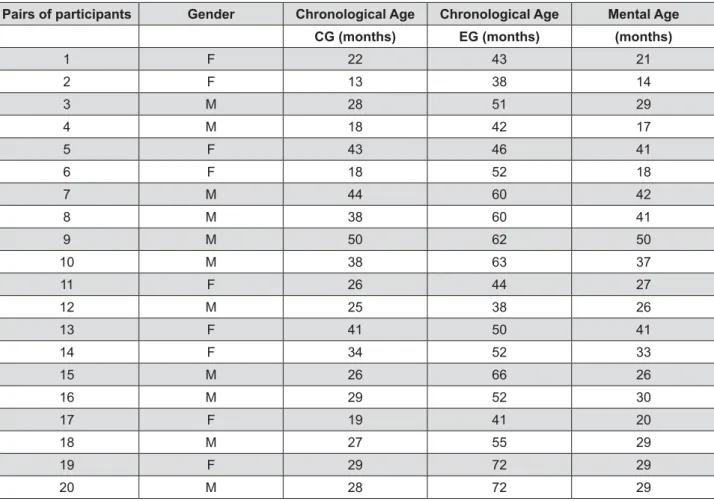
In Figure 1, the profile of participants is characterized in terms of gender, chronological and mental age.
The steps and age of acquisition of the milestones of psychomotor development are shown in Figure 2.
In this casuistry, the acquisition of cervical spine equilibrium in the EG occurred at ages between 3 )["[) without support occurred from the 7th to the 38th month of life, with a mean age of 15.1 months, and independent walking started at ages from 18 to 48 months, with a mean of 30.2 months. CG children " B " individuals with TD, i.e., the mean age for cervical \/ ]^ _* 12.2 months.
`/" "
Pairs of participants Gender Chronological Age Chronological Age Mental Age
CG (months) EG (months) (months)
1 F 22 43 21
2 F 13 38 14
3 M 28 51 29
4 M 18 42 17
5 F 43 46 41
6 F 18 52 18
7 M 44 60 42
8 M 38 60 41
9 M 50 62 50
10 M 38 63 37
11 F 26 44 27
12 M 25 38 26
13 F 41 50 41
14 F 34 52 33
15 M 26 66 26
16 M 29 52 30
17 F 19 41 20
18 M 27 55 29
19 F 29 72 29
20 M 28 72 29
F=female; M=male; CG=control group; EG=experimental group
words, the EG participants showed this skill at ages ranging from 10 to 48 months, with a mean of 28.7 months, while in the CG this skill started at ages between 8 and 18 months, with a mean of 12.7 months.
The statistical analysis of the Denver II results
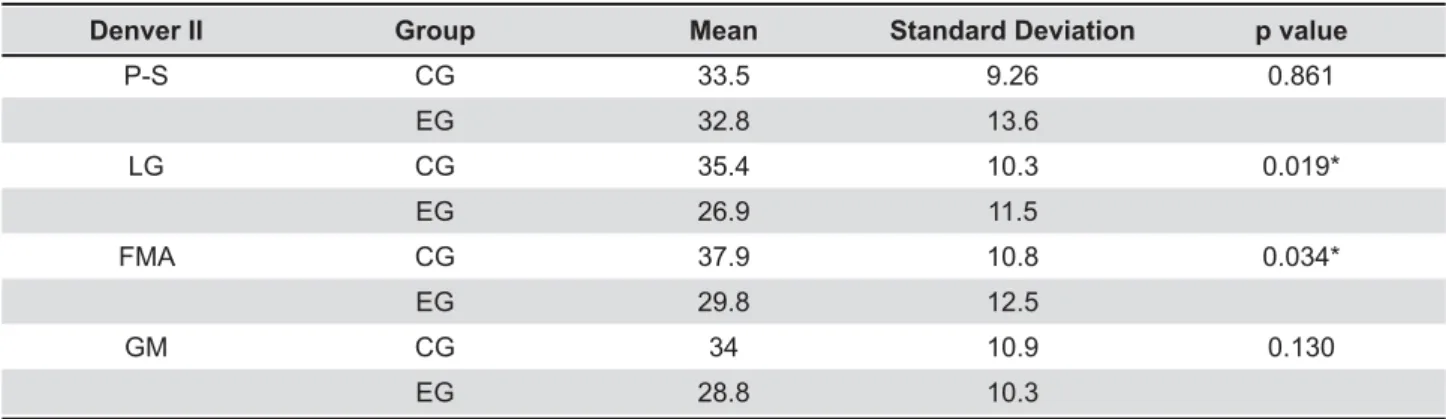
revealed a statistically significant difference /" adaptive areas.
Table 1 shows the mean and the standard deviation when comparing the CG and the EG performance in the application of the Denver II test
Pairs of Participants
Psychomotor Development
CSE (months) SWS (months) IW (months) FW (months)
CG EG CG EG CG EG CG EG
1 2 4 6 9 11 27 10 18
2 3 8 10 18 12 36 12 36
3 4 6 7 9 12 32 18 34
4 4 6 8 33 12 --- 12 36
5 2 8 6 14 12 38 10 24
6 5 5 7 8 13 27 16 40
7 3 28 6 38 11 48 12 36
8 3 3 7 7 12 27 24 13
9 3 6 6 8 10 21 12 42
10 3 5 9 9 12 23 11 10
11 3 6 7 12 14 23 18 24
12 3 4 6 7 14 18 8 36
13 5 5 8 11 12 20 8 22
14 3 11 8 13 13 22 11 24
15 1 10 5 30 13 48 16 24
16 4 5 6 9 13 20 12 30
17 3 8 7 14 10 36 14 24
18 3 9 7 12 14 20 12 24
19 2 9 6 17 12 40 12 28
20 3 18 6 24 11 48 12 48
! " group; EG=experimental group
Figure 2- Age of acquisition of the milestones of psychomotor development
Denver II Group Mean Standard Deviation p value
P-S CG 33.5 9.26 0.861
EG 32.8 13.6
LG CG 35.4 10.3 0.019*
EG 26.9 11.5
FMA CG 37.9 10.8 0.034*
EG 29.8 12.5
GM CG 34 10.9 0.130
EG 28.8 10.3
" "# $%% &" '(! % "')+!//<>?>H
through the Student’s t#{&&|+.
DISCUSSION
The sample of this study was designed to control important variables that have a bearing on child development, such as mental age, socioeconomic status, gender, birth at full term, birth weight, and absence of comorbidities, such as characteristics of the Autism Spectrum Disorder, metabolic alterations for congenital hypothyroidism and diagnosis of / allowed a more homogeneous sample.
Prematurity is considered an important biological risk for development delay. The literature shows that preterms, mainly those with low weight, come into the world in a very marked condition of general weakness that usually puts them in a situation of risk, not only of survival, but also of possible shortcomings in terms of development8. According to the inclusion criteria, no child of the sample showed a history of prematurity.
Congenital hypothyroidism is frequent among individuals with DS. Indeed, thyroid hormones are vital for the development of the central nervous system, particularly during childhood, as they affect the neuronal migration and differentiation, the activation of the sympathetic nervous system, synthesis and secretion of neurotransmitters and the processes of myelination. Untreated hypothyroidism can intensify several symptoms associated with DS during childhood such as psychomotor development, somatic and intellectual growth19. Thus, the sample was controlled considering the range of variables interfering in the process of global development of children with DS.
Recent research studies show that children < " the diagnosis criteria for the Autism Spectrum Disorder30. The sample was controlled in such a way that no child included in the study presented characteristics of the spectrum associated with DS.
One factor considered of risk for the alteration of the development is the presence of congenital heart disease. However, this was not an exclusion criterion in this study, although authors did state that children with DS who presented congenital " motor milestones when compared with children with DS who did not have a history of these associated alterations2. Individually analyzing the performance of the six children with DS that showed heart that only one of them showed cervical equilibrium, " notably superior (older age in the acquisition of development milestone) than the mean of the EG.
Analyzing Table 1, in the personal-social area,
/ "" between the groups, although the EG children had a chronological age superior to the CG. The personal-social area has been considered the development area that change the least among children with DS13,20,23, although it is not possible to establish = on many variables that are usually found in the particular social environments they attend. Indeed, children with DS are seen as extremely sociable and affectionate, and they also have an easy temperament. However, although these individuals / no means uniform23, since personal-social skills depend on the environment needs.
With effective social interactions and relationships initiated as early as possible, children tend to become more productive, showing the positive @ " that provide the social matrix for their overall development. The children who participated in this study started their intervention procedures still in " " educational system from an early age, which may have contributed to these results.
The difference regarding the educational degree of the groups in this casuistry is noteworthy due to the chronological age, since the classes in the Brazilian educational system are formed considering chronological age rather than level of development (/! "" degrees of stimulation for children from different / " " educational program.
The language area was the most impaired when comparing the groups, even considering that this study has strict control over the variables. We emphasize that the language skills required in the Denver II test referred mainly to the expression of concepts and production of words.
;"B skills are more impaired than the receptive ones in this population9,and that, regarding the cognitive " to severe. Language is the most extensively studied area in the context of the cognitive system, often giving a particular character to this performance considering the many involved variables31.
(2010) showed that the most impaired areas in the < " study.
< / have a considerable impact on the development of adaptive and functional skills, mainly in pre-school and school ages. Motor skills and acquisitions are determinant in social interactions, favoring the participation in interactional activities and in different social contexts in which language is developed29.
U that the EG children showed a delay in the neuropsychomotor development, observed from the acquisition of cervical equilibrium (mean of 8.2 months) to that of independent walking (mean of 30.3 months). The delay in the motor development of children with DS is expected, as well as the ""@B and joint hypermobility that influence posture control, adequate muscle synergy, accomplishment of movements and motor coordination14,18.
The delay in the neuropsychomotor development is an indication that there are alterations in the acquisition of skills in other development areas14, "" is considered the basis for the learning of new skills. Through the motor action, the child has the possibility to explore spaces, objects and their relationships. Thus, the motor limitation may " " of objects, with a loss of opportunities to develop the repertoire of learning experiences. The action creates and elicits cognition, through praxis, which has a form of mental planning that regulates, controls, integrates, elaborates and executes the child’s intentions12. In the comparison between the W$ difference in the gross motor skill. However, we must emphasize that these groups were matched considering mental age. Thus, the EG children showed chronological age superior to the CG children, which approximated the performance of these groups regarding the gross motor aspect. It /" < an altered performance in this aspect because this performance was similar to the ones of younger children with TD.
Considering the difference of performance in the areas evaluated for each group, we noticed that children with DS showed better performance " / motor-adaptive and gross motor areas, and worse performance in the language area. A different behavior pattern was shown by children with TD, /" adaptive area, followed by the language, gross
motor and personal-social areas.
The literature shows that the heterogeneity in the performance of children with DS, and suggest longitudinal studies aimed to evaluate the process of language development within this population throughout the years1,15,24,26.
Reflecting on the methodological path that reached its peak with these results, the importance of studies that show a control of variables is emphasized as a way to get more homogeneous groups. On the other hand, the sample group is expected to be smaller with such control of variables. A restriction of this study to be emphasized is the absence of an analysis of the participants’ central nervous system conditions by image exams, and the fact that individuals with congenital heart disease were not excluded.
In addition to the importance of matching of groups considering mental age, socioeconomic status and gender, as well as the control of variables considered as risk factors for development alterations, including premature birth, very low body weight, and congenital hypothyroidism, it is necessary to study these aspects while considering the anatomo-functional conditions of the nervous system of children with DS, for they would provide relevant information regarding the functioning of the processes that involve development. Longitudinal studies following the development of children with DS will be important to deepen the knowledge on this population development rhythm.
CONCLUSION
Children with DS showed an inferior performance compared with typical developing children matched for mental age, gender and socioeconomic status. ! "" the gross motor and personal-social areas.
ACKNOWLEDGMENTS
This study was supported by FAPESP - São Paulo Research Foundation, Process No. 2009/03355-9.
We would like to thank Professor José Roberto Pereira Lauris, professor of Statistics at the Bauru School of Dentistry, University of São Paulo, who helped us to carry out the statistical analysis of this study.
REFERENCES
1- Adamson LB, Bakeman R, Deckner DF, Nelson PB. Rating parent- child interactions: joint engagement, communication dynamics, and share topics in autism, Down syndrome, and typical ?)&^)'))_))]|
2- Anjos CC, Neto FG, Fontes VL. Comparative study of motor development of children with Down syndrome in relation to Denver ;;< Q)&&[*#_+][*^
]QUW $ $<QU ? "> $#?QW+)&^^
4- Campbell C, Landry O, Russo N, Flores H, Jacques S, Burack ?$@B/; @ " / / / ? ; /)&^]^^[#]+^*])&&
5- Carney DP, Henry LA, Messer DJ, Danielsson H, Brown JH, Rönnberg J. Using developmental trajectories to examine verbal and visuospatial short-term memory development in children and adolescents with Williams and Down syndromes. Res Dev Disabil. )&^]]']')^])
6- Chen CC, Ringenbach SD, Albert A, Semken K. Fine motor control is related to cognitive control in adolescents with Down ;/W )&^'_^#^+_^|
7- Edgin JO. Cognition in Down syndrome: a developmental ;>W$< )&^]']& 17.
[ =` $?$//>!@ of biological, social, and developmental factors on language acquisition in pre-term born children. Int J Speech Lang Pathol. )&^&^)#_+'_^^
* ?! ?$B " with Down syndrome and typically developing the same mental >$W ?$)&^)^'#|+[_*^
10- Frankenburg WK, Doods J, Archer P, Bresnick B, Maschka P, Edelman N, et al. Denver II Training Manual. Denver: Denver ^**)
11- Freire RC, Melo SF, Hazin I, Lyra MC. Neurodevelopmental and relational aspects of baby with Down syndrome. Av Psicol )&^'])#)+)'|*
12- Hadders-Algra A. General movements: a window for early " " )&&'^'|#)<+<^)[
13- Hippolyte L, Iglesias K, Van der Linden M, Barisnikov K. Social reasoning skills in adults with Down syndrome: the role of language, executive functions and socio-emotional behaviour. J ; />)&^&|'#[+^')_
14- Malak R, Kotwicka M, Krawczyk-Wasielewska A, Mois E, Samborski W. Motor skills, cognitive development and balance functions of children with Down syndrome. Ann Agric Environ )&^])&#'+[&]_
15- Martin GE, Losh M, Estigarribia B, Sideris J, Roberts J. Longitudinal profiles of expressive vocabulary, syntax and pragmatic language in boys with fragile-X syndrome or Down ;$)&^]'[#'+'])']
^_ %Q Q Q ? Q and affecting factors in 3- to 6-year-old children. Eur Arc `)&^')^#|+[^[
17- Pereira A, Riesgo RS, Wagner MB. Childhood autism: translation and validation of the Childhood Autism Rating Scale "QU)&&[['#_+'[*'
18- Pereira K, Basso RP, Lindquist AR, Silva LG, Tudella E. Infants with Down syndrome: percentage and age for acquisition of gross >/)&^]]'#]+[*'*&^
19- Purdy IB, Singh N, Brown WL, Vangala S, Devaskar UP. Revisiting early hypothyroidism screening in infants with Down )&^']'#^)+*]_'&
20- Rihtman T, Tekuzener E, Parush S, Tenenbaum A, Bachrach SJ, Ornoy A. Are the cognitive functions of children with Down syndrome related to their participation? Dev Med Child Neurol. )&^&|)#^+)[
21- Roizen NJ, Patterson D. Down’s syndrome. Lancet. )&&]]_^#*]_|+^)[^*
22- Santos AP, Weiss SL, Almeida GM. Assessment and intervention in the motor development of a child with Down syndrome. Rev QW W)&^&^_#^+^*]&
23- Silva NL, Dessen MA. Síndrome de Down: etiologia, U "; )&&)_#)+_^_ 24- Steele A, Scerif G, Cornish K, Karmiloff-Smith A. Learning to read in Williams syndrome and Down syndrome: F $ )&^]|'#+|'_)
25- Terman LM, Merril MA. Stanford-Binet Intelligence Scale: ""Q^*_& 26- Tsao R, Kindelberger C. Variability of cognitive development in children with Down syndrome: relevance of good reasons for >/)&&*]&')_]) 27- Van Gameren-Oosterin HB, Fekkes M, Reijineveld SA, Oudesluys-Murphy AM, Verkerk PH, Van Wouwe JP, et al. Practical and social skills of 16-19-years-olds with Down syndrome: ">/)&^]]'#^)+'|** 607.
28- Vicari S, Pontillo M, Armando M. Neurodevelopmental and psychiatric issues in Down’s syndrome: assessment and )&^])]#]+*|^&
29- Volman MJ, Visser JJ, Lensvelt-Mulders GJ. Functional status in 5 to 7-year-old children with Down syndrome in relation to motor ability and performance mental ability. Disabil Rehabil. )&&)*#^+)|]^
30- Warner G, Moss J, Smith P, Howlin P. Autism characteristics and behavioural disturbances in ~500 children with Down's syndrome W?>)&^'#'+']]'^