r e u m a
.
p t–
t h e r h e u m a t i c d i s e a s e sp o r t u g u e s e r e g i s t e r
Helena Canhão
*, Augusto Faustino
**, Fernando Martins
***, João Eurico Fonseca
****on behalf of the Rheumatic Diseases Portuguese Register Board Coordination,
Portuguese Society of Rheumatology:
Elsa Sousa, JA Pereira Silva, Maria José Santos, J Canas Silva, JA Melo Gomes, Cátia Duarte, José António Silva,
Luís Cunha-Miranda, Ana Teixeira, Walter Castelão, Jaime Branco, José António Costa, Domingos Araujo,
Teresa Nóvoa, Guilherme Figueiredo, Herberto Jesus, Alberto Quintal, Ana Rita Cravo, Graça Sequeira, Patrícia Pinto,
Rui André, Miguel Bernardes, Francisco Ventura, Inês Cunha, Anabela Barcelos, Patrícia Nero, Margarida Cruz
*Scientific coordinator Reuma.pt. Unidade de Investigação em Reumatologia, Instituto de Medicina Molecular. Faculdade de Medicina de Lisboa, Lisboa e Serviço de Reumatologia e Doenças Ósseas Metabólicas do CHLN - Hospital de Santa Maria. Lisboa. **National coordinator Reuma.pt. Instituto Português de Reuma-tologia e Clínica de ReumaReuma-tologia de Lisboa.
***Sociedade Portuguesa de Reumatologia
****Executive coordinator Reuma.pt. Unidade de Investigação em Reumatologia, Instituto de Medicina Molecular. Faculdade de Medicina de Lisboa, Lisboa e Serviço de Reumatologia e Doenças Ósseas Metabólicas do CHLN - Hospital de Santa Maria. Lisboa.
nic medical record linked to a SQL Server database. All Rheumatology Departments assigned to the Portuguese National Health Service (n=21), 2 Mili-tary Hospitals (Lisboa and Porto), 1 public-private Institution and 6 private centers adhered to the Register. Until now, 18 centers have entered data into Reuma.pt.
Results:By January 2011, 3438 patients and 16130 visits had been registered. 2162 (63%) were RA pa-tients, 700 of them treated with biological agents and 1462 with synthetic DMARDs. From the 515 (15%) AS patients, 297 were medicated with bio-logical and 218 with non-biobio-logical therapies. 293 (8%) were PsA patients, 151 treated with biological drugs and 142 with other treatment strategies. 368 (11%) had the diagnosis of JIA, 68 were under bio-logical treatment and 300 were managed with other treatment options. The register also includes 100 (3%) patients with other rheumatic diseases, submitted to treatments that required hospital day care infusions including 18 exposed to biological the rapies.
Conclusions: Registers are crucial to ensure cor-rect clinical use,adequate assessment of post-mar-keting biological therapies’ efficacy and safety, thus contributing for a better cost-benefit ratio. Reuma.pt, is a powerful and accurate tool to answer to these unmet needs. It presents a national covera -ge of the rheumatology centers and constitutes an invaluable resource for scientific research and to improve rheumatic patients care.
Keywords: Register; Biological therapies; Reuma.pt; Rheumatic diseases; Portuguese Society of Rheu -ma tology
Abstract
Introduction: Since June 2008, Portuguese rheu -matologists have been collecting on a routine basis, data into the nationwide Reuma.pt, the Rheu -matic Diseases Portuguese Register from the Por-tuguese Society of Rheumatology (SPR), which in-cludes rheumatic patients (rheumatoid arthritis – RA, ankylosing spondylitis – AS, psoriatic arthritis – PsA and juvenile idiopathic arthritis – JIA) recei -ving biological therapies or patients recei-ving syn-thetic disease modifying anti-rheumatic drugs (DMARDs).
The aim of this publication is to describe the stru cture of Reuma.pt and the population regis-tered since June 2008.
-Introduction
The Rheumatic Diseases Portuguese Register (RNDR), Reuma.pt, developed by the Portuguese Society of Rheumatology (SPR), became active in June 2008 and includes patients with rheumatoid arthritis (RA), ankylosing spondylitis (AS), psoria -tic arthritis (PsA) and juvenile idiopathic arthritis (JIA). The ultimate goal is to register all patients in Portugal (Mainland, Madeira and Azores Islands) with rheumatic diseases, treated with biological treatments and to follow them up to determine treatment efficacy, safety and long-term co-mor-bidities. The Register is also recruiting comparison cohorts of patients with RA, AS, PsA and JIA trea ted with synthetic disease modifying antirheu -matic drugs (DMARDs) and other treatment strate-gies (such as non-steroidal anti-inflammatory drugs in AS). This will enable to weigh the relative contribution of disease factors and standard treatments, whenever biological treatment effects (be ne ficial and hazardous) are being evaluated. Reu -ma.pt also includes BioGeral, a register for addi-tional rheumatic diseases treated at rheumato logy day care units, such as systemic lupus ery the -matosus, systemic sclerosis, vasculitis, Behçet’s disease, myositis, idiopathic, uveitis and osteo-porosis.
During the last decade, many rheumatology na-tional societies and rheumatology organizations have developed large registries (BSRBR1, DANBIO2,
RABBIT3, BIOBADASER4, CORRONA database5,
ARTIS6). In spite of differences regarding
informatics platforms, designs, data collection, natio -nal coverage and inclusion criteria, they all have a common mission of collecting data and increasing knowledge fostering the improvement of medical care of rheumatic patients. Moreover commonly used cores of validated measures such as ACR res -ponse components, RA disease activity score (DAS28), health assessment questionnaire (HAQ), Bath ankylosing spondylitis disease activity index (BASDAI) and adverse events are being registered. Reuma.pt was designed based on previously published standard observational protocols, which were in use for local printed registries7-9and on
na-tional recommendations for the use of biological agents10-13. Reuma.pt displays a user friendly clini
-cal chart scenario and has been subdivided for the medical users in several slightly different disease specific applications: BioRePortAR (the database for RA patients treated with biological therapies),
BioRePortEA (for AS), BioRePortAP (for PsA) and BioRePortAIJ (for JIA). RegistAR is similar to BioRe-PortAR and was designed to collect information from RA patients who are not treated with biologi -cal therapy. RegistEA, RegistAP and RegistAIJ are the correspondent databases to the other diseases. BioGeral is the registry used for rheumatic patients not included on the previous interfaces. All data -ba ses share the same platform and are linked upon the global register, Reuma.pt.
The aim of this publication is to describe the structure of Reuma.pt and the population regis-tered since June 2008.
Methods
Technical specifications
Reuma.pt is accessed through an electronic medi -cal record (EMR) application developed using Vi-sual Studio, an integrated development environ-ment (IDE) from Microsoft. It was written in
VB.NETfor the .NET Framework. The .NET
Frame-workprovides generic functionalities for Windows applications. It includes a large set of software components, and it supports several programming languages that allow language interoperability (each language can use code written in other lan-guages). Programs written for the .NET Framework
execute in virtual machine, known as the Common Language Runtime (CLR). The CLR provides seve -ral important services such as security, memory management, and exception handling.
Data are collected in a standardized format, through almost a hundred classification lists, that include drugs, pathologies, etc. All dates and nu-meric fields are also validated. The only fields that can be freely typed, are the fields specifically as-signed for notes.
All entered data is stored in a SQL Server data -ba se, a relational model data-base management sys tem produced by Microsoft. The application communicates with an instance of SQL Server by sending Transact-SQL statements to the server. SQL Server ensures that any change to the data is compliant with a set of properties (atomicity, con-sistency, isolation, durability), which guarantees that the database will always revert to a known con-sistent state on failure.
All entered data can be selected for exportation ac-cordingly to each analysis needs. A model of data exportation can also be selected. This can be done by choosing a longitudinal model (one row per vi -sit) and/or the data grid model (lists as the ones seen on most common application screens).
Nowadays, each center (hospital or medical office) has its own local installation of Reuma.pt. There is also a central server that stores data from all centers. However, this requires a regular data transfer from each center to the central server. La -ter this year, a Reuma.pt web version will be launched. This new version is a rich internet ap-plication (RIA) built on Microsoft Silverlight. Sil-verlight is a platform that enables to develop Web-based applications with a modern and efficient user interface, and also secure user interactions with desktop files, devices, data and applications such as Microsoft Office. This will leverage Reuma.pt to higher levels of accessibility. Addi-tionally, all entered data will be stored in a single web server, suppressing data transfers from local installations to a central server. All databases are linked, i.e. if a patient is already registered in Re gistAR and starts a biological agent, once that in-formation is inserted in the database, the patient is automatically switched to BioRePortAR envi-ronment.
Reuma.pt description and contents
Reuma.pt access is protected by username and password, which are unique to each rheumatolo-gist. New users can be authorized by current users. In the first menu the physician can create a new pa-tient or a new visit, or edit previous visits. On the left hand side, Reuma.pt screen displays a tree for-mat table of contents (Figure 1A). Some screens are the same across all databases: identification data, demographic data, work status, life styles, body mass index, previous medical history, joint surgeries, co-morbidities, SF-36 questionnaire, laboratorial results form, past and current thera-pies, adverse events, tuberculosis screening, observ ations/notes and charts while others are di -sease-specific. For RA, disease activity assessments include 3 visual analogue scales (VAS) (patient and physician disease activity and patient reported pain), 3 homunculus (tender joints, swollen joints and non evaluable joints), erythrocyte sedimenta-tion rate (ESR) and C reactive protein (CRP). When data needed for DAS28 (DAS 28 with 3 and 4 varia -bles, and with ESR or CRP) is inserted the score is
automatically computed (Figure 1B). ACR res -ponses between 2 requested time points are also automatically displayed (Figure 1C). Other screens include health assessment questionnaire, hand and feet X-rays Sharp/van der Heijde score and RA features like extra-articular manifestations, rheumatoid factor and anti-cyclic citrullinated pepti de (anti-CCP) antibodies. Screens are user friendly and give assisted support to fill in the bo -xes (scroll options, clever writing, pre-written ta-bles, classification systems, MedDRA), but w ithout neglecting detailed data collection. For instance «therapy fields» include start and end dates, fre-quency, dose, route of admi nistration, reasons for discontinuation and a link to the «adverse events window». «Adverse events» capture thorough in-formation according to regulatory authorities demand (Figure 1D), including type, severity, causali ty, actions taken and evolution. Registers dedica -ted to ankylosing spondylitis include BASDAI, BASFI, BASMI, ASDAS, ASAS res ponse, Stoke an -kylo sing spondylitis spine score, HLA B27 antigen and extra-articular manifestations. Psoriatic arthri-tis registers allow the patient disease classification in «AS-like» (axial disease) and/or «RA-like» (pe-ripheral disease) and the choice of the best evalu-ation measures for a specific patient. In addition, PASI is also collected. JIA patients have also specific questionnaires like the child health assessment questionnaire (CHAQ) and validated assessments (active joints, joints with decreased mobility and ACR30 responses). In BioGe ral instruments for SLE evaluation were included: SLE disease activity in-dex (SLEDAI) and SLICC damage inin-dex.
All screens are printable (before and/or after filled). After data collection, Reuma.pt can genera -te a pre-format-ted report, in-tegrating all informa-tion.
Reuma.pt Management
Reuma.pt was approved by National Data Protec-tion Board and by the local Ethics Committees. Pa-tients sign an informed consent for data research use and applications.
(the duration of a SPR electoral mandate). CC RNDR ordinary meetings are held every 6 months but extraordinary meetings can be scheduled whenever considered necessary. Regulations for data access, rules governing pharmaceuticals rela-tionship, project application forms, data agreement utilization and regulations for payment for data insertion were approved by CC RNDR and are pu bli -cly available at www.spreumatologia.pt. Indivi dual research projects addressing specific questions can be submitted to CC RNDR by SPR members.
Reuma.pt Implementation
Reuma.pt’s very early development was underta ken by SPR in a collaborative work with Instituto de Medicina Preventiva, Faculdade de Medicina de Lisboa.
Currently, Reuma.pt is widely established, en-compassing all Portuguese rheumatology centers. Identifying the contributing factors for this genera -li zed adherence could be of importance for coun-tries trying to establish new registers. From the be-ginning, we have involved representatives from all centers who had an important role in the design of
the interface and in the selection of the variables in-cluded in Reuma.pt. During the development, these representatives performed tests in their own centers and proposed changes. The database deve -lopment process has taken those suggestions into consideration and has been shaped fitting gene ral agreement. Moreover, advertisements and practi-cal training sessions were done during the major SPR meetings. The steering committee has been pe riodically promoting local sessions with rheuma-tologists, informatics and hospital mana gement staff, in order to facilitate Reuma.pt local imple-mentation. For eligible cases a fee has been paid for data insertion. Reuma.pt applications allowed the link with the electronic system from the hospital, namely the electronic medical record, avoiding double-typing and record duplications. Some tools like the automated calculation of DAS and HAQ, patients’ disease activity profile graphically dis-played, easy search of therapies and co-morbidities history, adverse event report based on the same classification system used by regulatory authori-ties and analysis of data for each center have been other important facilitating factors for the success
C
D
A
B
Figure1.Reuma.pt screens for patient synopsis (A), joint involvement (B), automatically display of ACR responses (C)
of Reuma.pt.
The collaborative work with Direcção Geral de Saúde (Portuguese Health Directorate) and also with international registers (such as the METEOR) has also been a priority. Reuma.pt has been fun ded by unrestricted grants from pharmaceutical
com-panies (Abbott, Bristol Myers Squibb, Merck Sharp and Dohme, Pfizer, Roche and UCB Pharma), which have not di-rect data access neither influen ce the research projects or data analysis. CC RNDR releases semiannual reports with detailed des cription of the data serted. Every 2 months, a Newsletter in-cluding a FAQ section and news is sent for all SPR members and is posted on SPR website.
Results
First BioRePortAR patients were regis-tered in June 2008 and progressively centers have begun inser ting patients and visits, with a steep increment since September 2009 (Figures 2 and 3). Data is prospectively inserted at each visit, but at the same time, rheumatologists have been inserting information recorded in paper forms before 2008, as part of the local printed registries that had been previously settled. Thus, Reuma.pt contains information on bio logical therapies since year 2000 (Fi -gure 4).
On January 2011, 3438 patients and 16130 visits were registered. From this global number, 2162 (63%) were RA pa-tients, 700 treated with biological agents and 1462 exposed to synthetic DMARDs. From the 515 (15%) AS pa-tients, 297 were medicated with bio-logical and 218 with non-biobio-logical therapies. 293 (8%) were PsA patients, 151 treated with biological drugs and 142 with standard nonbiological the -ra py. Of the 368 (11%) patients with the diagnosis of JIA, 68 were under biologi -cal treatment and 300 were managed with other strategies. The register also includes 100 (3%) patients with other diagnosis, submitted to treatments that required hospital day care infusions, including 18 exposed to biological therapies. This register’s environment includes diagnosis such as systemic lupus erythematosus, systemic sclerosis, myositis, idiopathic uveitis, vasculitis, Behçet’s di -sease and osteoporosis. All Rheumatology
De-0
2008-062008-082008-102008-122009-022009-042009-062009-082009-102009-122010-022010-042010-062010-082010-102010-12
4000Total number of registered patients 100050015003500300020002500Reg ARBio ARReg EABio EAReg APBio APReg AIJBio AIJReg GerBio GerTotal
0 2008-06 2008-08 2008-10 2008-122009-022009-042009-06 2009-08 2009-10 2009-122010-02 2010-04 2010-06 2010-08 2010-102010-12 4000
Total number of registered patients
1000 500 1500 3500 3000 2000 2500 Reg AR Bio AR Reg EA Bio EA Reg AP Bio AP Reg AIJ Bio AIJ Reg Ger Bio Ger Total
Figure2.Total number of patients registered in Reuma.pt
0
2008-062008-082008-102008-122009-022009-042009-062009-082009-102009-122010-022010-042010-062010-082010-102010-12 18000Total number of registered visits600040002000800016000140001000012000Reg ARBio ARReg EABio EAReg APBio APReg AIJBio AIJReg GerBio GerTotal
0 2008-06 2008-082008-10 2008-122009-022009-042009-062009-08 2009-102009-12 2010-02 2010-04 2010-06 2010-082010-102010-12 18000
Total number of registered visits
6000 4000 2000 8000 16000 14000 10000 12000 Reg AR Bio AR Reg EA Bio EA Reg AP Bio AP Reg AIJ Bio AIJ Reg Ger Bio Ger Total
Figure3.Total number of visits registered in Reuma.pt
0100501505004502002503003504002000-012000-072001-012001-072002-012002-072003-012003-072004-012004-072005-012005-072006-012006-072007-012007-072008-012008-072009-012009-072010-012010-072010-12RituximabTocilizumabAbataceptAdalimumabAnancinraEtanerceptCertolizumabGolimumabInfliximab Total number of registered biological therapies
0 100 50 150 500 450 200 250 300 350 400 Rituximab Tocilizumab Abatacept Adalimumab Anancinra Etanercept Certolizumab Golimumab Infliximab 2000-01 2000-07 2001-01 2001-07 2002-01 2002-07 2003-01 2003-07 2004-01 2004-07 2005-01 2005-07 2006-01 2006-07 2007-01 2007-07 2008-01 2008-07 2009-01 2009-07 2010-01 2010-07 2010-12
Total number of registered biological therapies
partments assigned to the Portuguese National Health Service (n=21), 2 Military Hospitals (Lisboa and Porto), 1 public-private Institution and 6 pri-vate centers adhered to the Register. Until now, 18 centers have entered data into Reuma.pt.
Rheumatoid arthritis (BioRePortAR and RegistAR)
As previously referred 2162 RA patients (700 were treated with biological agents and 1462 with syn-thetic DMARDs), with a currently mean age of 59.7 ± 13.8 years old, are registered in Reuma.pt. RA patients treated with synthetic DMARDs had a mean age of 61.5 ± 14.2 yearsold and those trea -ted with biological agents were 56.1 ± 12.2 years old. Mean age at time of diagnosis was 46.9 ± 14.4 years old and at the beginning of biological treat-ment was of 53.2 ± 12.6 years old. Mean disease du-ration at last observation was of 13.6 ± 9.9 years and at the starting of the biological was of 10.6 ± 9.1 years. Females represent 83.6% of patients, 81.3% in the group treated with synthetic DMARDs and 88.4% in the group treated with biological thera-pies (Table I). Rheumatoid factor was found in 73.6% and antiCCP in 70.9% of the cases. The di -sease was erosive in 72% of the patients. 35.7% of the patients treated with DMARDs and 35.6% trea -ted with a biological agent presen-ted extra-articu-lar manifestations.
Forty five point five percent were exposed to at least one administration of etanercept, 35.3% to infliximab, 31.1% to adalimumab, 11.2% to ritu
-ximab, 6.3% to tocilizumab, 2.2% to abatacept, 2.1% to anakinra and 1.4% to golimumab. The to-tal bio logical treatment’s exposure was of 2869.4 years (Table II).
In the group of patients treated with synthe tic DMARDs, current mean DAS28 (DAS 4 variables, with ESR) is 3.4 ± 1.5. 35.7% of patients with more than 6 months of follow-up were in remission de-fined by a DAS28 lower than 2.6 and 14.6% had a high disease activi ty (DAS28 above 5.1).
At the beginning of biological therapy, patients exhibited a mean DAS28 of 5.6 ± 1.7. Currently mean DAS28 is 3.6 ± 1.5 for patients under active treatment with a biological drug for more than 6 months and of 3.5 ± 1.4 for the group actively trea -ted for at least 1 year. The proportion of patients with a DAS28 below 2.6 is inferior in the biological treated group: 26.4% of the patients treated for at least 6 months and 26.9% for those with more than 1 year of treatment.
Current mean HAQ is 1.07 ± 0.75 for patients on synthetic DMARDs. Baseline mean HAQ was of 1.47 ± 0.63 for patients starting biological agents, 1.13 ± 0.69 when patients were treated for more than 6 months and 1.1 ± 0.69 in patients who had been treated with biological therapies for at least 1 year.
From the 804 RA patients who did at least one administration of a biological drug, 495 (61.5%) re-main on the first biological treatment registered into BioRePortAR, 108 (13.4%) definitely withdrew
Table I. Demographic features of patients registered in Reuma.pt, according to rheumatic disease.
Rheumatoid Ankylosing Psoriatic Juvenileidiopathic
arthritis spondylitis arthritis arthritis
Number of patients (total) 2162 515 293 368
with biological 700 297 151 68
non-biological 1462 218 142 300
Current age 59.7 ± 13.8 44.3 ± 12.7 53.3 ± 13 19.3 ± 11.1
Age at diagnosis 46.9 ± 14.4 31.9 ± 12.2 40.6 ± 12,9 6.6 ± 4.6
Age at biological onset 53.2 ± 12.6 40.6 ± 11.9 47.3 ± 11.1 20.6 ± 10.1
Mean disease duration 13.6 ± 9.9 17.7 ± 10.6 15.9 ± 9.5 13.3 ± 10.5
at last observation
Mean disease duration 10.6 ± 9.1 13.4 ± 10 12.5 ± 9.5 11.4 ± 9.6
at biological onset
Female 83.6% 38.2% 47.4% 68.2%
Biological 88.4% 35% 49% 73.5%
Non-biological 81.3% 42.7% 45.7% 67%
from the biological therapy and 201 (25 %) have been switched to other biological agent. From the group of 201 patients who switched therapies, 138 (68.7%) of them have switched once, 43 (21.4%) twice and 20 (9.9%) patients switched three or more times (Table III).
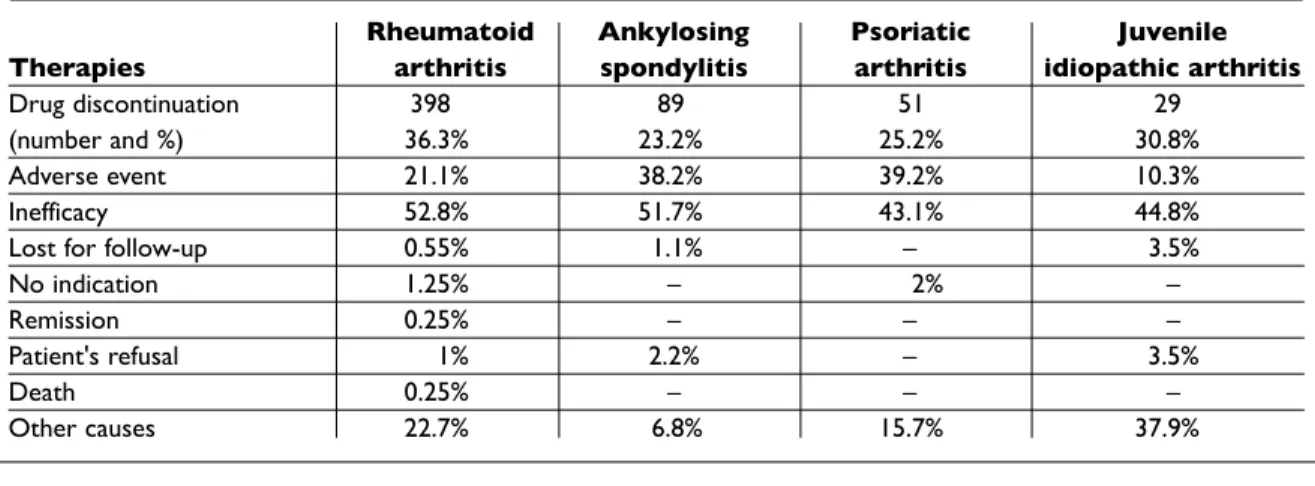
Considering 1096 biological therapies pres -cribed in BioRePortAR, drug was discontinued in 398 cases (36.35%). As we saw before, in 108 (27.1%) patients the drug was not resumed, and it was replaced by another biological agent in 290 (72.9%) of the cases. The main reason for discon-tinuation was inefficacy (52.8%) and in a lesser de-gree, adverse events (21.1%) or other causes (22.7%) (Table IV).
Ankylosing spondylitis (BioRePortEA and RegistEA)
From the 515 (15% of the registered patients) AS patients, 297 were medicated with biological and 218 with non-biological therapies. The mean age at diagnosis was 31.9 ± 12.2 years old. Current mean age is 44.3 ± 12.7 years old. Mean age at bio -logical treatment onset was of 40.6 ± 11.9 years old. Mean disease duration at last observation was of 17.7 ± 10.6 years and at the starting of the biologi -cal was of 13.4 ± 10 years. Males were 61.8%, 57.3% in the group without biological therapy and 65% in the group exposed to biological therapy (Table I). In this AS sample 82.3% were HLAB27 positive and 44% had extra-articular manifestations.
Considering all AS patients exposed to
biologi-Table II. Proportion of patients exposed to at least one drug's administration and total amount of biological treatment's exposure in years
Proportionofpatient's
exposedtoatleastone Rheumatoid Ankylosing Psoriatic Juvenile
administrationof arthritis spondylitis arthritis Idiopathicarthritis
Abatacept 2.2% – – 8.1%
Adalimumab 31.1% 31.7% 36.3% 21.6%
Anakinra 2.1% – – 10.8%
Etanercept 45.5% 35.9% 50% 68.9%
Golimumab 1.4% 0.6% 2.5%
-Infliximab 35.3% 53.8% 36.9% 9.5%
Rituximab 11.2% – – 1.3%
Tocilizumab 6.3% – – 2.7%
Total of biological 2869.4 987.6 512.3 275.3
treatment's exposure (years)
Table III. Proportion of patients remaining on the first biological drug, withdrew biological therapy and switched between biological agents
Rheumatoid Ankylosing Psoriatic Juvenile
Patients arthritis spondylitis arthritis idiopathicarthritis
Remaining in the first 495 235 118 55
biological therapy 61.5% 75.3% 73.7% 74.3%
Withdrew from biological 108 15 9 6
13.4% 4.8% 5.6% 8.1%
Switched 201 62 33 13
25% 19.9% 20.6% 17.6%
Once 68.7% 83.9% 72.7% 53.8%
Twice 21.4% 16.1% 27.3% 30.8%
DAI lesser than 2, and if the treatment was main-tained for a minimum of 1 year this proportion was of 47.2%.
From the 312 AS patients who did at least one administration of a biological drug, 235 (75.3%) re-main on the first biological treatment registered into BioRePortEA, 15 (4.8%) definitely withdrew from the biological therapy and 62 (19.9 %) have been switched to other biological therapies. From the group of 62 patients who switched therapies, 52 (83.9%) of them have switched once and 10 (16.1%) twice (Table III).
Considering the 384 biological therapies pres -cribed in BioRePortEA, the biological agent was discontinued in 89 cases (23.2%). As we have seen before, in 15 (16.8%) patients the drug was not re-sumed, and it was replaced by another biological agent in 74 (83.2%) of the cases. The reasons for dis-continuation were inefficacy (51.7%) in most ca ses and in a lesser degree, adverse events (38.2%) (Table IV).
cals, 53.8% of the patients received at least one ad-ministration of infliximab, 35.9% of etanercept, 31.7% of adalimumab and 0.64% of golimumab. The total amount of biological treatment’s expo-sure was of 987.6 years (Table II).
The mean BASDAI was reduced from 6 ± 2 at bio logical therapy onset to 2.7 ± 2.2 in the group of patients treated for at least 6 months and 2.5 ± 2.1 for those treated for at least 1 year.
The mean ASDAS improved from 3.8 ± 1 at ba -seli ne visit to 1.8 ± 1.1 in patients treated for 6 months or longer and to 1.7 ± 1 for patients under at least 1 year of biological therapy.
The mean BASFI was of 5.5 ± 2.4 at start and it is now of 2.9 ± 2.5 and 2.8 ± 2.4 for patients trea ted at least 6 months and 1 year with biological thera-pies, respectively.
At 6 months, the ASAS20 response was achieved by ~95% patients treated with biological therapies. Forty five per cent of AS patients treated with a bio -logical agent for at least 6 months presented a
BAS-Table IV. Reasons for biological therapy discontinuation
Rheumatoid Ankylosing Psoriatic Juvenile
Therapies arthritis spondylitis arthritis idiopathicarthritis
Drug discontinuation 398 89 51 29
(number and %) 36.3% 23.2% 25.2% 30.8%
Adverse event 21.1% 38.2% 39.2% 10.3%
Inefficacy 52.8% 51.7% 43.1% 44.8%
Lost for follow-up 0.55% 1.1% – 3.5%
No indication 1.25% – 2% –
Remission 0.25% – – –
Patient's refusal 1% 2.2% – 3.5%
Death 0.25% – – –
Other causes 22.7% 6.8% 15.7% 37.9%
Table V. Proportion of juvenile idiopathic arthritis (JIA) subtypes in patients treated with synthetic and biological therapies
JIAsubtypes SyntheticDMARDs BiologicalTherapies
Persistent oligoarthritis 42.6% 12.3%
Extended oligoarthritis 11.8% 12.3%
Poliarthritis with rheumatoid factor positive 8.8% 26.3%
Poliarthritis with rheumatoid factor negative 13.2% 19.3%
Systemic 10.3% 21.1%
Arthritis related with entesitis 11.8% 7%
Psoriatic arthritis 1.5% 1.7%
Psoriatic arthritis (BioRePortAP and RegistAP)
Two hundred and ninety three patients had PsA and they accounted for 8% of the patients regis-tered in Reuma.pt; 151 were treated with biologi-cal drugs and 142 with non-biologibiologi-cal therapies. The total biological treatment’s exposure was of 512.3 years.
Current mean age was of 53.3 ± 13 years old, 56.2 ± 14.7 years old for patients without biological the rapies and 50.6 ± 10.5 years old for patients trea -ted with biological agents. The mean age of di sease onset was of 37.4 ± 13.6 years old, the diagno sis was made, on average, at 40.6 ± 12.9 years old and the biological therapy initiated at a mean age of 47.3 ± 11.1 years old. Mean disease duration at last observation was of 15.9 ± 9.5 years and at the star -ting of the biological was of 12.5 ± 9.5 years. Con-sidering all PsA patients, 52.6% of the patients were males; 54.3% were medicated with conventional therapies and 51% with biological drugs (Table I).
From the group of patients treated with biologi -cal therapies 74.3% were classified as having «RA-like» psoriatic arthritis and 25.7% had an «AS--like» disease. 30.6% of PsA patients were HLAB27 positive. 50% of the patients were exposed to at least one administration of etanercept, 36.9% to infliximab, 36.3% to adalimumab and 2.5% to goli-mumab (Table II).
The number of tender joints was of 13.1 ± 11.2 in the beginning of biological therapy and was 3.4 ± 6.1 and 3 ± 5.7 after 6 months and 1 year under therapy, respectively. The correspondent figu -res for swollen joints were 6 ± 7.6, 0.9 ± 2.5 and 0.8 ± 2.3.
«RA-like» PsA group presented an initial mean DAS28 of 5.1 ± 1.6 and after at least 6 months and 1 year of biological therapy it was of 2.7± 1.4 and 2.6 ± 1,3, respectively. Currently, 49.1% of the pa-tients treated at least for 6 months and 51.1% in the group treated at least for 1 year present a DAS28 be-low 2.6. Mean DAS28 is currently of 4 ± 1.6 in pa-tients treated with synthetic DMARDs.
For the «AS-like» group, mean BASDAI was of 6.5 ± 1.8 at the beginning of biological therapy, it was 3.6 ± 2.4 after a minimum of 6 months of treat-ment and 3.4 ± 2.4 after 1 year.
Functional assessment in the «RA-like» group revealed a mean HAQ of 1.3 ± 0.7 when patients started biological therapy. It decreased to 0.85 ± 0.7 in patients treated for 6 months and to 0.82 ± 0.71 for treatments over 1 year. Current HAQ in the group of patients treated with standard treatments
was of 0.81 ± 0.65.
In spondylitis PsA patients, mean BASFI was of 5.7 ± 2.1 at baseline, and is currently of 3.5 ± 2.4 in patients treated for more than 6 months and of 3.4 ± 2.4 in those treated for more than 1 year.
From the 160 PsA patients who did at least one administration of a biological drug, 118 (73.7%) re-main on the first biological treatment registered into BioRePortAP, 9 (5.6%) definitely withdrew from the biological therapy regimen and 33 (20.6 %) have been switched to other biological therapy. From the group of 33 patients who switched the rapies, 24 (72.7%) of them have switched once and 9 (27.3%) twice (Table III).
Considering 202 biological therapies prescribed in BioRePortAP, drug was discontinued in 51 cases (25.2%). As we saw before, in 9 (17.6%) times the drug was not resumed, and it was replaced by an-other biological agent in 42 (82.4%) of the cases. The main reasons for discontinuation were ineffi-cacy in 43.1% and adverse events in 39.2% of ca ses (Table IV).
Juvenile idiopathic arthritis (BioRePortAIJ and RegistAIJ)
Three hundred sixty eight (11%) Reuma.pt patients had the diagnosis of JIA. 68 were currently medi-cated with biological agents while 300 were being managed with non-biological treatments. Mean age at disease onset was 6.6 ± 4.6 years old. Mean age at beginning of biological therapy was of 20.6 ± 10.1 years old. We clearly noticed two groups of JIA patients medicated with biological drugs. A group of JIA patients (n=32) who started biological therapies during childhood and whose mean age was of 12.8 ± 4.1 years old, and a group of JIA pa-tients (n=38) who started biological therapies al-ready as young adults with a mean age of 27.2 ± 8.9 years old at the beginning of biological treatment. The 300 JIA patients treated with synthetic DMARDs presented a mean age of 18.3 ± 11.1 years old. Mean disease duration at last observation was of 13.3 ± 10.5 years and at the starting of the biologi -cal treatment was of 11.4 ± 9.6 years. Females ac-count for 68.2% of patients; they were 67% in the synthetic treated group and represented 73.5% in the biological treated group (Table I).
The proportion of patients assigned to JIA subtypes differed in patients treated with non biologi -cal or biologi-cal therapies (Table V).
Rheumatoid factor was found in 22.1% and antiCCP in 31.2% of the patients. Extraarticular mani -festations were reported in 35.2% of patients from the conventional DMARDs group and 55.4% in the biological treated group.
The total amount of biological treatment’s ex-posure was of 275.3 years. Taking into account all JIA patients treated with biologics, 68.9% were ex-posed to at least one administration of etanercept, 21.6% to adalimumab, 10.8% to anakinra, 9.5% to infliximab, 8.1% to abatacept, 2.7% to tocilizu mab and to 1.3% rituximab (Table II).
The mean active joint count reported at begin-ning of biological therapies was 8.5 ± 8.4 and de-creased to 1.3 ± 2.2 and 1.4 ± 2.3 after 6 months and one year of therapy, respectively. Limitation of pas-sive motion (LOM) was observed at baseline in 4.7 ± 5 joints and after 6 months and 1 year in, respec -tively, 3.9 ± 8.8 and 4.2 ± 9.3 joints. Mean ESR was of 31.5 ± 21.4 mm/1sthour at biological treatment
onset and of 16.6 ± 15.5 and 17.3 ± 15.7 after, res -pectively, 6 months and 1 year of treatment. Mean Child health assessment questionnaire (CHAQ) and for adult patients HAQ scores showed 0.99 ± 0.7 at baseline, 0.42 ± 0.53 after 6 months and 0.45 ± 0.55 after at least 1 year of treatment.
From the 74 JIA patients who did at least one administration of a biological drug, 55 (74.3%) re-main on the first biological treatment registered into BioRePortAIJ, 6 (8.1%) definitely withdrew from the biological therapy and 13 (17.6%) have been switched to other biological therapy. From the group of 13 patients who switched therapies, 7 (53.8%) of them have switched once, 4 (30.8%) twice and 2 (15.4%) patients switched three or more times (Table III).
Considering 94 biological therapies prescribed in BioRePortAIJ, the drug was discontinued in 29 cases (30.8%). As we have seen before, in 6 (20.7%) of the times, the drug was not resumed, and it was replaced by another biological agent in 23 (79.3%) cases. The reasons for discontinuation were inef-ficacy in 44.8% of the cases and other reasons in 37.9%. Interestingly adverse events only accoun ted for 10.3% of the reasons reported for disconti nuing therapy in JIA patients (Table IV).
Discussion
The aim of this work was to present the structure, organization, management and first available data
from Reuma.pt, the Rheumatic Diseases Por-tuguese Register from SPR, after 2.5 years of its launch.
In 2005, SPR published two nationwide analy-ses of 376 rheumatoid arthritis14and 113 ankylo
-sing spondylitis15patients treated with biological
therapies. Also, single center’s analyses were per-formed16-17. At that time, observations were perio
-dically registered using paper forms with a com-mon core of measures. With Reuma.pt develop-ment and impledevelop-mentation a huge step has been made towards a more efficient and accurate data collection, storage and analysis.
In this work we have presented data that sup-ports the important role performed by registers in the evaluation of rheumatic patients treated with conventional or biological therapies. Treatment’s long term efficacy, drug’s survival time and analy-sis of switches between biologics are accurately evaluated by our and other registers.
Short and long term safety of biological agents in clinical practice pose additional challenges to registers. Similarly with the regulatory health au-thority INFARMED, we have adopted MedDRA as our classification system for adverse events. Ho w e ver in clinical daily practice, reporting all adver -se events is a difficult task for the overwhelmed physician and currently there are discrepancies be-tween centers in the criteria for registering adverse events in Reuma.pt. The CC RNSR is developing recommendations for adverse events collection, prioritizing adverse events by clinical relevance and/or severity in order to guarantee an adequate and reliable reporting from all centers.
Safety data analyses from Reuma.pt have been previously presented, based on a single center data. In an evaluation in 136 RA patients registered in BioRePortAR18, with a mean follow-up of 3.7±
2.8 years and an exposure to biological therapies of 510 patient-years, the authors have reported 311 adverse events, 242 of them classified by the rheumatologist as being related with the biologi-cal therapy. Twenty four (7.7%) were classified as serious adverse events which corresponded to an incidence rate of 5.8 serious adverse events/100 pa tients-year (2.2 infections /100 pt-years and 1.5 hypersensitivity reactions/ 100 pt-years).
Other analysis19of 42 BioRePortAP patients
therapy. The remaining adverse events were not severe and 67% of them were due to infections.
Also, in a group of 24 BioRePortAIJ patients20, 3
se rious adverse events (1 forearm fasciitis ne cro -sans, 1 orchiepididymitis and 1 allergic reaction) were reported, none of them resulted in patient’s death. There were no reports of opportunistic in-fections.
Latent tuberculosis infection (LTBI) is still a problem in Portugal. Due to that, SPR issued re -commendations21for LTBI screening in patients
starting biological therapies. In a previous nation-wide study22, based on the paper registry forms
prior to Reuma.pt launch, we have reported 13 ca -ses of tuberculosis between 1999 and 2005 in tients treated with biological therapies. Nine pa-tients had RA (in 639 RA exposed papa-tients, 1.4%), 3 AS (in 200 AS exposed patients, 1.5%) and 1 had PsA (in 101 PsA exposed patients, 1%). Tuberculin skin test (TST) was performed in 9 out of the 13 pa-tients. In 3 cases, the TST response was 0 mm. Also in 3 cases, the TST response was superior to 10 mm, and all of them were treated with isoniazid treat-ment 300 mg/d during 9 months. The time be-tween first symptoms and TB diagnosis was 2.6 +/ /-2.9 months. One death was reported; all of the other cases had a good outcome after anti-TB treat-ment. Four cases have occurred before the widespread screening established for all patients in 2003. The 2006 and 2008 update21 of the
recom-mendations for tuberculosis screening and LTBI treatment were more stringent, with the decrease of TST positivity threshold to 5mm and the intro-duction of a TST retest 2 weeks apart. Reuma.pt comprehends specific questions to address the is-sue of tuberculosis and a report will be prepared specifically on this issue.
In conclusion, patient registries are an impor-tant source for longitudinal observational studies in rheumatic diseases, which in turn are an essential complement to data obtained from randomi -zed clinical trials. In fact, registers are crucial to ensure correct clinical use,adequate assessment of post-marketing biological therapies’ efficacy and safety, therefore contributing for a rational cost--benefit ratio. Several registers across Europe and North America have demonstrated to be excellent tools for monitoring quality of care and for con-ducting scientific research that deals with impor-tant daily clinical problems. Reuma.pt, the national register from SPR, is also a powerful and accurate tool that will be able to contribute to some of the
unmet needs in the field of clinical rheumatology. In the near future, we are planning to develop sy -ner gies with international registers and to present Reuma.pt data in major scientific meetings and major international peer-review journals.
Correspondence to
Helena Canhão
Unidade de Investigação em Reumatologia Instituto de Medicina Molecular
Faculdade de Medicina de Lisboa Edifício Egas Moniz
Av Egas Moniz 1649-028 Lisboa
E-mail: [email protected]
Acknowledgements
Reuma.pt is supported by unrestricted research grants from Abbott, Bristol Myers Squibb, Merck Sharp and Dohme, Pfizer, Roche and UCB Pharma.
HC received a grant from Fundação para a Ciência e Tecnologia (FCT), Harvard Medical School-Portugal Pro-gram, HMSP-ICS/SAU-ICT/0002/2010.
References
1. Silman A, Symmons D, Scott DGI, Griffiths I. British Society for Rheumatology Biologics Register. Ann Rheum Dis 2003; 62: 28–29.
2. Hetland ML. DANBIO: a nationwide registry of bio-logical therapies in Denmark. Clin Exp Rheumatol 2005; 23: 205-207.
3. Listing J, Strangfeld A, Rau R et al. Clinical and func-tional remission: even though biologics are superior to conventional DMARDs overall success rates re-main low – results from RABBIT, the German biolog-ics register. Arthritis Res Ther 2006; 8:R66 (doi:10.1186/ar1933).
4. Gomez-Reino JJ, Carmona L, Angel Descalzo M; Biobadaser Group. Risk of tuberculosis in patients treated with tumor necrosis factor antagonists due to incomplete prevention of reactivation of latent infec-tion. Arthritis Rheum. 2007; 57: 756-761.
5. Kremer JM. The CORRONA Database. Clin Exp Rheumatol 2005; 23: 172-177.
6. van Vollenhoven RF, Askling J. Rheumatoid arthritis registries in Sweden. Clin Exp Rheumatol 2005; 23: 195-200.
7. Fonseca JE, Canhão H, Reis P, Jesus H, Pereira Silva JA, Branco J, Viana Queiroz M. [Protocol for Clinical Monitoring of Rheumatoid Arthritis (PMAR)]. De-cember 2007 update (PMAR)]. Acta Reuma Port 2007; 32: 367-374.
8. Canhão H, Fonseca JE, Castelão W, Viana Queiroz M. [Protocol for clinical monitoring of ankylosing spondylitis (PMEA)]. Acta Reuma Port 2003; 28: 93--97.
10. Fonseca JE, Canhão H, Reis P et al. Portuguese guide-lines for the use of biological agents in rheumatoid arthritis - March 2010 update. Acta Reumatol Port 2010; 35: 95-98.
11. Fonseca JE, Silva JA, Canhão H et al. [Practical guide for the use of biotechnological therapies in Rheuma-toid Arthritis] Acta Reumatol Port 2009; 34: 395-399. 12. Santos MJ, Fonseca JE, Canhao H et al. [Guidelines
for prescribing and monitoring biologic therapies in juvenile idiopathic arthritis]. Acta Reumatol Port 2007; 32: 43-47.
13. SPR Consensus Group for Biological Therapies on Ankylosing Spondylitis. [Consensus for the use of an-ti-TNF agents in ankylosing spondylitis]. Acta Reumatol Port 2005; 30: 155-159.
14. Grupo de Estudos de Artrite Reumatóide da So-ciedade Portuguesa de Reumatologia. Análise de 376 doentes com artrite reumatóide submetidos a ter-apêutica biológica registados na base de dados de agentes biológicos da sociedade portuguesa de reumatologia. Acta Reumatol Port 2005; 30: 63-71. 15. Grupo de Consensos para as terapêuticas Biológicas
na Espondilite Anquilosante da SPR. Análise de doentes com Espondilite Anquilosante submetidos a terapêutica biológica registados na base de dados de agentes biológicos da Sociedade Portuguesa de Reumatologia. Acta Reumatol Port 2005; 30: 253-256. 16. Cruz M, Branco J. Resultados em Mais de Um Ano de Terapêuticas Biológicas em Doentes com Artrite
Reumatóide. Acta Reumatol Port 2002; 27: 80-89. 17. Cruz M, Fonseca JE, Branco J. Três anos de
adminis-tração de etanercept e infliximab a doentes com ar-trite reumatóide refractária. Avaliação clínica e radio-gráfica e de segurança. Acta Reumatol Port 2004; 29: 21-32.
18. Pereira JP, Vieira M, Rodrigues A et al. [Safety evalua-tion of biological therapies in rheumatoid arthritis patients registered in BioRePortAR at Santa Maria Hospital]. Acta Reumatol Port 2010; 35: 51-52. 19. Campanilho-Marques R, Polido-Pereira J, Rodrigues
A et al. BioRePortAP, an electronic clinical record coupled with a database: an example of its use in a single center. Acta Reumatol Port 2010; 35: 176-183. 20. Mourao AF, Rodrigues A, Vinagre F et al. Seven years
of experience with biological treatment in juvenile idiopathic arthritis. Acta Reumatol Port 2010; 35: 63--64.
21. Fonseca JE, Lucas H, Canhão H et al. Recommenda-tions for the diagnosis and treatment of latent and active tuberculosis in inflammatory joint diseases candidates for therapy with tumor necrosis factor al-pha inhibitors: March 2008 update. Acta Reumatol Port 2008; 33: 77-85.
22. Fonseca JE, Canhao H, Silva C et al. [Tuberculosis in rheumatic patients treated with tumour necrosis fac-tor alpha antagonists: the Portuguese experience]. Acta Reumatol Port 2006; 31: 247-253.