ARTICLE
Motor Activity Log-Brazil: reliability and
relationships with motor impairments in
individuals with chronic stroke
Motor Activity Log-Brasil: confiabilidade e relações com a função motora em
indivíduos com acidente vascular cerebral crônico
Natalia Duarte Pereira1, Angélica Cristiane Ovando1, Stella Maris Michaelsen2, Sarah Monteiro dos Anjos3,
Renata Cristina Magalhães Lima4, Lucas Rodrigues Nascimento4, Luci Fuscaldi Teixeira-Salmela5
It is estimated that approximately 70% of individuals with hemiparesis following stroke with upper limb (UL) dysfunc-tions remain with residual disabilities1-4. hese deicits are
mainly characterized by slower reaching and grasping move-ments, excessive compensatory trunk movements and re-duced gross and ine manual dexterity5,6. After two to four
years after stroke, about 50 to 70% of the survivors demon-strate some resulting UL dysfunctions with functional losses and non-use of the paretic UL7.
Despite the large number of interventions designed to im-prove the motor ability of the most afected UL, studies have typically evaluated the UL function using measures which are
1 Mestre em Ciências do Movimento Humano, Universidade do Estado de Santa Catarina (UDESC), Florianópolis SC, Brazil;
2 Doutora, Docente dos Programas de Pós-graduação (PPG) em Ciências do Movimento Humano e de Fisioterapia, UDESC, Florianópolis SC, Brazil;
3 Mestranda do Programa de Pós-graduação do Departamento de Neurologia da Faculdade de Medicina da Universidade de São Paulo (FMUSP), São Paulo SP,
Brazil;
4 Mestre e Doutorando em Ciências da Reabilitação, Universidade Federal de Minas Gerais (UFMG), Belo Horizonte MG, Brazil; 5 Doutora, Docente do Programa de Pós-graduação em Ciências da Reabilitação, UFMG, Belo Horizonte MG, Brazil.
Correspondence: Natalia Duarte Pereira; Programa de Pós-Graduação em Ciências do Movimento Humano - CEFID/UDESC; Rua Pascoal Simone 358; 88080-350 Florianópolis SC - Brasil; E-mail: [email protected]
Conflict of interest: There is no conflict of interest to declare.
Received 09 May 2011; Received in final form 13 September 2011; Accepted 20 September 2011
ABSTRACT
The Motor Activity Log (MAL) assesses the spontaneous use of the most affected upper limb with the amount of use (AOU) and quality of movement (QOM) scales during daily activities in real environments in individuals with chronic stroke. Objectives: This study translated the testing manual into Portuguese and assessed the inter-rater and test-retest reliabilities of the MAL, based upon the Brazilian manual ver-sion. Methods: The inter-rater reliability was evaluated by comparing the results of two examiners, and the test-retest reliability was tested
by comparing the results of two evaluations, repeated one-week apart with 30 individuals with chronic hemiparesis (55.8±15.1 years).
Re-sults: The intra-class correlation coefficients (ICCs) for the total scores were adequate for both the inter-rater (0.98 for the AOU and 0.91 for QOM) and test-retest reliabilities (0.99 for both scales). Conclusions: The results suggested that the MAL was reliable to evaluate the spontaneous use of the most affected upper limb after stroke.
Key words: stroke, hemiplegia, quality of movement, motor impairment.
RESUMO
O Motor Activity Log (MAL) avalia o uso espontâneo do membro superior mais afetado por meio da escala de quantidade (EQT) e qualidade (EQL) de uso nas atividades cotidianas em ambiente real em pacientes com acidente vascular cerebral crônico. Objetivo: Este estudo tradu-ziu para o português o manual de aplicação e testou a confiabilidade interavaliadores e teste-reteste do MAL com base na versão brasileira
do manual. Métodos: Participaram 30 indivíduos (55,8±15,1 anos) com hemiparesia crônica. A confiabilidade interavaliadores foi testada
comparando o resultado de dois avaliadores, e a confiabilidade teste-reteste, pela comparação dos resultados de duas avaliações de um mesmo avaliador, todas com intervalo de uma semana. Resultados: As confiabilidades interavaliadores (coeficiente de correlação intra-classe - CCI=0,98 para a EQT e 0,91 para a EQL) e teste-reteste (CCI=0,99 para ambas as escalas) para os escores totais foram adequadas. Conclusões: A versão brasileira do MAL demonstrou confiabilidade adequada para avaliar o uso espontâneo do membro superior parético depois de um acidente cerebral vascular.
speciic to body structures and functions and/or global mea-sures of activity and participation within laboratory or clinical environments8. However, motor ability and the use of the UL
in this context may not correspond to what the individuals really perform in their daily lives. hus, it is important to rely on adequate instruments to assess relevant aspects of func-tional performance in real life contexts9. he efects of
neu-rorehabilitation on the most afected UL use in the real world are largely unexamined, and deicits in the most afected UL use after neurological injuries may be underdiagnosed8.
To evaluate the actual spontaneous use of the most af-fected UL during activities outside of the treatment settings, the Motor Activity Log (MAL) was developed. he MAL is composed of quantitative and qualitative scales and is ad-ministered by structured interviews during which patients are asked to rate how much, the amount of use (AOU), and how well, the quality of movement (QOM), their most im-paired arm was used to accomplish each of the 30 activities of daily living8,10.
The MAL was developed by Taub et al.10 to evaluate the
effects of constraint-induced movement therapy on the use of the most affected UL in individuals with stroke11. Its
original version was composed of 14 items8. Subsequently,
to allow the assessment of individuals with greater impair-ments, a 30-item version was developed11,12, which was
evaluated regarding its internal consistency, test-retest reliability and convergent validity. A summary of the psy-chometric properties of the MAL was previously report-ed by a systematic review of the literature13. The 30-item
MAL was translated and transculturally adapted to the Brazilian Portuguese language and some of its psychomet-ric properties were evaluated with Rasch analyses. The MAL-Brazil demonstrated to be clinically useful to assess the use of most affected UL of adults with chronic hemi-paresis13. However, the process of adaptation and
transla-tion does not assure the preservatransla-tion of the psychometric properties of the original version of the instrument and, thus, the reliability of the translated and transculturally adapted version should be evaluated.
Although Saliba et al.13 found adequate test-retest
reli-ability, they did not report the test-retest reliability for the in-dividual items and did not evaluate the inter-rater reliability of the Brazilian version. Since the reliability of the translated version of the MAL and the testing manual in the Portuguese language have not been evaluated, and considering the im-portance of systematic assessments to inform the efects of neurorehabilitation on the most afected UL use in the real world, the aims of the present study were: to evaluate the re-liability of the MAL, based upon the Brazilian version of the testing manual, and the relationships between the scores ob-tained from self-evaluation interviews regarding the AOU and QOM of the most afected UL and those obtained by the performance-based scale.
METHODS
Initial translation of the MAL testing manual
he present study used the items of the Brazilian ver-sion of the MAL13. he testing manual was translated by two
Brazilian physical therapists, who were luent in English and aware of the research objectives. hey received training regarding the MAL administration by the group of authors of the latest version of the test at the University of Alabama, United States.
MAL administration
he MAL is a structured interview, in which patients are asked to rate how much (AOU scale) and how well (QOM scale) their most afected arm was used to accomplish 30 activities of daily living outside of the therapeutic envi-ronment. he interview was conducted according to stan-dardized procedures described in the testing manual. Both scales, AOU and QOM, were printed on separate forms, which were placed in front of the participants during the test administration.
Both MAL scales are scored on six points, ranging from zero (never used) to ive (the same as pre-stroke), and partici-pants may select halfway scores, such as 1.5. Before its admin-istration, the diferences between the AOU and QOM scales were explained in detail and, during the test administration, these diferences were emphasized at regular intervals.
Each time the participants selected their scores, the in-terviewer veriied their answers by reading out loudly the chosen scores, so that they could conirm their choices, ac-cording to the testing manual instructions. Each scale total score corresponds to the mean of the items, calculated by the sum of the scores of all items, divided by the number of the accomplished items.
Participants
he translation of the testing manual and the partici-pants’ assessments were carried out after the study approv-al by the University Ethicapprov-al review board (#214/2009) and approv-all participants provide written informed consent.
hirty individuals (55.8±15.1 years) with chronic hemi-paresis (35.7±35.2 months after the onset of their stroke) were recruited from the general community of the cities of Belo Horizonte and Florianópolis, Brazil. All participants were in regular physical therapy treatment for at least six months. Fifteen participated in the test-retest and the other 15 in the inter-rater reliability measurements. Both samples were homogeneous regarding their ages, UL motor impair-ments, according to the Fugl-Meyer (FM) UL scores14,
Mini-Mental Status Examination scores15, and limb dominance.
To be included, the participants should have been at least 18 years old, had more than six months since the onset of their stroke and had no cognitive deicits, as determined by their Mini-Mental Status Examination scores15. Participants
were excluded if they had severe cognitive deicits, receptive aphasia, other neurological diseases, complete UL motor re-covery (FM≥65) or were completely plegic.
Test-retest and inter-rater reliabilities of the MAL based upon the testing manual information
To examine the test-retest reliability, one examin-er, who was not familiar with the interview administra-tion (LRN), applied the test twice, within one-week apart, based upon the testing manual information. The inter-rater reliability was evaluated by two independent rat-ers (ACO and NDP), one of them received training at the University of Alabama (NDP) and the other only had ac-cess to the translated testing manual. Subjects were test-ed by both raters approximately one-week apart13,16. The
decision to choose examiners, who were familiar and not familiar with the interview administration, was necessary to guarantee that the information described in the manu-al was sufficient to guide examiners and clinicians during clinical applications.
Statistical analyses
Intra-class correlation coeicients (ICCs) and their asso-ciated 95% conidence intervals (CIs) were used to estimate the inter- and test-retest reliabilities for the AOU and QOM scales. he ICC values were classiied as poor (<0.4), good (0.4<CCI<0.75) and excellent (>0.75)17. Spearman rank
corre-lation coeicients were calculated to evaluate the recorre-lation- relation-ships between the MAL scores and the motor impairment levels (FM scores), whereas the Bland and Altman18 method
was used to evaluate the test-retest and inter-rater agree-ments. he upper and lower limits of agreement represented the “error thresholds18. For all analyses, the signiicance level
was established at 5%.
RESULTS
Participants characteristics
The participants were predominantly men (66.6%). Twelve (40%) had motor impairments classified as mild (FM>50), eight (26.7%) as moderate (FM between 30 and 49) and ten (33.3%) had serious motor impairments (FM<30)14. Their Mini-Mental Status Examination scores
ranged from 20 to 30, and 56.6% had left hemiparesis. Regarding dominance, 86.6% were right-handed and 43.3% of the participants had paresis of their dominant UL. Table 1 gives the demographic and clinical information of the participants.
Reliability
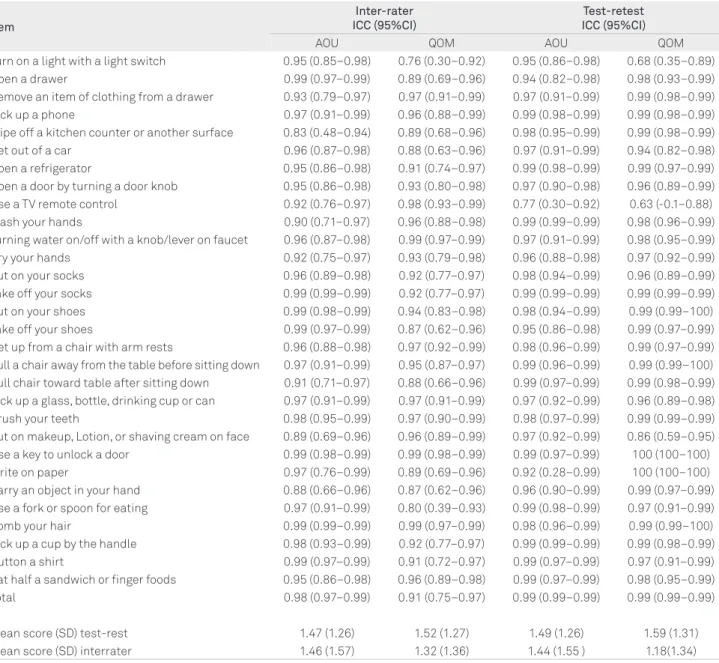
he total scores for the AOU and QOM scales regard-ing the test-retest reliability are shown in Table 2. he ICCs for the 29 tasks of the AOU scale were considered excel-lent (>0.94). Only the item related to the use of a TV re-mote control had an ICC of 0.77, although it was also con-sidered excellent. his same item together with the one related to turning on a light with a switch had ICCs con-sidered as good (0.63 and 0.68, respectively) for the QOM scale. he ICCs for the total scores were above 0.99 for both scales. he Bland and Altman plots illustrating the test-re-test agreement are shown in Figure. he mean diferences between the two measurements did not signiicantly difer from zero, and the limits of agreement were less than 5% of the range for both scales.
he ICCs for the AOU regarding the inter-rater reliabil-ity ranged from 0.83 to 0.99, and the lowest ICC was found for the “wipe of a kitchen counter” item, which was con-sidered excellent. he item-total reliability coeicient for the AOU scale was excellent (ICC=0.98) with ICCs ranging from 0.97 to 0.99. he lowest ICC for the QOM scale was found for the item “turn on a light with a light switch” (0.76) (Table 2). he Bland and Altman plots illustrating the inter-rater agreement showed that the mean diferences between the two measurements did not difer signiicantly from 0 and the limits of agreement were less than 10% of the range of the scale for the AOU scale. he limits of agreement for the QOM scales were 8.4 and 14% of the range of the scale.
Correlations between the MAL and the motor impairment scores
he Spearman’s correlation coeicients between the total AOU and FM scores for raters one and two were 0.76 (p<0.001) and 0.77 (p<0.001), respectively. Likewise, the total QOM scores correlated with the FM scores for both raters (ρ=0.78 and 0.80; p<0.001). When the most afected partici-pants (FM<30) were excluded, positive correlations (n=19) were found between the total AOU and FM scores for rater one (ρ=0.54, p=0.02) and two (ρ=0.47, p=0.04). Similarly, the total QOM correlated with the FM scores for the two raters (ρ=0.54 and 0.53, p=0.02).
Table 1. Demographic, stroke-related and clinical characteristics of the participants (n=30).
Variable Result
Age (years), mean (SD) 55.8 (15.1)
Time since stroke (years), mean (SD) 35.7 (35.2)
Gender (Men/Women), n Affected side (Right/Left), n Dominance (Right/Left), n
20/10 13/17 26/4
Fugl-Meyer – Upper limb score (0-66), mean (SD) 38.1 (21.1)
Mini-Mental State Examination Score (0-30), mean (SD)
Table 2. Intra-class correlation coefficients (ICCs) and 95% confidence intervals (CIs) for the test-retest and inter-rater
reliabilities for the amount of use (AOU) and quality of the movement (QOM) for the individual items of the Brazilian version of the Motor Activity Log (MAL-Brazil).
Item
Inter-rater ICC (95%CI)
Test-retest ICC (95%CI)
AOU QOM AOU QOM
Turn on a light with a light switch 0.95 (0.85–0.98) 0.76 (0.30–0.92) 0.95 (0.86–0.98) 0.68 (0.35–0.89)
Open a drawer 0.99 (0.97–0.99) 0.89 (0.69–0.96) 0.94 (0.82–0.98) 0.98 (0.93–0.99)
Remove an item of clothing from a drawer 0.93 (0.79–0.97) 0.97 (0.91–0.99) 0.97 (0.91–0.99) 0.99 (0.98–0.99)
Pick up a phone 0.97 (0.91–0.99) 0.96 (0.88–0.99) 0.99 (0.98–0.99) 0.99 (0.98–0.99)
Wipe off a kitchen counter or another surface 0.83 (0.48–0.94) 0.89 (0.68–0.96) 0.98 (0.95–0.99) 0.99 (0.98–0.99)
Get out of a car 0.96 (0.87–0.98) 0.88 (0.63–0.96) 0.97 (0.91–0.99) 0.94 (0.82–0.98)
Open a refrigerator 0.95 (0.86–0.98) 0.91 (0.74–0.97) 0.99 (0.98–0.99) 0.99 (0.97–0.99)
Open a door by turning a door knob 0.95 (0.86–0.98) 0.93 (0.80–0.98) 0.97 (0.90–0.98) 0.96 (0.89–0.99)
Use a TV remote control 0.92 (0.76–0.97) 0.98 (0.93–0.99) 0.77 (0.30–0.92) 0.63 (-0.1–0.88)
Wash your hands 0.90 (0.71–0.97) 0.96 (0.88–0.98) 0.99 (0.99–0.99) 0.98 (0.96–0.99)
Turning water on/off with a knob/lever on faucet 0.96 (0.87–0.98) 0.99 (0.97–0.99) 0.97 (0.91–0.99) 0.98 (0.95–0.99)
Dry your hands 0.92 (0.75–0.97) 0.93 (0.79–0.98) 0.96 (0.88–0.98) 0.97 (0.92–0.99)
Put on your socks 0.96 (0.89–0.98) 0.92 (0.77–0.97) 0.98 (0.94–0.99) 0.96 (0.89–0.99)
Take off your socks 0.99 (0.99–0.99) 0.92 (0.77–0.97) 0.99 (0.99–0.99) 0.99 (0.99–0.99)
Put on your shoes 0.99 (0.98–0.99) 0.94 (0.83–0.98) 0.98 (0.94–0.99) 0.99 (0.99–100)
Take off your shoes 0.99 (0.97–0.99) 0.87 (0.62–0.96) 0.95 (0.86–0.98) 0.99 (0.97–0.99)
Get up from a chair with arm rests 0.96 (0.88–0.98) 0.97 (0.92–0.99) 0.98 (0.96–0.99) 0.99 (0.97–0.99)
Pull a chair away from the table before sitting down 0.97 (0.91–0.99) 0.95 (0.87–0.97) 0.99 (0.96–0.99) 0.99 (0.99–100)
Pull chair toward table after sitting down 0.91 (0.71–0.97) 0.88 (0.66–0.96) 0.99 (0.97–0.99) 0.99 (0.98–0.99)
Pick up a glass, bottle, drinking cup or can 0.97 (0.91–0.99) 0.97 (0.91–0.99) 0.97 (0.92–0.99) 0.96 (0.89–0.98)
Brush your teeth 0.98 (0.95–0.99) 0.97 (0.90–0.99) 0.98 (0.97–0.99) 0.99 (0.99–0.99)
Put on makeup, Lotion, or shaving cream on face 0.89 (0.69–0.96) 0.96 (0.89–0.99) 0.97 (0.92–0.99) 0.86 (0.59–0.95)
Use a key to unlock a door 0.99 (0.98–0.99) 0.99 (0.98–0.99) 0.99 (0.97–0.99) 100 (100–100)
Write on paper 0.97 (0.76–0.99) 0.89 (0.69–0.96) 0.92 (0.28–0.99) 100 (100–100)
Carry an object in your hand 0.88 (0.66–0.96) 0.87 (0.62–0.96) 0.96 (0.90–0.99) 0.99 (0.97–0.99)
Use a fork or spoon for eating 0.97 (0.91–0.99) 0.80 (0.39–0.93) 0.99 (0.98–0.99) 0.97 (0.91–0.99)
Comb your hair 0.99 (0.99–0.99) 0.99 (0.97–0.99) 0.98 (0.96–0.99) 0.99 (0.99–100)
Pick up a cup by the handle 0.98 (0.93–0.99) 0.92 (0.77–0.97) 0.99 (0.99–0.99) 0.99 (0.98–0.99)
Button a shirt 0.99 (0.97–0.99) 0.91 (0.72–0.97) 0.99 (0.97–0.99) 0.97 (0.91–0.99)
Eat half a sandwich or finger foods 0.95 (0.86–0.98) 0.96 (0.89–0.98) 0.99 (0.97–0.99) 0.98 (0.95–0.99)
Total 0.98 (0.97–0.99) 0.91 (0.75–0.97) 0.99 (0.99–0.99) 0.99 (0.99–0.99)
Mean score (SD) test-rest 1.47 (1.26) 1.52 (1.27) 1.49 (1.26) 1.59 (1.31)
Mean score (SD) interrater 1.46 (1.57) 1.32 (1.36) 1.44 (1.55 ) 1.18(1.34)
All items with p<0.05.
DISCUSSION
he present study evaluated the reliability of the Brazilian version of the MAL accompanied by the translated testing manual, and the results for the inter-rater and test-retest reli-abilities were adequate. he second objective was to evaluate the relationships between the scores obtained from self-eval-uation interviews regarding the AOU and QOM of the most afected UL and those obtained by the performance-based scale, which evaluates post-stroke motor impairments.
he ICCs regarding the test-retest reliability were superi-or to those repsuperi-orted in previous studies, which assessed test-retest reliability with the original scale8,12,16, although both can
be considered excellent17. his diference may have occurred
due to distinct inclusion criteria, since for the reliability stud-ies with the original scale the participants should have been able to actively abduct their thumbs and extend their wrists and two or more digits more than ten degrees, which charac-terizes highly functioning individuals8,12,16. On the other hand,
the present study included individuals with all levels of mo-tor impairments, which can be observed by their Fulg-Meyer scores, ranging from four to 64. Considering that approxi-mately 2/3 of the MAL items require inger movements12, the
Previous studies adopted the minimal clinically impor-tant diference (MCID) set at 10% of the scale range, i.e., 0.5 points12,16, to demonstrate clinical improvements. While this
proposed value may have been a good starting point to demon-strate improvements, there is no consensus in the literature re-garding the responsiveness of the MAL to show improvements in the UL function19. In the present study, the mean test-retest
diferences for both AOU and QOM scales were 0.08 and 0.07, respectively, which were lower than the established clinically relevant limits. Observations of the mean diferences between the test-retest measurements on the scatter plots showed that they did not exceed 0.5 points (Figure), except for one partici-pant who showed an inter-rater diference of 0.6 points for the QOM scale. he test–retest agreement demonstrated that the MAL was stable for these individuals with chronic stroke, with limits of agreement less than 5% of the scale range for both the AOU and QOM scales. Regarding the inter-rater evaluations, the present results demonstrated that the mean diferences were respectively 0.2 and 0.3 for the AOU and QOM, which also did not exceed the adopted MCID.
When considering the inter-rater scores for the QOM scale, the scatter plot showed that changes should be above
14% of the scale range to exceed the measurement errors. his means that the reproducibility of the MAL scores by the same rater might be suicient to detect changes of 10% of the scale range, which was proposed as the MCID, but this is unclear when diferent raters evaluate the efects of neurorehabilitation at pre- and post-interventions. Despite that the inter-rater reliability for the QOM scale was con-sidered excellent (ICC=0.91), it is important to follow the testing manual instructions or use strategies, such as video demonstrations with examples of various ranking levels of QOM for some of the MAL items, so that the patients could establish a common point of reference and ensure accurate information.
In this study, individuals who had greater limitations of their UL use also had greater motor impairments, as dem-onstrated by the positive correlations between the AOU and QOM scores with the FM scores. According to Lang and Beeb20, to be able to use the hand for functional activities,
it is necessary to have control of the more proximal UL seg-ments to position and orient the hand with respect to the environment, and may need good control of the ingers to manipulate objects within the environment. hey reported
Figure. Scatter plots of the differences between the MAL amount of use (AOU) and quality of movement (QOM) scores and the mean of total scores per individual. (A) and (B): Test-retest scores for the AOU and QOM scales. (C) and (D): Inter-rater scores for the AOU and QOM scales. The horizontal continuous black lines in the middle indicate the mean differences and their confidence intervals are shown by black dotted lines. The gray dotted lines (more distant) indicate the upper and lower limits of agreement.
0.8 0.6 0.4 0.2 0.0 -0.2 -0.4 -0.6 -0.8 0 1
Mean of test-retest AOU measurements
Diff er ence be tw een t es t-r et es t A OU scor es
2 3 4 5
-0.25 -1,96 SD0.02 Mean0.21 +1.26 SD 0.8 0.6 0.4 0.2 0.0 -0.2 -0.4 -0.6 -0.8 0 1
Mean of test-retest QOM measurements
Diff er ence be tw een t es t-r et es
t QOM scor
es
2 3 4 5
-0.24 -1.96 SD-0.06 Mean0.12 +1.96 SD 0.8 0.6 0.4 0.2 0.0 -0.2 -0.4 -0.6 -0.8 0 1
Mean of test-retest AOU measurements
Diff er ence be tw een t es t-r et es t A OU scor es
2 3 4 5 6
-0.44 -1.96 SD -0.02 Mean 0.40 +1.96 SD 0.8 0.6 0.4 0.2 0.0 -0.2 -0.4 -0.6 -0.8 0 1
Mean of test-retest QOM measurements
Diff er ence be tw een t es t-r et es t A OU scor es
2 3 4 5
1. Wolf SL, Thompson PA, Winstein CJ, et al. The EXCITE stroke trial: comparing early and delayed constraint-induced movement therapy. Stroke 2010;41:2309-2315.
2. Dromerick AW, Edwards DF, Hahn M. Does the application of constraint-induced movement therapy during acute rehabilitation reduce arm impairment after ischemic stroke? Stroke 2000;31:2984-2988.
3. van der Lee JH, Beckerman H, Lankhorst GJ, Bouter LM. Constraint-induced movement therapy. Arch Phys Med Rehabil 1999;80:1606-1607.
4. Dromerick AW, Lang CE, Birkenmeier RL, et al. Very Early constraint-induced movement during stroke rehabilitation (VECTORS): a single-center RCT. Neurology 2009;73:195-201.
5. Broeks JG, Lankhorst GJ, Rumping K, Prevo AJ. The long-term outcome of arm function after stroke: results of a follow-up study. Disabil Rehabil 1999;21:357-364.
6. Michaelsen SM, Jacobs S, Roby-Brami A, Levin MF. Compensation for distal impairments of grasping in adults with hemiparesis. Exp Brain Res 2004;157:162-173.
7. Woldag H, Hummelsheim H. Evidence-based physiotherapeutic concepts for improving arm and hand function in stroke patients: a review. J Neurol 2002;249:518-528.
8. Uswatte G, Taub E, Morris D, Vignolo M, McCulloch K. Reliability and validity of the upper-extremity Motor Activity Log-14 for measuring real-world arm use. Stroke 2005;36:2493-2496.
9. Ashford S, Slade M, Malaprade F, Turner-Stokes L. Evaluation of functional outcome measures for the hemiparetic upper limb: a systematic review. J Rehabil Med 2008;40:787-795.
10. Taub E, Miller NE, Novack TA, et al. Technique to improve chronic motor deficit after stroke. Arch Phys Med Rehabil 1993;74:347-354.
11. Winstein CJ, Miller JP, Blanton S, et al. Methods for a multisite randomized trial to investigate the effect of constraint-induced
movement therapy in improving upper extremity function among adults recovering from a cerebrovascular stroke. Neurorehabil Neural Repair 2003;17:137-152.
12. Uswatte G, Taub E, Morris D, Light K, Thompson PA. The Motor Activity Log-28: assessing daily use of the hemiparetic arm after stroke. Neurology 2006;67:1189-1194.
13. Saliba VA, Magalhães LC, Faria CD, Laurentino GEC, Cassiano JG, Teixeira-Salmela LF. Adaptação transcultural e análise das propriedades psicométricas da versão brasileira do instrumento Motor Activity Log. Rev Panam Salud Publica 2011;30:262-271.
14. Michaelsen SM, Rocha AS, Knabben RJ, Rodrigues LP, Fernandes CGC. Tradução, adaptação e confiabilidade interexaminadores do manual de administração da escala de Fugl-Meyer. Rev bras fisioter 2011;15:80-88.
15. Bertolucci P, Brucki SMD, Campacci SR, Juliano Y. O mini-exame do estado mental em uma população geral: impacto da escolaridade. Arq Neuropsiquiatr 1994;52:1-7.
16. van der Lee JH, Beckerman H, Knol DL, de Vet HC, Bouter LM. Clinimetric properties of the motor activity log for the assessment of arm use in hemiparetic patients. Stroke 2004;35:1410-1414.
17. Fleiss Jl. Statistical methods for rates & proportions. New York: Wiley and Sons; 2004.
18. Bland JM, Altman DG. Statistical methods for assessing agreement between two methods of clinical measurement. Lancet 1986; 1:307-310.
19. Fritz SL, George SZ, Wolf SL, Light KE. Participant perception of recovery as criterion to establish importance of improvement for constraint-induced movement therapy outcome measures: a preliminary study. Phys Ther 2007;87:170-178.
20. Lang CE, Beebe JA. Relating movement control at 9 upper extremity segments to loss of hand function in people with chronic hemiparesis. Neurorehabil Neural Repair 2007;21:279-291.
References
that the movement control of all segments, as well as hand grip strength and active range of motion, was related to hand function for activities of daily living in chronic stroke individ-uals. In the present study, it was observed for the MAL items: “use a TV remote control”, “pick up a cup by a handle”, and “button a shirt” that 15 out of the 20 participants with FM scores <30 scored could not perform, i.e., they scored zero on the AOU scale, illustrating the relationships between func-tionality and ine motor activities.
his study also provided relevant information regarding the proile of the participants who might beneit from the MAL evaluations. Individuals with various motor impairment lev-els were evaluated and it was observed that the most severely impaired subjects showed loor efects. his may have hap-pened due to the fact that the MAL has few easy items. When the participants with severe motor impairments (FM<30) were excluded, the correlations between the FM scores and the AOU and QOM scores decreased. Clinically, these results are in accordance with those reported by Saliba13 and suggest
that the use of the MAL is limited when applied to individu-als with severe motor impairments. Otherwise, the scale al-lows measurement of individuals with superior UL abilities and does not demonstrate ceiling efects.
Some of the limitations of this study included the rela-tively small sample and the number of raters for the inter-rater reliability assessments, which could limit the generaliz-ability of the results. However, the inter-rater religeneraliz-ability was considered excellent between the trained and the untrained raters, which suggested that the manual was suiciently clear to guide the examiners during the test administration. Increased number of raters from diferent areas of rehabili-tation is strongly recommended in future studies to better demonstrate inter-rater reliability.