journal homepage:www.elsevier.com/locate/europolj
Functional polylactide via ring-opening copolymerisation with
allyl, benzyl and propargyl glycidyl ethers
Gwenaelle Pound-Lana
a,⁎, Jean-Michel Rabanel
b, Patrice Hildgen
b,
Vanessa Carla Furtado Mosqueira
aaLaboratório de Desenvolvimento Galênico e Nanotecnologia, Universidade Federal de Ouro Preto, Campus Universitário Morro do Cruzeiro, Ouro
Preto, MG 35400-000, Brazil
bLaboratoire de Nanotechnologie pharmaceutique, Faculty of Pharmacy, Université de Montréal, Montréal, QC H3T 1J4, Canada
A R T I C L E I N F O
Keywords:
Ring-opening copolymerisation Epoxide
Polymer-conjugate Fluorescent probe Azide-alkyne cycloaddition Polymeric nanoparticles
A B S T R A C T
A versatile and simple strategy is presented to synthesize reactive polylactide derivatives and their block copolymers with polyethylene glycol. Commercially available glycidyl ethers with an allyl, benzyl or propargyl functional group were copolymerised with D,L-lactide.
Tin(II)-2-ethylhexanoate-catalysis produced polymers with up to 4.6, 5.9 and 2.3 allyl, benzyl or propargyl groups per chain, respectively. In contrast, less than one reactive group per chain was obtained with the organocatalyst 1,5,7-triazabicyclo[4.4.0]dec-5-ene. By increasing the polymerisation feed ratio in glycidyl ether polymers with a higher number of reactive groups per chain were obtained, however a decrease in molar mass was observed. An azidocoumarin was conjugated to the propargylated polymersviacopper-catalysed azide-alkyne cycloaddition. These dye-labelled polymers produced nanospheres withfluorescent properties and diameters in the 100-nm size-range, as characterised by asymmetricflowfieldflow fractionation hyphenated with fluores-cence, static and dynamic light scattering detection. The functionalised polymers were obtained at gram-scale in one step from commercially available reagents; therefore providing a robust and easy to implement approach for the production of multifunctional nanomaterials.
1. Introduction
Polylactide is widely used in the field of biomaterials and drug delivery due to its exceptional biocompatibility and bioresorbability. The hydrophobic character of this polymer makes it suitable for the preparation of polymeric nanocarriers capable of encapsulating poorly soluble lipophilic drugs in aqueous suspensions. In such applications, where molar masses above 10,000 g mol−1 favour in vitro [1]and in vivostability of the nanoparticles, PLA is prepared via ring-opening polymerisation (ROP). In order to allow the conjugation of drugs, biological ligands or medical imaging probes great efforts have been made to introduce functional groups along the polymer chain. The most successful approach consists in the copolymerisation of lactide with functional derivatives of lactide or glycolide, as recently reviewed in[2]. The similar reactivities of the co-monomers allow high levels of incorporation of the functional co-monomers. However, the applicability of this method is limited by the difficulty in synthesizing the functional cyclic esters, since the alpha-hydroxy acid precursors require tedious multi-step synthesis and purification. In addition, a “copolymerisation” approach is particularly appealing because it allows the preparation of block
copolymers of functional PLA with polyethylene glycol (PEG), the amphiphilic block copolymer of choice for the preparation of
long-http://dx.doi.org/10.1016/j.eurpolymj.2017.03.028
Received 25 January 2017; Received in revised form 10 March 2017; Accepted 11 March 2017
⁎Corresponding author.
E-mail address:[email protected](G. Pound-Lana).
Available online 14 March 2017
0014-3057/ © 2017 Elsevier Ltd. All rights reserved.
circulating nanocarriers[3]. Consequently, more readily-available functional co-monomers have been sought after for copolymer-isation with lactide.
Within the library of compounds susceptible to undergo ring-opening (co)polymerisation, glycidyl ethers may be obtained from commercial sources with a variety of functional groups. In addition, conjugation chemistries with these monomers are already described for their homo- and copolymers [4]. In particular, allyl glycidyl ether (AGE) and propargyl glycidyl ether (PGE) incorporated in a polymer allow its direct modification under“click”chemistry conditions, such as thiol-ene for AGE[5]and
thiol-yne and the 1,3-dipolar cycloaddition with organic azides for PGE[6]. The benzyl ether group in benzyl glycidyl ether (BGE) is a precursor to the hydroxyl group, readily obtained via catalytic hydrogenation, and for which derivatisation and coupling strategies are available.
Copolymerisation of lactide with glycidyl ethers is an attractive strategy towards functionalised polylactide derivatives for the ease of implementation. Nonetheless, limitations have already been identified, which are a low degree of incorporation of the epoxide in the copolymer, even at high epoxide feed ratio, and a detrimental impact of the initial epoxide feed ratio on the resulting polymer molar mass and molar mass distribution. In the present study we investigate the potential and limits of this approach in terms of co-monomer incorporation for three reactive glycidyl ethers, namely AGE, BGE and PGE (Scheme 1), and the impact on the copolymer molar mass and molar mass distribution. The influence of the ROP catalyst was studied by comparing the copolymer composition, monomer conversion and polymerisation times under SnOct2or TBD catalysis.
The present synthetic strategy was applied to the preparation of a macromolecularfluorescent probe, whereby an azide-functional coumarin was conjugated to alkyne-functional PLA or PEG-b-PLA. The conjugates self-assembled intofluorescent nanospheres, which narrow size distribution was assessed upon fractionation under asymmetricflowfieldflow fractionation (AF4) withfluorescence, multi-angle light scattering (MALS) and dynamic light scattering (DLS) characterisation.
2. Experimental
2.1. Materials
The monomer 3,6-dimethyl-1,4-dioxane-2,5-dione (D,L-lactide, Sigma, 98%) was purified by three recrystallisations from dry toluene. Benzyl alcohol, used as a polymerisation initiator, was distilled under reduced pressure (160 °C, 70 kPa). The polymerisation catalyst tin (II) 2-ethylhexanoate (SnOct2, Sigma, 95%) was dried under reduced pressure (7 × 10⁻²mbar) and stored under argon and 1,5,7-triazabicyclo[4.4.0]dec-5-ene (TBD, Sigma-Aldrich, 98%) was dried by three azeotropic distillations with toluene and stored under argon. 3-(α-Azidoacetyl)coumarin was prepared from 3-(bromoacetyl)coumarin (Aldrich, 97%) according to a literature procedure[7]. Dry dichloromethane (Aldrich, 99%) was stored over 3 Å molecular sieves and degassed under aflow of argon for 30 min prior to use in polymerisations. Allyl glycidyl ether (AGE, Aldrich, > 99%), benzyl glycidyl ether (BGE, Aldrich, 99%), glycidyl propargyl ether (PGE, Aldrich, 95%), poly(ethylene glycol) monomethyl ether (mPEG5k, Mn5000 g mol−1and mPEG
2k, Mn
2000 g mol−1), poly(ethylene glycol) (PEG
2k, Mn 2050 g mol−1), sodium azide (Sigma, 99.5%), dry toluene (Aldrich, 99%), anhydrous Na2SO4, CuSO4,L-ascorbic acid, sodium bicarbonate, and PA grade dichloromethane, hexane, propan-2-ol and acetone
from VETEC (Brazil) were used as received.
2.2. Characterisation
1H and13C NMR experiments were recorded at 25 °C on a Bruker AVANCE DRX400 MHz spectrometer. Copolymers with BGE
were analysed in DMSO-d6and all other compounds in CDCl3, with tetramethylsilane (TMS) as the internal reference. Chemical shifts
(δ) are given in parts per million (ppm). The molar mass distribution of the polymers was characterised by gel permeation chromatography (GPC) on an Agilent Technologies 1260 Infinity unit comprising a solvent degasser, isocratic pump, an Agilent 1260 Infinity UV detector (G1314F) and a differential refractive index detector (G1362A RID at 35.0 °C) in series, a Varian PLgel 5 µm MiniMix-D 50 × 4.6 mm pre-column and two Agilent PLgel 5 µm MiniMix-D 250 × 4.6 mm columns in series at 30.0 °C with HPLC grade THF with 250 ppm BHT stabilizer as the eluent at aflow of 0.25 mL/min. The samples were prepared at a concentration of 3 mg/mL in the eluent,filtered (0.22 µm PVDF Milliporefilter) and the injection volume was 20 µL. The system was calibrated using Agilent Technologies EasiVial narrow dispersion polystyrene standards (162–371,100 g mol−1). Fluorescence spectra were recorded on a Shimadzu RF-5301PC spectrometer.
The polymeric nanosphere suspensions were diluted at 1:500 in 1 mM NaCl and characterised in terms of Z-average hydrodynamic diameter (Dh) by dynamic light scattering (DLS) and zeta potential by electrophoretic light scattering on a
Zetasizer Nano ZS (Malvern Instrument, UK) equipped with a He-Ne Laser at 633 nm. Dhwere calculated with cumulant analysis
membrane and a 350 µm spacer. The fractionated sample was detected using a PN3211 UV detector with absorbance at 254 nm, and a PN 3412fluorescence detector with excitation at 310 and emission at 390 nm, the gyration diameter of the fractions were determined with a PN3621 multi-angle laser light scattering (MALS) detector with a 532 nm laser (7–164°, 21 angles) and the
hydrodynamic diameter with a Zetasizer Nano ZS (Malvern Instrument, UK–as described above), in series. The carrier liquid was
10 mM NaCl in Milli-Q waterfiltered on a 0.1 µm PTFE membranefilter (Millipore®). The separation channel and detectors were kept at 25 °C and the detectorflowrate was maintained at 0.5 mL/min. The nanosphere suspensions were diluted at 1:3 in the carrier liquid. The injectionflowrate was set at 0.2 mL/min with injection time of 3 min, an injection volume of 20 µL and a transition time of 1 min. An initial crossflow of 1.5 mL/min was applied during injection, maintained for 3 min and was set to decrease exponentially to 0.05 mL/min over a period of 15 min and maintained at 0.05 mL/min for 10 min, allowing complete elution of the sample. The gyration diameters (Dg) were determined for each fraction at 3.8 s time intervals using the angular variation of the scattered light
intensity at angles 20–156° (19 angles) recorded on the MALLS detector using the Postnova AF2000 software calculation for spherical
shape model and Dhat 5.0 s intervals. The differential and cumulative Dg-distributions and distribution parameters D5, D50and D95%
were determined using the intensity of the UV signal as the value of concentration for each fraction relative to the total sample.
2.3. Polymer synthesis with SnOct2catalyst
2.3.1. Copolymers ofD,L-lactide and glycidyl ethers
In a typical copolymerisation (entry 9,Table 1)D,L-lactide (1.00 g, 7.0 mmol) was weighed in an oven-dried 50-mL Schlenkflask fitted with a 3 × 10 mm magnetic stirbar. PGE (246 µL, 2.2 mmol), benzyl alcohol (38 µL of a solution in toluene at 20 mg/mL) and SnOct2(155 µL of a solution in toluene at 20 mg/mL) were added. Theflask wasfitted with a rubber septum. Five cycles of vacuum
(1 × 10⁻¹mbar)/argon were applied. Theflask was sealed and placed in an oil bath at 128 °C (temperature inside theflask: 120 °C) with magnetic stirring (360 rpm). The reaction was interrupted at the point where magnetic stirring was impaired due to the high viscosity of the polymerisation medium, by cooling the reaction vessel in an ice bath. The polymers were dissolved in dichloromethane (5 mL), precipitated in hexane (50 mL), re-dissolved in dichloromethane (5 mL), precipitated in propan-2-ol (50 mL) and dried under high vacuum (7 × 10⁻²mbar).
Table 1
Influence of the polymerisation conditions on the copolymer composition.
Entry Glycidyl ether co-monomer
mol% GE in feed
Reaction time (min) Isolated yield
(%)a Mn(g/mol) (Ð)
b mol% GE in
polymerc Number of GE perchaind
Catalyst: SnOct2
1 – 0 34 85 31,500 (1.3) NA NA
2 AGE 6 52 71 25,600 (1.3) 0.4 0.7
3 AGE 24 99 61 18,500 (1.6) 1.7 2.2
4 AGE 46 192 59 6900 (1.5) 8.7 4.6
5 BGE 6 63 45 24,400 (1.2) 1.5 2.6
6 BGE 24 264 58 8000 (1.4) 5.9 3.5
7 BGE 46 267 99 6800 (1.6) 11.1 5.9
8 PGE 6 32 68 26,300 (1.2) 0.5 0.8
9 PGE 24 180 74 7600 (1.3) 3.2 1.7
10 PGE 46 270 57 4900 (1.2) 6.9 2.3
Catalyst: TBD
11 – 0 10 55 8600 (1.3) NA NA
12 AGE 24 10 ND 8600 (1.9) 0.2 0.1
13 AGE 24 1440 ND 7800 (2.1) 0.5 0.3
14 BGE 46 10 ND 5900 (1.3) 1 0.3
15 BGE 46 1440 ND 5500 (1.3) ND ND
16 PGE 46 10 ND 3700 (1.3) 2.8 0.7
17 PGE 46 1440 ND 3860 (1.3) 3.4 0.9
Experimental conditions:SnOct2catalyst: lactide:initiator:catalyst = 1000:1:1.1, T = 120 °C, bulk; TBD catalyst: lactide:initiator:catalyst = 88:1:1.1, T = 20 °C, in
dichloromethane (1 M lactide). GE glycidyl ether; AGE allyl glycidyl ether; BGE benzyl glycidyl ether; PGE propargyl glycidyl ether; TBD 1,5,7-triazabicyclo[4.4.0]dec-5-ene.
aGravimetric. bBy GPC. cBy NMR.
2.3.2. Block copolymers ofD,L-lactide and glycidyl ethers with PEG
In a typical copolymerisation (entry 26,Table 3) mPEG5k(0.15 g, 3 × 10⁻²mmol) andD,L-lactide (1.50 g, 10.4 mmol) were weighed in an oven-dried 50-mL round-bottomflaskfitted with a 3 × 10 mm magnetic stirbar. BGE (111 µL, 0.7 mmol) and SnOct2
(155 µL of a solution in toluene at 20 mg/mL) were added. The mixture was dried by two consecutive azeotropic distillations with 5 mL toluene at 40 °C under reduced pressure on a rotary evaporator. Theflask wasfitted with a vacuum adaptor andfive cycles of vacuum (1 × 10⁻¹mbar)/argon were applied. Polymerisation and polymer purification were carried out as described above.
2.4. Polymer synthesis with TBD catalyst
In a typical copolymerisation (entries 12 and 13,Table 1)D,L-lactide (0.672 g, 4.7 mmol) was weighed in an oven-dried 50-mL round-bottomflask cooled under an argon atmosphere. AGE (160 µL, 1.5 mmol) and dry dichloromethane (4.6 mL) were added. The flask wasfitted with a magnetic stirbar and a rubber septum and the solution wasflushed with argon via a needle for 10 min. To this solution 2.50 mL of a solution of TBD and benzyl alcohol (31 µL TBD and 20 µL benzyl alcohol in 8 mL dichloromethane,flushed with argon for 10 min) were added. The polymerisation was allowed to proceed at 20 °C for 10 min and 2 mL of the solution were withdrawn via a dry syringe and quenched with benzoic acid (0.2 mL of a 0.2 M solution in dichloromethane). The remaining solution was quenched with the same benzoic acid solution after 24 h. Dichloromethane was partially evaporated and the polymer was recovered by two successive cycles of solubilisation in dichloromethane and precipitation from propan-2-ol.
All polymers were dried under high vacuum (7 × 10⁻²mbar) prior to analysis. The ratios of glycidyl ether to lactide in the copolymers were determined by integrating the signal of the methine protons of the lactide monomer unit at 5.2 ppm (2 × 1H) and the signal of the allyl, benzyl and progargyl group of the glycidyl ether co-monomer at 6.9 ppm (1H), 7.3 ppm (5H) and 2.4 ppm (1H), respectively. The number of GE per chain was calculated as the product of the degree of polymerisation (Mnby GPC divided by
144–the molar mass of one lactide unit) by the mol percent of GE in the copolymer. Lactide conversions were determined from the
isolated gravimetric yield corrected by1H-NMR data for the presence of residual monomer or solvent and proportion of lactide in the
copolymer.
2.5. Conjugation of 3-(α-azidoacetyl)coumarin to alkyne functional polymers
The reaction was carried out on polymers 8–10 inTable 1. In a typical reaction P(LA-co-GE), entry 8 inTable 1, 400 mg, approx.
2.8 × 10⁻⁵mmol alkyne) and 3-(α-azidoacetyl)coumarin (18 mg, 7.7 × 10⁻⁵mmol) were dissolved in acetone (3 mL). 1 mL of a freshly prepared solution of CuSO4and sodium ascorbate (8.4 × 10⁻⁶mmol each, 0.3 eq with respect to alkyne) was added under magnetic stirring. The reaction was allowed to proceed for 4 h at 56 °C under magnetic stirring. Acetone was evaporated under rotary evaporation. Dichloromethane (30 mL) was added and the insoluble fraction was discarded. The organic phase was washed with brine (3 × 10 mL), dried over anhydrous Na2SO4,filtered and the solvent was evaporated under rotary evaporation. The polymer
was solubilized in dichloromethane, precipitated from hexane followed by two cycles of solubilisation in dichloromethane and precipitation from propan-2-ol to remove unreacted coumarin.
2.6. Preparation offluorescent nanospheres
Thefluorescent polymer nanospheres were obtained by nanoprecipitation[8]. Briefly, for the one-component nanospheres 20 mg of coumarin-labelled block copolymer (obtained by reaction of azidocoumarin with PEG-b-P(LA-co-PGE) entry 27 inTable 3) were dissolved in 2 mL acetone. The solution was poured slowly in milliQ water (4 mL) under magnetic stirring (360 rpm) at 20 °C. Magnetic stirring was continued for 10 min. Acetone and part of the water were evaporated under reduced pressure at 25 °C to a volume of 2 mL, thus obtaining a suspension of nanospheres at a concentration of 10 mg of polymer per mL. The two-component nanospheres were obtained from a mixture of 10 mg of coumarin-labelled copolymer (obtained from P(LA-co-PGE) entry 8 inTable 1) and 10 mg of PEG-b-PLA block copolymer (Mn17 kDa, prepared from mPEG5k). The suspensions were characterised in terms of
particle hydrodynamic diameter, zeta potential and luminescent properties in batch and by AF4.
3. Results and discussion
3.1. Incorporation of the glycidyl ether functional group along the polymer chain
PLA derivatives with allyl, benzyl and propargyl side-groups and their block copolymers with PEG were obtained in high yield (up to 99% lactide conversion) in bulk at 120 °C with SnOct2as the catalyst (Tables 1 and 2). Incorporation of the glycidyl ether
co-monomer was confirmed via1H-NMR spectroscopy of the isolated polymer (Fig. 1andsupplementary material). The degree of co-monomer incorporation was calculated from the integration of the functional group of the glycidyl ether (signal“a”in all spectra on Fig. 1). Consequently, the values indicated inTables 1 and 2correspond to the amounts of functional groups per chain available for subsequent derivatisation of the copolymers. Additional 2D homonuclear and heteronuclear correlation NMR spectroscopy experiments were carried out on the copolymer prepared with the highest composition of PGE (46 mol% PGE in the feed, entry 10 inTable 1, NMR spectra insupplementary material). Thereby the signal corresponding to the terminal alkyne group along the copolymer chain was unambiguously assigned (δ[1H] = 2.47 ppm, 1H, C^CeH,δ[13C] = 75 ppm, 1H, C^CeH).
–
19 AGE 50:1:1.1 6 95 7700 (1.5) 0.4 0.2
20 BGE 50:1:1.1 7 99 9300 (1.5) 2.6 1.7
21 PGE 50:1:1.1 6 94 7200 (1.5) 0.7 0.3
22 – 1000:1:11 0 94 29,900 (1.3) NA NA
23 PGE 1000:1:11 6 99 23,500 (1.4) 0.5 0.8
24 PGE 1000:1:11 24 100 11,600 (1.7) 1.5 1.2
LA:D,L-lactide; Ini: benzyl alcohol; cat: SnOct2; Reaction conditions: bulk, 120 °C; Reaction time: 25 min. GE glycidyl ether; AGE allyl glycidyl ether; BGE benzyl
glycidyl ether; PGE propargyl glycidyl ether.
aGravimetric. bBy GPC. cBy NMR.
dCalculated as the product of the degree of polymerisation by gel permeation chromatography and mol% GE in the polymer.
Fig. 1.1H NMR spectra of poly(lactide-co-glycidyl ethers) obtained by SnOct2-catalysed copolymerisation ofD,L-lactide with 46 mol% glycidyl ether in the feed.
position adjacent to an electron-withdrawing moiety, such as the ester group of a lactide unit. Such a downfield chemical shift not only indicates that the GE co-monomer was mostly incorporated between lactide monomer units, as opposed to forming block-like GE segments, but also that the nucleophilic attack on the oxirane ring occurred on the least substituted carbon, as represented on the polymer chemical structures inFig. 1. Previous literature reports indicate that the broad quartet at 4.3 ppm in CDCl3and 4.1 ppm in
DMSO-d6are due to the methine proton signal of a terminal lactic acid unit at the polymeric hydroxyl chain-end[9]and could
overlap with the methine signal of the lactide adjacent to a GE unit.
The percentage of glycidyl ether incorporated in the copolymer increased with increasing ratios of glycidyl ether in the polymerisation feed (Table 1andFig. 2). The ratio of incorporation also varied with the nature of the glycidyl ether functional group. A higher ratio of incorporation was obtained with BGE than with the other co-monomers. At high GE feed content the incorporation ratios followed the order: propargyl < allyl < benzyl. This result could be due to differences in reactivity of the oxirane ring, steric constraints or differences in glycidyl ether stability during ROP.
3.2. Influence of the co-monomer feed ratio on the polymer composition and molar mass distribution
A systematic decrease in molar mass was observed with increasing GE percentages in the feed and in the polymer (Fig. 2). The number of functional groups per chain was calculated based on the average molar mass of the polymer obtained by GPC and the percentage of GE by NMR (Table 1). While higher GE content in the feed affected significantly the molar mass, as many as 4.6, 5.9 and 2.3 allyl, benzyl and propargyl functional groups per chain, respectively, were incorporated in the copolymer (Table 1, entries 4, 7 and 10) with a GE feed content of 46 mol%. Such values, higher than unity, confirmed that copolymerisation did occur and that the decrease in molar mass observed with increasing GE in the feed and in the polymer were not due to systematic chain-termination upon GE incorporation, which would have resulted in a maximum of two GE units per chain.
A few examples are reported in the literature, where lactide was polymerised in the presence of epoxides in order to introduce functional groups along the polymer chain. In[10], the authors reported up to 8 mol% of incorporation of 1,2-epoxy-5-hexene withL -lactide and Al(Et)3·H2O as the catalyst (Mn= 16,200 g mol−1, PDI = 2). Nadeau and co-workers[11]polymerisedD,L-lactide in the presence of up to 30 mol% of AGE with tetraphenyltin and reported a decrease in molar mass from 19,700 to 3300 g mol−1upon increasing the AGE content in the feed from 2 to 30 mol%, respectively. Recently,D,L-lactide was polymerised in the presence of propargyl 3-methylpentenoate oxide[12] and a decrease in molar mass from 5900 to 2700 g mol−1 was also observed upon increasing the epoxy ester co-monomer content in the feed from 5 to 30 mol%, respectively. Heiny et al. made similar observations with other epoxy ester co-monomers[13]. In most of these studies, the molar mass dispersity was higher (1.5–2.0) than the values
usually reported for PLA homopolymer prepared under similar conditions with SnOct2(1.2–1.3 under our experimental conditions, Table 1, entries 1 and 11). Variations in molar mass dispersity between 1.2 and 1.6 were observed in our study (entries 1–17) but no
correlation with any specific reaction parameter could be identified. Dispersity values remained significantly lower than 2, indicating that chain-transfer, whereby a chain is terminated upon GE incorporation and a new chain is initiated, is unlikely to be the main cause for the decrease in Mnwith increasing GE content in the feed/copolymer. Instead, participation of the GE in chain-initiation,
resulting in a higher number of chains being initiated with higher GE content in the feed would explain the decrease in Mnand limited
effect on the molar mass dispersity. Longer polymerisation times were required to reach similar (or lower) lactide conversions in the presence of GE co-monomers (see entries 1, 2, 5, 8 inTable 1). Further kinetic studies would be required to identify the cause of such a decrease in lactide polymerisation rate in the presence of GE.
3.3. Influence of the catalyst on the polymer composition and molar mass distribution
SnOct2and TBD were tested as the copolymerisation catalysts. TBD, a strong organic base, is used as a ROP catalyst in lactide
polymerisation[14,15]and has been employed as a catalyst for the ring-opening of epoxides with nucleophiles[16].
Fig. 2.Evolution of copolymer molar mass (■) and degree of functional group incorporation (○) as a function of the feed composition in the SnOct2catalysed bulk
Polymers with less than one GE per chain were obtained when TBD was used as the catalyst (Table 1entries 12–17), even at high
GE contents in the feed. The reaction was left to proceed for up to 24 h in order to identify possible insertion of the epoxide via transesterification, as reported for poly(ε-caprolactone) under more strenuous conditions (using a stronger organic base and higher temperature)[17]. A slight increase in the polymer GE content was observed between the samples obtained after 10 min of reaction and 24 h (Table 1) but remained lower than one GE per chain. Other authors found that at 10 min lactide conversion was almost quantitative and longer reaction times lead to TBD-catalysed depolymerisation[18]. Limited depolymerisation could not be excluded in our case, where a slight decrease in molar mass was observed between 10 min and 24 h reaction time (entries 20 and 24).
In a pioneering study by Chen and co-workers[19],L-lactide was polymerised in the presence of ethylene oxide at 60 °C and a variety of metal catalysts. The1H NMR spectra of the resulting polymers indicated the presence of poly(ethylene oxide) and PLA
segments, suggesting a multiblock-like nature of the copolymer. At higher reaction temperature (130 °C) the segments had shorter lengths. Pitet and co-workers[20]tuned the polymerisation temperature to obtain epoxy chain-end functional PLA using glycidol as the ROP initiator. At 80 °C in toluene with SnOct2as the catalyst, the oxirane ring was left untouched, whereas at 130 °C in bulk a
branched polymer was obtained due to ring-opening of the oxirane ring of glycidol and its incorporation in the PLA chain. It is possible that higher degrees of GE incorporation were obtained in our study with SnOct2as the catalyst than with TBD because of the
higher reaction temperature with SnOct2increasing the reactivity of the oxirane ring. However, previous studies demonstrated better
control over lactide polymerisation and higher conversions under TBD catalysis at lower temperatures (as low as−10 °C)[18]and
we were not able to obtain polymers with TBD as the catalyst at high reaction temperature (120 °C).
Altogether our data indicates that TDB was not efficient in catalysing the ring-opening copolymerisation of glycidyl ethers with lactide. Consequently, SnOct2was used in subsequent work to prepare block copolymers of functional PLA with PEG (Table 3).
3.4. Influence of the catalyst (SnOct2) and initiator concentrations on the copolymer characteristics
Decreasing the ratio of monomer to initiator from 1000:1 (Table 1) to 50:1 (Table 2) with 6 mol% of GE in the feed produced shorter copolymers. With a ratio of monomer to initiator of 50:1 the polymer number average molar masses were close to the values expected, should each benzyl alcohol molecule initiate one copolymer chain (7200 g mol−1at 100% conversion). At high monomer to initiator ratio (1000:1), the molar masses of the polymers deviated greatly from the expected value (close to 25 kg mol−1with 6 mol % GE in the feed instead of 144 kg mol−1), indicating that some chains were not initiated by benzyl alcohol. The GE copolymer content was slightly lower when the initial monomer to initiator ratio was set at 50:1 instead of 1000:1. These observations support the hypothesis that GE contributed to chain initiation.
A higher SnOct2concentration while maintaining the monomer to initiator ratio at 1000:1 (catalyst to initiator ratio 11:1,Table 2
entries 22–24, instead of 1.1:1,Table 1entries 1, 8 and 9) produced copolymers ofD,L-lactide and PGE with similar molar masses and GE contents in shorter reaction times, however, with a higher molar mass dispersity (see in particular entry 24 inTable 2). The polymerisation time of 25 min was sufficient to reach quantitative lactide conversion for all experiments inTable 2, most likely because the higher catalyst concentrations used in comparison with the polymerisations presented inTable 1resulted in higher rates of propagation [21]. Nonetheless, the lower catalyst content was selected for the synthesis of polymers used in nanosphere preparation in order to guarantee control over the polymer molar mass distribution and minimize potential residual Sn in the formulations.
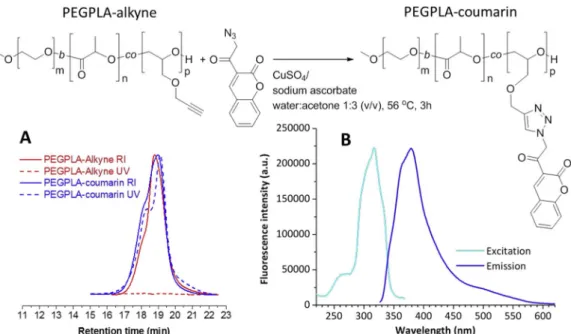
3.5. Conjugation of afluorescent azidocoumarin to alkyne-functional polymers via copper-catalysed Huisgen-1,3-dipolar cycloaddition
An azide-functional coumarin was conjugated to alkyne-functional PLA and PEG-b-PLA block copolymers via copper-catalysed Huisgen-1,3-dipolar cycloaddition to demonstrate the availability and reactivity of the alkyne group on the polymer backbone (reaction scheme inFig. 3). The GPC traces of the conjugates prepared from a polymer containing approximately 1% alkyne functional groups showed strong UV absorption at 320 nm, confirming covalent attachment of the coumarin to the polymer (Fig. 3A).
– 5k
26 BGE mPEG5k 6 25 96 1 22,000 (1.2)
27 PGE mPEG5k 6 25 85 1 22,600 (1.3)
28 – PEG2k 0 21 80 NA 13,300 (1.4)
29 BGE PEG2k 6 31 76 2 11,000 (1.2)
30 BGE mPEG2k 6 40 63 2 8200 (1.2)
Experimental conditions:SnOct2catalyst, T = 120 °C, bulk; lactide:mPEG5k:catalyst = 330:1:1.1; lactide:PEG2k:catalyst = 260:1:1.1. GE glycidyl ether; AGE allyl
glycidyl ether; BGE benzyl glycidyl ether; PGE propargyl glycidyl ether.
aGravimetric. bBy NMR.
The polymeric coumarin and triazole linkage were identified via NMR spectroscopy (supplementary information). The polymer showed luminescent properties in solution in acetonitrile (Fig. 3B) with a shift towards lower excitation and emission maxima upon formation of the triazole, from 450 to 319 nm and 510 to 388 nm for the excitation and emission maxima of the azido-coumarin (supplementary material) and polymer-coumarin conjugate, respectively.
Polymeric nanospheres were obtained from the PEG-b-PLA-coumarin conjugate (one-component nanospheres) or a mixture of PLA-coumarin conjugate and non-labelled PEG-b-PLA (two-component nanospheres) by the nanoprecipitation method [8]. Fractionation by AF4 withfluorescence detection revealed that the nanospheres had luminescent properties throughout their size distribution (Fig. 4). Absolute determination of the nanoparticle diameters by dynamic and static light scattering inflow mode confirmed the monodisperse character of the distribution.
The one-component nanospheres had a lower hydrodynamic diameter (66 nm) than their two-component counterparts (101 nm). In order to keep the PEG content in each formulations at 10 wt% while maintaining the PEG block length at 5 kDa, the block copolymer used in the two-component nanospheres had half the PLA content (or PLA molar mass) of that used in the one-component nanospheres. The size of self-assembled PEG5k-b-PLA nanospheres typically increases with increasing molar mass of the PLA block
[22]. Interestingly, the nanospheres composed of PEG5k-b-PLA40konly were smaller than those composed of a mixture of PLA22k
homopolymer and PEG5k-b-PLA21k, indicating that the polymer composition distribution had a stronger influence on the nanoparticle
size than the polymer chain-length. The zeta potentials of both nanosphere formulations measured in batch were close to neutrality (Table 4). PLA-based nanospheres prepared by this method typically have negative zeta potentials (lower than−30 mV)[23], which
suggests the PLA-b-PEG block copolymer with a PEG block of 5 kDa used in the proportion of 10 wt% with respect to the total polymer content was able to shield the negative surface charges by forming a PEG corona located at the nanoparticle interface [23,24].
These well-defined single- or two-componentfluorescently labelled nanostructures could potentially serve as drug carriers and imaging agents forin vitroapplications. Fluorescent labels suitable forin vivoimaging[25,26]could be conjugated to the polymers following the same synthetic strategy. Covalent attachment of thefluorescent label to the nanoparticles circumvents the issue of organic dye leakage or release from the nanoparticles and thus guarantees co-localisation of the dye with the nanoparticles inin vivo biodistribution studies. In addition, some of the brightestfluorescent probes have been obtained with organic nanoparticles[27]and the use of the bioresorbable polylactide is particularly attractive in the biomedicalfield.
4. Conclusions
Copolymers of allyl, benzyl and propargyl glycidyl ethers withD,L-lactide were obtained. Up to 8.7, 11.1 and 6.9 mol% of allyl, benzyl and propargyl functional groups, respectively, were incorporated along the polymer backbone with SnOct2 as the
polymerisation catalyst. Good control over the molar mass distribution was maintained. However, interference of the GE with the molar mass was observed, whereby the higher the ratio of GE co-monomer in the feed, the lower the copolymer average molar mass. TBD as the catalyst produced mostly PLA homopolymer, with less than 1 mol% of functional group in the polymer even at high feed content in GE.
Fig. 4.Asymmetricflowfieldflow fractionation of nanospheres of coumarin-labelled PLA and PEG-b-PLA. The nanospheres were prepared with coumarin-labelled PEG5k-b-PLA40kblock copolymer (A) or a 50:50 (w/w) mixture of coumarin-labelled PLA22kand non-labelled PEG5k-b-PLA21k(B). Both nanospheres contained approx.
1 mol% of coumarin (with respect to lactide) conjugated to the polymer and 10 wt% of PEG with respect to the total polymer content. The hydrodynamic diameter (Dh)
was determined by dynamic light scattering and the gyration diameter (Dg) by multi-angle light scattering. Graph C represents the differential and cumulative distributions of Dgcorresponding to fractograms A (black lines) and B (grey lines).
Table 4
Physico-chemical characterisation of thefluorescent nanospheres.
Nanosphere composition Batch Dh(nm) (PDI) Batch zeta potential
(mV)
Flow Dha
(nm)
Flow Dga
(nm)
D5%(nm) D50%
(nm)
D95%(nm)
PEG5k-b-PLA40k-coumarin 66 ± 1 (0.16) −2 ± 1 63 ± 1 40 ± 1 24 36 57
PLA22k-coumarin + PEG5k-b-PLA21k
(50:50 w/w)
101 ± 1 (0.09) −7 ± 3 99 ± 1 64 ± 2 42 62 97
Values are averages of three measurements ± standard deviation.
The reactive polymers were obtained at gram-scale in one step from commercially available reagents and therefore our approach is robust and easy to implement. The reactivity of the alkyne functional group along the polymer chain was demonstrated on alkyne-functional PLA and PEG-b-PLA block copolymers, leading to the formation of afluorescent polymer-coumarin conjugates via copper-catalysed azide-alkyne cycloaddition under mild conditions. Thesefluorescently labelled polymers self-assembled in water to form nanospheres that retained their luminescent properties in aqueous medium. The nanospheres had narrow size distributions with diameters below 100 nm, as determined by AF4 with hyphenated MALS and DLS detection.
Acknowledgements
This work wasfinancially supported by CAPES, FAPEMIG, CNPq, and NANOBIOMG network, Minas Gerais, Brazil. The authors thank the NMR facility staffand Welmarie van Schalkwyk at Stellenbosch University, South Africa, Ivana Lula and Jarbas Magalhães at Laboratório de Ressonância Magnética Multi-Usuário, Universidade Federal de Minas Gerais and Patrícia Monteiro at University of Nottingham for NMR spectroscopy analyses and Bruna Postacchini at UFOP forfluorescence spectroscopy.
Appendix A. Supplementary material
Supplementary data associated with this article can be found, in the online version, athttp://dx.doi.org/10.1016/j.eurpolymj. 2017.03.028.
References
[1] S.M. D'Addio, W. Saad, S.M. Ansell, J.J. Squiers, D.H. Adamson, M. Herrera-Alonso, A.R. Wohl, T.R. Hoye, C.W. Macosko, L.D. Mayer, C. Vauthier, R.K. Prud'homme, Effects of block copolymer properties on nanocarrier protection from in vivo clearance, J. Control. Release 162 (1) (2012) 208–217. [2] Y. Yu, J. Zou, C. Cheng, Synthesis and biomedical applications of functional poly(alpha-hydroxyl acid)s, Polym. Chem. 5 (20) (2014) 5854–5872. [3] R. Gref, Y. Minamitake, M.T. Peracchia, V. Trubetskoy, V. Torchilin, R. Langer, Biodegradable long-circulating nanospheres, Science 263 (5153) (1994)
1600–1603.
[4] A.-L. Brocas, C. Mantzaridis, D. Tunc, S. Carlotti, Polyether synthesis: from activated or metal-free anionic ring-opening polymerization of epoxides to functionalization, Prog. Polym. Sci. 38 (6) (2013) 845–873.
[5] C.E. Hoyle, C.N. Bowman, Thiol-ene click chemistry, Angew. Chem. Int. Ed. 49 (9) (2010) 1540–1573.
[6] V.V. Rostovtsev, L.G. Green, V.V. Fokin, K.B. Sharpless, A stepwise Huisgen cycloaddition process: Copper(I)-catalyzed regioselective“ligation”of azides and terminal alkynes, Angew. Chem.-Int. Ed. 41 (14) (2002) 2596–2599.
[7] R.A. Kusanur, M.V. Kulkarni, New 1,3-dipolar cycloadducts of 3-azidoacetylcoumarins with DMAD and their antimicrobial activity, Ind. J. Chem. Sect. B - Org. Chem. Incl. Med. Chem. 44 (3) (2005) 591–594.
[8] H. Fessi, F. Puisieux, J.P. Devissaguet, N. Ammoury, S. Benita, Nanocapsule formation by interfacial polymer deposition following solvent displacement, Int. J. Pharmaceut. 55 (1) (1989) R1–R4.
[9] J.L. Espartero, I. Rashkov, S.M. Li, N. Manolova, M. Vert, NMR analysis of low molecular weight poly(lactic acid)s, Macromolecules 29 (10) (1996) 3535–3539.
[10]S. Lee, K.Y. Cho, W.H. Seol, J.K. Park, Novel synthesis of reactive poly(ethylene glycol) grafted poly(L-lactide) via two step polymerizations, Polym. Bull. 52 (6) (2004) 393–400.
[11]V. Nadeau, G. Leclair, S. Sant, J.M. Rabanel, R. Quesnel, P. Hildgen, Synthesis of new versatile functionalized polyesters for biomedical applications, Polymer 46 (25) (2005) 11263–11272.
[12]N.S. Teske, J. Voigt, V.P. Shastri, Clickable degradable aliphatic polyesters via copolymerization with alkyne epoxy esters: synthesis and postfunctionalization with organic dyes, J. Am. Chem. Soc. 136 (29) (2014) 10527–10533.
[13]M. Heiny, V. Shastri, Cyclic comonomers for the synthesis of carboxylic acid and amine functionalized poly(l-lactic acid), Molecules 20 (3) (2015) 4764. [14]F. Nederberg, E.F. Connor, M. Möller, T. Glauser, J.L. Hedrick, New paradigms for organic catalysts: thefirst organocatalytic living polymerization, Angew.
Chem. Int. Ed. 40 (14) (2001) 2712–2715.
[15]R.C. Pratt, B.G.G. Lohmeijer, D.A. Long, R.M. Waymouth, J.L. Hedrick, Triazabicyclodecene: a simple bifunctional organocatalyst for acyl transfer and ring-opening polymerization of cyclic esters, J. Am. Chem. Soc. 128 (14) (2006) 4556–4557.
[16]F. Fringuelli, F. Pizzo, C. Vittoriani, L. Vaccaro, Polystyryl-supported TBD as an efficient and reusable catalyst under solvent-free conditions, Chem. Commun. 23 (2004) 2756–2757.
[17]S.Y. Hu, J.P. Zhao, G.Z. Zhang, Noncopolymerization approach to copolymers via concurrent transesterification and ring-opening reactions, Acs Macro Lett. 5 (1)
(2016) 45–49.
[18]S.A. van den Berg, H. Zuilhof, T. Wennekes, Clickable polylactic acids by fast organocatalytic ring-opening polymerization in continuousflow, Macromolecules
49 (6) (2016) 2054–2062.
[19]X.H. Chen, S.P. McCarthy, R.A. Gross, Synthesis and characterization ofL-lactide - ethylene oxide multiblock copolymers, Macromolecules 30 (15) (1997) 4295–4301.
[20]L.M. Pitet, S.B. Hait, T.J. Lanyk, D.M. Knauss, Linear and branched architectures from the polymerization of lactide with glycidol, Macromolecules 40 (7) (2007) 2327–2334.
[21]A. Kowalski, A. Duda, S. Penczek, Kinetics and mechanism of cyclic esters polymerization initiated with tin(II) octoate. 3. Polymerization of L, L-dilactide, Macromolecules 33 (20) (2000) 7359–7370.
[22]T. Riley, S. Stolnik, C.R. Heald, C.D. Xiong, M.C. Garnett, L. Illum, S.S. Davis, S.C. Purkiss, R.J. Barlow, P.R. Gellert, Physicochemical evaluation of nanoparticles assembled from poly(lactic acid)-poly(ethylene glycol) (PLA-PEG) block copolymers as drug delivery vehicles, Langmuir 17 (11) (2001) 3168–3174.
[23]R. Gref, M. Luck, P. Quellec, M. Marchand, E. Dellacherie, S. Harnisch, T. Blunk, R.H. Muller,‘Stealth’corona-core nanoparticles surface modified by polyethylene glycol (PEG): influences of the corona (PEG chain length and surface density) and of the core composition on phagocytic uptake and plasma protein adsorption, Colloids Surf. B–Biointerf. 18 (3–4) (2000) 301–313.
[24]C.R. Heald, S. Stolnik, K.S. Kujawinski, C. De Matteis, M.C. Garnett, L. Illum, S.S. Davis, S.C. Purkiss, R.J. Barlow, P.R. Gellert, Poly(lactic acid)-poly(ethylene oxide) (PLA-PEG) nanoparticles: NMR studies of the central solidlike PLA core and the liquid PEG corona, Langmuir 18 (9) (2002) 3669–3675.