A
BSTRACTS AND REPORTS
C
ON’I‘ROL OF
AEDES ALBOPICTUSIN THE AMERICAS
Introduction
The recent discovery of the mosquito Aedes adbopictgs in the United States and Brazil has serious public health implications. Specifically, there is concern that introduction of this exotic and efficient arbovirus vector into the Americas could aggravate the problems of dengue and yellow fever in endemic areas as well as the problem of California encephalitis in North America, and could possibly extend these and other arboviral diseases to new areas.
A. a&opictzls is widely distributed in Asia and the Pacific, ranging from temperate regions to the tropics (Figure
1). Although several isolated introductions were found in the continental United States as early as 1946, it was not until August 1985 that it was estab- lished in the state of Texas, and subsequently in 11 additional states. Since
June 1986 it has also been found in four Brazilian states (Figure 2).
There is evidence that A. aZbopictzls entered the United States in tires transported by large cargo containers from Japan, and it is suspected of entering Brazil in bamboo stumps from South- east Asia. Further introductions of A. aZbopictzr to other countries in the Americas seems imminent and may have already occurred.
A. aZ’bopicz#s is primarily a forest spe- cies that has become adapted to the urban environment. It breeds in tree holes, bamboo stumps, and leaf axils in the forest and in flower vases, bowls, bottles, tanks, drums, tires, and other artificial containers in towns and cities. Whereas the long-established vector Aedes aegypti is largely (but not entirely) restricted to breeding in artificial containers in and around human dwellings in urban environments, A. aZb0pictti.r utilizes similar sites but is also adapted to rural environments and a wider range of breeding habitats. Unlike A. aegypti it is a cold-adapted species throughout its range in northern Asia; females un- dergo ovarian diapause and survive in hibernation. The Houston strain has been shown to undergo similar diapause. It prefers to feed on man, but will readily feed on other mammals and sometimes on birds.
FIGURE i. Known worfdwide distribution of Aedes albopicfus as of October 1986.
40-N 40”N
20”N 20”N
0
20”s 20%
403 40”s
Public Health Implications
Dengue and yellow fever are the two most important diseases of the Americas that could potentially be transmit- ted by A. a&opictas. Hitherto, the only vector implicated in the urban trans- mission of these two diseases in the Americas was A. aegypti. Undoubtedly, the sharp increase of dengue activity observed in the past 20-25 years has been due primariiy to the resurgence and spread of A. aegyptz’ infestations. Unfortunately, despite political mandates adopted by the countries of the Americas to eradicate A. aegypt;t a constellation of financial, political, ad- ministrative, socioeconomic, and technical problems has reduced the effec- tiveness of vector control programs in the Region. A rapid growth and urban- ization of human populations in uopical areas, combined with increased travel and commerce between countries, has also contributed to this mosqui- to’s proliferation.
Dengue. Dengue fever activity in the Americas has increased markedly over the past two decades. The most notable recent episodes in the Americas have been the 1977-l 980 pandemic of dengue- 1 in the Caribbean, northern South America, Central America, Mexico, and Texas that caused approxi- mately 702,000 cases; the 1981 epidemic of dengue-2 in Cuba that caused
some 340,000 cases and 158 deaths; and the current epidemic of dengue-1 in Brazil that as of May 1987 had caused approximately 500,000 cases.
Although sporadic cases of dengue
FIGURE 2. Amas of Brazil (A) and the United States (B) known to be infested with Aedes albopicfus as of September 1986 in the U.S. and October 1986 in Brazil. Infested states are shown in gray, areas of known infestation in
MINAS GERAIS
ESPIRITO SANTO
RIO DE JANEIRO
---Ss3\0 PAUL0
Source: Ministerfo da Sairde, Superintendencia de Campanhas de Satide tiblica
(SUCAM), Brazil.
Source: Dr. Chester Moore, Biision of Vector-borne Viral Diseases, U.S. Centers for Disease Contmf, Fort Collins, Coiorado, USA.
the Americas, the frost major outbreak of dengue hemorrhagic fever/dengue shock syndrome in the Region occurred in Cuba in 1981. During this out- break 344,203 cases were reported, 116,143 people were hospitalized, some 24,000 cases of dengue hemorrhagic fever and 10,000 shock cases were re- ported, and 158 deaths occurred.
This Cuban DHF outbreak could mark the beginning of the same sort of situation that developed in Asia after an initial DHF epidemic in the Philippines in 1953. There the disease gradually
spread to other countries and became an important cause of death among infants and young children. l
Experimental and natural transmis- sion data show that A. &opictzcs is a very efficient vector of epidemic den- gue and has a higher susceptibility to oral infection with these viruses than A. aegypti, the principal epidemic vector in Asia. A. aZbopic&s has also been shown to transmit all four dengue serotypes transovarially (from female to offspring) and transstadially (between life stages in the same individual). It is thus highly likely that A. aZbopictzcs could play an important role in the den- gue virus maintenance cycle.
Yellow fever. Yellow fever continues to be a major threat in endemic zones of South America and in adjacent areas where the virus is able to reappear after long intervals of quiescence. It is essentially a disease of laborers en- gaged in forest work.
Most cases of yellow fever in the Americas are reported by five countries: Bolivia, Brazil, Colombia, Ecuador, and Peru. Together, these countries generally report 100 to 200 cases of yel- low fever annually, but the true incidence is probably 10 times higher.
The occurrence of yellow fever in close proximity to urban settings infested with A. aegypti, and the consequent risk that jungle yellow fever will be urbanized, are of special concern. It is be- lieved that one reason for nonurbanization of the virus has been the absence of a vector that can effectively utilize both the urban-suburban environment and rural or jungle areas. Because A. aZbopictzc.s can breed in urban, rural, and forest areas, it could bridge the jungle and urban environments and en- courage urban cycles of yellow fever. In the laboratory, A. albopictw has been infected orally with yellow fever and has been shown to transmit this virus to monkeys.
’ For more information about the Cuban outbreak, see M. G. GutmSn et al., Clinical and serologic study of Cuban children with dengue hemorrhagic fever/dengue shock syndrome (DHFIDSS), on pages 27C- 279 of this issue.
318
Other viruses. Experimental studies have demonstrated that A. aZbopic- tzcs can be infected orally with several other arboviruses and can transmit them efficiently. Among these are the Japanese encephalitis and West Nile flaviviruses, the Western equine encephalomyelitis and Ross River al- phaviruses, and the La Crosse and San Angelo bunyaviruses. It should be noted that La Crosse virus causes California encephalitis, an important public health problem of man in North America. Should A. adbopicttis become involved in the natural transmission of La Crosse virus, this agent could spread to suburban and urban settings and produce an increased incidence of California encephalitis.
Plan of Action
The ultimate goal of PAHO’s plan
of
action against A. &bopicttis is to eradicate this mosquito from the Americas. The plan’s initial aims are (a) to determine the mosquito’s distribution in the Americas; (b) to conduct A. aZbopictxs surveillance and control activities and to integrate these with existing A. aegypti surveillance and control programs; (c) to contain A. aZbopictzcs infestations and reduce the A. aZb0pictzl.s popu- lation to levels that cannot cause arboviral disease outbreaks and that are vulnerable to ultimate elimination; and (d) to prevent importation and es- tablishment of A.albopictm
in uninfested areas of the Americas.National activities. In pursuit of these aims, Member Countries will be encouraged to develop national plans of action. Each plan should begin by describing the current program against A. aegypti. Most of this information is obtainable from annual reports of the A. aegypti campaign or from annual
PAHO questionnaires regarding the resource inventory of A. aegypti pro- grams. This should be followed by a description of the program against A. aZbopictz4s if
one
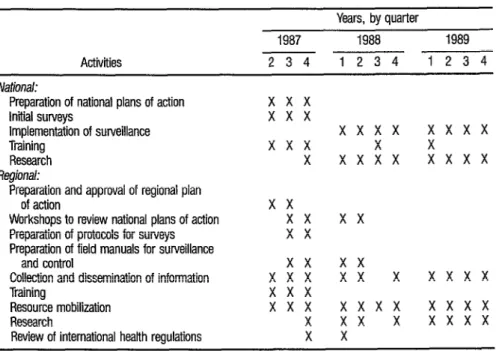
exists.Activities that should be included in the national plan (see Table 1) include surveys and surveillance efforts, pre- vention and control measures, training activities, and research. All such activities should be integrated with existing anti-aegy@ programs as much as possible.
l Surveys and surveillance. Since
in-
TABLE 1. A schedule of projected national and regional actbities directed against A. a/b@W in the Ameri- cas, 1987-1989.
Years, by quarter 1987 1988 1989 Activities 2 3 4 1234 1234 National:
Preparation of national plans of action lnltial surveys
Implementation of surveillance Training
Research Regional:
Preparation and approval of regional plan of action
Workshops to review national plans of action Preparation of protocols for surveys Preparation of field manuals for surveillance
and control
Collection and dissemination of information Training
Resource mobilization Research
Review of international heaith reoulations
x x x xxx
x x x x x x x x
x x x X X
X xxxx x x x x
x x
xx xx
x x
x x
xz xx x x x x x
x x x
x x x x x x x x x x x
X xx x x x x x
x x
formed, but field workers should also carry gear for collecting adults. Particu- lar attention should be paid to infestations in plants and ornamental flowers. A surveillance network should be es- tablished in the same localities covered by the initial surveys. This should conduct periodic larval and adult surveys and should deploy oviposition traps that should be checked weekly.
The survey and surveillance system should use the current A. aegypti program structure, personnel, and methodologies as much as possible. Where these are deficient, they must be strengthened. Incoming ships and aircraft from countries known to be in- fested with A. aZbopictzls should be inspected and disinsected. Special atten- tion should be given to cargos of tires, flowers, and other potential sources of eggs or larvae.
It will be important to identify col- lected larvae and adults as fast as possible. This may require some decentral- ization of the identification procedure, and will require additional equip- ment such as microscopes and personnel trained in identification of container-breeding mosquitoes.
320
When an A. aZbopictzls infestation is discovered, live eggs should be collected for colonization in a reference cen- ter’s laboratory-so as to permit definitive identification, biological typifica- tion, and susceptibility testing-before the focus is eliminated. However, colonization should not be undertaken in a country with a very low infes- tation index.
Reports of new infestations will be co- ordinated through PAHO and communicated immediately to all Member Countries. Routine surveillance reports should be made periodically to PAHO
on current forms that will be revised to accommodate information about both aegypti and aZbopictzls. Field forms will also be modified for inclusion of both species, so that information can be collected in a consistent and stan- dardized manner.
l Prevention and control measures.
The strategies and methods for prevention and control of adbopictzcs and aegypti are very similar. Therefore, countries that already have effective anti- aegypti programs will be able to employ the same strategies against albopic- tzcs, with the difference that albopictus may require inspections and treat- ments outside of urban settlements.
Preventive measures to be taken in- clude surveillance and disinsection (as just described) together with source reduction efforts. These source reduction activities should seek to eliminate all potential breeding sites of both aegypti and adbopictus. They must be performed continuously in and around all ports of entry, so as to reduce the possibility that any of these mosquitoes which are imported will become established.
Control measures can be directed at new infestations, established infestations, or infestations associated with dis- ease outbreaks. New infestations must be treated on an emergency basis. New resources must be added to the existing control program, and every effort must be made to eradicate the infested foci. More specifically, the fol- lowing steps should be taken:
1) Surveillance should be intensified to monitor known foci and detect the mosquito’s spread into new areas or habitats. Data should be obtained on the relative utilization of both artificial and natural containers in the domestic and peridomestic environments and at greater distances from human habitations.
2) Adulticides should be applied to infested areas to suppress adult populations until larviciding and source re- duction campaigns are complete. (Because A. aZbopictm in the U.S. has been shown to be at least partly resistant to malathion, the mosquito’s sus- ceptibility to insecticides must be tested.)
4) Source reduction campaigns should be conducted in problem focal areas with large accumulations of containers.
5) The public must be informed and its support enlisted.
Wherever A. albopictzcs is well estab- lished (currently in the United States and Brazil), a decision must be made about whether to attempt eradication or mere containment of the species.
In either case, it should be noted that improved solid waste programs are vital if source reduction campaigns are to succeed. (Accumulations of quantities of water-holding containers are gener- ally the result of inadequate garbage collection systems.)
Also, enactment and enforcement of legislation appropriate under local conditions is a valuable tool with which to support control operations.
Regarding containment, it appears that even well-established infestations can be contained in one sector of a country and kept from spreading. Of course, this requires detailed knowl- edge of the mosquito’s geographic distribution within the country in order to establish surveillance and disinsection posts outside the infested area.
Finally, every infested country has a moral and ethical responsibility to avoid exporting pest insects and vectors to other countries, and each should therefore write and implement legislation requiring the disinsection of cargos being prepared for export. In this vein, evaluations of the most suitable disinsection methods to apply are needed. In the event of an A&s-borne disease outbreak, rapid emergency control measures must be implemented. Aerial ultra-low-volume (WY) adulticides, applied at the correct time of day, dos- age, speed, and under the right climatic and other conditions must be used for sufficient reduction of the target Aedes populations. Ground LJLV spray- ing or thermal fogging, although less rapid and sometimes less effective than aerial uw spraying, may be used where it is not possible to use the latter.
Such measures must be coordinated at all levels of the government, with nongovernmental agencies, and with the media to ensure correct information dissemination and cooperation from of- ficials and the public.
Adulticiding efforts should be di- rected at areas having the greatest amount of new virus activity, For this rea- son it is essential to obtain and transfer epidemiologic information to the mosquito control program on a frequent and timely basis.
Areas such as tire dumps, ports of en- try, and densely populated high-rise urban areas will benefit from methodi- cal fogging operations, for which the speed of application, dosage rates, wind conditions, etc. must all be considered.
322
Public education is an important aspect of disease prevention. An informed public is able to provide some protection for itself in its own environment by using household insecticides to kill adult mosquitoes and by eliminating or covering water-bearing containers.
Source reduction, along with public education efforts, should be concentrated in areas having large numbers of containers and large populations of mosquitoes, with or without cases of dengue or other viral illnesses.
The effectiveness of control methods must be monitored or evaluated to ensure that they are accomplishing the desired objectives. Failure to evaluate control methods can result in wasteful and ineffective programs.
l Training activities. Survey person-
nel in each country will be trained in national courses by a team comprised of at least one PAHO entomologist, one national entomologist (previously
trained in an international course) and (optionally) a short-term consultant. After classroom and laboratory exercises, the participants will be transported to areas of the country considered at greatest risk for introduction of A. albo- pictzcs to do the actual initial surveys. Thus, the field training for the course
will also provide the initial survey to detect infestation of the country.
l Research. It will not be possible to
eliminate Aedes ahopictzcs or even control it effectively unless we know more about its distribution, modes of dispersal, breeding habitats, insecticide sus- ceptibilities, and response to control methods. This information can only be obtained from systematic studies, which need not compromise the control efforts. The following are priority research topics: (1) the ability of A. aho- p&zls to spread to new areas; (2) the mosquito’s vectorial capacity; (3) the
role of A. albopictus in dengue outbreaks in the Americas; and (4) A. albo- pictzcs control.
Regional activities. Activities to be carried out at the regional level to support national activities include collection and dissemination of informa- tion, assistance with initial surveys, training, provision of scarce human re- sources, preparation of manuals, assistance in developing national plans, and review of existing international health regulations (see Table 1).
Because A. ahopictus is an exotic mosquito in the Americas, limited information about it is available in Mem- ber Countries. Therefore, PAHO has begun distributing technical informa-
tion to national health authorities and has prepared a review of the literature on its taxonomic features, identification keys, biology, vector competence, insecticide susceptibilities, and control. Obviously, such information derives from observations made of A. albopictus populations from Asia.
periodically publish and distribute reports on the current status of A. aegypti and A. &opictzls in the Americas.
Initial surveys, organized to expedi- tiously detect the presence of A. aZbopictzcs, can be implemented faster by organizing international entomologic teams consisting of entomologists from PAHO and other international and national sources. These teams will visit key cities in Mexico, Central and South America, and the Caribbean, conduct short (one-day) training workshops on survey procedures and mos- quito identification, and actually conduct field surveys in these areas. Priority for surveys should be given to those countries with the most extensive impor- tations of used tires and other known natural or artificial breeding containers from infested areas-such as Asia, Brazil, and the United States.
Training in all aspects of A. aZb0pictzl.r biology and control will be provided at both the international and national levels. Courses will cover the taxonomy, biology, ecology, vector competence, insecticide susceptibilities, applicable survey and surveillance methods, and appropriate control strategies for both A. aZb0pictu-r and A. aegypti, showing the known differences and similarities of the two. PAHO held one workshop on A. aZbopicttis at the Caribbean Epidemiology Center (CARFIC) in Trinidad in October 1986, primarily for vector control workers from the Caribbean area. At least one other international workshop, for non-English-speaking parts of Latin America, is planned for 1987.
PAHO's human resources for promo- tion and coordination of vector control activities operate within the Organi- zation’s Communicable Disease Program. This program carries out activities such as collection and dissemination of information, technical consultations, preparation of training courses, organization of scientific and technical meet- ings, assistance with procurement of related supplies and equipment, and guidance for identifying sources of financial support. In addition, principally through its field staff of seven entomologists assigned to country or regional projects, the program provides direct technical assistance to countries, helps to supervise and orient national vector control programs, organizes and pro- vides instructors for training workshops on vector control, and assists with research projects on vector ecology, biology, and control.
Resources are also made available through specific consultantships arranged for experts, particularly from uni- versities and specialized agencies in the Member Countries.
PAHO will also develop protocols for
surveys and surveillance. These protocols will be publicized and distributed in all countries of the Region. In addition, a field manual for the identifica- tion, surveillance, and control of aegyptiand aZbopictm should be prepared. Preliminary keys in English, which have already been distributed, will be modified to include Central American, South American, and Caribbean spe- cies, and will be translated into Spanish.
324
As previously noted, each country will be encouraged to prepare a national plan of action for the control of A. albo- pictzcs. The present regional plan of action presents guidelines, but adjust- ments related to local conditions will be needed. PAHO will provide advice and technical information for the formulation of national plans of action, and will also promote regional workshops to review each country’s plans.
Finally, it seems evident that new transportation technologies-such as the use of containerization in cargo shipping-have facilitated the dissemination of insects. For this reason, it appears advisable to review the existing international health regulations and make appropriate changes directed at coping with this problem.
Soxrce: This report is a condensed version of PAHO document CE99/15 “Aea’es dbopictus in the Americas, Plan of Action,” produced by the Communicable Diseases Program under the coordination of Dr. E J. Lopez Antut’iano for presentation at the 99th Meeting of the PAHO Executive Committee held in Washing ton, D.C., USA, on 22-26 June 1987.
I’he scientific and technical background of the Plan of Action is summarized in its Appendix, “Ecology, Biology, and Control of Cedes afbopictus (Skuse),” which was prepared by Mr. Jost Estrada, PAHO Tempo- rary Adviser. The manuscript was kindly reviewed by Dr. George Craig of Notre Dame University and Drs. Francisco Pinheiro and Michael Nelson of PAHOIWHO.
The elaboration of the Plan of Action was a joint effort of the Pan American Health Organization, the Centers for Disease Control (Atlanta, GA; Fort Collins, CO; and Puerto Rico), and the Superintendency of Health Programs of the Ministry of Health, Brazil.
D
ENGUE IN THE AMERICAS, 1985The Americas experienced increased dengue activity in 1985, 68,998 cases being reported as compared to 43,434 cases in 1984 and 25,216 cases in 1983. As in 1983 and 1984, three serotypes (dengue- 1, dengue-2, and dengue-4) circulated in the Region. Twenty coun- tries reported dengue activity, and the serotypes involved were confirmed by virus isolation and/or serology in 14. Although all three serotypes were widely distributed in 1985, dengue- 1 continued to be the predominant sero- type in the Region. Three countries/ areas (Mexico, Puerto Rico, and Venezu- ela) had all three serotypes circulating simultaneously, while five other coun- tries had at least two serotypes in circulation (‘Gable 1).
Nicaragua and Aruba, Netherlands Antilles, experienced major dengue epidemics in 1985. Small numbers of cases with severe and fatal hemorrhagic disease were reported in both coun- tries. The Nicaraguan Ministry of Health reported 17,483 cases of dengue, most of which occurred late in the year. Dengue- 1 was the predominant virus isolated (18 strains), but dengue-2 was also isolated (eight strains). In addi- tion, seven cases of fatal hemorrhagic disease in adults were reported; one of these cases was confirmed as dengue-1 by virus isolation.