FLEAS COLLECTED DURING A PLAGUE SURVEY IN VENEZUELA1.2
c
BY ROBERT TRAUB, Major, MSC, and PHYLLIS T. JOHNSON, Parasitologist From the Department of Entomology, Army Medical Service Graduate School,
Washington, D. C.
At the invitation of the Government of Venezuela and of the Pan Ameritan Sanitary Bureau, a Mission from the Naval Medical School at Bethesda, Maryland, made a survey in 1950 of sylvatic plague in Venezuela. The epidemiological team consisted of Commander J. M. Amberson, MC, USN, Dr. Ernst Schwarz, Zoologist, and Mrs. H. K. Schwarz, Laboratory Assistant. The present paper presents data on the fleas collected by members of the Mission and includes the description and illustrations of a new species, as well as those of related and/or potentially medically important forms.
Y
It is of undoubted epidemiological significance that none of the fleas collected by the Mission in these endemic areas were Xenopsylla, the genus involved in classical plague transmission. Only one specimen of a cosmopolitan species was found (Ctenoce$&%!es felis felis); al1 the others were indigenous fleas.
Unless otherwise specified, fleas in the following lists were collected at Aragua, Campamento Rafael Rangel, by E. Schwarz, H. K. Schwarz and J. M. Amberson, July and August 1950. The team’s other collecting site was at Campamento Chacin, River Tuy, Miranda. The first section of this paper consists of a systematic list of fleas collected by the Mission, and in each instance cites the host involved; descriptions and notes are at times included. The second section lists the host mammals and their respective fleas. In the first list a fraction in parentheses follows the host name, i. e., under Polygenis b. bah& (Wagner, 1801), will be found Akodon urichi urichi Allen and Chapman (8/10). Th% signifies that out of 10 Akodon parasitized with fleas, 8 were hosts to P. b. bohìsi.
1. SYSTEMATIC LIST OF FLEAS, WITH DESCRIPTIONS AND NOTES Family HYSTFXCHOPSYLLIDAE
Subfamily CTENOPHTHALMINAE
TritopsylIa intermedia oxyura (Jordan, 1926)
Ex Didelphis m. mursupialis Allen, 7 d, 7 Q
Ex Sigmodon hispidus hirsutus Burmeister (1/42), 1 B
1 PubIished under the auspices of the Surgeon General, Department of the Army, who does not necessarily assume responsibility for ‘che professional opinions expressed by the authors.
112 BULLETIN OF THE PAN AMEBICAN WNITARY BUEEAU Family RHOPALOPSYLLIDAE
Polygenis ambersoni sp. nov.
Types.-Holotype male and allotype female ex Sigmodon hisp$dus hirsutus Burm. Venezuela: Aragua, Campamento Rafael, Rangel, elev. 1260 meters, coll. J. M. Amberson, E. Schwarz and H. K. Schwarz, 7 August 1950; deposited in United States National Museum. One paratype male with same data, two paratype males ibid., but 21 Sep- tember; in collection of senior author.
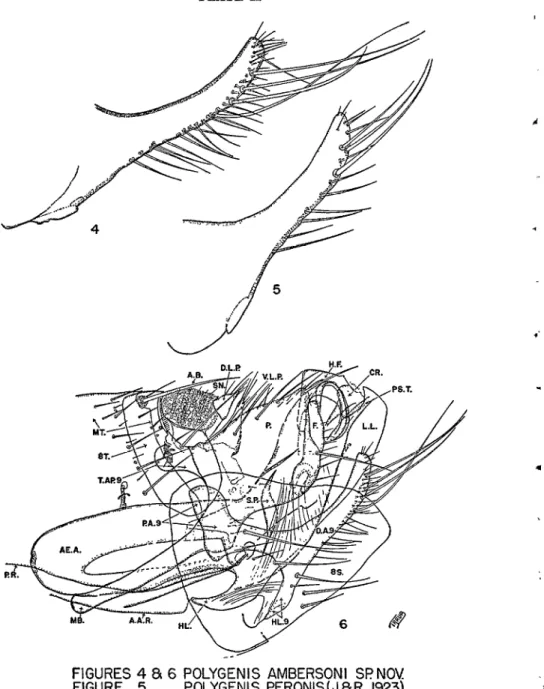
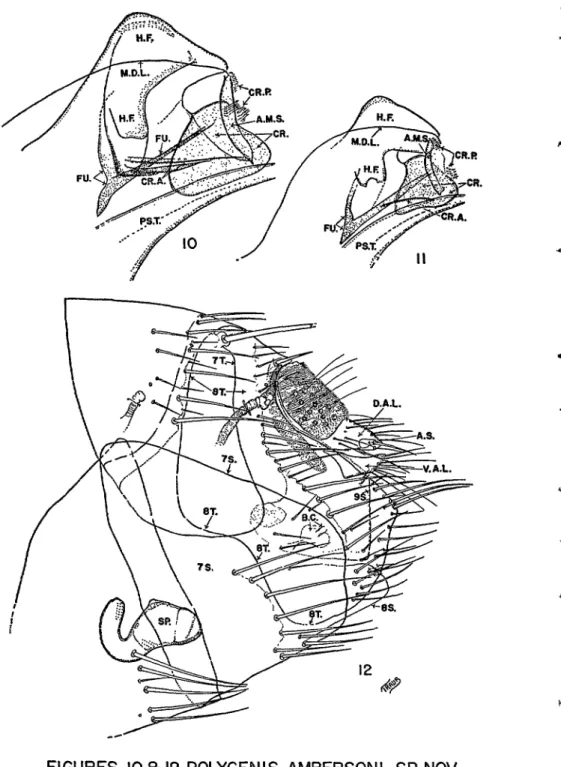
Diagnosis.-Near Polygenis peronis (J. & R., 1923) and P. acodontis (J. & R., 1923), but readily separable in that the male ninth sternum bears very long subapical bristles, longer than the dista1 arm itself (excluding the heel) (fig. 4), instead of these bristles being merely about half the length of the dista1 arm (fig. 5, P. peronis). Further separated from P. peronis as follows: maxillary palpus with second segment more than 14 times as long as first (fig. 1, MX.P.), not merely slightly longer (fig. 7, MX.P.); large acetabular bristle inserted well above acetabulum (fig. 13, AC.B. and AC.) (as in P. acodonlis) instead of approximately at same leve1 (fig. 15, AC.B. and AC.); dista1 arm of ninth sternum bear- ing a submarginal mesa1 row of bristles (fig. 4) which is lacking in P. peronis (fig. 5); crochet armature (fig. 10, CR.A.) well developed, ap- pearing on each side as a pair of subcontiguous rod-like sclerites, in- stead of being so reduced that it appears as a single thin line (fig. ll, CR.A.) ; spermatheca (fig. 14) head with somewhat of a dorsal hump, being about one and one-half times as long as broad instead of twice as long as broad (fig. 17). Separable from P. acodontis in that the dista1 arm of the ninth sternum is apically quite broad (fig. 4), not narrowed; this structure with subapical region about as broad as median portion of digitoid (fig. 13, F.), not definitely narrower than F. Spermatheca with head narrower than in P. acodontis, in which it is only slightly longer than broad.
Description
VENEZUELAN FLEAS 113 íive-segmented, extending approximately to apex of forecoxa. First an- termal segment about two and one-half times length of second; most of bristles antero- or caudomarginal; second antennal segment about twíce as broad as long, with a dorsomarginal fringe of bristles; asymmetrical club with apparently eight segments but in reahty true first segment k lying mesa1 to rest of club. Above club a row of short though fairly
broad bristles, bases of bristles virtually contiguous; with a few ama11 bristles above first two segments. Post-antennal region with three rows of bristles arranged approximately 4-7-6; small hairs intercalated be- tween bases of those in last row; the ventrahnost bristle of each row longer than others in row.
Thoraa: (figs. 1 and 3).-Pronotum (PRN.) and mesonotum (MSN.) with two rows of bristles, those of second row longer and with small intercalaries; flange of each notum lacking mesal pseudosetae. Mes- episternum (MPX.) with two bristles. Mesepimere (MPM.) with three bristles arranged 2-l. Metanotum (MTN.) with three rows of bristles, those of posterior row longest and with intercalaries; metanotal flange . with five or six somewhat pale, smaI1 apical spinelets on each side. Latera1 metanotal area (L.IM.) distinct, with caudal margin lateral to and ex- tending over most of pleural arch; with three or four small bristles near r anteroventral margin and two longer bristles bordering pleural arch. Metepisternum (MT&‘.) with a long bristle near posterodorsal angle; squamulum absent. Pleural ridge of metasternosome fitting into a well- scelerotized socket, the pleural arch (PL.A.). Metepimere (MTM.) with two rows of bristles arranged 4-6, 4-5.
. Legs.-Procoxa with many lateral bristles scattered over entire length of segment. Meso- and metacoxae with relatively few sueh bristles and those submarginal or subapical. Profemur with about sixteen small, i scattered, non-marginal lateral bristles and one mesa1 bristle; with two fairly long, subapical, ventromarginal bristles. Mesofemur similar but with ten to fifteen scattered non-marginal lateral bristles. Metafemur with a lateral, subventral row of five or six thin bristles and three or four subdorsal ones; metatibia (fig. 2) with large dorsomarginal notches bearing bristles as follows (from base to apex): 2-2-2-3-2-(excluding apical 3). Measurements of tibiae and segments of tarsi (petiolate base deIeted) of holotype shown in microns:
LEQ TIBIA Taasny SEGMENTO
1 II III Iv V
114 BULLETIN OB THE PAN AMERICAN SANITARY BUREAU
bristles, a fourth pair of much shorter lateral plantar bristles and an apical submedian pair subequal in size.
Abdomen.-First tergum (fig. 3, IT.) with two rows of bristles, those of posterior row longer and with intercalaries; with a total of about four- teen to sixteen somewhat pale, apical spinelets. Xucceeding terga with apical spinelets in holotype arranged 6-10-6-2 (totals); in female 10-7-4-l. In males, second and third terga with lowest bristle in first and second rows inserted slightly ventrad to spiracle; or other terga, first row much more abbreviated; in females first row always extending to spiracle. Basal sternum in male with one small ventromarginal bristle and two or three small lateromedian bristles; in female, with two or three ventro- marginal bristles on each side and about five small lateromedian bristles. Unmodified sterna usually with a row of four or five bristles. In female, third sternum with a patch of three to five much smaller bristles preced- ing this row. With only one antepygidial bristle in each sex.
ModijZed Abdominal Segments, Male (fig. 6.).-Eighth tergum (8T.) reduced, extending caudad only to a leve1 slightly beyond middle of sensilium and ventrad to near base of manubrium; its spiracle long and narrow. Eighth sternum (8S.) very large, covering much of the genitalia, and extending ventrad from leve1 of lowest bristle of seventh tergum and apicad to near leve1 of acetabulum; with about four or five long bristles and three or four smaller ones.
PLATE 1
.
FIG. l.-Polygenis ambersoni sp. nov. Head, male. FIG. 2.-Ibid. Posterior tibia; male.
FIG. 3.-Ibid. Thorax; male.
PLATE II
J
l
;W&S 5 & 6 POLYGENIS AMBERSONI SPNOV POLYGENIS PERONIStJ.&R., 1923)
Fm. 4.-Polygenis ambersoni sp. nov. Dista1 arm of ninth sternum; male. FIQ. 5.-Pdygenis peronis (Jordan and Rothschild, 1923) ; Dista1 arm of ninth sternum; male.
FIG. ô.-Polygenis ambersoni sp. nov., Modified segments; male.
February 19&?] VENEZUELAN FLEAS 117 thin bristles above acetabular bristle and one thin bristIe below ace- tabular bristle; with two or three small thin anteromarginal bristles.
Proximal arm of ninth sternum (P.A.9) roughly shaped like a short broad boot; its shank slightly narrowed at the middle. Dista1 arm of ninth sternum (D.A.9 and fig. 4.) proximally produced into a long heel (HL.9); about eight times as long (as measured from base of heel) as broad (measured at midpoint); with sides parallel for most of its Iength; slightly curved dorsally; apex somewhat rounded; apical third with four or five very long, lateromarginal bristles; with a mesa1 row of mar- ginal thin bristles commencing shortly above base of heel and extending to apex; with a group of five or six apical or subapical bristles, some of which are mesal.
Aedeagus (figs. 6, 9, and 10) essentially of the type of P. adocetus Traub, 1950 (q.v., p. 65, pl. 38, fig. 5 and pl. 39, fig. 1). Aedeagal apodeme
118 BU’f&ÉTEN ÓF THE PAN AMERICAN SANITARY BUREAU
appears on each side as an oblique, very shallow, elongate ellipsoid re- sembling a slightly concave disc seen on end; this sclerite herein desig- nated as the fender (FNR.). The fender lying ventrad (but laterad) to balloon of coil of penis tubes. Side pieces (Á3.P.) well developed, shaped like a sinuate spindle, vertical, laterad to sclerotized inner tube near base of A.I.T. Crescent sclerite (C.S.) distinct. Lateroventral sclerite (L.S.) of apodemal strut large, well developed, as is the adjacent vesicle (V.). With a semimembranous, mantle-like structure enclosing proximal portion of endchamber but mesa1 to lateral lobe; extending cephalad to vicinity of aedeagal heel, and distad to near thickening of pseudotube; ventral margin fluted. This structure is herein designated the fluted membrane (F.M.).
Tenth abdominal segment with sensilium large, fairly flat, about sixteen pits per side. Dorsal anal lobe (fig. 6, D.A.L.) well sclerotized, subconical, extending slightly more dorsad than sensilium; slightly less than twice as long as broad at base; with apical and subapical bristles. Ventral anal lobe (V.A.L.) about twice as long as dorsal lobe; much more acute; with ventral margin more heavily sclerotized than dorsal margin; with similar apical bristles.
. ModZfied Abdominal Xegments, Female (fig. 12).-Seventh sternum
PILA’333 III
M&S
; 8r 8 POLYGENIS PERONIS (J. & R., 1923)
POLYGENIS AMBERSONI SI? NO\/:
FIG. 7.--Polvgenis pero& (Jordan and Rothschild, 192) ; Anterior portion of head : male.
F&. 8.-Ed. Apex of aedeagus.
PLATE IV
.
e.L.
FIGURES 10 8 12 POLYGENIS AMBERSONI Sí? NOV.
FIGURE I I
POLYGENI S PERON I S (J. & R., 1923)
FIG. lO.-Polggenis ambersoni ep. nov. Apex of aedeague.
Fra. ll.-Polygenis peronis (Jordan and Rothschild, 1923) ; Apex of aedeagus. FIG. 12.-Polygenis ambersoni sp. nov. Modified segmenta; female.
PLATE V
4
c
.
,
FIGURES I3,14 & 16 POLYGENI S AMBERSONI Si? NOV
FIGURES 15 8 17 POLYGENIS PERON I S (J. & R, 1923)
E‘IG. 13.-Polygenis ambersoni sp. nov. Immovable process and digitoid of
clasper. FIG. 14.-Ibid. Spermatheca; female. FIG. 15.-PoEygenis pero& (Jordan and Rothschild, 1923); Immovable process of digitoid of clasper. FIG. IB.-Poly-
genis ambersoni, Anal stylet and ventral anal lobe of proctiger, female. FIG. 17. -PoZygcnis peronis (Jordan and Rothschild, 1923) Spermatheca; female.
PLATE VI
c
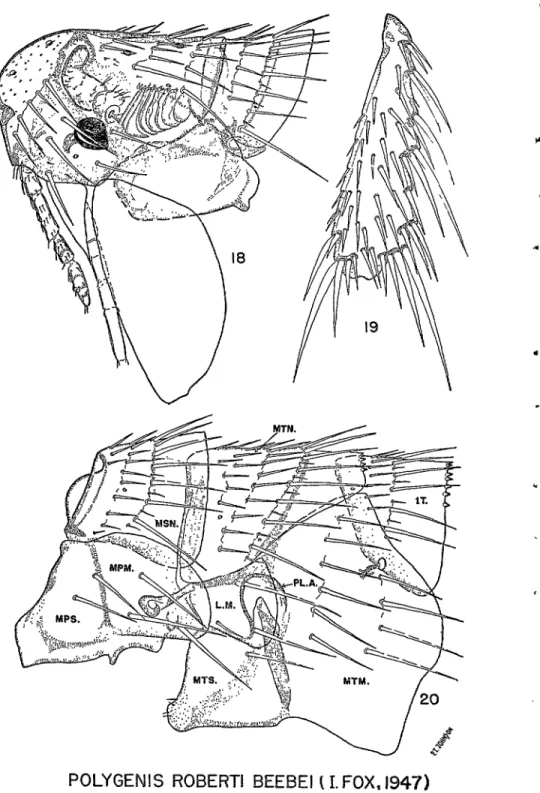
POLYGENIS ROBERT] BEEBEI II. FOX, 1947)
FIG. 18.-Polygenis roberti beebei (1. Fox, 1947), Head; male. FIG. 19.-Ibid. Posterior tibia; male.
FIG. ZO.-Ibid. Thorax; male.
February 1952] VENEZUl3LAN FLEAS 123 COMMENT ON THE AEDEAGUS OF P. ambersoni AND RELATED FLEAS The pseudotube (figs. 9 and 10, PS.T) is in reality a stout sclerite in the middle of the floor of the endchamber. It is subapically dorsally thickened, and it is this dorsal sclerot,ization which gives the structure of a tube when seen from the lateral aspe&, as in mounted specimens. From the proximal portion of the psuedotube arise a series of many thin, subvertical, convex rod-like sclerotizations, designated above as ribs
(RlB.). Most of the ribs are inclined or pitched dorso-apicad, but some apical ribs usually are inclined dorsoproximad. The more apical ribs arise from a slightly sclerotized sternum-like structure which lies on the dorsal thickening of the pseudotube and which is frequently diflicult to see. The presente of ribs on the pseudotube is characteristic of this group of fleas, as are the fluted membrane (F.M.), the side-pieces (S.P.), the fenders (FNR.), and the furca (FU.), as well as structures previously mentioned (Traub, 1950).
Remarks.-This species is named for one of the collectors, Commander J. M. Amberson, M.C., of the Naval Medical School, who has contributed much to the field of parasitology and tropical medicine.
Polygenis roberti (Rothschild, 1905)
Pulen robe& Rothschild, 1905, Nov. Zool. 12: 479481, figs. 1, 2.
RhopalopsyUus robe& Jordan and Rothschild, 1908, Parasitol. 1: 77. Jordan and Rothschild, 1923, Ectoparasites 1: 330, 350. Dalla Torre, 1924, Ber. Nat. Med. Ver. Inns. 39: 22. Pinto, 1929, Arthr. Parasit. 1: 326. Wagner, 1937, Zeits. Parasit. 9: 699. Costa Lima, 1937, Rev. Med. Cirur. Bras. 45(2): 117. Polygenis roberti Jordan, 1939, Nov. 2001. 41: 446, fig. 329. Guimarães, 1940, Arq. 2001.2: 223. Costa Lima and Hathaway, 1946, Monog. Inst. Oswaldo Cruz No. 4: 143.
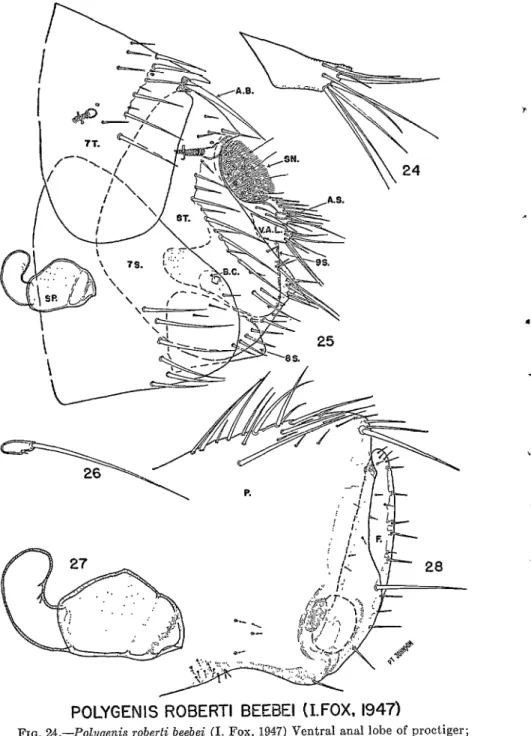
Many specimens of Polygenis roberti were collected during the plague survey. Study showed that these constitute a distinct subspecies and are the same as the form previously described as Rhopalopsyllus beebei 1. Fox, 1947. Dr. FOX kindly verified our belief that the present specimens are the same as those described as beebez’. For purposes of clarification, Polygenis roberti beebei (1. Fox) (new combination) is re-figured and re- described below.
124 BULLETIN OF THE PAN AMERICAN SANITARY BUREAU
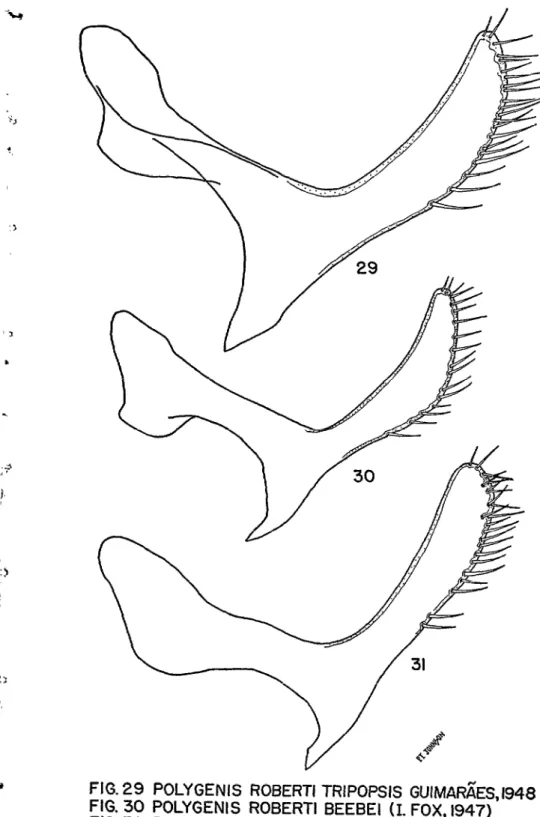
The three subspecies may be differentiated on the basis of the shape of the male ninth sternum. In P. roberti Iripopsis (fig. 29) the dista1 arm is of almost equal width from base to apex, with apex subrounded. In P. roberti beebei (fig. 30) the dista1 arm is characterized by being notice- ably convex on the ventral (posterior) margin; apex subrounded, the arm slightly upcurved. P. roberti roberti (fig. 31) is distinct in that the dista1 arm is narrower at base than at rounded apex.
Polygenis roberti beebei (1. Fox, 1947), new combination (figs. 18-28 and 30)
Species B (?) Hecht, 1942. Revista de Sanz’dud y Aeistencia Social ‘7(6): 815, fig. 1-B.
Rhopalopsyllus beebei 1. Fox, 1947, Zoologica 32(13) : 117.
Descrz@~on.-(Only differences from P. umbersoni are included.). Nead, male (fig. 18).-Frontal tubercle arising from triangular or subtriangluar sclerotixed area. First preantennal row of five to six bristles, most dorsal longest. Maxillary lobe extending beyond apex of third segment of maxillary palpus. Labial palpus about five-sixths length of forecoxa. Preantennal region with three rows of bristles arranged ap- proximately 4-5-6.
Thorm (fig. 18 and 20).-Metanotum with three to five apical spine- lets on each side. Lateral metanotal area with one to four small bristles near anteroventral margin.
Legs.-Profemur with two mesa1 bristles. Metatibia (fig. 19) with large dorsomarginal notches bearing bristles as follows: 2-2-2-3-l(2, or missing)-3; apical group of three or four bristles, usually four. Second and third hindtarsal segments with one or two apical bristles extending to or beyond apex of following segment.
Abdomen.-Basal abdominal sternum with four to five small ventro- marginal bristles and four or five small lateromedian bristles.
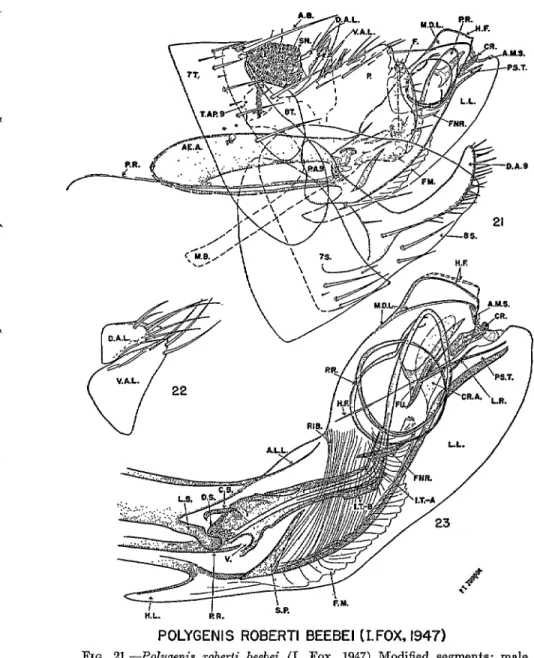
Modi$ed Abdominal: Segments, Mule (fig. al).-Eighth sternum (SS.) with four or five long bristles and one or two smaller ones. Dorsal margin of immovable process of clasper (P. and fig. 28) with about nine medium- sized marginal and submarginal bristles, apical one longest; with severa1 smaller submarginal bristles. Caudal margin with two bristles, longer inserted just dorsad to acetabulum. Three or four small, submedian mesa1 bristles posterior to and slightly dorsal to patch of mesa1 bristles just posterior to base of manubrium. Tergal apodeme of segment nine
(T.AP.9) with anterior margin subtruncate. Dista1 arm of ninth ster- num (D.A.9 and fig. 30) slightly upcurved, especially distally; proximally produced into an obtusely acuminate heel; arm narrowed apically; posterior (ventral) margin more convex than anterior; with a narrow rounded apex; with twenty to twenty-four lateromarginal, subequal bristles extending from near heel to apex.
PLATE VII
KL. i . . is+. ..“.<
POLYGE;IS ROBERT1 BEEBEI (IFOX, 1947)
FIG. 21.-PolygenZs robe& beebei (1. Fox, 1947) Modified segments; male. FIG. 22.-Ibid. Dorsal and ventral anal lobes of proctiger; male.
Fra. 23.-Ibid. Aedeagus.
PLATE VIII
\ 24
POLYGENIS ROBERT1 BEEBEI (I.FOX, 1947)
FIG. 24.-Polygenis roberti beebei (1. Fox, 1947) Ventral anal lobe of proctiger;
female.
FIG. 25.-Ibid. Modified segmenta; female. FIG. 26.-Ibid. Anal stylet; female. FIG. 27.-Ibid. Spermatheca; female.
February 1962j VENEZUELAN FLEAS 127 as long as broad. Hood flaps (H.F.) elongate, extending cephaIad beyond coiled penis rods (P.R.) ; the margin somewhat sclerotized part of its length. Median dorsal lobe (M.D.L.) convex, extending ahnost to apex of hood flaps. Apicomedian sclerite (A.M.S.) dorsally with a patch of semimembranous filaments (CR.P.), the crochet process. One penis rod (fig. 21, P.R.) extending well beyond apex of aedeagal apodeme, second rod ending short of apex. Ribs (R IB.) ending distally in a rounded spiculated process cephalad to flared apex of pseudotube (PS.T.). Crochets (CR.) apparent as slightly sinuate broad rods; corrugated along longitudinal aspe&, extending apicad of A.M.S. With paired wing-shaped pale sclerites, crochet arms, (CR.A.) extending from base
of crochet distoventrally to anterior leve1 of pseudotube, with convex dorsal margin, rounded at postero-apical angle, which is produced caudad about one-half length of crochet. Ventral arm of furca (FU.) extending caudad about one-half length of crochet. Fender (FNR.) more or less haIf-moon shaped. Side piece (S.P.) large, triangular, with longest side sinuate, apparently arising near base of vesicle, but lateral to vesicle.
Dorsal anal lobe (fig. 21, D.A.L. and fig. 22) extending as far dorsally as sensilium.
Modified Abdominal Segments, Femaíe (fig. %).--Seventh sternum with dorsal margin oblique; caudal margin rounded, vertical; with six long bristIes and one or two submarginal smaller bristles, which may be absent. Eighth tergum with definite angle on posterior margin; with row of bristles, alternating large and small, extending from above spiracle to well below midpoint. Anal stylet (A.S. and fig. 26) with Iong apical bristle and one very small subapical hair on ventral margin. Ventral anal Iobe (V.A.L. and fig. 24) angulate, twice as long as broad at base, bristles confined to caudal margin. Spermatheca (SP. and fig. 27) about three-fourths as broad as long; with tubercle on head indistinct.
Since 20 of 44 Sigmodon hispidus hirsutus were parasitized with this flea, it seems likely that this rat is the preferred host.
Records:
Ex Didelphis m. marsupialis Linnaeus (2/42), 6 3, 4 o Ex Sigmodon hispidus hirsutus Eurmeister (20/44), 17 CF, 13 0 Ex Alcodon urichi urichi Allen and Chapman (l/lO), 1 d, 1 o Ex Mus musculus brevirosíris Waterhouse (l/l) 1 o Ex Rattus rattus frugivorus Raíiiesque (2/6). 1 8, 1 0 Ex Heteromys a. anomalus Thompson (l/ll), 1 d
Ex Oecomys t. trinitatis Allen and Chapman (7/7), 17 $, 7 P Ex Oryzomys fulvescens delicatus Allen and Chapman (3/5), 4 d 6 p Ex Neacomys spinosus ssp. nov. (2/2), 1 3, 3 o
Polygenis b. bohlsi (Wagner, 1901)
128 BULLETIN OF TEE PAN AMERICAN BANITARY BUREAU
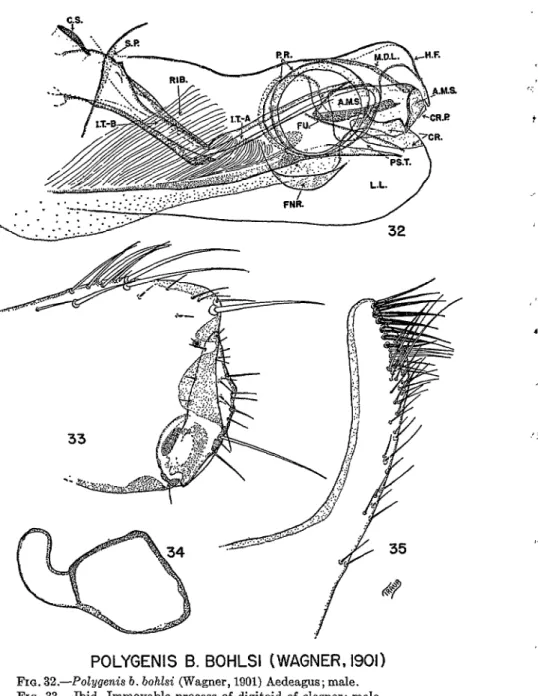
that it infests. Although this species has often been referred to in the literature, it has not been adequately illustrated. P. bohlsi is readily separated from others in the genus by the following: Digitoid (fig. 33, F.), shaped roughly like a low isosceles triangle; the dista1 arm of the ninth sternum (fig. 35) bearing an apical dense patch of spiniform bristles; fender of the aedeagus (fig. 32, FNR.) crescent-shaped; spermatheca
(fig. 34) with a very characteristic shape, its head four-fift,hs as broad as long, subtriangular, tail much shorter than head and somewhat up- turned; female eighth tergum with median patch of about 8 thin bristles anterior to row of bristles extending from ventral to dorsal margins. Records:
Ex DideZphis m. marsupialis Linnaeus (2/2), 2 o
Ex Sigmodon hispidus hirsutus Burmeister (31/44), ll d, 38 9 Ex Akodon urichi urichi Allen and Chapman (8/10), 4 8, 13 o Ex Rattus rattus frugivorus Raíinesque (3/6), 4 Q
Ex Heteromys a. anomalus Thompson (5/11), 2 8, 7 o Ex Oecomys t. trinitatis Allen and Chapman (1/7), 1 #, 1 Q
Ex Oryzomys pulvescens delicatus Allen and Chapman (2/5), 2 3, 4 o Ex Neacomys spinosus ssp. nov. (1/2), 1 Q
Ex Proechimys cayennensis trinitatis Allen and Chapman (2/4), 1 d (Also one female from Campamento Chacin, River Tuy). Ex Xciurus granatensis chapmani Allen (3/3), 3 Q
From the above list it will be seen that Sigmodon hispidus hirsutus and Akodon urichi urichi are the preferred hosts of this species, although its tastes are quite catholic.
Polygenis klagesi samuelis (Jordan and Rothschild, 1923) Ex Didelphis m. marsupialis Liiaeus (1/2), 1 Q
Ex Akodon urichi urichi Allen and Chapman (l/lO) ; 1 CF Ex Rattus rattus frugivorus Rafinesque (1/6), 1 c?, 1 Q
Ex Proechimys cayennensis trinitatis Allen and Chapman (3/4), 3 Q (and one female from Campamento Chacin) Polygenis steganus (Jordan and Rothschild, 1923) Ex Didelphis m. marsupialis Linnaeus (1/2), 2 8
Polygenis peronis (Jordan and Rothschild, 1923) (figs. 5, 7,8, ll, 15 and 17)
This species has not been reported since the original description. It has been above compared with P. ambersoni sp. nov. and pertinent draw- ings are included. The following records indicate that it is a fairly char- actetitic parasite of Heteromys a. anomulus:
PLATE IX
.
FIG. 29 POLYGENIS ROBERT1 TRIPOPSIS GUIMARiíESJ948
FIG. 30 POLYGENIS ROBERT1 BEEBEI (1. FOX, 1947)
FIG. 3 I POLYGENIS ROBERT1 ROBERT1 (ROTHS., 1905)
FIG. 29.-Polygenie robe& tripopsis Guimarães, 1948; Distal arm of ninth sterum; male. Fra. 30.-PoEygenis roberti beebei (1. Fox, 1947) ; Dista1 arm of ninth sternum; male. FIG. 31.-E’olygenis robe& robe& (Ftothschild, 1905); Dktal arm of ninth sternum; male.
PLATE X
POLYGENIS B. BOHLSI (WAGNER, 1901)
FIG. 32.-Polygenis b. bohlsi (Wagner, 1901) Aedeagus; male. FIG. 33.-Ibid. Immovable procesa of digitoid of clasper; male. FIO. 34.-Ibid. Spermatheca; female.
FIO. 35.-Ibid. Dista1 arm of ninth sternum; male.
u
Febrmry ILVZ?] vENEzlJxLAxFLEAs 131
Polygenis sp.
Females of this genus are often extremely difficult to identify unless accompanied by males. It is unfortunate that only females were repre- sented in the material collected in Campamento Chacin, at River Tuy. Some of these females are very close to Polygenis ambersmi sp. nov.
Ex Raftus rattus alexandrinus Geoffrey (2/2), 2 Q
Ex Proechimys cayennensis trinitatis Allen and Chapman (l/l), 2 Q Ex Heteromys a. anomahs Thompson (l/l), 3 Q
Ex Xigmodon hispidus hirsutu-s Burmeister (l/l), 1 Q
Rhopalopsyllus austral% australis (Rothschild, 1904) Ex Akodon u. wichi Allen and Chapman (l/lO), 1 d
Ex Didelphis m. marsupialis Linnaeus (1/2), 1 Q
Rhopalopsyllus cacicus saevus (Jordan and Rothschild, 1923) Family PULICIDAE
Ctenocephalides felis felis (Bouché, 1835) Ex Rattus rattus frugivorus Rafinesque (1/16), 1 Q
II. LISTS OF HOSTS AND THEIR ECTOPARASITES LOCALITY A. CAMPAMENTO RAFAEL RANGEL Didelphis marsupialis marsupialis Linnaeus
Polygenis roberti beebei (1. Fox, 1947) 6 d, 4 Q Polygenis sp. 1 Q
Tritopsylla intermedia oxyura (Jordan, 1926) 7 3, 7 Q Polygenis bohlsi bohlsi (Wagner, 1901) 2 Q
Polygenis steganus (Jordan and Rothschild, 1923) 2 3
Rhopalopsyllus cacicus saevus (Jordan and Rothschild, 1923) 1 Q Polygenis klagesi samuelis (Jordan and Rothschild, 1923) 1 Q Rhopalopsyllus australis australis (Rothschild, 1904) 1 d Polygenis roberti beebei (1. Fox, 1947) 1 c?, 1 0
Mus musculus brevirostris Waterhouse Polygenis roberti beebei (1. Fox, 1947) 1 Q Rattus rattus frugivorus Rafinesque
Polygenis klugesi samuelis (Jordan & Rothschild, 1923) 1 3, 1 Q Ctenocephalides felis felis (Bouché, 1835) 1 Q
Polygenis b. bohlsi (Wagner, 1901) 4 Q Polygenis roberti beebei (1. Fox, 1947) 1 #, 1 Q Heteromys a. anomalus Thompson
Polygenis roberti beebei (1. Fox, 1947) 1 d Polygenis b. bohìsi (Wamer, 1901) 2 d, 7 Q
132 BULLETIN OF TIIE PAN AMERICAN SUlITARY BUREAU Oeeomys t. tridztis Allen & Chapman
Polygenis roberti beebei (1. Fox, 1947) 17 3, 7 ? Polygenis b. bohlsi (Wagner, 1901) 1 9
Oryzomys fulvescens delicatus Allen & Chapman Polygenis roberti beebei (1. Fox, 1947) 4 8, 6 o Polygenis b. bohlsi (Wagner, 1901) 2 $,4 P Neacomys spinosus ssp. nov.
Polygenis robe& beebei (1. Fox, 1947) 1 d, 3 o Polygenis b. bohlsi (Wagner, 1901) 1 o
Proechimys cayennensis trinitatis Allen & Chapman Polygenis 6. bohlsi (Wagner, 1901) 1 d, 1 0
Polygenis klagesi samuelis (Jordan & Rothschild, 1923) 3 o Xciurus granatensis chapmani Allen
Polygenis b. bohlsi (Wagner, 1901) 3 o
LOCALITY B. CAMPAMENTO CHACIN, TUY RIVER Rattus rattus alexandrinus Goeffrey
Polygenis sp. 2 0
Proechimys cayennensis trinitatis Allen & Chapman Polygenis b. bohlsi (Wagner, 1901) 1 d, 1 P
Polygenis klagesi samuelis (Jordan & Rothschild, 1923) 1 o Polygenis sp. 2 0
Heteromys a. anomalus Thompson Polygenis sp. 3 9
Sigmodon hispidus hirsutus Burmeister Polygenis sp. 1 0
Rema&.-In the preceding drawings, mesa1 structures are indicated in the conventional manner, i.e., by broken lines. Bristles which were missing on the side of the flea which was drawn but which were present on the other side or on other specimens, are indicated by representing one of the margins of the bristles with a broken line.
AC. AC.B. AE.A. A.I.T. A.L.L. A.M.S. A.S. B.C. CR. CR.A. CR?. T.S. ABBREVIATIONS
Acetabulum D.A.L.
Acetabular bristle D.A.9
Aedeagal apodeme SS.
Armature of inner tube IT. Aocessory lateral lobe of 8T.
aedeagus F.
Apico-median sclerite of F.M.
aedeagus FNR.
Anal stylet FU.
Bursa copulatrix H.F.
Crochet HL.
Crochet armature
Crochet processes HL.9
Crescent sclerite of aedea- I.T.-A. w*
Dorsal anal lobe of proctiger Dista1 arm of ninth sternum Eighth sternum
First tergum Eighth tergum
Digitoid or movable finger Fluted membrane
Fender Furca
Hoodflaps of aedeagus Heel at base of aedeagal
pouch
Heel of ninth sternum Apical portion of sclero-
Febrero íN..] PULGAS VENEZOLANAS 133
I.T.23. L.L. L.M.
‘! L.S.
4 MB.
M.D.L. = MPM. MPS. MSN. MTM. MTN. MTS. MX.P.
Basal segment of sclerotized inner tube
Lateral lobes of aedeagus Lateral metanotal area Lateroventral sclerite Manubrium
Median dorsal lobe of ae- deaggus Mesepimere Mesepisternum Mesonotum Metepimere Metanotum Metepisternum Maxillary palpus
P. P.A.9 PL.A. P.R. PRN. PS.T. RIB. SP. S.P. T.AP.9 V. V.A.L.
Immovable prooess of cias- per
Proximal arm of ninth ster- num
Pleural arch Penis rod Pronotum Pseudotube Ribs Spermatheca Side pieces
Apodeme of ninth tergum Vesicle
Ventral anal lobe REFERENCES
Fox, 1.: Notes on Ectoparasites from Venezuela, Zoologica, New York Zoological Society, %?(13) :117-119, 1947.
Hecht, Otto: Las pulgas de las ratas en Venezuela, Rev. San. y Asid. Soc., 7(6) :811- 820, 1942.
Jordan, Karl: Flöhe sus Venezuela, Zeita. jur Parasitenkunde, 5(2):264-266, 1 fig., 1931.
Traub, R.: Siphonaptera from Central Ameriea and Mexico: A Morphological Study of the Aedeagus, with Descriptions of New Genera and Species, Zoological Memo& oj the Chicago Natural History Museum, l(1) :l-127 (Plates l-54), 1950.
5
PULGAS COLECCIONADAS EN UN ESTUDIO DE LA PESTE EN VENEZUELA (Sumario)
A invitación del Gobierno de Venezuela y de la Oficina Sanitaria Panameri- cana, una Misión de la Escuela Médica Naval, Bethesda, Maryland, llevó a cabo en 1950 un estudio de la peste selvática en Venezuela. El equipo epidemiológico estuvo integrado por el Comandante J. M. Amberson, el Dr. Ernst Schwarz y la Sra. H. K. Schwarz. En este trabajo se presentan los datos sobre las pulgas coleccionadas por los miembros de la Misión, asf como la descripción e ilustra- ciones de una especie nueva, y de las formas afines o que poseen importancia médica potencial.
134 BOLETfN DE LA OFICINA SANITARIA PANAMERICANA
Se coleccionaron las siguientes especies de pulgas, indicAndose en cada caso el huésped característico:
Familia HystrichopsyEZidae Subfamilia Ctenopthalminae
Tritopsylla intermedia oxyura (Jordan, 1926) Ex Didelphis m. marsupialis
Familia Rhopalopsyllidae
Polygenis ambersoni sp. nov. Ex Sigmodon hispidus hirsutus Polygenis roberti beebei (1. Fox, 1947)
Especie muy comtin que se encuentra en varios huéspedes, en particular Didelphis m. marsupial& Sigmoclon hispidus hirsutus, Oecomys t. trinitatis y Oryzomys fulvescens debicatus.
Polygenis b. bohlsi (Wagner, 1901)
Esta es una de las especies m6s dominantes en la zona y, lo mismo que la P. roberti beebei, se encuentra en una variedad de huéspedes, por ejemplo, Sigmodon hispidus hirsutus, Akodon urichi urichi y Heteromys a. anomalus, entre otros.
Polygenis klagesi samuelis (Jordan y Rothschild, 1923) S610 se tomaron muy pocos ejemplares, de cuatro huéspedes distintos.
Polygenis steganus (Jordan y Rothschild, 1923)
En la colección esta especie está representada por dos machos tomados de Didelphis m. marsupialis.
Polygenis peronis (Jordan y Rothschild, 1923)
Se comunica por primera vez desde la descripción original, y es al parecer un parásito bastante característico del Heteromys a. anomalus.
Rhopalopsyllus australis australis (Rothschild, 1904) Se tomó un macho del Akodon u. urichi.
Rhopalopsyllus cacicus saevus Jordan y Rothschild, 1923. Se tomó un macho del Didelphis m. marsupialis.
Polygenis ambersoni sp. nov.
Parecida a la P. pero& (Jordan y Rothschild, 1923) y a la P. acodontis (Jordan y Rothschild, 1923). Puede diferenciarse fácilmente de éstas por llevar el noveno esterno del macho (fig. 4) cerdas subapicales muy largas, más largas que el brazo dista1 mismo, en lugar de que esas cerdas ~610 tengan como la mitad de la longitud del brazo dista1 (fig. 5, P. peronis). Se diferencia ademas del P. peronis en la siguiente forma: los palpos maxilares con el segundo segmento son más de una y media veces más largos que los del primero (fig. 1, MX.P.), no sc510 ligeramente más largos (fig. 7, MX.P.) ; cerda acetabular grande que penetra bien arriba del acetábulo (fig. 13, ACB. y AC.) (como en la P. acodontis) en vez de aproximadamente al mismo nivel (fig. 15, AC.B. y AC.); el brazo dista1
t-
Febrero 1962] PULGAS T’ENEZOLANAS 135
del noveno esterno lleva en la línea media una fila submarginal de cerdas (fig. 4) que falta en la P. peronis (fig. 5) ; armadura de croché (fig. 10, CB.A.) bien desarrollada, apareciendo en cada lado como un par de escleritas subcontiguas parecidas a bastoncillos, en vez de estar tan reducidas que tengan el aspecto de sola fila delgada (fig. ll, CKA.) ; cabeza del espermaducto (fig. 14) con una ligera protuberancia dorsal, y de una longitud aproximadamente de una y media veces la anchura, en vez de ser dos veces más larga que ancha (fig. 17). Puede diferen- ciarse de la P. acodo& por ser bastante ancho el ápice del brazo dista1 del noveno esterno (fig. 4), y no angosto; esta estructura con la región subapical es casi tan ancha como la porción media del digitoide (fig. 13, P.), no marcadamente más angosta que F. La cabeza del espermaducto es más angosta que en la P. acodontis, en la que es ligeramente mas larga que ancha.
El estudio del material brasileño y venezolano indica que la Polygenis tipopsis Gkimurães, 1948, es una subespecie de P. roberli (Rothschild, 1905). Se considera que la forma descrita previamente como Rhopalopsyllus beebei (I. Fox, 1947) es también una subespecie de P. TobeTti. Estas conclusiones se basan en la semejanza de detalles de las escleritas especializadas de los edeagos y de los otros segmentos modificados del macho (con excepción del noveno esterno). La quetotaxia de la metatibia, empleada como rasgo distintivo en las descripciones primitivas de tripopsis y beebei, resultb más variable y no justifica la retenci6n de estas formas como especies completas. Por ejemplo, los ejemplares venezolanos de una región exhiben todas las variaciones de la tibia mencionadas.
I ,
Las tres subespecies pueden diferenciarse tomando por base la forma del noveno esterno del macho. En la P. TobeTti kipopsis (fig. 29) el brazo dista1 tiene casi la misma anchura desde la base hasta el ápice, con ápice casi redondo. En la P. roberti beebei (fig. 30) el brazo dista1 se caracteriza por ser bastante convexo en el margen ventral (posterior) ; ápice casi redondo, y el brazo ligeramente en- corvado hacia arriba. La P. Toberti roberti (fig. 31) se diferencia en que el brazo dista1 es mas angosto en la base que en el &pice redondo.
Se vuelve a describir e ilustrar (figs. 18-28 y 30) la especie Polygenis Tobertz beebei (1. Fox, 1947) por ser muy comti y tener importancia potencial en la epidemiología de la peste.
4