article
Epiphytic
Eunotia
(Bacillariophyceae) on
Podostemum
from Santa Catarina,
southern Brazil, including new observations on morphology and taxonomy of some rare
recorded species
Kaoli Pereira Cavalcante1,2, Priscila Izabel Tremarin1, Emanuela Cristina de Castro1, Carlos Eduardo
Junqueira de Azevedo Tibiric¸a´1, Juliana Wojciechowski1& Thelma Alvim Veiga Ludwig1
1
Laborato´rio de Ficologia, Departamento de Botaˆnica, Universidade Federal do Parana´, Caixa Postal 19031, Jardim das Ame´ricas, CEP 81531-980, Curitiba, PR, Brazil. 2
Corresponding author: Kaoli Pereira Cavalcante, e-mail:[email protected]
CAVALCANTE, K.P., TREMARIN, P.I., CASTRO, E.C., TIBIRIC¸ A´ , C.E.J.A., WOJCIECHOWSKI, J., LUDWIG, T.A.V. Epiphytic Eunotia (Bacillariophyceae) on Podostemum from Santa Catarina, southern Brazil, including new observations on morphology and taxonomy of some rare recorded species.
http://dx.doi.org/10.1590/1676-06032014003414
Abstract: Eunotia is a highly diverse diatom genus in the Neotropics. Considerable morphological variability of the valve showed in several species of the genus resulted in a quite confused taxonomy. TwelveEunotiataxa attached to Podostemumspp. were investigated using the light microscopy (LM). Additionally, scanning electron microscopy (SEM) was used in order to investigate the fine morphology of most abundant taxa. Samples were collected from four rivers from the State of Santa Catarina between March 2009 and July 2010. The freshwater diatom flora from this south Brazilian state is poorly known in relation to its neighboring states.Eunotia biseriatoideshas intermediate features betweenEunotiaand
Perinotia, and the circumscription of these genera is discussed here.Eunotia odebrechtianais very similar in morphology toE. biseriatoides, and the synonymy is proposed, as well as the transfer of the varietyE. odebrechtianavar.essequiboensisto the speciesE. biseriatoides. The fine structure ofE. epithemioidesis showed for the first time in SEM, revealing the unusual position of the rimoportula in this genus. A new variety, E. pseudosudeticavar. rotundata var. nov., was proposed and compared with the typical one. Except byE. veneris, all other eleven taxa presented here are new records for the State of Santa Catarina, Brazil.
Keywords:Diatom, Eunotiaceae, lotic systems, periphyton, taxonomy.
CAVALCANTE, K.P., TREMARIN, P.I., CASTRO, E.C., TIBIRIC¸ A´ , C.E.J.A., WOJCIECHOWSKI, J., LUDWIG, T.A.V.Eunotia(Bacillariophyceae) epı´fitas sobrePodostemumem Santa Catarina, sul do Brasil, incluindo novas observac¸o˜es sobre a morfologia e taxonomia de espe´cies raramente registradas.Biota
http://dx.doi.org/10.1590/1676-06032014003414
Resumo:Eunotiae´ um geˆnero de diatoma´ceas altamente diverso na regia˜o neotropical. A considera´vel variabilidade morfolo´gica encontrada nas valvas de va´rias espe´cies deste geˆnero resultam em uma taxonomia muito confusa. Neste estudo, 12 ta´xons de Eunotia aderidos a Podostemum spp. foram investigados usando microscopia o´ptica (MO). Adicionalmente, microscopia eletroˆnica de varredura (MEV) foi utilizada para investigar a morfologia ultraestrutural de ta´xons mais abundantes. Amostras foram coletadas em quatro rios do Estado de Santa Catarina entre marc¸o de 2009 e julho de 2010. A diatomoflo´rula deste estado e´ pobremente conhecida em relac¸a˜o aos estados vizinhos no sul do paı´s.
Eunotia biseriatoides e´ um taxon com caracterı´sticas intermedia´rias entre Eunotia e Perinotia e a circunscric¸a˜o destes geˆneros e´ discutida aqui.Eunotia odebrechtianae´ muito similar morfologicamente a
E. biseriatoidese a sinonimizac¸a˜o e´ proposta, bem como a transfereˆncia da variedadeE. odebrechtiana
var. essequiboensis a` espe´cie E. biseriatoides. A ultraestrutura de E. epithemioides e´ apresentada pela primeira vez em MEV, revelando a posic¸a˜o atı´pica da rimoportula dentro deste geˆnero. Uma nova variedade,E. pseudosudeticavar.rotundatavar. nov., foi proposta e comparada com a variedade tı´pica. Com excec¸a˜o deE. veneris, todos os outros 11 ta´xons apresentados aqui sa˜o novos registros para Santa Catarina.
Palavras-chave:Diatoma´cea, Eunotiaceae, perifı´ton, sistemas lo´ticos, taxonomia.
www.scielo.br/bn
Biota Neotropica 14(3): e20140034, 2014
Biota Neotropica. 14(3): e20140034.
Introduction
Eunotia Ehrenberg is a large periphytic diatom genus common in freshwater systems worldwide (Round et al. 1990). Diacritical features include dorsiventral valves, uniseriate striae, composed by small round poroids, raphe slits shortened lying at each pole and at least one rimoportula present near to the valve ends (Round et al. 1990). The species richness of this genus is high, and at least 1,500 species are estimated to exist throughout the world (Lange-Bertalot et al. 2011).
The diatom diversity in the Neotropics is considered rather high compared to the well-studied temperate regions of Europe and North America. Every new published flora results in dozens of new taxa proposed, some particularly endemics (e.g. Metzeltin & Lange-Bertalot 1998, 2007, Kociolek et al. 2001, Metzeltin et al. 2005). With regard toEunotia, there are about 245 taxa identified to Brazilian environments (Metzeltin & Lange-Bertalot 1998, 2007, Torgan et al. 1999, Ferrari et al. 2007, Tremarin et al. 2008, 2009, Bicca & Torgan 2009, Bicca et al. 2011, Silva et al. 2011, Burliga & Kociolek 2012), of which 81 taxa were proposed as new to science (e.g. Torgan & Becker 1997, Burliga et al. 2007, Wetzel et al. 2010, 2011, Metzeltin & Tremarin 2011, Burliga & Kociolek 2012, Fuhrmann et al. 2013).
Recent studies on periphytic algae suggested that architec-ture of Podostemum rutifoliumWarm. provides microhabitats for many algal species (mainly diatoms) and, therefore, is a key species in the structure of those communities. Aquatic plants are important structuring of algal communities and directly affect diversity and richness of the attached or associated microorgan-isms, especially in the lotic systems (Ferreira et al. 2011).
In the State of Santa Catarina, southern Brazil, there are few researches about diatoms (Souza-Mosimann 1980, Rodrigues 1984). The most of them are concentrated in littoral marine/estuarine communities, some of which recording fresh-water species (Fernandes et al. 1990, Saupe & Souza-Mosimann 2003, Mosimann & Laudares-Silva 2005, Souza-Mosimann et al. 2011). Epiphytic freshwater diatoms are poorly studied in this region.
Here we described 12Eunotiataxa from several rheophilic environments located in Santa Catarina, based on light and scanning electron microscopies analysis. These findings con-tribute to knowledge of the diatom flora from Santa Catarina, as well as from Brazil.
Material and methods
Three Podostemum Michaux species were collected in waterfalls of four distinct lotic systems of Santa Catarina:
P. distichum (Cham.) Wedd from river Pelotas, P. muelleri
Warm. from rivers Jacutinga and Irani, and P. rutifolium
Warm. from river Correas, between March 2009 and July 2010 (Table 1).
Algal biofilm attached to the macrophytes was removed using toothbrushes and preserved in a 4% formaldehyde solution. Subsamples were cleaned following the procedure described in Simonsen (1974) and modified by Moreira-Filho & Valente-Moreira (1981). Permanent slides were mounted with Naphax resin (R.I.=1.74) for taxonomic analysis on light microscope (LM) Olympus BX-40 equipped with Olympus DP71 image capture equipment. For scanning electron micro-scopy (SEM), subsamples were dried directly on aluminum stubs and sputter-coated with gold. Samples were observed using JEOL JSM 6360LV microscope, operated at 15 kV and 8 mm working distance, which is housed in the Electron Microscopy Center of the Federal University of Parana´. Samples and permanent slides are stored in the herbarium of the Federal University of Parana´ (UPCB, Table 1).
Results and discussion
Eleven Eunotia species and one non typical variety were identified from our samples. Eleven taxa (except byE. veneris) represent new records for Santa Catarina. Morphological descriptions and taxonomic observations are presented below.
Eunotia biseriatoides Kobayasi, Ando et Nagumo var.
biseriatoides, 1981, Proc. 6th Diat. Symp., p. 98, pl. 4, figs. 27––34.
Figs. 1-14
Synonyms: Eunotia odebrechtiana Metzeltin et Lange-Bertalot var. odebrechtiana, 1998, Iconogr. Diatomol. 5, p. 71, pl. 56, figs. 1-6, 13, 14
Eunotia monodonvar.constrictaHustedt (excl. typus) sensu Simonsen, 1987, Atlas and Catalogue of the Diatom Types of Friedrich Hustedt, pl. 31 figs. 2, 3 (non fig. 1).
Rectangular frustules in lateral view, with longest sides undulate, caused by interfascicular thickening in the valve surface; dorsiventral valves, isopolar; dorsal margin convex, ventral margin concave, almost straight in median region; ends rounded, detached from the valve; radiate striae, denser in the ends, unisseriate, with short striae irregularly inserted around each striae at dorsal margin; delicate round areolae; terminal nodules thickened located on the ventral margin and somewhat distant from the ends; one rimoportulae per valve, located at valve extremity (Figs. 2, 5). Length 44.3-69.7mm, width
7.6-10.7mm, 5-7 striae (valve face) in 10mm, 14-16 striae (ventral
mantle) in 10mm.
In SEM, areolae are simple round poroids, 33-35 in 10mm
(Figs. 8––10). Dorsal shortened striae are depressed compared to interstriae (Fig. 9). Striae are interrupted in the ventral valve-mantle junction by a hyaline edge (Figs. 9, 11, 13). Ventral valve mantle is more densely striated than valve surface (Fig. 13). External distal endings of raphe are simple, not reaching the valve center (Fig. 11). Externally, the raphe extends in oblique and slightly sinuous fissure at the ventral mantle, with simple
Table 1.Sampling data, with reference to local and date, host collected and register on herbarium of Federal University of Parana´ (UPCB).
Herbarium Code UPCB (diatoms)
Sampling date River Geographic coordinates Podostemumspecies
76020 10/07/2010 Pelotas 28608’S; 49637’W P. distichum
76021 09/03/2010 Jacutinga 2763’13.61"S; 51641’54.28"W P. muelleri
76022 17/03/2009 Correas 26625’6.28"S 49619’39.11"W P. rutifolium
76024 09/03/2010 Irani 26655’55.18"S 51652’22.37"W P. muelleri
2 Biota Neotrop
Cavalcante K.P. et al.
proximal ends (Fig. 13). Internally, the raphe ends in coarse helictoglossa (Fig. 12). Internally, the rimoportula is small, sessile (Fig. 12), often hidden by septum, when valvocopula was not detached from valve (Fig. 14). Valvocopula has delicate scalloped projections towards the internal valve surface (pars interior) on each interstriae (Fig. 10, arrowheads).
Occurrence in the samples:UPCB 76024
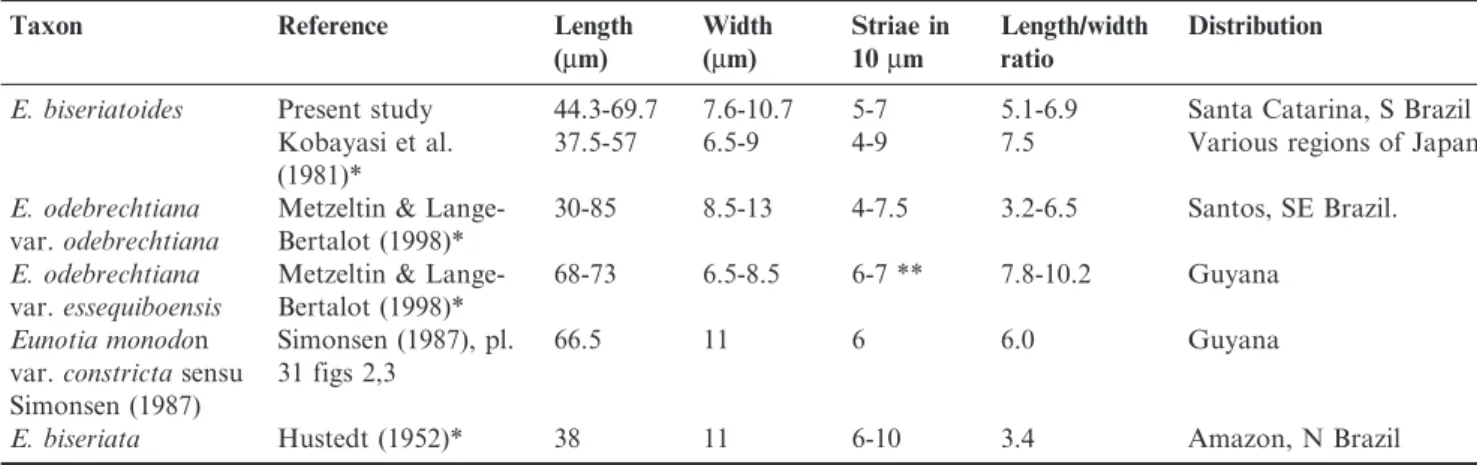
Comments:this species, described by Kobayasi et al. (1981), is characterized by broadly raised interstriae and short striae inserted on the dorsal side of each striae. These authors have distinguishedE. biseriatoidesfromE. biseriataHustedt by the ‘‘undulate dorsal margin, absence of ventral striae and more slender shape of the valve’’ of the former. In the light microscope, undulate dorsal margins are only detected when valves lie in girdle view (figs. 6, 7). Ventral striae are probably a reflection of ventral mantle striae, rather than projections of mantle striae reaching the valve face. This feature can be observed in the Hustedt’s iconotype of E. biseriata, but undiscernible in the Simonsen’s illustration of holotype (Simonsen 1987, pl. 567, figs. 9-11). Mantle striae can be observed also inE. biseriatoidesfrom present study (Figs. 5, 7) and synonyms E. monodon var. constricta (Simonsen 1987, pl. 31, fig. 2) andE. odebrechtianavar.odebrechtiana(Metzeltin & Lange-Bertalot 1998, pl. 56, figs. 1, 4). These two characters do not seem to be strong criteria for differentiation. The best distinguishing feature betweenE. biseriataandE. biseriatoides
is the valve shape, which is slender (length/width ratio 5.1-6.9) in the latter and more robust (length/width ratio 3.4) with broadly round apices, detached from the valve, in the former (Table 2).E. biseriatawas described in Hustedt (1952) based on a single specimen. A population-based morphometric study as well as SEM analysis of this taxon are necessary to clarify the boundaries between these taxa.
The species proposed by Metzeltin & Lange-Bertalot (1998) asEunotia odebrechtianacan not be accurately distinguished of
E. biseriatoidesand, therefore, is a younger synonym from the latter. As stated by these authors, the figures 2 and 3 in plate 31 from Simonsen (1987), misidentified as isolectotype of E. monodonvar.constricta, also correspond toE. biseriatoides.
Eunotia odebrechtianavar.essequiboensiswas also proposed by Metzeltin & Lange-Bertalot (1998) based on valves with structure similar to the typical variety, but with narrower valves (6.5-8.5 mm) resulting in the length/width ratio of 7.8-10.2
(Table 2). Because of the typical variety is here synonymized with
E. biseriatoides, a new combination of this variety is needed:
Eunotia biseriatoides var. essequiboensis (Metzeltin et Lange-Bertalot) Cavalcante, Tremarin et T. Ludwig comb. nov. Basionym:Eunotia odebrechtianavar.essequiboensisMetzeltin et Lange-Bertalot, 1998, Icon. Diat. 5, p. 72, pl. 57, figs. 1, 2.
The striation pattern present inEunotia biseriatoidesandE. biseriatoidesvar.essequiboensisis very similar to that found in
PerinotiaMetzeltin et Lange-Bertalot. The genusPerinotiawas
Figures 1-8.Eunotia biseriatoidesvar.biseriatoides.Figs 1-5.Specimens in valve view, LM.Fig. 6.Frustules in dorsal view, LM.Fig. 7.Frustules in ventral view, LM.Fig. 8.Valve overview in SEM. Scale bars: 10mm (Figs 1-7), 5mm (Fig. 8).
Biota Neotrop 3
Eunotia on Podostemum
described to accommodate eunotioid taxa that shows: uni-seriate striae becoming multiuni-seriate towards the dorsal side of valve, in which smaller poroids lie in deltoid depressions; internally, presence of thickened costae between each two striae; valvocopula projections on the internal dorsal valve surface. Rimoportula has not been observed in this genus. Currently, there are only two Perinotia species recognized (Metzeltin & Lange-Bertalot 2007, Ferrari et al. 2009).
Considering the set of diagnostic features above mentioned forPerinotia,Eunotia biseriatoidesdeserves to be highlighted as a species that shares features of both genera: this species possess rimoportula, like in Eunotia, and possess striae pattern and valvocopula projections like inPerinotia. However, there is no internal costa between dorsal striae.
Rimoportula is frequent in all the Eunotiaceae genera, except inSemiorbisPatrick. It has never been observed inPerinotiayet. But, this genus has a well-developed septum and a thick mantle edge, which can easily hide a small sessile labiate process. In all SEM pictures of Perinotia taxa recorded so far (Metzeltin & Lange-Bertalot 2007, Ferrari et al. 2009), none of them accurately
allow us to assert the lack of rimoportula. Therefore, presence of rimoportula inPerinotiaremains to be confirmed. Moreover, the typical striae pattern and valvocopula projections of Perinotia
plus the absence of costae inEunotia biseriatoides, still allow us to raise questions concerning the consistency of Perinotia as currently diagnosed. Unusual striae pattern and presence of costae are presented as weak diagnostic characters to distinguish generic level in other diatom groups (eg. Reichardt 2007, 2008, Tremarin et al. 2011).
Perinotia taxa are poorly known, besides the frustule morphology. Plastids and chain formation, for example, have not been studied yet. TransferringE. biseriatoidestoPerinotiais still premature, and requires more detailed analysis. Combined ultrastructural, molecular, and ecological investigations may provide a better elucidation about the circumscription of this taxon.
Eunotiacf. botuliformisWild, No¨rpel et Lange-Bertalot in Lange-Bertalot, 1993, Biblioth. Diat. 27, p. 29, pl. 33, figs. 2––15.
Fig. 15
Valve slightly dorsiventral, isopolar; dorsal margin convex, ventral margin slightly concave; ends rounded, not detached
Figures 9-14.Eunotia biseriatoidesvar.biseriatoidesin SEM.Fig. 9.Detail of valve center, external view.Fig. 10.Internal view of valve center, showing valvocopula projections (arrowheads).Fig. 11.External view of valve end.Fig. 12.Internal view of valve end , showing helictoglossa (black arrowhead) and small rimoportula (white arrowhead).Fig. 13.Detail of ends in ventral view of an entire frustule, showing girdle bands and raphe fissure.Fig. 14.Internal view of valve end, with valvocopula and septum. Scale bars: 2mm.
4 Biota Neotrop
Cavalcante K.P. et al.
from the valve; striae parallel, equidistant; areolae not discernible in LM; terminal nodules near to poles; rimoportula not observed. Length 12.1mm, width 2.2mm, 26 striae in 10mm.
Occurrence in the samples:UPCB 76024
Comments:the single specimen observed in this study shows lower width and striae density than that found in the literature (width 2.7-3.8mm, 15-22 striae in 10mm) (Lange-Bertalot 1993;
Lange-Bertalot et al. 2011). Due to the morphometric discrepan-cies and the rarity of this taxon in the samples, its identity cannot be accurately determined. Further studies of this population may provide clues about the precise identity of this taxon.
Eunotia epithemioidesHustedt in Schmidt 1913, Atlas Diat., pl. 287, figs. 16-19.
Figs. 16-35
Rectangular frustules in lateral view, with longest sides strongly undulate, caused by interfascicular thickening in the valve surface; dorsiventral valves, isopolar; dorsal margin convex, ventral margin concave; ends rounded, detached from the valve; parallel to radiate striae, arranged in irregular
fascicles with one to five striae; intercalated by short striae at dorsal margin; delicate round areolae; terminal nodules thickened near to poles; rimoportulae located at ventral mantle, one per valve, diagonally opposed in the frustule, such that can only be observed in lateral ventral view (Figs. 2, 3). Length 35.9-89.4mm, width 7.5-10.0mm, 9-14 striae (valve face) in 10mm,
16-19 striae (ventral mantle) in 10mm, 26-30 areolae in 10mm.
In SEM, external areolae occlusions are difficult to observe (Figs. 26, 27). External distal endings of raphe are simple, not reaching the valve center (Fig. 28). Externally, the raphe extends in oblique fissure at the ventral mantle, with proximal ends dilated in pore (Fig. 31). Externally, the rimoportula aperture is slit-like, perpendicular to the apical axis of the frustule (Figs. 29, 30), and internally sessile (Figs. 34, 35). Areolaeare simple poroids, striae were interrupted in ventral margin, at junction between valve surface and mantle, but not at dorsal margin (Figs. 32, 33). Mantle striae are equidistant and denser (Fig. 33) than those of valve surface. Short striae in valve surface are composed by slight projection of some mantle striae at dorsal
Figures 15-25.Eunotiaspp. in LM.Fig. 15.E.cf.botuliformisin valve view.Figs. 16-25.E. epithemioides.Fig. 16, 17.Ventral view.Fig. 18.Dorsal view.Figs 19-25.Valve view. Scale bar: 10mm.
Biota Neotrop 5
Eunotia on Podostemum
margin (Fig. 33). Pseudosepta present in the valve apices (Figs 34, 35).
Occurrence in the samples:UPCB 76022
Comments: the analyzed population is compatible with morphometric data from the iconotypes showed by Schmidt (1913, pl. 287, length 55.5-77.8 mm, width 9.4-11.7mm, 13-19
striae in 10mm, 27 areolae in 10mm) and with the lectotype found
in Simonsen (1987, pl. 34, length 54-72mm, width 11-12mm, 15-16
striae in 10mm, 24 areolae in 10mm). However, we are expanding
the ranges of valve width and striae density. We found smaller individuals than those selected as type material (we could compare only to specimens illustrated as type and we do not know, however, the morphological range of the type population).
Additionally, our specimens show fascicles with 1-5 striae, while the type material had 2-8 striae in each fascicle. This variation obviously results in lower striae density. This difference in striae density may be probably a factor affected by environmental conditions, further than a species-specific feature.
This species has not been previously documented in SEM, so morphological features as raphe and rimoportulae position were hitherto unknown. Rimoportula located in ventral mantle is not typical inEunotiaspp. Generally they have a single and sessile rimoportula, one per valve and lying in the valve apex (Round et al. 1990).
Eunotia epithemioides was originally described from a brackish lagoon of Republic of Cameroon, East Africa. The
Figures 26-31.Eunotia epithemioidesin SEM.Fig. 26.External valve overview.Fig. 27.Detail of valve center, external view.Fig. 28.External view of valve end.Figs 29-31.Frustule in ventral view, showing the slit-like external opening of the rimoportulae (arrowheads). Scale bars: 10mm (26, 29), 5mm (30, 31), 2mm (27, 28).
6 Biota Neotrop
Cavalcante K.P. et al.
species has few world records from tropical Asia and Africa (Hustedt 1949). In Brazil, it has been found only in southern region, in the state of Parana´ by Lozovei & Shirata (1990), Ludwig & Floˆres (1995) and Bartozek et al. (2013).
Eunotia groenlandica(Grunow) No¨rpel-Schempp et Lange-Bertalot in Lange-Lange-Bertalot & Metzeltin 1996, Icon. Diat. 2, p. 51, pl. 17, figs. 25––27.
Fig. 36
Dorsiventral, isopolar valve; dorsal margin slightly convex; ventral margin slightly concave; subcapitate ends, dorsally flexed, detached from the valve; striae parallel, equidistant; areolae inconspicuous on LM; terminal nodules distinct, near to poles; rimoportula not observed. Length 22.1 mm, width
2.2mm, 19 striae in 10mm.
Occurrence in the samples:UPCB 76021
Comments:the analyzed specimen is consistent with indivi-duals from lectotype slide showed by Lange-Bertalot et al. (2011) except for the narrower valvae and greater density of striae (pl. 137, figs. 1-3: 2.7-4mm wide, 12-16 striae in 10mm). However the
synonymizedE. fallaxvar.gracilimaKrasske shows similar width (2.0mm) (Lange-Bertalot et al 1996).
Eunotia meridianaMetzeltin et Lange-Bertalot, 1998, Icon. Diat. 5, p. 67, pl. 59, figs. 7––10.
Figs. 37-45, 54, 55
Rectangular frustules in lateral view, joined in linear chains by overlapping of valve surfaces from adjacent cells; valve surface flat to slightly concave; dorsiventral, isopolar valves; dorsal margin convex, ventral margin straight to slightly concave in the middle; ends rounded to attenuated-rounded, not detached from the valve; radiate striae, not equidistant, with more spaced median striae; mantle striae more clearly spaced and separated from the others in lateral view (Figs. 44, 45); areolae inconspicuous on LM; terminal nodules distinct, rimoportula not observed. Length 14.4-19.3 mm, width
4.1-4.6mm, 12-16 striae in 10mm.
In SEM, delicate areolae, punctuated. About three girdle bands per valve, ornated by one or two irregular rows of poroids. Proximal raphe endings as a simple pore.
Figures 32-35.Eunotia epithemioidesin SEM.Fig. 32.Internal valve overview.Fig. 33.Detail of valve center in internal view.Figs 34, 35.Internal view of ends showing helictoglossa and rimoportula located in ventral margin. Scale bars: 10mm (32), 2mm (33, 35), 1mm (34).
Table 2. Main morphometric and distributional features ofEunotia biseriatoides, its synonyms, varieties and allied taxa.*Protologue.**Measured from the type illustration.
Taxon Reference Length
(mm)
Width (mm)
Striae in 10mm
Length/width ratio
Distribution
E. biseriatoides Present study 44.3-69.7 7.6-10.7 5-7 5.1-6.9 Santa Catarina, S Brazil Kobayasi et al.
(1981)*
37.5-57 6.5-9 4-9 7.5 Various regions of Japan
E. odebrechtiana
var.odebrechtiana
Metzeltin & Lange-Bertalot (1998)*
30-85 8.5-13 4-7.5 3.2-6.5 Santos, SE Brazil.
E. odebrechtiana
var.essequiboensis
Metzeltin & Lange-Bertalot (1998)*
68-73 6.5-8.5 6-7 ** 7.8-10.2 Guyana
Eunotia monodon var.constrictasensu Simonsen (1987)
Simonsen (1987), pl. 31 figs 2,3
66.5 11 6 6.0 Guyana
E. biseriata Hustedt (1952)* 38 11 6-10 3.4 Amazon, N Brazil
Biota Neotrop 7
Eunotia on Podostemum
Occurrence in the samples:UPCB 76024
Comments: morphometric data agree with those recorded from original population (Metzeltin & Lange-Bertalot 1998) and another brazilian record (Tremarin et al. 2008). It is similar toE. incisaGregory, which is usually narrower and has lower striae density and more elongated ends (Metzeltin & Lange-Bertalot 1998). Also differs fromE. pirlaCarter et Flower that shows more convex ventral margin, ends detached from the valve and denser striae (Carter & Flower 1988, Tremarin et al. 2008). Whole frustules have never been illustrated in lateral view and the striae morphology in the ventral mantle seems to be a regular criterium for identifyingE. meridianain this view. This is the first SEM documentation of the species.
Eunotia paludosaGrunow, 1862, Ver. Kais.-Ko¨nigl. Zool.-Bot. Ges. Wien 12, p. 336, pl. 6, fig. 10.
Fig. 46
Dorsiventral, isopolar valves; dorsal margin convex, ventral margin almost straight; ends rounded, slightly detached from the valve; parallel striae, equidistant; areolae, terminal nodules and rimoportula inconspicuous in LM. Length 11.2mm, width
2.7mm, 22 striae in 10mm.
Occurrence in the samples:UPCB 76024
Comments: Krammer & Lange-Bertalot (1991) show a highly variable population for E. paludosa; but certainly, the specimens designated there should be reviewed. Our exemplar is especially similar to fig. 4 in plate 155 from those authors and is also in accordance to the description provided by Lange-Bertalot et al. (2011), based on lectotypified specimens of Grunow’s protologue, and to the population illustrated in plate 147, figs. 24––29.
Eunotia parallelaEhrenberg, 1843, Abh. Ko¨n. Akad. Wiss. Berlin, p. 414.
Figures 36-55.Eunotiaspp.Fig. 36.E. groenlandica, LM.Figs 37-45.E. meridiana, LM.Figs 37-43.Valve view.Fig. 44.Ventral view.Fig. 45.Dorsal view.Fig. 46.E. paludosa, LM.Figs 47, 48.E. parallela, LM. Arrowheads indicate rimoportulae position.Figs. 49-53.E. pirla, LM. Arrowheads indicate rimoportulae position.Figs 54, 55.E. meridianain SEM, ventral view. Scale bars: 10mm (36-53), 5mm (54), 2mm (55).
8 Biota Neotrop
Cavalcante K.P. et al.
Figs. 47––48
Dorsiventral, isopolar valves; dorsal margin convex, ventral margin slightly concave, margins parallel in the most of valve length; ends broadly rounded, not detached from the valve; striae parallel in the middle, becoming radiate towards the ends, not equidistant; short striae in the ends accompanying the apex curvature; areolae inconspicuous in LM; thick terminal nodules; terminal raphe fissures simple, almost reaching the apex center (Fig. 33); rimoportula visible in LM, one per valve, located between pole and ventral margin. Length 68.9-75.3mm,
width 7.7-8.2mm, 11-15 striae in 10mm.
Occurrence in the samples:UPCB 76024
Comments: Lange-Bertalot et al. (2011) remarked the difficulty of leptotypifying E. paralella from Ehrenberg’s (1843) syntypes. Mayama in Lange-Bertalot et al. (2011), proposed a lectotype, based on analysis of one only valve, notably observed by Ehrenberg, but without illustrations. Our specimens agrees with his morphological description (Lange-Bertalot et al., 2011), except by the lectotype is longer (ca. 130mm), wider (ca. 16mm) and has less striae density (7-8.5 in
10mm). Nevertheless, the ‘‘sausage-like’’ shape, with rounded,
not protracted ends, are typical features of the species. Moreover, our data agree with E. paralella populations described in Patrick & Reimer (1966) and Furey et al. (2011), based in many specimens.E. fabaEhrenberg is a similar taxon but differs by the typical bean-like outline and shorter length (16-65 mm) (Furey et al. 2011, Lange-Bertalot et al. 2011).
Eunotia paralelladubiaLange-Bertalot et Mayama also differs by being wider (8-11mm) and having terminal nodules closer to
ends (Lange-Bertalot et al. 2011).
Eunotia pirla Carter et Flower, 1988, Diat. Res. 3, p. 2, figs 5––48, 51––56.
Figs. 49––53
Dorsiventral, isopolar valves; dorsal margin convex, ventral margin straight with irregular margin thickening (slightly triundulate); ends attenuate-rounded, detached from the valve; striae parallel in the middle, becoming radiate toward the ends, not equidistant; short striae near to dorsal margin; areolae punctuated, hardly observed in LM; terminal nodules distinct; one rimoportula per valve, located on valve extremity (Figs. 35–– 37). Length 20.8-32.1mm, width 6.0-8.3mm, 13-17striae in 10mm.
Occurrence in the samples:UPCB 76024
Comments:the type population showed by Carter & Flower (1988) and Lange-Bertalot et al. (2011) is similar to our material. Carter & Flower (1988) presented individuals with ventral margin sharply triundulate (central region of ventral margin is convex) and discussed that this feature is highly variable into this species.
Eunotia pseudosudeticaMetzeltin, Lange-Bertalot et Garcı´a-Rodrı´guezvar. pseudosudetica, 2005, Icon. Diat.15, p. 57, pl. 24, figs. 15-18.
Figs. 56-66, 77-79
Rectangular frustules in lateral view, valve surface straight; dorsiventral, isopolar valves; dorsal margin convex, ventral
Figures. 56-76.Eunotiaspp. in LM.Figs 56-66.E. pseudosudeticavar.pseudosudetica.Figs 56-65.Valve view. Arrowheads indicate rimoportula position.Fig. 66.Ventral view.Figs. 67-74.E. pseudosudeticavar.rotundatavar. nov., valve view. Arrowheads indicate rimoportula position.Fig. 75.
E. tropico-arcus.Fig. 76.E. veneris. Scale bar: 10mm.
Biota Neotrop 9
Eunotia on Podostemum
margin straight, thickened in the median region, in the proximal raphe endings located in the mantle; ends nose-like, ventrally flexed, detached from the valve; striae parallel in the middle, radiate in the ends, not equidistant; punctuate, delicate areolae, hardly resolved in LM; terminal nodules distinct; one rimoportula per valve, close to the valve extremity (Figs. 43-51). Length 18.7-55.8mm, width 5.5-7.8mm, 11-15 striae in 10mm.
In SEM, areolae in round poroids, 36-38 in 10mm; ventral
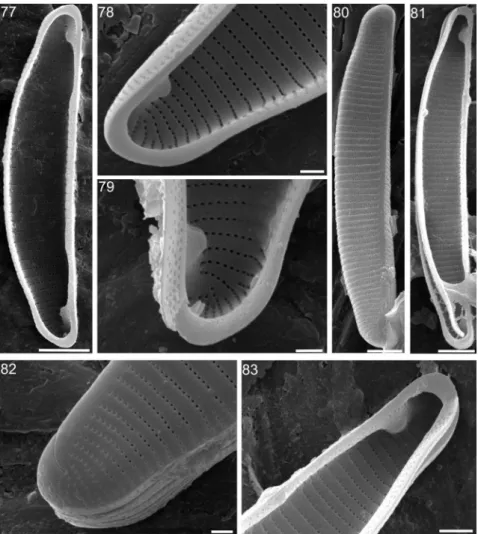
margin thickened in the median portion (Fig. 77); helictoglos-sae are developed; rimoportula is small and sessile, located in the valve surface-mantle junction, and can be hidden by the thick valve wall (Fig. 77-79).
Occurrence in the samples:UPCB 76024
Eunotia pseudosudeticavar.rotundataCavalcante, Tremarin et T. Ludwig var. nov.
Figs. 67-74, 80-83
Diagnosis: It differs from typical variety by the more rounded ends, less marked dorsiventrality of the valve and ventral margin without thickening.
Description: dorsiventral, isopolar valves; dorsal margin convex to slightly convex, ventral margin straight to slightly concave; rounded ends, detached from the valve; striae parallel, radiate in the ends, not equidistant; areolae punctuate, discernible in LM in some individuals; terminal nodules distinct; one small rimoportula per valve, near to poles.
Length 22.6-63.7 mm, width 5.2-6.8 mm, 11-14 striae in
10mm, 34-41 areolae in 10mm.
In SEM, areolae externally open in round poroids, 36-38 in 10mm (Fig. 80); terminal raphe fissures are simple, almost in the
center of valve end (Fig. 82); helictoglossae are developed, septum ornated by small poroids (Fig. 83); rimoportula not observed.
Holotype:BRAZIL, Santa Catarina: Herval D’oeste, Irani River. UPCB 76024. Periphyton attached to Podostemum muelleri. 09.III.2010. A.S. Melo & A. Nuernberg. Holotype represented by fig. 67.
Comments:this taxon is usually recorded asEunotia pectinalis
(Ku¨ tzing) Rabenhorst in Brazilian researches (eg. Moro et al. 1994, Raupp et al. 2006, Talgatti et al. 2007) orE. sudeticaO. Mu¨ ller (eg. Ludwig & Floˆres 1995).E. pectinalishas undulate dorsal margins and narrower ends (Tuji & Williams 2005). RegardingE. sudetica, this is a taxon often illustrated with high morphological variability (eg. Krammer & Bertalot 1991, Levkov et al. 2007, Lange-Bertalot et al. 2011). As the type material of this species is unknown, it is difficult to define the original forms ofE. sudetica stricto sensu. In contrast,E. pseudosudeticais a well-defined taxon (Metzeltin et al. 2005), and the population analyzed here is more similar to this taxon than to the former. Valve contour and apices are sufficient to propose this taxon as a new variety.
Our population was very similar to those determined asE. sudetica by Frenguelli (1933, pl. 8, figs. 8, 9), from northern
Figures 77-79.Eunotia pseudosudeticavar.pseudosudeticain SEM.Fig. 77.Internal valve overview.Figs 78, 79.Detail of valve ends in internal view, showing helictoglossa and rimoportula.Figs 80-83.E. pseudosudeticavar.rotundatavar. nov. in SEM.Figs 80, 81.External and internal valve overview, respectively. Fig. 82.Detail of valve end in external view.Fig. 83.Detail of valve end in internal view. Scale bars: 5mm (77, 80, 81), 2mm (83), 1mm (78, 79, 82).
10 Biota Neotrop
Cavalcante K.P. et al.
Argentina, as ‘‘Eunotia (?nov.) spec.’’ by Metzeltin & Lange Bertalot (1998, pl. 58, figs. 5, 8) from northern Brazil and as ‘‘Eunotiasp. 1’’ by Bertolli et al. (2010), from southern Brazil. All of them probably correspond toEunotia pseudosudeticavar.
rotundata.Eunotiaaff.donatoirecorded in Santos et al. (2011) is similar to this taxon, but differs by lower striae density (9-10 in 10mm) and narrower ends.
Eunotia tropico-arcus Metzeltin et Lange-Bertalot, 2007, Icon. Diat. 18, p. 123, pl. 74, figs. 1––10.
Fig. 75
Dorsiventral, isopolar valve; dorsal margin convex with median region almost straight; ventral margin slightly concave, especially in central region; truncate ends, dorsally flexed, detached from the valve; parallel striae, becoming radiate towards the ends, equidistant; areolae inconspicuous in LM; terminal nodules delicate, near to ends; rimoportula not observed. Length 37.4mm, width 8.1mm, 15 striae in 10mm.
Occurrence in the samples:UPCB 76020
Comments: the single specimen found conforms to the protologue’s description (Metzeltin & Lange-Bertalot 2007), except for striae density (11-12 in 10 mm). However, a
venezuelan taxon identified asE. praeruptaEhrenberg (Lange-Bertalot 1993, pl 33, fig. 5), but reinterpreted by Metzeltin & Lange-Bertalot (2007) asE. tropico-arcus, possesses very similar measurements to our exemplar (length 40mm, width 9mm, 15
striae in 10mm). Hence, we believe that the striae density may
reach15 striae in 10mm. It differs fromE. praeruptaby the latter
is wider (10-18 mm, Lange-Bertalot et al. 2011) and shows
strongly convex dorsal margin. Also differs from E. bidens
Ehrenberg especially by dorsal margin strongly biundulate and more truncate ends of the latter. Finally,Eunotia tropico-arcus
differs fromE. arcusEhrenberg because the latter shows less arcuate valves, ventral margins less concave and ends narrower than central region (Metzeltin & Lange Bertalot 2007).
Eunotia veneris(Ku¨tzing) De Toni, 1892, Syll. Alg. Omn. Hucusque Cogn. 2(2), p. 794.
Fig. 76
Dorsiventral, isopolar valve; dorsal margin convex, ventral margin almost straight, with slight central tumescence; sub-capitate ends, detached from the valve; striae parallel in the middle, radiate towards the ends, equidistant; areolae incon-spicuous; terminal nodules distinct; rimoportula inconspicuous. Length 26.5mm, width 5.6mm, 17 striae in 10mm.
Occurrence in the samples:UPCB 76024
Comments: identification of this taxon was based on Ku¨tzing’s type material ofEunotia venerisillustrated in Lange-Bertalot et al. (2011).E. venerishad ever been cited in state of Santa Catarina, in Conceic¸a˜o lagoon (Souza-Mosimann 1980) and Tubara˜o river (Rodrigues 1984), but without illustrations.
Acknowledgments
We thank MSc. Edimar F. Lopes for making macrophytes samples available, and MSc. Anderson S. de Mello for providing us the sampling data; the Electron Microscopy Center of UFPR provides the SEM analysis; the Conselho Nacional de Desenvolvimento Cientı´fico e Tecnolo´gico (CNPq) granted a scientific productivity scholarship to TAV. Ludwig, and REUNI, CAPES and CNPq granted master scholarship to CEJA.Tibiric¸a´, J. Wojciechowski and EC. Castro, respectively; we are also grateful to Dr. John Patrick Kociolek for valuable comments on the manuscript.
References
BARTOZEK, E.C.R, BUENO, N.C., LUDWIG, T.A.V., TREMARIN, P.I., NARDELLI, M.S. & ROCHA, A.C.R. 2013. Diatoms (Bacillariophyceae) of Iguac¸u National Park, Foz do Iguac¸u, Brazil. Acta Bot. Bras. 27: 108––123, http://dx.doi.org/ 10.1590/S0102-33062013000100012
BERTOLLI, L.M., TREMARIN, P.I. & LUDWIG, T.A.V. 2010. Diatoma´ceas perifı´ticas em Polygonum hydropiperoidesMichaux, reservato´rio do Passau´na, Regia˜o Metropolitana de Curitiba, Parana´, Brasil. Acta Bot. Bras. 24:1065––1081, http://dx.doi.org/ 10.1590/S0102-33062010000400022
BICCA, A.B., TORGAN, L.C. & SANTOS, C.B. 2011. Eunotiaceae (Eunotiales, Bacillariophyta) em ambientes lacustres na Planı´cie Costeira do Sul do Brasil. Rev. Bras. Bot. 34: 1––19, http:// dx.doi.org/10.1590/S0100-84042011000100002
BICCA, A.B. & TORGAN, L.C. 2009. Novos registros de Eunotia
Ehrenberg (Eunotiaceae-Bacillariophyta) para o Estado do Rio Grande do Sul e Brasil. Acta Bot. Bras. 23: 427––435, http:// dx.doi.org/10.1590/S0102-33062009000200014
BURLIGA, A.L. & KOCIOLEK, J.P. 2012. Four newEunotiaEhrenberg species (Bacillariophyceae) from pristine regions of Caraja´s National Forest, Amazonia, Brazil. Nova Hedwigia 141: 53––70.
BURLIGA, A.L., TORGAN, L.C. & BEAUMORD, A.C. 2007.
Eunotia ariengae sp. nov., an epilithic diatom from Brazilian Amazon. Diatom Res. 22: 247––253.
CARTER, J.R. & FLOWER, R.J. 1988. A new species ofEunotia,E. pirlasp. nov., from Woolmer pond, an acid pool in the southeast of England. Diatom Res. 3: 1––8.
EHRENBERG, C.G. 1843. Verbreitung und Einfluß des mikrosko-pischen Lebens in Su¨d- und Nord-Amerika. Abhand. Ko¨nig. Akad. Wiss., Berlin.
FERNANDES, L.F., SOUZA-MOSIMANN, R.M. & FELI´CIO-FERNANDES, G. 1990. Diatoms (Bacillariophyceae) of Ratones river, Floriano´polis, Santa Catarina, Brazil I –– Low current and estuary. Insula 20: 11––112.
FERRARI, F., PROCOPIAK, L.K., ALENCAR, Y.B. & LUDWIG, T.A.V. 2007. Eunotiaceae (Bacillariophyceae) em igarape´s da Amazoˆnia Central, Manaus e Presidente Figueiredo, Brasil. Acta Amazonica 37: 1––16.
FERRARI, F., WETZEL, C.E., ECTOR, L., BLANCO, S., VIANA, J.C.C., SILVA, E.M. & BICUDO, D.C. 2009.Perinotia diamantina
sp. nov., a new diatom species from the Chapada Diamantina, northeastern Brazil. Diatom Res. 24: 79––100.
FERREIRA, F.A, MORMUL, R.P., BIOLO, S. & RODRIGUES, L. 2011.Podostemum rutifoliumsubsp.rutifoliumcomo estruturador da comunidade de algas perifı´ticas em um rio neotropical. Rodrigue´sia 62: 813––825.
FRENGUELLI, J. 1933 Diatomeas de la regio´n de los esteros del Ybera´ (en la provincia de Corrientes). Anales Mus. Nac. Hist. Nat. 37: 365––476. FUHRMANN, A, METZELTIND & TREMARIN, P.I. 2013. A triangular Eunotia (Bacillariophyceae) in southeastern Brazil:
Eunotia trigona sp. nov. Acta Bot. Bras. 27: 694––697, http:// dx.doi.org/10.1590/S0102-33062013000400007
FUREY, P.C., LOWE, R.L. & JOHANSEN, J.R. 2011. Eunotia
Ehrenberg (Bacillariophyta) of the Great Smoky Mountains National Park, USA. Bibliot. Diatomol. 56: 1––133.
HUSTEDT, F. 1949. Su¨sswasser-diatomeen aus dem Albert-Nationalpark in Belgisch-Kongo. Exploration du Parc National Albert, Mission H. Damas (1935-1936). Vol. 8. Institut des Parcs Nationaux du Congo Belge, Brussels.
HUSTEDT, F. 1952. Neue und wenig bekannte Diatomeen. III. Phylogenetische Variationen bei den rhaphidioiden Diatomeen. Ber. Deutsch. Bot. Ges. 56: 133––145.
KRAMMER, K. & LANGE-BERTALOT, H. 1991. Bacillariophyceae, Teil. 3: Centrales, Fragilariaceae, Eunotiaceae. In Su¨bwasserflora von Mitteleuropa 2/3 (H. Ettl, I. Gerloff, H. Heynig & D. Mollenhauer, eds). Gustav Fischer Verlag, Stuttgart-Jena, p.1––576.
Biota Neotrop 11
Eunotia on Podostemum
KOBAYASI, H., ANDO, K. & NAGUMO, T. 1981. On some endemic species of the genusEunotiain Japan. Proc. 6thDiatom Symp. 1980: 93––114.
KOCIOLEK, J.P., LYON, D. & SPAULDING, S. 2001. Revision of the South American Species of Actinella. In Lange-Bertalot-Festschrift (R. Jahn, J.P. Kociolek, A. Witkowski & P. Compe`re, eds). Gantner, Ruggell, p.131––165.
LANGE-BERTALOT, H. 1993. 85 Neue taxa und u¨ber 100 weitere neu definierte taxa erga¨nzend zur su¨ßwasserflora von Mittleleuropa Vol. 2/1––4. Bibliot. Diatomol. 27: 1––454,http://dx.doi.org/10.1515/ bd.1993.27.1.1
LANGE-BERTALOT, H., BAK, M. & WITKOWSKI, A. 2011.
Eunotia and some related genera. In Diatoms of Europe 6 (H. Lange-Bertalot, ed.). Gantner, Ruggell, p.1––747.
LANGE-BERTALOT, H., KU¨ LBS, K., LAUSER, T., NO¨RPEL-SCHEMPP, M. & WILLMANN, M. 1996. Diatom Taxa introduced by Georg Krasske –– Documentation and Revision. In Iconographia Diatomologica 3 (H. Lange-Bertalot, ed.). Koeltz Scientific Books, Ko¨nigstein, p.1––358.
LEVKOV, Z., KRSTIC, S., METZELTIN, D. & NAKOV, T. 2007. Diatoms of Lakes Prespa and Ohrid –– About 500 taxa from ancient lake system. –– In Iconografia Diatomologica 16 (H. Lange-Bertalot, ed.). Gantner, Ruggell, p.1––613.
LOZOVEI, A.L. & SHIRATA, M.T. 1990. Diatoma´ ceas (Chrysophyta, Bacillariophyceae) no rio Passau´na, Curitiba, Parana´, Brasil: levantamento qualitativo da diatomoflo´rula em um segmento do manancial. Estudos de Biologia 27: 5––56. LUDWIG, T.A.V. & FLOˆ RES, T.L. 1995. Diatomoflo´rula dos rios da
regia˜o a ser inundada para a construc¸a˜o da usina hidrele´trica de Segredo, PR. I. Coscinodiscophyceae, Bacillariophyceae (Achnanthales e Eunotiales) e Fragilariophyceae (Meridion e
Asterionella). Arq. Biol. Tecnol. 38: 631––650.
METZELTIN, D. & LANGE-BERTALOT, H. 1998. Tropical Diatoms of South America I: About 700 predominantly rarely known or new taxa representative of the neotropical flora. In Iconographia Diatomologica 5 (H. Lange-Bertalot, ed.). Koeltz Scientific Books, Ko¨nigstein, p.1––695.
METZELTIN, D. & LANGE-BERTALOT, H. 2007. Tropical Diatoms of South America II: Special Remarks on Biogeographic Disjunction. In Iconographia Diatomologica 18 (H. Lange-Bertalot, ed.). Gantner, Ruggell, p.1––877.
METZELTIN, D. & TREMARIN, P.I. 2011. Uma nova espe´cie de
Eunotiapara o sudeste do Brasil:Eunotia fuhrmannii. Iheringia Se´r. Bot. 62: 201––208.
METZELTIN, D., LANGE-BERTALOT, H. & GARCI´ A-RODRIGUEZ, F. 2005. Diatoms of Uruguay. In Iconographia Diatomologica 15 (H. Lange-Bertalot, ed.). Koeltz Scientific Books, Ko¨nigstein, p.1––736.
MOREIRA FILHO H, & VALENTE-MOREIRA, I.M. 1981. Avaliac¸a˜o taxonoˆmica e ecolo´gica das diatoma´ceas (Bacillariophyceae) epı´fitas em algas pluricelulares obtidas nos litorais dos Estados do Parana´, Santa Catarina e Sa˜o Paulo. Bol. Mus. Bot. Munic. 47: 1––17. MORO, R.S., GARCIA, E. & OLIVEIRA-JR, HF. 1994. Diatoma´ceas
(Bacillariophyceae) da represa de Alagados, Ponta Grossa, Parana´, Brasil (exclusive ceˆntricas). Iheringia Se´r. Bot. 45: 5––9.
PATRICK, R. & REIMER, C.W. 1966. The Diatoms of United States: exclusive of Alaska and Hawaii. Academy of Natural Sciences, Philadelphia.
RAUPP, S.V., TORGAN, L.C. & BAPTISTA, L.R.M. 2006. Composic¸a˜o e variac¸a˜o temporal de diatoma´ceas (Bacillariophyta) no plaˆncton da represa de Canastra, sul do Brasil. Iheringia Se´r. Bot. 61: 105––134. REICHARDT, E. 2007. Neue und wenig bekannteGomphonema-Arten
(Bacillariophyceae) mit Areolen in Doppelreihen. Nova Hedwigia 85: 103––137.
REICHARDT, E. 2008.Gomphonema intermediumHustedt sowie drei neue, a¨hnliche Arten. Diatom Res. 23: 105––115,http://dx.doi.org/ 10.1080/0269249X.2008.9705740
RODRIGUES, L. 1984. Contribuic¸a˜o ao conhecimento das diatoma´-ceas do rio Tubara˜o –– Santa Catarina –– Brasil. Insula 14: 47––120. ROUND, F.E., CRAWFORD, R.M. & MANN, D.G. 1990. The diatoms: biology and morphology of the genera. Cambridge University Press, New York.
SANTOS, E.M., TREMARIN, P.I. & LUDWIG, T.A.V. 2011. Diatoma´ceas perifı´ticas em Potamogeton polygonus Cham. & Schltdl.: citac¸o˜es pioneiras para o estado do Parana´. Biota Neotrop. 11: 303––315 http://biotaneotropica.org.br/v11n3/en/ abstract?inventory++bn01611032011.
SAUPE, A.C. & SOUZA-MOSIMANN, R.M.S. 2003. Diatoma´ceas (Bacillariophyta) preservadas nos sedimentos holoceˆnicos da Lagoa do Peri- Floriano´polis-SC- Brasil. Insula 21: 33––61.
SCHMIDT, A. 1913. Atlas der Diatomaceen-Kunde. Tafel 287. O. R. Reisland, Leipzig.
SILVA, W.J., NOGUEIRA, I.S. & SOUZA, M.G.M. 2011. Cata´logo de diatoma´ceas da regia˜o Centro-Oeste brasileira. Iheringia Se´r. Bot. 66: 1––32.
SIMONSEN, R. 1974. The diatom plankton of the Indian Ocean expedition of the R/V Meteor 64-65. Meteor Forsch. D. 19: 1––107. SIMONSEN R. 1987. Atlas and catalogue of the Diatom types of
Friedrich Hustedt. Vol. 1––3. J Cramer, Berlin.
SOUZA-MOSIMANN, R.M. 1980. Diatoma´ceas da represa da Lagoa da Conceic¸a˜o. Insula 11: 1––36.
SOUZA-MOSIMANN, R.M. & LAUDARES-SILVA, R. 2005. Diatoms (Bacillariophyta) from the southern lagoon complex of Santa Catarina, Brazil. Insula 34: 39––82.
SOUZA-MOSIMANN, R.M., LAUDARES-SILVA, R., TALGATTI, D.M. & D’AQUINO-ROSA, V. 2011. The diatom flora in Conceic¸a˜o Lagoon, Floriano´polis, SC, Brazil. Insula 40: 25––54. TALGATTI, DM, GARCIA, M & SCHEFFER, L. 2007. O geˆnero
Eunotia Ehrenberg (Bacillariophyta) do arroio do Ecocamping Municipal de Pelotas, RS, Brasil. Rev. Bras. Bioc. 5: 756––758. TORGAN, L.C. & BECKER, V. 1997.Eunotia densistriatasp. nov.: a
subaerial diatom from Southern Brazil. Diatom Res. 12: 115––124. TORGAN, L.C., BECKER, V & PRATES, M. 1999. Checklist das diatoma´ceas (Bacillariophyta) de ambientes de a´guas continentais e costeiros o estado do Rio Grande do Sul, Brasil. Iheringia Se´r. Bot. 52: 89––144.
TREMARIN, P.I., LUDWIG, T.A.V. & MOREIRA-FILHO, H. 2008.Eunotia Ehrenberg (Bacillariophyceae) do rio Guaraguac¸u, litoral do Parana´, Brasil. Acta Bot. Bras. 22: 845––862, http:// dx.doi.org/10.1590/S0102-33062008000300020
TREMARIN, P.I., FREIRE, E.G, BERTOLLI, L.M. & LUDWIG, T.A.V. 2009. Cata´logo das diatoma´ceas (Ochrophyta-Diatomeae) continentais do estado do Parana´. Iheringia Se´r. Bot. 64: 79––107. TREMARIN, P.I., WETZEL, C.E., LUDWIG, T.A.V. & ECTOR, L.
2011. Encyonema exuberans sp. nov. (Bacillariophyceae) from southern Brazilian lotic systems. Nova Hedwigia 92: 107––120. TUJI, A. & WILLIAMS, D.M. 2005. Observation of the type materials
forEunotia pectinalis(Ku¨tz.) Rabenh. var.pectinalisandEunotia pectinalisvar.undulata(Ralfs) Rabenh. Diatom 21: 57––60. WETZEL, C.E., ECTOR, L., HOFFMANN, L. & BICUDO, D.C. 2010.
Colonial planktonic Eunotia (Bacillariophyceae) from Brazilian Amazon: Taxonomy and biogeographical considerations on theE. asterionelloidesspecies complex. Nova Hedwigia 91: 49––86. WETZEL, C.E., ECTOR, L., HOFFMANN, L., LANGE-BERTALOT,
H. & BICUDO, D.C. 2011. Two new periphyticEunotiaspecies from the neotropical Amazonian ‘black waters’, with a type analysis ofE. braunii. Diatom Res. 26: 135––146, http://dx.doi.org/10.1080/ 0269249X.2011.587644
Received 25/02/2014 Revised 09/06/2014 Accepted 01/09/2014
12 Biota Neotrop
Cavalcante K.P. et al.