aDepartment of Physiological Sciences - Institute of Biology Roberto
Alcântara Gomes, State University of Rio de Janeiro – Rio de Janeiro, Brazil.
bState Institute of Diabetes and Endocrinology - Rio de Janeiro, Brazil. cEndocrinology Department, Universidade Estadual de Campinas
(UNICAMP) - São Paulo, Brazil. Email: [email protected] Received for publication on April 19, 2006. Accepted for publication on July 18, 2006.
CLINICAL SCIENCES
RELATIONSHIP BETWEEN ADIPOKINES,
INFLAMMATION, AND VASCULAR REACTIVITY IN
LEAN CONTROLS AND OBESE SUBJECTS WITH
METABOLIC SYNDROME
Luciana Bahia,a Luiz Guilherme Aguiar,a Nivaldo Villela,a Daniel Bottino,a Amelio
F. Godoy-Matos,b Bruno Geloneze,c Marcos Tambascia,c and Eliete Bouskelaa
Bahia L, Aguiar LG, Villela N, Bottino D,Godoy-Matos AF, Geloneze B et al. Relationship between adipokines,
inflammation, and vascular reactivity in lean controls and obese subjects with metabolic syndrome. CLINICS. 2006;61(5):433-40.
PURPOSE: Metabolic syndrome is an important risk factor for cardiovascular disease. Adipokines interfere with insulin action and endothelial cell function. We investigated the relationship among adipokines, metabolic factors, inflammatory markers, and vascular reactivity in obese subjects with metabolic syndrome and lean controls.
METHODS: Cross-sectional study of 19 obese subjects with metabolic syndrome and 8 lean volunteers evaluated as controls. Vascular reactivity was assessed by venous occlusion pletysmography measuring braquial forearm blood flow (FBF) and vascular resistance (VR) responses to intra-arterial infusions of endothelium-dependent (acetylcholine-Ach) and independent (sodium nitroprusside-SNP) vasodilators.Blood samples were obtained to evaluate C reactive protein (CRP), plasminogen activator inhibitor 1 (PAI-1), fibrinogen, adiponectin, resistin, and lipid profile. Patients were classified with regard to insulin resistance through the HOMA-IR index.
RESULTS: PAI-1, CRP and fibrinogen were higher and adiponectin was lower in metabolic syndrome subjects compared to controls. Metabolic syndrome subjects had impaired vascular reactivity. Adiponectin and PAI-1 were associated with insulin, HOMA-IR, triglycerides, and HDLc; and resistin with CRP. Adiponectin was associated with VR after Ach in the pooled group and resistin with D FBF after Ach in the metabolic syndrome group.
CONCLUSION: Metabolic syndrome subjects exhibited low levels of adiponectin and high levels of CRP, fibrinogen, and PAI-1. Adiponectin and PAI-1 correlated with insulin resistance markers. Adiponectin and resistin correlated with vascular reactivity parameters. An adipocyte-endothelium interaction might be an important mechanism of inflammation and vascular dysfunction.
KEYWORDS: metabolic syndrome. Adipokines. Vascular reactivity. Inflammation markers. Venous occlusion plethysmography.
INTRODUCTION
Metabolic syndrome (MetSyn) comprises an array of cardiovascular risk factors such as abdominal obesity,
dyslipidemia, hypertension, and impaired glucose tolerance. Insulin resistance (IR) and/or increased abdominal (vis-ceral) obesity have been suggested as potential ethiological factors. Insulin resistance has negative effects on arterial and arteriolar function throughout the body.1 In addition to
the link between IR and the development of type 2 diabe-tes, IR-associated dysfunction of resistance vessels is re-lated to arterial hypertension and vascular occlusive dis-eases, such as myocardial infarction and stroke.2,3 The
second-ary to excessive generation of reactive oxygen species (ROS), a process denominated oxidative stress. Other fac-tors, such as increased production of vasoconstrictive agents, also seem to restrict the dilator responses. The un-derlying cause of augmented ROS availability is not com-pletely understood, but vascular inflammatory processes appear to be involved. Increasing evidence has associated insulin resistance with subclinical inflammation involving cytokines derived from adipose tissue.4 Metabolic syndrome
has also features of a pro-thrombotic state, consisting of increased levels of 3 clotting factors (tissue factor, factor VII, and fibrinogen) as well as inhibition of the fibrino-lytic pathway with increased plasminogen activator inhibi-tor 1 (PAI-1) and decreased tissue plasminogen activainhibi-tor activity.5
Adipose tissue is not an inert storage depot, but rather a tissue actively secreting a variety of bioactive substances, known as adipokines, with autocrine, paracrine, and endo-crine actions that probably contribute to the increased risk of type 2 diabetes and cardiovascular disease. Adiponectin, a newly found adipose tissue-specific collagen-like protein, has been noted as an important antiatherogenic and anti-inflammatory protein.6,7 On the other hand, resistin, also
produced by the adipose tissue, has been identified in sev-eral others tissues.8 More recently, it has been found in
monocytes and is suggested to be intrinsically related to the inflammatory process.9 Resistin antagonizes insulin
ac-tion and has been shown to impair glucose metabolism in wild-type mice. Increased levels of resistin mRNA have been detected in genetic and diet-induced obesity models,10
although in humans there is uncertainty about the relation-ships between resistin, body fat mass, and insulin resist-ance markers.11 PAI-1, also secreted by adipocytes, is
as-sociated with increased cardiovascular events in diabetic, obese, and insulin-resistant subjects.12-14
To elucidate the relationship among adipokines, inflam-mation, IR, and endothelial function, we performed a cross-sectional study comparing obese subjects with metabolic syndrome to lean controls.
SUBJECTS AND METHODS
The present study, approved by the local Ethical Com-mittee, included 19 nonsmoking subjects with MetSyn and 8 healthy volunteers. The general characteristics of both groups are described in Table 1. All subjects were selected at the Cardiometabolic Clinic for outpatient care at the State University of Rio de Janeiro. All of them signed an informed consent form approved by the Ehics Committee. At the first clinical visit, they were subjected to a com-plete clinical examination, went through a 10 to 12 h
fast-ing lipid profile and a 75-g oral glucose tolerance test. All subjects were found positive for at least 3 criteria for
MetSyn according to NCEP-ATPIII.15 The same trained
examiner collected anthropometric measurements twice: waist circumference at its smallest point with the abdomen relaxed, hip circumference at the widest part at the gluteal region and weight using a digital scale (Filizola, Rio de Janeiro, RJ-Brazil). Blood pressure (BP) was also meas-ured twice after a five-minute rest in the supine position using an automated apparatus (Multiparameter patient monitor - Lifewindow LW6000, Digicare Biomedical Tech-nology, West Palm Beach, WA-USA). Subjects with hyper-tension were instructed not to stop taking their anti-hyper-tensive medication. None was using angiotensin-convert-ing enzyme blockers, angiotensin II antagonists or choles-terol lowering drugs. Subjects were excluded for any of the following reasons: diabetes mellitus type 2, smoking habit, coronary heart disease or any major active medical issues.
VASCULAR REACTIVITY TESTS
We performed venous occlusion plethysmography af-ter intra-araf-terial infusions of endothelium-dependent (Ach) and independent (SNP) vasodilators, an accurate technique to study vascular reactivity in humans, which indirectly as-sess endothelial function. Forearm blood flow (FBF) and vascular resistance (VR) responses to intra-arterial infusions of Ach and SNP were analyzed. This study was performed in the morning period after a 8 to 10-hour overnight fast and in a temperature controlled room (20-22°C). A 27-gauge spinal needle (Becton, Dickinson Ind Cirurgicas Ltda, Juiz de Fora, MG-Brazil) was inserted into the left
Table 1 - General characteristics of control and metabolic syndrome (MetSyn) groups
MetSyn Control P value
n = 19 n = 8
Age (years) 40.8 ± 9.4 25.7 ± 3.9 < 0.001
Gender (male/female) 7/12 4/4 ns
Weight (kg) 102.5 ± 16 62.4 ± 12.8 < 0.001 BMI (kg/m2) 37.6 ± 6.30 21.6 ± 2.1 < 0.001
Waist circumference(cm)
women 106.5 ± 9.6 64.5 ± 5.2 < 0.001 men 105.4 ± 9.4 83.2 ± 6.4 < 0.001 Waist-hip ratio
women 0.90 ± 0.006 0.71 ± 0.004 < 0.001 men 0.97 ± 0.007 0.86 ± 0.004 < 0.001 Systolic blood pressure 150.0 ± 16.6 115.1 ± 11.4 < 0.001 (mm Hg)
Diastolic blood pressure 86.9 ± 9.6 71.0 ± 10.7 0.001 (mm Hg)
brachial artery, anterior to the elbow, under sterile condi-tions and local anesthesia. Baseline measurements of FBF, BP and heart rate were obtained after catheter insertion fol-lowed by a 20-minute rest. A mercury-filled silastic strain-gauge was placed on the upper third of the forearm in the point of maximal circumference. The arm collecting cuff pressure was 40 mm Hg and the wrist cuff occlusion pres-sure was 200 mm Hg. Wrist cuff was inflated 1 minute be-fore each flow measurement to avoid hand shunt. By block-ing venous efflux with the upper arm cuff, the slope of change in forearm volume expresses FBF. Blood pressure was measured noninvasively simultaneously in the right arm at each period. Baseline blood flow was recorded after a 20-minute infusion of saline at a rate of 0.8 mL/minute de-livered by a Harvard pump (Harvard Apparatus Inc, South Natick, Massachusetts-USA). Ach and SNP were infused for 5 minutes each at progressive doses: 7.5, 15, and 30 mg/minute and 2, 4, and 8 mg/minute, respectively. Blood flow was measured during the last 2 minutes for each dose and was recorded for 10 s in every 15 s. There was a 20-minute interval between each drug infusion. Forearm vas-cular resistance (VR), expressed in arbitrary units, was cal-culated by dividing mean BP by FBF for each recorded pe-riod. The plethysmograph (Hokanson EC6, D.E. Honkanson Inc, Bellevue, WA, USA) was connected to an analog-to-digital converter (8SP, AD Instruments Pty Ltd, Castle Hill-Australia) and the data was analyzed by Power Lab software on an IBM PC compatible.
LABORATORY ANALYSIS
Fasting plasma glucose, total cholesterol, triglycerides, and HDL-cholesterol (HDLc) were measured by enzyme-colorimetric GOD-PAP automated method (Modular Analytics PP, Roche). LDL cholesterol was calculated by the Friedwald equation. Fasting plasma insulin, C-reactive pro-tein (CRP), and fibrinogen were measured by automated chemoluminiscence (coefficient of variation-CV 4.68%), immunoturbimetric (CV 2.14%), and coagulometric (CV 1.6%) methods, respectively. Blood samples were centri-fuged and stored at -70oC for further analysis of adipokines.
Adiponectin (Adp), resistin, and PAI-1 were measured by human serum adipokine (panel A, Lincoplex kit CATHADK161KA, Linco ResearchSt Charles, Missouri -USA). The intra and inter-assay CV were 6.11% and 13.2%, 7.26% and 9.12%, and 4.37% and 20.8%, respectively. HOMA-IR was calculated to assess insulin resistance.16
STATISTICAL ANALYSIS
Data were analyzed using SPSS 10.0 software for
Win-dows (SPSS, Chicago, IL-USA). Comparisons between
groups were performed by independent samples Student t
test and Mann Whitney tests, as indicated. Correlation analysis was performed by Spearman rank order test. All group data are reported as mean ± SD, except for non-mal variables. Logarithmic transformation was used to nor-malize non-normally distributed variables. Significant dif-ferences were assumed when P < 0.05.
RESULTS
The differences in laboratory parameters are displayed in Table 2. As expected, MetSyn group had higher fasting plasma glucose, insulin and HOMA-IR. Adiponectin was lower, whereas PAI-1, CRP and fibrinogen were higher in the MetSyn group compared to the control group. Resistin values were not different between groups.
In the pooled group, adiponectin was associated with insulin (r = -0.50, P = 0.009), HOMA-IR (r = -0.41, P = 0.04), triglycerides (r = -0.44, P = 0.02), and HDLc (r = 0.49, P = 0.01). PAI-1 was associated with glucose (r = 0.67, P < 0.001), insulin (r = 0.68, P < 0.001), HOMA-IR (r = 0.69, P < 0.001), triglycerides (r = 0.53, P = 0.02), CRP (r = 0.39, P = 0.004), and HDLc (r = -0.55, P = 0.003) in the pooled group. In the MetSyn group, PAI-1 was as-sociated with glucose (r = 0.53, P = 0.01) and HOMA-IR (r = 0.50, P =0.02). Resistin was associated with CRP (r = 0.42, P = 0.02) only in the MetSyn group.
The MetSyn group had impaired endothelium-depend-ent and independendothelium-depend-ent vasodilation compared to the control
Table 2 - Laboratory measurements in control and metabolic syndrome (MetSyn) groups
MetSyn Control P value
n = 19 n = 8
Glucose (mmol/l) 5.43±0.73 4.71±0.47 0.01
2h post-load glucose 7.7±1.94 5.73±0.55 0.001 (mmol/l)
Insulin (mUI/ml) 14.4±4.6 4.1±1.7 <0.001
HOMA-IR 3.4±1.2 1.0±0.4 <0.001
Total Cholesterol (mmol/l) 5.12±0.86 4.71±1.7 0.26
LDLc (mmol/l) 3.29±0.81 2.79±0.56 0.12
HDLc (mmol/l)
women 1.13±0.37 1.85±0.31 0.001
men 1.10±0.18 1.44±0.15 0.001
Triglycerides (mmol/l) 1.81±0.81 0.61±0.25 <0.001 CRP (mg/dl) 1.0 [0.5-2.0] 0.3 [0.2-0.45] 0.002 Fibrinogen (mmol/l) 3.04±0.76 2.40±0.34 0.04 Adiponectin (mg/ml) 9.5 [3.7-14.2] 19.5 [8.6-53.4] 0.03
Resistin (ng/ml) 18.9±4.8 17.2±2.2 0.36
PAI-1 (ng/ml) 25.9±6.6 14.3±4.3 <0.001
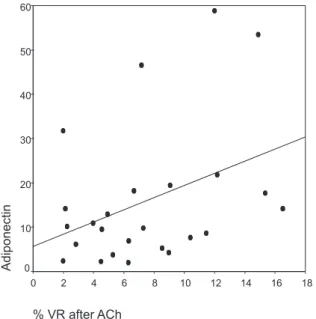
group (Figures 1 and 2). No association could be found be-tween PAI-1 and vascular reactivity measurements in both groups. Adiponectin was associated with DVR after Ach (r =0.39, P = 0.05) in the whole group, although after ad-justments to metabolic parameters, this relationship was not significant any more. In the MetSyn group, resistin was as-sociated with D FBF after Ach (r = -0.47, P = 0.04), but again, after adjustment to CRP, this relationship disap-peared (Figures 3 and 4).
DISCUSSION
In a previous study17 we have shown that endothelial
dysfunction correlates with markers of obesity. In this study, we show that subjects with MetSyn exhibited impaired en-dothelium-dependent and independent vasodilation re-sponses compared to the control group, as has already been shown in other studies in obese and type 2 diabetic
sub-jects,18,19 and is considered a risk factor for future
cardio-vascular ischemic events.20 There is increasing evidence that
new cases of cardiovascular diseases are closely associated with increased prevalence of insulin resistance and type 2 diabetes due to excessive weight and sedentary lifestyle.21,22
The convergence between insulin resistance and inflamma-tion in the pathogenesis of atherosclerotic coronary disease has been recognized over the past decade, 4,23 but the exact
mechanism by which excessive adiposity causes both in-sulin resistance and vascular dysfunction is not completely understood. Much of the recent work on obesity has high-lighted the key role of adipose tissue as an endocrine or-gan secreting a large number of substances that mediate vascular and metabolic complications of obesity.
Resistin, as suggested by its name, should be related to insulin resistance, but a lot of controversy surrounds its exact biological role in humans. Even without significant differences between the two groups studied, we were able
Figure 1 - Vascular resistance decrement (%) after Ach and SNP infusion in subjects with MS (·) and controls (²%). (*P <0.05 intergroup)
Figure 2 - Forearm blood flow increment (%) after Ach and SNP infusion in subjects with MS(·) and controls(²%). (*P <0.05 intergroup)
Figure 3 - Relationship between vascular resistance decrement (%) after Ach and adiponectin level in the pooled group
to show an inverse relationship between resistin and en-dothelium-dependent vasodilation in the MetSyn group. To our knowledge, this is the first study demonstrating this re-lationship in humans. Verma and co-workers24 reported, for
the first time, that human recombinant resistin exerted di-rect effects on cultured endothelial cells, promoting endotelin-1 release and upregulating adhesion molecules and cytokines, possibly a link between this adipokine and vascular dysfunction. Other authors have shown that resistin can cause endothelial dysfunction in porcine coronary ar-teries through oxidative stress and down-regulation of en-dothelial nitric oxide synthase25 and that it can induce
hu-man aortic smooth muscle cells proliferation.26
We could not demonstrate a difference in resistin lev-els between the two groups and any relationship between resistin and IR markers. The analysis of several published studies show conflicting results, some demonstrating a close relationship between resistin and insulin resistance27 while
many others arrive at the opposite conclusion.28-30 The
posi-tive correlation between resistin and CRP found in this
study and also in others,31-33 suggests a direct
proinflammatory role of resistin that might be involved in the inflammatory vascular process.34 In contrast to what was
found in rodents, human resistin is expressed primarily in inflammatory cells,9 and its expression is markedly
in-creased by treatment with endotoxin and proinflammatory cytokines in vitro.35 At cellular level, resistin has been
shown to exert pro-inflammatory properties by up-regulat-ing cytokines, probably via the NFk-B payhway.36 We found
that resistin was associated with CRP and endothelial-de-pendent vasodilation only in MetSyn group, with higher CRP and lower vasodilation capacity. When adjustment for CRP was done, the relationship between resistin and en-dothelial-mediated vasodilation disappeared. Considering the expression of resistin by mononuclear cells and assum-ing that obesity and MetSyn are states of low-grade inflam-mation, resistin may indeed represent a molecular link be-tween metabolic signals, inflammation, and vascular dys-function. Remarkably, Reilly and co-workers31 showed, in
a large study of 879 humans at high risk for coronary atherosclerosis, the relationship between resistin and diverse inflammatory markers, as well as with coronary atheroscle-rosis.
A positive association between PAI-1 and insulin resist-ance markers has been shown by several studies in insu-lin-resistant, obese and nonobese subjects.12-14 We also
dem-onstrated correlations between PAI-1, insulin resistance, and inflammatory markers. Chronic inflammation of the vascular wall shifts haemostatic mechanisms in favor of thrombosis. The possible mechanisms involved are en-hanced clotting process, impaired fibrinolysis capacity and
decreased natural anticoagulant pathways.35-38 C-reactive
protein and other inflammatory mediators can down-regu-late the protein C and thrombomodulin receptors of en-dothelial cells. In response there is an increase in cytokine expression and endothelial cell injury, creating a vicious cycle.37 Therefore, factors of haemostatic and fibrinolytic
systems could be directly linked to insulin-resistance syn-drome or be a reflection of endothelial cell activation and chronic low-grade inflammation.
Plasma levels of adiponectin were reduced in MetSyn group compared to the control group, which is in accord-ance to various studies showing reduced adiponectin lev-els in obese, diabetic, coronary heart disease, and hyper-tensive subjects.39-41 There was an inverse correlation
be-tween adiponectin and insulin-resistance markers in the whole group. The exact mechanism underlying the ob-served association between adiponectin and insulin is pres-ently unknown. In rhesus monkeys, the hyperinsulinemic-euglycemic clamp revealed a positive correlation between adiponectin and glucose uptake and, longitudinally, plasma adiponectin decreased in parallel to the progression of in-sulin resistance.42 In in vitro and animal studies, insulin
enhances adiponectin secretion,43,44 suggesting that
adiponectin secretion might be disturbed in the insulin-re-sistance states. Indeed, the administration of recombinant adiponectin in lipoatrophic mice caused a reversal of in-sulin resistance.45
In this cross-sectional study, we only found a tendency for correlation between adiponectin and endothelial de-pendent-vasodilation in the whole group, although this as-sociation disappeared after adjusting to metabolic param-eters. There are several studies showing that adiponectin favorably affects endothelial function and vascular homeostasis.45-47 Although there is evidence of direct effects
of adiponectin on endothelial cells, the lack of correlation after adjustments to metabolic parameters in our sample does not confirm it. In human studies, the relationship be-tween adiponectin and endothelial function has been dem-onstrated in obese, type 2 diabetic, hypertensive subjects and in healthy subjects.48-51 We found that adiponectin was
indeed decreased in subjects with MetSyn who also dem-onstrated an impaired endothelial-dependent vasodilation. The absence of correlation with vascular reactivity in MetSyn group could eventually be explained by our small sample size. Adiponectin might have a protective role in vascular function and high levels of adiponectin correlates to less coronary heart events in men with and without dia-betes.52,53 Further larger studies are needed to address
This is the first study showing a relationship between resistin and vascular reactivity in MetSyn subjects, although it has some limitations due its small sample, but also be-cause the comparison of groups was not matched by age, and because it was not possible to separate subgroups.
In conclusion, adiponectin and PAI-1 correlated with insulin-resistance markers, but resistin did not. In contrast with the initial studies connecting resistin to IR, our re-sults are in line with others suggesting a proinflammatory role of resistin interfering with vascular function. An adipocyte-endothelium interaction may be an important mechanism of inflammation and vascular dysfunction lead-ing to increased cardiovascular disease in obesity. However,
the exact mechanism linking resistin and adiponectin to the pathogenesis of obesity-induced insulin resistance and car-diovascular disease deserves further studies.
ACKNOWLEDGEMENTS
The work was supported by a grant from the national re-search Council of Brazil (CNPq number 505860/2004-0).
The authors wish to thank Mr Francisco Araujo, Mrs Cristiane Conte, Mrs Camila Laflor, Mrs Sofia Gama and Dr Beatriz Schaan for their technical help.
Part of this work has been presented as an abstract in Arq Bras Endocrinol Metab 2005;49(5):S878.
RESUMO
Bahia L, Aguiar LG, Villela N, Bottino D,Godoy-Matos
AF, Geloneze B et al. Relação entre as adipocinas, infla-mação e reatividade vascular em controles magros e paci-entes obesos com síndrome metabólica. CLINICS. 2006;61(5):433-40.
A Síndrome Metabólica é um importante fator de risco para doenças cardiovasculares. As adipocinas interferem com a ação da insulina e com a função endotelial.
OBJETIVO: Investigar a relação entre adipocinas, fato-res metabólicos, marcadofato-res inflamatórios e reatividade vascular para inferência da função endotelial em pacien-tes obesos e controles magros.
MATERIAL E MÉTODO: Estudo transversal de 19 pa-cientes obesos com Síndrome Metabólica e 8 controles magros. A reatividade vascular foi avaliada pela pletismografia de oclusão venosa medindo o fluxo sangüíneo da artéria braquial e sua resistência vascular a partir de infusões intra-arteriais de vasodilatadores endotélio-dependente (acetilcolina) e endotélio-independen-te (nitroprussiato de sódio). Foram também avaliados no sangue a proteína C reativa (PCR), o inibidor do ativador do plasminogênio 1 (PAI-1), fibrinogênio, adiponectina,
resistina e o perfil lipídico. Os pacientes foram classifica-dos quanto à resistência insulínica pelo índice HOMA-IR.
RESULTADO: PAI-1, PCR e fibrinogênio apresentaram va-lores mais altos e a adiponectina mais baixos para os pacien-tes com Síndrome Metabólica do que com os controles. Pa-cientes com Síndrome Metabólica apresentaram prejuízo da reatividade vascular. A adiponectina e PAI-1 estiveram asso-ciadas à insulina, HOMA-IR, triglicerídeos e HDLc; e resistina com o PCR. Adiponectina esteve associada com a resistência vascular e a resistina com o fluxo sangüíneo depois da acetilcolina em pacientes com Síndrome Metabólica.
CONCLUSÃO: Pacientes com Síndrome Metabólica exi-biram baixas concentrações sangüíneas de adiponectina e altos níveis de PCR, fibrinogênio e PAI-1. Adiponectina e PAI-1 correlacionaram com os marcadores da resistência insulínica. Adiponectina e resistina correlacionaram com a reatividade vascular. A interação adipócito-endotélio vascular pode ser um importante mecanismo de inflama-ção e disfuninflama-ção vascular.
UNITERMOS: Síndrome Metabólica. Adipocinas. Reatividade vascular. Marcadores inflamatórios. Pletismografia de oclusão venosa.
REFERENCES
1. Arcaro G, Cretti A, Balzano S, Lechi A, Muggeo M, Bonora E, et al. Insulin causes endothelial dysfunction in humans: sites and mechanisms. Circulation. 2002;105:576-82.
2. Lakka HM, Laaksonen DE, Lakka TA, Niskanen LK, Kumpusalo E, Tuomilehto J, et al. The metabolic syndrome and total and cardiovascular disease mortality in middle-aged men. JAMA. 2002;288:2709-16.
3. Isomaa B, Almgren P, Tuomi T, Forsen B, Lahti K, Nissen M, et al. Cardiovascular morbidity and mortality associated with the metabolic syndrome. Diabetes Care. 2001, 24:683-9.
5. De Pergola G, Pannacciulli N. Coagulation and fibrinolysis abnormalities in obesity. J Endocrinol Invest. 2002;25:899-904. 6. Maeda K, Okubo K, Shimomura I, Funahashi T, Matsuzawa Y,
Matsubara K. cDNA cloning and expression of a novel adipose specific collagen-like factor, apM1 (AdiPose Most abundant Gene transcript 1). Biochem Biophys Res Commun. 1996;221:286-9.
7. Funahashi T, Nakamura T, Shimomura I, Maeda K, Kuriyama H, Takahashi M, et al Role of adipocytokines on the pathogenesis of atherosclerosis in visceral obesity. Intern Med. 1999;38:202-6. 8. Adeghate E. An update on the biology and physiology of resistin. Cell
Mol Life Sci. 2004;61:2485-96.
9. Yang RZ, Huang Q, Xu A, McLenithan JC, Eisen JA, Shuldiner AR, et al. Comparative studies of resistin expression and phylogenomics in humans and mouse. Biochem Biophys Res Commun. 2003;310:927-35. 10. Steppan CM, Bailey ST, Bhat S, Brown EJ, Banerjee RR, Wright CM.
The hormone resistin links obesity to diabetes. Nature. 2001;409:307-312.
11. Rea R, Donnelly R. Resistin: an adipocyte-derived hormone. Has it a role in diabetes and obesity? Diabetes, Obesity and Metab. 2004;6:163-170.
12. Meade TW, Ruddock V, Stirling Y, Chakrabarti R, Miller GJ. Fibrinolytic activity, clotting factors and long-term incidence of ischaemic disease in the Northwick Park Heart Study. Lancet. 1993;342:1076-9. 13. Ridker PM, Hennekens CH, Stampfer MJ, Manson JE, Vaughan DE.
Prospective study of endogenous tissue plasminogen activator and risk of stroke. Lancet. 1994;343:940-3.
14. Vague J, Alessi MC. PAI-1, obesity, insulin resistance and risk of cardiovascular events. Thromb Haemost. 1997;78:656-60.
15. Third Report of the National Cholesterol Education Program (NCEP) Expert Panel on Detection, Evaluation, and Treatment of High Blood Cholesterol in Adults (Adult Treatment Panel III) final report. Circulation. 2002;106:3143-421.
16. Matthews DR, Hosker JP, Rudenski AS, Naylor BA, Teacher DF, Turner RC. Homeostasis model assessment: insulin resistance and beta cell function from fasting plasma glucose and insulin concentration in man. Diabetologia. 1985;28:412-9.
17. Villela NR, Aguiar LGK, Bahia L, Bottino D, Bouskela E. Does endothelial dysfunction correlate better with waist-to-hip ratio than with body mass index or waist circumference among obese patients? Clinics. 2006;61:53-57.
18. Steinberg HO, Chaker H, Leaming R, Johnson A, Bretchel D, Baron AD. Obesity/insulin resistance is associated with endothelial dysfunction. J Clin Invest. 1996;97:2601-10.
19. McVeigh GE, Brennan GM, Johnston GD, McDermott BJ, McGrath LT, Henry WR, et al. Impaired endothelium-dependent and independent vasodilation in patients with type 2 diabetes mellitus. Diabetologia. 1992;35:771-6 .
20. Quyyumi AA. Prognostic value of endothelial function. Am J Cardiol. 2003;91(12A):19H-24H.
21. McNeill AM, Rosamond WD, Girman CJ, Golden SH, Schmidt MI, East HE, et al. The metabolic syndrome and 11-year risk of incident cardiovascular disease in the atherosclerosis risk in communities study. Diabetes Care 2005;28(2):385-90.
22. Kannel WB, McGee DL. Diabetes and cardiovascular disease. The Framingham study. JAMA. 1979;241:2035-8.
23. Ross R. Atherosclerosis: an inflammatory disease. N Eng J Med. 1999;340:115-26.
24. Verma S, Li SH, Wang CH, Fedak PW, Li RK, Weisel RD, et al. Resistin promotes endothelial cell activation. Circulation. 2003;108:736-40. 25. Kougias P, Chai H, Lin PH, Lumsden AB, Yao Q, Chen C.
Adipocyte-derived cytokine causes endothelial dysfunction of porcine coronary arteries. J Vas Surg. 2005;41:691-8.
26. Calabro P, Samudio I, Willerson JT, Yeh ET. Resistin promotes smooth muscle cell proliferation through activation of extracelular signal-regulated kinase and phosphatidylinositol 3-kinase. Circulation. 2004;10:3335-40.
27. Silha JV, Krsek M, Skrha JV, Sucharda P, Nyomba BL, Murphy LJ. Plasma resistin, adiponectin and leptin levels in lean and obese subjects: correlations with insulin resistance. Eur J Endocrinol. 2003;149:331-5. 28. Junke J, Engeli S, Corselniak K, Luft FC, Sharma AM. Resistin gene expression in human adipocytes is not related to insulin resistance. Obes Res. 2002;10:1-5.
29. Azuma K, Katsukawa F, Oguchi S, Murata M, Yamazaki H, Shimada A, et al. Correlation between serum resistin level and adiposity in obese individuals. Obes Res. 2003;11:997-1001.
30. Lee JH, Chan JL, Yiannakouris N, Kontogianni M, Estrada E, Seip R, et al. Circulating resistin levels are not associated with obesity or insulin resistance in humans and are not regulated by fasting or leptin administration: cross-sectional and interventional studies in normal, insulin resistant and diabetic subjects. J Clin Endocrinol Metabo. 2003;88:4848-56.
31. Reilly AP, Lehrke M, Wolfe ML, Rohatgi A, Lazar MA, Rader AJ. Resistin is an inflammatory marker of atherosclerosis in humans. Circulation. 2005;111:932-9.
32. Shetty GK, Economides PA, Horton ES, Mantzoros CS, Veves A. Circulating adiponectin and resistin levels in relation to metabolic factors, inflammatory markers, and vascular reactivity in diabetic patients and subjects at risk for diabetes. Diabetes Care. 2004;27:2450-7.
33. Bo S, Gambino R, Pagani A, Guidi S, Gentile L, Cassader M, et al. Relationships between human serum resistin, inflammatory markers and insulin resistance. Iny J Obes. 2005;29:1315-20.
34.Kaser S, Kaser A, Snadhofer A, Ebenbichler CF, Tilg H, Patsch JR. Resistin messenger-RNA expression is increased by proinflammatory cytokines in vitro. Biochem Biophys Res Commun. 2003;309:286-90. 35. Speidl WS, Zeiner A, Nikfardjam M, Geppert A, Jordanova N, Niessner
A, et al. An increase of C-reactive protein is associated with enhanced activation of endogenous fibrinolysis at baseline but an impaired endothelial fibrinolytic response after venous occlusion. J Am Coll Cardiol. 2005;45:30-4.
36. Bokarewa M, Nagaev I, Dahlberg L, Smith U, Tarkowski A. Resistin, an adipokine with potent proinflammatory porperties. J immunolk. 2005;174;5789-95.
38. Festa A, D’Agostino R Jr, Mykkanen L, Tracy RP, Zaccaro DJ, Hales CN, et al. Relative contribution of insulin and its precursors to fibrinogen and PAI-1 in a large population with different states of glucose tolerance: the insulin resistance atherosclerosis study (IRAS). Arterioscler Thromb Vasc Biol. 1999;19:562-8.
39. Arita Y, Kihara S, Ouchi N, Takahashi M, Maeda K, Miyagawa J, et al. Paradoxical decrease of an adipose-specific protein, adiponectin, in obesity. Biochem Biophys Res Commun. 1999;257:79-83.
40. Weyer C, Funahashi T, Tanaka S, Hotta K, Matsuzawa Y, Pratley RE, et al. Hypoadiponectinemia in obesity and type 2 diabetes: close association with insulin resistance and hyperinsulinemia. J Clin Endocrinol Metab. 2001;86:1930-5.
41. Hotta K, Funahashi T, Arita Y, Takahashi M, Matsuda M, Okamoto Y, et al. Plasma concentrations of a novel, adipose-specific protein, adiponectin, in type 2 diabetic patients. Arterioscler Thromb Vasc Biol. 2000;20:1595-9.
42. Yamauchi T, Kamon J, Waki H, Terauchi Y, Kubota N, Hara K, et al. The fat-derived hormone adiponectin reverses insulin resistance associated with both lipoatrophic and obesity. Nat Med. 2001;7:941-6. 43. Hotta K, Funahashi T, Bodkin NL, Ortmeyer HK, Arita Y, Hansen BC, et al. Circulating concentrations of the adipocyte protein adiponectin are decreased in parallel with reduced insulin sensitivity during progression to type 2 diabetes in rhesus monkeys. Diabetes. 2001;50:1126-33.
44. Yamauchi T, Kamon J, Waki H, Terauchi Y, Kubota N, Hara K, et al. The fat-derived hormone adiponectin reverses insulin resistance associated with both lipoatrophy and obesity. Nat Med. 2001;7:941-6. 45. Ouchi N, Kihara S, Arita Y, Maeda K, Kuriyama H, Okamoto Y, et al. Novel modulator for endothelial adhesion molecules: adipocyte-derived plasma protein adiponectin. Circulation. 1999;100:2473-6.
46. Ouchi N, Kihara S, Arita Y, Okamoto Y, Maeda K, Kuriyama H, et al. Adiponectin, an adipocyte-derived plasma protein, inhibitis endothelial NF-kappaB signaling through a cAMP-dependent pathway. Circulation. 2000;102:1296-1301.
47. Chen H, Montagnani M, Funahashi T,Shimomura I, Quon MJ. Adiponectin stimulates production of nitric oxide in vascular endothelial cells. J Biol Chem. 2003;278:45021-6.
48. Goldstein BJ, Scalia R. Adiponectin: a novel adipokine linking adipocytes and vascular function. J Clin Endocrinol Metab. 2004;89:2563-8.
49. Fernandez-Real JM, Castro A, Vazquez G, Casamitjana R, Lopez-Bermejo A, Penarroja G, et al. Adiponectin is associated with vascular function independent if insulin sensitivity. Diabetes Care. 2004;27:739-45.
50. Shimabukuro M, Higa N, Asahi T, Oshiro Y, Takasu N, Tagawa T, et al. Hypoadiponectinemia is closely linked to endothelial dysfunction in man. J Clin Endocrinol Metab. 2003;88:3236-40.
51. Tan KC, Xu A, Chow WS, Lam MC, Ai VH, Tam SC, et al. Hypoadiponectinemia is associated with impaired endothelium-dependent vasodilation. J Clin Endocrinol Metab. 2004;89:765-9. 52. Schultze MB , Rimm EB, Li T, Rifai N, Hu FB. Adiponectin and future
coronary events among men with type diabetes. Diabetes. 2005;54:534-9.