ISSN 0104-6632 Printed in Brazil
www.abeq.org.br/bjche
Vol. 22, No. 01, pp. 9 - 18, January - March, 2005
Brazilian Journal
of Chemical
Engineering
IMPROVEMENT OF LIPASE PRODUCTION
AT DIFFERENT STIRRING SPEEDS
AND OXYGEN LEVELS
F.O.M. Alonso
1, E.B.L. Oliveira
1, G.M. Dellamora-Ortiz
1and F.V. Pereira-Meirelles
2*1
Laboratório de Enzimologia Industrial, Departamento de Fármacos, Faculdade de Farmácia, Universidade Federal do Rio de Janeiro, Centro de Ciências da Saúde, Bloco B subsolo, sala 15,
Ilha do Fundão, 21949-590. Rio de Janeiro - RJ, Brazil. 2
Departamento de Química, Pontifícia Universidade Católica do Rio de Janeiro, Phone: + (55) (21) 3393-3055, Fax: + (55) (21) 2274-1323, Av. Marquês de São Vicente 225,
Gávea, 22453-900, Rio de Janeiro - RJ, Brazil.
E-mail address: [email protected]
(Received: May 20, 2003 ; Accepted: June 16, 2004)
Abstract - Lipase production by a Brazilian wild strain of Yarrowia lipolytica at different stirring speeds and air flow rates was studied. The relationship among lipid consumption, cell growth and lipase production by this microorganism is presented. The most pronounced effect of oxygen on lipase production was determined by stirring speed. Maximum lipase activity was detected in the late stationary phase at 200 rpm and an air flow rate of 1-2 dm3/min (0.8-1.7 vvm) when the lipid source had been fully consumed. Higher stirring speeds resulted in mechanical and/or oxidative stress, while lower stirring speeds seemed to limit oxygen levels. An increase in the availability of oxygen at higher air flow rates led to faster lipid uptake and anticipation of enzyme release into the culture medium. The highest lipase production was obtained at 200 rpm and 1 dm3/min (0.8 vvm).
Keywords: Lipase; Yarrowia, oxygen; Stirring; Aeration; Air flow.
INTRODUCTION
Lipases (E.C. 3.1.1.3) have the ability to catalyze several reactions of industrial interest in addition to hydrolysis, such as esterification and transesterification. For this reason, these are the most widely used enzymes in organic synthesis (Elibol and Ozer, 2000). Promising fields for application of lipases include the biodegradation of plastics, such as polyhydroxyalkanoates (PHA) and polycaprolactone (PCL) (Gombert et al., 1999), and the resolution of racemic mixtures to produce optically active compounds (Reetz, 2002). Owing to their biotechnological interest, many of these enzymes have been identified, cloned and characterized
(Eggert et al., 2001). Nevertheless, the availability of lipases possessing characteristics appropriate for a specific application is still a limiting factor. Thus, the identification of conditions to improve lipase production and the search for new enzymes with different characteristics continue to be important research topics.
1999) and secretion (Flores et al., 2000). It is able to produce several substances of biotechnological importance, including citric acid (Finogenova et al., 2002) and enzymes (Mc Ewen and Young, 1998), and is increasingly being used for expression of heterologous proteins (Madzak et al., 2000) and biotransformations (Mauersberger et al., 2001). It is also able to grow on specific substrates (Flores et al., 2000) like hydrocarbons and thus can serve as an alternative in wastewater degradation (Scioli and Vollaro, 1997).
In spite of the great interest in both lipases and Yarrowia, much in respect to them is as yet unknown. Lipase production by Yarrowia lipolytica has been studied in shaking flasks with wild cells (Pereira-Meirelles et al., 1997; Corzo and Revah, 1999) and in a bench fermenter with a mutant strain (Destain et al., 1997), but little data regarding the influence of oxygen on this process can be found. For lipase production by Rhizopus arrhizus it has been reported that dissolved oxygen (DO) concentration is not the intrinsic factor affecting rates and yields (Elibol and Ozer, 2000). In addition, for lipase production with Aspergillus terreus, Gulati et al. (2000) verified that the modelling of aerobic fermentations is more appropriate for oxygen transfer rate (OTR) than in terms of DO levels, as previously suggested by Chen et al. (1999) for Acinetobacter radioresistens.
In order to improve lipase production and acquire additional knowledge of Yarrowia lipolytica metabolism, this work addresses the influence of OTR on lipase production by a Brazilian strain that produces highly stable lipases (Pereira-Meirelles et al., 1997).
MATERIALS AND METHODS
Microorganism
Yarrowia lipolytica (IMUFRJ 50682) selected from an estuary in the vicinity of Rio de Janeiro, Brazil (Hagler and Mendonça-Hagler, 1981) was used.
Production Conditions
Lipase production was carried out at 30ºC in a 2 L bench fermenter (New Brunswick Sci. Inc., USA, Multigen F2000), using 1.2 L of culture medium containing 1% olive oil, 0.64% bactopeptone, 0.1%
yeast extract and 0.1%v/v Fluent cane 114 antifoam, pH 6.0, inoculated with 2 mg cell dry weight/mL. Stirring speeds of 100-400 rpm and air flow rates (Q) of 1-3 dm3/min (0.8-2.5 vvm) were used.
Analytical Methods
1) Cell Growth
Samples were harvested and dried at 60ºC up to constant value. Biomass was expressed as mg of cell dry weight per milliliter (mg cell dry weight/mL).
2) Lipase Activity
Was determined at 30oC, pH 7.0, by the titrimetric (Dellamora-Ortiz et al., 1997) or the spectrophotometric method (Pereira-Meirelles et al., 1997). One unit (U) of lipase activity was defined as the amount of enzyme which produces 1µmol/min of product (free fatty acid and p-nitrophenol, respectively), under the assay conditions.
3) Protease Activity
Was estimated according to Charney and Tommarelli (1947). One unit (U) of protease activity was defined as the amount of enzyme that causes a difference of one absorbance (430 nm) unit between the sample and the blank per minute under assay conditions.
4) Lipid Contet
Total lipid content was determined according to Frings and Dunn (1970).
5) pH Measurement
pH was measured with a potentiometric electrode.
kLa Measurement
concentration in the medium (CL) as a function of
time made it possible to construct the plot ln (C-CL)
x time, where the slope corresponds to – kLa.
Cell Viability
Colony-forming units (CFU) were determined in YPD (2% glucose, 1% peptone, 1% yeast extract, 2% agar) medium, when indicated.
RESULTS
Yarrowia lipolytica lipase was produced at a constant air flow rate (Q = 1 dm3/min, 0.8 vvm) and different stirring speeds. Lipase activity was measured by the titrimetric and spectrophotometric methods (Figs. 1A and 1B, respectively). Comparison of activity profiles obtained with both methods indicates whether lipases (titrimetric method) are really being produced among the esterases (spectrophotometric method). The highest lipase levels (4,680 and 5,300 U/L, for the titrimetric and spectrophotometric methods, respectively) were obtained at 240 h and 200 rpm. When stirring speed was raised to 300 rpm, an early enzyme release into the medium was observed, with maximum activity levels (2,390 and 1,500 U/L, for the titrimetric and spectrophotometric methods, respectively) at 120 h. Considerably lower levels of 960 and 830 U /L were seen at 100 and 400 rpm, respectively, for the titrimetric method (Fig. 1a). Otherwise, activity values at 400 rpm were higher than at 300 rpm when the spectrophotometric method was used (Fig. 1b).
Protease was detected from the beginning of cultivation for all stirring speeds (Fig. 1c). The lowest protease levels were observed at 400 rpm. Of the conditions tested, 100 rpm produced the highest level of protease activity (13 U/L).
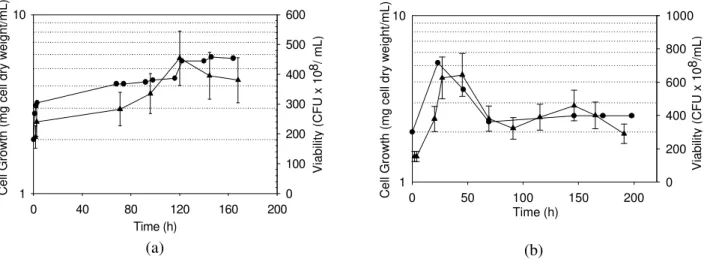
Cell growth profiles are presented in Fig 2a. The lowest cell growth (4.3 g cell dry weight/L) was observed at 100 rpm, suggesting limitation of oxygen. Biomass concentration (8.7 g cell dry weight/L) was highest at 200 rpm. The decrease in biomass concentration after 100 h at 200 rpm was possibly due to cell removal from the medium caused by the formation of foam. Increases in stirring speed to 300 and 400 rpm resulted in lower biomass concentrations (5.9 and 5.3 g cell dry weight/L, respectively), probably caused by mechanical stress as discussed bellow. Parallel profiles for viability and cell dry weight were found at 300 and 400 rpm (Figure 3). Viability remained unaffected at 300 rpm, while at 400 rpm a drastic drop was seen after 24 h.
Total lipid content was measured throughout the experiments (Fig. 2b). At stirring speeds from 200 to 400 rpm, most of the lipid was consumed during the first 24 h and none was left at around 150 h. At 100 rpm, on the other hand, no significant lipid consumption was observed in 24 h and about 10% of the total content was still found at 220 h.
At 100 rpm, pH remained almost unaltered during 200 h of cultivation (Fig. 2c), while for 200, 300 and 400 rpm a decrease followed by a plateau was seen. Similarly to lipid profiles, higher stirring speeds resulted in higher decreases of initial pH. Increases in pH values were observed after 200 h of cultivation.
Time (h)
0 50 100 150 200 250 300
Lipase Activity (U/L)
0 1000 2000 3000 4000 5000
(a)
Time (h)
0 50 100 150 200 250 300
Lipase Activity (U/L)
0 1000 2000 3000 4000 5000 6000
Time (h)
0 50 100 150 200 250 300
Protease Activity (U/L)
0 2 4 6 8 10 12 14
(c)
Figure 1: Enzyme production by Y.lipolytica inthebench fermenter at Q = 1 dm3/min (0.8 vvm) and 100 (p),
200 (˜), 300 (¢) or 400 (¿) rpm. A - Lipase activity measured by titrimetric method. B - Lipase activity measured by spectrophotometric method. C - Protease activity.
Time (h)
0 50 100 150 200 250 300
Cell Growth (mg dry weight cells/mL) 1
10
(a)
Time (h)
0 50 100 150 200 250 300
Lipids (%w/v)
0.0 0.2 0.4 0.6 0.8 1.0
(b)
Time (h)
0 50 100 150 200 250 300
pH
2 3 4 5 6 7 8 9
(c)
Time (h)
0 40 80 120 160 200
Cell Growth (mg cell dry weight/mL) 1 10
Viability (CFU x 10
8/ mL)
0 100 200 300 400 500 600
(a)
Time (h)
0 50 100 150 200
Cell Growth (mg cell dry weight/mL) 1
10
Viability (CFU x 10
8/mL)
0 200 400 600 800 1000
(b)
Figure 3: Cell growth (˜) and viability (p) profiles for Y.lipolytica inthebench
fermenter at Q = 1 dm3/min (0.8 vvm) and 300 (A) or 400 (B) rpm.
Table 1 summarizes the major process parameters when different stirring speeds were employed. Although kLa increased with stirring speed, the same
behavior was not seen for fermentation parameters. Maximum levels of lipase activity (Am) and lipase
production (Pm), as well as the highest yield
coefficients for product over biomass (YP/X), for cells
over lipids (YX/S) and for product over lipids (YP/S)
were attained at 200 rpm. However, volumetric productivity (Pv) values were similar at 200 and 300
rpm. Significantly lower values were obtained for all these parameters at 100 and 400 rpm.
Table 1: Influence of stirring speed on lipase productiona obtained in a bench fermenter at Q = 1 dm3/min (0.8 vvm).
Stirring speed kLa YP/X YX/S YP/S Am Pm Pv
100 8.5 ± 0.30 0.42 0.28 0.12 960 280 7
200 12.2 ± 1.02 0.70 0.74 0.52 4,680 780 20
300 26.0 ± 0.64 0.61 0.43 0.27 2,390 600 21
400 54.5 ± 0.51 0.25 0.37 0.09 830 330 9
a Stirringspeed (rpm); k
La, volumetric coefficient of oxygen transfer (h-1); YP/X, yield coefficient for product over biomass (U/mg); YX/S,
yield coefficient for cells over lipids (g cells/g lipids); YP/S, yield coefficient for product over lipids (U/mg); Am, maximum lipase
activity (U/L) measured by the titrimetric method; Pm,Specific production (U/g cells) measured at the time where lipase activity is
maximum; Pv, volumetric productivity (U/L.h). Parameters Am, Pm and Pv were obtained with the maximum lipase activity values, and
yield coefficients were calculated from the difference between maximum and initial values. Yield coefficients were calculated using values of ∆X, ∆S and ∆P.
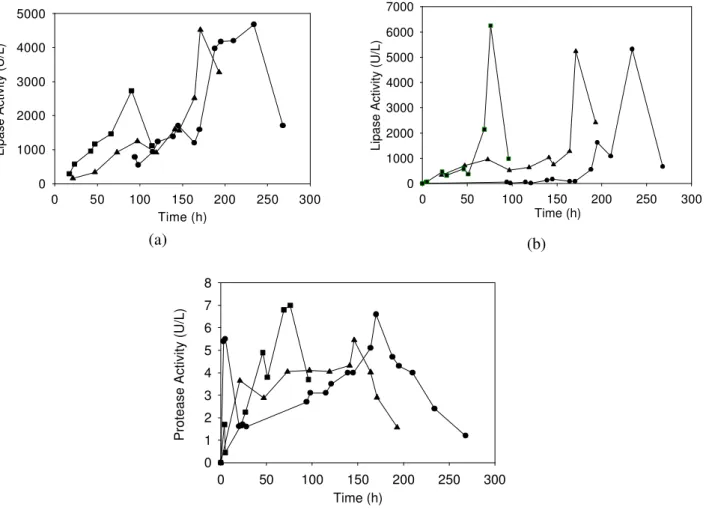
When enzyme was produced at a constant stirring speed (200 rpm) and air flow rates of 1, 2 and 3 dm3/min (0.8, 1.7 and 2.5 vvm), maximum lipase activity was obtained at 230, 170 and 90 h, respectively (Fig. 4). For the titrimetric method (Fig. 4a), similar maximum values of about 4,600 U /L were found at 1 and 2 dm3/min, while at 3 dm3/min lower values (2,730 U/L) were seen. For the spectrophotometric method (Fig. 4b), as well, approximately the same values for maximum levels
of activity (5,300 U/L) were reached at 1 and 2 dm3/min, whereas the highest level of activity (6,250 U/L) was obtained at 3 dm3/min.
The effect of air flow rate on cell growth was studied (Fig. 5a). Biomass concentration was 8.7 (100 h), 14.5 (190 h) and 15.6 (125 h) g cell dry weight/L at 1, 2 and 3 dm3/min, respectively. At about 24 h, cells were no longer in the exponential cell growth phase, and afterwards, shorter periods of diauxie were observed for higher air flow rates.
Lipid consumption and pH profiles show similar early trends in lipase and protease activity when air flow rate was altered from 1 to 3 dm3/min. Higher air flow rates resulted in higher lipid consumption rates (Fig. 5b). Moreover, lipid contents were exhausted at about 185, 162 and 78 h with 1, 2 and 3 dm3/min, respectively. An initial decrease in pH was observed for each condition (Fig. 5c). After variable periods of
stabilization, the pH increased at similar time intervals.
Figure 5 also shows that, at 200 rpm, cells stop to grow, independently of the air flow rate when the culture media achieved pH values lower than 4.0 and only begin to grow again when pH increases.
Process parameters obtained for different air flow rates are presented in Table 2. A threefold increase in air flow rate led to a twofold increase in kLa and
YX/S, while maximum lipase activity (Am) and the
related coefficient, YP/X, decreased. Consequently,
maximum lipase production (Pm) decreased with an
increase in air flow rate. On the other hand, the highest volumetric productivity (Pv) was attained at
Q = 3 dm3/min.
Time (h)
0 50 100 150 200 250 300
Lipase Activity (U/L)
0 1000 2000 3000 4000 5000
(a)
Time (h)
0 50 100 150 200 250 300
Lipase Activity (U/L)
0 1000 2000 3000 4000 5000 6000 7000
(b)
Time (h)
0 50 100 150 200 250 300
Protease Activity (U/L)
0 1 2 3 4 5 6 7 8
(c)
Figure 4: Lipase production by Y.lipolytica inthebench fermenter at 200 rpm and Q = 1 (˜), 2 (p), or 3 (¢) dm3/min (0.8, 1.7 or 2.5 vvm, respectively). A - Lipase activity measured by the titrimetric method.
Time (h)
0 50 100 150 200 250 300
Cell Growth (mg dry weight cells/mL)
1 10 100
(a)
Time (h)
0 50 100 150 200 250
Lipids (%w/v)
0.0 0.2 0.4 0.6 0.8 1.0
(b)
Time (h)
0 50 100 150 200 250 300
pH
2 3 4 5 6 7 8 9
(c)
Figure 5: Cultivation of Y.lipolytica inthebench fermenter at 200 rpm and Q = 1 (˜), 2 (p), or 3 (¢) dm3/min (0.8, 1.7 or 2.5 vvm, respectively). A - Cell growth profiles. B - Lipid consumption. C - pH profiles.
Table 2: Influence of air flow rate on lipase productiona obtained in bench-fermenter at 200 rpm
Air flow rate kLa YP/X YX/S YP/S Am Pm Pv
1 (0.8 vvm) 12.2 ± 1.02 0.70 0.74 0.52 4,680 780 20
2 (1.7 vvm) 21.0 ± 0.65 0.36 1.39 0.50 4,525 330 25
3 (2.5 vvm) 25.5 ± 1.08 0.20 1.51 0.30 2,735 200 30
a
Air flow rate (dm3/min); volumetric coefficient of oxygen transfer (h-1); YP/X, yield coefficient for product over biomass
(U/mg); YX/S, yield coefficient for cells over lipids (g cells/g lipids); YP/S, yield coefficient for product over lipids
(U/mg); Am, maximum lipase activity (U/L) measured by thetitrimetric method; Pm, Specific production (U/g cells)
measured at the time where lipase activity is maximum; Pv, volumetric productivity (U/L.h). Parameters Am, Pm and Pv
were obtained with the maximum lipase activity values, and yield coefficients were calculated from the difference
between maximum and initial values. Yield coefficients were calculated using values of ∆X, ∆S and ∆P.
DISCUSSION
The essential role of oxygen in lipid metabolism and cell growth is well known. Moreover, lipase production by several microorganisms depends on the availability of oxygen. Although in most cases oxygen seems to favor lipase production, low levels
of aeration have also been reported to increase production of the enzyme (Corzo and Revah, 1999).
varying with time due to the change in DO in the fermentation medium. Thus, kLa values can be used
to establish the relationship between OTR and lipase production (Elibol and Ozer, 2000).
It was clearly observed that an increase in stirring speed, rather than air flow rate, resulted in the most pronounced increase in kLa, as expected for a
mechanically stirred vessel. Maximum extracellular lipase activity was achieved when kLa was 12.2 h-1,
whereas at lower or higher kLa values lipase
production decreased. These results indicate that there is an optimum kLa value for maximum lipase
production by Yarrowia lipolytica. No linear correlation was found between volumetric productivity (Pv) and kLa for lipase production by
this microorganism, contrary to the previous findings of Elibol and Ozer (2000) for Rhizopus arrhizus. It is possible to state that these different responses are a consequence of the morphophysiological differences between the microorganisms, reflecting different oxygen requirements for maintenance of their physiological functions.
When lipase production was conducted at different stirring speeds, maximum activity values were attained at 200 rpm. Stirring speeds of 300 and 400 rpm produced not only reduced lipase activity levels but also slower cell growth. Possible explanations for this can be the mechanical and/or oxidative stress and the decrease in external pH.
These effectswere more pronounced at 400 rpm, where culture viability drastically decreased after 24 h, probably due to shear stress promoted by the impellers. Although at 300 rpm cell viability was maintained, the occurrence of a metabolic change is suggested by the lower maximum biomass concentration, which is lower than at 200 rpm. An increase in stirring speed up to 400 rpm resulted in a decrease in maximum lipase activity, assayed by the titrimetric method. These findings agree well with the results reported for Aspergillus terreus (Gulati et al., 2000), Rhizopus arrhizus (Elibol and Ozer, 2000) and Penicillium restrictum (Freire et al., 1997b).
A stirring speed of 100 rpm seemed to limit oxygen levels, impairing culture medium homogenization and reducing lipid availability or uptake by the cells. As a consequence, lower biomass and lipase levels were obtained.
On the other hand, activity detected by the spectrophotometric method was higher at 400 rpm than at 300 rpm. The appearance of this peak at 400 rpm (spectrophotometric method), which was not observed with the titrimetric method, indicates the
release of esterases, other than lipases into the culture medium. Thus, it can be suggested that, at 400 rpm, shearstress causes cell disruption, resulting in the release of other enzymes, including esterases and proteases. An increase in protease release into the culture medium was observed for Penicillium restrictum (Freire et al., 1997b) when stirring speed was raised from 50 to 300 rpm.
Air flow rates of 1 and 2 dm3/min (0.8 and 1.7 vvm) resulted in the highest values for cell growth and maximum lipase activity, when assayed by the titrimetric method. In contrast, for the spectrophotometric method, the highest maximum activity was achieved at 3 dm3/min (2.5 vvm).These results corroborate the hypothesis that oxygen availability enhances esterase release.
As previously described for shaking flasks (Pereira-Meirelles et al., 1997), maximum lipase activity was detected in the late stationary phase, when the lipid had been fully consumed. When oxygen availability was enhanced by either higher stirring speeds or higher air flow rates, faster lipid uptake and early lipase and protease release into the culture medium were observed, suggesting once more that some alteration of cell metabolism or the secretion process is occurring. These results were similar to those reported for Penicillium restrictum (Freire et al., 1997b) and confirm previous data obtained with Yarrowia lipolytica in shaking flasks, showing that lipase release into the culture medium only started when 50% of the carbon source had been consumed (Pereira-Meirelles et al., 2000). Apparently, factors that accelerate carbon source consumption can possibly cause the release of lipase into the culture medium. Thus, it can be proposed that lipase release into culture medium is triggered by decrease of external lipid under a critical level. Early enzyme release with an increase in stirring speed has also been observed with Penicillium restrictum (Freire et al., 1997a), and Geotrichum candidum (Baillargeon et al., 1989).
Dependence between protease production and pH has been previously demonstrated (Mc Ewen and Young, 1998). An increase in air flow rate produced an increase of pH at the beginning of cultivation. This observation corroborates the anticipation of protease release into the culture medium, observed at 3 dm3/min, and 200 rpm. Thus, it is possible to suggest that procedures that lead to increase of external pH would favor protease production by Yarrowia lipolytica.
was observed when either stirring speed or air flow rate was increased. In spite of this, no deleterious effects (lysis, for instance) on cell growth, were observed. Despite of pH decrease, cell growth is observed at the beginning of cultivation, even at 400 rpm. This decrease can be due to olive oil hydrolysis, caused by cell-bound enzyme (Pereira-Meirelles et al., 2000), which generates free fatty acids at the early stages of cell growth. The observation that cultivation of yeast cells with triacylglycerols and exogenously supplied lipase results in extensive incorporation of free fatty acids (Dyer et al., 2002) contributes to this hypothesis. Furthermore, peptone degradation, which results in amino acid release, can also explain the decrease in pH, as observed by Corzo and Revah (1999). These findings are supported by the detection of extracellular proteases from the beginning of cultivation.
After this initial decrease, pH stabilization occurs as nutrients are metabolized by the cells. Thus, it is possible to say that alterations in pH profiles reflect metabolic changes. This hypothesis is corroborated by the observation that when lipid metabolism was slower, decreases in pH were smaller, whereas at higher stirring speeds or air flow rates, when lipid consumption rates were higher, the decrease in pH was faster. The increase in pH at the late stationary phase (at a constant air flow) or after diauxie (at a constant stirring speed) can result from consumption of acid molecules present in the medium, as verified by Corzo and Revah (1999), and from ammonia released through amino acid deamination. Although drastic changes in the pH of the medium were observed, no correlation was found with maximum lipase levels, since high levels of lipase activity were obtained from pH 4 to 8 at 200 rpm. These results are in agreement with previous findings of Novotny et al., (1994), which described that although changes in pH seem to be related to cell growth, no correlation is observed between dimorphic growth and high lipase synthesis in five species of lipolytic yeasts.
Thus, this paper fills some gaps in the literature concerning the effect of oxygen on lipase production and on lipid metabolism by this NCY. Relationship among lipid consumption, cell growth and lipase production was presented. An improvement of lipase production from 1,700 U/L (Pereira-Meirelles et al., 1997) in shaking flasks to 4,680 U/L was obtained through the use of adequate air flows and stirring speeds. It was observed that the most pronounced effect of oxygen on lipase production was determined by stirring speed rather than by air flow
rate. Of the conditions tested 200 rpm and an air flow rate of 1 dm3/min resulted in the highest lipase production. Data presented herein will be used to support further work employing experimental design where other variables will be investigated.
ACKNOWLEDGEMENTS
The authors are very grateful to Dr. Maria Alice Zarur Coelho for help on kLa measurement. This
work was supported by grants from PRONEX/CNPq (664014/1998-4), FAPERJ (E-26/170.698/2000), and fellowships from CAPES for F.O.M. Alonso and PIBIC/CNPq-UFRJ for E.B.L. Oliveira.
REFERENCES
Baillargeon, M.W., Bistline Jr, R.G. and Sonnet, P.E., Evaluation of Strains of Geotrichum candidum for Lipase Production and Fatty Acid Specificity, Appl. Microbiol. Biotechnol., 30, 92-96 (1989).
Charney, J. and Tommareli, R.M., A Colorimetric Method for the Determination of the Proteolytic Activity of Duodenal Juice, J. Biol. Chem., 171, 501-505 (1947).
Chen, J., Wen, C. and Chen, T., Effect of Oxygen Transfer on Lipase Production by Acinetobacter radioresistens, Biotechnol. Bioeng., 62, 311-315 (1999).
Corzo, G. and Revah, S., Production and Characteristics of the Lipase from Yarrowia lipolytica 681, Biores. Technol., 70, 173-180 (1999).
Dellamora-Ortiz, G.M, Martins. R.C., Rocha, W.L. and Dias, A.P., Activity and Stability of a Rhizomucor miehei Lipase in Hydrophobic Media, Biotechnol. Appl. Biochem., 26, 111-116 (1997).
Destain, J., Roblain, D. and Thonart, P., Improvement of Lipase Production from Yarrowia lipolytica, Biotechnol. Lett., 19, 105-107 (1997).
Dyer, J.M., Chapital, D.C., Kuan, J.W., Mullen, R.T. and Pepperman, A.B., Metabolic Engineering of Saccharomyces cerevisiae for Production of Novel Lipid Compounds, Appl. Microbiol. Biotechnol., 59, 224-230 (2002).
from Bacillus subtilis Differ in Regulation of Gene Expression, Biochemical Properties and Three-Dimensional Structure, FEBS Lett, 502, 89-92 (2001).
Elibol, M. and Ozer, D., Influence of Oxygen Transfer on Lipase Production by Rhizopus arrhizus, Process Biochem., 36, 325-329 (2000). Finogenova, T.V., Kamzolova, S.V., Dedyukhina,
E.G., Shishkanova, N.V., Il’chenko, A.P, Morgunov, I.G., Chernyavskaya, O.G. and Sokolov, A.P., Biosynthesis of Citric and Isocitric Acids from Ethanol by Mutant Yarrowia lipolytica N1 Under Continuous Cultivation, Appl. Microbiol. Biotechnol., 59, 493-500 (2002).
Flores, C.-L., Rodríguez, C., Petit, T. and Gancedo, C., Carbohydrate and Energy-yielding Metabolism in Non-conventional Yeasts, FEMS Microbiol. Rev., 24, 507-529 (2000).
Freire, D.M.G., Gomes, P.M., Bon, E.P.S. and Sant’Anna Jr., G.L., Lipase Production by a New Promissing Strain of Penicillium restrictum, Rev. Microbiol., 28, 6-12 (1997a).
Freire, D.M.G., Teles, E.M.F., Bon, E.P.S. and Sant’Anna Jr., G.L., Lipase Production by Penicillium restrictum in a Bench-scale Fermenter. Effect of Carbon and Nitrogen Nutrition, Agitation and Aeration, Appl. Biochem. Biotechnol., 63-65, 409-421 (1997b). Frings, C.S. and Dunn, R.T. A Colorimetric Method
for Determination of Total Serum Lipids Based on the Sulfo-phospho Vanilin Reaction, Am. J. Clin. Pathol., 53, 89-91 (1970).
Gombert, A.K., Pinto, A.L., Castilho, L.R. and Freire, D.M.G., Lipase by Penicillium restrictum in Solid-state Fermentation Using Babassu Oil Cake as Substrate, Process Biochem., 35, 85-90 (1999).
Gulati, R., Saxena, R.K. and Gupta, R., Fermentation and Downstream Processing on Lipase from Aspergillus terreus, Proc. Biochem., 36, 149-155 (2000).
Hagler, A.N. and Mendonça-Hagler, L.C., Yeasts from Marine and Estuarine Waters with Different Levels of Pollution in the State of Rio de Janeiro,
Brazil. Appl. Environ. Microbiol., 41, 173-178 (1981).
Herrero, A.B., López, M.C., Fernández-Lago, L. and Domínguez, A., Candida albicans and Yarrowia lipolytica as Aternative Models for Analysing Budding Patterns and Germ Tube Formation in Dimorphic Fungi, Microbiology, 145, 2727-2737 (1999).
Madzak, C., Treton, B. and Blanchin-Roland, S., Strong Hybrid Promoter and Integrative Expression/Secretion Vectors for Quasi-constitutive Heterologous Proteins in Yarrowia lipolytica, J. Mol. Microbiol. Biotech., 2, 207-216 (2000).
Mauersberger, S., Wang, H.-J, Gaillardin, C., Barth, G. and Nicaud, J.-M., Insertional Mutagenesis in the n-Alkane-assimilating Yeast Yarrowia lipolytica: Generation of Tagged Mutations in Genes Involved in Hydrophobic Substrate Utilization, J. Bacteriol., 183, 5102-5109 (2001). McEwen, R.K. and Young, T.W., Secretion and pH-dependent Self-processing of the Pro-form of the Yarrowia lipolytica Acid Extracellular Protease, Yeast, 14, 1115-1125 (1998).
Novotny, C., Dolezalová, L. and Lieblová, J. Dimorphic Growth and Lipase Production in Lipolytic Yeasts, Folia Microbiologica, 39(1), 71-73 (1994),
Pereira-Meirelles, F.V., Rocha-Leão, M.H.M. and Sant’Anna Jr., G.L., A Stable Lipase from Candida lipolytica: Cultivation Conditions and Crude Enzyme Characteristics, Appl. Biochem. Biotechnol., 63-65, 73-85 (1997).
Pereira-Meirelles, F.V., Rocha-Leão, M.H.M. and Sant’Anna Jr., G.L., Lipase Location in Yarrowia lipolytica, Biotechnol. Lett., 22, 71-75 (2000). Reetz, M.T., Lipases as Practical Biocatalysts, Curr.
Op. Chem. Biol., 6, 145-150 (2002).
Scioli, C. and Vollaro, L., The Use of Yarrowia lipolytica to Reduce Polution in Olive Mill Wastewaters, Water Research, 31, 2520-2524 (1997).