Volume 1 PROGRESS IN PHYSICS January, 2013
Oblique-Length Contraction Factor in the Special Theory of Relativity
Florentin Smarandache
University of New Mexico 705 Gurley Ave. Gallup, NM 87301, USA. E-mail: [email protected]
In this paper one generalizes the Lorentz Contraction Factor for the case when the lengths are moving at an oblique angle with respect to the motion direction. One shows that the angles of the moving relativistic objects are distorted.
1 Introduction
According to the Special Theory of Relativity, the Lorentz Contraction Factor is referred to the lengths moving along the motion direction. The lengths which are perpendicular on the direction motion do not contract at all [1].
In this paper one investigates the lengths that are oblique to the motion direction and one finds their Oblique-Length Contraction Factor [3], which is a generalization of the Lorentz Contraction Factor (for θ = 0) and of the perpen-dicular lengths (forθ=π/2). We also calculate the distorted angles of lengths of the moving object.
2 Length-Contraction Factor
Length-Contraction FactorC(v) is just Lorentz Factor:
C(v) = r
1−v
2
c2 ∈[0,1] f orv∈[0,1] (1)
L = L′∙C(v) (2) whereL=non-proper length (length contracted),L′=proper length.C(0)=1, meaning no space contraction [as in Abso-lute Theory of Relativity (ATR)].
C(c) =0, which means according to the Special Theory of Relativity (STR) that if the rocket moves at speed ‘c’ then the rocket length and laying down astronaut shrink to zero! This is unrealistic.
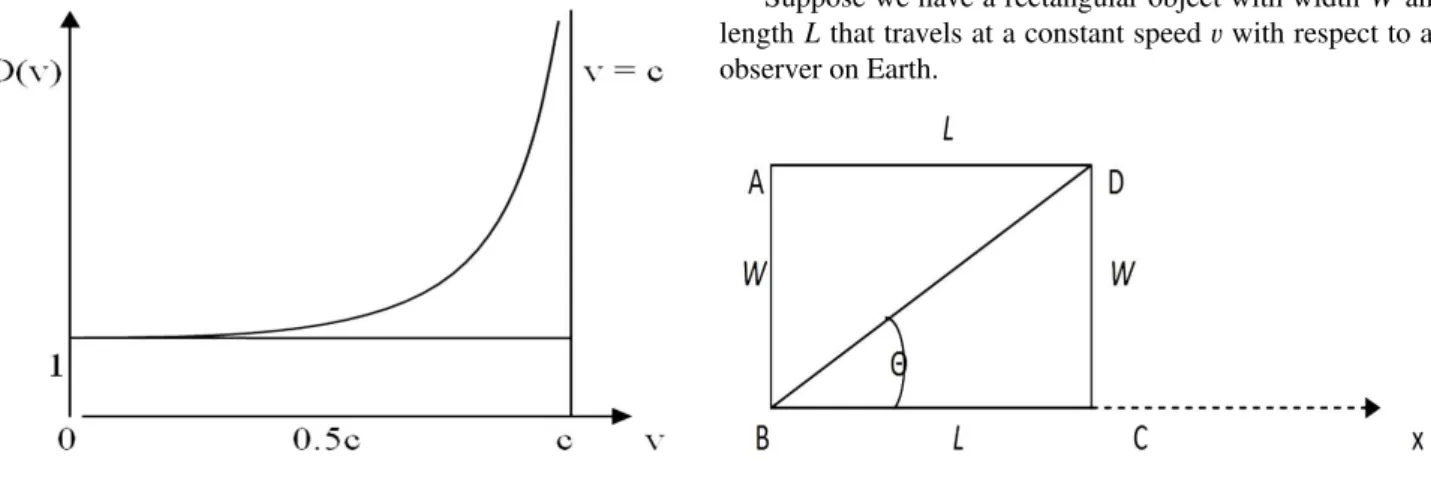
Fig. 1: The graph of the Time-Dilation Factor
3 Time-Dilation Factor
Time-Dilation Factor D(v) is the inverse of Lorentz Factor:
D(v) = r 1 1−v
2
c2
∈[1,+∞] f orv∈[0,c] (3)
∆t = ∆t′∙D(v) (4) where∆t=non-proper time and,∆t′=proper time.D(0)=1, meaning no time dilation [as in Absolute Theory of Relativity (ATR)];D(c)=limv→cD(v) = +∞, which means according to the Special Theory of Relativity (STR) that if the rocket moves at speed ‘c’ then the observer on earth measures the elapsed non-proper time as infinite, which is unrealistic.v=c
is the equation of the vertical asymptote to the curve ofD(v). 4 Oblique-Length Contraction Factor
The Special Theory of Relativity asserts that all lengths in the direction of motion are contracted, while the lengths at right angles to the motion are unaffected. But it didn’t say anything about lengths at oblique angle to the motion (i.e. neither per-pendicular to, nor along the motion direction), how would they behave? This is a generalization of Galilean Relativity, i.e. we consider the oblique lengths. The length contraction factor in the motion direction is:
C(v) = r
1−v
2
c2. (5)
Suppose we have a rectangular object with widthW and lengthLthat travels at a constant speedvwith respect to an observer on Earth.
Fig. 2: A rectangular object moving along thex-axis
January, 2013 PROGRESS IN PHYSICS Volume 1
Fig. 3: Contracted lengths of the rectangular object moving along thex-axis
Then its lengths contract and its new dimensions will be
L′andW′: where L′ = L∙C(v) andW′ = W. The initial diagonal of the rectangle ABCD is:
δ = |AC|=|BD|= √L2+W2
= √L2+L2tan2θ=L√1+tan2θ (6)
while the contracted diagonal of the rectangleA′B′C′D′is:
δ′ =|A′C′|=|B′D′|
= p(L′)2+(W′)2= pL2∙C(v)2+W2
= pL2C(v)2+L2tan2θ=Lp
C(v)2+tan2θ.
(7)
Therefore the lengths at oblique angle to the motion are contracted with the oblique factor
OC(v, θ)=δ ′
δ =
LpC(v)2+tan2θ
L√1+tan2θ
= r
C(v)2+tan2θ
1+tan2θ =
q
C(v)2cos2θ+sin2θ
(8)
which is different from C(v).
δ′=δ∙OC(v, θ) (9)
where 0≤OC(v, θ)≤1.
For unchanged constant speedv, the greater isθin0,π 2
the larger gets the oblique-length contradiction factor, and re-ciprocally. By oblique length contraction, the angle
θ∈
0,π 2
∪ π
2, π
(10) is not conserved.
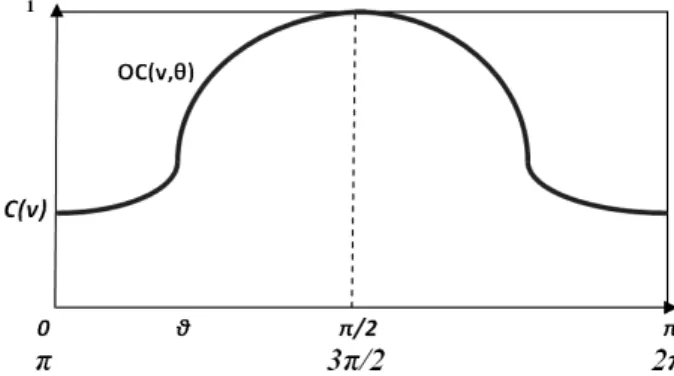
In Fig. 4 the horizontal axis represents the angleθ, while the vertical axis represents the values of the Oblique-Length Contraction FactorOC(v, θ) for a fixed speedv. HenceC(v) is thus a constant in this graph. The graph, forv fixed, is
Fig. 4: The graph of the Oblique-Length Contraction FactorOC(v, θ)
periodic of periodπ, since:
OC(v, π+θ) = q
C(v)2cos2(π+θ)+sin2
(π+θ) = pC(v)2[
−cosθ]2+[
−sinθ]2
= q
C(v)2cos2θ+sin2θ
=OC(v, θ).
(11)
More exactly about theOC(v, θ) range:
OC(v, θ)∈[C(v),1] (12) but sinceC(v)∈[0,1] , one has:
OC(v, θ)∈[0,1]. (13)
The Oblique-Length Contractor
OC(v, θ)= q
C(v)2cos2θ+sin2θ
(14) is a generalization of Lorentz ContractorC(v), because: when θ=0 or the length is moving along the motion direction, then
OC(v,0)=C(v). Similarly
OC(v, π)=OC(v,2π)=C(v). (15) Also, ifθ= π2, or the length is perpendicular on the mo-tion direcmo-tion, thenOC(v, π/2) = 1, i.e. no contraction oc-curs. SimilarlyOC(v,3π
2)=1.
5 Angle Distortion
Except for the right angles (π/2,3π/2) and for the 0,π, and 2π, all other angles are distorted by the Lorentz transform.
Let’s consider an object of triangular form moving in the direction of its bottom base (on thex-axis), with speedv, as in Fig. 5:
θ∈
0,π 2
∪ π
2, π
(16) is not conserved.
Volume 1 PROGRESS IN PHYSICS January, 2013
Fig. 5:
Fig. 6:
The side|BC|=αis contracted with the contraction fac-torC(v) sinceBCis moving along the motion direction, there-fore|B′C′|=α∙C(v). But the oblique sidesABandCAare contracted respectively with the oblique-contraction factors
OC(v,∡B) andOC(v,∡π−C), where∡Bmeans angle B:
A′B′
=γ∙OC(v,∡B) (17) and
C
′A′
=β∙OC(v,∡π−C)=β∙OC(v,∡A+B) (18) since
∡A+∡B+∡C=π. (19) Triangle ABC is shrunk and distorted to A′B′C′ as in Fig. 6.
Hence one gets:
α′=α∙C(v)
β′=β∙OC(v,∡A+B) γ′=γ∙OC(v,∡B)
(20)
In the resulting triangle A′B′C′, since one knows all its side lengths, one applies the Law of Cosine in order to find each angle∡A′,∡B′, and∡C′. Therefore:
∡A′=arccos−α
2
∙C(v)2+β2
∙OC(v,∡A+B)2+γ2
∙OC(v,∡B)2
2β∙γ∙OC(v,∡B)∙OC(v,∡A+B)
∡B′=arccosα
2 ∙C(v)2
−β2
∙OC(v,∡A+B)2+γ2
∙OC(v,∡B)2
2α∙γ∙OC(v)∙OC(v,∡B)
∡C′=arccosα
2
∙C(v)2+β2
∙OC(v,∡A+B)2 −γ2
∙OC(v,∡B)2
2α∙β∙OC(v)∙OC(v,∡A+B) . As we can see, the angles∡A′,∡B′, and∡C′are, in gen-eral, different from the original angles A, B, andC respec-tively.
The distortion of an angle is, in general, different from the distortion of another angle.
Submitted on November 12, 2012/Accepted on November 15, 2012
References
1. Einstein A. On the Electrodynamics of Moving Bodies.Annalen der Physik, 1905, v. 17, 891–921.
2. Smarandache F. Absolute Theory of Relativity and Parameterized Spe-cial Theory of Relativity and Noninertial Multirelativity. Somipress, Fes, 1982.
3. Smarandache F. New Relativistic Paradoxes and Open Questions. Somipress, Fes, 1983.