Revista
de
Administração
http://rausp.usp.br/ RevistadeAdministração52(2017)431–442
Marketing
Understanding
consumer’s
responses
to
negative
emotions
related
to
crowding
on
satisfaction
and
impulse
purchase
in
retail:
the
mediating
role
of
coping
Entendendo
respostas
às
emo¸cões
negativas
de
crowding
na
satisfa¸cão
e
compra
por
impulso
no
varejo:
o
papel
mediador
do
Coping
Respuestas
a
las
emociones
negativas
de
crowding
en
la
satisfacción
y
compra
por
impulso
en
el
comercio
minorista:
el
papel
mediador
del
coping
Marlette
Cassia
Oliveira
Ferreira
a,∗,
Marcelo
Moll
Brandão
b,
Flavio
Santino
Bizarrias
caInstitutoFederaldeEduca¸cão,CiênciaeTecnologia,Caraguatatuba,SP,Brazil bUniversidadeFederaldoEspíritoSanto,Vitória,ES,Brazil
cUniversidadeNovedeJulho,SãoPaulo,SP,Brazil Received30August2016;accepted25April2017
Availableonline7September2017 ScientificEditor:FilipeQuevedo-Silva
Abstract
Theperceptionofcrowding,understoodasanindividual’sresponsetocrowds,canbeobservedinretailenvironmentsandinfluencespositive andnegativeemotions.Inthisresearchwetestthemediatingeffectofcoping–rationalstrategiesadoptedtodealwithnegativeemotions–in therelationshipbetweennegativeemotions(resultingfromcrowdingperception)andconsumerbehavior(measuredbyimpulsepurchaseand satisfaction).Thefindingsrelatedtocopingexplaintowhatextentthereisapositiveresponsetohumandensityintheretailenvironment.For this,atheoreticalmodelwasdevelopedwhichincludestherelationshipsamongperceptionofcrowding,positiveandnegativeemotions,and consumerbehavior.Themodelenhancestheunderstandingofthecrowdingphenomenonbyincludingrelationshipsmediatedbyanoppositional strategy(copingdimension)betweennegativeemotionsandconsumerbehaviors.Totestthetheoreticalmodel,asurveywasconductedwith456 respondentsandhypothesistestsusingstructuralequationmodeling.Itwasevidencedthatcrowdingperceptionhasmorerobusteffectsonnegative emotionsthanpositiveemotions.Itisemphasizedthatwiththeinclusionofoppositionmediation,theweakdirectrelationshipbetweennegative emotionsandbehaviors,becomesapositiverelationshipbetweennegativeemotionandimpulsepurchase,andnegativeemotionandsatisfaction. Inadditiontothetheoreticalcontributionsofthetestedmodel,futureresearchandmanagerialimplicationsareproposedattheendofthearticle. ©2017DepartamentodeAdministrac¸˜ao,FaculdadedeEconomia,Administrac¸˜aoeContabilidadedaUniversidadedeS˜aoPaulo–FEA/USP. PublishedbyElsevierEditoraLtda.ThisisanopenaccessarticleundertheCCBYlicense(http://creativecommons.org/licenses/by/4.0/).
Keywords:Crowdingandcopingperception;Positiveandnegativeemotion;Impulsepurchaseandsatisfaction;Consumerbehavior;Humandensityinretail
Resumo
Apercepc¸ãodecrowding,entendidacomoarespostaindividualàaglomerac¸ãopodeserobservadaemumambientedevarejoeinfluenciaras emoc¸õespositivasenegativas.Nestapesquisapropõe-setestaroefeitomediadordocoping-estratégiasracionaisadotadasparalidarcomemoc¸ões negativas-narelac¸ãoentreemoc¸õesnegativas,consequentesdapercepc¸ãodecrowding,ecomportamentodeconsumidores(mensuradospor compraporimpulsoesatisfac¸ão).Osachadosreferentesaoefeitodecopingcontribuemparaexplicaremquemedidahárespostapositivaà
∗Correspondingauthorat:AvenidaRioGrandedoNorte,450,CEP11661-000,Caraguatatuba,SP,Brazil.
E-mail:[email protected](M.C.Ferreira).
PeerReviewundertheresponsibilityofDepartamentodeAdministrac¸ão, FaculdadedeEconomia,Administrac¸ãoeContabilidadedaUniversidadede SãoPaulo–FEA/USP.
https://doi.org/10.1016/j.rausp.2017.08.005
densidadehumanaemambientedevarejo.Paraisso,foidesenvolvidoummodeloteóricocomarelac¸ãodapercepc¸ãodecrowding,emoc¸ões positivasenegativasecomportamentodoconsumidor.Omodeloincrementaoentendimentodofenômenodecrowdingquandoincluirelac¸ões mediadaspelaoposic¸ão(dimensãodecoping)entreemoc¸ãonegativaecomportamentodoconsumidor.Paratestaromodeloteóricofoirealizado umsurveycom456respondenteseostestesdehipótesecomautilizac¸ãodemodelagemdeequac¸õesestruturais.Foievidenciadoquepercepc¸ão decrowdingtemefeitosmaisrobustosnasemoc¸õesnegativasquenasemoc¸õespositivas.Destaca-sequecomainclusãodamediac¸ãodeoposic¸ão, arelac¸ãofracaentreaemoc¸ãonegativaecomportamentos,narelac¸ãodiretatorna-sepositivaentreemoc¸ãonegativaecompraporimpulso,e emoc¸ãonegativaesatisfac¸ão.Alémdascontribuic¸õesteóricasdomodelotestado,futuraspesquisaseimplicac¸õesgerenciaissãopropostasnofinal doartigo.
©2017DepartamentodeAdministrac¸˜ao,FaculdadedeEconomia,Administrac¸˜aoeContabilidadedaUniversidadedeS˜aoPaulo–FEA/USP. PublicadoporElsevierEditoraLtda.Este ´eumartigoOpenAccesssobumalicenc¸aCCBY(http://creativecommons.org/licenses/by/4.0/).
Palavras-chave:Percepc¸ãodecrowdingecoping;Emoc¸ãopositivaenegativa;Compraporimpulsoesatisfac¸ão;Comportamentodoconsumidor;Densidadehumana novarejo
Resumen
La percepcióndehacinamiento,entendida comolarespuestaindividual alaaglomeración puedeserobservada enun entornodecomercio minoristaeinfluirenlasemocionespositivasynegativas.Enesteestudioseanalizaelefectomediadordelafrontamiento–estrategiasracionales adoptadasparahacerfrentealasemocionesnegativas–enlarelaciónentrelasemocionesnegativas,oriundasdelapercepcióndecrowding,y elcomportamientodeconsumidores(medidosporlacompraporimpulsoysatisfacción).Loshallazgossobreelefectodecopingcontribuyen paraexplicarenquémedidaexisteunarespuestapositivaaladensidadhumanaenelambientedeventaalpormenor.Sehadesarrolladoun modeloteóricoconenfoqueenlarelacióndelapercepcióndecrowding,emocionespositivasynegativasycomportamientodelconsumidor.El modeloincrementalacomprensióndelfenómenodecrowdingalincluirrelacionesmediadasporlaoposición(dimensióndecoping)entreemoción negativaycomportamientodelconsumidor.Paraprobarelmodeloteóricoylahipótesis,sehallevadoacabounsurveycon456encuestadosy sehanaplicadolosmodelosdeecuacionesestructurales.Sehademostradoquelapercepcióndecrowdingtieneefectosmássólidossobrelas emocionesnegativasqueenlasemocionespositivas.Esdedestacarque,conlainclusióndelamediacióndeoposición,larelacióndébilentrela emociónnegativayelcomportamiento,enlarelacióndirecta,seconviertaenpositivaentreemociónnegativaylacompraporimpulso,yemoción negativaysatisfacción.Ademásdelascontribucionesteóricasdelmodelopuestoaprueba,seproponenalfinaldelartículosugerenciasparafuturas investigacioneseimplicacionesdegestión.
©2017DepartamentodeAdministrac¸˜ao,FaculdadedeEconomia,Administrac¸˜aoeContabilidadedaUniversidadedeS˜aoPaulo–FEA/USP. PublicadoporElsevierEditoraLtda.Esteesunart´ıculoOpenAccessbajolalicenciaCCBY(http://creativecommons.org/licenses/by/4.0/).
Palabrasclave: Percepcióndecrowdingycoping;Emociónpositivaynegativa;Compraporimpulsoysatisfacción;Comportamientodelconsumidor;Densidad humanaenelcomercioalpormenor
Introduction
Oneofthefirstpublishedworksonthepurchaseandsocial relationenvironmentwasthatof Jonassen(1959).Sincethen, the quantityand compositionof humanor social density has beentreatedasoneofthe storeenvironmentalfactors. Turley andMilliman(2000)classifiedthe crowdingof peopleatthe pointof saleas afactorthat contributes tothestore environ-ment,andspecificallyasoneofthehumanfactors.Thisresearch focuseson the crowdingof consumers andtheconsequences in the store environment, since, according to Eroglu, Mach-leit,andBarr(2005),humandensityinfluencestheperception of otherfactorsof the store environment,such as layout and ambience.
AccordingtoMcclellandandAuslander(1978),the determi-nantsofcrowdingcanbephysical,informative,andevensocial, suchastypeofactivityandwhetherthelargenumberofpeople are“jostling”intheretailenvironment.Theperceptionof crowd-ingcanbe observedor not,undercrowded conditions.When crowdingisperceived,discomfortmayoccurintheenvironment, whichcanbetriggeredbypersonal,situational,andcultural vari-ables(Mehta,2013;Quezado,Costa,Pe˜naloza,Matos,&Ferraz, 2015).Whatcanbeperceivedascrowdingforsomepeoplemay benormalforothers,i.e.,justagroupofpeople.
Harrell, Hunt,andAnderson(1980)arguethat the percep-tionofcrowdingcanbeinfluencedbypersonalitytraitssuchas impatienceandaggressiveness.Fortheauthors,theconsumer whodoesnothavepriorexperiencewithinacrowded environ-mentmaybemoresensitivetodensityandthusreactnegatively. Similarly,buyerswithpersonalitytraitssuchasimpatienceand aggressivenessmayalsobemoresusceptibletohumandensity. Inthisresearch,weaddressthenegativeeffectofhumandensity, whichwillbetreatedasperceptionofcrowding.
Just as somepersonalitytraits mayexacerbatethe percep-tionofcrowding,tolerancetoithasbeenpresentedasatraitthat minimizesthenegativeeffect.PanandSiemens(2011)statethat crowdingtoleranceissignificantlycorrelatedwiththeintention toexplorethestore.InthestudybyMachleit,Eroglu,and Man-tel (2000),crowding tolerancewas treatedas moderating the relationshipbetweencrowdingperceptionandsatisfactionwith purchase,reducingthe negativeeffectofcrowdingperception onsatisfaction(Baker&Wakefield,2012).
BatersonandHui(1982)arguethattheperceptionof crowd-ingcaninfluenceemotion,causingconsumerexhaustion.The
perceptionof crowdingmaybeaccompaniedbysymptomatic
maymanifest withdiscomfort, aggression,andmotivation to eliminatethecausesof discomfortorreducetheirimportance (Stokols, 1972). The negative reaction to the perception of crowdingcanresultincopingandimpulsepurchase(Graa & Dani-Elkebir,2012).Negativeemotions,accordingtoLazarus (1993),canleadtostressand,consequently,coping,asa cog-nitivestrategytodealwithstress(Duhachek&Oakley,2007; Yi&Baumgartner,2004).Thetendencytoimpulsebuycanbe observedinthebehavioroftheconsumersatthetimeof pur-chase,when buying products thattheydid notintend tobuy, duetomanyreasons,includingenvironmentalstimulisuchas crowding(Beatty&Ferrell,1998).
Theretailenvironmentandtheperceptionofcrowdinghave been the subject of academic research, but, as highlighted, fewstudieshaveaddressedconsumerresponsesundernegative emotions.Baker,Levy, andGrewal (1992)analyzedbehavior resulting fromemotions,the relationshipbetweenthe buying environmentandbuyingorientation,examiningwhetherthe pur-chase is atask or asocial endeavor, as wellas the need for stresscontrol.ForBakeretal.(1992),thegreatertheperception ofcrowding,thegreaterthe stress.Butnoworkhasanalyzed theresultsof theperception ofcrowdinganditsinfluenceon emotionsandcoping,whichistheobjectofthecurrentstudy. Itisbelievedthat whenexperiencingemotions,theconsumer seekstoadapttotheenvironment,andmayemployan oppo-sitionstrategy, onecopingdimension(Lazarus, 1993),which resultsindifferentbehavioralresponses,suchas impulse pur-chase. In Brazil, some research has been carried out on the crowdingphenomenon(Aguiar,Farias,Gomes,&Santos,2015; Aurelianoetal.,2015;Brandão,Parente,&Oliveira,2010; Fer-reira, Bizarrias,Silva, & Brandão, 2015; Quezado, Costa, & Fuentes,2014;Quezado,Costa,Pe˜naloza,&Barboza,2012), but,again, none analyzed the results of crowding perception anditsinfluenceonemotionsandcoping.
Cognitiveresponses,suchasstrategiestominimizethe neg-ative emotional effect of perceived crowding, may explain behavioralreactionsandcontributetoamorepositiveconsumer shoppingexperience.However,evenwiththeimportanceof cop-ingstrategies,wefoundnostudiesthattestedtheeffectofcoping ontherelationshipbetweenperceptionofcrowding,satisfaction, andimpulse purchase.Eveninemergingmarketswithahigh populationdensity,asinmetropolitanareasofBrazil,thereare stillfewstudiesthatseektounderstandwhatexplainspositive responses(moresatisfactionandincreasesinimpulsepurchase). Sheth(2011)suggeststhatthephenomenastudiedindeveloped marketsmaynothavethesamerelationshipsbetweenthe vari-ablesthatmakeupthephenomenoninemergingmarkets,which reinforcestherelevanceofthisstudy.
Therefore,the questions under investigation for this work areasfollows.Whatarethebehaviorsofconsumers(impulse purchase,satisfaction)undernegativeandpositiveemotions,in environmentswithhighhumandensity?Howcancopingchange theinfluenceofnegativeemotionsfromhumandensity?
Theobjectiveofthisworkistotesttheeffectofcrowding perceptionandnegativeemotion,whenmediatedbycoping,on impulsepurchase andsatisfactionin aretailenvironment.To reachthisgoal,weneededtoidentifythedegreeofperceptionof
Crowding perception
Positive emotion
Negative emotion
Impulse purchase
Opposition (coping)
Satisfaction Crowding
tolerance
H1+
H2-H5+ H4+
H6+ H7+
H3+
Fig.1.Theoreticalmodel.
crowdingbyconsumers;measurenegativeemotionalresponses tocrowdingperception;testbehavioralresponsesunder nega-tiveemotionsmediatedbycoping;andtestbehavioralresponses underthepositiveemotionsthatinfluenceimpulsepurchaseand satisfaction.
The empirical findings of thisstudy will contribute to the management ofthe retailenvironment,presentingthe mecha-nismsthat explaindifferentreactionsofthe consumerstothe crowdinginstores.Even ifpart ofthe responseis influenced bytheconsumerprofile,issuesrelatedtotheemotionsfeltby theconsumerandtheirrationalresponsescanbeinfluencedby stimuliandstrategies.
Theoreticalreferenceandhypothesisdevelopment
Thisworkwasdevelopedbasedonthetheoreticalreviewof analysis of humandensity, perception of crowding,tolerance tocrowding,negativeandpositiveemotions,impulsepurchase, satisfaction,andcoping.Inthisresearch,anoppositionstrategy wasused as aproxyfor coping–andrepresentstheeffortto projectcausesofstresstoothers,assuminganaggressive pos-turethatcanoccurwiththeperceptionofcrowdingintheretail environment(Duhachek&Oakley,2007).
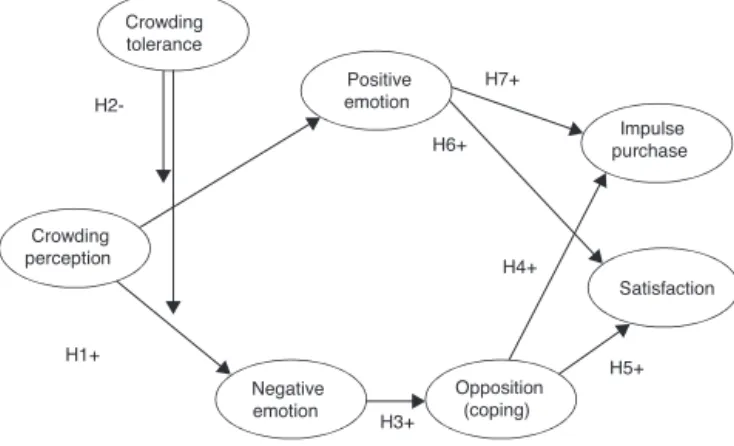
Thus, we have the perception of crowding as an
inde-pendent variable, which can directly influence the affective responses (negative andpositive emotions),and lead to cop-ing and the behaviors analyzed as our dependent variables: impulsepurchaseandsatisfaction.Crowdingtolerancewasused asamoderatingvariableintherelationshipbetweencrowding perceptionandemotion.Therelationshipbetweennegative emo-tions,positiveemotions,andimpulsepurchaseandsatisfaction weretestedasrelationshipsmediatedbycoping,accordingto thetheoreticalmodel(Fig.1).
Densityandperceptionofcrowding
orstatethatreferstothenatureofthespaceconstraintperceived bytheindividual.
Therearetwotypesofdensity:socialorhumandensityand space density(McGrew,1970; Stokols, 1972). Socialdensity referstotheactualnumberofpeopleinagivenspaceandspatial density,totheamountofspaceoccupiedperperson.Thespatial densityexperienceisrelatedtothephysicalstateofmovement restriction,whichmaybecausedbythenumberofpeopleinthe environment,amountofspace,andinterpersonaldistance. Stud-iesonthesubjectagreethathumandensityandspatialdensity arethetwomainantecedentsoftheperceptionofcrowding.
Machleit, Kellaris, and Eroglu (1994), through labora-toryexperiments,identifiedtwodimensionsofagglomeration, perceivedintheretailenvironment:atwo-dimensionalapproach andthehumanandspatialdimensions.However,theliterature on environmental psychology suggests two types of density: spatialandsocial(McGrew,1970),andthetopicisdiscussedin severalstudies(Erogluetal.,2005;Harrelletal.,1980;Hui& Bateson,1991;Machleitetal.,2000;Pan&Siemens,2011).In abibliographicalreview,Mehta(2013)treatshumanandsocial densitydimensionsassynonymous.
The definitionof crowding perceptionaccordingtoMehta (2013)becomescomplexasthesamedensityorperceptionof densitylevels mayormaynotresult indiscomfortfor differ-entcustomers.Forsome,theenvironmentmaybefullandfor othersitmaynot.Thisisduetoanumberof factors, includ-ingpersonal(Machleitetal.,2000),situational(Eroglu,Harrel, & Machleit, 1990; Machleit et al., 2000), and cultural vari-ables(Pons&Laroche,2007;Mehta,2013;Pons,Laroche,and Mourali,2006).Consumerswhodonothavepriorexperience inacrowdedenvironment maybesensitivetoagglomeration (Harrelletal., 1980).Similarly, buyerswithpersonality traits suchasimpatienceandaggressivenessmaybemoresusceptible toperceivedcrowding.
The perception of crowding may influence emotions
(Baterson&Hui,1982),mayhavedifferenteffectsondifferent people(Freedman,Levy,Buchaman,&Price,1972),andmaybe accompaniedbysymptomaticbehaviors,suchasstress(Stokols, 1972),causedbydiscomfort.Theremayalsobeaggressionand amotivationtoeliminatethecauseorreduceitsimportanceas anemotionalresponseinfluencedbypersonalitytraitssuchas impatienceandaggressiveness (Harrelletal., 1980).Thereis stillthe possibilityofapositivereaction,such aspleasure;or anegative reaction,such as displeasure (Baker& Wakefield, 2012;Freedmanetal.,1972;Lazarus,1993;Mehta,Sharma,& Swanmi,2013)inresponsetoasituationintheretail environ-mentinrelationtoacircumstance.Theresponsemaybea cogni-tiveelementofphysicalandsocialinteraction(Keating,1976). Thetopicsofcrowdingperceptionanditsinfluenceon
emo-tion and observed outcome have been controversial among
researchers.BakerandWakefield(2012)studiedthe behavior causedbyemotions,therelationshipbetweenthepurchase envi-ronmentandthepurchaseorientation,whetherthepurchaseisa taskorsocialpurchase,theneedforstresscontrol,andthe posi-tiveemotionsexperiencedbytheconsumer.Fortheauthors,the greatertheperceptionofcrowding,thegreaterthestress.
Crowdingtolerance
Crowdingtolerancemaymoderatetherelationshipbetween crowding perceptionandsatisfactionwithpurchase(Machleit etal.,2000).Thepurchasesatisfactionofcustomerswithhigh perceptionofcrowdingbutwithhightolerancetocrowdingwill notbeaffected.Also,crowdingperceptionwillnotaffectmost customersindiscountstores.
Incrowdingperceptionresearch,thecrowdingtolerance vari-able was identified as intervening between the perception of crowdingandthesatisfactionwiththepurchaseandis signifi-cantlycorrelatedwiththeintentiontoexplorethestore(Pan& Siemens,2011).Crowdingtolerancewastreatedasmoderating the relationshipbetweencrowdingperceptionandsatisfaction withpurchase,reducingthenegativeeffectofcrowding percep-tiononsatisfaction(Machleitetal.,2000).Crowdingtolerance has also been treated as a mediator in other studies (Baker &Wakefield,2012).Inthisresearch,crowdingtolerancewill betestedasamoderatingvariableintherelationshipbetween crowdingperceptionandnegativeandpositiveemotions.
Relationshipbetweenperceptionofcrowdingandemotional
response
Dion (2004) evidenced the relationship between crowd-ingperception,coping,andpersonalcontrolinahypermarket research study withThompson’s (1981)personalcontrol and stressscales.Thecrowdingandcopingscalesofperceptionwere developedbyDion(1999,ascitedinDion,2004).Erogluetal. (2005)analyzedtheperceptionofhumanandsocialcrowding thattakesintoaccountemotion,analyzingsixtypes:joy, inter-est, surprise,contempt,disgustandanger.Theseauthorsused theS-O-R(stimulus-organism-response)modelasthe theoret-icalparadigm fromMehrabianandRussell (1974,as citedin Soriano&Foxal,2001)
Emotionscangeneratesatisfactioninthepurchaseandone can observe impulsive purchases,time, andpurchasesby the aisle(Li,Kim,&Lee,2009).Inanotherstudy,Jones, Vilches-Montero, Spence, Eroglu, and Machleit (2010) evidenced a relationshipbetweendifferentemotionscausedbythe percep-tionof crowdingandsatisfaction.Emotionsweredividedinto groupsthathadanegativeeffectonthehedonicpurchase: Emo-tion1(frustrated,angry,irritated,feelingdisgusting,unfulfilled, unhappyanddisgusted)andEmotion2(provocative, contemp-tuous anddisrespectful). Emotion1setwastheonlyonethat hadadirectinfluenceonsatisfactionwiththepurchase.
None of these results are derived from analysis of the sameemotion.Whenthesameemotionissearched,theresults obtainedaredivergent.Bakeretal.(1992)investigatedthe influ-ence of stress. Although stress has a positive effect on the perceptionofcrowding,italsohasapositiveeffectonexcitation. IntheresearchbyLietal.(2009),pleasureisthemostsignificant positiveemotiontoachievesatisfactionwiththepurchase.
the effects of emotions. ForEroglu et al.(2005), anger and heartbreakweretheemotionsthatweremostinfluencedbythe perceptionofcrowding.ForDion(2004),discomfortandbeing inahurrywerethemostinfluential,unlikethatfoundinBaker andWakefield’s(2012)research,whichpointstostressasthe emotionthatreceivesthemostinfluenceofhumandensity.Thus itremainsimportanttoanalyzetheinfluenceofcrowdingover emotions.BakerandWakefield(2012)studypositiveemotions asresultsoftheperceptionofhumanagglomeration.The emo-tionsthatbestpredictnegativeresponses,aspointedoutbyDion (2004)wereaggressionandflight.
Basedon the crowding theory discussed so far about the relationshipbetweencrowding perception,positive emotions, negative emotions, and crowding tolerance, it is possible to proposethefollowinghypothesesalreadyrepresentedinFig.1.
H1. Increasedperceptionofhumancrowdingincreases nega-tiveemotions,buttheeffectismitigatedbycrowdingtolerance (crowdingtolerancemoderatingeffect).
H2. The increasedperception of humancrowding increases
negativeemotions,butthisrelationshipismoderatedby crowd-ingtolerance,whichreducesthisimpact.
Thatis,themoderatingeffectofcrowdingtolerancecauses adirectandnegativeeffectofcrowdingperceptiononanother variabletobeweakened,asfarasthisindirecteffectisobserved. Themodelspresentedonthephenomenonofcrowding per-ceptionexertinganinfluenceonemotions(Dion,2004;Eroglu etal.,2005;Jonesetal.,2010;Lietal.,2009)didnottestthe relationshipbetweencrowdingperceptionandcoping-mediated emotions. Coping is expected to be a mechanism that helps explain the positive responses to crowding perception, even whentheexperiencedemotionsarenegative.
Emotions,coping,andconsumerresponses(satisfaction
andimpulsepurchase)
Luce,Bettman,andPayne(2001),conductedoneofthebest studiesthat discussescopingstrategies asa tooltodeal with negativeemotions,sincecrowdingperceptionisanegative emo-tionalresponsetohighhumandensity.Inthisstudy,weexpected thatconsumerswouldpresentspecificcopingstrategiestofitthe particularcontextofthebuyingexperience.
Studiesoncopingvaryinthe constructionoftheir dimen-sionalstructures(Skinner,Sherwood,Edge,&Altman,2003). Copingresearchhasbeendevelopedaseitheremotion-oriented or problem-oriented, as well as with respect to withdrawal or approximation. Theseorientations configure the two most importantparadigmsinthisareaofstudy(Duhachek&Oakley, 2007).Inadditiontothesetwoparadigms,copinghasalsobeen treatedtheoreticallythroughmorecomplementarydimensions, suchasassimilation,control,andothers(Duhachek&Oakley, 2007;Skinneretal.,2003).
Thestudiesof Skinneretal.(2003),Duhachek(2005)and DuhachekandOakley(2007)considertheoriesthatexplain situ-ationalcopingbyaggregatedimensionsseekingparsimony,such as focus on emotions versus problems (Lazarus & Folkman,
1984), or withdrawal versus approximation (Roth & Cohen, 1986;Krohne,1993),whicharenotstableunderdifferent con-ditionsandstresssituations.Inthisbodyofresearch,morethan onetheoryisaggregatedinordertounderstandtheoppositional dimension,pointedoutasanefforttoprojectthecausesofstress onothersandadoptanaggressivestance(Duhachek&Oakley, 2007). In this work, the opposition dimension is tested,that is,theefforttoproject causesofstressinothers,assumingan aggressivestance(Duhachek&Oakley,2007).
The theoretical advance of this research comes from the investigation of which dimensions, among those considered moreconstantinpreviousstudies,canmeasurethestrategiesof theoppositionphenomenonwithincreasedperceptionof crowd-ing.ThisresearchisbasedonstudiesbySkinneretal.(2003), Duhachek(2005)andDuhachekandOakley(2007).Basedon theSORParadigm,itispossibletorelatetheopposition dimen-sionof copingasarationalresponse,whichseekstobalance negativeresponsesofconsumers.Inthisway,thebuying behav-iorwould occurafter thisattempt forinternal balancewithin the individual. Asaresult,the consumer would haveamore positivebuyingexperience,eveninhighhumandensity condi-tion.Theoppositionmediationhypothesisisjustifiedbecause itisaninternalcontrolmechanismoftheindividualandcanbe describedasfollows.
H3. Increasingnegativeemotionincreasesopposition.
Thestimulicreatedbythesellingenvironment,suchasselling techniques, used by stores (Stern, 1962; Kaltcheva & Weitz, 2006),helppromoteimpulsepurchaseandcanhelpclientsto buy products theydid not intend tobuy (Applebaum, 1951), mainlyguidedbyexternalmemories.Manyauthorspointout thatconsumersaremorepronetonewexperiencesandimpulse shoppinginsupermarketsormalls(Rook&Fisher,1995).
Theperceptionofcrowdingcangeneratenegativeemotions in the consumers, and by regulating actions, consumers can adjustthisemotion,andgeneratepositiveemotions(Tice, Brat-slavsky,&Baumeister,2001).Inthisresearch,copingfunctions asanegativeemotionregulatormakingthetendencyforfewer impulsepurchasesandlesssatisfactiontobereversed, generat-ing,fromtheoppositionstrategy,moreimpulsepurchasesand greatersatisfaction.Thatway,copingbecomesamediating vari-ableandfunctionsasamechanismthatregulatesthenegative responsetotheperceptionofcrowding.
In thisway,bothpositive emotionsandnegativeemotions maycreategreaterimpulse purchasesandgreater satisfaction responses.Forthistooccur,inthecaseofnegativeemotions, regulationisrequiredthroughthecopingmechanism.
H4. Theincreaseofnegativeemotionincreasesimpulse pur-chasewhenmediatedbytheoppositionalstrategy.
H5. An increase innegativeemotionincreases oppositional behaviorandsatisfactionwithpurchasesmadewhenmediated bytheoppositionalstrategy.
H6. Increasing positiveemotionsincreasessatisfactionwith purchases.
H7. Increasingpositiveemotionsincreasesimpulsepurchase.
Thefollowingisthemethodfortestingthehypothesesthat weredeveloped.
Method
Scalevalidationandconstructionofthedatacollection instrument
The data collection instrument was developed taking into accountthevariablesnecessarytorespondtotheobjectives pro-posed inthis study. The items of negative emotion variables andpurchaseintentionweretakenfromarticlesinEnglishand wereculturallyadaptedtoPortuguese.Followingtheprocessof BeatonandGuillemin(2000),theEnglishscaleswentthrough severalphasesforculturaladaptationandvalidation.
ThefirstphasewasthetranslationintothePortuguese lan-guage,withthetranslationbeingperformedbytworenowned professionals.Aconsensusversionwasthenproducedbya third-languageEnglishprofessional. Thenextstep wasthe reverse translationofthescale,withthehelpoftwomorelanguage pro-fessionals,whichgaverisetoanotherconsensusversion.Inthe validationbyexperts,theprobingtechniquewasusedtovalidate thecontentsoftheinstrumentforthepre-test,withthecultural adaptationoftheitems.
The emotional affective responses employed in this work havescalesof measurestoidentify the responsesof negative emotions(NE),takenfromthearticlebyBakerandWakefield (2012).Anexpressionwasusedintheopeningofthequestion: “In thisshop environmentI feel,” before the presentation of theitems“Frantic”,“Tense”,“Agitated”,“Terrified”,and “Hur-ried.”To complete the NEvariable, thedimensions of anger anddiscontent were taken from the workof Richins (1997). Anexpressionwasincludedintheopeningofthequestion:“In this shop environment I feel”,before the items “Frustrated”, “Angry”,“Irritated”,“Notfulfilled”,and“Displeased”.
Theaffirmationsforpositiveemotions(PE)weretakenfrom the works of Donovan and Rossiter (1982); Li et al. (2009) Mehrabian and Russell (1974, as cited in Soriano & Foxal, 2001) and Mehta (2013): “Happy – Unhappy”; “Grateful – Unpleasant(spoiled)”,“Satisfied– Unsatisfied”;“Confident– Discouraged”; “Relaxed – Tired (bored)”;“Relaxed – Bored (melancholic)”;“Content–Depressed”;“Important–
Negligi-ble”; and“Free– Restricted”. Theassertionsabout crowding perceptionemployedinthisworkweretakenfromtheworkby Machleitetal.(1994),“Thestoreseemsverycrowded,”“There isalotofmovementinthisstore,”and“Therearealotof cus-tomers in this store”. For crowding tolerance we used items fromJonesetal.(2010)including,“Iwouldbesatisfiedwithmy shoppingexperienceatthisstore”,“Havingachoice,Iwould probablygobacktothatstore”,and“Ichoosethisstorebecause Iliketocometoshopregularlyhere.”
Theitemstotestthepurchaseintentionweretakenfromthe works byLopesetal.(2012).Theseincluded:“Iwouldgoto thisstoretomakepurchasesinthefuture”,“Iwouldgotothis store frequently”,and“Iwould increasethevalueofmy pur-chases inthisstore,inadditiontowhat Ispendon average.” Additional items were taken from Vieira andMattos(2012), including “Yourintentiontopurchasetheproductis:1 –very low/7–veryhigh”,and“Theprobabilityofbuyingtheadvertised productis:1–none/7–high”.
Measurements for impulse purchases weretaken from the workbyRookandFisher(1995),andthusadapted:“Iwouldbuy thingsspontaneouslyinthissituation”,“’Buysoon’describes howIwouldbuyinthissituation”,“Inthistypeofsituation,I wouldbuythingswithoutthinkingaboutit”,“’Isawandbought’ would describeme inthissituation”, “’Buynow,think later’ would describe me inthis situation”,“Iwould buy thingsin theheatofthemoment,inthiskindofsituation”,“Iwouldbuy thingsaccordingtowhatIwasfeelingatthemoment”,“Iwould carefully planmypurchasesinthiskindof situation”,and“I would be alittle reckless with my purchases inthis kind of situation.”
Foropposition-copingmeasurement,itemsweretakenfrom theworkbyDuhachekandOakley(2007).Theseitemsinclude, “InthiskindofsituationIwouldaffirmthatthefault (responsi-bility)ofwhathappensisoftheothers”,“Inthistypeofsituation Iwouldbeaggressive”,and,“Inthistypeofsituation,Iwould blameothersfortheproblem.”Theitemstotestsatisfactionwere takenfromtheworkofBrandão(2012):“Iwouldfeelpleasure toshopatthisstore”;“I’dbehappywithmyshopping experi-enceatthisstore”;“Havingachoice,Iprobablywouldnotgo backtothatstore”;and“Iwouldrecommendthisstoretoother people.”
Theconstructsofperceptionofcrowdingandsatisfactionhad theculturaladaptationperformedbyBrandão(2012).Theitems ofthevariablesofnegativeemotion,tendencytoimpulsebuy, control ofthe purchase,andintimacywiththe purchasewere taken fromarticles in Englishand adapted culturally to Por-tuguese.FollowingtheBeatonandGuilleminprocess(2000),the Englishscalesunderwentseveralphasesofculturaladaptation andvalidation.
Strategyfordatacollection
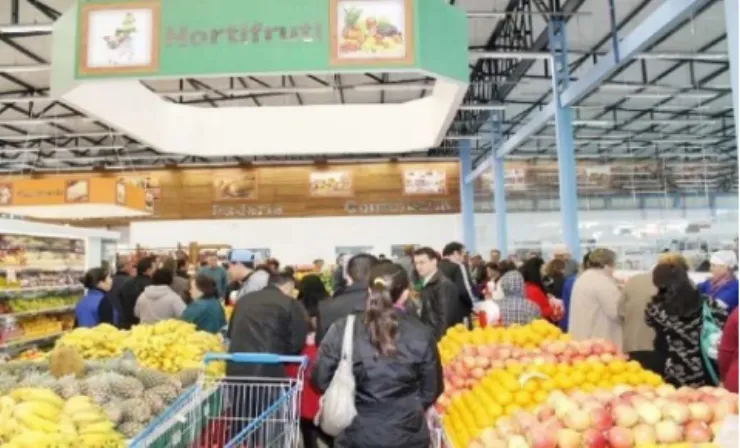
Fig.2.Stimuluswithhighhumandensity.
variationofindividualemotionalresponsesandofthe respon-dents’perception.
BatersonandHui(1982)demonstratedthatthereisecological validityintheuseofphotographsandfilmstotestthecrowding theory.
Afterviewingthephoto,therespondentsansweredthe ques-tionnaire with the measurement of the model variables and profiledataoftherespondents.
Criteriaforanalyzingthedata
Dataanalysisshowednormality,homoscedasticity(describe whatitis)andabsenceofmulticollinearity(VarianceInflation Factor,orVIF>5)withSPSS20.0software,andnomological validitybymeansofStructuralEquationsModeling(SEM).For theSEM,thesoftwareSmartPLS2.0M3wasused,whichis suit-ablefor estimationusingpartialleast squares,non-parametric samples,andsmallsizesamples(Ringle,Silva,&Bido,2014; Ringle,Wende,&Will,2005).
Asaparameterofanalysis,theSEMshouldverifyconvergent validity(λabove0.7)andmeanextractedvariance(AVE)greater than0.5. Discriminantvalidity analysis isalso recommended throughtheanalysisofthecomparisonofthesquarerootofthe AVEoftheconstructversusitscorrelationwiththeotherlatent variablesofthemodel.Thegeneraladequacyindexofthemodel throughGoodnessofFit(GoF)wasobserved,obtainedbythe geometricmeanbetweenthemeanR2andthemeanAVE.Hair, Hult,Ringle,andSarstedt(2014)suggestthataminimumGFR of0.36isadequateinthesocialsciences.Thenthebootstrapping testswereperformedtoanalyzethepathcoefficientswith crit-icalvaluesoftheStudentt-test,being1.64forp<0.1,1.96for
p<0.5,2.57forp<0.01,orbelow1.64asnon-significant(ns). Finally,blindfoldingwasobservedtoobtaintheaccuracyofthe proposedmodel(Stone-GeisserIndicator,orQ2)inwhichfor
Q2>0themodelhaspredictiverelevance,andforQ2 approxi-matelyzero,orlessthanzero,thereisnopredictiverelevance, andweestimatedtheCohen(orf2)indicatorthatevaluateshow muchtheconstructisusefulforconstructingthemodel(values of0.012havelittleutility, 0.15average utilityand0.35great utility)(Hairetal.,2014).
Analysisofresults
Thevariablesdidnotfollowanormalunivariatedistribution (asignificantKolmogorov–Smirnovtestatthe5%level), con-firmingtheneedtousethepartialleastsquarestechnique.No multicollinearitieswereobserved(allFIVsbelow5).
Firstly,itwasobservedthattherespondentswereinanideal condition to measure the perception of crowding elicited by the stimuluspresented inFig.1.Thisresult canbe observed inTable1.
During theprocessof analysisof the nomologicalvalidity to fit the final structural model by obtaining convergent and discriminantvalidities, severalitemsof the scaleswere with-drawn becausetheypresented alowload(less than0.7)or a non-significantstructuralrelationship(p-value>0.05).Onlyone itemwasremovedfromtheimpulsepurchase,negativeemotion, positiveemotion,andsatisfactiondimensions.
Thevalidsampleofthisstudyis457residentsofacityonthe coastofSãoPaulo,withameanageof24.7years(SD=5.39), ofwhich323(70.8%)arewomenand134(29.2%)aremen.
Anon-probabilisticsamplesurveywasconducted, character-izingaquantitativeanddescriptivestudywithcross-sectional data.In thissection, we presentthe study variables,the field procedures,andthecriteriaforanalyzingtheresults.
AllAVEswerehigherthan0.5,andthecoefficientof determi-nationofthemodel(R2)forthedependentvariableSatisfaction was34.4%andforimpulsivepurchase33.7%.Theother adjust-mentindicatorsofthemodelcanbeobservedinTable2.
TheAverageExtractedVariance(AVE)indicatesthedegree towhichtheitemsthatmeasurethevariableconvergewitheach other andshare variance toexplain it, indicatingthe conver-gent validity of the model. If the AVE is higher than 0.5, it isobservedthat morethan50%ofthevariablemeasuredwas explainedbythevarianceoftheitems.Thegreatertheloadofthe items,themoretheyhaveincommontomeasuretheconstruct
Table1
Perceptionofcrowding.
Itemsa Mean Median Standarddeviation
1.Thestoreseemstometoo crowded;2.Thereisalotoftrafficin thisstore;3.Therearealotof customersinthisstore
5.581 6.00 1.471
a7pointsLikert,1–totallydisagreeto7–totallyagree.
Table2
Construct,AVEs,Cronbach’salpha,R2,compositereliability.
Construct AVE Compositereliability R2 Cronbach’salpha Impulsepurchase 0.642 0.900 0.317 0.860
Negativeemotion 0.604 0.858 0.145 0.783 Positiveemotion 0.712 0.945 0.230 0.933 Oppositioncoping 0.683 0.866 0.036 0.774 Crowdingperception 0.716 0.883 0.000 0.806
Satisfaction 0.793 0.920 0.378 0.870
Crowdingtolerance 0.572 0.800 0.000 0.622
Table3
Analysisofthestructuralpathsofthemodel.
HypothesisRelationship Originalcoefficient Meanof500sub-samples Standarderror Testt p-Value Result H1+ Crowding
percep-tion→Negative emotion
0.141 0.148 0.046 3.059 0.002 Supported
Crowdingperception *Crowding tolerance→Negative emotion
−0.139 −0.160 0.065 2.135 0.033
H2− Crowding
perception→Positive Emotion
−0.099 −0.102 0.043 2.312 0.021 Supported
Crowdingperception* crowding
tolerance→Positive emotion
0.081 0.104 0.058 1.407 0.160
H3+ Negative
emo-tion→Oppositioncoping
0.190 0.195 0.053 3.602 0.000 Supported
H4+ Negative
emotion→Impluse purchase
0.038 0.036 0.049 0.782 0.435 Supported
Opposittion coping→Impulse purchase
0.446 0.449 0.043 10.408 0.001
Mediation EN→CO→CI
– – – Sobel=3.406 0.001
H5+ Negative emo-tion→Satisfaction
−0.046 −0.048 0.045 1.031 0.303 Supported
Oppositioncoping→Satisfaction 0.200 0.201 0.043 4.698 0.001
Mediation: EN→CO→Sat
– – – Sobel=2.859 0.004
H6+ Positive emo-tion→Satisfaction
0.579 0.577 0.037 15.496 0.001 Supported
H7+ Positive
emotion→impulse purchase
0.390 0.386 0.043 8.999 0.001 Supported
(Hairetal.,2014).Theotherindicatorscompletethefitofthe model,eitherbyreliabilityorinternalvalidity(Cronbach’s com-positereliabilityandalpha),orbytheproportionofhowmuch theexplanationoftheendogenousvariableswasperformed(R2) inthemodel,evenwhenweightedwiththeAVEtoobservea generalindexofgoodnessoffit(GoF).
The analysis of the structural relationships between the dimensions of the coping scale and the dependent variable Satisfaction was carried out with the re-sampling technique, bootstrap, with500repetitions toevaluatethesignificance of theloadsofthestructuralpaths.Theresultofthisstepisshown inTable3.
Table 3 indicates that all the established hypotheses were supported after the analysis of the proposedrelationships, as wellasthesuggestedmoderationandmediation.Thetestofthe hypothesesisgivenbytheanalysisofsignificanceofthepath coefficient(Γ),basedonStudentttestsforthesecoefficients. In thisstudy 500 re-samplingswereperformed for thewhole model.Valuesof tgreater thanor equalto1.96 (p-valueless thanorequalto5%)wereobservedforallhypotheses.
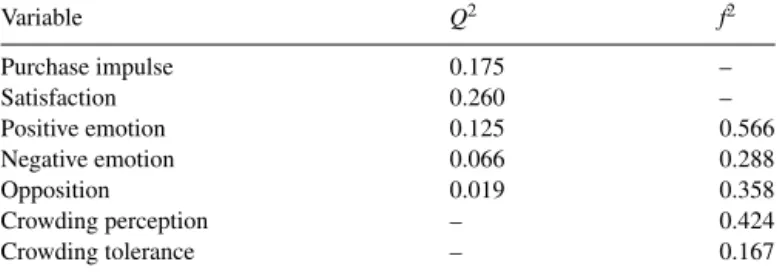
Table4presentstheindicatorsof predictiverelevance(Q2) andusefulnessof theconstruct(f2)inthe constructionofthe proposedmodel.Theblindfoldingtestpointstothepredictive abilityofthetestedmodel.IndicatorsofQ2,abovezero,have
Table4
Predictiverelevanceandeffectsize.
Variable Q2 f2
Purchaseimpulse 0.175 –
Satisfaction 0.260 –
Positiveemotion 0.125 0.566
Negativeemotion 0.066 0.288
Opposition 0.019 0.358
Crowdingperception – 0.424
Crowdingtolerance – 0.167
predictivevalidityandindicatorsoff2signaltheusefulnessof the constructintheformationofthemodel.Otherwise, omis-sionoftheconstructwouldresultinasignificantchangeinthe coefficientofdeterminationofthemodel(R2).Thecritical val-uesare0.012(lowutility),0.15(utilitymean)and0.35(utility) (Hairetal.,2014).
testconsistsofremovingthevariablefromthemodel,oneata time,andevaluatingtheeffectofitsabsence,oritsutility,onthe adjustmentofthemodel.Intheanalysis,itcanbeseenthat pos-itiveemotion(f2=0.566),followedbyperceptionofcrowding (f2=0.424)andopposition(copingdimension)(f2=0.358)are themostusefuldimensionsinthemodel.Inthecaseofthe pre-dictiverelation,satisfaction(Q2=0.260),followedbyimpulse purchase(Q2=0.175), arethe variablesbest explainedinthe model.
Themodelpresentspredictivevalidityandgoodutilityofthe constructsobservedintheconstructionoftheproposed theoret-icalmodel.
Discussionofresults
Inthisstudywetestedthebehaviorofconsumers(impulse purchase, satisfaction, and opposition – coping dimension) under negative andpositive emotions, in retail environments withhighhumandensity.
The proposed model reached a good quality for the test
of the hypotheses and all hypotheses were confirmed. The
suitabilityindex of the model (GoF)was 0.416, indicating a goodfit.Hairetal.(2014)alsoindicatethattheaccuracyindices (Stone-Geisser Indicator, or Q2) and predictive relevance of thevariables(f2)shouldbeobservedfortheevaluationofthe model. These parametersconfirm the good fit of the model. Thedependentvariables‘Impulsepurchase’and‘Satisfaction’ obtainedsignificantaccuracy(0.175and0.26),which,together withtheexplainedvalueofthesevariables(R2)of31.7%and 37.8%respectively,allowustoconcludetheacceptanceofthe proposedmodel.
The other variables also obtained satisfactory adjustment indicators.Positive emotionsdiffered significantly in achiev-ingbetterresultsamongtheindependentvariables(Q2=0.125,
R2=23%andf2=0.566).Inthissense,itwasobservedthatthe negativeemotionsobtainedpowerofsatisfactoryexplanationof themodel.Negativeemotions,althoughtheywerehighlighted asapredictivevariableofthemodel(f2=0.288),seemtohave beenlessexplained(Q2=0.066,R2=14.5%),eventhoughthey werewithintheestablishedparameters(Hairetal.,2014).
AccordingtoStokols(1972),crowdingperceptionisthe emo-tional response to stress caused by the density condition in whichthe consumerlosescontrol ofhis individualspace and thesituationgoesbeyondtheacceptablelimit.Theperceptionof crowdingwasarelevantvariableintheexplanationofthemodel (f2=0.288),indicatingthatthemanipulationofthecontextwas adequate,andestablishingtheimportanceofthephenomenon forunderstandingretailconsumptionanditsrelationswithother variablesasatriggerforemotionsthatconsumersexperiencein purchasesituations.
The opposition variable, one of the dimensions of cop-ing strategies that the consumer uses to deal with negative emotions,although having obtained a lower explained value (Q2=0.019, R2=3.6%),wasrelevant inexplainingthemodel (f2=0.358).Itisadifficultphenomenontoidentify,butithas greatcapacitytocontribute tothe understandingof situations ofconsumptioninvolvingnegativeemotions.Consumers,when
experiencingnegativesensationsintheretailenvironment,are expectedtoconveythesefeelingstotheirbehavioralintentions. Therefore,strategiesthattheconsumeradoptstoaddressthese negativeemotionsareofgreatinteresttoresearchersandretail professionals.
Inordertoanalyzetheroleofoppositionasoneofthecoping strategiesinretail,weanalyzethemediationofthisvariablefor therelationshipbetweennegativeemotions(H3)andconsumer responsessuchasimpulsepurchase(H4)andsatisfaction(H5), hoping it would be able toreduce the effect of the negative emotionsarousedbyCrowdingPerception(H1).
Theretailenvironmentdealswiththeemotionsofconsumers. Bagozzi(1982)presents,inhisresearch,thatemotioncanhavea positiveinfluenceonhumanbehavior,sincecognitionisdirectly influencedbyemotion.ForBakerandWakefield(2012), posi-tiveemotions maybearesult of the perceptionof crowding. IntheworkofJonesetal.(2010),theemotionalvariablesare understoodasmediatorsandtheperceptionofcrowdingexerts influenceonthenegativeemotionsintheworksofDion(2004). Erogluetal.(2005),Lietal.(2009),Jonesetal.(2010),in addi-tiontoBakerandWakefield(2012),pointtostressastheemotion thatreceivesthemostinfluenceofhumandensity.
Negativeemotionsinretailcanarisefromtheperceptionof crowding (H1+:Γ=0.141, t=3.059,p<0.002), whichat the same time reduces the perception of positive emotions (H2:
Γ=−0.139, t=2.135, p=0.033). This inverse effect
simul-taneously undermines the efficiency of retailers’ strategies, especiallyinsituationsthatmaybebeyondtheircontrol,such as the largeinfluxof consumerstostores.The morepositive theemotions,thebettertheconsumerresponses.Inthisstudy, thiswas verified for bothimpulsepurchase (H7+:Γ=0.390,
t=8.999, p<0.001) and satisfaction with purchases (H6+:
Γ=0.579, t=0.154, p<0.001). Therefore, the challenge for researchers and retailprofessionals is how to understand the negativeemotionsofconsumersintheirconsumerexperiences andfindwaystomitigatetheireffects.
Onewaytoreducetheeffectsofcrowdingperceptionisto findconsumerswhohavepersonalitytraitsthatcanunderstand andtoleratecrowdedphenomenamorethanotherconsumersin thespacestheyshare.
Inthisstudy,weobservedthatcrowdingtolerancewasable to reduce the negative effects of crowding perception. How-ever, crowding tolerance did not show significant effects on positiveemotions(H2:Γ=0.081,t=1.407,p=0.160,original CPpathPE,Γ =−0.242,t=5.352,p<0.001,forΓ=−0.099,
t=2.312, p=0.021, H2, with moderation of crowding toler-ance),but,perhapsmoreimportantly,itsignificantlymoderated the relationshipbetween crowdingperceptionandits potenti-ating roleof negative emotions,reducing thestrength of this relationship(H1+:Γ=−0.139,t=2.135,p=0.033,originalCP
pathΓ =0.3131,t=4.801, p<0.001, for Γ=0.141, t=3.059,
p<0.002,Moderatedbycrowdingtolerance).Theseresults indi-catethattheeffectsofnegativeemotionsarelessfeltbyaspecific groupofconsumers.Inthisstudy,analternativewaytodealwith phenomenaofthisnaturewaspresented.
Crowding perception
Positive emotion
Negative emotion
Impulse purchase
Opposition (coping)
Satisfaction Crowding
tolerance
H1+: t=3,059, p<0,002
H12-t=2,312, p=0,021
H6+ t=4,698 p<0,001 H6+:
t=0,15,496, p<0,001
H4+ t=10,408 p<0,001
H3+ t=3,602 p<0,001
H7+ t=8,999,
p<0,0001 R2 = 31,7%
R2= 37,8% R2= 23%
R2= 14,5%
R2= 3,6%
Fig.3.Finaltheoreticalmodel.
p=0.303,withoutoppositionmediation),notevenwithimpulse purchase(H4+:Γ =0.038,t=0.782,p=0.435,without oppos-ingmediation),althoughtheyemergedtheexpecteddirection. However,theroleofopposition,asastrategytodealwith nega-tiveemotionsinretail,provedtobevalid,indicatinganindirect relationbothtoSatisfaction(SobelTest=2.859,p<0.004)and to impulse purchases (Sobel=3.406, p<0.001). These alter-nativepaths,NegativeEmotions→Opposition→Satisfaction,
or Impulse purchase, represent an option for understanding the possibleresponses of consumersinsituations of negative emotions.The dimension of oppositioncoping is situational, aswaspresentedintheworksofLazarusandFolkman(1984), Skinner et al. (2003), Duhachek (2005), and Duhachek and Oakley(2007).
Fig.3 presentsthestructuralmodelproposedandtestedin thisstudy,withthemainindicatorsofthefinalresult.
In amorerelevant way,the finalstructural model presents themoderationofcrowdingtoleranceasatraitthatdecreases negative sensations due to high density, confirmingprevious studies(Machleitetal.,2000;Pan&Siemens,2011).Themodel
proposesthemediationoftheoppositiondimensionofthe cop-ing strategy when negativeemotions arerelated toconsumer responsesinahighdensitycontext.Toregulatethestress gen-erated by the high density the consumer blames the retailer (oppositiondimensionofcoping).Webelievethattheconsumer expectstheretailertoassumethisguilt,andthat,ifthishappens, theemotionalbalanceisrestoredbyamechanismofempathy, resultinginabetterconsumer-retailrelationship.
Purchaseorientation(Baker&Wakefield,2012)maybe sub-jecttonegativeemotionsarousedbyaspectsoftheenvironment thatarebeyondconsumers’control.Inthecaseofnegative emo-tions, when purchase orientation is an important motivation, the consumers use coping mechanisms to achieve their goal (Duhachek&Oakley,2007).
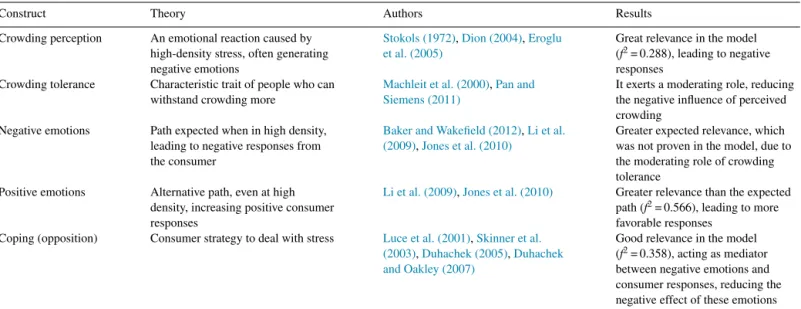
Takentogether,theseresultsvalidatetheproposedconceptual model and, morethan that,point outwaysto understandthe effectsofcrowdingperception;particularly,itsinfluenceonthe emotionsand,consequently,onconsumerresponseswithinthe retailenvironment.Dealingwiththestressofnegativeemotions inacrowdedretailenvironmentisonewaytheconsumerfinds tore-establish theircognitive andemotionalbalance.Table 5 presentsasummarytableofthefindingsandcontributionsof thisstudy.
The findings of this study shed light on the influence of
crowding on consumer responses in the retail environment
and mechanisms of regulation of the emotions experienced.
The strategies adopted by consumers to deal with
nega-tive emotionsin high-densityenvironmentswork as ameans for the shopping experience to continue, despite negative emotions.
Finalconsiderations
The objectiveof thisstudy wasachieved, sincethe results obtaineddemonstratedhowconsumersrespondtotheincreased perception of crowding and crowding’s impacton emotional
Table5
Synopsestableofthestudy.
Construct Theory Authors Results
Crowdingperception Anemotionalreactioncausedby high-densitystress,oftengenerating negativeemotions
Stokols(1972),Dion(2004),Eroglu etal.(2005)
Greatrelevanceinthemodel (f2=0.288),leadingtonegative responses
Crowdingtolerance Characteristictraitofpeoplewhocan withstandcrowdingmore
Machleitetal.(2000),Panand Siemens(2011)
Itexertsamoderatingrole,reducing thenegativeinfluenceofperceived crowding
Negativeemotions Pathexpectedwheninhighdensity, leadingtonegativeresponsesfrom theconsumer
BakerandWakefield(2012),Lietal. (2009),Jonesetal.(2010)
Greaterexpectedrelevance,which wasnotproveninthemodel,dueto themoderatingroleofcrowding tolerance
Positiveemotions Alternativepath,evenathigh density,increasingpositiveconsumer responses
Lietal.(2009),Jonesetal.(2010) Greaterrelevancethantheexpected path(f2=0.566),leadingtomore favorableresponses
Coping(opposition) Consumerstrategytodealwithstress Luceetal.(2001),Skinneretal. (2003),Duhachek(2005),Duhachek andOakley(2007)
Goodrelevanceinthemodel (f2=0.358),actingasmediator betweennegativeemotionsand consumerresponses,reducingthe negativeeffectoftheseemotions
andconsumerresponses.Themediatingroleoftheopposition
coping strategy and the moderation of crowding tolerance
emergedasimportantmechanismsinthisprocess.
Although human density has been much studied, it is
believed that there is much to be researched on the subject inrelation to the retail environment and consumer behavior, whichcontributestothemarketing area.Therefore,thiswork ispartofthebeginningandnottheconclusionoftheeffectof humandensityontheconsumer.Itscontinuitycanhelpdiscover newavenuestobeexploredbymarketing,crowdingandother dimensionsofcoping.
BasedonthecopingscaleofSkinneretal.(2003),Duhachek (2005), and Duhachek and Oakley (2007), we suggest new research analyzing the other dimensions of coping and their relationships,aswellastheperceptionofcrowdingandnegative emotions.Wealsosuggestidentificationofothervariables mod-eratingtheeffectsofcrowdingperception,mediatorsofnegative emotions,andconsumerresponses.
Thisstudycontributestotheliteraturebytestingthe percep-tion of crowding andnegative emotions, previouslyuntested using coping dimensions. Two paths are established in the shopping experience in highdensity environmentsand, even ifoneof themisloadedwithnegativeemotions,whichcould translateintounfavorableresponses,thisstudyshowsthatthe consumercanadoptstrategiestodealwiththisdiscomfortand continueinthe retailexperience(Duhachek&Oakley,2007). Theresultsofthisresearchencouragenewstudiesonconsumer responsesintheconditionofnegativeandpositiveemotions,as suggestedbyBakerandWakefield(2012).Thepresentedmodel canbetestedinmulti-groupswithexperimentsthatmanipulate negativeorpositiveemotions.
Forretailers, thisstudy contributes tothe management of marketingstrategiesatthepointofsale.Thisarticleteststhe rela-tionshipbetweenpromotionsthatcrowdstoresandcustomers’ impulsivebehavior,generatingpositiveemotionsbutultimately settinguphigh-densitycontextsthatarousenegativeemotions. It is suggested that managers, aware of these influences on consumerresponses,adoptactionsthatmakeconsumersmore tolerantoftheperceptionofcrowdingintheirshopping experi-ence,suchasthecreationofrestareas,queuemanagement,or circulationimprovement.
Another point that should be taken into account by man-agersisthattoolscanhelpconsumersself-regulatetheirnegative emotionsinhigh-densityhumanenvironments,leadingto close-ness and non-withdrawal (Duhachek & Oakley, 2007). The use of teams for interaction with consumers, to aid in pur-chasesituations, as wellas to showempathy, canpotentially assistinthemechanismofcopingwithstressgeneratedbyhigh density.
BasedonthecopingscaleofSkinneretal.(2003),Duhachek (2005), and Duhachek and Oakley (2007), new research is suggested toanalyze the other dimensions of coping andits relationwiththeperceptionofcrowding,negativeemotions,and responsesoftheretailconsumer.Itisalsosuggestedtoidentify othervariablesmoderatingtheeffects ofcrowdingperception andmediatorsofnegativeemotions.
Conflictsofinterest
Theauthorsdeclarenoconflictsofinterest.
References
Aguiar,E.C.,Farias,S.A.,Gomes,V.M.D.S.,&Santos,J.G.(2015).Percepc¸ão deCrowdingeComportamentodoConsumidor:UmaAbordagemnão Lin-earnoVarejoSupermercadistadeBaixaRenda.RevistadeAdministra¸cão daUnimep,13(3),207–229.
Applebaum,W.(1951).Studyingconsumerbehaviorinretailscores.Journalof Marketing,172–178.
Aureliano,L.S.,Brandão,M.M.,Strehlau,S.,&Pimenta,R.F.(2015).Oefeito doformatodeapresentac¸ãodedescontoemambientecrowding:umestudo experimental.RACE:RevistadeAdministra¸cão,ContabilidadeeEconomia, v.,14,653–676.
Bagozzi,R.P.(1982).Afieldinvestigationofcausalrelationsamong cog-nitions,affect,intentions,and behavior.JournalofMarketingResearch,
XIX(November),562–584.
Baker,J.,&Wakefield,K.(2012).Howconsumershoppingorientation influ-encesperceivedcrowding,excitement,andstressatthemall.Journalof AcademyofMarketingScience,(40),791–806.
Baker,J.,Levy,M.,&Grewal,D.(1992).Anexperimentalapproachtomaking retailstoreenvironmentaldecisions.JournalofRetailing,68(4),445–460. Baterson,E.G.,&Hui,M.K.(1982).Theecologicalvalidityofphotographic
slidesandvideotapesinsimulatingtheservicesetting.JournalofConsumer Research,19.
Beatty,S.E.,&Ferrell,M.E.(1998).ImpulsiveBuying:ModelingIts Precur-sors.JournalofRetailing,74(2),169–191.
Beaton, D., & Guillemin, F. (2000). Guidelines for theprocess of cross-culturaladaptationofself-reportmeasures.LippincottWilliams&Wilkins,
25,3186–3191.
Brandão,M.M.,Parente,J.,&Oliveira,B.B.(2010).Percepc¸ãodecrowding no varejo: Uma investigac¸ão exploratóriano mercado brasileiro. RAE-eletrônica,9(2),1–24.
Brandão,M.M.(2012).Crowdinginretail:Differences insatisfactionand perceivedhedonicvalueofhighandlow-incomeconsumersinBrazilSão PauloDoctoralThesis.FGV.
Dion,D.(1999).Atheoreticalandempiricalstudyofretailcrowding.InB. Dubois,T.M.Lowrey,L.J.Shrum,&M.Vanhuele(Eds.),Proceedingsof Europeanadvancesinconsumerresearch(vol.4)(pp.226–238). Dion,D.(2004).Personalcontrolandcopingwithretailcrowding.International
JournalofServiceIndustryManagement,15(3),250–263.
Donovan,R.J.,&Rossiter,J.R.(1982).Storeatmosphere:Anenvironmental psychologyapproach.JournalofRetailing,(spring(58)),34–57. Duhachek,A.(2005).Coping:Amultidimensional,hierarchicalframeworkof
responsestostressfulconsumptionepisodes.JournalofConsumerResearch,
32(June),41–53.
Duhachek,A.,&Oakley,J.(2007).Mappingthehierarchicalstructureof cop-ing:Unifyingempiricalandtheoreticalperspectives.JournalofConsumer Psychology,3(17),218–233.
Eroglu,S.A.,Harrel,G.D.,&Machleit,K.A.(1990).Anempiricalstudyof retailcrowding:Antecedentsandconsequences.JournalofRetailing,66(2). Eroglu,S.A.,Machleit,K.,&Barr,T.F.(2005).Perceivedretailcrowding andshoppingsatisfaction:Theroleofshoppingvalues.JournalofBusiness Research,58,1146–1153.
Ferreira,M.C.O.,Bizarrias,F.S.,Silva,J.G.,&Brandão,M.M.(2015).Muvuca naLojaAumentaCompraporImpulsoouAfastaConsumidores?AResposta DependedaTolerânciaaoCrowding.RevistaBrasileiradeMarketing,14(4), 545–556.
Freedman,J.L.,Levy,A.S.,Buchaman,R.W.,&Price,J.(1972).Journalof ExperimentalsocialPsychology,528–548.
Hair,J.F.,Hult,T.M.,Ringle,C.M.,&Sarstedt,M.(2014).APrimeronPartial LeastSquaresStructuralEquationModeling(PLS-SEM).ThousandOaks, CA:SagePublications.
Harrell,G.D.,Hunt,M.D.,&Anderson,J.C.(1980).Pathanalysisofbuyer behaviorunder conditionsofcrowding.JournalofMarketingResearch,
XVIII(February),45–51.
Hui,M.K.,&Bateson,J.E. G.(1991). Perceivedcontrolandtheeffects ofcrowdingandconsumer choiceontheserviceexperience.Journalof ConsumerResearch,18,174–184.
Jonassen,C.(1959).Contributionsofsociologyofmarketing.Journalof Mar-keting,(October),29–35.
Jones,M.Y.,Vilches-Montero,S.,Spence,M.T.,Eroglu,S.A.,& Mach-leit,K.A.(2010).DoAustralianandAmericanconsumersdifferintheir perceivedshoppingexperiences?:Abi-culturalanalysis.International Jour-nalofRetail&DistributionManagement,38(8),578–596.
Kaltcheva,V.D.,&Weitz,B.A.(2006).Whenshouldaretailercreateanexciting storeenvironment?JournalofMarketing,70(January),107–118. Keating,J.P.(1976).ScapegoatingtheEnvironment:Towardamodelof
crowd-ing.CrowdingandDensity.
Krohne,H.W.(1993).Vigilanceandcognitiveavoidanceasconceptsincoping research.InH.W.Krohne(Ed.),Attentionandavoidance.Strategiesin copingwithevasiveness(pp.19–50).Seattle/Toronto:Hogrefe&Huber. Lazarus,R.S.(1993).Frompsychologicalstresstotheemotions:Ahistoryof
changingoutlooks.AnnualReviewofPsychology,44,1–21.
Lazarus,R.S.,&Folkman,S.(1984).Stress,appraisalandcoping.NewYork: Springer.
Li,J.G.T., Kim,J.-O.,&Lee,S.Y.(2009).Anempiricalexaminationof perceivedretailcrowding,emotions,andretailoutcomes.TheService Indus-triesJournal,29(5),635–652.
Lopes,E.L.,Teixeira,J.M.,&Moretti,S.L.A.(2012).Valordecompra hedônicoouutilitárioesuainfluêncianovarejo:resultadosdeumsurveyno setordeconstruc¸ãocivil.Organiza¸cões&Sociedade(Online),19,87–108. Luce,M.F.,Bettman,J.R.,&Payne,J.W.(2001).Emotionaldecisions:Tradeoff difficultyandcopinginConsumerChoice.MonographsoftheJournalof ConsumerResearchChicago:UniversityofChicagoPress.
Machleit,K.,Eroglu,S.A.,&Mantel,S.P.(2000).Perceivedretailcrowdingand shoppingsatisfaction:Whatmodifiesthisrelationship?JournalofConsumer Psychology,9(1),29–42.
Machleit,K.A.,Kellaris,J.J.,& Eroglu,S.(1994).Humanversusspatial dimensionsofcrowdingperceptionsinretailenvironments:Anoteontheir measurementandeffectonshoppersatisfaction.MarketingLetters,5(2), 183–194.
Mattila,A.,&Wirtz,J.(2008).Theroleofstoreenvironmentalstimulationand socialfactorsonimpulsepurchasing.JournalofServicesMarketing,22, 562–567.
Mcclelland,L.,&Auslander,N.(1978).Determinantsofperceivedcrowding
andpleasantnessinpublicsettings.EnvironmentandBehavior,10(4). McGrew,P.L.(1970).Socialandspatialdensityeffectsonspacingbehaviourin
preschoolchildren.JournalChildPsychologyandPsychiatry,U,197–205. Mehrabian,A.,&Russell,J.A.(1974).Anapproachtoenvironmental
psychol-ogy.pp.216–217.USA:TheMassachusettsInstituteofTechnology. Mehta,R.(2013).Understandingperceivedretailcrowding:Acriticalreviewand
researchagenda.JournalofRetailingandConsumerServices,20(November (6)),642–649.
Mehta,R.,Sharma,N.K.,&Swanmi,S.(2013).Theimpactofperceived crowd-ingonconsumers’storebuyingimpulsive:Roleofoptimalstimulationlevel andshoppingmotivation.JournalofMarketingManagement,1–24. Pan,Y.,&Siemens,J.(2011).Thedifferentialeffectsofretaildensity:An
investigationofgoodsversusservicesettings.JournalofBusinessResearch,
64,105–112.
Pons,F.,&Laroche,M.(2007).Cross-culturaldifferencesincrowd assess-ment: Thedifferential influenceof densityexpectationson consumers’ shoppingexperienceinMexicoandCanada.JournalofBusinessResearch,
60,269–276.
Pons,F.,Laroche,M.,&Mourali,M.(2006).Cross-culturaldifferencesbetween NorthAmericaandtheMiddleEast.Psychology&Marketing,23(July(7)), 55–572.
Quezado,I.,Costa,R.B.L.,&Fuentes,V.L.P.(2014).Aglomerac¸ãoevalorde compraemcentrosdeconsumodebaixarenda.RevistadeAdministra¸cão daUFSM,7(1),49–64.
Quezado,I.,Costa,R.B.L.,Pe˜naloza,V.,&Barboza,M.V.(2012).Emoc¸ões esatisfac¸ãodecompraemsituac¸ãodecrowding:Umaabordagemcapital versusinterior.RevistaBrasileiradeMarketing,11(3),220–240. Quezado,I.,Costa,J.S.,Pe˜naloza,V.,Matos,F.R.N.,&Ferraz,S.B.(2015).
SempreCabeMaisUm?UmaInvestigac¸ãoCross-Culturaldo Comporta-mentodoConsumidoremAmbienteAglomerado.RevistadeAdministra¸cão FACESJournal,14(July–September(3)),56–74.
Ringle,C.M.,Silva,D.d.,&Bido,D.(2014).Modelagemdeequac¸ões estrutu-raiscomutilizac¸ãodoSmartPLS.RevistaBrasileiradeMarketing–ReMark,
13(May(2)).
Ringle,C.M.,Wende,S.,&Will,A.(2005).SmartPLS2.0(beta)Availablein SmartPLS/AccessedAugust2010.
Rook,D.W.,&Fisher,R.J.(1995).Normativeinfluencesonimpulsivebuying behavior.JournalofConsumerResearch,22(December),305–313. Roth,S.,&Cohen,L.J.(1986).Approach,avoidance,andcopingwithstress.
AmericanPsychologist,41(July(7)),813–819.
Sheth, J.N.(2011).Impactofemergingmarketsonmarketing:Rethinking existingperspectivesandpractices.JournalofMarketing,75(4),166–182. Skinner,E.A.,Sherwood,H.,Edge,K.,&Altman,J.(2003).Searchingforthe
structureofcoping:Areviewandcritiqueofcategorysystemforclassifying waysofcoping.PsychologicalBulletin,129,216–269.
Soriano,Y.M.,&Foxal,G.R.(2001).SpanishtranslationofMehrabianand Rus-sell’semotionalityscalesforenvironmentalconsumerpsychology.Journal ofConsumerBehaviour,2(1),138–154.
Stern,H.(1962).Thesignificanceofimpulsepurchasetoday.Journalof Mar-keting,26,59–62.
Stokols,D.(1972).Onthedistinctionbetweendensityandcrowding. Psycho-logicalReview,79(3),275–277.
Thompson,S.C.(1981).Acomplexanswertoasimplequestion:Willithurt lessifIcancontrolit?PPsychologicalBulletin,90,89–101.
Tice,D.M.,Bratslavsky,E.,&Baumeister,R.F.(2001).EmotionalDistress TakesPrecedenceoverimpulsecontrol:Ifyoufeelbad,doit!.Journalof PersonalityandSocialPsychology,80,53–67.
Turley,L.W.,&Milliman,R.E.(2000).Atmosphericeffectsonshopping behav-ior:Areviewoftheexperimentalevidence.JournalBusinessResearch,49, 193–211.