Rev Bras Cir Plást. 2012;27(3):411-4 411 Impact of adjuvant radiotherapy on the cosmetic outcome of immediate breast reconstruction performed using a transverse rectus abdominis myocutaneous lap
Impact of adjuvant radiotherapy on the cosmetic
outcome of immediate breast reconstruction performed
using a transverse rectus abdominis myocutaneous lap
Impacto da radioterapia adjuvante no resultado cosmético da reconstrução
mamária imediata com retalho TRAM
ABSTRACT
Background: The outcome of adjuvant radiotherapy performed after breast reconstruction
using autologous laps is controversial. In this study, we aimed to assess whether postope
-rative radiotherapy would induce volumetric and cosmetic changes after immediate breast reconstruction performed using a transverse rectus abdominis myocutaneous (TRAM) lap. Methods: We evaluated 25 patients who were previously diagnosed with breast cancer and underwent post-mastectomy autologous reconstruction with a pedicled TRAM flap follo wed by adjuvant radiotherapy. Late aesthetic results were recorded starting 6 months after the completion of a full course of radiotherapy. Results: The average patient age was 42.2 years (range, 30–53 years). Two (8%) complete lap losses occurred due to massive fat necrosis. Two (8%) patients exhibited lap contracture and volume loss, whereas skin changes were observed in 52% of patients. Most of the patients (84%), however, had no sig niicant initial lap volume loss, contour distortion, or lap contraction. Conclusions:
The cosmetic result obtained in the present study by immediate breast reconstruction
per-formed using an irradiated TRAM lap was satisfactory compared to the data described in the literature. These indings suggest that the lap contours may be distorted by contraction and that signiicant volume losses can be observed in patients who may be candidates for TRAM lap reconstruction and require post-mastectomy adjuvant radiotherapy. Thus, in these circumstances, late complications due to postoperative irradiation should be considered. Keywords: Mammaplastia. Breast/surgery. Radiotherapy.
RESUMO
Introdução: O efeito da radioterapia adjuvante após a reconstrução mamária com retalhos
autólogos é controverso. O objetivo deste estudo é analisar se a radioterapia pós-operatória
causa alterações volumétricas e cosméticas após a reconstrução mamária imediata com
retalho do músculo reto abdominal (TRAM, do inglês transverse rectus abdominis myo-cutaneous). Método: No total, foram avaliadas 25 pacientes submetidas a reconstrução
autóloga com retalho TRAM pediculado pós-mastectomia por câncer de mama e radioterapia
adjuvante. Os resultados estéticos tardios foram coletados após o intervalo mínimo de 6 meses posteriormente ao esquema completo da radioterapia. Resultados: A média de idade
das pacientes foi de 42,2 anos, variando de 30 anos a 53 anos. Duas (8%) perdas completas do retalho ocorreram por necrose gordurosa maciça, duas (8%) pacientes evoluíram com contratura do retalho e perda volumétrica, e 52% das pacientes apresentaram alterações cutâneas. Entretanto, a maioria das pacientes (84%) não evoluiu com perda signiicativa do volume inicial do retalho ou com distorção do contorno e contração do retalho. Con-clusões: O resultado cosmético após a reconstrução mamária imediata com retalho TRAM
This study was performed at the
Plastic Surgery and Reconstructive Microsurgery Service of Walter Cantidio University Hospital
(HUWC), Fortaleza, CE, Brazil.
Submitted to SGP (Sistema de
Gestão de Publicações/Manager Publications System) of RBCP (Revista Brasileira de Cirurgia Plástica/Brazilian Journal of Plastic Surgery). Article received: July 4, 2012 Article accepted: September 15, 2012
1. Member of the Sociedade Brasileira de Cirurgia Plástica/Brazilian Society of Plastic Surgery (SBCP), regent of the Plastic Surgery and Reconstructive Microsurgery Service of the Hospital Universitário Walter Cantídio (HUWC), Fortaleza, CE, Brazil.
2. Resident physician at the Plastic Surgery and Reconstructive Microsurgery Service of the HUWC, Fortaleza, CE, Brazil.
3. Expert member of the SBCP, preceptor of the Plastic Surgery and Reconstructive Microsurgery Service of the HUWC, Fortaleza, CE, Brazil. 4. Graduating medical student of the Universidade Federal do Ceará (UFC), member of the Plastic Surgery League of UFC, Fortaleza, CE, Brazil.
SaluStiano GomeS de
Pinho PeSSoa1
Juliana RéGia FuRtado
matoS2
iana Silva diaS3
dieGo tomaz teleS
Peixoto4
JéSSica SilveiRa aRaúJo4
Rev Bras Cir Plást. 2012;27(3):411-4
412
Pessoa SGP et al.
irradiado foi aceitável, comparativamente aos dados descritos na literatura. Esses achados indicam que os retalhos podem sofrer distorções de contorno pela contração, além de perda volumétrica signiicativa em pacientes candidatas à reconstrução com TRAM e necessidade de radioterapia adjuvante pós-mastectomia. Assim, as complicações tardias da irradiação pós-operatória devem ser consideradas nesse contexto.
Descritores: Mamoplastia. Mama/cirurgia. Radioterapia.
INTRODUCTION
The popularity of immediate breast reconstruction has
been gradually increasing since mastectomy was initially
con sidered a potential treatment for breast cancer1. These
procedures have been shown to improve the quality of life
of these patients2,3. However, a subgroup of mastectomized
patients requires adjuvant radiotherapy after reconstructive
surgery to ensure locoregional control of neoplasms1,3. Al -though radiation negatively affects breast reconstruction
performed with implants, the effect of radiotherapy on the
autologous tissue remains uncertain1,3-5.
In this study, we aimed to assess the incidence of atrophy
and volume loss of the reconstructed breast after immediate breast reconstruction performed using a transverse rectus
abdominis myocutaneous (TRAM) lap in patients under -going adjuvant radiotherapy for the treatment of breast
cancer.
METHODS
A total of 25 patients who underwent immediate breast reconstruction using a TRAM lap followed by adjuvant radiotherapy were prospectively evaluated.
The operations were performed between 2004 and 2011
at the Plastic Surgery Service of Hospital Universitário
Wal ter Cantídio (Fortaleza, CE, Brazil).
Data regarding volume loss, necrosis, and skin changes were collected. After the surgery, photographic records were monitored starting 6 months after the completion of a full course of radiotherapy.
RESULTS
Twenty-ive patients who underwent immediate breast reconstruction followed by radiotherapy were evaluated in this study. The average patient age was 42.2 ± 6.8 years (range, 30–53 years).
Two (8%) laps were completely lost due to massive fat necrosis and skin ulcerations that developed after irradia tion of the reconstructed breast and required the implementa tion
of an additional reconstructive surgical procedure in which
the latissimus dorsi lap was combined with the implant. Two
(8%) patients experienced signiicant atrophy of the lap that caused extensive asymmetry of the contralateral breast.
Most of the laps did not display a signiicant volume re duction, which is commonly responsible for asymmetry. Changes in skin color (hyperpigmentation) or ibrosis, with signiicant alteration of the skin consistency observed in the irradiated regions, were detected in 13 (52%) patients.
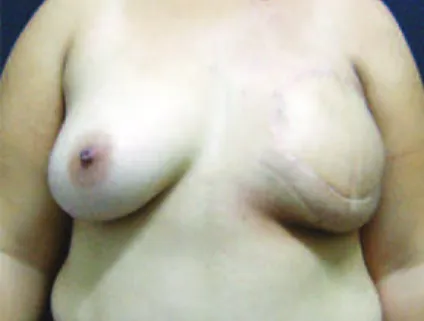
Figures 1 to 10 illustrate some cases in this series.
DISCUSSION
To date, no consensus has been reached on the ideal sur gical time at which breast reconstruction should be per -formed, especially considering the multimodal context of oncologic treatment, and particularly when radiation therapy
is indicated after mastectomy1.
Some authors recommend late reconstruction after ra
-dio therapy, suggesting that non-breast bed tissues (muscle laps, skin, and prostheses) would be irradiated unnecessarily,
presumably causing further damage to the reconstructed breast1. On the contrary, other scientists support the approach of immediate reconstruction based on the fact that the local
tissues and lymphatic drainage would be compromised after radiotherapy – an effect that hampers the lap construction
and raises the rates of postoperative complications1,6.
Tran et al.5,6 reported the incidence of aesthetic
deformi-ties in patients undergoing immediate breast reconstruction
performed using the TRAM lap followed by adjuvant ra -diotherapy. Although no lap loss was observed, the authors reported that 24% of the patients required an additional re constructive procedure to correct the lap contracture. In this study, 24% of the patients maintained normal lap volume, although 78% showed loss of symmetry. Williams et al.7 re vealed that post-irradiation changes in the TRAM lap occurred in 52.6% of cases and that 31.6% of patients required surgical intervention.
Chatterjee et al.8 conducted a prospective study in which 28 patients underwent immediate breast reconstruction
per formed using deep inferior epigastric artery perforator
(DIEP) laps. After assessing the pre- and post-irradiation volumes, these authors observed no signiicant differences
among the measurements obtained after radiotherapy.
Rev Bras Cir Plást. 2012;27(3):411-4 413 Impact of adjuvant radiotherapy on the cosmetic outcome of immediate breast reconstruction performed using a transverse rectus abdominis myocutaneous lap
Figure 1 – After breast reconstruction using a contralateral
transverse rectus abdominis myocutaneous lap and adjuvant radiotherapy, the patient experienced complete lap loss due
to massive fat necrosis. Skin changes including ibrosis and
depressions are visible around the scar.
Figure 2 – After breast reconstruction using a contralateral
transverse rectus abdominis myocutaneous lap, the patient experienced complete lap loss due to massive fat necrosis.
Skin hyperpigmentation and shape distortion of the reconstructed breast are visible in the picture.
Figure 3 – After breast reconstruction using a contralateral
transverse rectus abdominis myocutaneous lap, the patient
experienced atrophy and volume loss. Breast asymmetry and skin changes are visible in the picture.
Figure 4 – After breast reconstruction using a contralateral
transverse rectus abdominis myocutaneous lap, the patient experienced breast ibrosis and changes in the contour.
The volume, however, was preserved.
Figure 5 – Patient after breast reconstruction using a transverse
rectus abdominis myocutaneous lap. Cutaneous hyperpigmentation
was observed after radiotherapy.
Figure 6 – Patient after breast reconstruction using a transverse
rectus abdominis myocutaneous lap followed by adjuvant radiotherapy. Skin changes and ibrosis are visible around the scar.
when adjuvant radiotherapy is indicated, the immediate auto -logous approach is the best breast construction procedure3.
Of the patients presented in this study, 16% required surgical repair after radiotherapy. Two patients experienced radiotherapy on breast reconstruction conirmed that irradia
-tion has a detrimental effect on surgical outcome regardless of
Rev Bras Cir Plást. 2012;27(3):411-4
414
Pessoa SGP et al.
Figure 7 – Patient after breast reconstruction using a transverse
rectus abdominis myocutaneous lap followed by adjuvant radiotherapy; no signiicant changes due to the
irradiation were noted.
Figure 8 – Patient after irradiation who experienced
no signiicant late changes.
Figure 9 – Patient after irradiation in whom breast volume and symmetry were maintained after the surgery.
Figure 10 – Patient after breast reconstruction using a transverse
rectus abdominis myocutaneous lap in whom breast volume was
maintained and skin changes did not occur.
complete lap loss that hampered the subsequent reconstruc
-tion, which is still lower than the percentage of patients with lap loss reported in the literature.
Although immediate breast reconstruction is usually
successful, obtaining highly aesthetic and reproducible results
is a challenge for plastic surgeons due to possible changes in
the volume and contour of the lap caused by the irradiation.
CONCLUSIONS
The cosmetic outcome after immediate breast
recons-truction performed using an irradiated TRAM lap was consistent with the data reported in the literature. The high
incidence of changes in the appearance of autologously re
-constructed breasts after irradiation may lead to lap loss. It
is important to consider the unpredictability of the results
and the need for corrective procedures after radiotherapy.
REFERENCES
1. Marta GN, Hanna SA, Martella E, Silva JLF. Radioterapia e recons
-trução mamária após cirurgia para tratamento do câncer de mama. Rev Assoc Med Bras. 2011;57(2):132-3.
2. Webster RS. Avaliação da satisfação de pacientes submetidas a recons
-trução mamária pós-setorectomia e simetrização mamária contralateral imediata. Rev Bras Cir Plást. 2010;25(1):85-91.
3. Barry MJ, Kell MR. Meta-analysis on the impact of post-mastectomy radiotherapy on breast reconstruction outcome. J Clin Oncol. 2010;28:15s. 4. Spear SL, Onyewu C. Staged breast reconstruction with saline-illed
im plants in the irradiated breast: recent trends and therapeutic
impli-cations. Plast Reconstr Surg. 2000;105(3):930-42.
5. Tran NV, Chang DW, Gupta A, Kroll SS, Robb GL. Comparison of immediate and delayed free TRAM lap breast reconstruction in pa
-tients receiving postmastectomy radiation therapy. Plast Reconstr Surg. 2001;108(1):78-82.
6. Tran NV, Evans GR, Kroll SS, Baldwin BJ, Miller MJ, Reece GP, et al.
Postoperative adjuvant irradiation: effects on transverse rectus abdominis
muscle lap breast reconstruction. Plast Reconstr Surg. 2000; 106(2):313-7. 7. Williams JK, Carlson GW, Bostwick J 3rd, Bried JT, Mackay G. The
effects of radiation treatment after TRAM lap breast reconstruction. Plast Reconstr Surg. 1997;100(5):1153-60.
8. Chatterjee JS, Lee A, Anderson W, Baker L, Stevenson JH, Dewar JA, et al. Effect of postoperative radiotherapy on autologous deep inferior epigastric perforator lap volume after immediate breast reconstruction. Br J Surg. 2009;96(10):1135-40.
Correspondence to: Juliana Régia Furtado Matos