
Printed in Brazil - ©2006 Sociedade Brasileira de Química 0103 - 5053 $6.00+0.00
Article
*e-mail: [email protected]
3-Phenyl-4-Acyl-5-Isoxazolones as Reagents for Liquid-Liquid Extraction of
Tetravalent Zirconium and Hafnium from Acidic Chloride Solutions
B. Ramachandra Reddy,*,a J. Rajesh Kumarb and A. Varada Reddyb
a
Inorganic Chemistry Division, Indian Institute of Chemical Technology (CSIR), Hyderabad, 500 007 A.P., India
b
Analytical Chemistry Division, Department of Chemistry, Sri Venkateswara University, Tirupati, 517 502 A.P., India
Extração líquido-líquido de zircônio e háfnio tetravalentes, a partir de soluções de ácido clorídrico, foi investigada usando-se fenil-4-acil-5-isoxazolonas em xileno, tais como 3-fenil-4-benzoil-5-isoxazolonas (HPBI), 3-fenil-4-(4-fluorobenzoil)-5-isoxazolona (HFBPI) e 3-fenil-4-(4-toluoil)-5-isoxazolona (HTPI). A extração de zircônio(IV) / háfnio(IV)
mostrou um mecanismo de troca iônica: MO2+
(aq) + 2 HA (org) ↔ MOA2(org) + 2 H +
(aq), onde M
= Zr(IV) / Hf(IV) e HA = HPBI ou HFBPI ou HTPI. A variação dos valores D (razão [MOA2] (org) / [MO2+]
(aq);prováveis espécies em equilíbrio durante a extração) com o aumento
da concentração ácido/extrator mostrou um gráfico linear com inclinação 2. O efeito da
natureza dos diluentes, como tetracloreto de carbono, ciclohexano, n-hexano, benzeno,
nitrobenzeno, xileno, tolueno e clorofórmio na extração de zirônio(IV) / háfnio(IV) foi estudado. O comportamento da extração de zircônio(IV) / háfnio(IV) foi também comparado com o de outros íons metálicos, como titânio(IV), alumínio(III) e ferro(III), e pode, genericamente, ser aplicado aos íons metálicos estudados.
Liquid liquid extraction of tetravalent zirconium and hafnium from acidic chloride solutions has been investigated using phenyl-4-acyl-5-isoxazolones in xylene such as 3-phenyl-4-benzoyl-5-isoxazolones (HPBI), 3-phenyl-4-(4-fluorobenzoyl)-5-isoxazolone (HFBPI) and 3-phenyl-4-(4-toluoyl)-5-isoxazolone (HTPI). The extraction of zirconium(IV)
/ hafnium(IV) shows a ion exchange mechanism: MO2+
(aq) + 2 HA (org) ↔ MOA2(org) + 2
H+
(aq), where M = Zr(IV) / Hf(IV) and HA = HPBI or HFBPI or HTPI. The variation of the
D ([MOA2] (org) / [MO2+]
(aq); ratio of the possible extraction equilibrium species) values with
an increase of the acid / extractant concentration showed a linear plot with a slope of 2. The
effect of the nature of the diluents like carbon tetrachloride, cyclohexane, n-hexane, benzene,
nitrobenzene, xylene, toluene and chloroform on the extraction of zirconium(IV) / hafnium(IV) has been studied. The extraction behavior of zirconium(IV) / hafnium(IV) was also compared with that of other metal ions like titanium(IV), aluminium(III) and iron(III), which can be generally associated with the metal ions studied.
Keywords: 3-phenyl-4-acyl-5-isoxazolones, extraction, zirconium(IV), hafnium(IV), acidic chloride solutions
Introduction
In analytical chemistry, liquid-liquid extraction (LLE) enjoys a favored position among separation techniques because of its simplicity, speed and wide scope. This method is also frequently used in nuclear chemistry and technology for the separation of various radioisotopes and for the reprocessing of nuclear fuels. Zirconium and hafnium co-exist in nature and are
difficult to separate because of similar chemical properties. In order to achieve these objectives, the zirconium and hafnium metals industry needs to separate the title metals from other associated metals like Ti, Fe, Si and Al etc.
In our earlier investigations, the extraction behavior Zr/Hf from acidic chloride media was studied with organophosporus and oxime based extractants.1-7
because of their lower pKa values.8 In the present study,
substituted isoxazolones such as 3-phenyl-4-benzoyl-5-isoxazolone (HPBI), 3-phenyl-4-(4-fluorobenzoyl)-5-isoxazolone (HFBPI) and 3-phenyl-4-(4-toluoyl)-5-isoxazolone (HTPI) have been explored for Zr/Hf extraction from chloride medium.
Experimental
Reagents
HPBI, HFBPI and HTPI were synthesized from 3-phenyl-5-isoxazolone and corresponding acid chlorides according to the method described elsewhere.9
ZrOCl2.8H
2O and HfCl4 (Fluka, 98%) were used.
Working solutions of zirconium(IV)/ hafnium(IV) were freshly prepared and used for the extraction experiments through out the studies. All other reagents used were analytical reagent grade.
The synthesized 4-acyl-3-phenyl-5-isoxazolones was identified by elemental analysis, IR and 1H NMR
spectral data. Recrystallisation of the compounds was carried out in ethyl acetate – hexane mixture.
HPBI. mp 146 °C; 1H NMR data: δ 7.06-7.41 (m, 10H,
phenyl); IR (KBr) νmax/cm-1: 3062, 1701(C=O), 1620,
1489, 834; Elemental analysis: calculated for C16H11NO3. C 72.45, H 4.15, N 5.28. Found: C 72.27, H 4.18, N 5.17%.
HFBPI. mp 149 °C; 1H NMR data: δ 6.82-7.39 (m, 9H,
phenyl); IR νmax/cm-1: 2600, 1702 (C=O), 1620, 1583;
Elemental analysis: calculated for C16H10NO3F. C 67.84, H 3.53, N 4.95. Found: C 67.56, H 4.08, N 4.95%.
HTPI. mp 145 °C; 1H NMR data: δ 6.77-7.37 (m, 9H,
phenyl) 2.31(3H, methyl); IR νmax/cm-1: 2600, 1699 (C=O)
1613, 1600, 830; Elemental analysis: calculated for C17H13NO3C, 73.12, H 4.66, N 5.02. Found: C 73.52, H 4.73, N 5.1%.
In the 1H NMR spectrum of HPBI, a peak at δ 12.2
ppm has been observed corresponding to the enolic –OH. On the other hand, no peak was observed for the –OH in the case of HTPI. However, in the case of HFPBI, a broad peak at δ 3.57 ppm has been noted. This signal did not move on changing the concentration and found to disappear with the addition of D2O, thus confirming the existence of HFBPI in the enolic form. The absence of a peak at δ 3.8 ppm corresponding to the methylene proton at the fourth position of the isoxazolone ring, further
confirms the existence of various 3-phenyl-4-acl-5-isoxazolones in the enolic form.
Apparatus
The concentration of Zr(IV) and Hf(IV) in the aqueous phase was determined by the xylenol orange (XO) method10 at 535 nm and Ti (IV) by hydrogen peroxide10
methodat 410 nm using a GBC CINTRA 10e UV– Vis– DRS spectrometer. Analysis of Fe(III) and Al(III) was obtained using Perkin Elmer Model A 300 AAS. The NMR spectrum of the extracted solid comlex was recorded with Avance – 300 MHz 1H NMR instrument. The IR spectrum
of the solid complexes was recorded with FTIR-Nicolet (USA)-740- spectrophotometer.
General liquid–liquid extraction procedure
Equal volumes (10 mL) of the aqueous phase containing desired concentration of metal and organic phase containing the extractant, were equilibrated for 30 minutes in glass stoppered bottles using a mechanical shaker. Preliminary experiments on the kinetics of metal extraction showed that equilibrium was achieved with in 20 minutes contact. After phase disengagment, the aqueous phase was separated and metal concentrations were estimated by XO method. All the experiments were conducted at room tempe-rature (30 ± 1 oC) and the general agreement with D
values obtained was within ± 5%. The distribution ratio, D is calculated as the concentration of metal present in the organic phase to that part in the aqueous phase at equilibrium.
Results and Discussion
Effect of phase contact time
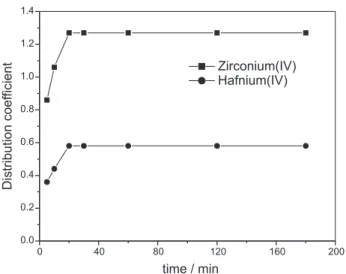
The effect of phase contact time was studied on the distribution ratio of 0.0005 mol L-1 zirconium(IV)/
hafnium(IV) from 0.1 mol L-1 hydrochloric acid solutions
using 0.001 mol L-1 3-phenyl-4-acyl-5-isoxazolones as the
extractants. Distribution ratio increases with increasing phase contact time upto 20 minutes and remains constant thereafter (Figure 1).
Extraction equilibrium and species
MO2+
(aq) + 2 HA(org) ↔
Kex
MOA2(org) + 2 H+
(aq) (1)
Where Kex denotes the equilibrium constant, M is equal to zirconium(IV) or hafnium(IV) and HA refers to HPBI or HFBPI or HTPI.
Substituting [MOA2] (org) / [MO2+]
(aq) for D and
rearranging equation (1) becomes
log D = log Kex + 2 log [HA] – 2 log [H+] (2)
The extraction of 0.0005 mol L-1 zirconium(IV) or
hafnium(IV) with 0.001 mol L-1
3-phenyl-4-acyl-5-isoxazolones in xylene as a function of hydrochloric acid has been studied. The extraction behavior shows an inverse dependence on the acidity (Figure 2). The log vs. log plots (Figure 3) for zirconium(IV) and hafnium(IV) gave slopes –2, confirming the formation of simple metal chelates. The results clearly indicate the release of H+ ions from
the extractant during the extraction process.
The effect of HPBI, HFBPI and HTPI concentrations in the range 4 × 10⁻³ to 1 × 10⁻³ mol L-1 on the extraction
of zirconium(IV) and hafnium(IV) has been studied by keeping the metal (0.0005 mol L-1) and hydrochloric
acid concentrations (0.1 mol L-1) constant. It is clear
from the results that the extraction of both Zr(IV) and Hf(IV) increases with increase in concentrations of 3-phenyl-4-acyl-5-isoxazolones (HA). The log vs. log plots gave slopes of 2, indicating extraction of the complex, MOA2 (M = Zr(IV) or Hf(IV) (Figure 4).
The effect of metal ion concentration on the extraction of zirconium(IV)/hafnium(IV) (0.0001 – 0.001 mol L-1) from hydrochloric acid solutions (0.1 mol L-1)
using various 3-phenyl-4-acyl-5-isoxazolones (0.001 mol L-1) has been investigated and the results are shown in
Figure 5. It has been observed that the extraction of Zr(IV) and Hf(IV) were found to be independent of metal ion concentrations in the studied range. The log-log plots of equilibrium organic phase metal concentrations to the aqueous phase metal concentrations are linear with slopes of unity, indicating the extraction of mononuclear species into the organic phase.
Based on these studies, the extracted species of Zr(IV) or Hf(IV) from hydrochloric acid solutions with 3-phenyl-4-acyl-5-isoxazolones (HA) may be represented as MOA2 (M = Zr(IV)/ Hf(IV)).
Effect of diluents
The differences in extractive properties of an extractant in various diluents are usually ascribed to a Figure 1. Dependence of distribution ratio on phase contact time. Zr(IV)/
Hf(IV):0.0005 mol L-1, HCl: 0.1 mol L-1, HPBI or HFBPI or HTPI: 0.001
mol L-1.
Figure 2. Effect of hydrochloric acid concentration on the extraction of zirconium(IV)/ hafnium(IV). Zr(IV) or Hf(IV): 0.0005 mol L-1, HPBI or
varying extent of non-ideality of the solutes, the free extractant and its metal salt adduct, in the diluent. A quantitative determination of these effects is at present hardly, possible, because of the lack of data on the physico-chemical properties of the systems. The extraction of zirconium(IV)/hafnium(IV) (0.0005 mol L-1) from 0.1 mol L-1 hydrochloric acid solutions with
0.001 mol L-1 HPBI using various diluents has been
studied. The results indicate that the extraction of Zr(IV) or Hf(IV) varies with the nature of diluents and follows the order (% E): carbon tetrachloride (70.2) > cyclohexane (64.5) > n-hexane, benzene (59.3) > nitrobenzene (56.5) > xylene (55.9) > toluene (53.7) > chloroform (51) for zirconium(IV) and carbon tetrachloride (58.7) > cyclohexane (52.4) > n-hexane (48.7) > nitrobenzene (42.9) > benzene (41.9)> toluene (39) > xylene (36.7) > chloroform (34.2) for hafnium(IV).
Figure 3. Plots of log D vs. log [HCl], mol L-1. Zr(IV) or Hf(IV): 0.0005
mol L-1, HPBI or HFBPI or HTPI: 0.001 mol L-1.
Effect of associated metal ions
The extraction behavior of zirconium(IV), hafnium (IV), titanium(IV), aluminium(III) and iron(III) (0.0005 mol L-1 each) has been investigated as a function of
hydrochloric acid concentration using 0.001 mol L-1
HPBI in xylene as an extractant (Figure 6). The results indicate that the percentage extraction of Ti(IV) and Al(III) is quantitative under the present experimental conditions. On the other hand, Zr(IV), Hf(IV) and Fe(III) extraction decreases with increasing acid concentration.
Conclusions
The extraction behavior of zirconium(IV)/ hafnium(IV) has been investigated using 3-phenyl-4-acyl-5-isoxazolones such as HPBI, HFBPI and HTPI Figure 4. Plots of log D vs. log [HA], mol L-1. Zr(IV) or Hf(IV): 0.0005
Figure 5. Effect of metal concentration on the extraction of zirconium(IV) / hafnium(IV). HCl: 0.1 mol L-1, HPBI or HFBPI or HTPI: 0.001 mol L-1.
in xylene. The present study on LLE of Zr(IV)/Hf(IV) from acidic chloride solutions by HPBI revealed the transfer of metal by cation exchange mechanism. The extraction efficiency of zirconium(IV) / hafnium(IV) with various HPBI reagents follow the order HPBI > HTPI > HFBPI for Zr(IV) and HFBPI > HPBI > HTPI for Hf(IV). Variation of D values with increase of extractant concentration showed linear plots with slope of 2, indicating that the species extracted as MOA2 (M = Zr(IV) or Hf(IV)).
Acknowledgments
J. Rajesh Kumar is grateful to Council of Scientific & Industrial Research (CSIR), Government of India, New Delhi, for financial assistance in the form of Senior Research Fellowship.
References
1. Reddy, B. R.; Kumar, J. R.; Reddy, A. V.; Priya, D. N.;
Hydrometallurgy 2004, 72, 303.
2. Reddy, B.R.; Kumar, J.R.; Reddy, A.V.; Miner. Eng.2004, 17, 553.
3. Reddy, B. R.; Kumar, J. R.; Reddy, A. V.; Anal. Sci.2004, 20, 501.
4. Reddy, B. R.; Kumar, J. R.; Reddy, A. V.; Hydrometallurgy 2004, 74, 173.
5. Reddy, B. R.; Kumar, J. R.; Raja, K. P.; Reddy, A. V.; Miner. Eng.2004, 17, 939.
6. Reddy, B. R.; Kumar, J. R.; Reddy, A. V.; J. Chem. Technol. Biotechnol.2004, 79, 1301.
7. Reddy, B. R.; Kumar,J. R.; Sep. Purif.Technol. 2004, 42, 169. 8. Remya, P. N.; Pavithran, R.; Reddy, M. L. P.; Solvent Extr. Ion
Exch.2004,22, 473.
9. Kamm, O.; Marvel, C. S.; J. Am. Chem. Soc.1920, 42, 299. 10. Marczenko, Z.; Spectrophotometric Determination of Elements,
John Wiley & Sons: New york, 1976, pp. 555, 609.
Received: October 20, 2005
Published on the web: June 6, 2006 Figure 6. Effect of hydrochloric acid concentration on the extraction of
![Figure 3. Plots of log D vs. log [HCl], mol L -1 . Zr(IV) or Hf(IV): 0.0005 mol L -1 , HPBI or HFBPI or HTPI: 0.001 mol L -1 .](https://thumb-eu.123doks.com/thumbv2/123dok_br/18991351.460753/4.892.479.825.102.648/figure-plots-log-log-hcl-hpbi-hfbpi-htpi.webp)

