Original Ar
tic
le
Study carried out at the Speech-Language Pathology Investigation Laboratory in Language Development and Disorders of the Speech-Language Pathology and Audiology Course of the School of Medicine, Universidade de São Paulo – USP – São Paulo (SP), Brazil, with inancing granted by Coordenação de Aperfeiçoamento de Pessoal de Nível Superior – CAPES.
(1) Graduate Program (Masters degree) in Rehabilitation Sciences of the School of Medicine, Universidade de São Paulo – USP – São Paulo (SP), Brazil.
(2)Physical Therapy, Speech-Language Pathology and Hearing Sciences, and Occupational Therapy Department of the School of Medicine, Universidade de São Paulo – USP – São Paulo (SP), Brazil.
Correspondence address: Erica Macêdo de Paula. R. Cipotânea, 51, Cidade Universitária, São Paulo (SP), Brasil, CEP: 05360-160. E-mail: ericamdp@ usp.br
Received: 6/28/2010; Accepted: 1/9/2010
language development: cooperation or individualism?
Estratégias de resolução de conflito em crianças em
desenvolvimento normal de linguagem: cooperação ou
individualismo?
Erica Macêdo de Paula1, Debora Maria Bei-Lopes2
Abstract
Purpose: To verify the conlict resolution abilities of 7- and 8-year-old children with normal language development. Methods:
Participants were 40 children with normal language development, with ages ranging from 7 to 8 years and 11 months. To evaluate conlict resolution abilities, ive hypothetical conlict contexts were presented. After the presentation of each story, children were asked the following question: “If you were him [examiner points to the story character], what would you do?”. Answers were arranged into ive levels and scored as it follows: level 0 (solutions that do not match the other levels) – score 0; level 1 (physical solutions) – score 1; level 2 (unilateral solutions) – score 2; level 3 (cooperative solutions) – score 3, and level 4 (mutual solutions) – score 4.
Results: Most of the proposed strategies were placed at levels 2 (M=2.55±0.34) and 3 (M=1.53±1.26). Signiicant but weak positive correlation was found between children’s age and their scores on the conlict resolution test (p=0.03, r=0.34). These results suggest that unilateral strategies are still frequently used by 7- and 8-year-olds, although they are already capable of dialoguing eficiently to solve problems. Conclusion: At 7 and 8 years of age,children with normal language development frequently use unilateral and cooperative strategies to solve problems.
Keywords: Child language; Language development;Speech; Cognition; Comprehension; Language tests
INTRODUCTION
Social cognition is an important aspect of cognition which consists in the comprehension of the social world, including comprehension regarding someone else’s knowledge, thoughts, intentions, emotions and point of views, as well as knowledge about social roles and relations. Conlict resolution is a type of social interaction that characterizes cognitive development. It requires the comprehension of someone else’s point of view, and also the ability of developing and expressing strategies to
solve disputes; hence, both cognitive and linguistic abilities
are necessary(1).
Children with normal language development (NLD) present a great number of conlict resolution strategies, which become more complex with age. Small children or children with social cognition deicits, however, use more global and less sophisticate conlict resolution strategies, because they are frequently not
able to comprehend their opponent’s point of view(1).
Linguistic and cognitive abilities, such as executive func-tions and the ability to put oneself in the interlocutor’s place and comprehend the opponent’s intentions and thoughts (The-ory of Mind – ToM), are fundamental for social information processing. Many studies have reported the importance of these
abilities to obtain success in social situations(2-7).
Studies have shown strong correlation between ToM and executive function tests, regardless of age and intelligence
level(3,8,9). Two executive abilities seem to be more related
to the development of the ToM: inhibitory control(3,10) and
working memory(11), since the success in tests involving ToM
Another line of studies have shown the importance of the mirror neurons system, found in the premotor cortex, to the development of social cognition and the comprehension of other people’s intention. This network of mirror neurons, which have the ability to correlate perceptions from the environment to the internal sensorimotor representations, might have an important role in multiple aspects of social cognition, from
the perception of actions to empathy(12,13).
In humans, it is speculated that the mirror neurons system is involved not only with the physical representation of an action, but also with the comprehension of intentions, thoughts and feelings that motivate an action, possibly through reciprocal connections with other brain regions, such as the limbic system
or the medial prefrontal cortex(14).
Conlict resolution abilities can provide rich and varied information about linguistic, cognitive and social competencies of children with normal language development.
Hence, the aim of this study was to verify the conlict resolution abilities of 7- and 8-year-old children with normal language development.
METHODS
Ethical aspects
The present study was approved by the Ethics Commitee for the Analysis of Research Projects of the Clinics Hospital of the School of Medicine of Universidade de São Paulo, under process number 0602/07. Parents or caregivers of the participants signed the Free and Informed Consent.
Casuistry
Participants were 40 children with no language deicits and ages between 7 years and 8 years and 11 months (20 children in each age range), from both genders (18 female and 22 male), residents in the city of São Paulo (Brazil) and regularly enrolled in one of two public schools selected for this study.
For subjects’ selection, teachers were asked to indicate children with no scholar dificulties and with adequate langua-ge development to participate in the study. Indicated children were submitted to a battery of tests to be actually included (or not) in the study.
The following tests were included in the battery: Phonology Test – ABFW, Test of Segmentation of Words and Pseudowords into Letters, Phonological Sensitivity Test, and Reading and Writing Test (Level I was carried out with 7-year-old children,
and Level II with 8-year-old children)(15-18). The selection
pro-cess ended when 40 children presented adequate performances in all tests, and were selected for the study.
Procedure
Selected children were assessed using the Conlict
Reso-lution Test(1). The test was carried out in approximately 15
minutes, in a room within the school setting.
Initially, children were given the following instruction: “I would like to know how boys (girls) like you think about
some things. I’m gonna tell you something that happened to a boy. After that, I would like you to think about everything that he could do about that. Tell me everything that comes to your mind. Pretend that all the boys are [subject’s age] years”.
After that, ive hypothetic conlict contexts were orally
presented to the subjects (Appendix 1)(1). All stories are
composed by three stages and drawings that represented the conlict situations were presented at the same time, in order to facilitate children’s comprehension; three drawings were presented for each story, representing each of the stages. The drawings were judged by four post-graduate speech-language pathologists, who veriied whether they actually depicted the stories.
After each presentation, children were instructed to retell the story, in order to verify their comprehension of the events. Children who did not understand the hypothetical conlict situations would have been excluded from the study sample; however, all subjects demonstrated adequate comprehension of the ive stories.
After each story was retold, the following question was asked: “If you were him [examiner points to the character], what would you do?”. Hence, children should report what the protagonist of the story could do in that speciic situation, providing only one strategy to solve the problem. Responses were recorded in a Panasonic® digital recorder model RR-US380 for further analysis.
Subjects’ answers were analyzed to determine, initially, the presence or absence of conlict resolution strategies. Then, responses were organized into 27 strategies, described
in Chart 1(1).
Strategies were grouped into ive levels, which constitute an evolutionary development scale for conlict resolution abilities, and children’s responses were scored according to the proposed levels, as described in Chart 1.
Data analysis
The signiicance level adopted was 0,05 (5%). Statistical analysis used the following tests: Wilcoxon, Mann-Whitney, Spearman correlation, and, to validate the correlations, the Correlation Test.
RESULTS
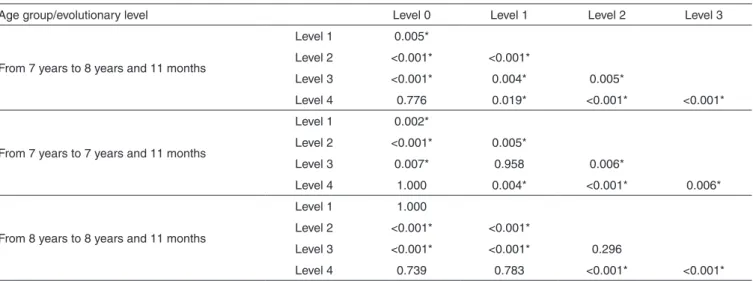
Table 1 presents the comparison of mean number of answers for the ive proposed levels; statystical analysis of these data used the Friedman test. The results showed a signiicant difference between levels, both for the general sample and for each age group. To precisely determine which levels present differences, the Wilcoxon test was used, and all levels were paired to be compared; these p-values are described in Table 2.
Spearman Correlation was used to measure the correlation degree between subjects’ age ranges (7-year-old age range: from 7 years to 7 years and 11 months; 8-year-old age range: from 8 years to 8 years and 11 months) and total score obtained in the Conlict Resolution Test, and the Correlation Test vali-dated the correlation found. A positive signiicant correlation was found (p=0.03, r=0.34), however, r=0.34 means that the correlation was poor.
The Mann-Whitney test was used to compare genders and total score on the task. Although there was a difference betwe-en gbetwe-enders, with the score obtained by female subjects being higher than that obtained by male subjects, such difference was not signiicant, that means, genders had similar behaviors on the Conlict Resolution Test.
DISCUSSION
Level 0 and 4 strategies were the least used in the general
sample and for each age range; for 8-year-olds, level 1 also did not differ from levels 0 and 4. Hence, based on the strategies used, it can be concluded that 7- and 8-year-old children still frequently use unilateral conlict resolution strategies, however, they are able to eficiently dialogue in order to solve problems. Even though subjects still used mutual solutions (level 4), which are frequently more eficient, they also used level 0 strategies a few times, demonstrating that, although children in this study were not able to use more sophisticated strate-gies, from the linguistic point of view, they did show ability to solve problems.
It is expected that social cognitive abilities and, consequen-tly, abilities necessary to solve problems, improve considerably with age; even so that many studies regarding these abilities
were carried out with older children(1,2,19,20).
Because it is probable that older children and adolescents frequently use more sophisticated strategies, it would be in-teresting to expand this studies’ sample, including older age
Chart 1. Conlict resolution strategies for hypothetical situations
Evolutionary levels Score Strategy Deinition
Level 0
Solutions not described in the other levels
Score 0 “Others” All strategies that do not it in the other levels
Level 1
Physical solutions
Score 1
Physical intervention Use of strength, for instance pushing, punching
Verbal intention Insults
“Non-interaction” Get out or avoid the other
Level 2
Unilateral solutions
Score 2
Material bribe Bribe for objects
To threaten, demand or claim To demand someone else’s action
Punishment To punish the other individual
To appeal for the adult’s
authority To try to ind an adult’s help to solve the conlict
To justify To justify saying that he was there irst or that he had an
adult’s permission
To complain Expression of dissatisfaction or resentment
Sarcasm Sarcastic expressions
Exclusion of the other To not ponder about the other individual
To question To question in order to solve the conlicts
“Weak” initiatives To use “please” or play the victim or weak
To obey the orders, give in To use someone else’s power
To apologize, to appease Attempts to diminish the situation for the other individual
Level 3
Cooperative solutions
Score 3
Requests, suggestions,
instructions To ask give hints or instructions
To persuade and explain Appeal to the other’s ability to reason
To wait, postpone the action To postpone the resolution
Punishment to teach a lesson To provide a punishment, forcing a possible learning
Interpersonal bribe Psychological , non-material bribe
Conciliation Turn taking, to mediate and share
Change of perspective To take into account the other’s point of view
Empathy, interference of
feeling/compliance To interfere over the other’s feeling
Level 4
Mutual solutions
Score 4
Discussion To talk about the conlict
To appeal for unity To appeal for a group of “unity”
Joint solutions Solutions that involve mutual decisions or interpersonal
Table 1. Number of responses in each of the ive levels, for the total sample and 7- and 8-year-old groups
Age range/evolutionary levels Number of
responses Mean Median SD CI p-value
From 7 years to 8 years and 11 months
Level 0
40
0.15 0.0 0.36 0.11
<0.001*
Level 1 0.60 0.0 0.90 0.28
Level 2 2.55 3.0 1.11 0.34
Level 3 1.53 1.5 1.26 0.39
Level 4 0.18 0.0 0.50 0.16
From 7 years to 7 years and 11 months
Level 0
20
0.15 0.0 0.37 0.16
<0.001*
Level 1 1.05 1.0 1.00 0.44
Level 2 2.60 3.0 1.23 0.54
Level 3 1.05 1.0 1.19 0.52
Level 4 0.15 0.0 0.49 0.21
From 8 years to 8 years and 11 months
Level 0
20
0.15 0.0 0.37 0.16
<0.001*
Level 1 0.15 0.0 0.49 0.21
Level 2 2.50 2.0 1.00 0.44
Level 3 2.00 2.0 1.17 0.51
Level 4 0.20 0.0 0.52 0.23
* Signiicant values (p≤0,05) – Friedman test
Note: SD = standard deviation; CI = conidence interval
Table 2. p-values regarding the number of responses on the ive levels, for the total sample and 7- and 8-year-old groups
Age group/evolutionary level Level 0 Level 1 Level 2 Level 3
From 7 years to 8 years and 11 months
Level 1 0.005*
Level 2 <0.001* <0.001*
Level 3 <0.001* 0.004* 0.005*
Level 4 0.776 0.019* <0.001* <0.001*
From 7 years to 7 years and 11 months
Level 1 0.002*
Level 2 <0.001* 0.005*
Level 3 0.007* 0.958 0.006*
Level 4 1.000 0.004* <0.001* 0.006*
From 8 years to 8 years and 11 months
Level 1 1.000
Level 2 <0.001* <0.001*
Level 3 <0.001* <0.001* 0.296
Level 4 0.739 0.783 <0.001* <0.001*
* Signiicant values (p≤0,05) – Wilcoxon test
ranges. This would allow the analysis of how and when the improvement on conlict resolution abilities occurs and in what age children begin to use mutual strategies to solve problems. When the score obtained by the participants on the Con-lict Resolution Test was analyzed, it was observed there was a poor correlation between age range and total score, which
corroborates the literature(1) and suggests that 7- and 8-year-old
children present the same conlict resolution abilities . The poor correlation between score and age was expec-ted because linguistic abilities do not improve signiicantly between 7 and 8 years old. Meta-representation abilities and executive functions (fundamental for problem solving)
pre-sent great improvement around 4 years(3,7,8,21,22) and the next
linguistic development milestone that could inluence social
abilities is literacy, which occurs around 5 years old(23).
Howe-ver, although no difference was found between the scores of different age groups, 7-year-old subjects used level 1 strategies more frequently than 8-year-old subjects, and 8-year-olds used more level 3 strategies when compared to 7-year-olds.
Until 7 years of age, children are not yet able to comple-tely comprehend the nature of someone else’s knowledge and thoughts, and therefore, at this age, they still have great dificulty to understand thoughts as interpretations that can vary from one individual to another. The idea that important improvements occur aroud 6/7 years old corroborates the idea that at 5/6 years old children still have dificulties reasoning
about problems that involve thoughts(6).
vary according to the situation (an ability necessary for conlict resolution); this information is important to understand why 7-year-old children used level 3 strategies less frequently in the present study. It is possible that these subjects are still beginning to better comprehend someone else’s thoughts, and did not yet experience many social situations in which they could actually use this recently acquired knowledge. There-fore, the improvement observed at seven years might justify why 8-year-olds used more level 3 strategies, since at this age children are already able to comprehend with more assertive-ness the nature of thoughts and have had more opportunities to have used this knowledge in social situations, being able to elaborate strategies more relevant to the problem situation. Another important developmental milestone that occurs just before seven years and might have favored the performance of 8-year-old subjects regarding the use of level 3 strategies is the ability to reason about multiple possibilities and to answer questions like: “If tomorrow rains, can we go to the beach?”. It is only around 7 years that children are able to maturely think about future possibilities and genuinely evaluate the possible
alternatives(24).
According to the exposed, it is possible that the impro-vement of social cognition abilities and, hence, of
problem-solving abilities, is related to the individual’s social experience, along with the improvements observed in language develop-ment and abstract reasoning, which emphasizes the importance of further studies with older children.
In the present study, no differences were found between genders on scores obtained in the Conlict Resolution Test. This result corroborates the literature, since there are no evidences that boys and girls at this age present differences in the
deve-lopment of linguistic and cognitive abilities(1,2,20).
This study provides important background to future studies regarding conlict resolution abilities of children with normal language development, and keeps open the possibility of important correlations between the improvement of conlict resolution abilities and the increase of social situations expe-rienced by older children.
CONCLUSION
Seven- and 8-year-old children with normal language deve-lopment frequently use unilateral and cooperative strategies to solve problems. Although they still rarely use mutual solution strategies, children at these ages already demonstrate some problem-solving abilities.
RESUMO
Objetivo: Veriicar as habilidades de resolução de conlito de crianças de 7 e 8 anos em desenvolvimento normal de linguagem.
Métodos: Participaram do estudo 40 crianças em desenvolvimento normal de linguagem, com idades entre 7 anos e 8 anos e 11 meses. Para avaliar as habilidades de resolução de conlito foram apresentados cinco contextos hipotéticos de conlito. Após a apre-sentação de cada história, foi feita a seguinte pergunta: “Se você fosse ele [avaliadora aponta para o personagem da história], o que você faria?”. As respostas foram agrupadas em cinco níveis e pontuadas da seguinte forma: nível 0 (soluções que não se enquadram nos demais níveis) – zero ponto; nível 1 (soluções físicas) – um ponto; nível 2 (soluções unilaterais) – dois pontos; nível 3 (soluções cooperativas) – três pontos e nível 4 (soluções mútuas) – quatro pontos. Resultados: A maioria das estratégias propostas pertenciam aos níveis 2 (M=2,55±0,34) e 3 (M=1,53±1,26). Foi observada correlação signiicante e positiva (p=0,03, r=0,34), porém ruim, entre a faixa etária das crianças e a pontuação na prova de resolução de conlito. Esses resultados indicam que aos 7 e 8 anos as crianças ainda utilizam frequentemente estratégias unilaterais, porém já são capazes de dialogar com eiciência para solucionar problemas.
Conclusão: Aos 7 e 8 anos de idade, crianças em desenvolvimento normal de linguagem utilizam com mais frequência estratégias unilaterais e cooperativas para solucionar problemas.
Descritores: Linguagem infantil; Desenvolvimento da linguagem; Fala; Cognição; Compreensão; Testes de linguagem
REFERENCES
1. Stevens LJ, Bilss LS. Conlict resolution abilities of children with speciic language impairment and children with normal language. J Speech Hear Res. 1995;38(3):599-611.
2. Farmer M. Language and social cognition in children with speciic language impairment. J Child Psychol Psychiatry. 2000;41(5):627-36. 3. Carlson SM, Moses LJ. Individual differences in inhibitory control and
children’s theory of mind. Child Dev. 2001;72(4):1032-53.
4. Garfield JL, Peterson CC, Perry T. Social cognition, language acquisition and the development of the theory of mind. Mind Lang. 2001;16(5):494-541.
5. Apperly IA, Robinson EJ. When can children handle referential opacity? Evidence for systematic variation in 5- and 6-year-old children’s reasoning about beliefs and belief reports. J Exp Child Psychol.
2003;85(4):297-311.
6. Farrant BM, Fletcher J, Maybery MT. Speciic language impairment, theory of mind, and visual perspective taking: evidence for simulation theory and the developmental role of language. Child Dev. 2006;77(6):1842-53.
7. Thirion-Marissiaux AF, Nader-Grosbois N. Theory of Mind “emotion”, developmental characteristics and social understanding in children and adolescents with intellectual disabilities. Res Dev Disabil. 2008;29(5):414-30.
8. Sabbagh MA, Moses LJ, Shiverick S. Executive functioning and preschoolers’ understanding of false beliefs, false photographs, and false signs. Child Dev. 2006;77(4):1034-49
Anexo 1. Hypothetical conlict situations – translated stories(1)
1 - Thiago is João’s best friend. But now Thiago plays with a new boy at school every day. Thiago doesn’t play with João anymore.
2 - Rodrigo wants to use the computer to play his favorite game. His brother Lucas is already using the computer. Lucas hates to be interrupted when he’s using the computer.
3 - Marcelo is hungry. He wants his older brother Daniel to help him get some cookies in a high kitchen shelf. Marcelo is afraid that Daniel says no.
4 – There’s a boy named Marcos who lives next to Eduardo. Marcos is very annoying. Almost every day Marcos insults Eduardo on his way to school.
5 - Pedro is a new boy in the neighborhood. One Saturday, Bruno asked Pedro to come over to watch cartoons. After ten minutes, Pedro changes the TV channel without asking.
Function, and Social Competence: A Longitudinal Analysis. J Appl Dev Psychol. 2009;30(3):332-43.
10. Hala S, Hug S, Henderson A. Executive function and false-belief understanding in preschool children: two tasks are harder than one. J Cogn Dev. 2003;4(3):275-98.
11. Gordon AC, Olson DR. The relation between acquisition of a theory of mind and the capacity to hold in mind. J Exp Child Psychol. 1998;68(1):70-83
12. Iacoboni M, Molnar-Szakacs I, Gallese V, Buccino G, Mazziotta JC, Rizzolatti G. Grasping the intentions of others with one’s own mirror neuron system. PLoS Biol.2005;3(3):e79.
13. Oberman LM, Pineda JA, Ramachandran VS. The human mirror neuron system: a link between action observation and social skills. Soc Cogn Affect Neurosci.2007;2(1):62-6.
14. Rizzolatti G, Fogassi L, Gallese V. Neurophysiological mechanisms underlying the understanding and imitation of action. Nat Rev Neurosci. 2001;2(9):661-70. Review.
15. Wertzner HF. Fonologia. In: Andrade CR, Bei-Lopes DM, Fernandes FD, Wertzner HF. ABFW: teste de linguagem infantil nas áreas de fonologia, vocabulário, luência e pragmática. 2a ed. rev. ampl. e atual. Barueri: Pró-Fono; 2004. p. 5-31.
16. Herrero SF. Perfil das crianças: pré-escolares e escolares no teste de sensibilidade fonológica [dissertação]. São Paulo: Faculdade de Medicina da Universidade de São Paulo; 2001.
17. Rosal CA. Habilidades de segmentação fonêmica em crianças normais de primeira, segunda e terceira séries do ensino fundamental
[dissertação]. São Paulo: Faculdade de Medicina da Universidade de São Paulo; 2002.
18. Fernandes FD, Andrade CR, Bei-Lopes DM, Wertzner HF. Manual de avaliação de linguagem do serviço de Fonoaudiologia do centro de saúde escola Samuel B. Pessoa [manual]. São Paulo: Centro de Saúde Escola Samuel B. Pessoa; 1997.
19. Hart KI, Fujiki M, Brinton B, Hart CH. The relationship between social behavior and severity of language impairment. J Speech Lang Hear Res. 2004;47(3):647-62.
20. Marton K, Abramoff B, Rosenzweig S. Social cognition and language in children with speciic language impairment (SLI). J Commun Disord. 2005;38(2):143-62.
21. Moore C, Pure K, Furrow D. Children’s understanding of the modal expression of speaker certainty and uncertainty and its relation to the development to the development of a representational theory of mind. Child Dev. 1990;61(3):722-30.
22. Sabbagh MA, Xu F, Carlson SM, Moses LJ, Lee K. The development of executive functioning and theory of mind. A comparison of Chinese and U.S. preschoolers. Psychol Sci. 2006;17(1):74-81.
23. Leitão S, Fletcher J. Literacy outcomes for students with speech impairment: long-term follow-up. Int J Lang Commun Disord. 2004;39(2):245-56.