Magneti, Strutural and Superonduting
Properties of MgC(Ni
1 x Fe
x )
3
M. Alzamora,D. R. Sanhez, M.Cindra, and E. M.Baggio-Saitovith
Centro BrasileirodePesquisas Fsias,
Rua XavierSigaud150,Ura,CEP22290-180RiodeJaneiro,Brasil
Reeivedon28February,2002
X-raydiration,asuseptibilityand 57
FeMossbauerspetrosopymeasurementshavebeen
per-formedintheMgC(Ni
1 x Fe
x )
3
(0x0.5)series. Thesuperondutingtransitiontemperature
T ofthe undopedsample, determinedby a suseptibility, is 7K. The Fedoping quikly
de-pressesT
,ompletelydestroyingthesuperondutingstateforx0.04. Theestablishmentofan
orderedmagnetistateisonlyobservedforFeonentration(x0.3)farabovetheonentration
forwhihthesuperondutingstatehasompletelydisappeared. Anexpansionofthelattiewith
theinreaseoftheFeontent wasobserved.
I Introdution
ThedisoveringofsuperondutivityintheMgB
2
om-poundwithT
39K[1℄hasrenewedtheinterestforthe
searhofnewintermetalliompoundswithhigh
super-onduting transitiontemperatures. Reently, another
intermetalliompound ontainingMgwasdisovered:
MgCNi
3
, with T
8 K [2℄. Dierent of the layered
MgB
2
(spaegroupP6/mmm),wheretheboronlayers
are alternately stakedon theMg layers,the MgCNi
3
has the lassial ubi perovskite struture (Pm3m),
resembling the struture of the high T
superondu-tors. However,in ontrast to thehigh T
perovskites,
the MgCNi
3
hasno oxygen in its struture.
Further-more, the establishment of a superonduting than a
ferromagnetigroundstateinaintermetalliompound
with a high Ni ontent(element usually assoiatedto
ferromagnetism) is verysurprising and make it a
po-tentialandidateforunonventionalsuperondutivity,
aspointedoutbyT.He[2℄.
ThesuperondutingpropertiesoftheMgCNi
3 are
assoiated with the ourrene of an intense peak in
the density ofNi 3d statesatthe Fermi level. Infat,
the Fermi level is loated in the slope desending of
this peak [3-7℄. In the same way, these alulations
suggestthatintroduingeletronsorholedopantsinto
MgCNi
3
willresultinadereaseorinreaseinN(E
F ),
respetively. In the former ase (substituting Ni by
Cu),onemayexpetthatsuperondutivityofthe
sys-temdeteriorate. Dopingwithholes(e.g. NibyFe)will
inrease the N(E
F
). However, a large N(E
F
) is not
alwaysbeneialforsuperondutivity,beauseavery
large N(E ) tendsto indue spin utuationor
mag-netiorder,whihquiklydestroythesuperonduting
eletronpairing.
TheinueneofNisubstitutionbyFe,onthe
stru-tural,magneti andsuperonduting propertiesof the
MgC(Ni 1 x Fe x ) 3
(0 x 0.5) system has been
in-vestigated, in this work, by x-ray, magnetization and
Mossbauerspetrosopyof 57
Fe.
II Experimental
Samples with nominal formula MgC(Ni
1 x Fe x ) 3 for
0x0:5where preparedandthestartingmaterials
werebrightMgakes,ne Nipowder,andhighpurity
amorphousarbonpowder. Thereationsweredonein
atubefurnaeunderhigh-pureAratmosphereforhalf
anhourat600 o
C,followedbyanhourat900 o
C.After
ooling, the samples were grained again, pressed into
pellets, andsinteredformoreone hourat900 o
C.The
struturalharaterizationweremadebypowderX-ray
dirationusingaRigakuX-raydiratometerwithCu
K
radiation.g hesampleswereanalyzedbyMossbauer
spetrosopyintransmissiongeometryin the
tempera-turerangeof2-300K. AC suseptibility measurements
were performed in aQuantum Design SQUID
magne-tometer.
III Results and Disussion
ToobtainstoihiometriompositionMgC(Ni
1 x Fe x ) 3 ,
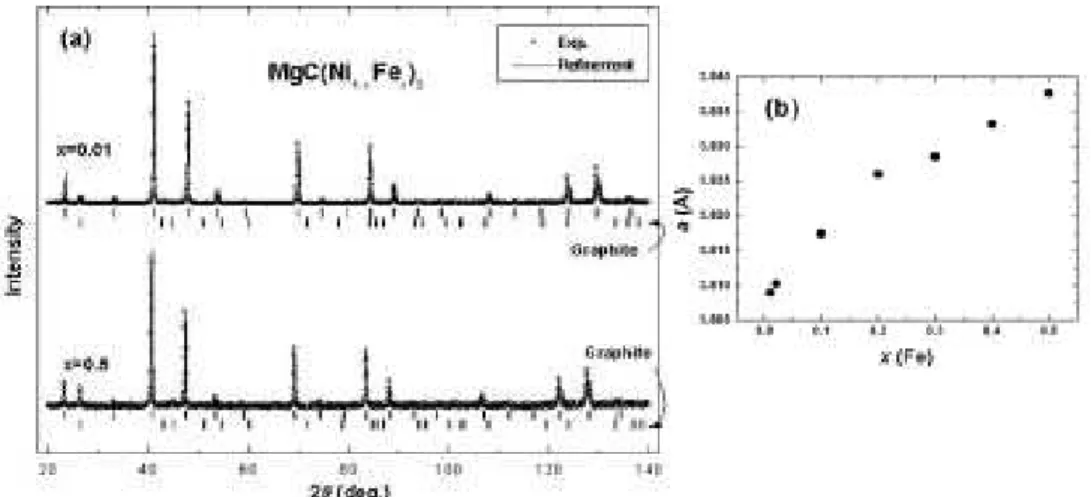
TheX-rayspetra(Fig. 1a)forallthesamplesshowthe
singleubiMgCNi
3
(Pm3m)asamajorityphasewith
asmall amountof unreated graphite. After Rietveld
analysis, anexpansionof the lattiewith the inrease
oftheFedopingisdetermined(Fig. 1b).
Figure1. (a). CuKx-raydirationpatternofthesamplesMgC(Ni1 xFex)3 withx=0.01andx=0.5. TheBraggpeaksof
theremaininggraphiteareindiated. (b)LattieparameteraasafuntionofFeontent.
Theasuseptibilitymeasurements,showingthe
su-peronduting and magneti transition of the doped
materials,are displayedin Fig 2a. TheT
7Kofthe
undopedsampleisinagreementwithpreviousdata
ob-tainedfromdmagnetizationmeasurements[1,8℄. The
Fedilutionat theNisiteinduesafastdereaseofthe
superondutingtransition temperaturefrom T
7 K
(x=0:0)toT
3K(x=0:02),andthedisappearane
of thesuperondutingstate isextrapolatedto ours
atx0:04(Fig. 2b). Thissuppressionof
superondu-tivity an,in priniple, be explainedonsidering band
struturealulations:asmentionedbefore,forthe
par-entMgCNi
3
ompound,theFermienergyE
F
isonthe
high-energy side of an intense peak of the density of
Ni3dstates[3-7℄.DopingtheompoundwithFe(hole
doping) redues the number of valene eletrons and
movestheFermileveltolowerenergies,whihausesan
inreaseintheDOSattheFermilevelN(E
F
).
Aord-ingtotheBCStheory,T
shouldrisewiththeinrease
in N(E
F
), and notderease asobserved. However, an
inreaseintheDOSleadstoenhanementoftheStoner
exhange parameter S=N(E
F )I
ex (I
ex
is theexhange
integral),andheneinduingspinutuationsor
mag-neti order,whih should destroythe superonduting
pairing[4,5℄. IntheinsetofFig.2anbeobservedthat
amagnetitransitionoursonlyforFeonentrations
x0.3.
Figure2. (a). Magneti haraterization ofthe superondutingandmagnetitransitionsofMgC(Ni1 xFex)3(0x 0.3)
57
Fe Mossbauer experiments were performed in
MgC(Ni
1 x Fe
x )
3
system inorder torevealthereferred
magneti utuations responsible, as pointed out by
band lling,forthedisappearaneofthe
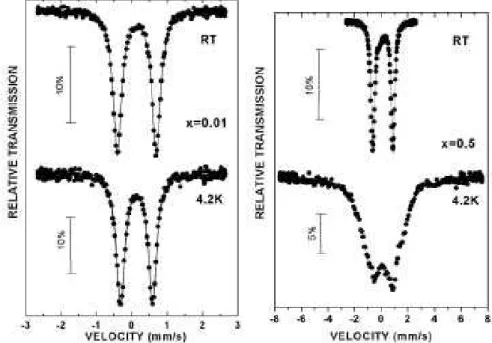
superondu-tivityin this series. Atroomtemperaturethe spetra
showasinglequadrupoledoublet(Fig. 3),whihis
at-tributedtoFeintheMgCNi
3
struture. Thesharp
res-onanelinesindiate thatthere isasinglewelldened
site for Fe in these ompounds. In some samples an
additional weak doublet(5% oftotal absorptionarea)
wasobserved,whihisprobablyduetoimpurityphase.
Theeletrial quadrupolesplittingE
Q
,ameasureof
thestruturalhangesofthelattie,inreaseswiththe
Fe onentration (Fig. 4), in agreementwith the
ex-pansionofthelattiedisplayedbyX-raydiration.
For the samplesin the range0x 0:3, the low
temperature Mossbauer spetra are very similar with
the spetraat room temperature, whih an be
inter-pretedasabsene ofmagneti utuationor magneti
ordering in thisrange ofFeonentration,even at4.2
K.These resultsseemto ontradittheexpetationof
simple band lling, aordingto whih magneti
u-tuations wouldberesponsibleforthedisappearaneof
superondutivity[4,5℄. Ontheotherhand,forx0:3
thelowtemperatureMossbauerspetrabroadenanda
magneti hyperne eld is deteted at the Fe nuleus
(Ni site) (Fig. 3). Then Mossbauer and a
susepti-bilityresultsindiatethatamagnetiorderingor
mag-neti utuations isestablishedonly forFe
onentra-tionsfarawayfromthatforwhihthe
superondutiv-ityisompletelydestroyed(x 0:04):Further
exper-iments,ofMossbauerspetrosopyunderexternaleld
in the sample with 1at. % of Fe, are in progress to
onrmthepreseneofmagnetimomentattheFe.
Figure3.Roomtemperatureeletrialquadrupolesplitting
EQobservedinMgC(Ni1 xFex)3(0x0:3).
Figure4. Roomtemperatureand4.2KMossbauer spetraofthesamplesMgC(Ni1 xFex)3withx=0:01andx=0:5.
Band struture alulations in MgC(Ni
1 x Co
x )
3
x 0:03 (assuming the same strutural parameter
as in MgCNi
3
) [6℄ yield no magneti instabilities, in
agreementwith theexperiments where noevidene of
magnetiorstruturaltransitionhasbeenreportedyet
modelmaynotworkwellintheaseofNisubstitution.
However,anexpansionofthelattiewiththeCodoping
isalsoexpeted,similartothatproduedbyFedoping
(above),andmustbeonsideredin theband struture
desribing the nature of the depressionof T
. Hene,
thestrutural eets, dueto theNi doping, should be
inludedin theanalysisof thegroundstateproperties
oftheseseries.
IV Conlusion
Our preliminary results on X-ray diration, 57
Fe
Mossbauer spetrosopy, on the MgC(Ni
1 x Fe
x )
3
0 x 0:5 system show that an expansion of
the lattie with the Fe doping ours. This
expan-sion was monitored through the hange in the
lat-tie parameterand the eletrial quadrupole splitting
E
Q
. Preliminary a suseptibility results show no
evidene of magneti utuation and no magneti
or-dering was observed neither in the range of Fe
dop-ingforwhihthesuperondutivitywassystematially
destroyed (x 0:04) nor just above of that,
on-trary to the expeted by simple band lling model.
Only for onentration well above of the value for
whih the superondutivity is ompletely destroyed
(x0:3),theestablishmentofamagnetiorderedstate
isobservedby asuseptibilityas byMossbauer
spe-trosopy. TheseresultssuggestthatFehasamagneti
Referenes
[1℄ J. Nagamatsu, N. Nakagawa, T.Muranaka, Y.
Zeni-tani,andJ.Akimitsu,Nature410,63(2001)
[2℄ T.He,Q.Huang, A.P.Ramirez,Y.Wang,K.A.
Re-gan, N. Rogado, M. A. Hayward, M. K. Haas, J. S.
Slusky, K. Inumara, H. W. Zandbergen, N. P. Ong,
andR.J.Cava,Nature(London)411,54(2001).
[3℄ Andrzej Szajek, J.Phys.: Condens. Matter13, L595
(2001).
[4℄ I. R. Shein, A. L. Ivanovskii, and N. I. Medvedeva,
JETPLett.74,122(2001)
[5℄ S. B. Dugdale and T. Jarlborg, Phys. Rev. B 64,
100508(2001).
[6℄ J.H.Shim,S.K.Kwon, andB.I.Min,Phys.Rev.B
64,180510-1(2001).
[7℄ D.J.SinghandI.I.Mazin,Phys.Rev.B64,140507-1
(2001).
[8℄ M. A. Hayward, M. K. Haas, A. P. Ramirez, T. He,
K.A.Regan,N.Rogado,K.Inumara,andR.J.Cava,
SolidStateCommun.119,491(2001).
[9℄ Q.Huang, T.He, K.A. Regan,N. Rogado, M.
Hay-ward,M.K.Haas,K.Inumaru,andR.J.Cava,Physia