Printed in Brazil - ©2007 Sociedade Brasileira de Química 0103 - 5053 $6.00+0.00
A
r
ti
c
le
*e-mail: [email protected]
p
-Nitrobenzoic Acid Promoted Synthesis of 1,5-Benzodiazepine Derivatives
Ravi Varala,* Ramu Enugala and Srinivas R. Adapa*
Indian Institute of Chemical Technology, Hyderabad-500 007, India
Entre vários ácidos carboxílicos testados, o ácido p-nitrobenzóico mostrou ser o mais versátil para a preparação de derivados de 1,5-benzodiazepinas a partir de uma série de o-fenilenodiaminas substituídas e cetonas. Os produtos foram obtidos em bons rendimentos (62-92%) sob condições brandas, usando acetonitrila como solvente, a temperatura ambiente. Adicionalmente, o reagente pode ser facilmente recuperado e re-utilizado.
p-Nitrobenzoic acid was found to be the versatile Bronsted organic acid promoter among the carboxylic acids tested for the preparation of 1,5-benzodiazepine derivatives from a wide range of substituted o-phenylenediamines and ketones. The corresponding products were obtained in good isolated yields (62-92%) under mild conditions using acetonitrile as solvent at ambient temperature. Further, the reagent could be easily recovered and reused.
Keywords: 1,5-benzodiazepines, bronsted acid, o-phenylenediamines and ketones,
p-nitrobenzoic acid
Introduction
1,5-benzodiazepine derivatives have received significant attention and the core is indeed a “privileged scaffold” found in compounds active against a variety of target types including peptide hormones (such as CCK), interleukin converting enzymes (ICE) and potassium blockers (Ik).1 More recently,
the area of biological interest of 1,5-benzodiazepines has been extended to various diseases such as cancer, viral infection (non-nucleoside inhibitors of HIV-1 reverse transcriptase), cardiovascular disorders.2 In addition,
1,5-benzodiazepines show antidepressive, antifungal, anti-bacterial, antifeedant, antiinflammatory, analgesic and anticonvulsant activities.3 Besides these derivatives are also
used as dyes for acrylic fibre in photography.4 Moreover,
1,5-benzodiazepines are valuable synthons used for the preparation of other fused ring compounds such as triazolo-, oxadiazolo-, oxazino-, or furano-benzodiazepines.5
Despite their importance from a pharmacological, industrial and synthetic point of view, comparatively few methods for their preparation are reported in the literature, a great number of which have appeared only very recently employing BF3-etherate, NaBH4,polyphosphoric acid or SiO2, MgO/POCl3, Yb(OTf)3, and InBr3as catalysts or as stoichiometric reagents.6 However, many of these methods
have some drawbacks such as low yields of the products,
high temperatures,drastic reaction conditions,long
reaction times, and relatively expensive reagents. From the viewpoints above, the development of environmentally benign, less expensive and easily handled promoters for the preparation of benzodiazepines (hereafter 1,5-BDPs) is still highly desirable.
Very recently, we have reported synthesis of 1,5-BDPs using CANas catalyst in methanol.7 In recent years, lot
of attention has been paid to organocatalysts owing to their eco-friendliness and can proceed under aerobic atmosphere, other notable advantages are: usually less expensive and commercially available.8 Intrigued by the
results achieved by Zhao et al.9 in allylation of aldehydes
using carboxylic acids as Bronsted organocatalysts and Gopal’s report9 which was limited only for the reaction
between acetone and o-phenelynediamine (o-PD)
involving supramolecular chemistry, we have undertook advantage of both the reports and tried to explore the utility of several organo acids in the preparation of various structurally and electronically divergent 1,5-BDPs.
Results and Discussion
of chosen organoacids (1 equiv. as standard) for the model
reaction using o-PD (1 mmol) and acetophenone (2.2
mmol) in acetonitrileat ambient temperature to afford the corresponding 1,5-benzodiazepine (Table 1).
Among the acids screened, p-nitrobenzoic acid (p -NBA) was found to be the best promoter in terms of reaction times and yields (entry 2, Table 1). To the best of our knowledge, there are no earlier reports on the preparation of 1,5-benzodiazepines using p-nitrobenzoic acid (Scheme 1). The optimum yields of the product were obtained when a ratio of o-PD to ketone 1:2.2 is used. The reaction is found to be sluggish when carried out using even 0.5 equiv. of catalyst amounts. In all cases, the reactions are clean and are completed within 3.5-15 h. The benzodiazepines were the only products obtained and the rest of the material was essentially starting material.
The crude product was filtered and washed with DCM to recover the p-nitrobenzoic acid, the filtrate was extracted with DCM and after usual workup and further purification by silica gel column chromatography yielded the desired pure product. Furthermore, p-NBA could be recovered and repeated minimum three times with slight decrease in the yield (88%, 80%, 77%) due to the loss of p-NBA in recovery.
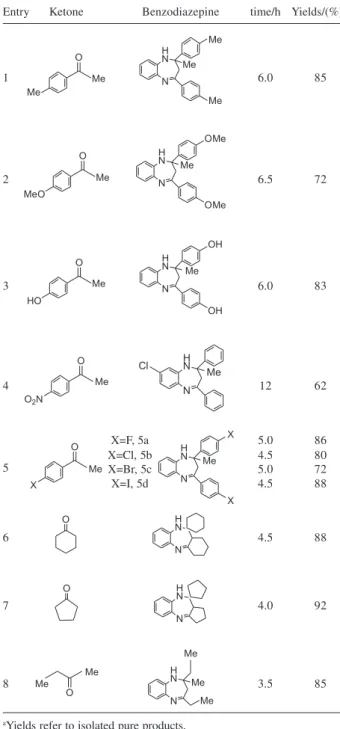
Encouraged by these results, at first, we studied the condensation of acetophenone with divergent o-PD’s for the synthesis of corresponding 1,5-benzodiazepine derivatives under standardized conditions and the results were quite satisfactory (Table 2). The scope and generality of the present procedure was then extended to electronically divergent acetophenones towards o-PD and the results are presented in Table 3. It is interesting to note that under our optimized conditions, exclusively one regioisomer is favoured para position in relation to the imine moiety as confirmed by 1H
NMR spectroscopic data. (entries 2, 4, 6 and 7, Table 2).
Table 2. p-NBA mediated synthesis of 1,5-benzodiazepines from
acetophenone
Entry Diamine Benzodiazepine time/h Yields/(%)a
1 7 90
2 4.5 76
3 15 70
4 12 75
5 4.5 88
6 6 85
7 12 83
a Yields refer to the isolated pure products.
Table 1. Reaction of o-PD with acetophenone promoted by organoacids
in 1,5-benzodiazepines synthesis
Entry Organo acid time/h Yield/(%)a
1 benzoic acid 24 80
2 p-nitrobenzoic acid 07 90
3 m-bromobezoic acid 24 60
4 phenylacetic acid 24 80
5 mandelic acid 24 32
6 p-tolunesulphonic acid 72 N.R
7 cinnamic acid 24 N.R
8 anthranilic acid 24 83
9 o-picolinic acid 24 79
10 isonicotinic acid 24 83
11 malonic acid 24 35
12 adipic acid 12 78
13 valaric acid 24 40
14 citric acid 12 88
15 imino diacetic acid 24 N.R
16 p-anisic acid 24 85
a G.C Yield %; N.R = No Reaction.
In a similar fashion, cyclic ketones such as cyclo-pentanone and cyclohexanone also reacted well with o -PD to furnish the corresponding 1,5-BDPs in good yields (entries 6-7, Table 3). In case of unsymmetrical ketones such as 2-butanone (entry 8, Table 3), the ring closure occurred selectively giving a single product.
Conclusions
In conclusion, we have developed a practical and novel procedure for the synthesis of
2,3-dihydro-1H-1,5-benzodiazepine derivatives using p-NBA in acetonitrile. The present protocol has several advantages: mild reaction conditions (at room temperature), operational and experimental simplicity, readily availability, study of wide range of electronically divergent ketones and o-PDs, easily recoverable and reusable organo promoter for applicability in large scale synthesis. We believe that this p-NBA promoted methodology will be a valuable contribution to the existing processes in the field of synthesis of 1,5-benzodiazepines.
Experimental
General
Melting points were measured using a Buchi R-535 apparatus. IR spectra were taken on a Bruker Vector-22 spectrometer in KBr pellets and reported in cm-1. 1H NMR
spectra were recorded at 300 MHz on a Bruker Avance-300 spectrometer in CDCl3 withchemical shifts (δ) given relative to TMSas an internal standard. 13C NMR spectra
were recorded on a Bruker Avance-300 (75.5 MHz) spectrometer with complete proton decoupling; chemical shifts are reported in ppm relative to the solvent resonance as the internal standard (CDCl3, δ 77.16 ppm. CHN analyses were recorded on a Vario EL analyzer.
Representative procedure
To a suspension of p-nitrobenzoic acid (1 mmol) in acetonitrile (3 mL) were added successively
o-phenylenediamine (1 mmol) and acetophenone (2.2
mmol) at room temperature for the time specified in Table 2. After the reaction was over, the reaction mixture was filtered and washed with DCM to recover p-nitrobenzoic acid. The filtrate was extracted with DCM (20 mL) and the combined organic layer was dried over Na2SO4, concentrated under reduced pressure to furnish the crude product, which was purified by silica gel chromatography using EtOAc/Hexane (1:5), to afford corresponding pure product. All compounds gave satisfactory spectroscopic data in accordance to their proposed structures.
Spectral data for compounds
Entry 1, Table 2
Yellow solid. mp 150–152 °C. IR (KBr) ν
max/cm -1: 3320,
1631, 1597. 1H NMR (300 MHz, CDCl
3) δ: 1.80 (s, 3H),
2.95 (d, 1H, J 12.8 Hz), 3.15 (d, 1H, J 12.8 Hz) 3.45 (br s, NH), 6.55–7.01 (m, 3H), 7.15–7.35 (m, 7H), 7.55–7.65 (m, 4H); 13C NMR (75 MHz, CDCl
3) δ: 29.7, 42.9, 73.3, 121.2,
Table 3. p-NBA mediated synthesis of 1,5-benzodiazepines from o-PD
Entry Ketone Benzodiazepine time/h Yields/(%)a
1 6.0 85
2 6.5 72
3 6.0 83
4 12 62
X=F, 5a 5.0 86
5
X=Cl, 5b 4.5 80
X=Br, 5c 5.0 72
X=I, 5d 4.5 88
6 4.5 88
7 4.0 92
8 3.5 85
121.4, 125.2, 126.1, 126.8, 126.9, 127.8, 128.1, 128.5, 129.5, 137.9, 139.5, 139.9, 147.4, 167.3. MS (EI), m/z [M+] = 312. Anal. Calc. for C
22H20N2: C, 84.58; H, 6.45; N,
8.97: Found: C, 84.55; H, 6.51; N, 8.94.
Entry 2, Table 2
Yellow solid. mp 92-94 °C. IR (KBr) ν
max/cm -1: 3275,
1659, 1614. 1H NMR (300 MHz, CDCl
3) δ: 1.80 (s, 3H),
2.41 (s, 3H), 3.01 (d, J 13.2 Hz, 1H), 3.15 (d, J 13.2 Hz, 1H), 3.51 (br s, 1H, NH), 6.70–7.69 (m, 13H); 13C NMR
(75 MHz, CDCl3) δ: 20.9, 28.7, 45.9, 51.0, 113.5, 123.5, 125.7, 126.3, 127.4, 128.2, 128.3, 128.5, 128.6, 129.0, 130.8, 131.2, 134.0, 136.9, 164.6. MS (EI), m/z [M+] =
326.Anal. Calc. for C23H22N2: C, 84.63; H, 6.79; N, 8.58: Found: C, 84.53; H, 6.85; N, 8.62.
Entry 3, Table 2
Yellow solid. mp 115-116 °C. IR (KBr) ν
max/cm -1:
3285, 1635, 1609. 1H NMR (300 MHz, CDCl
3) δ: 1.70 (s,
3H), 2.25 (s, 6H), 2.90 (d, 1H, J 12.8 Hz), 3.10 (d, 1H, J 12.8 Hz), 3.45 (br s, 1H), 6.60 (s, 1H), 7.15 (s, 1H),
7.18-7.30 (m, 6H), 7.50–7.60 (m, 4H); 13C NMR (75 MHz,
CDCl3) δ: 18.6, 19.3, 29.7, 43.2, 73.0, 122.3, 125.4, 126.8, 126.9, 127.8, 128.2, 129.3, 129.4, 129.6, 134.8, 135.7, 137.6, 139.7, 147.8, 166.8. MS (EI), m/z [M+] = 340. Anal.
Calc. for C24H24N2: C, 84.66; H, 7.10; N, 8.22: Found: C, 84.78; H, 7.25; N, 8.35.
Entry 4, Table 2
Yellow solid. mp 121–123 °C. IR (KBr)ν
max/cm -1:
3290, 1647, 1598, 854. 1H NMR (300 MHz, CDCl
3) δ: 1.76 (s, 3H), 2.96 (d, J 12.8 Hz, 1H), 3.15 (d, J 12.8 Hz, 1 H), 3.35 (br s, NH), 6.78-6.81 (m, 1H), 6.95-6.98 (m, 1H), 7.15-7.27 (m, 6H), 7.42-7.58 (m, 3H), 7.91-7.96
(m, 2H); 13C NMR (75 MHz, CDCl
3) δ: 29.6, 44.7, 71.2,
120.9, 122.9, 124.1, 128.9, 139.9, 130.5, 132.0, 137.6, 138.2, 146.0, 169.1. MS (EI), m/z [M+] = 346. Anal. Calc.
for C22H19ClN2: C, 76.18; H, 5.52; N, 8.08: Found: C, 76.07; H, 5.49; N, 8.12.
Entry 5, Table 2
Yellow crystalline solid. mp 158–160 °C. IR (KBr)
ν
max/cm
-1: 3304, 1638, 1603, 761. 1H NMR (300 MHz,
CDCl3) δ: 1.75 (s, 3 H), 2.93 (d, J 12.8 Hz, 1 H), 3.12 (d, J 12.8 Hz, 1 H), 3.49 (br s, NH), 6.88 (s, 1 H), 7.13-7.30 (m, 5 H), 7.36 (s, 1H), 7.50-7.53 (m, 5 H); 13C NMR (75
MHz, CDCl3) δ: 29.9, 43.2, 72.9, 121.9, 124.1, 125.3 127.3, 128.4, 128.7, 130.1, 137.8, 139.3, 146.8, 168.8. MS (EI), m/z [M+] = 381. Anal. Calc. For C
22H18Cl2N2: C,
69.30; H, 4.76; N, 7.35: Found: C, 69.28; H, 4.81; N, 7.32.
Entry 6, Table 2
Yellow solid. mp 114-116 °C. IR (KBr) ν
max/cm -1:
3327, 1681, 1649, 1601, 1249, 1178, 981, 820. 1H NMR
(300 MHz, CDCl3) δ: 1.78 (s, 3H), 2.96 (d, 1H, J 12.8 Hz), 3.31 (d, 1H, J 12.8 Hz), 3.51 (br s, 1H, NH), 7.12-7.26 (m, 5H), 7.34-7.61 (m, 7H), 7.72-7.78 (m, 2H), 7.81-7.85 (m, 1H), 7.88-7.92 (m, 2H), 7.98-8.01 (m, 1H); MS (FAB), m/z [M++H] = 417. Anal. Calc. for
C29H24N2O: C, 83.63; H, 5.81; N, 6.73; Found: C, 83.49; H, 5.94; N, 6.69.
Entry 7, Table 2
Yellow solid. mp 136-138 °C. IR (KBr) ν
max/cm -1:
3318, 1638, 1554, 1356. 1H NMR (300 MHz, CDCl
3) δ: 1.79 (s, 3H), 3.06 (d, 1H, J 13.4 Hz), 3.32 (d, 1H, J 13.4 Hz), 4.41 (br s, 1H, NH),6.92-6.94 (d, 1H, J 8.7
Hz), 7.17-7.55 (m, 10H), 7.92-7.96 (m, 2H); 13C NMR
(75 MHz, CDCl3) δ: 29.1, 45.8, 65.8, 111.8, 116.9, 124.2, 125.8, 127.6, 128.8, 129.2, 132.2, 132.5, 133.4, 135.6, 137.8, 139.6, 143.1, 166.8. MS (EI), m/z [M+] =357. Anal.
Calc. for C22H19N3O2: C, 73.93; H, 5.36; N, 11.76; Found: C, 73.87; H, 5.41; N, 11.67.
Entry 1, Table 3
Pale yellow crystalline solid. mp 98-99 oC. IR (KBr)
ν
max/cm
-1: 3318, 1630, 1598. 1H NMR (300 MHz, CDCl 3) δ: 1.72 (s, 3H), 2.26 (s, 3H), 2.32 (s, 3H), 2.98 (d, 1H, J 13.4 Hz), 3.05 (d, 1H, J 13.4 Hz), 3.43 (br s, 1H, NH), 6.74-6.76 (m, 1H), 6.98-7.02 (m, 6H), 7.21-7.23 (m, 1H),
7.47-7.50 (m, 4H); 13C NMR (75 MHz, CDCl
3) δ: 20.7,
21.2, 29.8, 42.9, 73.1, 121.3, 121.4, 125.2, 126.0, 127.1, 128.5, 128.6, 128.9, 129.2, 136.4, 137.0, 138.2, 139.7, 140.3, 145.0, 166.8. MS (EI), m/z [M+] = 340. Anal. Calc.
for C24H24N2: C, 84.70; H, 7.05; N, 8.23: Found: C, 84.68; H, 7.13; N, 8.18.
Entry 2, Table 3
Yellowish solid. mp 114-116 oC. IR (neat) ν max/cm
-1:
3325, 1135, 1640, 1594, 1190. 1H NMR (200 MHz,
CDCl3) δ: 1.71 (s, 3H), 2.85 (d, 1H, J 12.8 Hz), 2.98 (d, 1H, J 12.8 Hz), 3.73 (s, 3H), 3.77 (s, 3H), 6.65-6.78 (m, 4H), 6.95-7.02 (m, 2H), 7.18-7.25 (m, 2H), 7.42-7.55 (m, 4H); MS (EI), m/z [M+] = 372. Anal. Calc. for C
24H24N2O2:
C, 77.37; H, 6.52; N, 7.50: Found: C, 77.18; H, 6.64; N, 7.52.
Entry 3, Table 3
Yellow crystalline solid. mp 219-220 oC. IR (KBr)
ν
max/cm
(m, 1H), 7.10-7.18 (m, 1H), 7.28-7.55 (m, 4H). 13C NMR
(75 MHz, CDCl3) δ: 29.2, 42.0, 72.6, 114.4, 114.6, 120.5, 120.9, 124.9, 125.8, 127.0, 128.2, 130.0, 137.9, 139.5, 155.3, 158.6, 166.8. MS (EI), m/z [M+] = 344. Anal. Calc.
for C22H20N2O2: C, 76.74; H, 5.81; N, 8.15: Found: C, 76.76; H, 5.84; N, 8.13.
Entry 4, Table 3
Red crystalline solid. mp 156-158 oC. IR (KBr) ν max/
cm-1: 3325, 1642, 1597. 1H NMR (300 MHz, CDCl
3) δ: 1.83 (s, 3H), 2.96 (d, 1H, J 13.4 Hz), 3.27 (d, 1H, J 13.4 Hz), 3.52 (br s, NH), 6.97-6.98 (m, 1H), 7.00-7.02 (m, 6H), 7.21-7.22 (m, 1H), 7.45-7.47 (m, 4H); 13C NMR
(75 MHz, CDCl3) δ: 30.0, 42.9, 73.4, 121.3, 122.2, 123.5, 123.4, 126.8, 127.6, 127.7, 129.6, 137.2, 138.8, 144.6, 146.9, 148.4, 154.1, 163.8. MS (EI), m/z [M+] = 402. Anal.
Calc. for C22H18N4O4: C, 65.67; H, 4.47; N, 13.93: Found: C, 65.65; H, 4.40; N, 13.98.
Entry 5a, Table 3
Pale yellow crystalline solid. mp 104-105 oC. IR (KBr)
ν
max/cm
-1: 3271, 1651, 1603, 1231. 1H NMR (300 MHz,
CDCl3) δ: 1.75 (s, 3H), 2.87 (d, 1H, J 13.6 Hz), 3.04 (d, 1H, J 13.6 Hz), 3.30 (br s, NH), 6.75-6.79 (m, 1H), 6.82-6.92 (m, 4H), 7.00-7.05 (m, 2H), 7.19-7.25 (m, 1H),
7.48-7.62 (m, 4H); 13C NMR (75 MHz, CDCl
3) δ: 29.7, 42.9,
73.4, 114.7, 114.8, 115.0, 115.1, 126.2, 127.0, 128.5, 129.2, 135.5, 137.4, 140.3, 143.2, 160.2, 162.2, 165.3, 165.5, 163.5. MS (EI), m/z [M+] = 348. Anal. Calc. for
C22H18 F2N2: C, 75.86; H, 5.17; N, 8.04: Found: C, 75.82; H, 5.20; N, 8.07.
Entry 5b, Table 3
Pale yellow crystalline solid. mp 143-145 oC. IR (KBr)
ν
max/cm
-1: 3269, 1636, 1593, 765. 1H NMR (200 MHz,
CDCl3) δ: 1.70 (s, 3H), 2.79 (d, 1H, J 13.3 Hz), 2.97 (d, 1H, J 13.3 Hz), 3.25 (br s, NH), 6.68-6.75 (m, 1H), 6.92-7.02 (m, 1H), 7.12-7.20 (m, 5H), 7.38-7.52 (m, 5H); 13C
NMR (75 MHz, CDCl3) δ: 29.7, 42.8, 73.4, 121.4, 121.9, 126.6, 127.0, 128.2, 128.3, 128.6, 133.0, 137.5, 137.7, 139.8, 145.8, 165.9. MS (EI), m/z [M+] = 381. Anal. Calc.
for C22H18Cl2N2: C, 69.29; H, 4.72; N, 7.34: Found: C, 69.30; H, 4.78; N, 7.31.
Entry 5c, Table 3
Yellow solid. mp 145-146 oC. IR (KBr)ν
max/cm -1:
3325, 1640, 1589, 1198, 574. 1H NMR (200 MHz,
CDCl3) δ: 1.72 (s, 3H), 2.87 (d, 1H, J 13.6 Hz), 3.00 (d, 1H, J 13.6 Hz), 2.65 (br s, NH), 6.97-6.98 (m, 1H), 7.00-7.04 (m, 6H), 7.18-7.24 (m, 1H), 7.45-7.48 (m, 4H). MS (FAB), m/z [M++H] = 471. Anal. Calc. for
C22H18Br2 N2: C, 56.17; H, 3.82; N, 5.95: Found: C, 56.19; H, 3.78; N, 5.89.
Entry 5d, Table 3
Pale yellow crystalline solid. mp 143-144 oC. IR (KBr)
ν
max/cm
-1: 3259, 1636, 1579, 462. 1H NMR (200 MHz,
CDCl3) δ: 1.71 (s, 3H), 2.85 (d, 1H, J 12.8 Hz), 2.99 (d, 1H, J 12.8 Hz), 3.32 (br s, NH), 6.73-6.75 (m, 1H), 6.98-7.03 (m, 2H), 7.21-7.33 (m, 5H), 7.53-7.58 (m, 4H); 13C
NMR (75 MHz, CDCl3) δ: 30.3, 43.4, 74.1, 93.4, 97.4, 122.1, 122.6, 127.3, 128.2, 129.2, 129.3, 137.8, 138.0, 139.4, 140.4, 147.6, 166.8. MS (FAB), m/z [M++H] = 565.
Anal. Calc. for C22H18 I2N2: C, 46.97; H, 3.20; N, 4.98: Found: C, 46.92; H, 3.22; N, 5.01.
Entry 6, Table 3
Yellow solid. mp 137-138 °C. IR (KBr) ν
max/cm -1:
3290, 1640, 1600. 1H NMR (200 MHz, CDCl
3) δ:
1.23-1.85 (m, 16H), 2.30-2.70 (m, 3H), 4.49 (br s, 1H),
6.65-7.35 (m, 4H); 13C NMR (75 MHz, CDCl
3) δ: 21.6, 21.7,
23.2, 24.5, 25.3, 33.2, 34.4, 39.3, 40.5, 52.4, 63.1, 121.3, 121.5, 126.3, 129.6, 138.1, 142.6, 178.9. MS (EI), m/z [M+] = 268. Anal. Calc. for C
18H24N2: C, 80.55; H, 9.01;
N, 10.44: Found: C, 80.26; H, 9.54; N, 10.31.
Entry 7, Table 3
Yellow solid. mp 138-140 °C. IR (KBr) ν
max/cm -1:
3338, 1659, 1600. 1H NMR (200 MHz, CDCl
3) δ:
1.30-1.90 (m, 12H), 2.30-2.61 (m, 3H), 4.50 (br s, 1H),
6.70-7.39 (m, 4H); 13C NMR (75 MHz, CDCl
3) δ: 23.4, 24.1,
24.3, 28.7, 33.4, 38.5, 39.2, 54.4, 67.3, 118.6, 119.3, 126.9, 132.1, 139.2, 143.4, 178.0. MS (EI), m/z [M+] = 240. Anal.
Calc. for C16H20N2: C, 79.96; H, 8.39; N, 11.66: Found: C, 79.64; H, 8.22; N, 11.45.
Entry 8, Table 3
Yellow solid. mp 137-139 °C. IR (KBr) ν
max/cm -1:
3329, 1637, 16057. 1H NMR (200 MHz, CDCl
3) δ: 0.99
(t, J 6.9 Hz, 3H), 1.25 (t, J 6.9 Hz, 3H), 1.70 (q, J 6.9 Hz, 2H), 2.15 (m, 2H), 2.35 (s, 3H), 2.69 (q, J 6.9 Hz, 2H), 3.27 (br s, 1H, NH), 6.78-7.35 (m, 4H); 13C NMR (75
MHz, CDCl3) δ: 8.7, 10.8, 26.9, 35.5, 35.7, 42.1, 70.5, 121.8, 125.4, 126.2, 127.0, 137.9, 140.8, 175.6. MS (FAB), m/z [M++H] = 216. Anal. Calc. for C
14H20N2: C, 77.73; H,
9.32; N, 12.95: Found: C, 77.71; H, 9.36; N, 12.93.
Acknowledgments
References
1. Herpin, T. F.; Van Kirk, K. G.; Salvino, J. M.; Yu, S. T.; Labaudinière,R. F.; J. Comb. Chem.2000, 5, 513.
2. Atwal, K. S.; Bergey, J. L.; Hedberg, A.; Moreland, S.; J. Med. Chem. 1987, 30, 635; Merluzzi, V.; Hargrave, K. D.; Labadia, M.; Grozinger, K.; Skoog, M.; Wu, J. C.; Shih, C-K; Eckner, K.; Hattox, S.; Adams, J.; Rosenthal, A. S.; Faanes, R.; Eckner, R. J.; Koup R. A.; Sullivan, J. L.; Science1990, 250, 1411; Di Braccio, M.; Grossi, G.; Roma, G.; Vargiu, L.; Mura, M.; Marongiu, M. E.; Eur. J. Med. Chem. 2001, 36, 935. 3. Schutz, H.; Benzodiazepines, Springer: Heidelberg, 1982;
Landquist, J. K. In Comprehensive Heterocyclic Chemistry; Katritzky, A. R.; Rees, C. W., eds. Pergamon: Oxford, 1984, vol. 1. pp.166–170; Randall, L. O.; Kappel, B. In Benzodiazepines, Garattini, S.; Mussini, E.; Randall, L. O.; eds., Raven Press: New York, 1973, p. 27.
4. Haris, R. C.; Straley, J. M.; U. S. Patent 1,537,757, 1968. (CA 1970, 73, 100054w)
5. El-Sayed, A. M. El.; Abdel-Ghany, H.; El-Saghier, A. M. M.; Synth. Commun. 1999, 29, 3561; Xu, J. X.; Wu, H. T.; Jin, S.; Chin. J. Chem. 1999, 17, 84; Zhang, X. Y.; Xu, J. X.; Jin, S.; Chin. J. Chem. 1999, 17, 404; Kim, K.; Volkman, S. K.; Ellman, J. A.; J. Braz. Chem. Soc.1998, 9, 375.
6. Herbert, J. A. L.; Suschitzky, H.; J. Chem. Soc., Perkin Trans. 11974, 2657; Morales, H. R.; Ulbarela, B. A.; Contreras, R.; Heterocycles 1986, 24, 135; Jung, D. I.; Choi, T. W.; Kim, Y. Y.; Kim, I. S.; Park, Y. M.; Lee, Y. G.; Jung, D. H.; Synth. Commun. 1999, 29, 1941; Balakrishna, M. S.; Kaboudin, B.; Tetrahedron Lett. 2001, 42, 1127; Curini, M.; Epifano, F.; Marcotullio, M. C.; Rosati, O.; Tetrahedron Lett. 2001, 42, 3193; Yadav, J. S.; Reddy, B. V. S.; Kumar, S. P.; Nagaiah, K.; Synthesis 2005, 3, 480 and references cited therein. 7. Varala, R.; Ramu, E.; Sreelatha, N.; Adapa, S. R.; Synlett2006,
7, 1009.
8. Peter, P. I. D.; Moisan, L.; Angew. Chem., Int. Ed. 2001, 40, 3726. 9. Li, Gui-long.; Zhao, G.; J. Org. Chem. 2005, 70, 4272; Thakuria, H.; Pramanik, A.; Borah, B. M.; Das, G.; Tetrahedron Lett. 2006, 47, 3135; Yanagisawa, A.; Nakamura, Y.; Arai, T.; Tetrahedron: Asymmetry 2004, 15, 1909.
10. Varala, R.; Ramu, E.; Sreelatha, N.; Adapa, S. R.; Tetrahedron Lett. 2006, 47, 877; Varala, R.; Adapa, S. R.; Org. Process Res. Dev.2005, 9, 853; Varala, R.; Sreelatha, N.; Adapa, S. R.; Synlett
2006, 10, 1549 and references cited therein; Varala, R.; Ramu, E.; Adapa, S. R.; Synthesis2006, 3825.
Received: July 8, 2006