Article
Printed in Brazil - ©2012 Sociedade Brasileira de Química0103 - 5053 $6.00+0.00A
*e-mail: [email protected]
Preparation, Characterisation and Evaluation of Brazilian Clay-Based Catalysts for
use in Esterification Reactions
Michelle J. C. Rezende,*,a Mírian S. C. Pereira,b Gabriel F. N. Santos,b Gabriel O. P. Aroeira,a Tiago C. Albuquerque Jr.,a Paulo A. Z. Suarezb and Angelo C. Pintoa
aInstituto de Química, Universidade Federal do Rio de Janeiro, Cidade Universitária,
CT, Bloco A, 21941-909 Rio de Janeiro-RJ, Brazil
bInstituto de Química, Universidade de Brasília, Campus Universitário Darcy Ribeiro,
CP 4478, 70904-970 Brasília-DF, Brazil
Catalisadores a base de argilas naturais brasileiras foram preparados, caracterizados, e sua atividade catalítica foi avaliada em reações de esterificação. As argilas naturais foram ativadas por tratamento ácido como recebidas, sem qualquer tratamento prévio. As argilas naturais e as argilas ácidas foram caracterizadas por DRX, TPD-NH3, termodessorção de n-butilamina, análise de adsorção de N2, FT-IR, TGA e DTA. O desempenho catalítico foi investigado em reações de esterificação de diversos ácidos carboxílicos com diferentes álcoois. As reações foram realizadas com razão molar ácido carboxílico/álcool 1:3, a 100 °C e pressão atmosférica, por 3 h. As argilas ácidas forneceram boas conversões e apresentaram desempenho melhor que a argila comercial K10.
Natural Brazilian clay-based catalysts were prepared, characterised, and their catalytic activity was assessed in esterification reactions. The natural clays were acid activated as received, without any previous treatment. Both natural and acid-activated clays were characterised by XRD, NH3-TPD, thermodesorption of n-butylamine, N2 adsorption analysis, FT-IR, TGA and DTA. The catalytic performance was investigated in the esterification of several carboxylic acids with different alcohols. The reactions were carried out in a 1:3 carboxylic acid/alcohol molar ratio at 100 °C and atmospheric pressure for 3 h. The acid-activated clays provided good yields and better
performance than commercial clayK10.
Keywords: acid activation, clay, smectite, esterification
Introduction
Esterification reactions are widely employed in a variety of chemical industries.1 The procedure generally
uses either sulfuric, hydrochloric or sulfonic acid as catalyst. These catalysts generate large quantities of acidic waste, which require appropriate treatment before disposal. The most widely used catalyst is sulfuric acid. It is a low cost reagent and is very active. However, it is also corrosive and presents problems of storage and control.2
To minimise the problems associated with the homogeneous process, intensive research has been recently devoted to the development of heterogeneous catalysts for esterification. Some examples include functionalised
mesoporous materials,3,4 ion-exchange resin,1 oxides5-7 and
metal complexes.8,9
There is considerable interest in developing catalysts based on clays. In terms of their environmental aspect, these materials are one of the most friendly solid catalysts. Additionally, clay-based catalysts are very promising because of the low cost of the raw material, ease of properties manipulation and ease of recovery and reuse.10
Ion exchange capacity and the potential for increased interlayer spacing are important characteristics of clay minerals that strongly influence their physical-chemical and technological properties. These characteristics, as well as their high surface area, have lead clay minerals to be explored as catalysts. The acid activation method is usually employed to modify the textural characteristics of clays.
Preparation, Characterisation and Evaluation of Brazilian Clay-Based Catalysts J. Braz. Chem. Soc.
1210
There have also been studies using other minerals.18-21
With respect to esterification, some studies have used commercial, metal-exchanged and heteropoly acid supported montmorillonite.22-28 We report here the
preparation, characterisation and catalytic activity of two Brazilian clay-based catalysts in esterification reactions at atmospheric pressure and without a Dean-Stark apparatus or co-solvent.
Experimental
Materials
The two natural clays were from Boa Vista District, Paraíba, Brazil. Sulfuric acid, lauric acid, sodium sulfate, hexanol and cyclohexanol were purchased from Vetec (Brazil). n-Butylamine, phenylacetic, benzoic and
cyclohexanoic acids were from Aldrich (USA). Ethyl acetate, hexane and methanol were from Tedia (Brazil) and silica gel (70-230 mesh) was from Merck (USA).
Catalysts preparation
The two clays were completely crushed and passed through a 60 mesh sieve. The homogenised clays, called BBn and VLn, were acid-activated, without any previous treatment, in a round-bottom flask connected to a reflux condenser.29 A 10% m/v suspension of clay in 4 mol L-1
sulfuric acid was stirred at 90 °C for 2 h. The solid was filtered under reduced pressure and washed with distilled water until the washing water has the same pH of the first. The material was dried in an oven at 110 °C for 24 h and finally ground until passage through a 60 mesh sieve again. The activated clays, called BBa and VLa, were kept in a dessicator.
Catalysts characterisation
XRD analysis was performed on a Rigaku D/Max-2A/C with Cu-Kα (λ = 1.5406 Å) at 40 kV and 20 mA. A 2θ
range from 5° to 80° was scanned at 0.02° s-1. BET specific
surface area was measured by nitrogen adsorption data in a relative pressure range from 0.05 to 0.98, employing a Quantachrome NOVA 2200e. The average distribution of pore sizes was calculated using the BJH method. All of the adsorption and desorption isotherms were obtained at the temperature of –196 oC. Prior to each measurement, all
samples were degassed at 110 °C for 5 h under vacuum. Temperature programmed desorption of ammonia
(NH3-TPD) was performed using a CHEMBET-3000
apparatus (American Quantachrome Company). Each
sample was treated at 250 °C for 50 min under a constant flow of helium (80 mL min-1) prior to NH
3 adsorption. The
TPD spectrum was obtained across a temperature increase from 100 °C up to 800 °C at a rate of 15 °C min-1. The
desorbed NH3 was detected by a thermal detector.
The number of acid sites was estimated by thermodesorption of n-butylamine. Each sample was
heated to 120 °C at a rate of 10 °C min-1 under He flow
at 40 mL min-1. After 30 min at 120 °C, the material
was kept under He flow saturated with n-butylamine for
10 min. Next, pure N2 percolated the sample during 20 min
to remove any physiosorbed n-butylamine molecules.
Thermogravimetric results were obtained under N2 flow at
20 mL min-1 from 20 up to 800 °C at a rate of 10 °C min-1,
on a TGA-51 Shimadzu.
The thermal analysis (TGA and DTA) was done on a DTG-60 Shimadzu instrument under N2 flow (50 mL min-1).
The samples were analysed from 25 to 1000 °C at a rate of 20 °C min-1. The thermal analyser was a TA-60WS.
The infrared spectrum was obtained from a powder sample and KBr pellets. The analysis was performed on a Bruker Equinox 55 interferometer (Ettlingen, Germany) using a DTGS detector. The FT-IR spectrum in the range 4000 to 400 cm-1 is the average of 32 scans at a nominal
spectral resolution of 4 cm-1.
Esterification reactions
The catalysts were pre-activated in a microwave oven at 760 W for 5 min immediately before the catalytic test. This activation method does not modify the crystalline structure and the catalytic properties of clays.30 The reaction
medium was composed of carboxylic acid (4 mmol), alcohol (12 mmol) and catalyst (200 mg). The reaction was carried out in a 5 mL round-bottom flask connected to a reflux condenser and immersed in a heating bath at 100 oC. The suspension was kept under constant stirring at
atmospheric pressure. After 3 h, the reaction mixture was cooled and ethyl acetate was added to extract the products. The catalyst was filtered; the organic layer was dried over anhydrous sodium sulfate and evaporated under reduced pressure. All of the reactions were performed in duplicate.
Conversion calculation
to 180 °C at a rate of 10 °C min-1, followed by a second
rate of 3 °C min-1 up to 220 °C. The injector and detector
temperatures were held at 240 °C. A sample volume of 1.0 µL and the split mode with a 1:20 ratio were used.
The conversion to ester was determined by the internal standard (IS) addition method. Pentadecanoyl propanoate was used as IS.31 The response factors were calculated
for the carboxylic acids and for their esters. The ester standards were obtained by esterification using sulfuric acid as a catalyst. The product was purified by column chromatography over silica gel using hexane/ethyl acetate 8:1 as the eluent. GC-FID analyses indicated that the ester standards were more than 99% pure.
The standard solutions (acid and ester) and the sample solutions were prepared by mixing 10 mg of the standard (or reaction product) with 250 µL of 5000 mg L-1 IS solution
and completing the volume to 5 mL with ethyl acetate.
Results and Discussion
Natural Brazilian clays were used without any previous treatment to eliminate organic materials, quartz, other materials or minerals. The objective was to simplify the preparation of clay-based catalysts to evaluate their potential for use in esterification reactions. Of course, for industrial use of these catalysts a deeply study is needed in order to evaluate the differences in the catalytic activity according to the composition of the clay which may vary in the mining site.
Characterisation of the catalysts
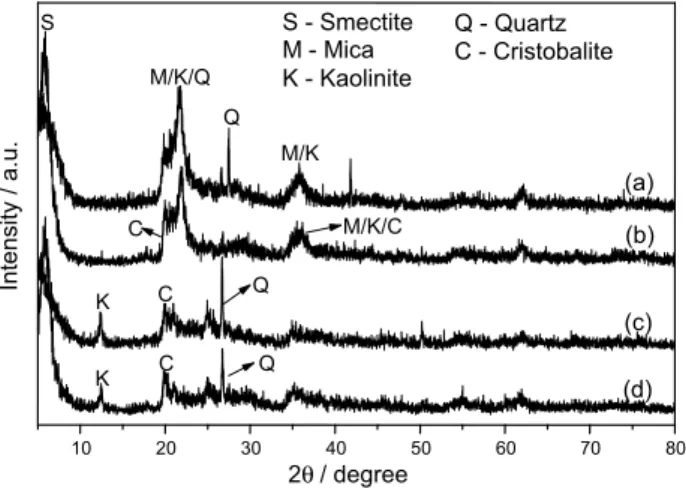
Figure 1 indicates the XRD patterns of the clays. As can be seen, the XRD shows a mixture of different minerals. The natural clays presented reflections at
14.9 Å (2θ = 5.9°), typical of smectite. The XRD analyses indicated that smectite is the dominant mineral in the two natural clays. The peaks at 2θ = 22.3° and 27.5° suggest the presence of quartz in the raw materials. Kaolinite (2θ = 12.5°), mica (2θ = 22.3°) and cristobalite (2θ = 20.8°) may also be present.
The characterization of smectite was confirmed by the expansion of the interlayer distance by treatment with ethylene glycol. A heat treatment at 550 °C was also used to check the collapse of the structure. The XRD analyses indicated a peak at 17.2 Å (2θ = 5.1°) after the first treatment and a breakdown to 10.3 Å (2θ = 8.5°) after heating.
XRD analyses of the acid-activated clays BBa and VLa revealed that the d(001) smectite peak at 2θ = 5.9° was of a lower intensity compared with the natural samples, suggesting a partial destruction of the crystalline phase of the clays after acid treatment.
Nitrogen adsorption isotherms for the samples are indicated in Figure 2. All of the isotherms exhibit stepwise adsorption and desorption (type IV isotherms), indicating a typical mesoporous structure. The textural data are displayed in Table 1 and indicate that the surface area increased dramatically with the acid treatment. The maximum BET surface area with the maximum pore size occurred in VLa (238 m2 g-1). The corresponding pore size
distributions indicate the presence of mesoporosity in the clays. The hysteresis loop observed in the isotherm can be classified as H4 type in the IUPAC system. This H4 hysteresis loop indicates that the structures are mesoporous, reinforcing the isotherm data.
The range of NH3 desorption temperatures for all of
the catalysts are provided in Table 2. Note that the values in mV presented in Table 2 for the intensity of the peaks have a direct relation to the amount of desorbed ammonia,
Figure 1. XRD diffraction patterns of clays: (a) BBa, (b) BBn, (c) VLa, (d) VLn.
Preparation, Characterisation and Evaluation of Brazilian Clay-Based Catalysts J. Braz. Chem. Soc.
1212
and thus with the quantity of acid sites. Although it is not possible to obtain an absolute value, these results allow us to compare the relative surface acidities of the different catalysts studied here. The clays presented two peaks, one at lower temperatures (200 to 300 °C), related to Bronsted or weaker Lewis acid sites, and another at higher temperatures (300 to 800 °C), related to strong acid sites. The intensity of both peaks was low, leading to the conclusion that the catalysts present few acidic sites. However, it is possible to conclude that the acid treatment of BBn had not increased the acidity of the sample and that the treatment of VLn increased the weak acid sites.
The thermodesorption of n-butylamine analysis
corroborate the NH3-TPD results. The data showed that
the acid treatment of VLn increased the weak acid sites but did not affect the number of moderate and strong sites. Moreover, the treatment of BBn slightly increases the weak acid sites. The number of acid sites as a function of temperature is summarized in Table 3.
The TGA and DTA profiles obtained for the different clays are indicated in Table 4 and Figure 3, respectively. The DTA of the raw material revealed an intense endothermic peak between 25 and 100 °C, accompanied
by a continuous loss of mass in the TGA. This peak can be attributed to the dehydration of the samples due to water molecules adsorbed in the interlayer or coordinated with exchangeable cations. The peak around 500 °C is a characteristic one and can be attributed to the loss of structural hydroxyls in iron-rich smectites. At 900 °C, a soft double endoexothermic peak appeared in the natural clays. The endothermic peak represents the destruction of the crystalline framework and structural dehydration, whereas the exothermic peak represents the formation of quartz. The TGA showed that the BBa clay is more thermally stable, losing only about 1% of its mass with increasing temperature.
The IR spectra of the clays are indicated in Figure 4. A strong band at 900-1300 cm-1 was assigned to asymmetric
stretching of Si−O and Al−O. For BBn was observed an absorption band at 790 cm-1 related to the SiO
4 vibrations
of non-structural silicates, which disappeared after the acid treatment. The most remarkable similarity between the natural clay spectra and those of the acid-activated clays were bands between 3700 and 3200 cm-1, which
can be related to structural OH− in kaolinite (bands from 3700 and 3600 cm-1), to free hydroxyl mode vibrations (at
3630 cm-1), and to hydroxyl hydrogen bond at 3420 cm-1,
and the vibrations of associated hydroxyl groups at 1640 cm-1.
Table 1. Textural properties of clays
Clays SBET / (m2 g-1) Pore diameter / Å
Pore volume / (cm3 g-1)
BBa 170 40.6 0.17
BBn 123 45.8 0.14
VLa 238 41.4 0.25
VLn 71 41.0 0.07
Table 2. Temperature ranges and peak intensity (NH3-TPD) Clays Temperature ranges / °C Peak intensity / mV
BBa 200-300 and 300-800 6 and 11 BBn 200-300 and 300-800 8 and 11
VLa 200-350 and 350-800 15 and 8 VLn 200-300 and 300-800 6 and 13
Table 3. Number of acid sites (mmol g-1 clay) per range of temperature Clays 50-150 °C 150-350 °C 350-500 °C
BBa 0.29 0.31 0.45
BBn 0.18 0.26 0.43
VLa 0.61 0.40 0.74
VLn 0.27 0.39 0.78
Table 4. Loss of mass from the TGA curves
Temperature ranges / °C
Clays
BBn BBa VLn VLa
25-100 4.5% 1.0% 5.0% 4.5%
100-600 3.5% - 7.5% 3.5%
600-1000 1.5% - 1.0% 1.0%
Catalysts performance in esterification
The catalytic performance of BBn, VLn, BBa and VLa was investigated in the esterification of several carboxylic acids with different alcohols. The purpose was to evaluate the versatility of the acid-activated clays as catalysts in the synthesis of esters from carboxylic acids and alcohols with different chemical structures. The montmorillonite K10, a commercial catalyst produced by the acid treatment of raw clay,32 was also used. The reactions were performed at
atmospheric pressure, and neither a Dean-Stark apparatus nor a co-solvent was used. The duplicates presented a difference from 0.5 to 4% of conversion. The average results are summarised in Table 5.
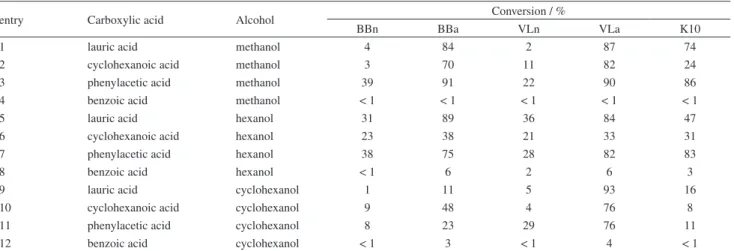
The acid activation treatment markedly increased the catalytic activities of the clays. The conversion of lauric, cyclohexanoic and phenylacetic acids to their methyl esters
was higher using BBa or VLa than with BBn or VLn. BBa and VLa also exhibited better results than did the commercial clay K10. Benzoic acid underwent no conversion under similar conditions. The selectivity of the esterification of aliphatic carboxylic acid using Fe3+-K-10 montmorillonite
has been demonstrated by Srinivas and Das.23
With the exception of the esterification of phenylacetic acid (wherein the two catalysts promoted the same conversion, ca. 90%), VLa presented slightly higher
conversions to methyl esters than did BBa. These values can be attributed to the greater specific area and pore volume of the VLa catalyst. Both the natural and activated clays promoted the esterification of phenylacetic acid with methanol more efficiently than those of other carboxylic acids. This result may be associated with the presence of methylene in the phenylacetic acid structure, allowing the carboxyl group to rotate. This rotation increases the probability of access to the catalytic site in the clay.
The acid activation allows the esterification of phenylacetic acid with hexanol and cyclohexanol at high conversion rates. The reactions with these alcohols were carried out without cooled water circulation in the reflux condenser, which can help evaporate the water produced by the reaction. Even so, the results indicated a slightly reduced conversion to esters. This observation can be attributed mainly to steric effects.
BBn provided a slightly better conversion rate in the synthesis of methyl phenylacetate and hexyl phenylacetate than did VLn. This result is consistent with the characterisation data, which indicated that the latter has a lower specific area and less pore volume. After the acid treatment, VLa presented higher specific area and more pore volume than BBa. This difference between the textural properties of the two acid-activated clays could explain the higher conversion
Figure 4. Infrared spectra of the studied clays: (a) BBa, (b) BBn, (c)
VLa, (d) VLn.
Table 5. Esterification of different carboxylic acids with various alcohols
entry Carboxylic acid Alcohol Conversion / %
BBn BBa VLn VLa K10
1 lauric acid methanol 4 84 2 87 74
2 cyclohexanoic acid methanol 3 70 11 82 24
3 phenylacetic acid methanol 39 91 22 90 86
4 benzoic acid methanol < 1 < 1 < 1 < 1 < 1
5 lauric acid hexanol 31 89 36 84 47
6 cyclohexanoic acid hexanol 23 38 21 33 31
7 phenylacetic acid hexanol 38 75 28 82 83
8 benzoic acid hexanol < 1 6 2 6 3
9 lauric acid cyclohexanol 1 11 5 93 16
10 cyclohexanoic acid cyclohexanol 9 48 4 76 8
11 phenylacetic acid cyclohexanol 8 23 29 76 11
12 benzoic acid cyclohexanol < 1 3 < 1 4 < 1
Preparation, Characterisation and Evaluation of Brazilian Clay-Based Catalysts J. Braz. Chem. Soc.
1214
achieved by VLa because the NH3-TPD analyses and the
thermodesorption of n-butylamine results did not indicate
a substantial difference in acidity between these catalysts. As with the esterifications with methanol, hexyl benzoate and cyclohexyl benzoate were obtained in limited quantities, even when using the acid-activated clays.
The natural clays performed better in the formation of hexyl esters than cyclohexyl esters. The low conversion rates for cyclohexyl esters could be attributed to steric effects induced by the catalyst. Relative to primary alcohols, it is more difficult for a secondary cyclic alcohol to access the mesoporous system of a smectite.
BBa and VLa were very active for the esterification of lauric acid with hexanol (89% and 84%) and for that of phenylacetic acid with the same alcohol (75% and 82%). In the esterification of cyclohexanoic acid with hexanol, the acid-activated clays afforded conversions close to those of the natural clays. This result could be attributed to sterically hindered access of hexanol to the electrophilic site of cyclohexanoic acid.
The esterification of carboxylic acids with cyclohexanol was catalysed more efficiently by BBa and VLa than by BBn or VLn. Moreover, the VLa catalyst provided better conversions of cyclohexyl esters than did BBa. The VLa provided better catalytic performance than did K10 for all of the esterifications assessed in this study.
It was not done a mechanistic study on the esterification using the clays as catalysts. However, we assume that the mechanism involved is probably similar those proposed by our group in other works involving Bronsted or Lewis acid transesterification, esterification or hydrolysis.5,6,8,9,33
Conclusions
Two Brazilian clays mainly composed by smectite were acid activated without any previous treatment. The acid treatment significantly increased the surface area of the materials without changing their surface acidity. The catalytic activity of the clays for esterification was strongly enhanced after acid treatment. The acid-activated clays exhibited high efficiency even when the by-product (water) was not removed. These catalysts show potential use as catalyst for the esterification of multiple carboxylic acids with various alcohols, mainly because smectite is cheap and abundant in Brazil.
Supplementary Information
Supplementary information (Figures S1-S16, Table S1-S2) is available free of charge at http://jbcs.sbq.org.br as a PDF file.
Acknowledgments
The authors thank CAPES and CNPq (Brazil) for financial support and research fellowships. The authors also wish to thank Bentonisa-Bentonita do Nordeste S.A. for providing the natural clay samples.
References
1. Yadav, G. D.; Rahuman, M. S. M. M.; Org. Process Res. Dev.
2002, 6, 706.
2. Bondioli, P.; Top. Catal.2004, 27, 77.
3. Alvaro, M.; Corma, A.; Das, D.; Fornés, V.; García, H.; J. Catal.
2005, 231, 48.
4. Mbaraka, I. K.; Shanks, B. H.; J. Catal.2005, 229, 365. 5. Brandão, R. F.; Quirino, R. L.; Mello, V. M.; Tavares, A. P.;
Peres, A. C.; Guinhos, F.; Rubim, J. C.; Suarez, P. A. Z.;
J. Braz. Chem. Soc.2009, 20, 954.
6. Mello, V. M.; Pousa, G. P. A. G.; Pereira, M. S. C.; Dias, I. M.; Suarez, P. A. Z.; Fuel Process. Technol.2010, 92, 53.
7. Furuta, S.; Matsuhashi, H.; Arata, K.; Catal. Commun.2004,
5, 721.
8. Neto, B. A. D.; Alves, M. B.; Lapis, A. A. M.; Nachtigall, F. M.; Eberlin, M. N.; Dupont, J.; Suarez, P. A. Z.; J. Catal.2007,
249, 154.
9. Brito, Y. C.; Mello, V. M.; Macedo, C. C. S.; Meneghetti, M. R.; Suarez, P. A. Z.; Meneghetti, S. M. P.; Appl. Catal., A2008,
351, 24.
10. Vaccari, A.; Appl. Clay Sci.1999, 14, 161. 11. Varma, R. S.; Tetrahedron2002, 58, 1235.
12. Cornélis, A.; Gerstmans, A.; Laszlo, P.; Mathy, A.; Zieba, I.;
Catal. Lett.1990, 6, 103.
13. Laszlo, P.; Montaufier, M. T.; Randriamahefa, S. L.; Tetrahedron Lett.1990, 31, 4867.
14. Choudary, B. M.; Rao, B. P. C.; Chowdari, N. S.; Kantam, M. L.;
Catal. Commun. 2002, 3, 363.
15. Kou, M. R. S.; Mendioroz, S.; Salerno, P.; Muñoz, V.; Appl. Catal., A.2002, 6337, 1.
16. Varma, R. S.; Dahiya, R.; Tetrahedron Lett.1997, 38, 2043. 17. Ribeiro, N. M.; Pinto, A. C.; Violante, F. A.; Dias, M. O.; Silva,
B. V.; Catal. Commun.2007, 8, 2130.
18. Collet, C.; Laszlo, P.; Tetrahedron Lett.1991, 32, 2905.
19. Ponde, D.; Borate, H. B.; Sudalai, A.; Ravindranathan, T.; Deshpande, V. H.; Tetrahedron Lett.1996, 37, 4605.
20. Lei, Z.; Zhang, Q.; Luo, J.; He, X.; Tetrahedron Lett.2005, 46, 3505.
21. Silva, F. C.; Souza, M. C. B. V.; Ferreira, V. F.; Sabino, S. J.; Antunes, O. A. C.; Catal. Commun.2004, 5, 151.
22. Kantam, M. L.; Bhaskar, V.; Choudary, B. M.; Catal. Lett.2002,
78, 185.
24. Kawabata, T.; Mizugaki, T.; Ebitani, K.; Kaneda, K.;
Tetrahedron Lett.2003, 44, 9205.
25. Reddy, C. R.; Vijayakumar, B.; Iyengar, P.; Nagendrappa, G.; Prakash, B. S. J.; J. Mol. Catal. A: Chem.2004, 223, 117.
26. Reddy, C. R.; Iyengar, P.; Nagendrappa, G.; Prakash, B. S. J.;
Catal. Lett. 2005, 101, 87.
27. Neji, S. B.; Trabelsi, M.; Frikha, M. H.; Energies2009, 2, 1107. 28. Bhorodwaj, S. K.; Dutta, D. K.; Appl. Catal., A2010, 378, 221.
29. Foletto, E. L.; Volzone, C.; Morgado, A. F.; Porto, L. M.;
Ceramica2001, 47, 208.
30. Pinto, A. C.; Oliveira, C. H.; Ribeiro, N. M.; Quim. Nova2008,
31, 562.
31. Faria, R. C. M.; Rezende, M. J. C.; Rezende, C. M.; Pinto, A. C.;
Quim. Nova2007, 30, 1900.
32. Flessner, U.; Jones, D. J.; Rozière, J.; Zajac, J.; Storaro, L.; Lenarda, M.; Pavan, M.; Jiménez-López, A.; Rodríguez-Castellón, E.; Trombetta, M.; Busca, G; J. Mol. Catal. A: Chem.
2001, 168, 247.
33. Alves, M. B.; Medeiros, F. C. M.; Suarez, P. A. Z.; Ind. Eng. Chem. Res.2010, 49, 7176.
Submitted: July 28, 2011
Supplementary Information
S
I
J. Braz. Chem. Soc., Vol. 23, No. 7, S1-S7, 2012. Printed in Brazil - ©2012 Sociedade Brasileira de Química 0103 - 5053 $6.00+0.00
*e-mail: [email protected]
Preparation, Characterisation and Evaluation of Brazilian Clay-Based Catalysts for
use in Esterification Reactions
Michelle J. C. Rezende,*,a Mírian S. C. Pereira,b Gabriel F. N. Santos,b Gabriel O. P. Aroeira,a Tiago C. Albuquerque Jr.,a Paulo A. Z. Suarezb and Angelo C. Pintoa
aInstituto de Química, Universidade Federal do Rio de Janeiro, Cidade Universitária,
CT, Bloco A, 21941-909 Rio de Janeiro-RJ, Brazil
bInstituto de Química, Universidade de Brasília, Campus Universitário Darcy Ribeiro,
CP 4478, 70904-970 Brasília-DF, Brazil
Data for calculation of the response factors of acids and esters standards
Figure S1. Chromatogram of lauric acid (tR 10.4 min) and internal standard (tR 7.5 min).
Figure S3. Chromatogram of hexyl laurate (tR 5.2 min) and internal standard (tR 5.6 min).
Figure S5. Chromatogram of phenylacetic acid (tR 11.1 min) and internal standard (tR 7.3 min).
Figure S4. Chromatogram of cyclohexyl laurate (tR 8.4 min) and internal standard (tR 7.4 min).
Rezende et al. S3 Vol. 23, No. 7, 2012
Figure S7. Chromatogram of hexyl phenylacetate (tR 4.4 min) and internal standard (tR 5.4 min).
Figure S9. Chromatogram of benzoic acid (tR 6.9 min) and internal standard (tR 5.5 min).
Figure S8. Chromatogram of cyclohexyl phenylacetate (tR 11.9 min) and internal standard (tR 12.0 min).
Figure S11. Chromatogram of hexyl benzoate (tR 3.8 min) and internal standard (tR 5.5 min).
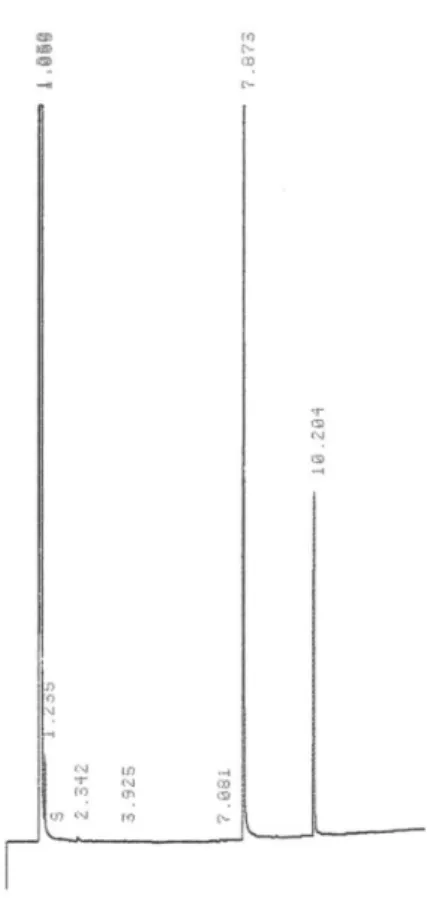
Figure S13. Chromatogram of cyclohexanoic acid (tR 7.9 min) and internal standard (tR 10.2 min).
Figure S12. Chromatogram of cyclohexyl benzoate (tR 4.5 min) and internal standard (tR 5.2 min).
Rezende et al. S5 Vol. 23, No. 7, 2012
Figure S15. Chromatogram of hexyl cyclohexanoate (tR 4.5 min) and internal standard (tR 8.8 min).
Table S1. Data for calculation of the response factors of acids and esters standards
Standard SArea SConc ISArea ISConc FR FR
lauric acid 218841 1020 83333 268 0.690 0.684
lauric acid 216720 1020 83928 268 0.678
methyl laurate 492794 1040 71675 268 1.772 1.758
methyl laurate 539675 1040 79744 268 1.744
cyclohexyl laurate 412109 1630 77671 268 0.872 0.876
cyclohexyl laurate 506955 1630 94774 268 0.879
hexyl laurate 323411 1330 107778 238.5 0.538 0.534
hexyl laurate 368092 1330 124750 238.5 0.529
phenylacetic acid 384842 1620 136902 248 0.430 0.421
phenylacetic acid 378276 1620 140893 248 0.411
methyl phenylacetate 438196 1410 156421 248 0.493 0.509
methyl phenylacetate 366980 1410 122895 248 0.525
cyclohexyl phenylacetate 1366540 1710 144943 248 1.367 1.375
cyclohexyl phenylacetate 1394862 1710 146311 248 1.383
hexyl phenylacetate 904087 1670 122677 239 1.055 1.054
hexyl phenylacetate 927589 1670 126073 239 1.053
cyclohexanoic acid 412674 1340 108036 265.5 0.757 0.727
cyclohexanoic acid 372292 1340 105803 265.5 0.697
methyl cyclohexanoate 728707 1940 112690 265.5 0.885 0.913
methyl cyclohexanoate 596780 1940 86712 265.5 0.942
cyclohexyl cyclohexanoate 891191 1630 159304 238.5 0.818 0.827
cyclohexyl cyclohexanoate 1070347 1630 187300 238.5 0.836
hexyl cyclohexanoate 2038730 2870 167994 241 1.019 1.021
hexyl cyclohexanoate 1993908 2870 163741 241 1.022
benzoic acid 262536 960 98661 265.5 0.736 0.756
benzoic acid 249880 960 89095 265.5 0.776
methyl benzoate 263392 940 92042 265.5 0.808 0.806
methyl benzoate 279626 940 98359 265.5 0.803
cyclohexyl benzoate 640039 1850 104871 238.5 0.787 0.785
cyclohexyl benzoate 568059 1850 93466 238.5 0.783
hexyl benzoate 874892 1630 116861 239 1.098 1.101
hexyl benzoate 863688 1630 114751 239 1.104
Rezende et al. S7 Vol. 23, No. 7, 2012
Table S2. Oven temperature program used on GC-FID analyses
Product Oven temperature program tR / min
acid ester IS
methyl phenylacetate 140 °C to 180 °C at 10 °C min-1 followed by 180 °C to 220 °C at 3 °C min-1 8.7 3.0 5.4 hexyl phenylacetate 140 °C to 180 °C at 10 °C min-1 followed by 180 °C to 220 °C at 3 °C min-1 8.7 4.4 5.4 cyclohexyl phenylacetate 5 min at 140 °C followed to 180 °C at 8 °C min-1. After 3 min at 180 °C followed
to 220 °C at 3 °C min-1
17.6 11.9 12.0
methyl laurate 140 °C to 180 °C at 10 °C min-1 followed by 180 °C to 220 °C at 3 °C min-1 8.1 1.4 5.5 hexyl laurate 140 °C to 180 °C at 10 °C min-1 followed by 180 °C to 220 °C at 3 °C min-1 8.1 5.1 5.5
cyclohexyl laurate 140 °C to 180 °C at 10 °C min-1 followed by 180 °C to 220 °C at 3 °C min-1 8.1 8.4 5.5 methyl benzoate 140 °C to 180 °C at 10 °C min-1 followed by 180 °C to 220 °C at 3 °C min-1 6.9 1.5 5.2 hexyl benzoate 140 °C to 180 °C at 10 °C min-1 followed by 180 °C to 220 °C at 3 °C min-1 6.9 3.8 5.5
cyclohexyl benzoate 140 °C to 180 °C at 10 °C min-1 followed by 180 °C to 220 °C at 3 °C min-1 6.9 4.5 5.2 methyl cyclohexanoate 100 °C to 180 °C at 10 °C min-1 followed by 180 °C to 200 °C at 3 °C min-1 6.9 1.5 9.0