Anti-Corrosive Effect of Tridax Procumbens
–
Zn
2+System
Controlling the Corrosion of Carbon Steel
C. Kumar
1, R. Mohan
2, A. John Amalraj
3, A. Peter Pascal Regis
4, C.
Rajarathinam
4, S.K. Selvaraj
5, Sakthivel
6and J. Wilson Sahayaraj
71
Bharathiar Matric higher secondary school, Elumalai, Madurai - 625535, Tamil Nadu, India.
2
Department of Chemistry, Surya Polytechnic College, Villupuram - 605652, Tamil Nadu, India.
3
PG and Research Department of Chemistry, Periyar E.V.R college (Autonomous), Trichy - 620023, Tamil Nadu, India.
4PG and Research Department of Chemistry, St.Joseph’s College (Autonomous), Trichy
- 620002, Tamil Nadu, India.
5
PG and Research Department of Chemistry, GTN Arts College, Dindigul-624 005, Tamilnadu, India.
6
Tamil Nadu Pollution control Board, Dindugal-624003, Tamil Nadu, India.
7
Department of Chemistry, Jeppiaar Engineering College, Chennai- 600119, Tamil Nadu, India.
ABSTRACT
The corrosion inhibition efficiency (IE) of an aqueous extract Tridax Procumbens(TP) in controlling the corrosion of carbon steel aqueous medium containing 60 ppm of chloride ions in absence and presence of Zn2+ has been studied by weight loss method. The formulation consisting of 1 ml of Tridax Procumbens extract and 150 ppm of Zn2+ offers 96% inhibition efficiency. The synergistic effect exists between Tridax Procumbens and Zn2+ system. Polarization study shows that the Tridax Procumbens – Zn2+ system function as a cathodic inhibitor. AC impedance spectra reveal that a protective film formed on the surface. The Adsorption equilibrium exhibited better fit to Langmuir isotherm than Freundlich isotherm. FTIR spectra reveal that the protective film consists of Fe2+-Tridax Procumbens and Zn(OH)2.
Key Words : Carbon steel, Tridax Procumbens, Corrosion inhibitor, Inhibition efficiency, protective film.
I.
INTRODUCTION
Corrosion is a natural phenomenon involving the reversion from metallic to compound state. The corrosion occurs because of the natural tendency for most metals to return to their natural state. It cannot be avoided, but it can be controlled and prevented using the suitable preventive measures such as alloying, cathodic protection, anodic protection, protective coating and application of inhibitors, etc. Among all these techniques inhibitors reduce the aggressiveness of the corrosive environment and forming a protective layer on the metal surface thereby the metal and alloys are prevented from corrosion One way of protecting metal from corrosion is to use corrosion inhibitors. Corrosion inhibitors are widely used in industry to reduce the corrosion rate of metals and alloys in contact with aggressive environment. Most of the corrosion inhibitors are synthetic chemicals, expensive and very hazardous to environment. Therefore, it is desirable to source for environmentally safe inhibitors [1–4]. It has been shown that natural products of plant origin contain different organic compounds (e.g., alkaloids, tannins, pigments, and organic and amino acids, and most are known to have inhibitive action [5, 6]). The aqueous
extracts from different parts of some plants such as Henna, Lawsonia inermis [7], Rosmarinous officinalis L. [8], Carica papaya [9], cordia latifoliaand curcumin [10], date palm, phoenix dactylifera, henna, lawsonia inermis, corn, Zea mays [11], Atropa Belladonna Extract[12] and Nypa Fruticans Wurmb [13] have been found to be good corrosion inhibitors for many metals and alloys.
Recently, an excellent review about “natural products as corrosion inhibitors for metals in corrosive media”
has been published [14]. So the less toxic inhibitors such as molybdate, sodium gluconate, citrate, amino acids, and green inhibitors like seed, stem, flower of plant extracts are being used as corrosion inhibitors. So the research is focus on Tridax Procumbens as corrosion inhibitors.
The present work is undertaken:
1. To evaluate the inhibition efficiency (IE) of an aqueous extract Tridax Procumbens (TP) in controlling the corrosion of carbon steel in aqueous medium containing 60 ppm of chloride ions in the absence and presence of Zn2+
2. To analysis the protective film formed on the carbon steel by FTIR spectra.
3. To understand the mechanistic aspects of corrosion inhibition by polarization studies and AC impedance analysis
4. To analysis the protective film formed on the carbon steel by Langmuir and Freundlich isotherm
5. To propose a suitable mechanism for corrosion inhibition.
II.
EXPRIMENTAL
II.1. Preparation of plant extract
An aqueous extract of Tridax-procumbens was prepared by grinding 50g of Tridax-procumbens with double distilled water, filtering the suspending impurities, and making up to 500ml. The extract was used as corrosion inhibitor in the present study.
II.2. Preparation of the specimen
Carbon steel (0.026%S, 0.06%P, 0.4%Mn, 0.1% C, and the rest Fe) specimen of dimension 1 cm x 4 cm x 0.2 cm were used for weight loss study. Carbon steel rod of the same composition, encapsulated in Teflon was polished to a mirror finish and degreased with trichloroethylene.
II.3. Weight loss method
Carbon steel specimens in triplicate were immersed in 100 ml of distilled water containing 60 ppm of chloride ions with test solution containing various concentrations of the inhibitors, in the absence and presence of and Zn2+ ions, for a period of three days. The weight of the specimens before and after immersion was determined using Shimadzu balance, AY62 model. The corrosion products were
cleansed with Clarke’s solution[15]. From the change in weight of the specimens, corrosion rates were calculated with the help of the following relationship:
where
CR - corrosion rate
Δm - loss in weight (mg)
A - surface area of the specimen (dm2) t - period of immersion (days)]
The inhibition efficiency (IE) was then calculated using the equation
Where W1 and W2 are the corrosion rates in the
absence and presence of the inhibitor, respectively.
II.4.Polarization study
Polarization studies were carried out in on H&CH electrochemical work station impedance analyzer model CHI 660A. A three electrode cell assembly was used. The working electrode was
carbon steel. A saturated calomel electrode (SCE) was used as the reference electrode and a rectangular platinum foil was used as the counter electrode. According to the stern-Geary equation, the steps of the linear polarization plot are substituted to get corrosion current
Icorr = ba × bc / 2.303 (ba + bc) Rp
Where Rp is polarization resistance.
II.5. AC impedance study
The instrument used polarization was also used for AC impedance study. The cell set up was the same as that used for polarization measurements. The real part and imaginary part of the cell impedance were measured in ohms at various frequencies. The values of charge transfer resistance(Rt) and the
double layer capacitance(Cdl)were calculated.
Rt = (Rs + Rt) - Rs
Where, Rs = solution resistance
Cdl = ½ Rt fmax
Where, fmax = maximum frequency
II.6. Surface examination
The carbon steel specimens were immersed in various test solutions for a period of Three days, taken out and dried. The nature of the film formed on the surface of metal specimens was analyzed by FTIR spectroscopic and adsorption studies.
II.7. Surface coverage area
1/θ = θ/1-θ, 1/C-θ
C/θ = C/1-θ/θ.B
Where, θ =surface coverage area of metal ion
solution at equilibrium,
C = equilibrium concentration of the metal ion, 1-θ = rate of adsorption,
B = constant related to the energy of adsorption.
II.7.1. Langmuir Adsorption isotherm model The Langmuir model was developed based on assumption of the formation of a monolayer of the metal ion solution onto the surface of the Tridax Procumbens, It has also been assumed that surface sites are completely heterogeneous. The study of Langmuir isotherm is essential in assessing the adsorption efficiency of the Tridax Procumbens. In this regard the Langmuir isotherm is important, through the restriction and the limitation if this model has been well recognized.
II.7.2. Freundlich Adsorption isotherm Model The Freundlich isotherm is the earliest known relationship describing the sorption equation. The fairly satisfactory empirical isotherm can be used for non-ideal sorption that involves heterogeneous surface energy system and is expressed by the following equation
2
100 1 (2)
1 W IE
W
IE = KFTP 1/n
Where KF is roughly an indicator of the
adsorption capacity and 1/n is the adsorption intensity. The essential characteristics of Langmuir and freundlich isotherm can be expressed in terms of dimension less constant, separate ion factor or equilibrium parameter RL, which is defined by RL =
Co / 1+bCo is the initial metal ion concentration and b
is the Langmuir constant the parameter indicates the shape of isotherm as follows.
RL Types of isotherm RL > 1 Unfavorable
RL =1 Linear
0< RL < 1 Favorable
RL = 0 Irreversible
The applicability of Langmuir and Freundlich model to then chosen metal ion solution system was studied in the present work.
II.8. FTIR spectra
FTIR spectra were recorded in a Perkin – Elmer 1600 spectrophotometer. The film was carefully removed, mixed thoroughly with KBr made in to pellets and FTIR spectra were recorded.
III.
RESULTS
AND
DISCUSSION
III.1. Analysis of Results of Mass Loss Method The corrosion inhibition efficiency of carbon steel immersed in an aqueous solution containing 60 ppm of chloride ions in the absence and presence of inhibitor systems are given in Table 1 and Table 2. It is seen from Table 1. that the aqueous extract of Tridax Procumbens (TP) alone is good inhibitor. As concentration TP increases, IE slightly increases. That is at higher concentrations, TP accelerates corrosion. For example 1 ml of TP shows -1% IE; But addition of 150 ppm of Zn2+ with Tridax Procumbens (TP) shows 96% IE. This suggests that a synergistic effect exists between TP – Zn2+ system[16].
Table 1. Corrosion inhibition efficiency (IE) of
carbon steels in 60 ppm Chloride solution in the presence of inhibitor obtained by weight loss method. Inhibitor system : TP- Zn2+ system.
Table 2. Corrosion inhibition efficiency (IE) of
carbon steels in 60 ppm Chloride solution in the presence of inhibitor obtained by weight loss method. Inhibitor system : TP- Zn2+ system.
III.2. Influence of TP on the inhibition efficiency with Zn2+ system
The influence of TP on the inhibition efficiency with Zn2+ system is given Table 2. When various concentration of TP added to the TP –Zn2+ system, the inhibition efficiency does not altered. The Zn2+ - TP systems are much transported towards the metal surface, hence protective film is stable.
III.3. Polarization curves
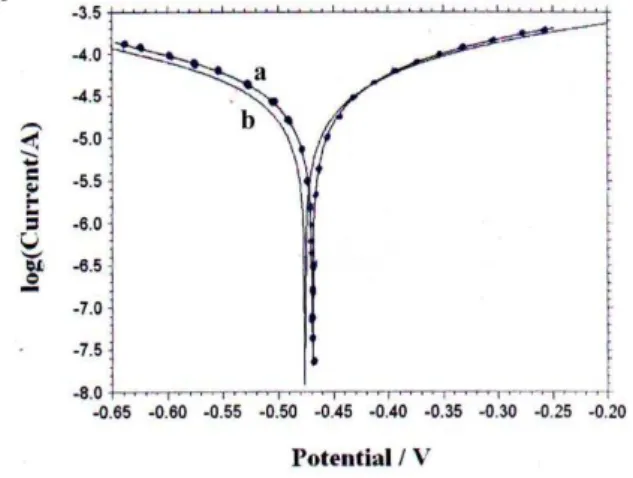
The polarization curves of carbon steel immersed in various test solution are shown in Figure 1. The corrosion parameters such as corrosion potential (Ecorr), corrosion current (Icorr), Tafel slopes
(ba and bc) and Linear polarization resistance (LPR)
given in the Table 3.
Figure 1 polarization curves of carbon steel immersed in various test solution
(a) Aqueous solution contains 60 ppm Cl- (b) 150 ppm of Zn2+ + 1 ml of TP
S.No. TP Extract
ml
Zn2+ 0 (ppm)
Zn2+ 50 (ppm))
Zn2+ 100 (ppm)
Zn2+ 150 (ppm)
IE% IE% IE% IE%
1 0 - 3 5 9
2 1 -1 -23 16 96
3 2 07 01 40 81
4 3 08 05 37 75
5 4 17 07 47 88
6 5 14 44 65 89
7 6 26 54 71 93
S.No. TP
Extract ml
Zn2+ (ppm)
IE %
1 0 - -
2 1 150 96
3 2 150 96
4 3 150 96
5 4 150 96
6 5 150 96
Table 3. Corrosion parameter of carbon steel immersed in 60 ppm Chloride solution in the absence and presence of inhibitors
When carbon steel immersed in aqueous solution containing 60 ppm Cl- ions, the corrosion potential is -469 mv vs SCE. The formulation consisting of 150 ppm of Zn2+ and 1 ml of TP has corrosion potential of -476 mv vs SCE. The corrosion potential shift is very small. The Tafel slopes ba and
bc for the system are almost equal (531mv/decade
and 494 mv/decade). These results suggest that TP -Zn2+ system formulation functions as mixed inhibitor but it is controlled predominately as the cathodic reaction.
The formation of protecting film on the metal surface is further supported by the fact that the linear polarization resistance (LPR) value increases
from 1317 Ω cm2 to 1509 Ω cm2
. The corrosion current decreases from 3.22× 10⁻⁵ A/cm2 to 2.81× 10
-5
A/cm2. Thus the polarization study confirms the formation of protecting film on the metal surface[17]
III.4. Analysis of AC impedance spectra
The AC impedance spectra of carbon steel immersed in various test solution and shown in Figure 2. The AC impedance parameters namely, charge transfer resistance(Rt) and the double layer
capacitance(Cdl) are given in the Table 4.
Figure 2. AC impedance of carbon steel immersed in various test solution
(a) Aqueous solution contains 60 ppm Cl- (b) 150 ppm of Zn2+ + 1 ml of TP
When carbon steel immersed in aqueous solution containing 60 ppm Cl- ions, the Rt value is
found to be 729 Ωcm2
. The Cdl value is 5.828X10⁻⁷
F/cm2. When 150 ppm of Zn2+ and 1 ml of TP are added, the Rtvalue increased from 729 to 1130 Ωcm2
and the Cdl value has decreased from 5.828X10⁻⁷ to
2.443X10⁻⁷ F/cm2.The increase in Rt values obtained
from impedance studies justify the good performance of a compound as an inhibition in aqueous medium. This behaviour means that the film obtained act as a barrier to the corrosion process that clearly proves the formation of the film[18].
Table 4. AC impedance parameters of carbon steel immersed in 60 ppm Chloride solution in the absence and presence of inhibitors.
III.5. Langmuir adsorption isotherm Model The Langmuir adsorption model is based on the assumption that maximum adsorption corresponds to the saturated monolayer of Langmuir equation can be described by
C/θ = 1/θ.B + (1/θ)
Where C is the equilibrium concentration
of the metal ion solution, θ is the surface coverage
area of the metal ion, B is the Langmuir constant related to adsorption capacity and rate of adsorption, respectively. The linear plot of specific adsorption
C/θ against the equilibrium concentration (C) Figure
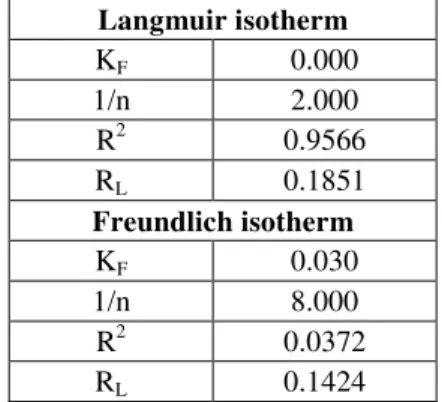
3. Shows that the adsorptions obey the Langmuir model. The Langmuir constant B were determined from the slope and intercept of the plot and are presented in Table 5. The R2 values (0.9566) suggest that the Langmuir isotherm provides a good fit to the isotherm data
Figure 3.Langmuir isotherm for Zn2+ Solution on to Tridax Procumbens
P (ml)
Zn2+ ppm
Ecorr mv vs SCE
ba mv/ decade
bc mv/ decade
LPR cm2
Icorr A/ cm2
0 0 -469 529 494 1317 3.22×
10-5
1 150 -476 531 494 1509 2.81× 10⁻⁵
TP (ml)
Zn2+ ppm
Rt
cm2
Cdl F/cm2
0 0 729 5.828x 10⁻⁷
The essential characteristics if the Langmuir isotherm can be expressed in terms of a dimensionless constant separation factor RL given by
the equation
RL = 1/1+bco
Where C0 is the highest initial concentration of
Tridax Procumbens and b is Langmuir constant.The parameter RL, indicates the nature of shape of
isotherm accordingly.
Table 5. Langmuir Isotherm for Zn2+ Solution on Tridax Procumbens
III.6. Freundlich adsorption isotherm Model The Freundlich isotherm (Table 6) is the earliest known relationship describing the sorption equation.
Table 6.Freundlich isotherm for Zn2+ solution on Tridax Procumbens
The fairly satisfactory empirical isotherm can be used for non-ideal sorption that involves heterogeneous surface energy system and is expressed by the following equation
IE = KFTP1/n
Where KF is roughly an indicator of the adsorption
capacity and 1/n is the adsorption intensity. In general as the KF value increases the adsorption
capacity of Tridax Procumbens. Value n>1 represent favourable adsorption condition[19]. The Linear form of equation is given below
log IE% = log KF + (1/n) log TP
Values of KF and n are calculated from the intercept
and slope of the plot Figure 4. and are listed in Table 7. The R2 value (0.0372) is lower than Langmuir isotherm.
Figure 4.Freundlich isotherm for Zn2+ solution on to Tridax Procumbens
Table 7. Langmuir and Freundlich isotherm constant and correlation Co-efficient for Adsorption of Zn2+ Solution Concentration
Langmuir isotherm
KF 0.000
1/n 2.000
R2 0.9566
RL 0.1851
Freundlich isotherm
KF 0.030
1/n 8.000
R2 0.0372
RL 0.1424
The best equilibrium model is determined based linear square regression correlation co-efficient R2 from Figure 5, It was observed that the equilibrium sorption data were very best fit isotherm expression conform the monolayer coverage process of Tridax Procumbens on to Zn2+.
III.7. Analysis of FTIR spectra
The active component present in Tridax Procumbens is shown in scheme 1.
Scheme 1
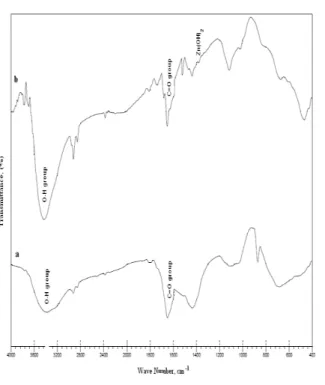
A few drops of an aqueous extract of aqueous extract of Tridax Procumbens(TP) was dried on a glass plate. A solid mass was obtained. Its spectrum is shown in figure 5a. The peak at 3385 cm
-1
corresponds to -OH Stretching frequency, the peak at 1651 cm-1 corresponds to >C=O Stretching frequency.
Zn2+ ppm
TP
(ml) ln C
/1 -
ln /1
-
CR
150 1 0.0 0.96 24.00 3.18 0.90 150 2 0.7 0.81 4.26 1.45 05 150 3 1.1 0.75 3.00 1.10 07 150 4 1.4 0.88 7.33 1.99 03 150 5 1.6 0.89 8.09 2.09 03 150 6 1.8 0.93 13.29 2.59 01
Zn2+ (ppm)
TP (ml)
IE %
CR (mdd)
log
TP log IE %
150 1 96 0.90 0.00 1.98
150 2 81 05 0.30 1.91
150 3 75 07 0.48 1.88
150 4 88 03 0.60 1.94
150 5 89 03 0.70 1.95
Figure 5. FTIR spectrum of various test solution (a) Pure TP
(b) Film formed on carbon steel after immersion of test solution containing 150 ppm of Zn2+ + 1ml TP
FTIR spectrum of thin film formed on the metal surface, after the immersion in 150 ppm of Zn2+ and 1 ml of TP solution in shown in figure 5b. The –OH stretching frequency shifted from 3385 cm
-1
to 3426 cm-1, and the >C=O stretching frequency shifted from 1651 cm-1 to 1653 cm-1.This indicates that the oxygen atom of carbonyl group has coordinated with Fe2+-TP complex on the anodic sites of the metal surface. The peak at 1381 cm-1 due to the Zn(OH)2 formed on the cathodic sites. The FTIR
spectrum confirmed that the protective film consist of Fe2+-TP complex and Zn(OH) 2 on the metal
surface[20,21].
IV.
MECHANISM
The weight – loss study reveals that the formulation consisting of 150 ppm of Zn2+ and 1ml of Tridax Procumbens has 96 % inhibition efficiency. The FTIR spectrum reveals that the protective film consist of Fe2+ - TP complex and Zn(OH)2.
In order to explain the above observations, the following mechanism of corrosion inhibition is proposed[21].
1. When the environment consisting of 150ppm of Zn2+ and 1ml of TP is prepared, there is a formation of Zn2+ -TP complex.
2. When Carbon steel is introduced in this solution there is diffusion of Zinc complex towards the metal surface.
3. On the metal surface Zinc complex is converted into iron complex on the anodic site.
Zn2 -TP+ Fe2+ Fe2+ - TP+ Zn2+ 4. The released Zn 2+ combined with OH- to form
Zn(OH)2 on the cathodic Sites.
Zn2+ + 2OH- Zn(OH)2
5. Thus protective film consists of Fe2+ - TP and Zn(OH)2.
V.
CONCLUSION
The present study leads to the following conclusions:
The formulation consisting of 1 ml Tridax Procumbens extract and 150 ppm of Zn2+ offers 96% inhibition efficiency;
The synergistic effect exists between Tridax Procumbens – Zn2+ system;
Polarization study reveals that this formulation controls the cathodic reaction predominantly;
AC impedance spectra reveal that a protective film is formed on the metal surface;
The value of the separation factor RL, indicated
the Tridax Procumbens system was favourable adsorption.
FTIR spectra reveal that the protective film consists of Fe2+ - Tridax Procumbens complex and Zn(OH) 2
VI.
ACKNOWLEDGEMENT
The Authors are thankful to their respective management for their help and encouragement.
REFERENCE
[1] A. Y. El-Etre, Inhibition of aluminum corrosion using Opuntia extract, Corrosion Science, 45(11), 2003, 2485–2495.
[2] M. Bouklah and B. Hammouti, Thermodynamic characterisation of steel corrosion for the corrosion inhibition of steel in sulphuric acid solutions by Artemisia, Portugaliae Electrochimica Acta, 24, 2006, 457–468.
[3] E. E. Oguzie, Inhibition of acid corrosion of mild steel by Telfaria occidentalis extract, Pigment and Resin Technology, 34(6), 2005, 321–326.
[4] E. E. Oguzie, Adsorption and corrosion inhibitive properties of Azadirachta indica in acid solutions, Pigment and Resin Technology, 35(6), 2006, 334–340.
[5] E. E. Oguzie, Studies on the inhibitive effect of Occimum viridis extract on the acid corrosion of mild steel, Materials Chemistry and Physics, 99(2), 2006, 441–446.
Sansevieria trifasciata extract, Corrosion Science, 49(3), 2007, 1527–1539.
[7] H. Al-Sehaibani, Evaluation of extracts of Henna leaves as environmentally friendly corrosion inhibitors for metals, Materialwissenschaft und Werkstofftechnik, 31(12), 2000, 1060–1063.
[8] M. Kliškić, J. Radošević, S. Gudić, and V.
Katalinić, Aqueous extract of Rosmarinus
officinalis L. as inhibitor of Al-Mg alloy corrosion in chloride solution, Journal of Applied Electrochemistry, 30(7), 2000, 823– 830.
[9] P. C. Okafor and E. E. Ebenso, Inhibitive action of Carica papaya extracts on the corrosion of mild steel in acidic media and their adsorption characteristics, Pigment and Resin Technology, 36(3), 2007, 134–140. [10] I. H. Farooqi, A. Hussain, M. A. Quraishi,
and P. A. Saini, Study of low cost eco-friendly compounds as corrosion inhibitors for cooling systems, Anti-Corrosion Methods and Materials, 46(5), 1999, 328– 331.
[11] H. H. Rehan, Corrosion control by water-soluble extracts from leaves of economic plants, Materialwissenschaft und Werkstofftechnik, 34(2), 2003, 232–237. [12] K. Shalabi, Y.M. Abdallah, Hala M. Hassan
and A.S. Fouda, Adsorption and Corrosion Inhibition of Atropa Belladonna Extract on Carbon Steel in 1 M HCl Solution, International Journal of Electrochemical Science, 9, 2014, 1468 – 1487.
[13] K. O. Orubite and N. C. Oforka, Inhibition of the corrosion of mild steel in hydrochloric acid solutions by the extracts of leaves of Nypa fruticans Wurmb, Materials Letters, 58(11), 2004, 1768–1772.
[14] P. B. Raja and M. G. Sethuraman, Atropine sulphate as corrosion inhibitor for mild steel in sulphuric acid medium, Materials Letters, 62(10), 2008, 1602–1604.
[15] G. Wranglen, Introduction to Corrosion and Protection of Metals(London, U.K:Chapman and Hall), 1985, 236.
[16] V. Johnsirani, J. Sathiyabama, Susai
Rajendran and R. Nagalakshmi, “Corrosion
inhibition by an aqueous extract of curcumin
dye for carbon steel in sea water”, European chemical bulletin, 2(6), 2013, 401-406. [17] Susai Rajendran, K. Duraiselvi, P.
Prabhakar, M. Pandiarajan, M. Tamilmalar and R. Joseph Rathish, Corrosion resistance of commercial aluminium in simulated concrete pore solution in presence of
curcumin extract, European Chemical. Bulletin, 2(11), 2013, 850-854.
[18] V. Sribharathy, Susai Rajendran and J. Sathyabama, Inhibition of mild steel corrosion in sea water by daucus carota, International Journal of Chemical Science and Technology, 1(3), 2013, 108-115. [19] Eno E. Ebenso1, Ime B. Obot and L. C.
Murulana, Quinoline and its Derivatives as Effective Corrosion Inhibitors for Mild Steel in Acidic Medium, International Journal of Electrochemical Science, 5, 2010, 1574 – 1586.
[20] K. Nakamoto, Infrared and Raman Spectra of Inorganic and Coordination Compounds,
Wiley and Sons, New York, 4th edition”,
1986, 95.
[21] R.M. Silverstein, G.C. Bassler and T.C. Morril Spectrometric Identification of Organic compounds, John Wiley and Sons, New York , 1986, 72.