Aspects of resistance in teaching practice
Almir Martins VieiraI
Octavio Ribeiro de Mendonça NetoII Maria Thereza Pompa AntunesII
Abstract
This study addresses behavior deviations that professors use to resist the management models of Brazilian universities; this resistance is made clear by assessing teaching performance in Brazilian universities. We used Foucault’s concepts (1975) of surveillance and control mechanisms as well as Hodson’s work (1995) on the relationship between power and resistance in daily professional life. Most teaching institutions do not collaboratively construct projects that are devoted to changes in institutional practices, nor do they collaboratively implement mechanisms such as information and education management systems. Besides meeting financial objectives, these systems include resources that equip teaching activities with “transparency and calculability.” Recurring forms of resistance to these measures can be observed in the Brazilian academic environment, notably in private institutions. Among these forms or resistance, a notable form is the use of humor as a way of expressing discontent and even ridicule of management discourse and its control mechanisms. In this context, we aim to present some common forms of resistance in teaching practice, either on the individual or on the collective plane and to foster debate on this issue. Therefore, we can recognize the resistance issue as volatile, contextual, and sometimes contradictory because it coexists with acceptance behaviors. In the context of teaching institutions, the absence of discussion and collective construction of projects of change in institutional practices may become fertile ground for the expression of resistance behaviors.
Keywords
Teaching practice; Control; Resistance
I- Universidade Metodista de São Paulo, São Bernardo do Campo, SP, Brasil.
Contact: [email protected]
II- Universidade Presbiteriana Mackenzie, São Paulo, SP, Brasil.
Aspectos da resistência na atividade docente
Almir Martins VieiraI
Octavio Ribeiro de Mendonça NetoII Maria Thereza Pompa AntunesII
Resumo
Este artigo trata dos desvios de comportamento (misbehavior) utilizados pelos professores como forma de resistência aos modelos de gestão das universidades brasileiras, pautados na calculabilidade do desempenho docente. Utiliza os conceitos de Foucault (1975) a respeito dos dispositivos de vigilância e de controle, além do trabalho de Hodson (1995), que versa sobre a relação entre poder e resistência no cotidiano de trabalho. Em grande parte das instituições de ensino, constata-se a ausência de construção coletiva no tocante a projetos de mudança nas práticas institucionais, além de dispositivos materializados pela instalação de sistemas de informação e de gestão educativa. Esses sistemas, além de atenderem a objetivos financeiros, dispõem de recursos que tornam a atividade docente “transparente e calculável”. No ambiente acadêmico brasileiro, notadamente no âmbito das instituições privadas, observam-se formas de resistência que são recorrentemente verificadas. Dentre elas, merece destaque o humor (humour) como forma de expressar a insatisfação e até mesmo ridicularizar o discurso gerencialista e as formas de controle dele decorrentes. Nesse contexto, procura-se apresentar algumas formas de resistência comuns na prática docente, seja no plano individual seja no coletivo, além de fomentar o debate sobre o tema. Reconhece-se, assim, a questão da resistência como volátil, contextual e, às vezes, contraditória, pois convive com comportamentos de aceitação. No contexto das instituições de ensino, a ausência de discussão sobre e de construção coletiva de projetos de mudança nas práticas institucionais pode se tornar terreno fértil para a manifestação de comportamentos de resistência.
Palavras-chave
Trabalho docente — Controle — Resistência
I-Universidade Metodista de São Paulo, São Bernardo do Campo, SP, Brasil.
Contato: [email protected]
II- Universidade Presbiteriana Mackenzie, São Paulo, SP, Brasil.
Introduction
Since the last few decades of the twentieth century, the growing influence of managerialism has been a defining characteristic of organizations. Since this time, we have witnessed the dissemination of managerialist models from large private corporations into the public sector, the non-governmental sector, and the liberal professions (SPICER; BOHM, 2007, p. 1667). Taking the perspective of market ideology, the primary aim of these models is to achieve performance efficiency and assessment and to encompass a set of practices and arguments disseminated through disciplined knowledge. Another aim of these models is to produce scenarios that can be controlled by managers and management technologies (PARKER, 2002, p. 1–16). The situation in Brazil is no different. Measures to implement models of this type were initiated in the 1990s, when the government of Fernando Henrique Cardoso established neoliberal policies such as the “configuration of the managerial state and, following that path, the regulation of subjection was established” (RAMOS; MARQUES, 2011, p. 187).
This managerial trend has also manifested itself in the education sector, as teaching institutions adopted management models based on teacher performance and implicitly on surveillance and control (LIPMAN; HAINES, 2010, p. 489). In Brazil, the situation is very similar, given the implementation of educational policies that aim to align teaching practice with neoliberal capitalist demands, as reported by Vieira (2002) and Maués (2003).
In a study on Australian universities, Anderson (2008, p. 251) observed that since the mid-1980s, academic faculty have witnessed great changes in their institutions, many of which reflect the ascendancy of managerialism. According to the author, “[…]managerial change has involved the adoption of a more muscular management style, an emphasis on particular forms of accountability, the development of a market-orientation, a focus
on securing non-government funding, and increased concern with issues of efficiency and economy.” (ANDERSON, 2008, p. 252). Also, these changes have been implemented through a series of management practices that include performance assessment systems, quality assurance mechanisms, department restructuring, etc., thereby building an array of control and surveillance mechanisms. The author also notes that these changes have caused anxiety and demoralization among academic faculty, leading them, in many cases, to refuse to accept measures they considered degrading and thus to establish resistance mechanisms to neutralize managerial changes and practices. In a Spanish and Latin American research project involving 1,253 academic and public health professionals in Brazil, Chile, Colombia, and Spain, Blanch (2011) concluded that professionals facing the managerialist demands of the organizations developed practices of submission and resistance by blending into the same environment and coexisting among the same people. Furthermore, the author highlights that “it is precisely on the plane of individual strategies and tactics that the most evident indications of micro-resistance become visible, with the format of ‘hidden discourse’ […]” (BLANCH, 2011, p. 90).
teachers’ positions are a determining factor in the implementation of political-pedagogic guidelines, as well as in the legitimation of the school’s role in the external community.
As theoretical background, we use Michel Foucault’s ideas on power and resistance, especially those developed in his work Surveiller et punir (1975). Furthermore, we also consider the responses to the control and surveillance mechanisms in academic practice resulting from the managerialist practices adopted by the affected higher education institutions (HEIs); specifically, the forms of resistance used by academics to re-establish the dignity of teaching practice.
Thus, this paper analyzes the influence of technology in the construction of knowledge in modern times. We then analyze the systems of control and forms of resistance found in related scientific literature, and finally, using our experience with teaching practice, we discuss the frequently recurrent forms of resistance that were observed.
Technology, calculability, and control
Adorno and Horkheimer (1985) noted that the essence of knowledge produced in modern times is technical knowledge “[…] that does not aim at concepts or images, nor at the pleasure of discernment, but the method, the use of the work of others, the capital”1 (ADORNO; HORKHEIMER, 1985, p. 18). They also note that
[...] in the path for modern science, men have renounced sense and replaced concept by formula, cause by rule, and probability.2 (ADORNO; HORKHEIMER, 1985, p. 19)
Therefore, according to the authors, anything that is not calculable is viewed as suspicious, and the heterogeneous becomes
1- Free translation by the authors from Portuguese to English. 2- Free translation by the authors from Portuguese to English.
comparable; what would be different becomes the same, with the end result being that “the unity of the manipulated collectivity consists in the denial of each individual” (ADORNO; HORKHEIMER, 1985, p. 24).
In modern times, economic establishments determine people’s behavior, imposing normalized behaviors, which are seen by society as natural, decent, and rational, so “all the rest […] feels the force of the collectivity, which monitors everything, from the classroom to the union”3 (ADORNO; HORKHEIMER, 1985, p. 35). In organizations, control structures have evolved in the last few decades to encompass the management of total quality, human resource management, and particularly technology use. In the specific case of technological mechanisms, by proposing an agenda for research of forms of resistance in the workplace, Hodson (1995) noted that electronic control, if excessively exerted, could trigger specific behaviors of resistance, such as sabotage or manipulation of data and information. While discussing the growing forms of control in corporations, Siqueira (2009, p. 49) noted that:
[...] the individual faces new management techniques and tools, consolidated in models that embody in their scope not only control over the individual’s body, but of his/her intellect and psyche.
The imposition of standardized behaviors presupposes equality. Under the managerialist logic prevalent today in HEIs, everyone is treated and assessed in the same manner. The fairness of equal treatment is, in principle, unquestionable; however, it presupposes standardization, which requires easy implantation of control mechanisms. Making everyone equal means making everyone comfortable, maybe even happy, but certainly also controlled and calculable.
Surveillance and control
mechanisms: the eyes of power
The focus on market ideology, as mentioned, introduced into the teaching activity managerialist practices aimed at productivity and the maximization of results, not only in purely academic terms but mainly in economic ones.
To be effective, these practices have to incorporate tools of standardization and calculability, as well as surveillance and control mechanisms. These mechanisms establish a panoptic environment, creating a state of consciousness of total transparency in the managed individual and guaranteeing that even when not being controlled, they act as if they are being controlled (FOUCAULT, 1975, p. 234–235). Hence, these are instruments that exercise power because by using them, one seeks to guarantee that individuals adopt a conduct that conforms to the rules established by those in power (FOUCAULT, 2001, p. 1462). Moreover, Foucault observes that Bentham idealized his own panoptic environment with the objective of exerting power well and easily, and highlights that the panoptic “[…] describes, within a utopia, a general system of particular mechanisms that actually exist”4 (FOUCAULT, 2001, p. 207).
In the specific case of teaching institutions, these mechanisms emerge through the establishment of information systems and education management. It is important to remember that in Foucault’s perspective (1975), surveillance is not restricted to direct control; however, as observed by Clegg (1998, p. 38), it “[…] may include new technologies such as computer use monitoring.”5
Moeglin classifies these systems (2010, p. 91) into two categories: systems of service infrastructures, oriented toward teaching management; and systems of technical-pedagogic tools, oriented toward technical-pedagogic resource management. Besides meeting
4- Free translation by the authors from Portuguese to English. 5- Free translation by the authors from Portuguese to English
financial objectives, these systems introduce management tasks into the teacher’s practice and thus employ resources for surveillance and control that transform teaching practice into an entirely transparent and calculable activity. This architecture makes possible the identification of individuals who do not comply to norms established from above, leading to a standardized panoptic behavior. Furthermore, these information systems coexist with more explicit control mechanisms, justified as instruments of safety assurance, such as turnstiles, cameras, badges with electronic mechanisms to open and close classrooms, etc.
In the sense given by Marx, this panoptic process of standardization transforms teaching practice into an alien activity. It transforms the teacher’s work into an activity outside oneself that is no longer one’s own. Thus,
[…] he does not affirm himself but denies himself, does not feel content but unhappy, does not develop freely his physical and mental energy but mortifies his body and ruins his mind. (MARX, 2009, p. 4)
Misbehavior as resistance
Karlsson (2012, p.3) states that people need dignity and autonomy at work, and that when these conditions are not met, they manifest themselves as a strong tendency to resist and adopt deviant behavior practices. The author also notes that worker dignity frequently conflicts with employer demands, which are focused on the search for efficiency, productivity, and profit: “For employers, employees are resources for profit or efficiency, while for employees, employers are resources for making a living under dignifying conditions.” (KARLSSON, 2012, p. 3).
Hence, resistance materializes as behavior deviations. Thus, their complete elimination becomes necessary because, according to Edwards, Collinson, and Rocca (1995), certain behavior deviations, although subtle, should not be underestimated because their effects and results may impact organizational management more drastically than apparently more forceful practices (such as strikes involving all employees of the corporation).
In the context of a corporation, resistance is a socially built behavior deviation resulting from multiple interpretations by practitioners. It does not include standardized actions or previously known courses of action (MUMBY, 2005). Meanwhile, when manifesting such behavior deviations, people incorporate time, work style, identity, and even products into their resistance actions. Thus, one obtains a set of functional elements of conflict. Resistance can also be understood as a constant adaptation, subversion, and remodeling process of dominant discourses present in confrontations between the individual and the organization, related to performance, as well as tensions and contradictions, in the work environment (THOMAS; DAVIES, 2005). It constitutes a form of power exerted by subordinates in their workplace (COLLINSON, 1994, p. 49). Therefore, it subverts the discourse of organizational logic, rewarding subordinates with positive feelings. In Hebdige’s words (1997), resistance is the “voice from underneath”, or according to Scott (1985, p.12), it is the manifestation of the “hidden discourse” performed “behind the backs of the dominant,” as a form of criticism built by a group of subordinates. Thus, where there are doubts about the social legitimacy of work organization principles, resistance, the “desire of non-assimilation” (ROSENFIELD, 2003) manifests itself as everything from small instances of rule-breaking to major fraud committed by those in strategic positions within the organization (HODSON; MARTIN; LOPEZ; ROSCIGNO, 2012, p. 17).
According to Edwards, Collinson, and Rocca (1995), the emphasis in the study of resistance practices has changed from the obvious and collective (such as strikes and symbolic halts) to routine practices in the workplace. Therefore, resistance in defense of dignity is more related to subverting disciplinary practices than explicit disobedience, because as Foucault noted (1975, p. 341), “[…] more than through infraction, it is by indiscipline that rupture occurs.” Within the workplace, such a divide also serves to protect space for reproduction, consolidation, and protection of the worker’s identity (EZZAMEL; WILLMOTT; WORTHINGTON, 2001), i.e., an abstraction developed to give meaning to certain organizational practices and behaviors, as highlighted by Edwards, Collinson, and Rocca (1995). The authors also noted that as an opposition practice, resistance has two functions: to give voice to employee discontent and to encourage the creation of a space where autonomy can be exerted (EDWARDS; COLLINSON; ROCCA, 1995, p. 293). In certain situations, participants do not even recognize themselves as resistant. However, an accurate analysis can reveal certain aspects of “organizational subversion.”
Hence, within the scope of this study, we can conceptualize misbehavior as a form of resistance to the discipline imposed merely to accomplish managerialist objectives. It is implemented by adopting what Ortner (1995) calls “underground resistance practices”, which do not conform to expected behavior (indiscipline) and aim to restore dignity and autonomy to the workplace and “make the day bearable” in McNay’s (1996) words. The scientific literature on behavior deviation is prolific; however, it concentrates mainly on the industrial and service sectors, and only a few works examine behavior deviation in academia.
is a way through which collective solidarity resists tedium, the status of the organizational system and its emergent control” (COLLINSON, 1988, p. 197). However, the author also found some contradictions to this feeling of resistance because humor was also used in the plant to assert the dominance of male over female workers and to control who work too hard. A similar result was found by Rodrigues and Collinson (1995) during their study of a Brazilian telecommunication company; they showed that
[…] Humour may be a relatively effective means of expressing employee dissatisfaction especially where more overt forms of resistance might provoke managerial reprisals. (RODRIGUES; COLLINSON, 1995, p. 739)
Through a case study of a health institution in the United States, Prasad and Prasad (2001) analyzed the forms of resistance present during the installation of a new information system. In that case, the authors identified forms of resistance as negligence (careful carelessness) and dumbness (dumb resistance). The first case included intentional carelessness, such as deliberately forgetting to “save the data” when performing a computer task, and the second would include non-intentional actions identified by the managers as such; however, this still led to a similar result. The authors concluded that both intentionality and non-intentionality constitute a problem for managers. In the first case, such problems indicate that the possibility of resistance is always present, which leads supervisors to assume that their subordinates “[…] are never considered totally reliable” (PRASAD; PRASAD, 2001, p. 122); whereas in the second case, subordinates are regarded as resistant because of who they are and not because of their intentions.
In a study of a call center in Ireland, Mulholland (2004) found forms of resistance
to management practices concerning salaries and increased working hours. This resistance included sales sabotage, working to strict rules, work avoidance, absenteeism, and high turnover. According to the author, participation in acts of resistance resulted from the “[…] emergence of informal collective practices” (MULHOLLAND, 2004, p. 721).
Korczynski (2011) conducted participant observation in a “Taylorized” plant producing blinds in England to analyze the use of humor on the plant floor. On the basis of his observations, the author categorized two types of humor: routine humor, present in the way workers play with work routine; and the routine absurdity, in which humor manifests in the way workers carry work routine logic to its logical extreme. The author points out that “[…] these types of humor may be seen as dialectic, in the sense that they manifest a feeling of resistance to the process of daily work routine, while helping to validate the work process” (KORCZYNSKI, 2011, p. 1436).
Using research results from a study of a call center in Australia, Sewell, Barker, and Nyberg (2012) reported that capable and motivated employees—recognized as such by systems of performance assessment—tend to see these systems as a form of objective justice because they “[…] appreciate the caring side of surveillance and support its ability to protect committed workers” (SEWELL; BARKER; NYBERG, 2012, p. 211). However, the less committed view these systems as oppressive mechanisms that will eventually lead them to change their work habits. In short, they simply see the coercive side of surveillance.
However, Contu (2008) presents a quite critical view of the efficacy of misbehavior
a cost that cannot be accounted for in advance.” (CONTU, 2008, p. 364). To understand this cost, Contu argued that following Lacan’s “ethics of the real” is necessary for quintessential ethical acts that go beyond self-interest, utility, and the pursuit of pleasure. This entails risking the objects of desire that are dear to us, such as health, career, estate, and family: “It is the risk of dying symbolically, as well as perhaps physically” (CONTU, 2008, p. 375).
Behavior deviations in teaching practice
As previously noted, the educational field has experienced a series of changes related to academic managerialism, including programs of performance assessment, quality tools in service provision, restructuring of departments, etc. In general, these actions have been justified by the (traditional) quality discourse and thus are assumed by teachers to be merely instrumental, minimalists, and mediocre (ANDERSON, 2008). Assuming the Foucauldian factors previously mentioned, such managerialism emerged because of the discourses of power resulting from the abovementioned changes, such as techniques, practices, and mechanisms within the academic environment.
In the specific case of professor, Trowler (1998, p. 138) noted that
[...] probably more than any other social group, professors are more apt to reflect on their work context, to establish points of view and then to act according to a change they consider necessary.
Vallas (2003) added that knowledge shared by academics may lead to subtle (and hardly detectable) forms of resistance. Furthermore, teachers always look for explanations for projects imposed without additional information or discussion; (CARVALHO; MACEDO, 2011) thus, they resist adopting projects about which they know too little. A similar perspective was presented
by Anderson (2008), who noted that teachers condemn many managerialist practices imposed in their teaching institutions because they consider them ineffective and feel that they compromise their pursuit of better teaching, which Carvalho and Macedo (2011) call “discourse stressed by explanatory elements.” Such condemnation, as Anderson noted (2008), has surfaced as solid and empirically proved arguments; a considerable number of articles have criticized, and “den[ied] the academic managerialism present at universities” (ANDERSON, 2008).
Meanwhile, in the academic context, instances of rejection of resistant individuals have also occurred because academics are frequently labeled as individualists in how they perform their work. The same situation holds when a professor disagrees with certain institutional policies, but has no support from fellow colleagues (DAMNROSCH, 1995). In one of her examples, Damnrosch says that a certain professor refused to participate in an interview about the workload, alleging that such an institutional initiative meant a lack of trust on the part of the institution toward its faculty. From the professor’s perspective, there is a right to determine one’s individual workload (DAMNROSCH, 1995).
Another notable example is the case of an academic director who sent an email expressing concern that some professors were not actually working in their research facilities during working hours. The director received replies arguing that if they were in their offices, they would not be doing their work. Such examples illustrate what Anderson (2008) called amplification of the professor’s pedagogic role because these acts of resistance are elaborated in a creative and effective manner and with a certain “reflexive humor”. This is what one could call minimum collaboration by means of pragmatic and strategic actions.
humor stands out as a way to express discontent and even ridicule management discourse and its control mechanisms. Bearing this in mind, it is vital to note that professors commonly ridicule performance assessments performed by non-faculty staff; teaching plans imposed by the board to standardize and control teaching practice; imposition of learning evaluation models; and establishment of tight schedules for classroom activities. In fact, they perceive such practices as means to control and evaluate teaching. This form of resistance may be characterized as routine humor, through which, according to Korczynski (2011), one plays with work routine.
Other frequently observed forms of resistance are neglect (careful carelessness) and work avoidance, characterized by Prasad and Prasad (2001) and Mulholland (2004). In the first case, professors intentionally “forget” to undertake certain tasks, such as reading and answering emails from their “academic
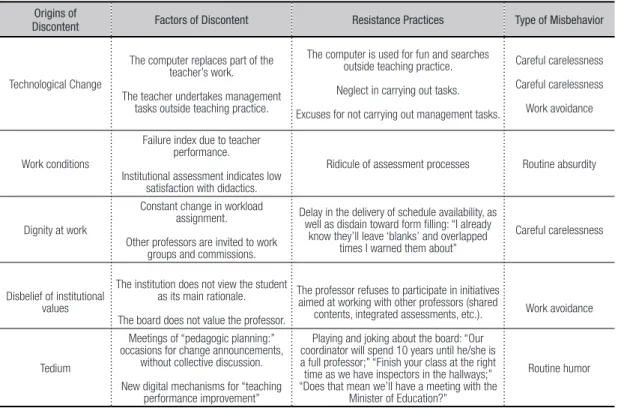
managers” and keeping track of grades and absences as per deadlines, etc. In the second case, they utilize varied tricks to avoid activities they consider outside their responsibility, such as participating in after-hour meetings, pedagogic improvement courses, pedagogical training, and talks on uninteresting topics. The latter form of resistance is enabled by the hierarchical matrix structure used in many institutions, where professors must answer to several superiors of equal hierarchic level who do not frequently communicate with each other. According to Jacomini (2004), conservative and even antidemocratic reactions from professors can be detected and deemed as resistance behaviors. Hence, conceptions of teaching practice are an important factor motivating opposition. To illustrate the discussion proposed in this paper, Table 1 presents some examples of the abovementioned behavior deviations, which are based on Efthymiou’s work (2009) and can be manifested as resistance practice.
Table 1 - Resistance behaviors
Origins of
Discontent Factors of Discontent Resistance Practices Type of Misbehavior
Technological Change
The computer replaces part of the teacher’s work.
The teacher undertakes management tasks outside teaching practice.
The computer is used for fun and searches outside teaching practice.
Neglect in carrying out tasks.
Excuses for not carrying out management tasks.
Careful carelessness
Careful carelessness
Work avoidance
Work conditions
Failure index due to teacher performance.
Institutional assessment indicates low satisfaction with didactics.
Ridicule of assessment processes Routine absurdity
Dignity at work
Constant change in workload assignment.
Other professors are invited to work groups and commissions.
Delay in the delivery of schedule availability, as well as disdain toward form filling: “I already
know they’ll leave ‘blanks’ and overlapped times I warned them about”
Careful carelessness
Disbelief of institutional values
The institution does not view the student as its main rationale.
The board does not value the professor.
The professor refuses to participate in initiatives aimed at working with other professors (shared
contents, integrated assessments, etc.). Work avoidance
Tedium
Meetings of “pedagogic planning:” occasions for change announcements,
without collective discussion.
New digital mechanisms for “teaching performance improvement”
Playing and joking about the board: “Our coordinator will spend 10 years until he/she is a full professor;” “Finish your class at the right time as we have inspectors in the hallways;” “Does that mean we’ll have a meeting with the
Minister of Education?”
Routine humor
facilitate this understanding, which may lead to the construction of a conceptual model that presents resistance in a broad and dialectic fashion to show its relationship to discourse, power, identity, and subjectivity.
Furthermore, it is important to recognize that the resistance is volatile, contextual, and sometimes contradictory because it coexists with acceptance behaviors. Therefore, within the context of teaching institutions, the lack of discussion about and collaboration on changes and new projects in institutional practices may become fertile ground for resistance behaviors because professors do not passively accept changes in academic work practices. Hence, research on resistance as a building block of organizational dynamics is necessary to understand its material, ideological, pedagogic, and institutional constraints. Can professors simultaneously resist and collaborate? For studies on resistance in the academic environment, Anderson (2008) recommends qualitative research proposals so that one can identify the nature and reality of the issues from the perspective of the affected individuals. Such research may offer alternatives to the already cited “academic managerialism.”
The heads of the HEI need to be aware that professors, like any other workers, must be treated with dignity to teach effectively. Imposing standardized teaching practices and assessment systems exclusively on the basis of calculability and submitting professors to unnecessary surveillance and control systems is not dignifying treatment and causes actions of resistance.
Managing teaching practices is a difficult challenge because, as Knight observed (2009, p. 511),
[…]few professions are more personal than teaching. Change agents need to be aware that they walk on sacred ground when they suggest news ways of teaching, especially when they criticize a teacher’s current teaching practices.
Mulholland (2004) noted that when the teachers are aware of the inefficacy of the imposed changes, certain types of work practices are considered superior to others, particularly in the private sector. In this case, the teachers do not make the slightest effort to make these changes viable, but strictly do as they were told, allowing unfavorable results to weaken their superiors’ position of power.
According to Ambrosetti (1990), we may designate such behavior as the “pedagogy of the possible:” Professors formally meet the official requirements, add to their practice what they consider convenient and adequate, and continue to work otherwise in their own way. Consequently, their work is done more accurately; however, the teachers can assume a negative position that results in a “disinvestment in work” (ROSENFIELD, 2003). Carvalho and Macedo (2011) detected a similar situation when they observed that certain teachers practiced actions of resistance (reaction, adaptation, transgression, or fraud) because of their disagreement with certain aspects of a recently implemented assessment program. In that sense, notably, Jacomini (2004) observed that one cannot implement any educational proposal when the main stakeholders—teachers—do not understand it or refuse to adopt it in their teaching practice.
Final Considerations
First, this study does not intend to exalt the inefficacy of surveillance and control systems, and much less, to romanticize the resistance of those who oppose these systems. It merely seeks to foster reflection and discussion on some important issues that are unarguably present in daily teaching practice.
Meanwhile, we do not intend here to defend the total elimination of teaching practice assessment activities, and less so, to create a “eulogy of revolt” (CONTU, 2008) because as Foucault states, “living in society is, nevertheless, to live in order to act upon the action of others. A society without relations of power cannot be anything other than an abstraction” (FOUCAULT, 2001, p. 1058).
It is crucial to note that when not treated with dignity while exercising their teaching, professors will react, in a more or less effective manner, individually or collectively. This tendency reflects their concerns about what they consider misunderstandings, lies, or even persecution. Hence, fostering reflection on professor dignity and autonomy among HEI leaders and government agencies involved in teaching practices can lead to the adoption of
policies that dignify professors, benefiting not only them but, ultimately, society as a whole.
Because this work has conveyed the idea that resistance presents a particular relation with power, future studies might also investigate different aspects of power and their corresponding dimensions of resistance, since this attitude is a key issue for the understanding of contemporary work relationships. If power involves a set of rules and influences in the workplace that, in the words of Certeau (1984), “establish the coordinates” to control behavior at work, resistance could be researched on just like any action intended to disrupt such a process to favor those who are dominated whose behavior challenges power relations without necessarily avoiding them (CERTEAU, 1984, p. 78). Would then resistance be present in all practices of professional daily life?
References
ADORNO, Theodor; HORKHEIMER, Max. Dialética do esclarecimento. São Paulo: Jorge Zahar Editor Ltda., 1985.
AMBROSETTI, Neusa Banhara. Ciclo básico: uma proposta vista pelos professores. Cadernos de Pesquisa, 75, p. 57–70, 1990.
ANDERSON, Gina. Mapping academic resistance in the managerial university. Organization, 15 (2), 251–270, 2008.
BLANCH, Josep. Afrontando la nueva gestión publica: obedeciendo y resistiendo. In: FERREIRA, Mário César; ARAÚJO, José Newton Garcia de; ALMEIDA, Cleverson Pereira de; MENDES, Ana Magnólia (Orgs.). Dominação e resistência no contexto
trabalho-saúde. São Paulo: Universidade Presbiteriana Mackenzie, 2011.
CARVALHO, Gisele Francisca da Silva; MACEDO, Maria do Socorro Alencar Nunes. Avaliação oficial: o que dizem os professores sobre o impacto na prática docente. Educação e Pesquisa, 37 (3), 549–564, 2011.
CERTEAU, Michel de. The practice of everyday life. Berkeley: University of California Press, 1984.
CLEGG, Stewart. Foucault, power and organizations. In: MCKINLAY, Alan; STARKEY, Ken (Eds.). Foucault management and
organization theory. London: Sage Publications Ltd, 1998.
COLLINSON, David. Engineering humor: masculinity, joking and conflict in shop-floor relations. Organization Studies, 9(2), 181– 199, 1988.
COLLINSON, David. Strategies of resistance. In: JERMIER, John; KNIGHTS, David; NORD, Walter (eds). Resistance and power in
organizations, London: Routledge, 1994.
CONTU, Alessia. Decaf resistance: on misbehavior, cynicism, and desire in liberal workplaces. Management Communication
Quarterly, 21(3), 364–379, 2008.
EDWARDS, Paul; COLLINSON, David; ROCCA, Giuseppe Della. Workplace resistance in the Western Europe: a preliminary overview and a research agenda. European Journal of Industrial Relations, 1 (3), 283–316, 1995.
EFTHYMIOU, Leonidas. Workplace control and resistance from below: an ethnographic study in a cipriot luxury hotel. Doctoral dissertation, School of Management, University of Leicester, Leicester, United Kingdom, 2009.
EZZAMEL, Mahmoud; WILLMOTT, Hugh; WORTHINGTON, Frank. Power, control and resistance in the factory that time forgot.
Journal of Management Studies, 38, 1053–1078, 2001.
FLEMING, Peter; SEWELL, Graham. Looking for the good soldier, Svejk: alternative modalities of resistance in the contemporary workplace. Sociology, 36 (4), 857–873, 2002.
FOUCAULT, Michel. Surveiller et punir. Paris: Éditions Gallimard, 1975.
FOUCAULT, Michel. Dits et écrits II, 1976–1988. Paris: Éditions Gallimard, 2001.
HEBDIGE, Dick. Posing… threats, striking… poses–youth, surveillance and display. In: GELDER, Ken; THORNTON, Sarah (eds). The
subcultures reader. London: Routledge, 1997.
HODSON, Randy. Worker resistance: an underdeveloped concept in the sociology of work. Economic and Industrial Democracy, 16, 79-110, 1995.
HODSON, Randy; MARTIN, Andrew; LOPEZ, Steven; ROSCIGNO, Vincent. Rules don’t apply: Kafka’s insights on bureaucracy.
Organization, 20 (2), 256–278, 2012.
JACOMINI, Maria Aparecida. A escola e os educadores em tempo de ciclos e progressão continuada: uma análise das experiências no estado de São Paulo. Educação e Pesquisa, 30 (3), 401–418, 2004.
KARLSSON, Jan Ch. Organizational misbehavior in the workplace: narratives of dignity and resistance. New York: Palgrave Macmillan, 2012.
KNIGHT, Jim. What can we do about teacher resistance? Phi Delta Kappan, 90(7), 508–513, 2009
KORCZYNSKI, Marek. The dialectical sense of humor: routine joking in a taylorized factory. Organization Studies, 32(10), 1421– 1439, 2011.
LIPMAN, Pauline; HAINES, Nathan. From accountability to privatization and African American exclusion: Chicago’s “Renaissance 2010.” Educational Policy, 21(3), 471–502, 2010.
MARX, Karl. Estranged labor - Economic & philosophical manuscripts of 1844. Available at: [http://www.marxists.org/archive/ marx/works/1844/manuscripts/labor.htm] 21 fev. 2013.
MAUÉS, Olgaíses. Os organismos internacionais e as políticas públicas educacionais no Brasil. In: GONÇALVES, Luiz Alberto Oliveira (Org.). Currículo e políticas públicas. Belo Horizonte: Autêntica, 2003.
MCNAY, Lois. Michel de Certeau and the ambivalent everyday. Social Semiotics, 6(1), 61–81, 1996.
MOEGLIN, Pierre. Les industries éducatives. Paris: Presses Universitaires de France, 2010.
MULHOLLAND, Kate. Workplace resistance in an Irish call center: slammin’, scammin’ smokin’ an’ leavin’. Work, employment
and society, 18(4), 709–724, 2004.
MUMBY, Dennis. Theorizing resistance in organizational studies: a dialectical approach. Management Communication Quarterly, 19 (1), 19–44, 2005.
ORTNER, Sherry. Resistance and the problem of ethnographic refusal. Comparative Studies in Society and History, 37 (1), 93–173, 1995.
PRASAD, Anshuman; PRASAD, Pushkala. (Un) Willing to resist? The discursive production in of local workplace opposition. Studies
in Cultures, Organizations and Societies, 7(1), 105– 125, 2001.
RAMOS, Elbo Lacerda; MARQUES, Mara Rúbia Alves. A constituição do estado gerencial e a emergência da regulação de sujeição.
Revista Contemporânea de Educação. 11, 186–201, 2011.
RODRIGUES, Suzana; COLLINSON, David. Having fun? Humour as resistance in Brazil. Organization Studies,16(5), 739–768, 1995.
ROSENFIELD, Cinara. Autonomia outorgada e relação com o trabalho: liberdade e resistência no trabalho na indústria de processo.
Sociologias, 10, 350–378, 2003.
SCOTT, James. Weapons of the weak - everyday forms of peasant resistance. New Haven, CT: Yale University Press, 1985.
SEWELL, Graham; BARKER, James; NYBERG, Daniel. Working under intensive surveillance: when does “measuring everything that moves” become intolerable? Human Relations, 65(2), p. 189–215, 2012.
SIQUEIRA, Marcus Vinicius Soares. Gestão de pessoas e discurso organizacional. Curitiba: Juruá, 2009.
SPICER, Andre; BOHM, Steffen. Moving management: theorizing struggles against the hegemony of management. Organization
Studies, 28(11), 1667–1698, 2007.
THOMAS, Robyn; DAVIES, Annette. Theorizing the micro-politics of resistance: new public management and managerial identities in the UK public services. Organization Studies, 26 (5), 683–706, 2005.
TROWLER, Paul. Academics responding to change–new higher education frameworks and academic cultures. Buckingham: SRHE and Open University Press, 1998.
VALLAS, Stephen. Rethinking Post-Fordism: The Meaning of Workplace Flexibility. Sociological Theory, 17, 68–101, 2003.
VIEIRA, Jarbas Santos. Política educacional, currículo e controle disciplinar. Currículo sem Fronteiras, 2(2), 111–136, 2002.
Received on: 10.11.2013.
Accepted on: 18.03.2014.
Almir Martins Vieira holds a doctorate degree in Education by the Universidade Estadual Paulista (UNESP) and is currently the coordinator of the Post-graduation Program in Management of the Methodist University of São Paulo (UMESP).
Octavio Ribeiro de Mendonça Neto holds a doctorate degree in Accounting by the University of São Paulo (USP) and is currently professor of the Post-graduation Program in Accounting Sciences of the Mackenzie Presbyterian University and the Faculty of Business Administration and Economics of the Methodist University of São Paulo (UMESP).