ABSTRACT: Nitrogen (N) can be recovered from different types of wastewaters. Among these wastewaters, anaerobically digested swine manure (digestate) has the highest N content in am-monia form (NH3). It is desirable to reduce N in digestate effluents to safely incorporate them in arable soil in N vulnerable zones (NVZ) and to mitigate NH3 emissions during N land application. Additional benefit is to minimize inhibition of the anaerobic process by removing NH3 during the anaerobic digestion process. This work aimed to apply the gas-permeable membrane technol-ogy to evaluate ammonia (NH3) recovery from high-ammonia digested swine manure. Anaerobi-cally digested swine manure with NH4
+ content of 4,293 mg N L−1 was reduced by 91 % (to 381 mg N L−1) during the 32-day experiment. Although the results showed a total N recovery efficiency of 71 %, it is possible to increase this recovery efficiency to > 90 % by adjusting the area of the membrane system to match the high free ammonia concentration (FA) in digested swine manure. Moreover, final digestate pH and alkalinity were kept around 8.1 and 8,923 mg-CaCO3 L
−1, which are convenient for the anaerobic process or incorporation in arable soil when the process is finished.
Keywords: N removal, digestate, manure management, membrane technology 1Agricultural Technological Institute of Castilla and León −
Ctra. Burgos, km.119 − 47071 − Valladolid − Spain. 2United States Department of Agriculture − Agricultural Research Service − Coastal Plains Soil, Water and Plant Research Center − 2611 W. Lucas St. − Florence − SC − USA.
*Corresponding author <[email protected]>
Edited by: Airton Kunz
Recovery of ammonia from anaerobically digested manure using gas-permeable
Maria Cruz García-González1*, Matias B. Vanotti2, Ariel A. Szogi2
Received April 10, 2015 Accepted September 30, 2015
Introduction
Anaerobic digestion (AD) is a widely used technique with an increasing number of full biogas-plants under op-eration for organic solid waste treatment and energy recov-ery (Carrosio, 2014). The rise in environmental concerns associated with energy production and CO2 mitigation poli-cies has renewed interest in digestion technologies.
Ammonia inhibition in AD has been reported with a wide range of inhibiting NH3, because of differenc-es in the nature of substratdifferenc-es, inocula, environmental conditions and acclimation periods (Chen et al., 2008). Sung and Liu (2003) and Procházka et al. (2012) showed that NH3 concentrations higher than 3,000 mg L−1 could
cause obvious inhibition of methanogenesis. In another study, Hejnfelt and Angelidaki (2009) concluded that NH3 levels of 1,500-7,000 mg L−1 caused a decrease in
methane production.
The gas-permeable membrane technology (GPMT) has been successfully used to recover NH3 from swine ma-nure (García-Gonzalez and Vanotti, 2015; García-Gonzalez et al., 2015). This technology can be combined with other treatment technologies such as AD and phosphorus recov-ery to improve their performance (Vanotti and Szogi, 2015). In the case of anaerobic digestion, the process can be ap-plied inside a digester to remove ammonia without dam-aging the carbonaceous material and therefore improving the anaerobic process, as reported by Garcia-Gonzalez and Vanotti (2015). Other studies reported AD performance im-provement in semi-batch experiments using GPMT to treat slaughterhouse waste (Lauterbock et al., 2014). Hence, if a large quantity of NH3 is removed from digestate, the typi-cal inhibition caused by this compound will be minimized, improving both AD and methane production.
Nowadays, AD is an important technology and strategy to manage manure worldwide and in many countries, with high number of NVZ (Nitrate Vulnerable Zones), thus, land application of the digestate is an im-portant strategy to recycle nutrients and organic matter. However, the application is limited by the N content of digestate (European Council, 1991). Reducing ammonia from digestate using GPMT could help reduce environ-mental pressure in these intensive livestock production areas. This study aimed to apply GPMT to evaluate NH3 recovery from digested swine manure at lab scale. The pH of the digested manure was kept above 7.7 by adding sodium hydroxide when necessary to enhance ammonia capture by the membrane.
Materials and Methods
Experimental procedure
A batch experiment was conducted in 2 L waste-water vessels consisting of polyethylene terephthalate (PET) plastic jars for an effective digestate volume of 1.3 L using the experimental device and diagram de-scribed in Garcia-Gonzalez and Vanotti (2015). The acid tank consisted of 500 mL Erlenmeyer flasks containing 280 mL 1 N H2SO4. A diaphragm pump (Alldos, TrueDos model, Denmark) was used to continuously circulate the acid through tubular membranes inside the digestate vessels and back into the acid tank using a constant flow rate of 5.8 L d−1. The pH in the acidic tank increased,
as ammonia was captured by the membrane, therefore, the acid pH was adjusted to keep it below 1.5. Gas-per-meable tubing (60 cm long, 10.25 mm outer diameter and 0.75 mm wall thickness) made of expanded poly-etrafluoroethylene (ePTFE) (Phillips Scientific Inc., Rock
Hill, SC) was used for NH3 capture. The membrane man-ifolds were submerged in digestate contained in PET jars, which were kept closed but not airtight. Ports were installed on top of the reactor vessels to obtain samples and monitor pH. The digestate was continuously agitat-ed using magnetic stirrers.
The experiment was carried out to evaluate N recov-ery from anaerobically digested swine manure. Chemical characteristics are shown in Table 1. The biogas plant was located in Salamanca (Spain). The plant was a co-digestion plant treating the manure of a farm with 6,000 fattening pigs as well as agro-food wastes. Digestate was collected directly from the mesophilic digester in plastic containers, transported in coolers to the laboratory and subsequently stored at 4 ºC for further use.
The pH of the digestate was adjusted whenever it decreased below 7.7, according to (Garcia-Gonzalez and Vanotti, 2015). This adjustment consisted in increasing the digestate pH using sodium hydroxide (5 N), which was added when necessary to endpoint pH 8.5-9.0. Di-gestate samples from the vessels and acidic solution samples from the concentrator tank were collected daily to monitor pH, alkalinity and NH4+. All experiments
were carried out in duplicate and results were expressed as means. The test was run at room temperature to simu-late ammonia recovery from the digested manure in a system external to the anaerobic digestion.
Analytical methods
Analyses of total solids (TS), volatile solids (VS), total chemical oxygen demand (CODt), total Kjeldahl ni-trogen (TKN) and total phosphorus (TP) were performed in duplicate in accordance with APHA Standard Meth-ods (1989). The pH and total alkalinity were monitored using a pH meter Crison Basic 20 (Crison Instruments S.A., Barcelona, Spain). Total alkalinity was obtained by measuring the amount of standardized sulphuric acid needed to bring the sample to a pH endpoint of 4.5 and expressed as mg CaCO3 L−1. NO
3
− and NO 2
− were
monitored using colorimetric strips (MQuantTM, Merck).
NH4+ concentrations were determined using a NH 3
gas-sensing electrode Orion 900/200 (Thermo Electron
Cor-poration, Beverly, USA) after adjusting sample to pH >11. Free NH3 (FA) was quantified theoretically accord-ing to Eq. (1), where NH3 was the FA content and TNH3 was the total NH4+ (measured in the NH
4
+
determina-tion described above) (Hansen et al., 1998):
NH TNH
pH T 3 3 009018 272992
1 1 10
10
[
] [
]
= +
−
− +
−
/ ( / (1)
Results and Discussion
NH4+ concentration in digestate decreased from
4,293 ± 0 mg N L−1 to 381 ± 55 mg N L−1 in the 32
days of experiment (Figure 1). Ammonia capture by the membrane continuously increased until day 25, af-ter which, little or no more NH3 was recovered in the acidic solution. Similarly, NH4+ in digestate decreased
little at the end of the experiment, from 433 (day 27) to 381 (day 32) mg N L−1 at the end of the experiment
(Figure 1). The acidic solution was the same during the entire experiment, thus, the recirculation of this liquid occurs in a closed loop between the treatment vessel and the acid tank, which achieved an NH4+concentration in
the recovery solution (11,200 ± 1,100 mg N L−1) of
al-most three-fold higher than in digestate (4,293 mg N L−1;
Figure 1). Sixty-two percent of NH4+ removed from
di-gestate during the experimental period was recovered in the acidic solution. These findings are in agreement with those reported by García-Gonzalez and Vanotti (2015) who observed a high N recovery from manure with dif-ferent NH4+ strengths using GPMT.
The rate of NH4+ recovery was not linear and
fol-lowed a 2nd-order curve (Figure 2), meaning that the NH3 capture rate was higher during the first days, and decreased as it was being depleted from the manure.
Figure 1 − Removal of ammonia in digestate () by the gas membrane system and recovery and concentration in the acid tank (). The error bars are the standard deviation of duplicate experiments.
Table 1 − Chemical characteristics of the digestate at the beginning and at the end of each batch experiment. The standard deviation of duplicate experiments are shown in parenthesis.
Initial Final
pH 8.01 (0) 8.11 (0.01)
CODt (g L−1) 27 (1) 22 (0.23)
TS (g L−1) 35 (0.32) 36 (0.54)
VS (g L−1) 25 (0.33) 22 (0.20)
Pt (mg L−1) 771 (3.54) 645 (1.06)
TKN (mgN L−1) 4,690 (44) 1,244 (89)
NH4
+(mgN L−1) 4,293 (0) 381 (55)
NO3 −+ NO
2
− (mg L−1) 0 0
Alkalinity (mgCaCO3 L
Similar to what was observed in raw swine manure, when FA content in the manure was low, the rate of NH3 captured by the membrane decreased (García-Gonzalez and Vanotti, 2015).
Most of the NH3 recovery occurred during the first 25 days of the experimental period, with an average re-covery rate of 405 mg N L−1 d−1 and a high NH
4 +
recov-ery efficiency of 71 % (Table 2). The average recovrecov-ery rate during the second part of the batch (25-32 days) was 81 mg N L−1 d−1 and the corresponding NH
4
+ recovery
efficiency was 45 % of the remaining NH4+. The
inabil-ity of the membrane to recover additional N from day 25 to the end of the experiment can be explained by the NH3 content in digestate. The average free NH3 in di-gestate until day 25 of the experiment was 178 mg N L−1, however, from that day until the end of the
experi-ment, average free NH3 in digestate decreased to 69 mg N L−1. This means that NH
3 concentration in digestate
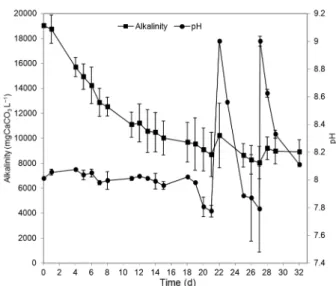
was low and permeated slowly through the membrane. Therefore, it was necessary to keep a high level of free NH3 to continuously recover N, which was achieved by keeping the pH of digestate above 8.5 (García-Gonzalez and Vanotti, 2015). As NH3 was removed, the pH of the digestate was keep around 8.0 for the first 19 days of the experiment by adjusting it with alkali on days 21 and 27 (Figure 3). This indicates that, although alkalinity was consumed to neutralize digestate acidification due to NH3 removal, the buffer capacity of digestate was very high. Therefore, a 53 % decrease in the digestate alkalin-ity was observed with a consumption of 10,115 ± 947 mg CaCO3 L−1 (Figure 3).
In contrast with previous studies carried out with raw manure, both the maximum NH4+ recovery rate and
the average NH4+ recovery rate obtained in this study
were very high as well as the FA content in the digestate (Table 3). According to previous studies, mass recovery of NH4+ through the membrane increased as FA content
increased in manure because of pH adjustment (with aeration treatment or alkali addition). However, in the present study, FA content remained high during the first 25 days of experimentation (178 mg N L−1). This high
FA content allowed active permeation of NH3 through the membrane. Yet, the absorption capacity of the mem-brane was not enough to recover all FA in digestate and a fraction of NH4+ was volatilized, as the reaction
ves-sels were not airtight. This volatilization loss was sig-nificant in the mass balance, representing 1,370 mg N or 25 % of initial NH4+. These volatilization losses were
high compared with results from García-Gonzalez and Vanotti (2015), who treated raw manure and obtained volatilization losses of 187 mg N (8 % of initial NH4+),
also compared with results from García-Gonzalez et al. (2015) who obtained volatilization losses also in raw ma-nure of 50 and 220 mg N (2 to 6 % of initial NH4+)
us-ing similar reactor vessels and tubular membrane length (Table 3). Thus, to recover all N and to avoid significant volatilization from digestate, the reaction device should be totally hermetic for the membrane manifold work at its maximum absorption capacity.
As previously mentioned, digestate from on-farm biogas plants is commonly used as fertilizer in countries with high intensive livestock pressure. Digested slurries have been found to be significant sources of ammonia (NH3), methane (CH4) and nitrous oxide (N2O) emissions (Amon et al., 2006; Bacenetti et al., 2013; Nkoa, 2014), with potential implications for local-to-regional climate (NRC, 2002; Ravishankara et al., 2009). Thus, an impor-tant challenge is to develop strategies that help to con-trol the impact of agriculture on the environment, such
Figure 2 − Mass of ammonia recovered in the acid tank. A second-order equation and R2 are represented. The error bars are the standard deviation of duplicate experiments.
as mitigating NH3 emissions when applying digestate to crops. In this sense, when GMPT is applied to digested manure, an important reduction of ammonia in the di-gestate is observed, recovering N for further use as fer-tilizer (NH4)2SO4, while reducing the ammonia emission potential of digested manure.
Moreover, the final digestate pH was kept around 7.7-8.0 (Figure 3), which is convenient to incorporate the digestate into arable soils at the end of the anaerobic process. Another advantage of using the gas-permeable membranes was that soluble carbonaceous compounds did not pass through the membrane (Vanotti and Szogi, 2015). According to Table 1, while the NH4+ was
signif-icantly reduced, TS, VS and CODt remained almost sta-ble from the beginning to the end of the experiment.
The non-significant VS reduction was probably due to the anaerobic digestion process still occurring in the jars. This technology represents a good example of mit-igation of environmental impacts caused by agriculture and nutrient recycling due to recovery of an end product (ammonium salt fertilizer) for agriculture application.
In summary, ammonia was successfully recovered from digestate using gas-permeable membranes. Remov-al and recovery efficiencies were 91 and 62 % respec-tively, being possible to increase this recovery efficiency
if the area of the membrane system is adjusted to max-imize N recovery efficiency and to shorten N recovery time. Therefore, N recovery from digestate is a good strategy to reduce N contents in digestate effluents to be safely incorporated into arable soil in nitrogen vulner-able zones (NVZ).
Acknowledgements
Cooperation with USDA-ARS Project 6082-13630-005-00D “Innovative Animal Manure Treatment Technologies for Enhanced Environmental Quality” is grateful acknowledged. Mention of trade names or com-mercial products in this article is solely for the purpose of providing specific information and does not imply rec-ommendation or endorsement by the U.S. Department of Agriculture.
References
Amon, B.; Kryvoruchko, V.; Amon, T.; Zechmeister-Boltenstern, S. 2006. Methane, nitrous oxide and ammonia emissions during storage and after application of dairy cattle slurry and influence of slurry treatment. Agriculture, Ecosystems and Environment 112: 153-162.
Table 2 − Mass balances of the recovery of nitrogen in digestate using gas-permeable membranesa.
Days in the batchb Initial NH4 +-N in digestate
Remained NH4
+-N in digestate NH4 +-N removed from digestatec NH4 +-N recovered in the acid solution NH4 +-N removal efficiencyd NH4 +-N recovery efficiencye Maximum NH4 +-N recovery ratef Average NH4 +-N recovery rate --- mgN --- --- % --- mg NH4
+-N L−1 d−1
First part (0-25 days) 5581 (0) 892 (240) 4689 (240) 3316 (308) 84 71 1244 405
Second part (25-32 days) 892 (240) 495 (71) 396 (169) 180 (85) 44 45 168 81
All (0-32 days) 5581 (0) 495 (71) 5086 (71) 3136 (308) 91 62 1244 324
a1.3 L of digestate in a 2 L vessel, using 280 mL 1 N H
2SO4 of acidic solution in the concentrator tank (recirculation rate = 5.8 L d
−1). bData are average and standard deviation of duplicate reactors during 32-day experiment. First row of data shows mass balances for the first 25 days of the batch when recovery was active. Second row shows mass balances for the following period (25-32 days). cNH
4
+ removed from digestate = initial NH 4
+ in digestate – remained NH4
+ in digestate. dNH 4
+ removal efficiency = (NH 4
+ lost from digestate/initial NH 4
+ in digestate) × 100. eNH 4
+ recovery efficiency = (NH 4
+ recovered in the acidic solution/ NH4
+ lost from digestate) × 100. fHighest NH 4
+ mass recovered in 1 day; 0.0323 m2 of membrane surface area.
Table 3 − Comparison of free ammonia (FA) and average NH4+ recovery rate by the gas-permeable membrane reactor in digestate and manure from previous studiesa.
Type of wastewater
Initial NH4 +-N in manure reactor NH4 +-N volatilized in the airb
FAc NH4 +-N recovery efficiency Maximum NH4 +-N recovery rate Average NH4 +-N recovery rate Reference
--- mgN --- mgN L−1 % --- mgNH 4
+-N L−1 d−1
---Manured 2310 187 45 91 412 148 García-Gonzalez and Vanotti, 2015
Manuree 3410 50 80 99 780 184 García-Gonzalez et al., 2015
Manuref 3930 220 40 93 810 172 García-Gonzalez et al., 2015
Digestateg 5581 1373 178 71 1244 405 This study
aThe reactors in all referenced studies contained a 60 cm length polyetrafluoroethylene (ePTFE) membrane tubing with a 0.0323 m2 surface area and were operated with a recirculation rate of 5.8 L d−1. bNH
4
+-N volatilized in the air was equal to initial NH 4
+-N in manure minus the remained NH 4
+-N in manure minus the NH 4
+-N recovered in the acidic solution. cFA is the average of data collected during the experimentation time. dAlkali was added to manure to raise pH. Data are average of duplicate reactors during 30 days of experiment.Data expressed as NH4+ in this publication was converted to NH
4
American Public Health Association [APHA]. 1989. Standard Methods for the Examination of Water and Wastewater. 17ed. APHA, Washington, DC, USA.
Bacenetti, J.; Negri, M.; Fiala, M.; Gonzalez-García, S. 2013. Anaerobic digestion of different feedstocks: impact on energetic and environmental balances of biogas process. Science of Total Environment 463-464: 541-551.
Carrosio, G. 2014. Energy production from biogas in the Italian countryside: modernization vs. repeasantization. Biomass and Bioenergy 70: 141-148.
Chen, Y.; Cheng, J.J.; Creamer, K.S. 2008. Inhibition of anaerobic digestion process: a review. Bioresource Technology 99: 4044-64.
European Council. 1991. Council Directive of 12 December 1991 Concerning the Protection of Waters Against Pollution Caused by Nitrates from Agricultural Sources (91/676/EEC). Available at: <http://eur-lex.europa.eu/LexUriServ/LexUriServ.do?uri= CELEX:31991L0676:EN:HTML> [Accessed Aug. 20, 2015]. García-Gonzalez, M.C.; Vanotti, M.B.; Szogi, A.A. 2015. Recovery
of ammonia from swine manure using gas-permeable membranes: effect of aeration. Journal of Environmental Management 152: 19-26.
García-Gonzalez, M.C.; Vanotti, M.B. 2015. Recovery of ammonia from swine manure using gas-permeable membranes: effect of water strength and pH. Waste Management 38: 455-461. Hansen, K.; Angelidaki, I.; Ahring, B. 1998. Anaerobic digestion
of swine manure: inhibition by ammonia. Water Research 32: 5-12.
Hejnfelt, A.; Angelidaki, I. 2009. Anaerobic digestion of slaughterhouse by-products. Biomass and Bioenergy 33: 1046-1054.
Lauterbock, B.; Nikolausz, M.; Lv, Z.; Baumgartner, M.; Liebhard, G.; Fuchs, W. 2014. Improvement of anaerobic digestion performance by continuous nitrogen removal with a membrane contactor treating a substrate rich in ammonia and sulphide. Bioresource Technology 158: 209-216.
National Research Council [NRC]. 2002. The Scientific Basis for Estimating Air Emissions from Animal Feeding Operations. National Academy Press, Washington DC, USA.
Nkoa, R. 2014. Agricultural benefits and environmental risks of soil fertilization with anaerobic digestates: a review. Agronomy of Sustainable Development 34: 473-492.
Procházka, J.; Dolejs, P.; Maca, J.; Dohanyos, M. 2012. Stability and inhibition of anaerobic processes caused by insufficiency or excess of ammonia nitrogen. Applyed Microbiology Biotechnology 93: 439-47.
Ravishankara, A.R.; Daniel, J.S.; Portmann, R.W. 2009. Nitrous oxide (N2O): the dominant ozone-depleting substance emitted in the 21st Century. Science 326: 123-125.
Sung, S.; Liu, T. 2003. Ammonia inhibition on thermophilic anaerobic digestion. Chemosphere 353: 43-52.