15
N UPTAKE FOM MANURE AND FERTILIZER SOURCES BY
THREE CONSECUTIVE CROPS UNDER CONTROLLED
CONDITIONS
(1)Héctor Mario Quiroga Garza(2), Jorge A. Delgado(3), José Antonio Cueto Wong(4) & William C. Lindemann(5)
SUMMARY
There are several regions of the world where soil N analysis and/or N budgets are not used to determine how much N to apply, resulting in higher than needed N inputs, especially when manure is used. One such region is the North Central “La Comarca Lagunera”, one of the most important dairy production areas of Mexico.
We conducted a unique controlled greenhouse study using 15N fertilizer and 15N
isotopic-labeled manure that was labeled under local conditions to monitor N cycling and recovery under higher N inputs. The manure-N treatment was applied only once and was incorporated in the soil before planting the first forage crop at
an equivalent rate of 30, 60 and 120 Mg ha-1 dry manure. The 15N treatments were
equivalent to 120 and 240 kg ha-1 (NH
4)2SO4-N for each crop. The total N fertilizer
for each N fertilized treatment were 360, and 720 kg ha-1 N. We found very low N
recoveries: about 9 % from the manure N inputs, lower than the 22 to 25 % from the fertilizer N inputs. The manure N recovered belowground in soil and roots ranged from 82 to 88 %. The low recoveries of N by the aboveground and low soil inorganic
nitrate (NO3-N) and ammonium (NH4-N) content after the third harvested
suggested that most of the 15N recovered belowground was in the soil organic
form. The losses from manure N inputs ranged from 3 to 11 %, lower than the 34 to 39 % lost from fertilizer N sources. Our study shows that excessive applications of
(1) Received for publication in February 2009 and accepted in July 2009.
(2) Instituto Nacional de Investigaciones Forestales, Agrícolas y Pecuarias (INIFAP). Blvd. José S. Valdez 1200 Pte., Matamoros,
Coahuila, México CP 27440. E-mail: [email protected]
(3) Soil Plant Nutrient Research Unit, USDA, Agricultural Research Service 2150 Centre Avenue, Building D, Suite 100, Fort
Collins, CO 80526. E-mail: [email protected]
(4) Visiting scientist at USDA-ARS-SPNR, Fort Collins, CO, USA, 80526, Faculty Affiliate with Colorado State University, Fort
Collins, Colorado. E-mail: [email protected]
manure or fertilizer N that are traditionally used in this region will not increase the rate of N uptake by aboveground compartment but will increase the potential for N losses to the environment.
Index terms: denitrification, nitrogen use efficiency, annual ryegrass, salinity, sudangrass.
RESUMO: ABSORÇÃO DE N15 DE FERTILIZANTES E ESTERCO POR
TRÊS CULTIVOS SUCESSIVOS EM CONDIÇÕES CONTROLADAS
No mundo existem várias regiões em que as fontes de N e as análises de solo não são levadas em consideração para determinar as necessidades desse elemento, o que resulta em aplicações excessivas, especialmente quando se utiliza esterco. Uma dessas regiões é a Centro-Norte do México, chamada de “La Comarca Lagunera”, uma das maiores áreas produtoras de leite do país. Um experimento em casa de vegetação foi realizado com fertilizante e esterco marcados com o isótopo N15 para monitorar a ciclagem e a recuperação do
N quando grandes quantidades são aplicadas. O tratamento N15-esterco foi aplicado somente
uma vez e incorporado no solo previamente à plantação da primeira pastagem, com as seguintes doses: 30, 60 e 120 Mg ha-1 de matéria seca. O tratamento N15-fertilizante consistiu na aplicação
de 120 e 240 kg (NH4)2SO4 ha-1 em cada cultivo. O total de N-fertilizante para cada tratamento
foi de 360 e 720 kg ha-1 de N. A quantidade de N-esterco recuperado foi de 9 %, muito menor
que a quantidade de N recuperado do fertilizante, que variou entre 22 e 25 %. A quantidade de N-esterco recuperado nas raízes e em profundidade no solo variou entre 82 e 88 %. A reduzida quantidade de N recuperado no solo nas formas de nitrato (NO3-N) e amônio (NH4-N) após a
terceira colheita indica que a maior parte do 15N recuperado estava na forma orgânica. As
perdas de N-esterco variaram entre 3 e 11 %, sendo bem menores que as do N-fertilizante (34– 39 %). Este estudo mostra que as aplicações excessivas de esterco e fertilizantes, rotineiramente empregadas na região, não aumentam a taxa de absorção de N pela biomassa aérea das culturas, mas incrementam as perdas de N no ambiente.
Termos de indexação: denitrificação, eficiência de uso do nitrogênio, raygrass anual, salinidade, sudangrass.
INTRODUCTION
Losses of reactive N from agricultural systems that receive higher than needed N inputs negatively impact air, groundwater and surface water quality (Follett & Walker, 1989; Antweiler et al., 1996; Delgado et al, 2008). There are several regions of the world that tend to receive higher than needed N inputs, where soil testing and N budgets are not used as part of management practice planning. For example, several scientists have reported that N recoveries in China tend to be low due to excessive application of N fertilizer (Zhang et al., 1996; Zhu & Chen, 2002; Liu & Ju, 2003; Li et al., 2007). In some regions of China, applications of N can be as high as 750 to 1,900 kg ha-1 yr-1 N for
greenhouse vegetables (Zhang et al., 1996; Zhu & Chen, 2002). Li et al. (2007) recommended best management practices that include soil testing and N budgets to increase N use efficiencies and decrease losses to the environment.
Another region that tends to receive higher than needed N inputs is located in North-Central Mexico.
In areas from the North-Central “La Comarca Lagunera” region, application of manure is traditionally excessive (Personal communications, Drs. Uriel Figueroa and Jose Cueto). This region is one of the most important dairy production areas of Mexico and generates an estimated 800,000 Mg yr-1 of manure
(dry basis). Manure fertilization operations are traditionally excessive, without any use of N budgets or soil and/or manure testing to determine N content.
In the USA, Sharpley et al. (1999, 2002, 2003) reported that confined animal operations helped change the roles of nutrient management operations of farms in the USA from those of sinks and users of nutrients to those of sources and exporters. This effect has also been reported for other regions of the globe such as La Comarca Lagunera that commonly have large numbers of animals and limited acreage, similar to some operations in the Southern United States. Based on the dry basis manure production in La Comarca Lagunera of 800,000 Mg yr-1, we estimate
cycling of 5,000 metric tons of available N during the first year after application. We also estimate that this manure N can supply the N needs for at least 17,000 ha of irrigated forage per year. Since there is limited data about N cycling of manure sources in La Comarca Lagunera, our objective was to assess the N recovery from dairy manure and fertilizer N sources using the isotopic 15N technique.
State of the art isotopic 15N techniques are
available to quantify N losses and N cycling (Delgado 2002; Delgado et al., 2004). Comparatively few studies have been conducted with 15N-labeled manure as
opposed to 15N-labeled fertilizer forms. Using 15
N-labeled manure, Sørensen et al. (1994) found that 20 % of the N in sheep manure was recovered during the first year, compared to 57 % recovered from the
15NH
415NO3 applied to a barley (Hordeum vulgare L.)/
grass catch crop. During the second year there were lower recoveries (5 and 6 %) of the 15N-labeled manure
and fertilizer sources, respectively (Sørensen et al., 1994). Thomsen et al., (1993) found a recovery of 23 % with barley from 15N sheep slurry and 42 % with 15NH
415NO3 during the first year. Both sources had
a 3 % recovery during the second year.
Jokela (1992) studied the effect of N fertilizer and dairy manure on corn (Zea mays L.) yield. He found that the N recovery in corn from applied manure was 35, 49, and 43 % for three consecutive years. Recoveries were much larger than those measured by Muñoz et al., (2003) who used labeled 15N manure
and reported a recovery range from 13 to 22 % in three years of corn production.
The goal of this study was to trace the fate of N and determine how much N can be taken up under these high N input systems from Mexico. The only method for conducting such an assessment is with the use of isotopic 15N techniques using labeled manure
and labeled N fertilizer. Using these techniques, we can see how much 15N is taken up by the aboveground
shoots, how much stays as residual belowground and how much may be lost from the system.
MATERIALS AND METHODS Field procedure to label the 15N-manure
This study was established at “La Laguna” Research Station of INIFAP, Mexico, located in the semi-arid North Central region (25 ° 31 ’ N, 103 ° 14 ’ W, 1096 masl) with a mean annual temperature of 20.7 °C and precipitation of 210 mm per year. In order to conduct a 15N-manure study,
we first had to feed 15N labeled forage to a cow, then
collect the 15N labeled manure.
In spring 2001, we established two 64 m2 plots of
sudangrass (Sorghum sudanense Piper Staff); one received non-labeled ammonium sulfate ((NH4)2SO4),
and the other received (15NH
4)2SO4 labeled 5 atom % 15N. The non-labeled sudangrass, with a background
reading of 0.3726 15N atom %, was harvested first.
The labeled sudangrass plot, with an enrichment of 0.7291 atom % 15N, was harvested second to avoid
cross-contamination.
A non-lactating cow was exclusively fed with the non-labeled sudangrass hay for the first 10 days. The manure obtained during the first three days was discarded, collecting only the manure of the following seven days. The non-labeled manure was piled separately from the cow in an enclosed area. Then, for the following ten days, the same cow was exclusively fed with the 15N-enriched sudangrass hay.
Similarly, the manure obtained during the first three days was discarded, and we collected and stored the 15N
labeled manure generated during the last seven days. Manure from both sources was stored under similar conditions for three months to simulate commercial practices. Each pile was stored at a sufficient distance to avoid cross-contamination between labeled and non-labeled manures. The non-non-labeled manure pile was mixed with a spade to increase uniformity of manure after the three months. The 15N labeled manure pile
was also mixed with a different spade to avoid cross contamination. Because of the need for a highly intensive management system to produce 15N manure
and the large cost of 15N material for handling and
analysis, we only labeled enough 15N manure material
to conduct a controlled greenhouse study.
Greenhouse study
We used isotopic 15N techniques to study the
recovery and losses of manure-N and (NH4)2SO4
sources applied to a forage rotation (annual ryegrass-sudangrass-annual ryegrass) grown in large pots. Each pot had a 15 cm internal diameter and a 50 cm height, and was filled with 14 kg of an Aridisol – a typical soil type in this agricultural region – collected from the top 30 cm arable layer. The soil clay, silt, and sand content were 52, 34, and 14 %, respectively and were determined with the hydrometer method (Bouyoucos) (Gee & Bauder, 1986).
The soil pH, soil organic matter, and electrical conductivity (EC) were 8.38, 1.05 % and 1.4 dS m-1,
respectively, with 15.9 % total calcium carbonates. Soil pH was determined electrometric in aqueous extract of saturated soil pastes. (ORION 3 STAR, Thermo Electronic Corporation(6); Thomas, 1996).
Soil organic matter was measured with the Walkley
(6) Manufacture names are necessary to report factually on
and Black method (Nelson & Sommers, 1996). The soil EC was determined using a conductance meter in aqueous extract of saturated soil pastes. (ORION 3 STAR, Thermo Electronic Corporation; Rhoades, 1996). The total carbonates was determined using the pressure calcimeter method (Loeppert & Suarez, 1996).
The NO3-N content was 57.5 mg kg-1 while the
NH4-N was minimal. This high NO3-Ncontent is in
agreement with other measured high residual soil NO3-N across the region(personal communications from Dr. Figueroa, May, 2008). The soil NO3-N
content was measured with the colorimetric method from Robarge et al. (1983) and NH4-N was determined
with the steam distillation in soil extracts using 2 mol L-1 KCL (Mulvaney, 1996).
Pots were placed on greenhouse benches and received 100 to 150 mL of tap water with no detectable N every day during the summer and every other day in the winter. Irrigation kept soil moisture at an adequate level without drainage induction. For the manure treatments and in accordance with the application, soil and ground manure were mixed prior to pot filling.
Manure-N treatments were 0, 55, 110, and 220 g/ pot dry basis manure (equivalent to 0, 30, 60, and 120 Mg ha-1 dry manure). The manure-N treatment
was applied only once and was incorporated in the soil before planting the first forage crop. The N content of the manure was 1.97 %, equivalent to an application of 591, 1182 and 2364 kg ha-1 N for 30, 60 and 120 Mg
ha-1 dry manure, respectively.
Fertilizer N treatments were 0, 220, and 440 mg crop-1 (NH
4)2SO4-N, equivalent to 0, 120, and
240 kg ha-1 of N. For each of the three forage crops,
(NH4)2SO4 fertilizer was applied in four liquid
applications: 25 % (NH4)2SO4 at planting time and
25 % (NH4)2SO4 after the first, second, and third harvest. The total N fertilizer applications for each pot were 0, 360, and 720 kg ha-1 (NH
4)2SO4-N.
Treatments were arranged in a 4 x 3 factorial scheme, distributed in a randomized complete block design with three replicates.
We used 15N isotopic techniques to assess the
recovery and losses of N. For each of the three replicates of the manure-fertilizer combination, we applied the treatments in two combinations, one receiving a labeled manure (0.5335 15N atom %) and
labeled fertilizer, and the other receiving non-labeled manure (0.3727 15N atom %) and labeled
(15NH
4)2SO4 (10 atom % 15N). To avoid
cross-contamination, we applied all the non-labeled (NH4)2SO4 first, then we applied the (15NH4)2SO4
fertilizer using a different pipette. The N content and
15N were determined on a continuous-flow gas-ratio
mass spectrometer (Finnigan Delta PlusXL) coupled to an elemental analyzer (Costech) in the isotope laboratory of the University of Arizona (USA).
The first forage crop consisted of annual ryegrass (Lolium multiflorum Lam.) planted in the fall of 2001. The aboveground biomass was harvested four times, simulating a hay field production schedule. The second forage crop was sudangrass, which was planted in the spring of 2002, and was harvested four times for hay. The third forage crop was annual ryegrass planted in the fall of 2002 and harvested four times for hay until spring 2003.
At each of the four cuts, dry matter yield was measured by hand-harvesting the aboveground biomass, dried at 75 oC, weighed, and ground.
Aboveground N and 15N was measured as described
before. At the end of the third forage crop a soil sample was taken from each pot for analysis.
We used the equations from Picchioni & Quiroga (1999) to determine the 15N recoveries. The percentage
of N derived from fertilizer (NDFf) or from manure
(NDFm) was determined with equation 1. The amount
of N derived from fertilizer (FDNf) or from manure
(FDNm) was determined with equation 2. The percentage of N recovered (NR) was determined with equation 3. The N losses from manure (NLlm) or
fertilizer (NLlf) inputs were calculated as the difference
between 100 % minus NR.
(1)
(2)
(3)
The dry matter produced and recovered N by crop, were analyzed using the PROC ANOVA procedure and Least Significant Difference (LSD) for treatment analysis (SAS, 1990).
RESULTS AND DISCUSSION Dry matter
There were no interactions between fertilizer and manure N inputs in dry matter production. For manure N inputs, the general trend for the first two crops was increased dry matter production as the manure N inputs increased; however there were no significant differences due to manure N input in the third crop (Table 1). Fertilizer N inputs of 120 and 240 kg ha-1 N increased dry matter production for the
first and second forage crops by 11 and 25 %, respectively (p ≤ 0.05). Although fertilizer N inputs of 240 kg ha-1 N increased dry matter production for
control or non-fertilizer plots, the harvested dry matter production for the third forage crop was still reduced by 63 % when compared to the first harvest crop (p ≤ 0.05).
Salinity
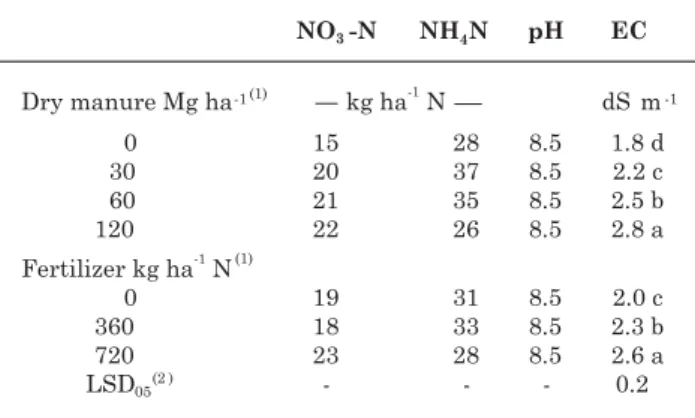
There were no interactions between manure and fertilizer N inputs and the residual salinity effect. At the end of the third forage crop, EC increased with manure and fertilizer N inputs, ranging from 1.8 dS m-1 for the absolute 0 treatment to 2.8 dS m-1
for the highest manure and fertilizer input combination. Chang et al. (1991), Ginting et al. (2003), and Eghball et al. (2004) reported soil EC increases as a result of manure and compost applications. Harivandi et al. (1992) reported that ryegrass is moderately sensitive to soil EC of 3 to 6 dS m-1. We found a significant negative relationship
between dry matter yields and EC (r2 = 0.69; p ≤ 0.05).
Because the all the pots were irrigated without drainage, we suggest that the reduction in dry matter yields for the third forage crop (Table 1) were due to an increase in soil EC, which is in concurrence with Chang et al. (1991), Harivandi et al. (1992), Ginting et al. (2003), and Eghball et al. (2004).
Percentage of NDF
The percentage of N derived from manure input (NDFm) and fertilizer input (NDFf) for each of the
forage crops is shown in table 2. For the three forage crops, no significant interaction (p ≤ 0.05) was found between manure and fertilizer N sources for NDFm.
The NDFm increased significantly from 12 to 22 %
for the 30 to 120 Mg ha-1 manure. The fertilizer N
inputs did not have any effects on NDFm, with an
average of 16 to 18 % for the three fertilizer N rates (Table 2). By the second forage crop, manure N significantly increased (p ≤ 0.05) NDFm with each rate: 15, 23, and 36 % for the 30, 60, and 120 Mg ha-1 rates,
respectively. Fertilizer N decreased NDFm, ranging
from 29 % for 0 mg/pot N to 19.0 % for the 240 kg ha-1
N rate. During the last forage crop, the highest NDFm
(27 %) was found at the highest manure N rate and it was significantly higher (p ≤ 0.05) than the NDFm resulting from each of the intermediate and lower manure N rates (20 and 18 %, respectively). Fertilizer N significantly decreases (p ≤ 0.05) NDFm with each rate increase (32, 21, and 12 % for the 0, 120, and 240 kg ha-1 N rates, respectively) (Table 2).
During the first forage crop without fertilizer N, 77 % of the total N uptake by the forage crop with the highest manure N input came from the soil (Table 2). Similarly, during the second forage crop, without fertilizer N, soil N contributed between 81 and 63 % of the total N uptake, for the 30 and 120 Mg ha-1 dry
manure rates, respectively (Table 2). By the third forage crop without fertilizer N, about 70 % of the total N uptake came from the soil (Table 2).
FDN
There were no significant interactions between manure and fertilizer N inputs in total N uptake (Table 3). For manure N inputs, no significant differences (p ≤ 0.05) between manure N uptake levels were found. For the three forage crops, fertilizer N inputs of 240 kg ha-1 N significantly increased N
Table 1. Total dry aboveground matter production for the first (annual ryegrass), second (sudangrass) and third (annual ryegrass) forage crops grown under four manure and three fertilizer rates,
labeled with 15N
(1) The manure-N treatment was applied only once and was incorporated in the soil before planting the first forage crop. Fertilizer
N treatments were equivalent to 0, 120, and 240 kg ha-1 (NH
4)2SO4-N, for each crop. The total N fertilizer applications for each
pot were 0, 360, and 720 kg ha-1 (NH
4)2SO4-N. The manure rates were applied at an equivalent rate of 0, 30, 60 and 120 Mg ha-1
dry manure. The manure-N treatment was applied only once and was incorporated in the soil before planting the first forage crop. (2) Means with the same letter and N source in the same column are statistically equal. NS: no significant difference (p =
0.05). (3) LSD
uptake by aboveground biomass (p ≤ 0.05). Nitrogen uptake decreased with each crop, probably as a result
of the salt accumulation that was caused by conducting the study without drainage.
Table 2. Percentage of the N in aboveground dry matter that is derived from manure (NDFm). The first
(annual ryegrass), second (sudangrass) and third (annual ryegrass) forage crops grown under four
manure and three fertilizer rates, labeled with 15N
(1) The manure-N treatment was applied only once and was incorporated in the soil before planting the first forage crop. Fertilizer
N treatments were equivalent to 0, 120, and 240 kg ha-1 (NH
4)2SO4-N, for each crop. The total N fertilizer applications for each
pot were 0, 360, and 720 kg ha-1 (NH
4)2SO4-N. The manure rates were applied at an equivalent rate of 0, 30, 60 and 120 Mg ha -1
dry manure. The manure-N treatment was applied only once and was incorporated in the soil before planting the first forage crop. (2) Means with the same letter and N source in the same column are statistically equal. NS: no significant difference. (p =
0.05). (3) LSD05: Least Significant Difference (p = 0.05). Treatment main effects.
Table 3. Shoot N uptake by aboveground dry matter production by each forage crop, fertilized with four manure and three N fertilizer inputs. The first (annual ryegrass), second (sudangrass) and third (annual
ryegrass) forage crops grown under four manure and three fertilizer rates, labeled with 15N
(1) The manure-N treatment was applied only once and was incorporated in the soil before planting the first forage crop. Fertilizer
N treatments were equivalent to 0, 120, and 240 kg ha-1 (NH
4)2SO4-N, for each crop. The total N fertilizer applications for each
pot were 0, 360, and 720 kg ha-1 (NH
4)2SO4-N. The manure rates were applied at an equivalent rate of 0, 30, 60 and 120 Mg ha -1
dry manure. The manure-N treatment was applied only once and was incorporated in the soil before planting the first forage crop. (2) Means with the same letter and N source in the same column are statistically equal. NS: no significant difference
(p = 0.05). (3) LSD
The average total N uptake by the first forage was 277 kg ha-1 N, ranging from 261-296 kg ha-1 N. Since
there was initially an average of 443 kg ha-1 NO 3-N
in the soil, enough to supply all the N needs for the first forage crop, we cannot explain why we got an N response to fertilizer N inputs of (NH4)2SO4. We
suggest that the ryegrass root system may have a greater affinity for NH4-N uptake, showing a response
pertaining to the presence of NH4. Therefore, this hypothesis should be tested with nutrient solutions and combinations of different NH4-N/NO3-N concentrations.
N recovery
The total N recovered by the aboveground dry matter after three extraction cycles is shown in table 4. No interactions (p ≤ 0.05) between the applied manure and fertilizer N were found for NR. Only manure N inputs had significant (p ≤ 0.05) effects on N recovered from the manure source (NRm) (Table 4), which was
higher at the lower rates, decreasing as the manure N input increased. The average recoveries from the manure N inputs were about 9.3 % NRm. Nitrogen
recovery from the fertilizer source (NRf) was significantly affected (p ≤ 0.05) only by the fertilizer rates. As an average over the three crops, NRf ranged
from 22 to 25 % for the lower and higher fertilizer rates, respectively.
Manure N amounts remaining in the soil (NRsm) after three growing cycles ranged from 82 to 88 %, and the N from the fertilizer source (NRsf) ranged from 37 to 43 %. Losses ranging from 4 to 11 % from
manure inputs (NLlm) in our study were lower than the 34 and 39 % of N losses were from the fertilizer sources (NLlf). We suggest that these losses were mainly lost through atmospheric pathways, since no leaching was induced.
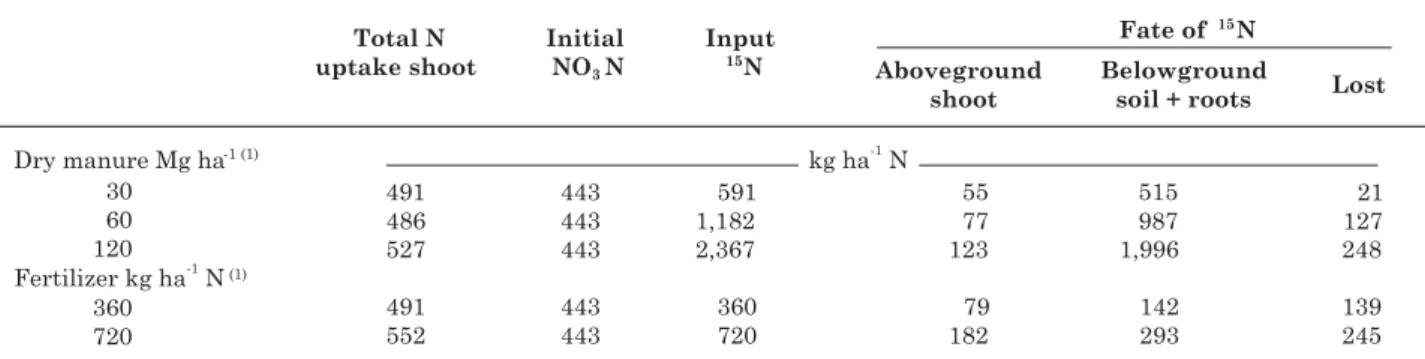
The total N uptake for the three crops ranged from 486 to 552 kg ha-1 N (Table 5). The initial inorganic
soil NO3-N available was 443 kg ha-1 N. Traditional
practices in this region do not account for inorganic soil NO3-N; however this study shows that the initial soil NO3-N was high and almost enough to supply
the total N uptake for these three crops.
These data and recoveries of N from the soil show that the initial soil NO3-N are important N sources
for this region. Although we did not conduct a soil mineralization rate study, we suggest that the mineralized N from the soil organic matter is also an important N source for this region. This data shows that if nutrient managers do not account for these sources, the recovery efficiencies due to excessive manure applications can be lower than 10 % of the applied N (Table 4 and 5). Excessive applications of manure will not increase the rate of N uptake and will increase the potential for N losses to the environment.
The unaccounted for N loss from the 30 and 120 Mg ha-1 dry manure were 21 and 248 kg ha-1 N,
respectively (Table 5). The unaccounted-for N loss from the pots receiving 360 and 720 kg ha-1 N were
139 and 245 kg ha-1 N, respectively (Table 5). The
average N losses were higher for the readily available N fertilizer. These results clearly show that the
Table 4. Total N recovered from manure and fertilizer in the aboveground dry matter (NRm & NRf), N
recovered belowground (soil and roots) (NRsm & NRsf), and unrecovered N or estimated losses (NLlm &
NLlf) after three extraction cycles with annual crops (annual ryegrass-sudan grass-annual ryegrass)
(1) The manure-N treatment was applied only once and was incorporated in the soil before planting the first forage crop. Fertilizer
N treatments were equivalent to 0, 120, and 240 kg ha-1 (NH4)2SO4-N, for each crop. The total N fertilizer applications for each pot were 0, 360, and 720 kg ha-1 (NH
4)2SO4-N. The manure rates were applied at an equivalent rate of 0, 30, 60 and 120 Mg ha-1
dry manure. The manure-N treatment was applied only once and was incorporated in the soil before planting the first forage crop. (2) Means with the same letter and N source in the same column are statistically equal. NS: no significant difference (P =
0.05). (3) LSD
excessive manure rate applications increased N losses to the environment and are in agreement with the Delgado et al. (2008) assessment of N losses to the environment from higher manure rates.
Interaction between salinity and nitrogen inputs
The initial conductivity of the unamended soil used for the greenhouse cylinder study was slightly saline at 1.4 dS m-1, above the threshold that is considered
the lower limit for optimal microbial activity (Smith & Doran, 1996). Table 6 presents the data at the end of the study showing that the application of N inputs increased to about 2.8 dS m-1 for the higher N rates,
levels that likely changed the balance of aerobic and anaerobic microbial activity (Smith & Doran, 1996). Smith & Doran (1996) reported that these conductivity levels can severely inhibit nitrification, and decrease the N loss by denitrification and may enhance the loss of N2O. The choice of ryegrass as a bioassay crop probably masked the effects of high salinity, because this crop is much less susceptible to salt damage than many other agronomic and horticultural crops (Harivandi et al., 1992; Smith & Doran, 1996).
The initial level of NO3-N was 443 kg ha-1 NO 3-N
(Table 5), while at the end of the study the total inorganic soil N was lower than 60 kg ha-1 N
(Table 6). The aboveground N uptake was also lowered from more than 260 kg ha-1 N with the first harvest,
to about 60 kg ha-1 N with the last harvest (Table 3).
However, we would have expected about 45 % mineralization from the applied manure according to Eghball et al. (2002). If we apply these guidelines to the equivalent manure rates applied in this study, we should have expected that about 236, 473, and
947 kg ha-1 N from the dry manure applied at 30, 60
and 120 Mg ha-1 N, respectively, would be available
for uptake as inorganic N. Despite the high manure and N fertilizer application, the 15N labeled data
showed that there still was not high residual soil NO3
-N in this study or high -N uptake and/or high -N losses to the environment from manure. These results suggest that the mineralization of organic N was significantly reduced at these levels of electrical conductivity, in agreement with Smith & Doran (1996).
Our 15N study clearly shows the following: (a)
There was no significant 15N uptake by the
aboveground biomass as was expected because of the large mineralization pulse (Table 4), (b) there was not a significantly high residual NO3-N or NH4-N at the
end of the study as was expected from the high mineralization rate assumed; (c) there was high rate of manure N recovery (over 82 % still in the soil, probably as organic N because the inorganic N content at the end of the study was minimal) (Tables 4, 6); (d) because the pots had no drainage, making leaching impossible, we suggest that the atmospheric N losses were most likely driven by denitrification since the N inputs were incorporated in the soil that was expected to reduce NH3-N volatilizations losses (Meisinger &
Randall, 1991).
Our mass balance approach with this 15N recovery
study demonstrates that these excessive manure applications impact electrical conductivity, resulting in an unbalanced biological situation that affects N transformations. This unique 15N study conducted
under controlled environment with large high labeled
15N manure applications shows that the N losses from
the manure applications were 127 and 248 kg ha-1 N
for the equivalent dry manure rates of 60, and 120 Mg ha-1, respectively. The 15N recovery rates
Table 5. Assessment of N budget. Total N uptake shoots, initial soil NO3-N, input of 15N manure or fertilizer,
fate of recovered 15N in aboveground forage, belowground (soil and roots) and lost. after three extraction
cycles with annual crops (annual ryegrass-sudan grass-annual ryegrass). Studies were conducted under irrigated greenhouse pots using a representative typical Aridisol from North Central “La Commarca Lagunera” region of Mexico
(1) The manure-N treatment was applied only once and was incorporated in the soil before planting the first forage crop. Fertilizer
N treatments were equivalent to 120, and 240 kg ha-1 (NH
4)2SO4-N, kg ha-1 N for each crop. The total N fertilizer applications for
(aboveground biomass) were 77 and 123 kg ha-1 N, for
the equivalent dry manure rates of 60, and 120, respectively. The amount of 15N lost was nearly twice
the amount of 15N recovered by the aboveground
biomass with the equivalent dry manure rates of 60, and 120 Mg ha-1. Since there was no drainage from
the pots, the N losses were via atmospheric pathways.
The lower application of manure, combined with a smaller increase in salinity, reduced atmospheric N losses to 21 kg ha-1 N, nearly two and half times lower
than the 51 kg ha-1 Nrecovered by the aboveground
biomass. The data set suggests that management is the key to reducing the development of conditions that may increase the potential for atmospheric nitrogen losses. Since there was no accumulation of nitrate and/or ammonium at the end of the study, we suggest that these N losses were due to denitrification, created by the unbalanced biological situation resulting from high salinity at these high manure rates (Smith & Doran, 1996). Other recent studies have shown that these changes in electrical conductivity affect the rates of N2O emissions by way of a shift in microbial
populations that drive nitrification and denitrification (Amos et al., 2005; Adviento-Borbe et al., 2006). Additional studies need to be conducted to see if these changes in microbial activity affect potential losses of N2, N2O, and/or NOx, which was beyond the scope of
this study.
CONCLUSIONS
1. Excessive manure and/or fertilizer N applications result in minimal N use efficiencies (< 10 %) and increased potential for losses of reactive N to the environment.
2. More efficient N use by crops and fewer negative effects from salinity will be achieved through lower-rate, more frequent manure applications, rather than higher rate, infrequent applications.
3. When management practices increase electrical conductivity and soil salinity, there is potential for an unbalanced biological situation that may reduce nitrification.
4. Management and application of manure rates that are more aligned with N uptake demands may minimize atmospheric N losses (lower than 3.5 %).
ACKNOWLEDGMENTS
Financial support was provided by CONACYT, Consejo Nacional de Ciencia y Tecnología (research project 35071-B) in collaboration with INIFAP, Instituto Nacional de Investigaciones Forestales Agrícolas y Pecuarias, México.
LITERATURE CITED
ADVIENTO-BORBE, M.A.; DORAN, J.W.; DRIJBER, R.A. & DOBERMAN, A. Soil electrical conductivity and water content affect nitrous oxide and carbon dioxide emissions in intensively managed soils. J. Environ. Qual., 35:1999-2010, 2006.
AMOS, B.; ARKEBAUER, T.J. & DORAN, J.W. Soil surface fluxes of greenhouse gases in an irrigated maize-based agroecosystem. Soil Sci. Soc. Am. J., 69:387-395, 2005. ANTWEILER, R.C.; GOOLSBY, D.A. & TAYLOR, H.E.
Nutrients in the Mississippi River. In: MEADE, R.H., ed. Contaminants in the Mississippi River. Reston, 1996. p.73-85. (U.S. Geol. Surv. Circ., 1133)
CHANG, C.; SOMMERFELDT, T.G. & ENTZ, T. Soil chemistry after eleven annual applications of cattle feedlot manure. J. Environ. Qual., 20:475-480, 1991.
DELGADO, J.A. Quantifying the loss mechanisms of nitrogen. J. Soil Water Conserv., 57:389-398, 2002.
DELGADO, J.A.; DILLON, M.A.; SPARKS, R.T. & FOLLETT, R.F. Tracing the fate of 15N in a small-grain potato rotation
to improve accountability of N budgets. J. Soil Water Conserv., 59:271-276. 2004.
DELGADO, J.A.; SHAFFER, M.J.; LAL, H.;MCKINNEY, S.; GROSS, C.M. & COVER, H. Assessment of nitrogen losses to the environment with a Nitrogen Trading Tool (NTT). Comput. Electron. Agric., 63:193-206, 2008.
Table 6. Final soil nitrate-nitrogen (NO3-N),
ammonium-nitrogen (NH4-N), pH, and electrical
conductivity (EC) measurements conducted at the end of the study after three extraction cycles with annual crops (annual ryesudan grass-annual ryegrass)
(1) The manure-N treatment was applied only once and was
incorporated in the soil before planting the first forage crop. Fertilizer N treatments were equivalent to 120, and 240 kg ha-1 (NH
4)2SO4-N, for each crop. The total N fertilizer
applications for each pot were 360, and 720 kg ha-1 (NH 4)2SO4
-N. The manure rates were applied at an equivalent rate of 30, 60 and 120 Mg ha-1 dry manure. The manure-N treatment was
applied only once and was incorporated in the soil before planting the first forage crop. (2) LSD
05: Least Significant
EGHBALL, B.; WIENHOLD, B.J.; GILLEY, J.E. & EIGENBERG, R.A. Mineralization of manure nutrients. J. Soil Water Conserv., 57:470-473, 2002.
EGHBALL, B.; GINTING, D. & GILLEY, J.E. Residual effects of manure and compost applications on corn production and soil properties. Agron. J., 96:442-447, 2004. FOLLETT, R.F. & WALKER, D.J. Groundwater quality
concerns about nitrogen. In: FOLLETT, R.F., ed. Nitrogen management and groundwater protection. Amsterdam, Elsevier Science Publication, 1989. p.1-22.
GEE, G.R. & BAUDER, J.W. Particle soil analysis. In: KLUTE A., ed. Methods of soil analysis: Physical and mineralogical methods. 2.ed. Madison, America Society of Agronomy, 1986. Part 1. p.383-411. (Agronomy Monograph, 9) GINTING, D.; KESSAVALOU, A.; EGHBALL, B. & DORAN,
J.W. Greenhouse gas emissions and soil indicators four years after manure and compost applications. J. Environ. Qual., 32:23-32, 2003.
HARIVANDI, M.A.; BUTLER, J.D. & WU, L. Salinity and turfgrass culture. In: WADDINGTON, D.V.; CARROW, R.N. & SHEARMAN, R.C., eds. Turfgrass. Madison, America Society of Agronomy, 1992. p.207-229. (Agronomy Series, 32)
JOKELA, W.E. Nitrogen fertilizer & dairy manure effects on corn yield & soil nitrate. Soil Sci. Soc. Am. J., 56:148-154, 1992. LI, X.; HU, C.; DELGADO, J.A.; ZHANG, Y. & OUYAN, Z. Increased nitrogen use efficiencies as a key mitigation alternative to reduce nitrate leaching in the northern China Plain. J. Agric. Water Manag., 89:137-147, 2007. LIU, X. & JU, X. Nitrogen dynamics & budgets in a winter
wheat-maize cropping system in the North China Plain. Field Crops Res., 83:111-124, 2003.
LOEPPERT, R.H. & SUAREZ, D.L. Carbonate and gypsum. In: BIGHAM, J.M., ed. Methods of soil analysis: Chemical methods. Madison, Soil Science Society of America, 1996. Part 3. p. 437-474. (Book Series, 5)
MEISINGER, J.J. & RANDALL, G.W. Estimating nitrogen budgets for soil-crop systems. In: FOLLETT, R.F.; KENNEY, D.R. & CRUSE, R.M., eds. Managing nitrogen for groundwater quality and farm profitability. Madison, Soil Science Society of America, 1991. p.85-122. MULVANEY, R.L. Nitrogen-Inorganic forms. In: BIGHAM,
J.M., ed. Methods of soil analysis: Chemical methods. Madison, Soil Science Society of America, 1996. Part 3. p.1123-1184. (Book Series, 5)
MUÑOZ, G.R.; POWELL, J.M. & KELLING, K.A. Nitrogen budget and soil N dynamics after multiple applications of non-labeled or 15nitrogen-enriched dairy manure. Soil
Sci. Soc. Am. J., 67:817-825, 2003.
NELSON, D.W. & SOMMERS, L.E. Total carbon, organic carbon, and organic matter. In: BIGHAM, J.M., ed. Methods of soil analysis: Chemical methods. Madison, America Society of Agronomy, 1996. Part 3. p.961-1010. (Book Series, 5)
PICCHIONI, G.A. & QUIROGA, G.H.M. Growth and nitrogen partitioning, recovery, and losses in bermudagrass receiving soluble sources of labeled 15Nitrogen. J. Am.
Soc. Hortic. Sci., 124:719-725, 1999.
RHOADES, J.D. Salinity: Electrical conductivity and total dissolved solids. In: BIGHAM, J.M., ed. Methods of soil analysis: Chemical methods. Madison, America Society of Agronomy, 1996. Part 3. p.417-435. (Book Series, 5) ROBARGE, W.P.; EDWARDS, A. & JOHNSON B. Water and
waste analysis via nitration of salicylic acid. Comm. Soil Sci. Plant Anal., 13:1207-1215, 1983.
SAS Institute. User’s guide. Version 6. Cary, 1990. v.2. SHARPLEY, A.N.; WELD, J.L.; BEEGLE, D.B.; KLEINMAN,
P.J.A.; GBURUK, W.J.; MOORE JR., P.A. & MULLINS, G. Development of phosphorus indices for nutrient management planning strategies in the United States. J. Soil Water Conserv., 53:137-151, 2003.
SHARPLEY, A.N.; KLEINMAN, P.J.A.; MCDSOWELL, R.W.; GITAU, M., & BRYANT, R.B. Modeling phosphorus transport in agricultural watersheds, processes and possibilities. J. Soil Water Conserv., 57:425-439, 2002. SHARPLEY, A.N.; DANIEL, T.; SIMS, T.; LEMUNYON, J.;
STEVENS, R. & PARRY, R. Agricultural phosphorus and eutrophication. Washington, USDA, 1999. (USDA-ARS, 149)
SMITH, J.L. & DORAN, J.W. Measurement & use of Ph and electrical conductivity for soil quality analysis. In: JONES, A.J. & DORAN, J.W., eds. Methods for assessing soil quality. Madison, Soil Science Society of America, 1996. p.169-188. (Special Publication, 49)
SØRENSEN, P.; JENSEN, E.S. & NIELSEN, N.E. The fate of
15N-labelled organic nitrogen in sheep manure applied to
soils of different texture under field conditions. Plant Soil,
162:39-47, 1994.
THOMAS, G.W. Soil pH and soil acidity. In: BIGHAM, J.M., ed. Methods of soil analysis: Chemical methods. Madison, America Society of Agronomy, 1996. Part 3. p.475-490. 1996. (Book Series, 5)
THOMSEN, I.K.; HANSEN, J.F.; KJELLERUP, V. & CHRISTENSEN, B.T. Effects of cropping system and rates of nitrogen in animal slurry and mineral fertilizer on nitrate leaching from a sandy loam. Soil Use Manag.,
9:53-58, 1993.
ZHU Z.L. & CHEN, D.L. Nitrogen fertilizer use in China: Contributions to food production, impacts on the environment and best management strategies. Nutr. Cycl. Agroecosyst., 63:117-127, 2002.