WORK, CONTINUING EDUCATION AND INCOME
PROFESSIONAL AUDIOLOGIST ACTIVE IN AUDIOLOGY
Trabalho, educação continuada e renda do proissional
fonoaudiólogo atuante em Audiologia
Mariana Thuany Gonçalves(1), Brízia Lacerda Fernandes(1), Juliana Nunes Santos(2),
Camila Queiroz de Moraes Silveira Di Ninno(1), Denise Brandão de Oliveira e Britto(1)
(1) Pontifícia Universidade Católica de Minas Gerais - PUC
Minas - Minas Gerais, MG, Brasil.
(2) Universidade Federal de Minas Gerais – UFMG, MG,
Brasil.
Conlict of interest: non-existent
and introduction, in October 2004, of rule GM nº 2073 creating the National Politcs of Attention to The Auditory Health, allowed a decisive step in the organization of a comprehensive caring range to the people, pointing out the importance of the univer-sality of acess, equality, integrity and humanization at the auditory public health². In 2010, was approved the Law of Neonatal Universal Auditory Triage, that brought a new dimension to the precocious
diagnosis of deiciency auditory3,4.
The national politics of health have being favouring the introduction of the professional speech therapist at USH, mainly at the basic attention, with large growing of the health attention network profes-sionals number in the last years5,6. This introduction
was afirmed and ensured by the creation of Family
INTRODUCTION
The Unique System of Health (USH) (Sistema Único de Sáude – SUS) constituted in 1988 has as priorities universality, integrity and equality in the actions of brazilian’s health. Since its creation, many advances are observed, specially in auditory, incorporated as public health politics in Brazil in 1993, with the introduction of cochlear implant in the Unique System of Health (USH)¹. The creation
ABSTRACT
Purpose: to investigate the formation pattern and performance of the audiologist in Audiology in the 6th Region, besides analyzing job satisfaction, and to verify the relationship between the degree of professional development and the degree of satisfaction with the speech therapist monthly income – salary. Methods: cross-sectional study with audiologists enrolled in the 6th Region Regional Speech Council, through the application of a questionnaire to analyze the variables: education, professional activity areas, salary and satisfaction with the profession, in the period of May to October 2012.
Results: 857 audiologists were investigated. Of these, 63.8% work in Audiology, 53.7% graduated in Minas Gerais, 51.4% have specialization and 5.5% are masters, which was associated statistically with higher wage income (p <0.05) . With regard to the source of income, 84.1% reported having in Speech Therapy your only source of income and most receive from 2 to 5 minimum wages. Most work with occupational audiology. The ENT is the professional who most directs patients. From those
investigated, 54.1% are not satisied with their profession. There was a signiicant relationship between
job satisfaction and income. Conclusion: there was little integration of the speech therapist in the areas
of expertise, central auditory processing test, vestibular rehabilitation, hearing conservation program
and labyrinthine tests. The importance of continuing studies is emphasized to assist in employability on the labor market and improve professional skills. It is evident the need to integrate academic and professional training.
used a questionnaire consisting of 27 questions with opened and closed options to answer, made by speech therapists from CRFa 6th Region, SINFEMG
and students and professors from Speech Therapy Courses at Pontifícia Universidade Católica de Minas Gerais (PUC Minas), FEAD MG and Universidade Federal de Minas Gerais (UFMG).
The questions investigate data related to the level of training, professional practice location, monthly income/salary and satisfaction with the career.
The data bank of the research was available to realize to realize this present research, that considered as initial criteria being a speech therapist registered at 6th Region and has performing in the
Audiology area (positive answer to the the question 16 A from the questionnaire). The questionnaires
with mistakes and incoherencies at fulillment were excluded.
To the portal, processing and quantitative analysis of the data was used software SPSS-16.o version. To the descriptive analysis, was made a distribution of frequency of categorical variables of diffusion of diffusion of continuous variables involved in the performing characterization and professional pattern of speech therapist inserted at 6th Region. It
was used the test Qui-quadrado to verify the
differ-ences between the ratios, with signiicance level of
p<0,05.
RESULTS
The study of CRFa 6th Region investigated
857 speech therapists from different areas of performing. In this present research, were selected only the professionals that perform in the Audiology area, corresponding to 547 (63,8%) speech thera-pists. From these, 523 (95,6%) are female gender; 20 (3,7%) are male gender; and 4 (0,7%) didn’t pronounce the gender. The middle of ages was 32,2 years old (+ 6,4 years), between 21 to 58 years old.
From professionals the perform in the Audiology area, 294 (53,7%) graduated in the Minas Gerais State; 59 (10,8%), in Espírito Santo; 25 (4,6%), in Mato Grosso do Sul; 10 (1,8%), in Mato Grosso and 156 (28,5%) in States that are not in 6th Region.
From people that graduated in Minas Gerais State, the majority (58,2%) concluded the graduation in Belo Horizonte municipality. From professionals the graduated in Espírito Santo, 52 (88,1%) graduated in Vila Velha. Among the graduating students in Mato Grosso do Sul State everyone (100%) concluded the course at the capital – Campo Grande. From professionals graduated in Mato Grosso State, 5 (50%) accomplished the course in Cuiabá and 5 (50%) in Várzea Grande Municipality.
Health Support Nuclei (FHSN)7 and other programs
of health, although it’s still observed the necessity
of expansion of speech therapy assistance actions8.
Currently, the speech therapists act with actions in family’s health strategies9, child’s health, mental’s
health, school’s health and teenager’s health and they are essential in the actions embraced by the National Auditory Health Politics10,11, because it’s
speech therapist’s task the realization of evaluation, diagnoses, treatment, rehabilitation and auditory triage12.
The shortage of studies related to the pattern of the speech therapist who acts in the Audiology’s area contributes to the importance of this research, as long as allows the characterization of these profes-sionals and a diagnoses of the market situation, favoring the discover of potential areas, a higher compromising with the class and the profession value.
This way, the current study had as purpose to investigate the pattern of vocational training and speech therapist’s performance in the Audiology area at 6th region (Minas Gerais, Espírito Santo,
Mato Grosso and Mato Grosso do Sul), besides analyzing the professional satisfaction and verifying possible relations between the degree of profes-sional improvement and satisfaction of the speech therapist with the monthly income provided by his/ her salary.
METHODS
The research was approved by the Committee of Etics in Research of Faculdade de Estudos Administrativos de Minas Gerais (FEAD MG) under the protocol 202. Everyone who was investigated
signed the Free Consent Term and Clariied autho
-rizing his/her participation in the research.
It was realized a descriptive transversal study from April to October 2012, wich speech therapists registered at Regional Council of Speech Therapy (CST) (Conselho Regional de Fonoaudiologia - CRFa) of the 6th region, with a questionnaire
appli-cation .
The study was an initiative of CRFa 6th region in
partnerships with the Universities and Colleges with graduation in speech therapy from Belo Horizonte, that authorized/allowed the data analysis in this research.
The professionals received the questionnaire
and the free consent term and clariied by mail;
income, 52 (9,5%) has in the Speech Therapy as the most important income, but it is not the only one and 32 (5,9%) related having another incomes.
About the monthly income, the major part of the people who was investigated receive R$ 1.635,01 to R$ 3.270,00 (Figure 1), that stands for two to
ive minimum wage of present study’s year. Among
professionals that have income superior to R$ 5.450,00, 30 (86%) related having specialization (Table 1).
From everyone that was investigated, 281 (51, 4%) have specialization, being 119 (42,3%) with specialization only in Audiology and 24 (8,5%) are specialized in one more area, being Audiology one of them. The rest of others, 49,1%, has special-ization in other areas of Speech Therapy or from Health.
From professionals that perform with Audiology, 30 (5,5%) have master and 1 (0,2%) has doctorate.
From the amount of 547 professionals, 460 (84,1%) related the Speech Therapy is their only
Table 1 – Relationship between the professional pattern and the monthly income of the speech therapists that perfom in Audiology area at 6th Region
Continuing Education
Monthly income
Test p value Until R$545,01- R$1635,01- R$3270,01- Over
R$545,00 R$1635,00 R$3270,00 R$5450,00 R$5450,00
Specialization Yes 6 (40%) 77 (49%) 155 (65%) 76 (82%) 30 (86%) 39,3 0,00* No 9 (60%) 81 (50%) 85 (35%) 17 (18%) 5 (14%)
Master Yes 0 (0%) 3 (2%) 12 (5%) 9 (10%) 2 (6%) 11,1 0,51 No 15 (100%) 155 (98%) 227 (94%) 84 (90%) 33 (94%)
*Values statistically meaningful (p<0,05) – Qui-Quadrado Test
Figure 1 – Monthly salary income of speech therapists from 6th region that perform in Audiology area
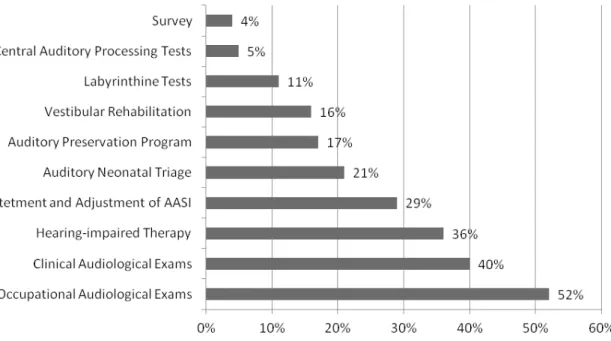
About the performing areas, 52% of profes-sionals work accomplishing occupational
audio-logical exams (Figure 2).
About the performing areas and the distri-bution in the states that reach 6th Region, it’s
noticed that major number of speech therapists is working in Minas Gerais. Mato Grosso do Sul State
represents the smallest percentage of performing.
The expertise areas, central auditory processing
test, vestibular rehabilitation, hearing conservation
program and labyrinthine tests (except for Espírito
Figure 2 – Speech Therapists´ performing from 6th Region in the Audiology area
Table 2 – Relationship between performing areas and the distribution per states of active speech therapists in the audiology area at 6th region
Performing areas
States Minas
Gerais (N=394)
Espírito Santo (N=78)
Mato Grosso
(N=35)
Mato Grosso do Sul (N=32)
Out of 6th Region
(N=5)
Clinical audiological
exam YesNo 153 - 38,8%241 - 61,1% 29 - 37,1%49 - 62,8% 15 - 42,8%20 - 57,1% 14 - 43,7%18 - 56,2% 3 - 60%2 - 40% Occupational
audiological exam YesNo 199 - 50,5%195 - 49,4% 46 - 58,9%32 -41% 16 - 45,7%19 - 54,2% 20 - 62,5%12 - 37,5% 2 - 40%3 - 60%
Labyrinthine tests Yes 39 - 9,8% 10 - 12,8% 6 - 17,1% 2 - 6,2% 1 - 20% No 354 - 89,8% 68 - 87,1% 29 - 82,8% 30 - 93,7% 4 - 80%
Vestibular rehabilitation Yes 68 - 17,2% 8 - 10,2% 7 - 20% 3 - 9,3% 2 - 40% No 326 - 82,7% 70 - 89,7% 28 - 80% 29 - 90,6% 3 - 60% Universal auditory
neonatal triage
Yes 77 - 19,5% 17 - 21,7% 10 - 28,5% 7 - 21,8% 2 - 40% No 317 - 80,4% 61 - 78,2% 25 - 71,4% 25 - 78,1% 3 - 60% Hearing-impaired
Therapy
Yes 145 - 36,8% 26 - 33,3% 11 - 31,4% 13 - 40,6% 3 - 60% No 249 - 63,1% 52 - 66,6% 24 - 68,5% 19 - 59,3% 2 - 40% Statement and
adjustment of AASI
Yes 134 - 34% 9 - 11,5% 9 - 25,7% 7 - 21,8% 2 - 40% No 260 - 65,9% 69 - 88,4% 26 - 74,2% 25 - 78,1% 3 - 60% Processing central
auditory test
Yes 23 - 5,8% 2 - 2,5% 1 - 2,8% 1 - 3,1% 2 - 40% No 371 - 94,1% 76 - 97,4% 34 - 97,1% 31 - 96,8% 3 - 60% Auditory preservation
program
Yes 69 - 17,5% 8 - 10,2% 6 - 17,1% 6 - 18,7% 0 - 0% No 325 - 82,4% 70 - 89,7% 29 - 82,8% 26 - 81,2% 5 - 100%
Survey Yes 14 - 3,5% 3 - 3,8% 2 - 5,7% 1 - 3,1% 0 - 0% No 380 - 96,4% 75 - 96,1% 33 - 94,2% 31 - 96,8% 5 - 100%
52 (9,5%), another professionals 27 (4.9%), alergol-ogist 17 (3,1%), dermatolalergol-ogist 9 (1,6%) and beauty surgeon 7 (1,3%).
From who was investigated, 248 (45,4%) are
satisied with their profession and 296 (54,1%) are not satisied. From these, 189 (34,6%) are not satisied because of bad income, 56 (10,2%)
because of lack of job, 29 (5,3%) because people do not recognize their work and 22 (4%) did not justify the reason.
From speech therapists that receive the salary
over R$5400,00, 29 (85%) are satisied as profes
-sionals (Table 3).
Insert place of table 3. Among the speech therapists that perform with
Audiology, 489 (89,4%) receive patients from others professionals, being the otorhinolaryngologist 419 (76,6%) the professional that does more routings, followed by pediatrician 321 (58,7%), orthodontist 277 (50,6%), school 271 (49,5%), neurologist 268 (49%), psychologist 254 (46,4%), speech therapist 230 (42%), labor doctor 210 (38,4%), physiother-apist 210 (38,4%), general practitioner 200 (36,6%), psycopedagogue 183 (33,5%), odontopediatrician 135 (24,7%), geriatrician 144 (20,8%), occupational therapist 101 (18,5%), surgeon of head and neck 88 (16,1%), nutritionist 79 (14,4%), jaw facial surgeon 75(13,7%), neo pediatrician 72 (13,2%), oncologist
Table 3 – Relationship between professional satisfaction and monthly salary income of performing speech therapists in the audiology area at 6th region
Professional satisfaction
Monthly salary income
Test p value Until R$545,01- R$1635,01- R$3270,01- Over
R$545,00 R$1635,00 R$3270,00 R$5450,00 R$5450,00
Yes 4 (29%) 39 (26%) 110 (47%) 53 (58%) 29 (85%) 53,6 0,00* No 10 (71%) 113 (74%) 125 (53%) 38 (42%) 5 (15%)
*Values statistically meaningful (p<0,05) – Qui-Quadrado Test
DISCUSSION
By the analysis of database of the research about the professional pattern of Speech Therapy Regional Council 6th Region (Conselho Regional de
Fonoaudiologia da 6ª Região), it was tried to typify the speech therapy professional that performs at the Audioliogy area. From who was investigated, the major referred working with evaluation, diagnosis or hearing rehabilitation or vestibular. This datum goes
to the reality of job market where the irst option of
speech therapist´s job is Audiology, with spotlight to audiology´s area that absorbs a big amount that has just graduated, professionals are going to be out for
their irst job and professional upgrading.
The growing demand and the economic pattern
from each region set a higher search to a speciic area
of Speech Therapy. The industries ´concentration in Minas Gerais state belongs to 6th Region, propitiate
the growing of the occupational audiology´s service. The speech therapist who works in this area is responsible for monitoring the workers´ health and preventing future auditory problems13,14.
Study tells that the major dificulties of speech
therapists insert at the job market are related to the lack of knowledge about the possibilities of
performing, academic formation at the graduation specially clinic and the growing of competitiveness in the face of growing of the number of professionals at the market. As enablers, are quoted the net of
contacts, the planning and identiication of oppor
-tunities, the continuing education and the ability at activities performances15.
Related to the graduation it is observed that there is a major concentration in Minas Gerais. That
can be explained by the concentration of graduation
courses in Speech Therapy at the State. From 14 Colleges that offer the speech therapy course at 6th Region, 9 are in Minas Gerais16, being the irst
course created in 1990 at University Methodist
Center Izabela Hendrix17. In 2000, it was created the
irst public course of Speech Therapy in the state,
at UFMG18. At PUC MG, the course was implanted
in 200219. In 2008, was recognized at FEAD MG
and at FUMEC University (Mineira Foundation of Education and Culture) 20,21.
At this present study it was veriied that more
than half of the professionals has specialization and 5,5% from who was investigated referred having master, what corroborates to established of liter-ature22. Similar studies made with newly graduated
The indings from this research show that most
of people who were investigated is disgruntled
with the profession. Possible explanation to this
is the decrease wage and the lack of employment and no recognition at work. Besides, many speech
therapists examined are newly graduated and they are still itting themselves in the market. Study with
speech therapists that perform in clinical audiology
foreground that the major fells satisied with the
profession22.
It was observed that the level of professional satisfaction is directly related to the monthly salary income sustaining the literature26.
The characterization and the comprehension of the situation of the professionals who perform at Audiology area contribute to help the professional in
his/her ill at the job market and support the knowing
of new niches.
The sample does not represent a loyal portrait from reality, once that only 15,8% from registrated people at CRFa 6th Region participated, what
shows the little adhesion of the professional to the category´s initiatives. Moreover, the data contributes to the understanding of the speech therapists´ work situation at the 6th Region and reinforce the necessity
of continuing education as a way to increase and professional success.
It is recommended that the speech therapists who wants to work with Audiology invests in areas
that represent niches of market to be explored.
Stands out the importance of continuing the studies, in order to help the professional insert at the job market and improving the professional
qualiication. It is clear the necessity of integrating
academic and professional formation.
It is understood that the research must be stimulated once that represents a way of let out the profession, document new therapeutic practices
and validated existent practices.
CONCLUSION
The speech therapists that perform in the Audiology area at 6th Region are, in a majority,
women and are in 32 years old average. The major part graduated in Minas Gerais, has specialization, has in Speech Therapy his/her only source of income, receive from 2 to 5 minimum wage. About the performing area, it is noticed predominance in the realization of occupational audiological tests and clinical tests. They receive routings mainly from Otorhinolaryngologist, and make known that they are disgruntled with the profession. There was a It is noticed, therefore, that search to improvement
has been a reality at Speech Therapy career. About the monthly salary income, the major part of those were investigated pronounced receive from 2 to 5 minimum wages, that goes to the meeting with literature. The monthly income of speech therapist is higher than the real Brazilian income per month in the 2011 year24 and equal to the professionals
from Psychology, Nursing and Physical Education. Values referent to the Demographic Census 2000/ IBGE25.
This present study showed too that the
profes-sional upgrading by specialization inluences in the
speech therapist´s monthly income (Table 1), that
increased in a signiicative degree to the profes
-sionals that committed in continuing education. These data are different from the study accom-plished in Fortaleza city26.
The major part of these professionals works
accomplishing occupational exam, followed by clinical audiological exam, hearing-impaired
therapy and instruction and adjustment of Device of
Individual Resonant Ampliication (DIRA)- Aparelho de Ampliicação Sonora Individual(AASI). This fact
can be justiied by the strong inluence of rehabili
-tation view in this profession27, and care about
hearing adjustment occurred because of labour activity28,29. However, there are few speech
thera-pists committing in the survey areas, central auditory processing tests and labyrinthine tests. Notice that
these areas are barely explored and, therefore,
represent potentials niches of Speech Therapy´s performing.
It was observed a major insert of professionals performing in different areas of Audiology in Minas Gerais state, what was acceptable once that among the states belonging to the 6th Region, it is what has
a major number of speech therapists16.
It was veriied that at the speech therapist´s
performing the contact´s network is essential and the same receive routing from various professionals30,
being that the otorhinolaryngologist, the pediatrician the orthodontist and the teachers those who direct patients to the speech therapists at most. Research in this area relates the otorhinolaryngologist and the teachers are the professionals that direct at
most, reafirming the indings of the present study.
Dentists and speech therapists are also reported in the literature, in minor percentage than that found at this present study30. It is worth to mention that the
ACKNOWLEDGMENTS
To the Speech Therapy Regional Council 6th
Region for making available the database;
To the Speech Therapists who answered the questionnaires, making this job possible;
To Graziela Zanoni de Andrade, Andréa W. Dias Gattoni and Juliana Lara Lopes, speech therapists.
signiicant relation between the specialization and
the professional satisfaction and the monthly salary income.
It was observed just a little speech therapist´s insert in the survey areas, central auditory processing test, vestibular rehabilitation, hearing conservation program and labyrinthine tests.
REFERENCES
1. Melo TM, Yamaguti EH, Moret ALM, Bevilacqua
MC. Audição e linguagem em crianças deicientes
auditivas implantadas inseridas em ambiente bilíngue: um estudo de casos. Rev Soc Bras Fonoaudiol. 2012;17(4):476-81.
2. Scaziotta MACM, Andrade IFC, Lewis DR. Programa de triagem auditiva seletiva em crianças de risco em um serviço de saúde auditiva de São Paulo. Rev CEFAC. 2012;14(2):234-42. 3. Aurelio FS, Tochetto TM. Triagem auditiva
neonatal: experiências de diferentes países. Arq Int
Otorrinolaringol. 2010;14(3):355-63.
4. Faistauer M, Augusto TAM, Floriano M, Tabajara CC, Martini CM, Schmidit VB, et al. Implementação
do programa de triagem auditiva neonatal universal em hospital universitário de município da região Sul
do Brasil: resultados preliminares. Rev AMRIGS. 2012;56(1):22-5.
5. Santos JN, Maciel FJ, Martins VO, Rodrigues ALV, Gonzaga AF, Silva LF. Inserção dos fonoaudiólogos no SUS/MG e sua distribuição no território de Minas Gerais. Rev CEFAC. 2012;14(2):196-205.
6. Ferreira CL, Silva FR, Martins-Reis VO, Friche AAL, Santos JN. Distribuição dos fonoaudiólogos na atenção à saúde no estado de Minas Gerais entre 2005 e 2010. Rev CEFAC. 2013;15(3):672-80. 7. Fernandes TL, Nascimento CMB, Sousa FOS. Análise das atribuições dos fonoaudiólogos do NASF em municípios da região metropolitana do Recife. Rev CEFAC. 2013;15(1):153-9.
8. Santos JN, Gomes LBP, Souza LM, Souza NRM.
Aspectos da assistência fonoaudiológica segundo
a pesquisa por amostra de domicílios de Minas Gerais. Rev CEFAC. 2013;15(2):366-73.
RESUMO
Objetivo: investigar o peril de formação e atuação do fonoaudiólogo na área de Audiologia na 6ª
Região, além de analisar a satisfação proissional, e veriicar possíveis relações entre o grau de aper
-feiçoamento proissional e de satisfação do fonoaudiólogo com a renda salarial mensal. Métodos:
estudo transversal descritivo com fonoaudiólogos inscritos no Conselho Regional de Fonoaudiologia
6ª Região por meio da aplicação de um questionário analisando as variáveis: formação acadêmica, áreas de atuação proissional, faixa salarial e satisfação com a proissão, no período de maio a
outubro de 2012. Resultados: foram investigados 857 fonoaudiólogos. Destes, 63,8% atuam com Audiologia, 53,7% se graduaram em Minas Gerais, 51,4% possuem especialização e 5,5%, mes-trado, o que se relacionou estatisticamente com maior renda salarial (p<0,05). No que se refere à fonte de renda, 84,1% relataram ter na Fonoaudiologia a sua única fonte de renda e a maior parte recebe de 2 a 5 salários mínimos. A maioria trabalha com audiologia ocupacional. O
otorrinolaringo-logista é o proissional que mais encaminha pacientes. Dos investigados, 54,1% não estão satisfei
-tos com a proissão. Houve relação signiicante entre satisfação proissional e renda. Conclusão:
observou-se pouca inserção do fonoaudiólogo nas áreas de perícia, teste de processamento auditivo central, reabilitação vestibular, programa de conservação auditiva e testes labirínticos. Ressalta-se a
importância da continuidade dos estudos para auxiliar na inserção proissional no mercado de traba
-lho e me-lhorar a qualiicação proissional. Torna-se evidente a necessidade de se integrar formação acadêmica e proissional.
DESCRITORES: Audiologia; Área de Atuação Proissional; Mercado de Trabalho; Fonoaudiologia;
CUR_ARQ_PROJE_PEDAG20100414134210. pdf?PHPSESSID=481a02f937c466bd890697651c f01dd
20. FEAD. Fonoaudiologia. [Internet] [Acesso 2012 Out. 30] Disponível em: http://www.fead.br/ infocurso.asp?CC=786
21. Universidade FUMEC. Fonoaudiologia - apresentação. [Internet] [Acesso 2012 Out. 30] Disponível em: http://www.fumec.br/cursos/ graduacao/fonoaudiologia/apresentacao/
22. Braga CM, Martins KVC, Queiroz MAS, Câmara
MFS. Peril mercadológico do fonoaudiólogo
atuante na área de Audiologia Clínica.Rev CEFAC. 2013;15(3):546-51.
23. Silva DGM, Sampaio TMM, Bianchini EMG. Percepções do fonoaudiólogo recém-formado
quanto à sua formação, intenção proissional e
atualização de conhecimentos. Rev Soc Bras Fonoaudiol. 2010;15(1):47-53.
24. Instituto Brasileiro de Geograia e Estatística.
PNAD 2011: crescimento da renda foi maior nas
classes de rendimento mais baixas. [Internet]
[Acesso 2012 Out. 30] Disponível em: http://www. ibge.gov.br/home/presidencia/noticias/noticia_ visualiza.php?id_noticia=2222&id_pagina=1
25. Centro de Políticas Sociais. O retorno da educação no mercado de trabalho. [Internet] [Acesso 2012 Out. 30] Disponível em: http://www. fucape.br/downloads/fgv-2005.pdf
26. Martins KVC, Costa TP, Câmara MFS. Peril mercadológico do proissional fonoaudiólogo
atuante na área de triagem auditiva escolar. Rev CEFAC. 2012;14(4):641-9.
27. Stefaneli FR, Monteiro KDGM, Spinelli RL.
Peril do fonoaudiólogo na cidade de São José dos
Campos. Rev CEFAC. 2004;6(1):101-5.
28. Arakawa AM, Sitta EI, Caldana ML, Sales-Peres SHC. Análise de diferentes estudos epidemiológicos em Audiologia realizados no Brasil. Rev CEFAC. 2011;13(1):152-8.
29. Boger ME, Mitre EI. Análise do desencadeamento
de perda auditiva por exposição a níveis de
intensidade sonora menores que 85db. Rev Med Saude Brasilia. 2012;1(2):71-9.
30. Marchesan IQ. Quem encaminha pacientes para fonoaudiólogos? In: 16° Congresso Brasileiro de Fonoaudiologia; 24-27 set. 2008. Campos do Jordão: SBFa; 2008; 406.
9. Peranich LM, Reynolds KB, O’Brien S, Bosch
J, Cranill T. The Roles of Occupational Therapy,
Physical Therapy, and Speech/Language Pathology in Primary Care. The Journal for Nurse Practitioners – JNP. 2010;6(1):36-43.
10. Moreira MD, Mota HB. Os caminhos da fonoaudiologia no Sistema Único de Saúde – SUS. Rev CEFAC. 2009;11(3):516-21.
11. Silva KR, Ferreira MC, Guia ACOM, Oliveira
Neto R, Lemos SMA. Produção cientíica em saúde
auditiva no Brasil: análise do período de 2000 a 2010. Rev CEFAC. 2013;15(1):215-27.
12. Correia RBF, Coelho JMS. Ações em Saúde Auditiva escolar no município de Sobral-CE: percepção de fonoaudiólogos. Rev bras promoç saúde. 2012;25(2):228-34.
13. Nunes CP, Abreu TRM, Oliveira RMA. Sintomas auditivos e não auditivos em trabalhadores
expostos ao ruído. Rev baiana saúde pública.
2011;35(3):548-55.
14. Oliveira WTGH, Andrade WTL, Teixeira CF, Lima
MLLT. Audição de Trabalhadores Antes e Após o
Programa de Conservação Auditiva. Rev bras ciênc
saúde. 2012;16(4):517-24.
15. Gattoni AWD. A inserção do fonoaudiólogo no mercado de trabalho de Belo Horizonte [dissertação]. Belo Horizonte (MG): FEAD - Centro de Gestão Empreendedora; 2008.
16. Conselho Federal de Fonoaudiologia. Número de fonoaudiólogos do Brasil por regional em Maio/2012. [Internet] [Acesso em 18 out. 2012]. Disponível em: http://www.fonoaudiologia.org.br.
17. Rosa LLC, Oliveira TCM. Izabela Hendrix -
Pioneirismo em Minas Gerais. In: Gama ACC, Lemos SMA (org.). Histórico da Fonoaudiologia em Minas Gerais. Belo Horizonte: Folium; 2010.p.55-68.
18. Pereira FCB, Aarão PCL, Seixas KL, Silva
HG, Tavares APN, Campos FR, et al. Histórico da
Fonoaudiologia em Minas Gerais: impressão dos protagonistas. Rev CEFAC. 2012;14(2):313-26. 19. Fonoaudiologia - Coração Eucarístico. [Internet] [Acesso 2012 Out. 30] Disponível em: http:// www.pucminas.br/graduacao/cursos/arquivos/
Received on: June 26, 2013 Accepted on: December 13, 2013
Mailing address:
Mariana Thuany Gonçalves R. Juatuba 15, Vista Alegre Belo Horizonte – MG – Brasil CEP: 30512-680