ABSTRACT
BACKGROUND AND OBJECTIVES: Temporomandibular joint dysfunction is a chronic condition that afects a large part of the college population, deserving greater importance in public health due to the negative consequences in students’ performance and in the quality of life of these individuals. he objective of this study is to check the association and correlation of temporoman-dibular dysfunction symptoms and signs with depression in stu-dents from the School of Science and Technology of Maranhão. METHODS: Epidemiological, descriptive and cross-sectional study with the quantitative approach with 199 undergraduate students. For data collection, we used Fonseca’s Anamnestic Index and the Research Diagnostic Criteria for Temporoman-dibular Disorders, Axis II. Data were analyzed using Pearson’s Chi-square test, Fisher’s Exact test, and Spearman’s Correlation, considering a statistical signiicance of 5%.
RESULTS: 37.7% students showed signs and symptoms of mild temporomandibular dysfunction, 19.6% moderate and 9% severe. Temporomandibular dysfunction was more frequent in female students (70.2%) between the ages of 19 to 24 years (70.2%). When assessing the level of depression symptoms, it was found that 25.1% students had moderate depression and 17.1% severe. here was no statistically signiicant association (p<0.001) and weak positive correlation (r=0.38; p<0.001) be-tween the presence of temporomandibular dysfunction signs and symptoms and depression.
CONCLUSION: he results of this study suggest that there is a relationship between temporomandibular dysfunction and de-pression in undergraduate students, with higher prevalence in women, however, more speciic diagnostic methods are necessary to conirm this relationship and the need for treatment.
Association between temporomandibular signs and symptoms and
depression in undergraduate students: descriptive study
Associação entre sinais e sintomas de disfunção temporomandibular com depressão em
universitários: estudo descritivo
Raydelane Grailea Silva Pinto1, Weryk Manoel Araújo Leite1, Laylson da Silva Sampaio1, Mariana de Oliveira Sanchez2
1. Faculdade de Ciências e Tecnologia do Maranhão, Departamento de Fisioterapia, Caxias, MA, Brasil.
2. Universidade Federal do Maranhão, Caxias, MA, Brasil.
Submitted in September 23, 2016. Accepted for publication in July 17, 2017.
Conlict of interests: none – Sponsoring sources: Programa Institucional de Bolsas de Ini-ciação Cientíica – PIBIC.
Correspondence to: Rua Aarão Reis, 1000 – Centro 65606-020 Caxias, MA, Brasil. E-mail: [email protected]
© Sociedade Brasileira para o Estudo da Dor
Keywords: Depression, Health Sciences Students, Illness severity score, Signs and symptoms, Temporomandibular joint syndrome.
RESUMO
JUSTIFICATIVA E OBJETIVOS: A disfunção temporo-mandibular é uma condição crônica que afeta grande parte da população universitária, merecendo maior importância na saúde pública, devido as consequências negativas que pode proporcio-nar no rendimento acadêmico e na qualidade de vida desses indi-víduos. Esta pesquisa teve como objetivo veriicar a associação e correlação entre os sinais e sintomas de disfunção temporoman-dibular com depressão em universitários da Faculdade de Ciên-cias e Tecnologia do Maranhão.
MÉTODOS: Estudo epidemiológico, descritivo e transversal de abordagem quantitativa com 199 estudantes universitários. Para a coleta de dados, foram aplicados o Índice Anamnésico de Fonseca e o Research Diagnostic Criteria for Temporomandibular Disorders eixo II. Os dados foram analisados por meio dos testes Qui-quadrado de Pearson, Exato de Fisher e correlação de Spear-man, considerando uma signiicância estatística de 5%.
RESULTADOS: 37,7% dos acadêmicos apresentavam sinais e sintomas de disfunção temporomandibular leve, 19,6% mod-erada e 9% grave. A disfunção temporomandibular foi mais frequente em acadêmicos do sexo feminino (70,2%) e na faixa etária dos 19 aos 24 anos (70,2%). Ao avaliar os graus de sinto-mas de depressão, veriicou-se que 25,1% dos acadêmicos apre-sentavam depressão moderada e 17,1% grave. Houve associação estatisticamente signiicativa (p<0,001) e correlação positiva fraca (r=0,38; p<0,001) entre a presença de sinais e sintomas de disfunção temporomandibular com depressão.
CONCLUSÃO: Os resultados desta pesquisa sugerem que existe uma relação entre disfunção temporomandibular e depressão em universitários, com maior prevalência em mulheres, entretanto necessita-se de métodos diagnósticos mais especíicos para com-provar essa relação e necessidade de tratamento.
Descritores: Depressão, Estudantes de Ciências da Saúde, Ín-dice de gravidade de doença, Sinais e sintomas, Síndrome da ar-ticulação temporomandibular.
INTRODUCTION
temporomandibular joints (TMJ) and related structures1. TMJ presents a range of symptoms that include pain in the joint and surrounding area, muscular fatigue, mandibular joint crackling, mouth opening limitation, optic disorders, headaches and psy-chological disorders2,3.
More than 50% of the Brazilian population has at least one or more signals of TMD, which does not necessarily mean that these people need treatment. It is estimated that only 3.6 to 7% of the individuals seeking care need some intervention 4. he prevalence of TMD is around 40 and 60% in the general popu-lation5. Among college students, this prevalence varies from 15 to 92%, depending on the origin of the students and the diag-nostic method used, representing a common health problem in this population group6-9.
DTM can occur in all age groups, but its incidence is higher between 20 and 45 years of age. Between the ages of 15 and 30, the most frequent causes are from muscle origin and after the age of 40, joint origin. hey afect more women than men, in a ratio of ive women to every man (5:1)10.
Many studies mention depression as one of the main factors associated with the presence of TMD, generating investigations and innumerable inquiries regarding the inluence of psycho-logical factors, mainly depression, for the onset and/or worsen-ing of TMD.
Depression, disability, and changes in behavior are critical aspects of the proile of patients with TMD. However, its importance is neglected for the classiication of these factors as adjuvant factors for a detailed knowledge of this condition, or to guide the clini-cal treatment and the evaluation of physiclini-cal and psycho-social results in a long run11.
In the population where there is a clinical manifestation of TMD, there is a signiicant psycho-social involvement and de-crease in the quality of life12. he perpetuation of TMD is due to mechanical and muscle tension, metabolic problems, and es-pecially behavioral, social and emotional variants that lead to the spasm of the masticatory muscles caused by excessive contraction or muscle fatigue due to parafunctional habits13,14.
In this context, the objective of this study was to check the as-sociation and correlation of TMD symptoms and signs with de-pression in students from the School of Science and Technology of Maranhão - FACEMA.
METHODS
he study observed the ethical aspects that were involved in studies of this nature, supported by Resolution 466/2012 of the National Health Council, that establishes the standard for health studies. he subject`s agreement to participate in the study was obtained by signing a Free and Informed Consent (FICT). his is an epidemiologic, descriptive and cross-section study with a quantitative approach, carried through at FACEMA, in the city of Caxias, Maranhão. he size of the sample was calculat-ed according to the formula: n = N.z2.p.(1-p)/e2.(N–1)+z2.p.(1– p), where n is the calculated sample, N is the population, z the conidence level of 95% (1.96), p the frequency the event occurs and e the sampling error (0.05). he population of the study
was college students enrolled in the academic year of 2015 at FACEMA (2392). A prevalence of TMD in college students of 19%, according to the study of Khan, Khan and Hussain15, sam-pling error of 5% and conidence level of 95%, resulting in a inal sample of approximately 215 students.
Data collection occurred between the months of February and August of 2015, during class intervals and performed by two physiotherapists and two students of the Physiotherapy course. he evaluators were previously trained by the Research Coordi-nator on the use of the Fonseca’s Anamnestic Index (IAF) ques-tionnaire and Research Diagnostic Criteria for Temporomandib-ular Disorders (RDC/TMD), objectives of the research and data collection. he evaluators received a list of students registered at FACEMA and copies of the IAF questionnaire, the RDC/TMD, and the FICT.
he evaluators were trained together for two days, and after this, they were divided into pairs. he teacher gave permis-sion to approach the students in the classroom to explain the objectives/background of the study, as well as to conirm the students’ interest in participating in the study. he students who agreed to participate in the research were invited to go to a reserved room during the breaks to sign the FICT and answer the questionnaires.
he inclusion criteria adopted were: students enrolled in one of FACEMA courses, with age between 18 and 45 years, of both genders. Students who were undergoing orthodontic treatment, pregnant women and those who reported the use of anti-inlam-matory drugs in the last six months were excluded.
To collect the data about students’ TMD signs and symptoms we used the IAF since it is a Brazilian instrument, developed in Portuguese, that assesses the severity of TMD signs and symp-toms. It has 10 questions with the possibility of three answers: “Yes,” which is equivalent to 10 points; “sometimes,” equivalent to 5 points; and “no,” which score is zero. Questions check the presence of pain in the TMJ, neck, when chewing, headache, a diiculty of mandibular movements, joint noises, parafunctional habits (clenching and grinding the teeth), a perception of maloc-clusion and sense of emotional stress. According to the sum of points, the index can sort participants into categories of severity of symptoms, without TMD (0 to15 points), mild TMD (20 to 40 points), moderate TMD (45 to 65 points) and severe TMD (70 to 100 points)16.
“much”, which is equivalent to 3 points and “extremely”, which is equivalent to 4 points. he sum of the points ranks individuals according to the degree of signs and symptoms of depression as normal (result<0.535), moderate depression (result>0.535 and <1.105) and severe depression (result >1.105)18.
his study was approved by the Committee on Ethics in Research of the University Hospital of the Federal University of Maranhão/ HU/UFMA, under number CAAE: 42793015.5.0000.5086.
Statistical analysis
he data was organized using Microsoft Excel version 2016 for Window and for the statistical analysis it was used the Stata soft-ware® version 12.0 for Windows.
he univariate analysis was carried through the description of all the studied variables. he Shapiro Wilk test was used to check data normality. Numerical variables were represented by mean and standard deviation (mean±SD), or medians and quartiles, and the categorical by absolute and relative frequencies, respec-tively. he comparison between male and female in the presence of the signs and symptoms of TMD and depression was made using the Mann-Whitney test.
In the bivariate analysis of the data, we used Pearson’s Chi-square test and Fisher’s Exact test to check associations among
inde-pendent variables (gender, age group, and depression), with the dependent variable (TMD).
he correlation between variables was evaluated using Spearman›s rank correlation, considering weak correlation (0.26-0.49), moderate correlation (0.50-0.69), a strong correlation (0.70-0.89) and very strong correlation (0.9-119.22. he signiicance considered for all analysis in the study was 5%.
RESULTS
Of the 300 distributed questionnaires, 221 were answered (re-sponse rate: 79.6%). Of these, 22 were excluded because the items related to depression were not completed. Among the 199 students included, 75.9% (151) were female and 24.1% (48) male. he age of the participants varied from 19 to 42 years, with an average of 24.2±4.6 years and median of 23 years (Q1 21; Q3 26), in which 69.4% (138) of students were between 19 and 24 years, 20.1% (40) between 25 and 30 years, 7% (11) between 31 and 36 years and only 3.5% (7) between 37 and 42 years (Table 1).
he prevalence of TMD signs and symptoms in its diferent levels was 66.3%, totaling 132 individuals with the presence of the symptoms of the dysfunction. Among those who presented TMD, 37.7% had a mild degree, 19.6% moderate and 9% se-vere. TMD symptoms were more frequent in females, with a prevalence of 70.2% (106), as well as the mild (39.7%), moder-ate (21.2%) and severe (9.3%) degrees, but there was no sta-tistically signiicant diference compared to males (p=0.078). In relation to age, the presence of TMD signs and symptoms was higher in students in the age group of 19 to 24 years (70.2%), as well as the mild degree (44.3%). he moderate degree was more frequent in students in the age group of 31 to 36 years (35.7%), being absent among students in the age group of 37 to 42 years, and the severe degree had a higher frequency among those above 31 years old (28.6%) (Table 2).
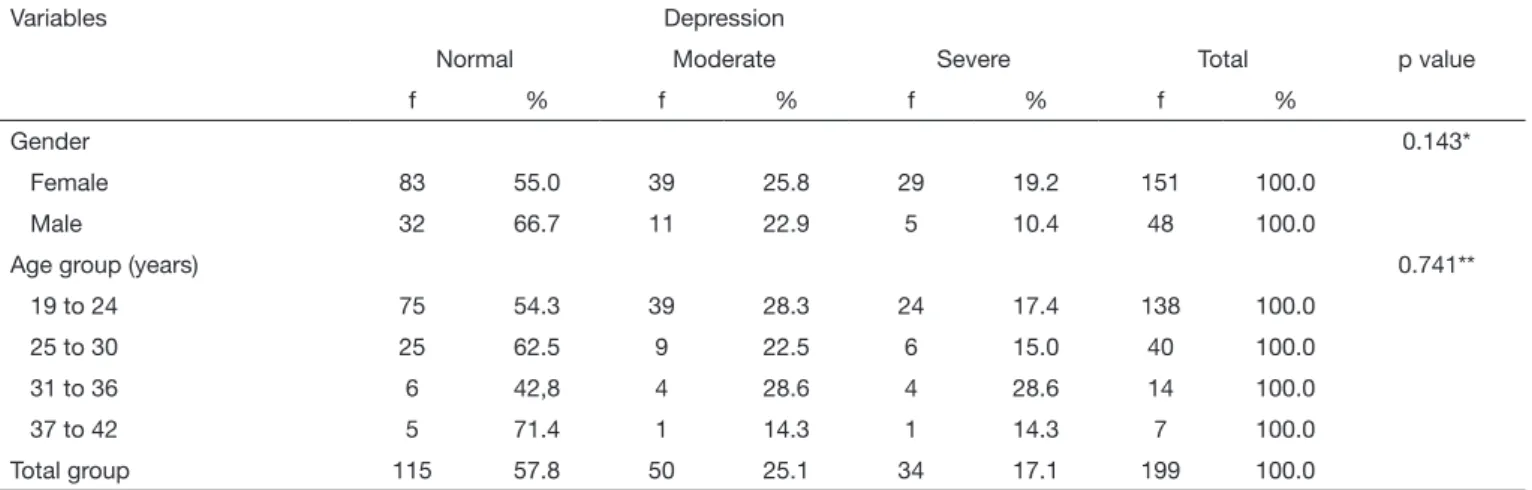
he prevalence of symptoms of depression among students was 42.2%, of which 57.8% has been classiied as normal, 25.1% with moderate depression, and 17.1% severe. Considering gender, the signs and symptoms of depression had a higher prevalence in
Table 2. Distribution of students according to the degree of the signs and symptoms of the temporomandibular dysfunction. Caxias-MA, 2016
Variables Temporomandibular dysfunction
Without TMD Mild Moderate Severe Total p value*
f % f % f % f % f %
Gender 0.255
Female 45 29.8 60 39.7 32 21.2 14 9.3 151 100.0
Male 22 45.8 15 31.3 7 14.6 4 8.3 48 100.0
Age group (years) 0.461
19 to 24 41 29.7 61 44.2 26 18.8 10 7.2 138 100.0
25 to 30 17 42.5 10 25.0 8 20.0 5 12.5 40 100.0
31 to 36 5 35.7 2 14.3 5 35.7 2 14.3 14 100.0
37 to 42 4 57.1 2 28.6 0 0.0 1 14.3 7 100.0
Total group 67 33.7 75 37.7 39 19.6 18 9.0 199 100.0
* Fisher’s Exact test; f = absolute frequency; % = relative frequency.
Table 1. Distribution of students regarding age and gender. Caxias--MA, 2016
Variables f %
Gender
Female 151 75.9
Male 48 24.1
Age group (years)
19 to 24 138 69.4
25 to 30 40 20.1
31 to 36 14 7.0
37 to 42 7 3.5
Total 199 100.0
women (45%), as well as the moderate degree (25.8%) and the severe (19.2%). However, no signiicant statistical diference was observed in relation to males (p=0.259). he signs and symptoms of depression were more frequent among students in the age group of 31 to 36 years (57.2%), and its absence was higher among stu-dents in the age group of 37 to 42 years (71.4%). Both the mod-erate degree (28.6%) and the severe degree (28.6%) were more frequent in students with ages between 31 and 36 years (Table 3). he TMD signs and symptoms most reported by the college stu-dents were: headaches (60.8%), tinnitus (40.2%), crackle when
chewing (37.7%), malocclusion (34.2%) and noise in the TMJ (31.2%), as shown in table 4.
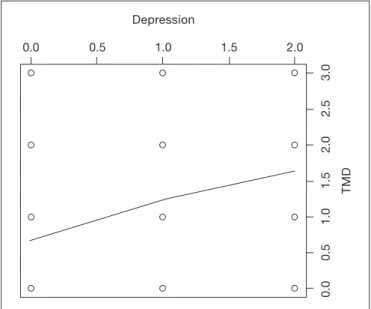
Of the 132 students who presented TMD symptoms, 72 had depression symptoms, representing a prevalence of 54.5% of students with signs and symptoms of both diseases. There was a statistically significant association between the pres-ence of TMD signs and symptoms and depression (p<0.001) (Table 5). Also, there was a weak positive and statistical-ly significant correlation between the variables (r=0.38; p<0.001) (Figure 1).
Table 3. Distribution of students according to the degree of the signs and symptoms of depression. Caxias-MA, 2016
Variables Depression
Normal Moderate Severe Total p value
f % f % f % f %
Gender 0.143*
Female 83 55.0 39 25.8 29 19.2 151 100.0
Male 32 66.7 11 22.9 5 10.4 48 100.0
Age group (years) 0.741**
19 to 24 75 54.3 39 28.3 24 17.4 138 100.0
25 to 30 25 62.5 9 22.5 6 15.0 40 100.0
31 to 36 6 42,8 4 28.6 4 28.6 14 100.0
37 to 42 5 71.4 1 14.3 1 14.3 7 100.0
Total group 115 57.8 50 25.1 34 17.1 199 100.0
*Pearson’s Chi-square, **Fisher Exact; f = absolute frequency; % = relative frequency.
Table 4. Percentage of more frequent signs and symptoms of temporomandibular dysfunction among students. Caxias-MA, 2016
Signs and symptoms No Yes Total
f % f % f %
Facial pain 146 73.4 53 26.6 199 100.0
Jaw locking 160 80.4 39 19.6 199 100.0
Crackle when chewing 124 62.3 75 37.7 199 100.0
Noise in the TMJ 137 68.8 62 31.2 199 100.0
Bruxism 165 82.9 34 17.1 199 100.0
Tinnitus 119 59.8 80 40.2 199 100.0
Malocclusion 131 65.8 68 34.2 199 100.0
Headache 78 39.2 121 60.8 199 100.0
TMJ = temporomandibular joint; f = absolute frequency; % = relative frequency.
Table 5. Association of signs and symptoms of temporomandibular dysfunction and depression among students. Caxias-MA, 2016
Depression Temporomandibular dysfunction
Without TMD Mild Moderate Severe Total p value
f % f % f % f % f %
Normal 53 79.1 42 56.0 13 33.3 7 38.9 115 57.8 <0.001*
Moderate 11 16.4 20 26.7 15 38.5 4 22.2 50 25.1
Severe 3 4.5 13 17.3 11 28.2 7 38.9 34 17.1
Total 67 33.7 75 37.7 39 19.6 18 9,0 199 100.0
DISCUSSION
TMD represents a chronic picture for those with this disorder that afects the TMJ motor functions as well as the speech, breathing, swallowing, the quality of life and the social inter-action of the individual. hat is why it is necessary to have less elaborate evaluation processes, greater applicability covering the main clinical results, enabling its use both in epidemio-logical or populational studies, as well as a unique instrument to calibrate studies involving samples collections20. In this study, we used the IAF and RDC/TMD questionnaires axis II since they are accurate, simple, reliable assessment tools with high reproducibility for the diagnosis of TMD.
Since it is a simple questionnaire, IAF favors its use in epide-miological and populational studies, presenting high accuracy since it has been previously tested in patients with TMD and demonstrated a correlation of 95% with the Helkimo clinical index14. We decided to use this index in this study because it is a tool of quick and easy application, and because the subjects were not looking for TMD treatment; therefore, the original intention was just to track the signs and symptoms of this disorder in college students. In addition, several Brazilian and international studies have been using the IAF to classify patients as to TMD signs and symptoms3,4,7-9,14,15,20-27.
We noticed that most of the students participating in this study were female, showing that currently, the number of women attending universities is bigger than men. his is due to the increasing role women are playing in society and the labor market, creating a greater demand for their qualiication which can be obtained through higher education.
According to the results, we noticed that the number of stu-dents with TMD signs and symptoms is substantial (66.3%), consistent with the results found in the studies of Goyatá et al.4, that present a prevalence of TMD signs and symptoms in 63.9% of the evaluated students. Bezerra et al.21 found a
prev-alence of 62.5%, Barbosa and Swerts22, a prevalence of 66% of TMD signs and symptoms in Dentistry students, and Dan-tas23, a prevalence of 64.4%. Lower results of TMD signs and symptoms were found in several studies conducted in other countries, with prevalence varying from 15 to 57.7%6,9,14,15,24-26. Other authors found a higher prevalence among the students evaluated in their respective studies, varying from 74.9 to 92.3%7,8,10,12,27,28.
hese diferences in relation to the present study can be at-tributed to the use of diferent TMD diagnostic methods, gender distribution and diferences in the sample, where the origin and cultural, economic and food habits are considered. Some authors have evaluated students of Eastern and Euro-pean origin, and others evaluated only male students since it is scientiically proven that the prevalence of TMD is higher in women.
College students are potential candidates for the onset of TMJ alterations, leading to disorders that afect this joint, since during their studying period they develop parafunction-al habits, such as to support the jaw on the hand, bruxism, clenching, chewing gum, biting the lips, onychophagia and to biting objects20,22,28,29, due to discharge of the nervous ten-sions on the masticatory muscles and, consequently muscle hyperactivity that in turn can be triggered by emotional alter-ations such as depression and stress11,14, requiring more elabo-rate and speciic investigation in order to scientiically deter-mine the inluence that depression exerts in the onset and/or worsening of TMD. Due to this overload on the masticatory muscles triggered by the adoption of harmful parafunctional habits, this group is more prone to have TMD of muscular origin than articular origin.
Parafunctional habits trigger isometric muscle contraction, inhibition of normal blood low to muscle tissue, increase of carbon dioxide and metabolic waste in muscle tissue, culmi-nating in fatigue, spasms, and pain. As a result, the parafunc-tional habits are more likely to cause changes in the muscular system and the TMJ, since the structures of the masticatory system stand a certain amount of force generated by the hy-peractivity, and, after this level, tissue collapse may occur20. In relation to the degrees of severity, mild TMD was the most frequent (37.7%), followed by moderate (19.6%) and severe (9%), which corroborates previous studies carried out with university students that found a higher frequency of the mild degree of TMD signs and symptoms4,9,10,14,21,24-26,28. In this study, although it was observed a higher prevalence of TMD signs and symptoms among university students between ages of 21 to 24 years, the degree of impairment that can be a possible indication for treatment (moderate and severe de-grees), were more frequent among students over 31 years old, proving that TMD worsens with age, which has been already described in the literature10,28.
Corroborating other studies12,14,15,20-22,24,26,28, it was observed that women are more afected by the TMD symptoms than men, with a prevalence of 70.2% showing the symptoms of the dysfunction versus 55.2% of men, however, no statisti-cally signiicant diference between genders was observed
Figure 1. Correlation between signs and symptoms of temporoman-dibular dysfunction and depression
0.0 0.5 1.0 1.5 2.0
0.0
0.5 1.0 1.5 2.0 2.5 3.0
Depression
(p=0,078). Other studies have found a higher prevalence of TMD in men6,9.
According to Martins et al.30 women tend to have retroposi-tioned mandibular condyles when compared with men, which probably predisposes them to anterior disc displacements. For Medeiros, Batista and Forte28, this higher prevalence in females must be because women look for treatment more frequently, meaning that they are more careful and attentive to health than men. Minghelli, Kiselova and Pereira24 claim that women are more susceptible to TMD due to the inluence of physiological characteristics, hormonal variations and the structures of the connective tissue and muscle, and since a greater laxity of these tissues is related to estrogen levels, it explains the fact that these tissues have less capacity to support functional pressure, lead-ing to TMD. Wahid et al.8 argue that women have more TMD due to greater mental stress.
In the distribution of the TMD degree in relation to gender, it was perceived that both in females and males, the mild degree was more frequent than the other degrees, with a prevalence of 39.7 and 31.3% respectively, being these results in accordance with other studies18,24,26,28. Bezerra et al.21, Barbosa and Swerts22 and Al Moaleem et al.9 have also found a higher prevalence of mild TMD symptoms in both genders. However, unlike the results found in this study, and in most studies available in the literature, this prevalence was higher in men compared to women (51.7, 46.3 and 40.2%, respectively). Because it is a young population, a higher incidence of TMD is accepted since the symptoms may worsen with age, and the worsening of TMD etiological factors, such as parafunctional habits and emotional stress.
he prevalence of signs and symptoms of depression among the evaluated college students, in RDC/TMD axis II, was signii-cant (42.2%), what it draws the attention since it is a relatively young population e supposedly with good general health. Oth-er studies have found an equivalent prevalence of symptoms of depression18,31,32 in 41.1, 43.9 and 41% of college students, respectively. However, most of the studies13,14,24,33-36 found a prevalence diferent from this study, with values of 50, 30.5, 18.3, 34.6, 24.2, 54.2 and 51.4, respectively.
he use of the RDC/TMD, axis II, is considered a trustwor-thy and valid indicator to track the symptoms of depression, somatization and psychosocial dysfunction related to pain. Even not providing a psychiatric diagnosis, it gives initial sci-entiic support to validate the clinical decision-making based on evidence, referring these patients to a psychological evalua-tion and intervenevalua-tions in the psychosocial barriers to minimize TMD17,37. Also, axis II has been used in several clinical and epidemiological studies to describe high levels of depression and somatization, as well as the high prevalence of pain-related disability in social activities in patients with TMD12,18,34,35,37. However, some authors warn that the use of axis II should be used with caution because it presents high sensitivity (87%), but lower speciicity (53%) in identifying patients with depres-sion (comparing low scores with moderate/severe depresdepres-sion). his can generate false positive diagnoses, where serious levels of somatization may mistake the interpretation of the clinical
examination17,38. In order to solve these problems, a new RDC/ TMD is being elaborated to evaluate the psychological factors and their relationship with the TMD diagnosis38.
When distributed by the degree of depression symptoms, we no-ticed that more than the half (57.9%) of the college students presented normal conditions. When analyzing the presence of depression symptom, it was observed that most of the afected students presented a moderate degree (25.1%), and 17.1% pre-sented severe signs and symptoms. In previous studies, it was also proved that the degree of depression most present among the evaluated students was the moderate degree, and the ma-jority had normal psychological conditions, for the presence of signiicant sign and symptoms of depression13,31,33,36. However, it should be noted that in this study, the presence of severe symp-toms was more signiicant compared to the studies mentioned. When comparing the presence of symptoms of depression in both genders, the prevalence in women is higher (45%), while in men it is 33.3%, however, despite the numerical diference, there was no signiicant statistical diference between genders (p=0.278). he results obtained in this study, as well as in oth-ers14,18,24,31,36, showed that women are more susceptible to de-pression, showing the need to investigate the causes for this higher prevalence of symptoms in women.
When classifying the degree of symptoms of depression by gender, it was observed that both women and men had a higher prevalence of the moderate degree (25.8 and 22.9%, respectively), which was also observed in the studies of Toledo, Capote and Campos18 (17.8% for women and 16.1% for men) and Iqbal, Gupta and Venkatarao36 (22.7% for women and 11% for men).
he higher prevalence of symptoms of depression in women can be explained by the fact that women report depressive symptoms more frequently than men and present a higher in-dex of psychosomatic diseases24,36. Justo and Calil39 explain that changes in levels of estrogen in women afect mood and cogni-tion, working not only in the hypothalamus but also in the hippocampus and cerebellum, leaving women more vulnerable to depression. Other factors such as sexual abuse in childhood, double workday, conlicts in social and family relationships, lower educational level and motherhood may contribute to the high prevalence of depression in women.
We noticed that the symptom of depression was more present in college students with ages between 31 and 36 years (57.2%), in both the moderate and severe degrees. his can be explained by the fact that this is the most productive phase of the indi-vidual, period when the person is more exposed to stressing factors due to the demand of the professional routine. How-ever, this airmation requires more speciic studies to provide a scientiically proven conclusion. For Jadoon et al.31, depression can lead to negative results, including school truancy, reduced capacity to work eiciently, deterioration of relationships, ex-haustion, increased suicidal tendency and existing problems, which is part of the health care.
well as the increase in the risk of other diseases, as TMD21. his can probably be explained by the high level of mental pressure and demand in obtaining high academic results and, conse-quently, fear to fail in their professional life, since they are daily dealing with human lives.
he signs and symptoms of TMD most reported are headaches (60.8%), tinnitus (40.2%), crackle when chewing (37.7%), malocclusion (34.2%) and noise in the TMJ (31.2%). he least reported was the presence of pain or fatigue when waking up, with a prevalence of 14.1%. Headache was also the most report-ed symptom in some studies15,24, with a prevalence of 20 and 31.6%, respectively. In other studies21,29,30, the pain in the back of the head or neck was more prevalent, with 47.3, 93 and 38%, respectively. Goyatá et al.4 and Toledo, Capote and Campos18 identiied bruxism as the sign of TMD more present among the interviewed (41.2 and 23.2%, respectively), yet Habib et al.25 found a higher frequency of malocclusion (23.2%). he possible relationship between TMD and headache can be attributed to the fact that headaches are related to muscle activity. herefore, activities involving the head and the neck probably play an im-portant role in the etiology of this condition24.
In this study, we found a signiicant statistical association (p<0.001) and positive correlation (r=0.38; p<0.001) between the presence of TMD signs and symptoms and the presence of depression symptoms.More than half of the students (54.5%) showed symptoms of both conditions, which leads to suggest that the psychological factors, especially depression, inluence the clinical conditions of TMD, as described in the literature. hese results are supported by the studies of Toledo, Capote, and Campos18, who found that 53.3% of the interviewed college students showed signs and symptoms of TMD and depression and Nery32, who found a prevalence of signs and symptoms of depression in 52% of individuals with signs and symptoms of TMD. Minghelli, Morgado and Caro14 and Minghelli, Kiselova and Pereira24 found a lower prevalence of signs and symptoms of depression in students who also had TMD symptoms, 44 and 30.7%, respectively. Another study found a higher prevalence of signs and symptoms of both diseases (64%)35.
Orhbach et al.17 report that psychiatric disorders as depression and generalized anxiety, as well as psychological disorders, are common in patients who look for treatment of TMD chronic pain and they can interfere with the response to the treatment. In many patients, there is a cycle where the TMD generates emotional disorders that increase the symptoms of the TMD, and the opposite is also true, that is, the emotional disorder generates TMD and this, in turn, aggravates the emotional distress. However, it is still unclear whether the emotional dis-orders, in chronic conditions, are the trigger of TMD, or if it is the worsening of TMD that leads to the onset of emotional disorders, especially depression40.
he importance of the results of this study reassures that for the TMD treatment to be efective it is necessary a psychological follow-up of these patients with emotional alterations because only by treating the root cause it will be possible to have sat-isfactory results in the treatment of functional changes caused by TMD.
CONCLUSION
he results of this study showed a high prevalence of TMD signs and symptoms in college students, similar to other studies in the literature. Among them, women and those in the younger age group showed a higher prevalence of symptoms of this dysfunction.
ACKNOWLEDGMENTS
he authors gratefully acknowledge the support of FAPEMA (Foun-dation for the support of research and scientiic and technological de-velopment of Maranhão) for the execution of this study and all to all the TMD research group of the School of Science and Technology of Maranhão – FACEMA for their vital contribution to data collection.
REFERENCES
1. Al-Khotani A, Naimi-Akbar A, Albadawi E, Ernberg M, Hedenberg-Magnusson B, Christidis N. Prevalence of diagnosed temporomandibular disorders among Saudi Arabian children and adolescents. J Headache Pain. 2016;41.
2. Blanco-Hungría A, Blanco-Aguilera A, Blanco-Aguilera E, Serrano-del-Rosal R, Biedma-Velázquez L, Rodríguez-Torronteras A, et al. Prevalence of the diferent Axis I clinical subtypes in a sample of patients with orofacial pain and temporomandibu-lar disorders in the Andalusian Healthcare Service. Med Oral Patol Oral Cir Bucal. 2016;21(2):e169-77.
3. Oliveira CB, Lima JA, Silva PL, Forte FD, Bona PR, Batista AU. Temporomandibular disorders and oral habits in high-school adolescents: a public health issue? RGO - Rev Gaúch Odontol. 2016;64(1):8-16.
4. Goyatá FR, Taira NV, Almeida SD, Silva DD, Taira CV. Avaliação de sinais e sintomas de disfunção temporomandibular entre os acadêmicos do curso de odontologia da universidade Severino Sombra, Vassouras – RJ. Int J Dent. 2010;9(4):181-6. 5. Plesh O, Adams SH, Gansky SA. Temporomandibular joint and muscle disorder-type
pain and comorbid pains in a national US sample. J Orofac Pain. 2011;25(3):190-8. 6. Rani S, Pawah S, Gola S, Bakshi M. Analysis of Helkimo index for temporomandibu-lar disorder diagnosis in the dental students of Faridabad city: a cross‑sectional study. J Indian Prosthodont Soc. 2017;17(1):48-52.
7. Sousa EF, Moreira TR, Santos LH. Correlação do nível de ansiedade e da qualidade de vida com os sinais e sintomas da disfunção temporomandibular em universitários. Clipe Odonto. 2016;8(1):16-21.
8. Wahid A, Mian FI, Razzaq A, Bokhari SAH, Kaukab T, Iftikhar A, et al. Prevalence and severity of temporomandibular disorders (TMD) in undergraduate medical students using Fonseca’s Questionnaire. Pakistan Oral & Dental Journal. 2014;34(1):38-41. 9. Al Moaleem MM, Okshah AS, Al-Shahrani AA, Alshadidi AA, Shaabi FI, Mobark
AH, et al. Prevalence and severity of temporomandibular disorders among undergra-duate medical students in association with Khat Chewing. J Contemp Dental Pract. 2017;18(1):23-8.
10. Parente IA, Cerdeira DQ. Disfunção temporomandibular: a avaliação isioterapêutica em discentes de uma instituição de ensino superior do município de Sobral – Ceará. SANARE. 2013;12(2):27-33.
11. Pasinato F, Corrêa EC, Souza JA. Avaliação do estado e traço de ansiedade em indiví-duos com disfunção temporomandibular e assintomáticos. Saúde. 2009;35(1):10-5. 12. Geres GS, Pachioni CA, Masselli MR, Minonroze D, Ferreira A, Gomes DC, et al.
Análise de condições clínicas em estudantes com disfunção temporomandibular. Ter Man. 2013;11(53):361-6.
13. Paiva RC. A depressão e a disfunção temporomandibular – estudo clínico [disserta-ção]. Viseu (PT): Universidade Católica Portuguesa; 2012.
14. Minghelli B, Morgado M, Caro T. Association of temporomandibular disorder symptoms with anxiety and depression in Portuguese college students. J Oral Sci. 2014;56(2):127-33.
15. Khan M, Khan A, Hussain U. Prevalence of temporomandibular dysfunction (TMD) among university students. Pakistan Oral & Dental Journal. 2015;35(3):382-5 16. Fonseca DM, Bonfarte G, Valle AL, Freitas SF. Diagnóstico pela anamnese da
disfun-ção crâniomandibular. Rev Gaúcha Odontol. 1994;42(1):23-8.
17. Ohrbach R, Turner JA, Sherman JJ, Mancl LA, Truelove EL, Schifman EL, et al. he Research Diagnostic Criteria for Temporomandibular Disorders. IV: evaluation of psychometric properties of the Axis II measures. J Orofac Pain. 2010;24(1):48-62. 18. Toledo BA, Capote TS, Campos JA. Associação entre disfunção temporomandibular
e depressão. Cienc Odontol Bras. 2008;11(4):75-9.
19. Munro BH. Correlation. In: Munro BH, (editors). Statistical Methods for Health Care Research. 4th ed. Philadelphia, PA: Lippincott; 2001. 223-43p.
21. Bezerra BP, Ribeiro AI, Farias AB, Farias, AB, Fontes LD, Nascimento SR, et al. Pre-valência da disfunção temporomandibular e de diferentes níveis de ansiedade em estu-dantes universitários. Rev Dor. 2012;13(3):235-42.
22. Barbosa JA, Swerts AA. Prevalência da disfunção temporomandibular em graduandos do curso de Odontologia da Universidade José de Rosário Vellano – UNIFENAS, MG. Rev CROMG. 2011;12(2):65-8.
23. Dantas ID. Prevalência da disfunção temporomandibular em estudantes de Odonto-logia por meio de diferentes índices [dissertação]. Natal (RN): Universidade Federal do Rio Grande do Norte; 2013.
24. Minghelli B, Kiselova L, Pereira C. Associação entre os sintomas da disfunção tem-poromandibular com fatores psicológicos e alterações na coluna cervical em alu-nos da Escola Superior de Saúde Jean Piaget do Algarve. Rev Port Saúde Pública. 2011;29(2):140-7.
25. Habib SR, Al Rifaiy MQ, Awan KH, Alsaif A, Alshalan A, Altokais Y. Prevalence and severity of temporomandibular disorders among university students in Riyadh. Saudi Dent J. 2015;27(3):125-30.
26. Cabral RP, Moiolli-Rodrigues ME, Motta FL, Motta FC, Silva JR, Malheiros L, et al. Temporomandibular disorder in university students of the Parque das Rosas Campus, Universidade Estácio de Sá that practice sports. Health. 2016;8:18-23.
27. Ahmed LI, Abuafan AH. Prevalence of temporomandibular joint disorders among Sudanese University students. J Oral Hyg Health. 2016:4(2). doi: 10.4172/2332-0702.1000202
28. Medeiros SP, Batista AU, Forte FD. Prevalência de sintomas de disfunção temporo-mandibular e hábitos parafuncionais em estudantes universitários. Rev Gaúcha Odon-tol. 2011;59(2):201-8.
29. Melchior MO, Mazzetto MO, Felício CM. Temporomandibular disorders and para-functional oral habits: an anamnestic study. Dental Press J Orthod. 2012;17(2):83-9. 30. Martins RJ, Garcia AR, Garbin CA, Sundefeld ML. Relação entre classe
socioeconô-mica e fatores demográicos na ocorrência da disfunção temporomandibular. Ciênc Saúde Coletiva. 2008;13(2):2089-96.
31. Jadoon NA, Yakoob R, Raza A, Shehzad MA, Zeshan SC. Anxiety and depression among medical students: a cross-sectional study. J Pak Med Assoc. 2010;60(8):699-702. 32. Nery FS. Avaliação da ansiedade e depressão em indivíduos portadores de Desordem
Temporomandibular [dissertação]. Salvador (BA): Universidade Federal da Bahia; 2007. 33. Lucena IM, Rodrigues LL, Teixeira ML, Pozza DH, Guimarães AS. Prospective study of a group of pre-university students evaluating anxiety and depression relationships with temporomandibular disorders. J Clin Exp Dent. 2012;4(2):102-6.
34. Lee JY, Kim YK, Kim SG, Yun PY. Evaluation of Korean teenagers with temporoman-dibular joint disorders. J Korean Assoc Oral Maxillofac Surg. 2013;39(5):231-7. 35. Almeida CD, Paludo A, Stechman-Neto J, Amenábar JM. Saliva cortisol levels and
depression in individuals with temporomandibular disorder: preliminary study. Rev Dor. 2014;15(3):169-72.
36. Iqbal S, Gupta S, Venkatarao E. Stress, anxiety & depression among medical undergradu-ate students & their socio-demographic correlundergradu-ates. Indian J Med Res. 2015;141(3):354-7. 37. Piccin CF, Pozzebon D, Chiodelli L, Bouleus J Pasinato F, Corrêa EC. Aspectos clíni-cos e psiclíni-cossociais avaliados por critérios de diagnóstico para disfunção temporoman-dibular. Rev CEFAC. 2016;18(1):113-9.
38. Schifman E, Ohrbach R, Truelove E, Look J, Anderson G, Goulet JP et al. Diagnostic criteria for temporomandibular disorders (DC/TMD) for clinical and research applica-tions: recommendations of the International RDC/TMD Consortium Network and Orofacial Pain Special Interest Group. J Oral Facial Pain Headache. 2014;28(1):6-27. 39. Justo LP, Calil HM. Depressão – o mesmo acometimento para homens e mulheres?
Rev Psiq Clín. 2006;33(2):74-9.