EUROPEAN ORGANIZATION FOR NUCLEAR RESEARCH (CERN)
CERN-PH-EP/2013-098 2013/12/03
CMS-SMP-12-020
Measurement of the production cross section for Zγ
→
ννγ
in pp collisions at
√
s
=
7 TeV and limits on ZZγ and Zγγ
triple gauge boson couplings
The CMS Collaboration
∗Abstract
A measurement of the Zγ → ννγ cross section in pp collisions at √
s = 7 TeV is presented, using data corresponding to an integrated luminosity of 5.0 fb−1collected with the CMS detector. This measurement is based on the observation of events with an imbalance of transverse energy in excess of 130 GeV and a single photon in the absolute pseudorapidity range|η| < 1.4 with transverse energy above 145 GeV. The Zγ → ννγproduction cross section is measured to be 21.1±4.2 (stat.)±4.3 (syst.)±
0.5 (lum.) fb, which agrees with the standard model prediction of 21.9±1.1 fb. The results are combined with the CMS measurement of Zγ production in the`+`−γfinal
state (where ` is an electron or a muon) to yield the most stringent limits to date on triple gauge boson couplings: |hZ
3| < 2.7×10⁻³, |hZ4| < 1.3×10⁻⁵ for ZZγ and
|hγ3| <2.9×10⁻³,|hγ4| <1.5×10⁻⁵for Zγγ couplings.
Published in the Journal of High Energy Physics as doi:10.1007/JHEP10(2013)164.
c
2013 CERN for the benefit of the CMS Collaboration. CC-BY-3.0 license ∗See Appendix A for the list of collaboration members
1
1
Introduction
The study of the production of pairs of gauge bosons in high-energy particle collisions provides an important test of the electroweak sector of the standard model (SM). The diboson production rate is sensitive to the gauge boson self-interactions that arise as a consequence of the non-Abelian nature of the SU(2)×U(1) symmetry of the SM. The values of these couplings are fixed in the SM, and any observed deviation from the SM predictions would be an indication of new physics at the vertex involving the bosons [1, 2]. In most searches for anomalous triple gauge couplings (TGCs), including this study, the boson transverse energy spectrum is used as a sensitive observable, as new physics is likely to result in an excess of energetic bosons over the SM expectation.
In this paper, a study of the production of a Z boson and a photon, with the Z boson decaying to a pair of neutrinos, is presented. We describe the measurement of the production cross section as well as the extraction of limits on the anomalous couplings for ZZγ and Zγγ.
The ννγ final state can be produced through initial-state radiation, where a photon is emitted by an initial-state parton, or through anomalous coupling vertices. The allowed electroweak tree-level diagram in the SM for Zγ production in pp collisions is shown in Fig. 1 (left). The photon produced in the s channel via an anomalous ZZγ or Zγγ TGC is shown in Fig. 1 (right).
ν
¯
ν
q
¯
q
γ
Z
ν
¯
ν
q
¯
q
γ
Z, γ
Z
Figure 1: Feynman diagrams of Zγ production via initial state radiation in the SM at tree level (left) and via anomalous ZZγ and Zγγ triple gauge couplings (right).
The most general Lorentz- and gauge-invariant ZVγ vertex can be described by four coupling parameters hVi (i = 1, . . . , 4)[3, 4], where V denotes either a photon or a Z boson. The first two couplings (i= 1, 2) are CP-violating, while the latter two are CP-conserving [4, 5]. At tree level in the SM, the individual values of these TGCs are zero. The photon transverse energy spectrum has similar sensitivity to CP-violating and CP-conserving couplings [6]. Therefore, the results are generally interpreted in terms of CP-conserving TGCs hV3 and hV4.
The sensitivity to TGCs in Zγ production is higher in the Z→ννdecay mode than in Z boson
decay modes with charged leptons for two reasons. First, the branching fraction for a Z boson decay to a pair of neutrinos is six times higher than for a decay to a particular charged lepton pair. Second, the neutrino channel acceptance is higher.
Searches for anomalous ZZγ and Zγγ TGCs have been performed at LEP [7–9], the Teva-tron [10–12], and the Large Hadron Collider (LHC) [13, 14]. No evidence has been found; the most stringent limits in pp collisions at√s=7 TeV were set by the ATLAS Collaboration [14].
2 3 Data selection and analysis
2
CMS detector
The measurements reported here are based on a data set corresponding to an integrated lumi-nosity of 5.0 fb−1, collected in 2011 at a center-of-mass energy of√s =7 TeV with the Compact Muon Solenoid (CMS) detector at the LHC. The momenta of charged particles are measured by a silicon pixel and strip tracker. The tracking system is surrounded by a crystal electromag-netic calorimeter and a brass-scintillator hadron calorimeter, which measure particle energies deposited in a barrel and two endcaps. The tracking system and calorimeters are immersed in a 3.8 T magnetic field provided by the superconducting solenoid. Muons are measured in gas-ionization detectors embedded in the steel yoke outside the solenoid. A more detailed de-scription of the CMS detector can be found in Ref. [15]. The trajectory of the particles in the detector can be described by the azimuthal angle φ, measured in the x-y plane with respect to the x axis, and the pseudorapidity η, defined as η = −ln tan(θ/2), where θ is the polar angle of the trajectory of the particle with respect to counterclockwise beam direction.
3
Data selection and analysis
Candidate events are selected in the experiment using unprescaled single-photon triggers with the lower threshold on photon transverse energy ranging from 75 to 135 GeV as defined by the two-level CMS trigger system. The triggers are fully efficient within 2% statistical uncertainty for photons with pseudorapidity|η| <1.4 and transverse energy EγT >145 GeV.
The final state consisting of an energetic photon accompanied by an imbalance of transverse energy can be mimicked by several other processes in the SM with at least one photon in the final state, such as Wγ, γ+jets, and γγ processes, in which only a single energetic photon is reconstructed in the event. Additionally, there are instrumental backgrounds as discussed later in the paper. Characteristics of both the signal and background events have been studied us-ing simulated events. A sample of signal events Zγ → ννγ is obtained using the PYTHIA
v6.424 [16] event generator at leading order. The Wγ events are generated with the MAD -GRAPH v5 generator [17], and the cross section is corrected to include next-to-leading-order (NLO) effects through a K factor calculated with the MCFM program [18, 19]. The γ+jets, W boson, and diphoton samples are obtained usingPYTHIA. We do not consider final-state radia-tion W→ `νγevents in thePYTHIAW boson sample as those are included in the MADGRAPH
Wγ sample. All leading-order simulation samples are propagated using CTEQ6L1 [20] parton distribution functions (PDFs).
To distinguish photons from misidentified jets, we apply additional calorimetric selection crite-ria by requiring the shower shape to be consistent with that of an electromagnetic particle [21]. To further reduce the contribution from processes with misidentified jets, the photons are re-quired to be isolated from other activity in the electromagnetic and hadronic calorimeters as well as the tracker. In particular, the scalar sum of the transverse component of the energy de-posits (ET) in the electromagnetic calorimeter within an annulus of 0.06<∆R< 0.40 centered
on the photon candidate, where ∆R = p(∆η)2+ (∆φ)2, must not exceed 5 GeV, while that
in the hadronic calorimeter within an annulus of 0.15 < ∆R < 0.40 must be below 2.6 GeV. The scalar sum of the transverse momenta of charged particles, originating from the primary vertex, in an annulus of 0.04< ∆R<0.40 must be below 2.1 GeV; the central cone around the photon,∆R < 0.04, is excluded to maintain a high efficiency for photons that initiate electro-magnetic showers early in the tracker. Since the high instantaneous luminosity operation of the LHC results in multiple pp interactions in a single bunch crossing (pileup), the track isolation is calculated separately with respect to each vertex in the event; the largest value of this isolation
3
is then required to satisfy the track isolation condition. This procedure reduces the background from jets originating from other vertices in the event corresponding to soft scattering processes. Beam-halo muons are machine-induced particles that travel parallel to the beam line. When such muons interact with the electromagnetic calorimeter they can undergo a bremsstrahlung process resulting in an electromagnetic energy deposition identified as a photon. To reduce the background due to bremsstrahlung photons from beam-halo and cosmic-ray muons, the timing of the photon measured in the CMS ECAL detector [22] is required to be consistent with that of the beam crossing. To further reduce this background, additional requirements are imposed on the photon candidates in events containing reconstructed muons. Furthermore, to minimize the background due to the electrons from W → eν decays that are misidentified as photons, the photons that have a pattern of hits in the pixel detector similar to that expected for electrons are rejected [23].
The imbalance of the transverse energy, ETmiss, in the reconstructed event is defined by the mag-nitude of the vector sum of the transverse energies of all the reconstructed objects in the event, and is computed using a particle-flow algorithm [24]. The signal events have an ETmiss compa-rable in magnitude to the photon transverse energy because the neutrinos from the Z boson decay recoil against the photon. In this study, events are required to have EmissT > 130 GeV, which is less stringent than the 145 GeV requirement on the photon ET. The EmissT criterion is
fully efficient for signal events and reduces a potential systematic uncertainty related to the modeling of ETmissin the simulation.
Finally, events are vetoed if they contain other particles of significant energy or momentum, defined by (i) a track with pT > 20 GeV that is ∆R > 0.04 away from the photon or (ii) a
jet, reconstructed with pT > 40 GeV using the particles in the event identified by the
particle-flow algorithm and clustered using an anti-kTformalism [25] with a distance parameter of 0.5,
within|η| < 3.0 and∆R < 0.5 of the axis of the photon. After applying all of the selection criteria, 73 candidate events are selected.
The background from misidentified photons originating in jet fragmentation and decay pro-cesses is estimated by constructing a control sample in data, enriched with multijet events. We use this sample to calculate a misidentification ratio, defined as the number of events where the photon candidate satisfies the signal selection criteria to the number of events where the photon candidate satisfies looser selection criteria but fails the isolation condition. Since not all photon candidates in the multijet control sample are from misidentified jets, a correction is applied for genuine photons from direct photon production in the multijet sample. The photon contribution is estimated by means of a fit to the shower shape profile of photon candidates in the control data sample, where the distribution for genuine photons is taken from simulated
γ+jets events; this contribution is subtracted from both the numerator and denominator of the
misidentification ratio. The corrected ratio is then multiplied by the number of events in the sig-nal data sample that pass the photon selection criteria but fail the isolation requirements. The background contribution due to misidentified jets is estimated to be 11.2±1.6 (stat.)±2.2 (syst.) events. The systematic uncertainty reflects the modeling of the genuine photon shower profile in the simulation, as well as the dependence of the misidentification ratio on the choice of the looser selection criteria and isolation requirements.
The dominant background where an electron is misidentified as a photon is W → eν pro-duction. The contribution from this process is estimated from a control sample, dominated by W → eν events, that is selected by requiring events to pass the full selection criteria ex-cept for the requirement of no pixel hits for the photon. Then, the contribution to the Zγ sample from processes with misidentified electrons is estimated by scaling the control
sam-4 4 Cross section measurement
ple by (1−eps)/eps, where eps is the probability for an electron to produce hits during its
passage through the pixel detector. The value of eps is estimated from a Z → ee data
sam-ple to be eps = 0.994±0.003. The estimated number of events with misidentified electrons
is 3.5±0.1 (stat.)±1.5 (syst.). The systematic uncertainty is dominated by the uncertainty in measuring epsin Z→ee events.
The total amount of background from γ+jet, Wγ, and diphoton processes, after the full selec-tion, is estimated from simulation to be 4.4±1.0 (stat.)±0.4 (syst.) events. The uncertainty in the simulated backgrounds takes into account the uncertainty in the scale factor that corrects for the data-simulation difference in the efficiency.
The out-of-time backgrounds, which are not produced via pp interactions, are from beam-halo muons, cosmic rays, and anomalous signals due to neutron interactions with the electromag-netic calorimeter readout system which can produce a final-state signature of a single photon and an imbalance of transverse energy. The contributions from these sources are estimated with data from the timing and the shapes of the shower energy deposition in the ECAL calorimeter using the methods described in Ref. [26]. All contributions are found to be negligible except for the beam-halo muon process, which is estimated to contribute 11.1±0.6 (stat.)±5.5 (syst.) events. The uncertainty in the prediction is calculated by propagating the uncertainty in the shape of the timing distribution for the beam-halo bremsstrahlung shower.
4
Cross section measurement
The expected cross section of the signal process for Eγ
T > 145 GeV and |η| < 1.4, obtained
with the NLO generator WGRAD [4], is 21.9±1.1 fb. A consistent prediction of 24.6±2.5 fb is obtained with MCFM. The quoted uncertainties in both predictions take into account the
PDF and scale uncertainties. Based on theWGRADprediction, the expected number of Z(νν)γ
signal events is 45.3±0.3 (stat.)±6.9 (syst.). The total number of expected background events is 30.2±2.0 (stat.)±6.2 (syst.). A summary of the backgrounds and data yield is given in Table 1, wherein the uncertainties in the background estimates include both statistical and systematic sources.
Table 1: Summary of estimated backgrounds to the Z(νν)γprocess. The statistical and system-atic uncertainties are added in quadrature.
Source Number of selected events Misidentified jets 11.2±2.8
Beam-halo muon processes 11.1±5.6 Misidentified electrons 3.5±1.5 Wγ 3.3±1.0 γγ 0.6±0.3 γ+jet 0.5±0.2 Total background 30.2±6.5 Zγ→ννγ(NLO) 45.3±6.9 Data 73
The Zγ → ννγcross section for EγT > 145 GeV and |η| < 1.4 is calculated using the following
formulae:
σ× B =
Ndata−Nbg A×e×L ,
5
A×e= (A×e)sim×ρ,
where Ndata is the number of observed events, Nbg is the estimated number of background
events, A is the geometrical and kinematic acceptance of the selection criteria, e is the signal selection efficiency, and L is the integrated luminosity. The product of A×eis estimated from
the simulation to be 0.452±0.003, where the uncertainty is statistical. The correction factor
ρ = 0.90±0.11 takes into account the efficiency difference between data and simulation for
the trigger, photon reconstruction and identification, consistency of cluster timing, and jet and track veto requirements [26].
The largest contribution to the systematic uncertainty in(A×e)sim comes from the modeling of the photon energy scale [21], which gives 4.3%. The uncertainties in the PDFs [20, 27, 28] and the pileup each contribute 2.4%. Additionally, there are systematic uncertainties due to the energy scale and resolution in the measurement of ETmiss [29], the jet energy scale and res-olution [30], and the selection of the photon production vertex; each of these contribute less than 3%. All these uncertainties are summarized in Table 2. The systematic uncertainty in the measured integrated luminosity is 2.2% [31].
Table 2: Systematic uncertainties in(A×e)sim.
Source Systematic uncertainty in(A×e)sim(%) Photon energy scale ±4.3
Emiss
T scale +1.6−3.1
Emiss
T resolution ±0.03
Jet energy scale ±0.8 Jet energy resolution ±0.2 Identification of photon vertex ±0.3 Pileup modeling ±2.4
PDF modeling ±2.4
Total +5.7−6.3
The measured production cross section for Zγ → ννγ for EγT > 145 GeV and |η| < 1.4 is
21.1±4.2 (stat.)±4.3 (syst.)±0.5 (lum.) fb, which is in agreement with the theoretical cross section, predicted at NLO, of 21.9±1.1 fb.
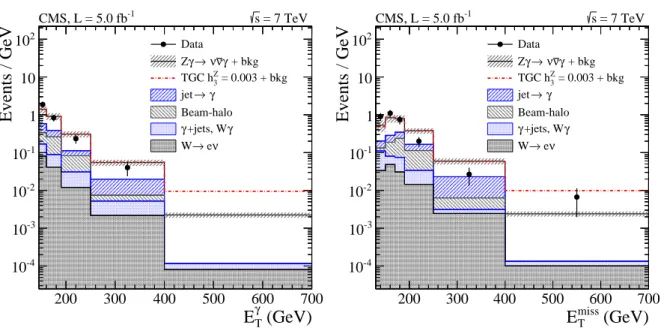
The distributions of photon transverse energy and Emiss
T are given in Fig. 2, with the signal and
background predictions overlaid. The expected contributions from a nonvanishing neutral TGC are also shown. Such a coupling would give rise to more events with large ETγand EmissT than predicted in the SM. No excess of events is observed.
5
Limits on triple gauge couplings
We use the Eγ
Tspectrum to set limits on anomalous TGCs by means of the likelihood formalism.
Simulated samples of Zγ signal for a grid of TGC values are produced using theSHERPAv1.2.2
generator [32]. In this study, we follow the CMS convention of not suppressing the anomalous TGCs by an energy-dependent form factor.
The probability of observing the number of data events in a given range of Eγ
T is estimated
using a Poisson distribution given by the expected signal and background predictions. The un-certainties in the quoted luminosity, signal efficiency, and background fraction are considered to follow a log-normal distribution. Limits on TGCs are calculated on the basis of a modified frequentist CLsmethod as described in Refs. [33, 34].
6 6 Summary (GeV) γ T E 200 300 400 500 600 700 Events / GeV -4 10 -3 10 -2 10 -1 10 1 10 2 10 -1 CMS, L = 5.0 fb s = 7 TeV Data + bkg γ ν ν → γ Z = 0.003 + bkg Z 3 TGC h γ → jet Beam-halo γ +jets, W γ ν e → W (GeV) miss T E 200 300 400 500 600 700 Events / GeV -4 10 -3 10 -2 10 -1 10 1 10 2 10 -1 CMS, L = 5.0 fb s = 7 TeV Data + bkg γ ν ν → γ Z = 0.003 + bkg Z 3 TGC h γ → jet Beam-halo γ +jets, W γ ν e → W
Figure 2: The ETγ and EmissT distributions in data (points with error bars) compared with the SM Zγ → ννγsignal and estimated contributions from backgrounds (filled histograms). The
shaded band illustrates the total uncertainty in the predicted distribution of the signal plus background hypothesis. A typical anomalous TGC signal would provide an excess, as shown in the dot-dashed histogram. The last bin in the distributions includes overflows.
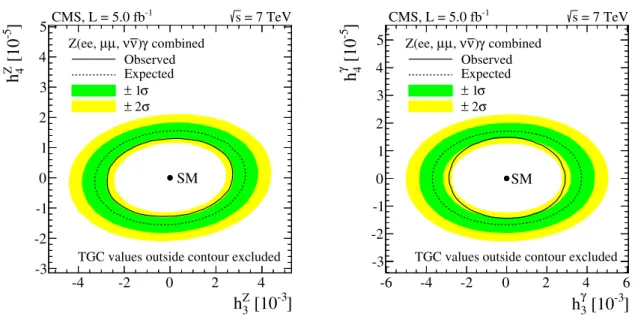
Limits at 95% CL are set on pairs of TGC parameters (hZ
3, hZ4)and (h
γ
3, h
γ
4), as presented in
Fig. 3. Furthermore, one-dimensional 95% CL limits are obtained for a given anomalous TGC while setting the other neutral TGCs to their SM values, i.e., to zero. The results, illustrated in Figs. 4 and 5, are|hZ3| <3.1×10⁻³,|hZ4| <1.4×10⁻⁵,|hγ3| <3.2×10⁻³, and|h4γ| <1.6×10⁻⁵. We combine the results presented here, based on the Z boson decay to neutrinos, with those obtained by analysis of Zγ candidate events where the Z boson decays to a pair of electrons or muons [35]. The combination is performed by summing the negative log-likelihoods at each TGC hypothesis tested. The combined limits are set in the same way as for each individual channel, while also accounting for correlations between the systematic uncertainties in different channels. The resulting two-dimensional 95% CL bounds on TGCs are given in Fig. 6, and one-dimensional limits are as follows: |hZ3| <2.7×10⁻³,|hZ4| <1.3×10⁻⁵,|hγ3| <2.9×10⁻³, and
|hγ4| <1.5×10⁻⁵.
6
Summary
In conclusion, we have presented a measurement of the Zγ → ννγ production cross section
in pp collisions at √s = 7 TeV in 5.0 fb−1 of CMS data. The measured Z(νν)γ cross section for photons with ET > 145 GeV and|η| < 1.4 is 21.1±4.2 (stat.)±4.3 (syst.)±0.5 (lum.) fb, in
agreement with the SM NLO prediction of 21.9±1.1 fb. No evidence was found for anomalous neutral triple gauge couplings in Zγ production and 95% CL limits have been placed on the hV3 and hV4 parameters of ZZγ and Zγγ couplings: |hZ3| <3.1×10⁻³,|hZ4| < 1.4×10⁻⁵,|hγ3| <
3.2×10⁻³, and|hγ4| <1.6×10⁻⁵. These results, combined with those obtained from Z boson decays to a pair of electrons or muons, yield the most stringent limits to date on neutral triple gauge couplings: |hZ3| < 2.7×10⁻³, |hZ4| < 1.3×10⁻⁵ for ZZγ couplings and |hγ
3| < 2.9×
10−3,|hγ
4| < 1.5×10⁻⁵for Zγγ. The results from the ννγ analysis dominate the sensitivity to
7 ] -3 [10 Z 3 h -4 -2 0 2 4 ] -5 [10 Z 4 h -3 -2 -1 0 1 2 3 4 5 SM γ ν ν → pp Observed Expected σ 1 ± σ 2 ± -1 CMS, L = 5.0 fb s = 7 TeV
TGC values outside contour excluded
] -3 [10 γ 3 h -6 -4 -2 0 2 4 6 ] -5 [10 γ 4 h -3 -2 -1 0 1 2 3 4 5 SM γ ν ν → pp Observed Expected σ 1 ± σ 2 ±
TGC values outside contour excluded
-1
CMS, L = 5.0 fb s = 7 TeV
Figure 3: Two-dimensional 95% CL limits on ZZγ couplings (left) and Zγγ couplings (right).
] -3 [10 Z 3 h -4 -2 0 2 4 TGC σ/ excluded at 95% CL σ 1 pp →ννγ Observed Expected σ 1 ± σ 2 ± -1 CMS, L = 5.0 fb s = 7 TeV 3 0.3 ] -5 [10 Z 4 h -2 -1 0 1 2 TGC σ/ excluded at 95% CL σ 1 γ ν ν → pp Observed Expected σ 1 ± σ 2 ± -1 CMS, L = 5.0 fb s = 7 TeV 3 0.3
Figure 4: Cross section limits as functions of the ZZγ couplings hZ
3 (left) and hZ4 (right). The
vertical axis represents the ratio of the 95% CL upper limit on the signal contribution from anomalous couplings to the expected contribution for a given TGC hypothesis.
Acknowledgements
We congratulate our colleagues in the CERN accelerator departments for the excellent perfor-mance of the LHC and thank the technical and administrative staffs at CERN and at other CMS institutes for their contributions to the success of the CMS effort. In addition, we gratefully acknowledge the computing centres and personnel of the Worldwide LHC Computing Grid for delivering so effectively the computing infrastructure essential to our analyses. Finally, we acknowledge the enduring support for the construction and operation of the LHC and the CMS detector provided by the following funding agencies: the Austrian Federal Ministry of Science and Research and the Austrian Science Fund; the Belgian Fonds de la Recherche
Scien-8 6 Summary ] -3 [10 γ 3 h -6 -4 -2 0 2 4 6 TGC σ/ excluded at 95% CL σ 1 pp →ννγ Observed Expected σ 1 ± σ 2 ± -1 CMS, L = 5.0 fb s = 7 TeV 3 0.3 ] -5 [10 γ 4 h -2 -1 0 1 2 TGC σ/ excluded at 95% CL σ 1 γ ν ν → pp Observed Expected σ 1 ± σ 2 ± -1 CMS, L = 5.0 fb s = 7 TeV 3 0.3
Figure 5: Cross section limits as functions of the Zγγ couplings hγ3 (left) and hγ4 (right). The vertical axis represents the ratio of the 95% CL upper limit on the signal contribution from anomalous couplings to the expected contribution for a given TGC hypothesis.
tifique, and Fonds voor Wetenschappelijk Onderzoek; the Brazilian Funding Agencies (CNPq, CAPES, FAPERJ, and FAPESP); the Bulgarian Ministry of Education and Science; CERN; the Chinese Academy of Sciences, Ministry of Science and Technology, and National Natural Sci-ence Foundation of China; the Colombian Funding Agency (COLCIENCIAS); the Croatian Ministry of Science, Education and Sport; the Research Promotion Foundation, Cyprus; the Ministry of Education and Research, Recurrent financing contract SF0690030s09 and European Regional Development Fund, Estonia; the Academy of Finland, Finnish Ministry of Education and Culture, and Helsinki Institute of Physics; the Institut National de Physique Nucl´eaire et de Physique des Particules / CNRS, and Commissariat `a l’ ´Energie Atomique et aux ´Energies Alternatives / CEA, France; the Bundesministerium f ¨ur Bildung und Forschung, Deutsche Forschungsgemeinschaft, and Helmholtz-Gemeinschaft Deutscher Forschungszentren, Germany; the General Secretariat for Research and Technology, Greece; the National Scientific Research Foundation, and National Office for Research and Technology, Hungary; the Department of Atomic Energy and the Department of Science and Technology, India; the Institute for Stud-ies in Theoretical Physics and Mathematics, Iran; the Science Foundation, Ireland; the Istituto Nazionale di Fisica Nucleare, Italy; the Korean Ministry of Education, Science and Technology and the World Class University program of NRF, Republic of Korea; the Lithuanian Academy of Sciences; the Mexican Funding Agencies (CINVESTAV, CONACYT, SEP, and UASLP-FAI); the Ministry of Business, Innovation and Employment, New Zealand; the Pakistan Atomic Energy Commission; the Ministry of Science and Higher Education and the National Science Centre, Poland; the Fundac¸˜ao para a Ciˆencia e a Tecnologia, Portugal; JINR, Dubna; the Min-istry of Education and Science of the Russian Federation, the Federal Agency of Atomic Energy of the Russian Federation, Russian Academy of Sciences, and the Russian Foundation for Basic Research; the Ministry of Education, Science and Technological Development of Serbia; the Sec-retar´ıa de Estado de Investigaci ´on, Desarrollo e Innovaci ´on and Programa Consolider-Ingenio 2010, Spain; the Swiss Funding Agencies (ETH Board, ETH Zurich, PSI, SNF, UniZH, Can-ton Zurich, and SER); the National Science Council, Taipei; the Thailand Center of Excellence in Physics, the Institute for the Promotion of Teaching Science and Technology of Thailand, Special Task Force for Activating Research and the National Science and Technology
Develop-References 9 ] -3 [10 Z 3 h -4 -2 0 2 4 ] -5 [10 Z 4 h -3 -2 -1 0 1 2 3 4 5 SM combined γ ) ν ν , µ µ Z(ee, Observed Expected σ 1 ± σ 2 ±
TGC values outside contour excluded
-1 CMS, L = 5.0 fb s = 7 TeV ] -3 [10 γ 3 h -6 -4 -2 0 2 4 6 ] -5 [10 γ 4 h -3 -2 -1 0 1 2 3 4 5 Z(ee, µµ, νν)γ combined Observed Expected σ 1 ± σ 2 ±
TGC values outside contour excluded SM
-1
CMS, L = 5.0 fb s = 7 TeV
Figure 6: Two-dimensional 95% CL limits on ZZγ couplings (left) and Zγγ couplings (right) for combined neutral and charged leptonic channels.
ment Agency of Thailand; the Scientific and Technical Research Council of Turkey, and Turkish Atomic Energy Authority; the Science and Technology Facilities Council, UK; the US Depart-ment of Energy, and the US National Science Foundation.
Individuals have received support from the Marie-Curie programme and the European Research Council and EPLANET (European Union); the Leventis Foundation; the A. P. Sloan Foundation; the Alexander von Humboldt Foundation; the Belgian Federal Science Policy Office; the Fonds pour la Formation `a la Recherche dans l’Industrie et dans l’Agriculture (FRIA-Belgium); the Agentschap voor Innovatie door Wetenschap en Technologie
(IWT-Belgium); the Ministry of Education, Youth and Sports (MEYS) of Czech Republic; the Council of Science and Industrial Research, India; the Compagnia di San Paolo (Torino); the HOMING PLUS programme of Foundation for Polish Science, cofinanced by EU, Regional Development Fund; and the Thalis and Aristeia programmes cofinanced by EU-ESF and the Greek NSRF.
References
[1] J. Ellison and J. Wudka, “Study of trilinear gauge-boson couplings at the Tevatron collider”, Ann. Rev. Nucl. Part. Sci. 48 (1998) 33,
doi:10.1146/annurev.nucl.48.1.33.
[2] K. Hagiwara, R. D. Peccei, and D. Zeppenfeld, “Probing the weak boson sector in e+e−→W+W−”, Nucl. Phys. B 282 (1987) 253,
doi:10.1016/0550-3213(87)90685-7.
[3] G. J. Gounaris, J. Layssac, and F. M. Renard, “Signatures of the anomalous Zγ and ZZ production at the lepton and hadron colliders”, Phys. Rev. D 61 (2000) 073013,
doi:10.1103/PhysRevD.61.073013.
[4] U. Baur and E. L. Berger, “Probing the weak boson sector in Zγ production at hadron colliders”, Phys. Rev. D 47 (1993) 4889, doi:10.1103/PhysRevD.47.4889.
10 References
[5] U. Baur, S. Errede, and J. Ohnemus, “Ratio of W±γand Zγ cross sections: new tools in
probing the weak boson sector at the Tevatron”, Phys. Rev. D 48 (1993) 4103, doi:10.1103/PhysRevD.48.4103.
[6] D0 Collaboration, “Study of Zγ events and limits on anomalous ZZγ and Zγγ couplings in p ¯p collisions at√s=1.96 TeV”, Phys. Rev. Lett. 95 (2005) 051802,
doi:10.1103/PhysRevLett.95.051802.
[7] L3 Collaboration, “Study of e+e− →Zγ process at LEP and limits on triple
neutral-gauge-boson couplings”, Phys. Lett. B 597 (2004) 119, doi:10.1016/j.physletb.2004.07.002.
[8] L3 Collaboration, “Measurement of energetic single-photon production at LEP”, Phys. Lett. B 346 (1995) 190, doi:10.1016/0370-2693(95)00023-E.
[9] OPAL Collaboration, “Study of Z pair production and anomalous couplings in e+e− collisions at√s between 190 GeV and 209 GeV”, Eur. Phys. J. C 32 (2003) 303, doi:10.1140/epjc/s2003-01467-x.
[10] D0 Collaboration, “Measurement of the Zγ→ν ¯νγcross section and limits on anomalous
couplings in p ¯p collisions at√s=1.96 TeV”, Phys. Rev. Lett. 102 (2009) 201802, doi:10.1103/PhysRevLett.102.201802.
[11] D0 Collaboration, “Zγ production and limits on anomalous ZZγ and Zγγ couplings in p¯p collisions at√s=1.96 TeV”, Phys. Rev. D 85 (2012) 052001,
doi:10.1103/PhysRevD.85.052001.
[12] CDF Collaboration, “Limits on Anomalous Trilinear Gauge Couplings in Zγ Events from p¯p Collisions at√s=1.96 TeV”, Phys. Rev. Lett. 107 (2011) 051802,
doi:10.1103/PhysRevLett.107.051802.
[13] CMS Collaboration, “Measurement of Wγ and Zγ production in pp collisions at√
s =7 TeV”, Phys. Lett. B 701 (2011) 535, doi:10.1016/j.physletb.2011.06.034. [14] ATLAS Collaboration, “Measurement of Wγ and Zγ production in pp collisions at√
s =7 TeV with the ATLAS detector at the LHC”, Phys. Rev. D 87 (2013) 112003, doi:10.1103/PhysRevD.87.112003.
[15] CMS Collaboration, “The CMS experiment at the CERN LHC”, JINST 3 (2008) S08004, doi:10.1088/1748-0221/3/08/S08004.
[16] T. Sj ¨ostrand, S. Mrenna, and P. Z. Skands, “PYTHIA 6.4 Physics and Manual”, JHEP 5 (2006) 26, doi:10.1088/1126-6708/2006/05/026, arXiv:hep-ph/0603175. [17] J. Alwall, M. Herquet, F. Maltoni, and O. Mattelaer, “MadGraph 5: Going Beyond”, JHEP
6(2011) 128, doi:10.1007/JHEP06(2011)128.
[18] J. Campbell, R. K. Ellis, and C. Williams, “Vector boson pair production at the LHC”, JHEP 1107 (2011) 018, doi:10.1007/JHEP07(2011)018.
[19] J. Campbell and R. K. Ellis, “An update on vector boson pair production at hadron colliders”, Phys. Rev. D 60 (1999) 113006, doi:10.1103/PhysRevD.60.113006. [20] J. Pumplin et al., “New generation of parton distributions with uncertainties from global
QCD analysis”, JHEP 07 (2002) 012, doi:10.1088/1126-6708/2002/07/012, arXiv:hep-ph/0201195.
References 11
[21] CMS Collaboration, “Isolated Photon Reconstruction and Identification at√s=7 TeV”, CMS Physics Analysis Summary CMS-PAS-EGM-10-006, (2010).
[22] CMS Collaboration, “Time reconstruction and performance of the CMS electromagnetic calorimeter”, JINST 5 (2010) T03011, doi:10.1088/1748-0221/5/03/T03011, arXiv:0911.4044.
[23] CMS Collaboration, “Electron Reconstruction and Identification at√s=7 TeV”, CMS Physics Analysis Summary CMS-PAS-EGM-10-004, (2010).
[24] CMS Collaboration, “Commissioning of the Particle-Flow Reconstruction in Minimum-Bias and Jet Events from pp Collisions at 7 TeV”, CMS Physics Analysis Summary CMS-PAS-PFT-10-002, (2010).
[25] M. Cacciari, G. P. Salam, and G. Soyez, “The anti-kT jet clustering algorithm”, JHEP 04
(2008) 063, doi:10.1088/1126-6708/2008/04/063.
[26] CMS Collaboration, “Search for Dark Matter and Large Extra Dimensions in pp
Collisions Yielding a Photon and Missing Transverse Energy”, Phys. Rev. Lett. 108 (2012) 261803, doi:10.1103/PhysRevLett.108.261803.
[27] M. Botje et al., “The PDF4LHC Working Group Interim Recommendations”, (2011). arXiv:1101.0538.
[28] A. D. Martin, W. J. Stirling, R. S. Thorne, and G. Watt, “Parton distributions for the LHC”, Eur. Phys. J. C 63 (2009) 189, doi:10.1140/epjc/s10052-009-1072-5,
arXiv:0901.0002.
[29] CMS Collaboration, “Missing transverse energy performance of the CMS detector”, JINST 06 (2011) 9001, doi:10.1088/1748-0221/6/09/P09001.
[30] CMS Collaboration, “Jet Performance in pp Collisions at√s=7 TeV”, CMS Physics Analysis Summary CMS-PAS-JME-10-003, (2010).
[31] CMS Collaboration, “Absolute Calibration of the Luminosity Measurement at CMS : Winter 2012 Update”, CMS Physics Analysis Summary CMS-PAS-SMP-12-008, (2012). [32] T. Gleisberg et al., “Event generation with SHERPA 1.1”, JHEP 02 (2009) 007,
doi:10.1088/1126-6708/2009/02/007.
[33] T. Junk, “Confidence level computation for combining searches with small statistics”, Nucl. Instrum. Meth. A 434 (1999) 435, doi:10.1016/S0168-9002(99)00498-2. [34] A. L. Read, “Presentation of search results: the CLs technique”, J. Phys. G 28 (2002) 2693,
doi:10.1088/0954-3899/28/10/313.
[35] CMS Collaboration, “Measurement of the Wγ and Zγ inclusive cross sections in pp collisions at√s=7 TeV and limits on anomalous triple gauge boson couplings”, (2013). arXiv:1308.6832. Submitted to Phys. Rev. D.
13
A
The CMS Collaboration
Yerevan Physics Institute, Yerevan, Armenia
S. Chatrchyan, V. Khachatryan, A.M. Sirunyan, A. Tumasyan
Institut f ¨ur Hochenergiephysik der OeAW, Wien, Austria
W. Adam, T. Bergauer, M. Dragicevic, J. Er ¨o, C. Fabjan1, M. Friedl, R. Fr ¨uhwirth1, V.M. Ghete, N. H ¨ormann, J. Hrubec, M. Jeitler1, W. Kiesenhofer, V. Kn ¨unz, M. Krammer1, I. Kr¨atschmer, D. Liko, I. Mikulec, D. Rabady2, B. Rahbaran, C. Rohringer, H. Rohringer, R. Sch ¨ofbeck,
J. Strauss, A. Taurok, W. Treberer-Treberspurg, W. Waltenberger, C.-E. Wulz1
National Centre for Particle and High Energy Physics, Minsk, Belarus
V. Mossolov, N. Shumeiko, J. Suarez Gonzalez
Universiteit Antwerpen, Antwerpen, Belgium
S. Alderweireldt, M. Bansal, S. Bansal, T. Cornelis, E.A. De Wolf, X. Janssen, A. Knutsson, S. Luyckx, L. Mucibello, S. Ochesanu, B. Roland, R. Rougny, Z. Staykova, H. Van Haevermaet, P. Van Mechelen, N. Van Remortel, A. Van Spilbeeck
Vrije Universiteit Brussel, Brussel, Belgium
F. Blekman, S. Blyweert, J. D’Hondt, A. Kalogeropoulos, J. Keaveney, M. Maes, A. Olbrechts, S. Tavernier, W. Van Doninck, P. Van Mulders, G.P. Van Onsem, I. Villella
Universit´e Libre de Bruxelles, Bruxelles, Belgium
B. Clerbaux, G. De Lentdecker, L. Favart, A.P.R. Gay, T. Hreus, A. L´eonard, P.E. Marage, A. Mohammadi, L. Perni`e, T. Reis, T. Seva, L. Thomas, C. Vander Velde, P. Vanlaer, J. Wang
Ghent University, Ghent, Belgium
V. Adler, K. Beernaert, L. Benucci, A. Cimmino, S. Costantini, S. Dildick, G. Garcia, B. Klein, J. Lellouch, A. Marinov, J. Mccartin, A.A. Ocampo Rios, D. Ryckbosch, M. Sigamani, N. Strobbe, F. Thyssen, M. Tytgat, S. Walsh, E. Yazgan, N. Zaganidis
Universit´e Catholique de Louvain, Louvain-la-Neuve, Belgium
S. Basegmez, C. Beluffi3, G. Bruno, R. Castello, A. Caudron, L. Ceard, C. Delaere, T. du Pree, D. Favart, L. Forthomme, A. Giammanco4, J. Hollar, P. Jez, V. Lemaitre, J. Liao, O. Militaru, C. Nuttens, D. Pagano, A. Pin, K. Piotrzkowski, A. Popov5, M. Selvaggi, J.M. Vizan Garcia
Universit´e de Mons, Mons, Belgium
N. Beliy, T. Caebergs, E. Daubie, G.H. Hammad
Centro Brasileiro de Pesquisas Fisicas, Rio de Janeiro, Brazil
G.A. Alves, M. Correa Martins Junior, T. Martins, M.E. Pol, M.H.G. Souza
Universidade do Estado do Rio de Janeiro, Rio de Janeiro, Brazil
W.L. Ald´a J ´unior, W. Carvalho, J. Chinellato6, A. Cust ´odio, E.M. Da Costa, D. De Jesus Damiao, C. De Oliveira Martins, S. Fonseca De Souza, H. Malbouisson, M. Malek, D. Matos Figueiredo, L. Mundim, H. Nogima, W.L. Prado Da Silva, A. Santoro, A. Sznajder, E.J. Tonelli Manganote6,
A. Vilela Pereira
Universidade Estadual Paulistaa, Universidade Federal do ABCb, S˜ao Paulo, Brazil
C.A. Bernardesb, F.A. Diasa,7, T.R. Fernandez Perez Tomeia, E.M. Gregoresb, C. Laganaa, F. Marinhoa, P.G. Mercadanteb, S.F. Novaesa, Sandra S. Padulaa
Institute for Nuclear Research and Nuclear Energy, Sofia, Bulgaria
14 A The CMS Collaboration
University of Sofia, Sofia, Bulgaria
A. Dimitrov, R. Hadjiiska, V. Kozhuharov, L. Litov, B. Pavlov, P. Petkov
Institute of High Energy Physics, Beijing, China
J.G. Bian, G.M. Chen, H.S. Chen, C.H. Jiang, D. Liang, S. Liang, X. Meng, J. Tao, J. Wang, X. Wang, Z. Wang, H. Xiao, M. Xu
State Key Laboratory of Nuclear Physics and Technology, Peking University, Beijing, China
C. Asawatangtrakuldee, Y. Ban, Y. Guo, Q. Li, W. Li, S. Liu, Y. Mao, S.J. Qian, D. Wang, L. Zhang, W. Zou
Universidad de Los Andes, Bogota, Colombia
C. Avila, C.A. Carrillo Montoya, J.P. Gomez, B. Gomez Moreno, J.C. Sanabria
Technical University of Split, Split, Croatia
N. Godinovic, D. Lelas, R. Plestina8, D. Polic, I. Puljak
University of Split, Split, Croatia
Z. Antunovic, M. Kovac
Institute Rudjer Boskovic, Zagreb, Croatia
V. Brigljevic, S. Duric, K. Kadija, J. Luetic, D. Mekterovic, S. Morovic, L. Tikvica
University of Cyprus, Nicosia, Cyprus
A. Attikis, G. Mavromanolakis, J. Mousa, C. Nicolaou, F. Ptochos, P.A. Razis
Charles University, Prague, Czech Republic
M. Finger, M. Finger Jr.
Academy of Scientific Research and Technology of the Arab Republic of Egypt, Egyptian Network of High Energy Physics, Cairo, Egypt
Y. Assran9, S. Elgammal10, A. Ellithi Kamel11, M.A. Mahmoud12, A. Mahrous13, A. Radi14,15
National Institute of Chemical Physics and Biophysics, Tallinn, Estonia
M. Kadastik, M. M ¨untel, M. Murumaa, M. Raidal, L. Rebane, A. Tiko
Department of Physics, University of Helsinki, Helsinki, Finland
P. Eerola, G. Fedi, M. Voutilainen
Helsinki Institute of Physics, Helsinki, Finland
J. H¨ark ¨onen, V. Karim¨aki, R. Kinnunen, M.J. Kortelainen, T. Lamp´en, K. Lassila-Perini, S. Lehti, T. Lind´en, P. Luukka, T. M¨aenp¨a¨a, T. Peltola, E. Tuominen, J. Tuominiemi, E. Tuovinen, L. Wendland
Lappeenranta University of Technology, Lappeenranta, Finland
A. Korpela, T. Tuuva
DSM/IRFU, CEA/Saclay, Gif-sur-Yvette, France
M. Besancon, S. Choudhury, F. Couderc, M. Dejardin, D. Denegri, B. Fabbro, J.L. Faure, F. Ferri, S. Ganjour, A. Givernaud, P. Gras, G. Hamel de Monchenault, P. Jarry, E. Locci, J. Malcles, L. Millischer, A. Nayak, J. Rander, A. Rosowsky, M. Titov
Laboratoire Leprince-Ringuet, Ecole Polytechnique, IN2P3-CNRS, Palaiseau, France
S. Baffioni, F. Beaudette, L. Benhabib, L. Bianchini, M. Bluj16, P. Busson, C. Charlot, N. Daci, T. Dahms, M. Dalchenko, L. Dobrzynski, A. Florent, R. Granier de Cassagnac, M. Haguenauer, P. Min´e, C. Mironov, I.N. Naranjo, M. Nguyen, C. Ochando, P. Paganini, D. Sabes, R. Salerno, Y. Sirois, C. Veelken, A. Zabi
15
Institut Pluridisciplinaire Hubert Curien, Universit´e de Strasbourg, Universit´e de Haute Alsace Mulhouse, CNRS/IN2P3, Strasbourg, France
J.-L. Agram17, J. Andrea, D. Bloch, D. Bodin, J.-M. Brom, E.C. Chabert, C. Collard, E. Conte17, F. Drouhin17, J.-C. Fontaine17, D. Gel´e, U. Goerlach, C. Goetzmann, P. Juillot, A.-C. Le Bihan,
P. Van Hove
Centre de Calcul de l’Institut National de Physique Nucleaire et de Physique des Particules, CNRS/IN2P3, Villeurbanne, France
S. Gadrat
Universit´e de Lyon, Universit´e Claude Bernard Lyon 1, CNRS-IN2P3, Institut de Physique Nucl´eaire de Lyon, Villeurbanne, France
S. Beauceron, N. Beaupere, G. Boudoul, S. Brochet, J. Chasserat, R. Chierici, D. Contardo, P. Depasse, H. El Mamouni, J. Fay, S. Gascon, M. Gouzevitch, B. Ille, T. Kurca, M. Lethuillier, L. Mirabito, S. Perries, L. Sgandurra, V. Sordini, Y. Tschudi, M. Vander Donckt, P. Verdier, S. Viret
Institute of High Energy Physics and Informatization, Tbilisi State University, Tbilisi, Georgia
Z. Tsamalaidze18
RWTH Aachen University, I. Physikalisches Institut, Aachen, Germany
C. Autermann, S. Beranek, B. Calpas, M. Edelhoff, L. Feld, N. Heracleous, O. Hindrichs, K. Klein, A. Ostapchuk, A. Perieanu, F. Raupach, J. Sammet, S. Schael, D. Sprenger, H. Weber, B. Wittmer, V. Zhukov5
RWTH Aachen University, III. Physikalisches Institut A, Aachen, Germany
M. Ata, J. Caudron, E. Dietz-Laursonn, D. Duchardt, M. Erdmann, R. Fischer, A. G ¨uth, T. Hebbeker, C. Heidemann, K. Hoepfner, D. Klingebiel, P. Kreuzer, M. Merschmeyer, A. Meyer, M. Olschewski, K. Padeken, P. Papacz, H. Pieta, H. Reithler, S.A. Schmitz, L. Sonnenschein, J. Steggemann, D. Teyssier, S. Th ¨uer, M. Weber
RWTH Aachen University, III. Physikalisches Institut B, Aachen, Germany
V. Cherepanov, Y. Erdogan, G. Fl ¨ugge, H. Geenen, M. Geisler, W. Haj Ahmad, F. Hoehle, B. Kargoll, T. Kress, Y. Kuessel, J. Lingemann2, A. Nowack, I.M. Nugent, L. Perchalla, O. Pooth,
A. Stahl
Deutsches Elektronen-Synchrotron, Hamburg, Germany
M. Aldaya Martin, I. Asin, N. Bartosik, J. Behr, W. Behrenhoff, U. Behrens, M. Bergholz19, A. Bethani, K. Borras, A. Burgmeier, A. Cakir, L. Calligaris, A. Campbell, F. Costanza, C. Diez Pardos, S. Dooling, T. Dorland, G. Eckerlin, D. Eckstein, G. Flucke, A. Geiser, I. Glushkov, P. Gunnellini, S. Habib, J. Hauk, G. Hellwig, H. Jung, M. Kasemann, P. Katsas, C. Kleinwort, H. Kluge, M. Kr¨amer, D. Kr ¨ucker, E. Kuznetsova, W. Lange, J. Leonard, K. Lipka, W. Lohmann19, B. Lutz, R. Mankel, I. Marfin, I.-A. Melzer-Pellmann, A.B. Meyer, J. Mnich, A. Mussgiller, S. Naumann-Emme, O. Novgorodova, F. Nowak, J. Olzem, H. Perrey, A. Petrukhin, D. Pitzl, R. Placakyte, A. Raspereza, P.M. Ribeiro Cipriano, C. Riedl, E. Ron, M. ¨O. Sahin, J. Salfeld-Nebgen, R. Schmidt19, T. Schoerner-Sadenius, N. Sen, M. Stein, R. Walsh, C. Wissing
University of Hamburg, Hamburg, Germany
V. Blobel, H. Enderle, J. Erfle, U. Gebbert, M. G ¨orner, M. Gosselink, J. Haller, K. Heine, R.S. H ¨oing, G. Kaussen, H. Kirschenmann, R. Klanner, R. Kogler, J. Lange, I. Marchesini, T. Peiffer, N. Pietsch, D. Rathjens, C. Sander, H. Schettler, P. Schleper, E. Schlieckau, A. Schmidt,
16 A The CMS Collaboration
M. Schr ¨oder, T. Schum, M. Seidel, J. Sibille20, V. Sola, H. Stadie, G. Steinbr ¨uck, J. Thomsen, D. Troendle, L. Vanelderen
Institut f ¨ur Experimentelle Kernphysik, Karlsruhe, Germany
C. Barth, C. Baus, J. Berger, C. B ¨oser, T. Chwalek, W. De Boer, A. Descroix, A. Dierlamm, M. Feindt, M. Guthoff2, F. Hartmann2, T. Hauth2, H. Held, K.H. Hoffmann, U. Husemann, I. Katkov5, J.R. Komaragiri, A. Kornmayer2, P. Lobelle Pardo, D. Martschei, Th. M ¨uller, M. Niegel, A. N ¨urnberg, O. Oberst, J. Ott, G. Quast, K. Rabbertz, F. Ratnikov, S. R ¨ocker, F.-P. Schilling, G. Schott, H.J. Simonis, F.M. Stober, R. Ulrich, J. Wagner-Kuhr, S. Wayand, T. Weiler, M. Zeise
Institute of Nuclear and Particle Physics (INPP), NCSR Demokritos, Aghia Paraskevi, Greece
G. Anagnostou, G. Daskalakis, T. Geralis, S. Kesisoglou, A. Kyriakis, D. Loukas, A. Markou, C. Markou, E. Ntomari
University of Athens, Athens, Greece
L. Gouskos, T.J. Mertzimekis, A. Panagiotou, N. Saoulidou, E. Stiliaris
University of Io´annina, Io´annina, Greece
X. Aslanoglou, I. Evangelou, G. Flouris, C. Foudas, P. Kokkas, N. Manthos, I. Papadopoulos, E. Paradas
KFKI Research Institute for Particle and Nuclear Physics, Budapest, Hungary
G. Bencze, C. Hajdu, P. Hidas, D. Horvath21, B. Radics, F. Sikler, V. Veszpremi, G. Vesztergombi22, A.J. Zsigmond
Institute of Nuclear Research ATOMKI, Debrecen, Hungary
N. Beni, S. Czellar, J. Molnar, J. Palinkas, Z. Szillasi
University of Debrecen, Debrecen, Hungary
J. Karancsi, P. Raics, Z.L. Trocsanyi, B. Ujvari
National Institute of Science Education and Research, Bhubaneswar, India
S.K. Swain23
Panjab University, Chandigarh, India
S.B. Beri, V. Bhatnagar, N. Dhingra, R. Gupta, M. Kaur, M.Z. Mehta, M. Mittal, N. Nishu, L.K. Saini, A. Sharma, J.B. Singh
University of Delhi, Delhi, India
Ashok Kumar, Arun Kumar, S. Ahuja, A. Bhardwaj, B.C. Choudhary, S. Malhotra, M. Naimuddin, K. Ranjan, P. Saxena, V. Sharma, R.K. Shivpuri
Saha Institute of Nuclear Physics, Kolkata, India
S. Banerjee, S. Bhattacharya, K. Chatterjee, S. Dutta, B. Gomber, Sa. Jain, Sh. Jain, R. Khurana, A. Modak, S. Mukherjee, D. Roy, S. Sarkar, M. Sharan
Bhabha Atomic Research Centre, Mumbai, India
A. Abdulsalam, D. Dutta, S. Kailas, V. Kumar, A.K. Mohanty2, L.M. Pant, P. Shukla, A. Topkar
Tata Institute of Fundamental Research - EHEP, Mumbai, India
T. Aziz, R.M. Chatterjee, S. Ganguly, S. Ghosh, M. Guchait24, A. Gurtu25, G. Kole, S. Kumar, M. Maity26, G. Majumder, K. Mazumdar, G.B. Mohanty, B. Parida, K. Sudhakar, N. Wickramage27
17
Tata Institute of Fundamental Research - HECR, Mumbai, India
S. Banerjee, S. Dugad
Institute for Research in Fundamental Sciences (IPM), Tehran, Iran
H. Arfaei28, H. Bakhshiansohi, S.M. Etesami29, A. Fahim28, H. Hesari, A. Jafari, M. Khakzad, M. Mohammadi Najafabadi, S. Paktinat Mehdiabadi, B. Safarzadeh30, M. Zeinali
University College Dublin, Dublin, Ireland
M. Grunewald
INFN Sezione di Baria, Universit`a di Barib, Politecnico di Baric, Bari, Italy
M. Abbresciaa,b, L. Barbonea,b, C. Calabriaa,b, S.S. Chhibraa,b, A. Colaleoa, D. Creanzaa,c, N. De
Filippisa,c, M. De Palmaa,b, L. Fiorea, G. Iasellia,c, G. Maggia,c, M. Maggia, B. Marangellia,b, S. Mya,c, S. Nuzzoa,b, N. Pacificoa, A. Pompilia,b, G. Pugliesea,c, G. Selvaggia,b, L. Silvestrisa, G. Singha,b, R. Vendittia,b, P. Verwilligena, G. Zitoa
INFN Sezione di Bolognaa, Universit`a di Bolognab, Bologna, Italy
G. Abbiendia, A.C. Benvenutia, D. Bonacorsia,b, S. Braibant-Giacomellia,b, L. Brigliadoria,b, R. Campaninia,b, P. Capiluppia,b, A. Castroa,b, F.R. Cavalloa, M. Cuffiania,b, G.M. Dallavallea, F. Fabbria, A. Fanfania,b, D. Fasanellaa,b, P. Giacomellia, C. Grandia, L. Guiduccia,b,
S. Marcellinia, G. Masettia,2, M. Meneghellia,b, A. Montanaria, F.L. Navarriaa,b, F. Odoricia, A. Perrottaa, F. Primaveraa,b, A.M. Rossia,b, T. Rovellia,b, G.P. Sirolia,b, N. Tosia,b, R. Travaglinia,b
INFN Sezione di Cataniaa, Universit`a di Cataniab, Catania, Italy
S. Albergoa,b, M. Chiorbolia,b, S. Costaa,b, F. Giordanoa,2, R. Potenzaa,b, A. Tricomia,b, C. Tuvea,b
INFN Sezione di Firenzea, Universit`a di Firenzeb, Firenze, Italy
G. Barbaglia, V. Ciullia,b, C. Civininia, R. D’Alessandroa,b, E. Focardia,b, S. Frosalia,b, E. Galloa, S. Gonzia,b, V. Goria,b, P. Lenzia,b, M. Meschinia, S. Paolettia, G. Sguazzonia, A. Tropianoa,b
INFN Laboratori Nazionali di Frascati, Frascati, Italy
L. Benussi, S. Bianco, F. Fabbri, D. Piccolo
INFN Sezione di Genovaa, Universit`a di Genovab, Genova, Italy
P. Fabbricatorea, R. Musenicha, S. Tosia,b
INFN Sezione di Milano-Bicoccaa, Universit`a di Milano-Bicoccab, Milano, Italy
A. Benagliaa, F. De Guioa,b, L. Di Matteoa,b, S. Fiorendia,b, S. Gennaia, A. Ghezzia,b, P. Govoni, M.T. Lucchini2, S. Malvezzia, R.A. Manzonia,b,2, A. Martellia,b,2, D. Menascea, L. Moronia, M. Paganonia,b, D. Pedrinia, S. Ragazzia,b, N. Redaellia, T. Tabarelli de Fatisa,b
INFN Sezione di Napoli a, Universit`a di Napoli ’Federico II’ b, Universit`a della Basilicata (Potenza)c, Universit`a G. Marconi (Roma)d, Napoli, Italy
S. Buontempoa, N. Cavalloa,c, A. De Cosaa,b, F. Fabozzia,c, A.O.M. Iorioa,b, L. Listaa, S. Meolaa,d,2, M. Merolaa, P. Paoluccia,2
INFN Sezione di Padovaa, Universit`a di Padovab, Universit`a di Trento (Trento)c, Padova, Italy
P. Azzia, N. Bacchettaa, M. Biasottoa,31, D. Biselloa,b, A. Brancaa,b, R. Carlina,b, P. Checchiaa, T. Dorigoa, U. Dossellia, M. Galantia,b,2, F. Gasparinia,b, U. Gasparinia,b,
P. Giubilatoa,b, A. Gozzelinoa, K. Kanishcheva,c, S. Lacapraraa, I. Lazzizzeraa,c, M. Margonia,b, A.T. Meneguzzoa,b, J. Pazzinia,b, N. Pozzobona,b, P. Ronchesea,b, F. Simonettoa,b, E. Torassaa, M. Tosia,b, S. Vaninia,b, S. Venturaa, P. Zottoa,b, A. Zucchettaa,b, G. Zumerlea,b
18 A The CMS Collaboration
INFN Sezione di Paviaa, Universit`a di Paviab, Pavia, Italy
M. Gabusia,b, S.P. Rattia,b, C. Riccardia,b, P. Vituloa,b
INFN Sezione di Perugiaa, Universit`a di Perugiab, Perugia, Italy
M. Biasinia,b, G.M. Bileia, L. Fan `oa,b, P. Laricciaa,b, G. Mantovania,b, M. Menichellia, A. Nappia,b†, F. Romeoa,b, A. Sahaa, A. Santocchiaa,b, A. Spieziaa,b
INFN Sezione di Pisaa, Universit`a di Pisab, Scuola Normale Superiore di Pisac, Pisa, Italy
K. Androsova,32, P. Azzurria, G. Bagliesia, J. Bernardinia, T. Boccalia, G. Broccoloa,c, R. Castaldia, R.T. D’Agnoloa,c,2, R. Dell’Orsoa, F. Fioria,c, L. Fo`aa,c, A. Giassia, M.T. Grippoa,32, A. Kraana, F. Ligabuea,c, T. Lomtadzea, L. Martinia,32, A. Messineoa,b, F. Pallaa, A. Rizzia,b, A.T. Serbana, P. Spagnoloa, P. Squillaciotia, R. Tenchinia, G. Tonellia,b, A. Venturia, P.G. Verdinia, C. Vernieria,c
INFN Sezione di Romaa, Universit`a di Romab, Roma, Italy
L. Baronea,b, F. Cavallaria, D. Del Rea,b, M. Diemoza, M. Grassia,b,2, E. Longoa,b, F. Margarolia,b, P. Meridiania, F. Michelia,b, S. Nourbakhsha,b, G. Organtinia,b, R. Paramattia, S. Rahatloua,b, L. Soffia,b
INFN Sezione di Torino a, Universit`a di Torino b, Universit`a del Piemonte Orientale (No-vara)c, Torino, Italy
N. Amapanea,b, R. Arcidiaconoa,c, S. Argiroa,b, M. Arneodoa,c, C. Biinoa, N. Cartigliaa, S. Casassoa,b, M. Costaa,b, N. Demariaa, C. Mariottia, S. Masellia, E. Migliorea,b, V. Monacoa,b, M. Musicha, M.M. Obertinoa,c, G. Ortonaa,b, N. Pastronea, M. Pelliccionia,2, A. Potenzaa,b, A. Romeroa,b, M. Ruspaa,c, R. Sacchia,b, A. Solanoa,b, A. Staianoa, U. Tamponia
INFN Sezione di Triestea, Universit`a di Triesteb, Trieste, Italy
S. Belfortea, V. Candelisea,b, M. Casarsaa, F. Cossuttia,2, G. Della Riccaa,b, B. Gobboa, C. La
Licataa,b, M. Maronea,b, D. Montaninoa,b, A. Penzoa, A. Schizzia,b, A. Zanettia
Kangwon National University, Chunchon, Korea
S. Chang, T.Y. Kim, S.K. Nam
Kyungpook National University, Daegu, Korea
D.H. Kim, G.N. Kim, J.E. Kim, D.J. Kong, Y.D. Oh, H. Park, D.C. Son
Chonnam National University, Institute for Universe and Elementary Particles, Kwangju, Korea
J.Y. Kim, Zero J. Kim, S. Song
Korea University, Seoul, Korea
S. Choi, D. Gyun, B. Hong, M. Jo, H. Kim, T.J. Kim, K.S. Lee, S.K. Park, Y. Roh
University of Seoul, Seoul, Korea
M. Choi, J.H. Kim, C. Park, I.C. Park, S. Park, G. Ryu
Sungkyunkwan University, Suwon, Korea
Y. Choi, Y.K. Choi, J. Goh, M.S. Kim, E. Kwon, B. Lee, J. Lee, S. Lee, H. Seo, I. Yu
Vilnius University, Vilnius, Lithuania
I. Grigelionis, A. Juodagalvis
Centro de Investigacion y de Estudios Avanzados del IPN, Mexico City, Mexico
H. Castilla-Valdez, E. De La Cruz-Burelo, I. Heredia-de La Cruz33, R. Lopez-Fernandez, J. Mart´ınez-Ortega, A. Sanchez-Hernandez, L.M. Villasenor-Cendejas
19
Universidad Iberoamericana, Mexico City, Mexico
S. Carrillo Moreno, F. Vazquez Valencia
Benemerita Universidad Autonoma de Puebla, Puebla, Mexico
H.A. Salazar Ibarguen
Universidad Aut ´onoma de San Luis Potos´ı, San Luis Potos´ı, Mexico
E. Casimiro Linares, A. Morelos Pineda, M.A. Reyes-Santos
University of Auckland, Auckland, New Zealand
D. Krofcheck
University of Canterbury, Christchurch, New Zealand
A.J. Bell, P.H. Butler, R. Doesburg, S. Reucroft, H. Silverwood
National Centre for Physics, Quaid-I-Azam University, Islamabad, Pakistan
M. Ahmad, M.I. Asghar, J. Butt, H.R. Hoorani, S. Khalid, W.A. Khan, T. Khurshid, S. Qazi, M.A. Shah, M. Shoaib
National Centre for Nuclear Research, Swierk, Poland
H. Bialkowska, B. Boimska, T. Frueboes, M. G ´orski, M. Kazana, K. Nawrocki, K. Romanowska-Rybinska, M. Szleper, G. Wrochna, P. Zalewski
Institute of Experimental Physics, Faculty of Physics, University of Warsaw, Warsaw, Poland
G. Brona, K. Bunkowski, M. Cwiok, W. Dominik, K. Doroba, A. Kalinowski, M. Konecki, J. Krolikowski, M. Misiura, W. Wolszczak
Laborat ´orio de Instrumenta¸c˜ao e F´ısica Experimental de Part´ıculas, Lisboa, Portugal
N. Almeida, P. Bargassa, A. David, P. Faccioli, P.G. Ferreira Parracho, M. Gallinaro, J. Rodrigues Antunes, J. Seixas2, J. Varela, P. Vischia
Joint Institute for Nuclear Research, Dubna, Russia
S. Afanasiev, P. Bunin, M. Gavrilenko, I. Golutvin, I. Gorbunov, V. Karjavin, V. Konoplyanikov, G. Kozlov, A. Lanev, A. Malakhov, V. Matveev, P. Moisenz, V. Palichik, V. Perelygin, S. Shmatov, N. Skatchkov, V. Smirnov, A. Zarubin
Petersburg Nuclear Physics Institute, Gatchina (St. Petersburg), Russia
S. Evstyukhin, V. Golovtsov, Y. Ivanov, V. Kim, P. Levchenko, V. Murzin, V. Oreshkin, I. Smirnov, V. Sulimov, L. Uvarov, S. Vavilov, A. Vorobyev, An. Vorobyev
Institute for Nuclear Research, Moscow, Russia
Yu. Andreev, A. Dermenev, S. Gninenko, N. Golubev, M. Kirsanov, N. Krasnikov, A. Pashenkov, D. Tlisov, A. Toropin
Institute for Theoretical and Experimental Physics, Moscow, Russia
V. Epshteyn, M. Erofeeva, V. Gavrilov, N. Lychkovskaya, V. Popov, G. Safronov, S. Semenov, A. Spiridonov, V. Stolin, E. Vlasov, A. Zhokin
P.N. Lebedev Physical Institute, Moscow, Russia
V. Andreev, M. Azarkin, I. Dremin, M. Kirakosyan, A. Leonidov, G. Mesyats, S.V. Rusakov, A. Vinogradov
Skobeltsyn Institute of Nuclear Physics, Lomonosov Moscow State University, Moscow, Russia
A. Belyaev, E. Boos, V. Bunichev, M. Dubinin7, L. Dudko, A. Ershov, V. Klyukhin, O. Kodolova, I. Lokhtin, A. Markina, S. Obraztsov, S. Petrushanko, V. Savrin, A. Snigirev
20 A The CMS Collaboration
State Research Center of Russian Federation, Institute for High Energy Physics, Protvino, Russia
I. Azhgirey, I. Bayshev, S. Bitioukov, V. Kachanov, A. Kalinin, D. Konstantinov, V. Krychkine, V. Petrov, R. Ryutin, A. Sobol, L. Tourtchanovitch, S. Troshin, N. Tyurin, A. Uzunian, A. Volkov
University of Belgrade, Faculty of Physics and Vinca Institute of Nuclear Sciences, Belgrade, Serbia
P. Adzic34, M. Ekmedzic, D. Krpic34, J. Milosevic
Centro de Investigaciones Energ´eticas Medioambientales y Tecnol ´ogicas (CIEMAT), Madrid, Spain
M. Aguilar-Benitez, J. Alcaraz Maestre, C. Battilana, E. Calvo, M. Cerrada, M. Chamizo Llatas2,
N. Colino, B. De La Cruz, A. Delgado Peris, D. Dom´ınguez V´azquez, C. Fernandez Bedoya, J.P. Fern´andez Ramos, A. Ferrando, J. Flix, M.C. Fouz, P. Garcia-Abia, O. Gonzalez Lopez, S. Goy Lopez, J.M. Hernandez, M.I. Josa, G. Merino, E. Navarro De Martino, J. Puerta Pelayo, A. Quintario Olmeda, I. Redondo, L. Romero, J. Santaolalla, M.S. Soares, C. Willmott
Universidad Aut ´onoma de Madrid, Madrid, Spain
C. Albajar, J.F. de Troc ´oniz
Universidad de Oviedo, Oviedo, Spain
H. Brun, J. Cuevas, J. Fernandez Menendez, S. Folgueras, I. Gonzalez Caballero, L. Lloret Iglesias, J. Piedra Gomez
Instituto de F´ısica de Cantabria (IFCA), CSIC-Universidad de Cantabria, Santander, Spain
J.A. Brochero Cifuentes, I.J. Cabrillo, A. Calderon, S.H. Chuang, J. Duarte Campderros, M. Fernandez, G. Gomez, J. Gonzalez Sanchez, A. Graziano, C. Jorda, A. Lopez Virto, J. Marco, R. Marco, C. Martinez Rivero, F. Matorras, F.J. Munoz Sanchez, T. Rodrigo, A.Y. Rodr´ıguez-Marrero, A. Ruiz-Jimeno, L. Scodellaro, I. Vila, R. Vilar Cortabitarte
CERN, European Organization for Nuclear Research, Geneva, Switzerland
D. Abbaneo, E. Auffray, G. Auzinger, M. Bachtis, P. Baillon, A.H. Ball, D. Barney, J. Bendavid, J.F. Benitez, C. Bernet8, G. Bianchi, P. Bloch, A. Bocci, A. Bonato, O. Bondu, C. Botta, H. Breuker, T. Camporesi, G. Cerminara, T. Christiansen, J.A. Coarasa Perez, S. Colafranceschi35, D. d’Enterria, A. Dabrowski, A. De Roeck, S. De Visscher, S. Di Guida, M. Dobson, N. Dupont-Sagorin, A. Elliott-Peisert, J. Eugster, W. Funk, G. Georgiou, M. Giffels, D. Gigi, K. Gill, D. Giordano, M. Girone, M. Giunta, F. Glege, R. Gomez-Reino Garrido, S. Gowdy, R. Guida, J. Hammer, M. Hansen, P. Harris, C. Hartl, A. Hinzmann, V. Innocente, P. Janot, E. Karavakis, K. Kousouris, K. Krajczar, P. Lecoq, Y.-J. Lee, C. Lourenc¸o, N. Magini, M. Malberti, L. Malgeri, M. Mannelli, L. Masetti, F. Meijers, S. Mersi, E. Meschi, R. Moser, M. Mulders, P. Musella, E. Nesvold, L. Orsini, E. Palencia Cortezon, E. Perez, L. Perrozzi, A. Petrilli, A. Pfeiffer, M. Pierini, M. Pimi¨a, D. Piparo, M. Plagge, G. Polese, L. Quertenmont, A. Racz, W. Reece, G. Rolandi36, C. Rovelli37, M. Rovere, H. Sakulin, F. Santanastasio, C. Sch¨afer, C. Schwick,
I. Segoni, S. Sekmen, A. Sharma, P. Siegrist, P. Silva, M. Simon, P. Sphicas38, D. Spiga, M. Stoye,
A. Tsirou, G.I. Veres22, J.R. Vlimant, H.K. W ¨ohri, S.D. Worm39, W.D. Zeuner
Paul Scherrer Institut, Villigen, Switzerland
W. Bertl, K. Deiters, W. Erdmann, K. Gabathuler, R. Horisberger, Q. Ingram, H.C. Kaestli, S. K ¨onig, D. Kotlinski, U. Langenegger, D. Renker, T. Rohe
Institute for Particle Physics, ETH Zurich, Zurich, Switzerland
F. Bachmair, L. B¨ani, P. Bortignon, M.A. Buchmann, B. Casal, N. Chanon, A. Deisher, G. Dissertori, M. Dittmar, M. Doneg`a, M. D ¨unser, P. Eller, K. Freudenreich, C. Grab, D. Hits,
21
P. Lecomte, W. Lustermann, A.C. Marini, P. Martinez Ruiz del Arbol, N. Mohr, F. Moortgat, C. N¨ageli40, P. Nef, F. Nessi-Tedaldi, F. Pandolfi, L. Pape, F. Pauss, M. Peruzzi, F.J. Ronga, M. Rossini, L. Sala, A.K. Sanchez, A. Starodumov41, B. Stieger, M. Takahashi, L. Tauscher†, A. Thea, K. Theofilatos, D. Treille, C. Urscheler, R. Wallny, H.A. Weber
Universit¨at Z ¨urich, Zurich, Switzerland
C. Amsler42, V. Chiochia, C. Favaro, M. Ivova Rikova, B. Kilminster, B. Millan Mejias, P. Otiougova, P. Robmann, H. Snoek, S. Taroni, S. Tupputi, M. Verzetti
National Central University, Chung-Li, Taiwan
M. Cardaci, K.H. Chen, C. Ferro, C.M. Kuo, S.W. Li, W. Lin, Y.J. Lu, R. Volpe, S.S. Yu
National Taiwan University (NTU), Taipei, Taiwan
P. Bartalini, P. Chang, Y.H. Chang, Y.W. Chang, Y. Chao, K.F. Chen, C. Dietz, U. Grundler, W.-S. Hou, Y. Hsiung, K.Y. Kao, Y.J. Lei, R.-W.-S. Lu, D. Majumder, E. Petrakou, X. Shi, J.G. Shiu, Y.M. Tzeng, M. Wang
Chulalongkorn University, Bangkok, Thailand
B. Asavapibhop, N. Suwonjandee
Cukurova University, Adana, Turkey
A. Adiguzel, M.N. Bakirci43, S. Cerci44, C. Dozen, I. Dumanoglu, E. Eskut, S. Girgis, G. Gokbulut, E. Gurpinar, I. Hos, E.E. Kangal, A. Kayis Topaksu, G. Onengut45, K. Ozdemir, S. Ozturk43, A. Polatoz, K. Sogut46, D. Sunar Cerci44, B. Tali44, H. Topakli43, M. Vergili
Middle East Technical University, Physics Department, Ankara, Turkey
I.V. Akin, T. Aliev, B. Bilin, S. Bilmis, M. Deniz, H. Gamsizkan, A.M. Guler, G. Karapinar47,
K. Ocalan, A. Ozpineci, M. Serin, R. Sever, U.E. Surat, M. Yalvac, M. Zeyrek
Bogazici University, Istanbul, Turkey
E. G ¨ulmez, B. Isildak48, M. Kaya49, O. Kaya49, S. Ozkorucuklu50, N. Sonmez51
Istanbul Technical University, Istanbul, Turkey
H. Bahtiyar52, E. Barlas, K. Cankocak, Y.O. G ¨unaydin53, F.I. Vardarlı, M. Y ¨ucel
National Scientific Center, Kharkov Institute of Physics and Technology, Kharkov, Ukraine
L. Levchuk, P. Sorokin
University of Bristol, Bristol, United Kingdom
J.J. Brooke, E. Clement, D. Cussans, H. Flacher, R. Frazier, J. Goldstein, M. Grimes, G.P. Heath, H.F. Heath, L. Kreczko, S. Metson, D.M. Newbold39, K. Nirunpong, A. Poll, S. Senkin, V.J. Smith, T. Williams
Rutherford Appleton Laboratory, Didcot, United Kingdom
L. Basso54, K.W. Bell, A. Belyaev54, C. Brew, R.M. Brown, D.J.A. Cockerill, J.A. Coughlan, K. Harder, S. Harper, J. Jackson, E. Olaiya, D. Petyt, B.C. Radburn-Smith, C.H. Shepherd-Themistocleous, I.R. Tomalin, W.J. Womersley
Imperial College, London, United Kingdom
R. Bainbridge, O. Buchmuller, D. Burton, D. Colling, N. Cripps, M. Cutajar, P. Dauncey, G. Davies, M. Della Negra, W. Ferguson, J. Fulcher, D. Futyan, A. Gilbert, A. Guneratne Bryer, G. Hall, Z. Hatherell, J. Hays, G. Iles, M. Jarvis, G. Karapostoli, M. Kenzie, R. Lane, R. Lucas39, L. Lyons, A.-M. Magnan, J. Marrouche, B. Mathias, R. Nandi, J. Nash, A. Nikitenko41, J. Pela, M. Pesaresi, K. Petridis, M. Pioppi55, D.M. Raymond, S. Rogerson, A. Rose, C. Seez, P. Sharp†, A. Sparrow, A. Tapper, M. Vazquez Acosta, T. Virdee, S. Wakefield, N. Wardle, T. Whyntie
22 A The CMS Collaboration
Brunel University, Uxbridge, United Kingdom
M. Chadwick, J.E. Cole, P.R. Hobson, A. Khan, P. Kyberd, D. Leggat, D. Leslie, W. Martin, I.D. Reid, P. Symonds, L. Teodorescu, M. Turner
Baylor University, Waco, USA
J. Dittmann, K. Hatakeyama, A. Kasmi, H. Liu, T. Scarborough
The University of Alabama, Tuscaloosa, USA
O. Charaf, S.I. Cooper, C. Henderson, P. Rumerio
Boston University, Boston, USA
A. Avetisyan, T. Bose, C. Fantasia, A. Heister, P. Lawson, D. Lazic, J. Rohlf, D. Sperka, J. St. John, L. Sulak
Brown University, Providence, USA
J. Alimena, S. Bhattacharya, G. Christopher, D. Cutts, Z. Demiragli, A. Ferapontov, A. Garabedian, U. Heintz, G. Kukartsev, E. Laird, G. Landsberg, M. Luk, M. Narain, M. Segala, T. Sinthuprasith, T. Speer
University of California, Davis, Davis, USA
R. Breedon, G. Breto, M. Calderon De La Barca Sanchez, S. Chauhan, M. Chertok, J. Conway, R. Conway, P.T. Cox, R. Erbacher, M. Gardner, R. Houtz, W. Ko, A. Kopecky, R. Lander, O. Mall, T. Miceli, R. Nelson, D. Pellett, F. Ricci-Tam, B. Rutherford, M. Searle, J. Smith, M. Squires, M. Tripathi, S. Wilbur, R. Yohay
University of California, Los Angeles, USA
V. Andreev, D. Cline, R. Cousins, S. Erhan, P. Everaerts, C. Farrell, M. Felcini, J. Hauser, M. Ignatenko, C. Jarvis, G. Rakness, P. Schlein†, E. Takasugi, P. Traczyk, V. Valuev, M. Weber
University of California, Riverside, Riverside, USA
J. Babb, R. Clare, M.E. Dinardo, J. Ellison, J.W. Gary, G. Hanson, H. Liu, O.R. Long, A. Luthra, H. Nguyen, S. Paramesvaran, J. Sturdy, S. Sumowidagdo, R. Wilken, S. Wimpenny
University of California, San Diego, La Jolla, USA
W. Andrews, J.G. Branson, G.B. Cerati, S. Cittolin, D. Evans, A. Holzner, R. Kelley, M. Lebourgeois, J. Letts, I. Macneill, B. Mangano, S. Padhi, C. Palmer, G. Petrucciani, M. Pieri, M. Sani, V. Sharma, S. Simon, E. Sudano, M. Tadel, Y. Tu, A. Vartak, S. Wasserbaech56, F. W ¨urthwein, A. Yagil, J. Yoo
University of California, Santa Barbara, Santa Barbara, USA
D. Barge, R. Bellan, C. Campagnari, M. D’Alfonso, T. Danielson, K. Flowers, P. Geffert, C. George, F. Golf, J. Incandela, C. Justus, P. Kalavase, D. Kovalskyi, V. Krutelyov, S. Lowette, R. Maga ˜na Villalba, N. Mccoll, V. Pavlunin, J. Ribnik, J. Richman, R. Rossin, D. Stuart, W. To, C. West
California Institute of Technology, Pasadena, USA
A. Apresyan, A. Bornheim, J. Bunn, Y. Chen, E. Di Marco, J. Duarte, D. Kcira, Y. Ma, A. Mott, H.B. Newman, C. Rogan, M. Spiropulu, V. Timciuc, J. Veverka, R. Wilkinson, S. Xie, Y. Yang, R.Y. Zhu
Carnegie Mellon University, Pittsburgh, USA
V. Azzolini, A. Calamba, R. Carroll, T. Ferguson, Y. Iiyama, D.W. Jang, Y.F. Liu, M. Paulini, J. Russ, H. Vogel, I. Vorobiev
23
University of Colorado at Boulder, Boulder, USA
J.P. Cumalat, B.R. Drell, W.T. Ford, A. Gaz, E. Luiggi Lopez, U. Nauenberg, J.G. Smith, K. Stenson, K.A. Ulmer, S.R. Wagner
Cornell University, Ithaca, USA
J. Alexander, A. Chatterjee, N. Eggert, L.K. Gibbons, W. Hopkins, A. Khukhunaishvili, B. Kreis, N. Mirman, G. Nicolas Kaufman, J.R. Patterson, A. Ryd, E. Salvati, W. Sun, W.D. Teo, J. Thom, J. Thompson, J. Tucker, Y. Weng, L. Winstrom, P. Wittich
Fairfield University, Fairfield, USA
D. Winn
Fermi National Accelerator Laboratory, Batavia, USA
S. Abdullin, M. Albrow, J. Anderson, G. Apollinari, L.A.T. Bauerdick, A. Beretvas, J. Berryhill, P.C. Bhat, K. Burkett, J.N. Butler, V. Chetluru, H.W.K. Cheung, F. Chlebana, S. Cihangir, V.D. Elvira, I. Fisk, J. Freeman, Y. Gao, E. Gottschalk, L. Gray, D. Green, O. Gutsche, D. Hare, R.M. Harris, J. Hirschauer, B. Hooberman, S. Jindariani, M. Johnson, U. Joshi, B. Klima, S. Kunori, S. Kwan, J. Linacre, D. Lincoln, R. Lipton, J. Lykken, K. Maeshima, J.M. Marraffino, V.I. Martinez Outschoorn, S. Maruyama, D. Mason, P. McBride, K. Mishra, S. Mrenna, Y. Musienko57, C. Newman-Holmes, V. O’Dell, O. Prokofyev, N. Ratnikova,
E. Sexton-Kennedy, S. Sharma, W.J. Spalding, L. Spiegel, L. Taylor, S. Tkaczyk, N.V. Tran, L. Uplegger, E.W. Vaandering, R. Vidal, J. Whitmore, W. Wu, F. Yang, J.C. Yun
University of Florida, Gainesville, USA
D. Acosta, P. Avery, D. Bourilkov, M. Chen, T. Cheng, S. Das, M. De Gruttola, G.P. Di Giovanni, D. Dobur, A. Drozdetskiy, R.D. Field, M. Fisher, Y. Fu, I.K. Furic, J. Hugon, B. Kim, J. Konigsberg, A. Korytov, A. Kropivnitskaya, T. Kypreos, J.F. Low, K. Matchev, P. Milenovic58,
G. Mitselmakher, L. Muniz, R. Remington, A. Rinkevicius, N. Skhirtladze, M. Snowball, J. Yelton, M. Zakaria
Florida International University, Miami, USA
V. Gaultney, S. Hewamanage, L.M. Lebolo, S. Linn, P. Markowitz, G. Martinez, J.L. Rodriguez
Florida State University, Tallahassee, USA
T. Adams, A. Askew, J. Bochenek, J. Chen, B. Diamond, S.V. Gleyzer, J. Haas, S. Hagopian, V. Hagopian, K.F. Johnson, H. Prosper, V. Veeraraghavan, M. Weinberg
Florida Institute of Technology, Melbourne, USA
M.M. Baarmand, B. Dorney, M. Hohlmann, H. Kalakhety, F. Yumiceva
University of Illinois at Chicago (UIC), Chicago, USA
M.R. Adams, L. Apanasevich, V.E. Bazterra, R.R. Betts, I. Bucinskaite, J. Callner, R. Cavanaugh, O. Evdokimov, L. Gauthier, C.E. Gerber, D.J. Hofman, S. Khalatyan, P. Kurt, F. Lacroix, D.H. Moon, C. O’Brien, C. Silkworth, D. Strom, P. Turner, N. Varelas
The University of Iowa, Iowa City, USA
U. Akgun, E.A. Albayrak52, B. Bilki59, W. Clarida, K. Dilsiz, F. Duru, S. Griffiths, J.-P. Merlo, H. Mermerkaya60, A. Mestvirishvili, A. Moeller, J. Nachtman, C.R. Newsom, H. Ogul, Y. Onel, F. Ozok52, S. Sen, P. Tan, E. Tiras, J. Wetzel, T. Yetkin61, K. Yi
Johns Hopkins University, Baltimore, USA
B.A. Barnett, B. Blumenfeld, S. Bolognesi, D. Fehling, G. Giurgiu, A.V. Gritsan, G. Hu, P. Maksimovic, M. Swartz, A. Whitbeck
24 A The CMS Collaboration
The University of Kansas, Lawrence, USA
P. Baringer, A. Bean, G. Benelli, R.P. Kenny III, M. Murray, D. Noonan, S. Sanders, R. Stringer, J.S. Wood
Kansas State University, Manhattan, USA
A.F. Barfuss, I. Chakaberia, A. Ivanov, S. Khalil, M. Makouski, Y. Maravin, S. Shrestha, I. Svintradze
Lawrence Livermore National Laboratory, Livermore, USA
J. Gronberg, D. Lange, F. Rebassoo, D. Wright
University of Maryland, College Park, USA
A. Baden, B. Calvert, S.C. Eno, J.A. Gomez, N.J. Hadley, R.G. Kellogg, T. Kolberg, Y. Lu, M. Marionneau, A.C. Mignerey, K. Pedro, A. Peterman, A. Skuja, J. Temple, M.B. Tonjes, S.C. Tonwar
Massachusetts Institute of Technology, Cambridge, USA
A. Apyan, G. Bauer, W. Busza, E. Butz, I.A. Cali, M. Chan, V. Dutta, G. Gomez Ceballos, M. Goncharov, Y. Kim, M. Klute, Y.S. Lai, A. Levin, P.D. Luckey, T. Ma, S. Nahn, C. Paus, D. Ralph, C. Roland, G. Roland, G.S.F. Stephans, F. St ¨ockli, K. Sumorok, K. Sung, D. Velicanu, R. Wolf, B. Wyslouch, M. Yang, Y. Yilmaz, A.S. Yoon, M. Zanetti, V. Zhukova
University of Minnesota, Minneapolis, USA
B. Dahmes, A. De Benedetti, G. Franzoni, A. Gude, J. Haupt, S.C. Kao, K. Klapoetke, Y. Kubota, J. Mans, N. Pastika, R. Rusack, M. Sasseville, A. Singovsky, N. Tambe, J. Turkewitz
University of Mississippi, Oxford, USA
L.M. Cremaldi, R. Kroeger, L. Perera, R. Rahmat, D.A. Sanders, D. Summers
University of Nebraska-Lincoln, Lincoln, USA
E. Avdeeva, K. Bloom, S. Bose, D.R. Claes, A. Dominguez, M. Eads, R. Gonzalez Suarez, J. Keller, I. Kravchenko, J. Lazo-Flores, S. Malik, F. Meier, G.R. Snow
State University of New York at Buffalo, Buffalo, USA
J. Dolen, A. Godshalk, I. Iashvili, S. Jain, A. Kharchilava, A. Kumar, S. Rappoccio, Z. Wan
Northeastern University, Boston, USA
G. Alverson, E. Barberis, D. Baumgartel, M. Chasco, J. Haley, A. Massironi, D. Nash, T. Orimoto, D. Trocino, D. Wood, J. Zhang
Northwestern University, Evanston, USA
A. Anastassov, K.A. Hahn, A. Kubik, L. Lusito, N. Mucia, N. Odell, B. Pollack, A. Pozdnyakov, M. Schmitt, S. Stoynev, M. Velasco, S. Won
University of Notre Dame, Notre Dame, USA
D. Berry, A. Brinkerhoff, K.M. Chan, M. Hildreth, C. Jessop, D.J. Karmgard, J. Kolb, K. Lannon, W. Luo, S. Lynch, N. Marinelli, D.M. Morse, T. Pearson, M. Planer, R. Ruchti, J. Slaunwhite, N. Valls, M. Wayne, M. Wolf
The Ohio State University, Columbus, USA
L. Antonelli, B. Bylsma, L.S. Durkin, C. Hill, R. Hughes, K. Kotov, T.Y. Ling, D. Puigh, M. Rodenburg, G. Smith, C. Vuosalo, G. Williams, B.L. Winer, H. Wolfe
Princeton University, Princeton, USA