HOW DO DISMISSAL LAWS AFFECT FIRM PROFITABILITY? Miguel Yum Gama
Dissertation submitted in partial fulfillment of requirements for the degree of MSc in Business Administration, at the Universidade Católica Portuguesa, date 2013.
ABSTRACT Title: How do dismissal laws affect firm profitability? Author: Miguel Yum Gama
The purpose of this dissertation is to study whether and to what extent dismissal laws affect firm profitability. To achieve this goal, a within-country analysis was conducted into U.S. firms that were affected by the passage of the federal Worker Adjustment and Retraining Notification Act of 1989 (the WARN Act) in the years between 1980 and 2000. The results show that the introduction of such dismissal law had a positive and statistically significant impact on firm profitability. Furthermore, this effect was particularly pronounced for those firms that invested in R&D expenditure.
TABLE OF CONTENTS
AKNOWLEDGEMENTS ... I
1. INTRODUCTION ... 1
2. LITERATURE REVIEW AND THEORY DEVELOPMENT ... 4
2.1. Labor dismissal laws ... 4
2.2. Dismissal laws in U.S. ... 5
2.3. The impact of dismissal law on company profitability ... 9
3. METHODOLOGY ... 12
3.1. Data and sample ... 12
3.2. Empirical strategy ... 13
4. RESULTS ... 15
4.1. Descriptive statistics ... 15
4.2. Difference-in-difference analysis ... 15
4.3. Robustness check ... 17
5. DISCUSSION AND CONCLUSIONS ... 18
I
AKNOWLEDGEMENTS
The challenges that I faced while working on this thesis could not have been overcome if not for the help of different persons who were fundamental in my progress. I would like to thank them.
First of all, my deepest gratitude to Prof. Raffaele Conti whose guidance, teachings, and unparalleled patience were essential in order for me to continuously improve both my skills and my work. A special thanks to Mr. Douglas Bissel who helped making sure that any traces of my sloppy English did not reach the final version of the manuscript. Gratitude to my family, who always gave me their support in what ways they could. Among them, my dad, who was able to encourage me during the hard times and when I was feeling most frustrated. My mom, for her perseverance and constant help in tuning the details of my work. My aunt for always calling me when she had found new things that could aid me, even for as little as they were.
To all my friends, who had the endurance to listen through countless hours of my boring discussions, even though they understood nothing or very little of my work's subject: the laughs I shared with all of you gave me the second wind that I so often needed. A special thanks to my Católica colleagues Julio and Fred, who along with me embraced this big step in our life: we did it guys.
Finally, I am grateful to my beloved Inês, who sacrificed our time together with kind understanding, who endured my mistakes when I felt most depressed, and, above all, who believed in me: always.
1
1. INTRODUCTION
Many factors determine a company's profitability. Strategy literature has usually focused on factors endogenous to the firm, such as, for instance, firm decision to innovate (Cefis and Ciccarelli, 2005). However, firm profits also strongly depend on factors exogenous to the firm, such as the firm's sector (Nagy, 2009), including the degree of industry competition (Allen et al., 2011), and the legal system (Pe'er and Gottschalg, 2011).
As a matter of fact, according to the McKinsey Global Survey (2009), governments are one of the most important stakeholders of a company: government policies are more likely to affect firm profitability than actions by any other stakeholder, with the exception of customers1. Furthermore, among the different activities that governments perform, passing laws and enforcing regulations have likely the greatest effects on business management.
Previous literature has shown that many laws and regulation likely affect companies’ strategies and performance. For example, Garmaise (2011) finds evidence that tougher non-competition enforcement not only promotes executive stability, but also reduces research and development (R&D) spending and capital expenditures per employee. Atanassov (2009), in his research on U.S. states, finds a decline in innovation for firms incorporated in states that pass antitakeover laws relative to firms incorporated in states that do not. The impact of dismissal laws on company profitability has not yet been investigated though. This study intends to fill this gap.
Dismissal laws regulate the extent to which employers can easily terminate labor contracts with employees, and constitute a branch of labor laws. Whether the effect of dismissal laws on company profitability is positive or negative is not clear ex-ante. On the one hand, they may have a negative impact on profitability as they increase costs. Essentially, the stricter dismissal laws are, the harder it becomes for employers
1
Results comprised responses from 1,167 executives representing the full range of industries, regions, and functional specialties.
2 to fire employees such that companies have to keep workers who otherwise would have been laid off (Botero et al., 2004). The wages that are paid to these workers thus constitute extra expenses.
Moreover, reducing the employers' possibility to terminate the employment contract at-will, can lead to ex-post inefficient outcomes. Employees will feel less pressure to be efficient if there is a decrease in the risk of losing their jobs (Autor, Kerr and Kugler, 2007). For this reason, Bassanini, Nunziata and Venn (2009) argue that mandatory dismissal regulations have a depressing impact on productivity growth in industries where layoff restrictions are more likely to be binding. Overall, these studies suggest that stricter dismissal laws reduce employee efficiency and increase costs, which should have a predictable negative effect on firm profitability.
On the other hand, dismissal laws may increase profitability by making firms more innovative (Acharya, Baghai and Subramanian, 2012a, 2012b). Innovation is bound to experimentation, trial and error, and very often, many failures occur before success. As such, the optimal incentive for innovation exhibit a high degree of tolerance for early failure and reward long-term results (Ederer and Manso, 2010; Manso, 2011). However, the pressure faced by companies may lead to the premature dismissal of corporate inventors because their projects do not show any short-term results. By increasing the hurdles for terminating contracts, dismissal laws may enhance employees' innovative efforts, by providing them with the possibility to fail without the fear of being dismissed (Acharya et al., 2012a, 2012b).
The goal of this research is to assess how dismissal laws impact firm profitability, through the two routes of increased innovation, on one side, and costs, on the other side. Ultimately, this study aims at understanding which route prevails.
In order to accomplish this task, I executed a difference-in-difference analysis using the data collected from Compustat database from 1980 to 1990. Following the strategy of Acharya et al. (2012a), I exploit the discontinuity created by the 1989 Worker Adjustment and Retraining Notification Act (WARN Act), which represented an
3 increase in dismissal law strictness. The main objective was to assess its effect on the profitability of U.S. firms, as measured by their return on assets (ROA).
The empirical analysis provided evidence that the changes in dismissal law had a positive impact on company profitability and, furthermore, that this impact was more evident in firms with significant R&D investment. In conclusion, the results of this study illustrate an additional positive aspect of labor laws on companies' economic performance.
This thesis is structured as follows. Section 2 reviews the existing literature regarding labor laws. Section 3 describes the empirical methodology and the data used. Section 4 reports the results of the empirical analyses. Finally, Section 5 gives a conclusion to the work.
4
2. LITERATURE REVIEW AND THEORY DEVELOPMENT 2.1. Labor dismissal laws
Dismissal laws exist in every country as a form of employees' protection, as they prevent employers from terminating labor contracts with employees at-will.
Dismissal laws constitute a branch of labor laws. The characteristic of labor laws is closely tied to the civil or common law legal origin of the country (La Porta et al., 1997). Common law has always been supportive of employment relationship independence. In other words, the contracting parties are free to contract under whatever terms they wish and their agreement is a matter that only concerns them. In contrast, the civil approach is less flexible regarding the terms under which employer and employee can contract and, consequently, terminate such bonds.
Consider the following examples: An English Court of Appeal judge commented in 1988 that a person 'is without question free under the law of contract to carry out certain work for another without entering into a contract of service. Public policy has nothing to say either way'2. On the other hand, the Federal Labor Court in Germany stated in 1967 that: 'German labor law is mandatory', such that 'only in borderline cases can account be taken of how the parties have labeled a particular contract'3 (Deakin, Lele and Siems, 2007).
Besides the legal origin another important factor that explains labor law strictness is the timing in which the major legal innovations of the nineteenth century, with regard to industrialization, took place in each country (Deakin et al., 2007).
For instance, the early industrialization observed in Britain led to the emergence of big business companies at a point in which the legal transition from late-medieval or early-modern forms of regulation were still in progress. One consequence of this scenario was the English Government's view of the enterprise as the employer's unencumbered property up until almost the end of the nineteenth century (Deakin and Wilkinson,
2
Ralph Gibson in Calder v. H. Kitson Vickers & Sons (Engineers) Ltd. [1988] ICR 232, 251.
3
5 2005). The fact that it was so late also led to the same model being adopted by its colonies, namely those in Africa, India, Australia and North America, which we will delve into later. In contrast to Britain's situation, by the time most countries in Western Europe, like France and Germany, underwent large-scale industrialization, private law codes had already been well established for some decades.
2.2. Dismissal laws in U.S.
In the case of the U.S., labor regulation was largely influenced by its British heritage. Employment law has mostly been based on the common law rule of at-will employment, in all U.S. states, according to which employer and/or employee may choose to terminate contract without given notice or any stated reason. Figure 1 shows an illustration of U.S. regulation of dismissal compared with the U.K., Germany, France and India.
Figure 1. Regulation of Dismissal
(1) The figure shows the strength of the "Regulation of Dismissal" for a given country and year. Higher values indicate more employment protection/stricter laws. The dismissal index data is from Deakin et al. (2007).
6 The dismissal law index is part of a larger labor law index developed by Deakin et al. (2007) and covers five aspects of labor and employment law: the regulation of alternative forms of labor contracting to that of the standard full-time, indeterminate employment relationship (self-employment, part-time work, fixed-term contracting and agency work); the regulation of working time; the regulation of dismissal; the law governing employee representation; and the law governing industrial action. It reports the laws for five countries – the U.K., U.S., Germany, France and India – for the period between 1970 and 2006. Altogether, the index consists of 40 individual variables – nine in the "Regulation of Dismissal" category. For the full dataset, with sources and explanations for the coding, I refer the reader to Deakin et al. (2007).
As it is clear from the figure, in the U.S., laws affecting dismissal only started to see some significant change in the late 1980s, while in U.K. and France, these laws had already been well established since the early 1970s. Nevertheless, the late strengthening verified in the index does not mean that no changes occurred in the U.S. dismissal regulation until 1989.
From the 1930s, there have been legislative modifications to the at-will rule. The National Labor Relations Act of 1935 (NLRA) created a major exception to employers' rights to dismiss employees at will by making it unlawful to dismiss an employee for union activity. This modification of the common law was upheld by the Supreme Court in 1937 in the landmark case, NLRB v. Jones & Laughlin Steel Corp.
Three decades later, Congress made another inroad into the at-will rule by enacting Title VII of the Civil Rights Act of 1964, which made it unlawful to dismiss an employee or deny employment on the basis of race, sex, national origin or religion. These exceptions, while important, were narrow inroads in the doctrine giving employees dismissal protection in only a narrow range of circumstance and the at-will employment model was still predominant (Stone, 2006).
However, beginning in the 1970s, the legal consensus supporting this model started to erode. In a series of precedent-setting cases between 1972 and 1992, an overwhelming majority of U.S. state courts adopted one or more common law
7 exceptions to the at-will employment doctrine. Known as "wrongful discharge laws" (WDL), these constrained the ability of employers operating in the adopting states to dismiss workers, increasing employee protection from unfair dismissal.
The legal profession distinguishes three distinct WDL: the public-policy exception, the good-faith exception, and the implied-contract exception. In a given state, courts recognize anywhere from zero to all three of these exceptions.
The public-policy exception states that an employer cannot discharge an employee for declining to violate lawful public policy, taking actions that are in the public's interest, or refusing to commit an illegal act.
The implied-contract exception is applied in situations where the employer implicitly indicates that termination shall only occur due to just cause. Legal scholars claim that this exception offers limited leverage in reducing employers' ability to unilaterally decide the fate of an employment relationship.
The good-faith exception applies in situations where a court determines that an employer discharged an employee for "bad cause." Importantly, unjust dismissal can arise even when no implied contract exists between the employer and the employee (e.g. even if no indication had been made that the employment contract was long-term). Many legal scholars deem the good-faith exception to be the most far-reaching WDL (Kugler and Saint-Paul, 2004). Due to the applicability of tort law – which entails damages to punish the defendant and thereby deter future wrongdoing – the good-faith exception is a potentially very costly one for employers. Table 1 summarizes each one of them.
8
Table 1. Wrongful discharge laws
WDL DESCRIPTION
Number of adopting states
by 1999 The public-policy
exception When the employee refused to violate the law 43 The implied-contract
exception
When the employer implicitly indicated that
termination would only occur due to just cause 41 The good-faith
exception
When a court determines that termination
occurred in "bad cause" 13*
* Since 1970
Source: Acharya, Baghai and Subramanian, 2012b
Furthermore, in 1988 the U.S. Congress enacted the federal law known as the WARN Act. Constituting one of the major reforms in the U.S. employment market, it represents the basis for my analysis.
The WARN Act is a federal law, which came into force in 1989, that required employers to give 60 days' written notice before a mass layoff or plant closure to: (i) affected workers; (ii) the chief elected official of the local government where the employment site is located; and (iii) the State Rapid Response Dislocated Worker Unit. All private employers with 100 or more full-time employees, or with 100 or more employees who work at least a combined 4,000 hours a week, are subject to the law. Only layoffs classified as "mass layoffs" or "plant closures," or layoffs of 500 or more full-time workers at a single site of employment, are covered.4 In the case of non-compliance, employees, their representatives, or local government can bring individual or class action suits in federal district courts against employers. Any employers who break the WARN Act are liable for damages in the form of back pay and benefits to affected employees.
4 A "plant closure" is defined as the closure of a facility within a single employment site involving the
layoff of at least 50 full-time workers. In the case of a "mass layoff," an employer lays off either between 50 and 499 full-time workers at a single site of employment, or 33% of the number of full-time workers at a single employment site.
9 Both the WDL and the WARN Act represent important dismissal law changes which are expected to have an impact on profitability.
2.3. The impact of dismissal law on company profitability
Previous literature has analyzed whether dismissal laws are beneficial or detrimental to companies. A first group of studies argue that limiting the company's possibility of firing employees at-will, has a detrimental effect on company profitability for several reasons.
First, dismissal laws, by making it harder for employers to dismiss employees constitute a sort of tax on firing. This implies that firms decide to keep even those workers who otherwise, due to their insufficient productivity, would have been laid off. In other words, firms retain unproductive workers (Blanchard and Portugal, 2001). For the very same reason, dismissal laws also discourage new hiring. Firms will refrain from hiring even those workers whose productivity would in principle exceed their market wage, without the tax imposed by the dismissal law. The distortions induced by dismissal laws may also incentivize firms to substitute labor for capital or technological solutions (Autor et al., 2007).
Second, dismissal laws can reduce workers incentive to exert effort and thus reduce employees' productivity. The substantial increase in job security that dismissal laws confer to employees makes them feel less pressured about their work, which in turn leads them to put less effort in their tasks. This productivity loss has been verified in India, where pro-worker labor laws led to lower levels of investment, productivity and output (Besley and Burgess, 2004). Also true in OECD countries, mandatory dismissal regulations probably had an adverse effect on productivity in industries where layoff restrictions are more likely to be binding (Bassanini et al., 2009).
A second group of studies reached the opposite conclusion and found positive outcomes of dismissal law regulation. The findings of Acharya et al., (2012a, 2012b) in particular, pointed out the positive impact that stricter dismissal regulation has on innovation.
10 Innovation is the result of learning from the exploration of new technologies (Jovanovic and Rob, 1990; Jovanovic and Nyarko, 1996; Aghion, 2002), and failures are sometimes needed to make way for new discoveries. The intolerant nature of some employers has adverse consequences to this progress, many times leading to the premature dismissal of the inventors when they fail to show short-term results.
More precisely, past studies on incentives for creativity and innovation have shown that the optimal incentive scheme that motivates innovation exhibits substantial tolerance for early failure and reward for long-term success. Moreover, inefficient continuation may be optimal to induce exploration since the threat of termination may prevent innovation pursuers from exploring new untested approaches (Ederer and Manso, 2010; Manso, 2011).
By making it harder to terminate employees' contracts, stricter dismissal laws can introduce the tolerance that inventors need from their companies. Confirming this argument, Acharya et al. (2012a) verified an increase both in patents and citations in U.S. firms following the increase in dismissal strictness that was introduced by the WARN Act.
Supporting these findings, in a different study, they provided empirical evidence that WDL can be instrumental in advancing innovation (Acharya et al., 2012b).
There is also a further reasons explaining why WDL, particularly those that prohibit employers from acting in bad faith ex-post, limit employers' ability to hold up innovating employees after the innovation is successful. An example of such a hold-up situation was the case filed against the video-game company Activision by its former employees West and Zampella, which alleged that the company fired these employees after they completed a video-game development but before they received any royalties for their work.5
5
For further details about the case, I refer the reader to a news article published at http://ve3d.ign.com/articles/news/54192/Activision-Counter-Sues-Fired-Infinity-Ward-Founders-Suit-Scanned-Broken-Down-Transcribed
11 By reducing the possibility of this kind of hold-up, dismissal laws enhance employees' innovative efforts and encourage firms to invest in risky, but potentially mould-breaking, projects. Based on the previous arguments and findings, we can assume that there is a causal relationship between firm-level innovation and the passage of laws governing the ease with which firms can dismiss their employees.
In turn, innovation is likely to increase firms' profitability. A considerable amount of empirical literature has considered the link between R&D inputs, innovation and firms' profitability. The consensus is overwhelmingly of a positive relationship, alas with some debate about the precise nature of the relationship. Geroski, Machin and Van Reenen (1993) and Leiponen (2000), for instance, conclude that the profitability effects of individual innovations are relatively transitory, and that firms with strong investment in R&D are steadily more profitable than those with weak or no investment because they have superior internal capabilities. On the other hand, in an analysis of the U.S. pharmaceutical industry, Roberts (1999) finds evidence of a conveyor belt of new products, each of which provides only a temporary monopoly position, but which collectively result in high profits among innovative firms. Despite these differences, all studies suggest that innovators are persistently more profitable than non-innovators, making the positive effect that innovation has on profitability quite clear.
Overall, as illustrated in figure 2, the overall effect of dismissal law on profitability is ambiguous, as dismissal laws increase costs, on one side, but also increase innovation, on the other side. The aim of this work is precisely to assess which effect prevails, if any.
Figure 2. The routes through which dismissal law may affect profitability
12
3. METHODOLOGY 3.1. Data and sample
In order to study the impact of dismissal laws on company profitability, I have used a differences-in-differences technique. Following the strategy of Acharya et al. (2012a), I took advantage of the fact that the WARN Act only applies to firms with 100 or more employees, allowing me to explore the discontinuity created by its passage.
For collecting information about companies I mainly relied on the Compustat database, which contains data about U.S. public companies (i.e. companies listed in the U.S. stock market). In particular, I sourced the following data: R&D expenditure, number of employees, total assets and earnings before interest and taxes. Table 2 provides a short description of all the variables used in the analysis:
Table 2. Main Variables
I limited the sample period to 1980–2000, in order to identify the effect of the WARN Act, which was implemented in 1989, more reliably. I also limited the sample to companies with between 50 and 150 employees in order to have more similar companies in the comparison. Finally, any observations that had negative R&D expenditure or that were related to States outside of the U.S. were also removed from
VARIABLES DEFINITION
Profitablity Approximation to the firm's return on assets
[EBIT divided by total assets]
Post 1989 Dummy variable coded 1 after the passage of the WARN Act
[i.e. for the years 1989–2011]
Size 100 Dummy variable coded 1 if a firm has 100 employees in a given year
R&D Expenditure (log) Natural log of R&D expenditure Num. of Employees (log) Natural log of number of employees
13 the sample. All this led to a total of 3,348 U.S. companies and 11,471 firm-year observations.
3.2. Empirical strategy
The empirical analysis pertains to the firm level. I estimated the impact that the bolstering of dismissal laws had on the firms' overall profitability. Specifically, I estimated the following regression model through OLS:
where Yit is the return on assets for firm i in year t. t accounts for year fixed effects and
general macro-economic factors varying over time. Xit represents a set of control
variables which include the natural log of both R&D expenditure and number of employees. β1 measures the effect that the WARN Act had on firms' profitability. If the
cost effect prevails, β1 is negative. Otherwise, if the innovation effect prevails, its value
is positive.
Furthermore, I also analyzed whether the impact of labor dismissal law was different for firms that spent more on R&D. To do so, I performed a similar regression, interacting the WARN Act with the firms' R&D expenditure. The specification is:
where logxrd is the natural log of R&D expenditure for firm i in year t. If β2 is positive,
the innovation effect predominantly accentuated for firms that have a high R&D expenditure.
An important issue concerning the use of difference-in-difference analysis is the inconsistency in standard errors that can result from serial correlations among observations (Bertrand, Duflo and Mullainathan, 2004). Subsequently, it can lead to false statistical significance in the treatment. Given that my analysis includes several periods of time, this effect can be particularly high. Therefore, I have clustered all standard errors to the firm level.
14 Another important problem regarding the analysis is endogeneity of the WARN Act. A first issue is that the threshold size of the firm (i.e. 100 employees) established by the WARN act may be somehow correlated with ROA. I account for this by reducing my sample to firms between 50 and 150 employees. In this way, the size difference between companies is very small, such that it is probably not crucially important for ROA. In this sense, the treated group of firms (i.e. firm with more than 100 but less than 150 employees) is substantially similar to the control group (i.e. firms with more than 50 employees but less than 100 employees).
Secondly, firms might endogenously choose the number of employees in order to not be affected by WARN. Acharya et al. (2012a) accounts for this by performing a separate analysis. The results suggest that it is unlikely that companies changed their size in order to avoid being affected by the law. Moreover, due to the relatively short period of time taken into account in the analysis (i.e. 1980–2000, and 1985–1995, in the robustness checks), firms likely do not have time to react by making strategic adjustment to the number of employees, even if they wanted to do so.
Overall, comparing companies in a relatively short period of time (i.e. between 1980 and 2000) and close to the threshold (i.e. between 50 and 150 employees) is a way to compare similar companies, such that we can assume that for them the treatment is exogenous. To further account for this issue, I also conduct a robustness test of the main regression in a shorter span of years.
15
4. RESULTS
4.1. Descriptive statistics
The descriptive statistics and the pairwise correlations among variables are displayed in Tables 3 and 4 below.
Table 3. Descriptive statistics
Variable Obs Mean Std. Dev. Min Max
Return on assets 11,471 -0.1691 0.5549 -28.7282 0.7377
(Post1989)*(Size100) 11,471 0.2757 0.4469 0 1
(Post1989)*(Size100)*(logxrd) 11,471 0.3107 0.7027 0 5.7733 R&D Expenditure (log) 11,471 0.7970 0.8163 0 5.7733 Number of Employees (log) 11,471 0.0895 0.0267 0.0488 0.1398
Post 1989 11,471 0.6873 0.4636 0 1
Size 100 11,471 0.4017 0.4903 0 1
Table 4. Correlations matrix
1 2 3 4 5 6 7
1 Return on assets 1
2 (Post1989)*(Size100) 0.0386 1
3 (Post1989)*(Size100)*(logxrd) -0.0603 0.7167 1
4 R&D Expenditure (log) -0.2596 0.2494 0.5974 1
5 Number of Employees (log) 0.1245 0.6533 0.4786 0.1334 1
6 Post 1989 -0.1188 0.4161 0.2982 0.3362 0.0021 1 7 Size 100 0.1098 0.7528 0.5396 0.1113 0.8631 -0.0019 1
Consideration should be given to the high correlation between the control variables, which increase the chances of multicolinearity problems. Nevertheless, the large pool of observations limits this probability fairly well.
4.2. Difference-in-difference analysis
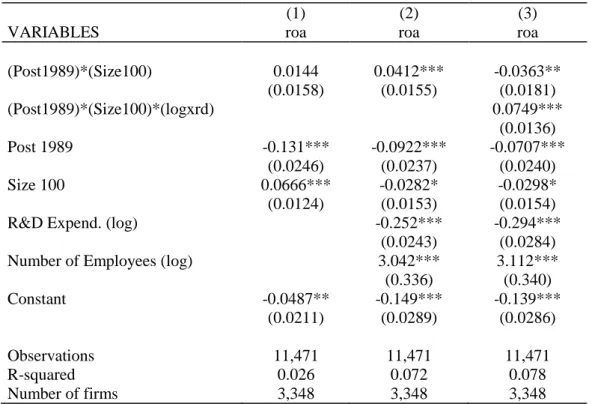
Table 5 shows the results obtained from the analysis. In the three columns we can see the impact that each variable has on firms' return on assets. While in Column (1) the analysis is restricted to the use of the main independent variables, in Column (2) I
16 control for firm R&D expenditure and number of employees. The reason for the WARN Act not being significant in Column (1) might be determined by the fact that I am omitting important variables in the regression, which changes in Column (2) when I introduce the control variables.
In Column (2) the coefficient of the WARN Act, 0.0412(±0.0155), meaning that after the WARN, the ROA increases by 4.12 percentage point for the treatment group of firms. So if the original ROA is 1% it becomes 5.12%, if it is 2% becomes 6.12% and so on. These results suggest that the passage of the WARN Act had a significant and positive impact on firm profitability.
In Column (3) I introduced a variable to see whether the effect of WARN changes for firms that invest more in R&D. The coefficient 0.0749(±0.0136) implies the ROA increases by 7.49 percentage point for these firms, implying that the positive effect of the WARN Act on firms' profitability was even more significant in companies with more R&D investment. Overall, these results suggest that the effect of the change in dismissal laws is good only for firms that invest in R&D.
Table 5. Difference-in-differences: Return on assets
(1) (2) (3)
VARIABLES roa roa roa
(Post1989)*(Size100) 0.0144 0.0412*** -0.0363** (0.0158) (0.0155) (0.0181) (Post1989)*(Size100)*(logxrd) 0.0749*** (0.0136) Post 1989 -0.131*** -0.0922*** -0.0707*** (0.0246) (0.0237) (0.0240) Size 100 0.0666*** -0.0282* -0.0298* (0.0124) (0.0153) (0.0154)
R&D Expend. (log) -0.252*** -0.294***
(0.0243) (0.0284)
Number of Employees (log) 3.042*** 3.112***
(0.336) (0.340) Constant -0.0487** -0.149*** -0.139*** (0.0211) (0.0289) (0.0286) Observations 11,471 11,471 11,471 R-squared 0.026 0.072 0.078 Number of firms 3,348 3,348 3,348
17
4.3. Robustness check
The differences-in-differences analysis raises some concerns, in that having a large sample can provide minor effects with statistical significance. In order to address this problem, I replicated the analysis using a shorter period of time, limiting the analysis to the years between 1985 and 1995. This reduced the number of observations and consequentially the likelihood of minor effects being significant.
This also builds on the previous argument that the WARN Act is exogenous. Restricting the time period even more, it becomes even less likely that firms are reacting to the law change in such a short amount of time by endogenously changing the number of employees.
The results are presented in Table 6. While in Column (2) the analysis loses significance without any great difference between firms' R&D expenditure, Column (3) shows that the impact of the WARN Act on ROA remains significant, with a slight increase in coefficient value, 0.0764(±0.0185) and -0.0433(±0.0197), both for firms that invest in R&D and those that do not. These findings are consistent with the results in Table 5.
Table 6. Robustness Check: Between 1985 and 1995
(1) (2) (3)
VARIABLES roa roa Roa
(Post1989)*(Size100) 0.000877 0.0199 -0.0433** (0.0165) (0.0163) (0.0197) (Post1989)*(Size100)*(logxrd) 0.0764*** (0.0185) Post 1989 -0.0708*** -0.0269 -0.0194 (0.0248) (0.0233) (0.0231) Size 100 0.0462*** -0.0325* -0.0327* (0.0136) (0.0169) (0.0169)
R&D Expend. (log) -0.246*** -0.293***
(0.0265) (0.0311) Number of Employees (log) 2.848*** 2.895*** (0.369) (0.368) Constant -0.0930*** -0.169*** -0.147*** (0.0148) (0.0285) (0.0287) Observations 5,871 5,871 5,871 R-squared 0.014 0.076 0.084 Number of firm 1,985 1,985 1,985
18
5. DISCUSSION AND CONCLUSIONS
This work provides empirical evidence that government regulation of employee dismissal is a causal determinant in firms' profitability, by fostering innovation. Using firms' return on assets as a measure for profitability, and exploiting the enhanced dismissal strictness imposed by the 1989 WARN Act, I found that the increased hurdles that employers are faced with when terminating with employee contracts actually boosted the profitability of companies in the U.S. that are investing in innovation. There are limitations to this study that are also worth noting. Essentially, restricting the sample to public companies may result in unobserved effects on private companies, for which additional research is necessary. Since profitability may come from the firms' increased willingness to invest in risky R&D projects, this effect can be particularly accentuated given that the ownership structure of a firm may directly influence its corporate risk taking (Jensen and Meckling, 1976; May, 1995). Therefore, the fact that this study only focuses on public companies prevents us from assessing the overall impact of dismissal law on economic performance.
Another important issue is related to the difference-in-difference tests. The analysis was conducted by comparison over a stipulated critical mass (i.e. over 100 employees). Therefore, laws or policy changes that may influence profitability, could affect the results if they resemble WARN in discrimination based on the size of the workforce. Lastly, the results of this study are consistent with the findings by Acharya et al. (2012a) that exploited the same effect in U.S. legislation to show that stricter dismissal laws have a positive effect on innovation. By contrast, the findings in this study confute a large stream of literature arguing that dismissal law harm company profits (e.g. Botero et al., 2004; Atanassov and Kim, 2009; Besley and Burgess, 2004).
The findings in this analysis help shed some light on the positive effects of dismissal laws and, in a larger context, labor market regulation. Assessing the aggregate welfare implications of labor laws, not only for companies, but also for the society as a whole, is an important topic for future research.
19
6. REFERENCES
Acharya V, Baghai R, Subramanian K. 2012a. Labor laws and innovation. Working paper, New York University Stern School of Business.
Acharya V, Baghai R, Subramanian K. 2012b. Wrongful discharge laws and innovation. Working paper, New York University Stern School of Business.
Aghion P. 2002. Schumpeterian growth theory and the dynamics of income inequality. Econometrica 70(3): 855–882.
Allen AJ, Shaik S, Myles AE, Yeboah O. 2011. Determinants of profitability performance: an analysis of class I railroads in the United States. Paper presented at the annual meeting of the Southern Agricultural Economics Association, Corpus Christi, TX.
Atanassov J. 2009. Do hostile takeovers stifle innovation? Evidence from antitakeover legislation and corporate patenting. Working paper, University of Oregon.
Atanassov J, Kim EH. 2009. Labor laws and corporate governance: international evidence from restructuring decisions. Journal of Finance 64(1): 341–374.
Autor DH, Kerr WR, Kugler AD. 2007. Does employment protection reduce productivity? Evidence from US states. Economic Journal 117(521): F189–F217.
Bassanini A, Nunziata L, Venn D. 2009. Job protection legislation and productivity growth in OECD countries. Economic Policy 24(58): 349–402.
Bertrand M, Duflo E, Mullainathan S. 2004. How much should we trust differences-in-differences estimates? Quarterly Journal of Economics 119(1): 249–275.
Besley T, Burgess R. 2004. Can labor regulation hinder economic performance? Evidence from India. Quarterly Journal of Economics 119(1): 91–134.
Blanchard O, Portugal P. 2001. What hides behind an unemployment rate: comparing Portuguese and U.S. labor markets. American Economic Review 91(1): 187–207.
Botero J, Djankov S, La Porta R, Lopez-de-Silanes F, Shleifer A. 2004. The regulation of labor. Quarterly Journal of Economics 119(4): 1339–1382.
Cefis E, Ciccarelli M. 2005. Profit differentials and innovation. Economics of Innovation and New Technology 14(1-2): 43–61.
Deakin S, Lele P, Siems M. 2007. The evolution of labour law: calibrating and comparing regulatory regimes. International Labour Review 146(3-4): 133–162.
Deakin S, Wilkinson F. 2005. The Law of the Labour Market: Industrialization, Employment and Legal Evolution. Oxford University Press: Oxford, England, U.K..
20 Ederer F, Manso G. 2010. Is pay-for-performance detrimental to innovation? Working paper presented at the Entrepreneurship Finance and Innovation Conference, Cambridge, MA.
Garmaise MJ. 2011. Ties that truly bind: noncompetition agreements, executive compensation, and Firm Investment. Journal of Law, Economics, and Organization
27(2): 376–425.
Geroski P, Machin S, Van Reenen J. 1993. The profitability of innovating firms. RAND Journal of Economics 24(2): 198–211.
Jensen MC, Meckling WH. 1976. Theory of the firm: managerial behavior, agency cost and ownership structure. Journal of Financial Economics 3(4): 305–360.
Jovanovic B, Nyarko Y. 1996. Learning by doing and the choice of technology. Econometrica 64(6): 1299–1310.
Jovanovic B, Rob R. 1990. Long waves and short waves: growth through intensive and extensive search. Econometrica 58(6): 1391–1409.
Kugler A, Saint-Paul G. 2004. How do firing costs affect worker flows in a world with adverse selection? Journal of Labor Economics 22(3): 553–584.
La Porta R, Lopez-de-Silanes F, Shleifer A, Vishny R. 1997. Legal determinants of external finance. Journal of Finance 52(3): 1131–1150.
Leiponen A. 2000. Competencies, innovation and profitability of firms. Economics of Innovation and New Technology 9(1): 1–24.
Manso G. 2011. Motivating innovation. Journal of Finance 66(5): 1823–1860.
May D. 1995. Do managerial motives influence firm risk-reduction strategies? Journal of Finance 50(4): 1291–1308.
Nagy N. 2009. Determinants of profitability: what factors play a role when assessing a firm's return on assets? Working paper, University of Akron.
Pe'er A, Gottschalg O. 2011. Red and Blue: the relationship between the institutional context and the performance of leveraged buyout investments. Strategic Management Journal 32(12): 1356–1367.
Roberts PW. 1999. Product innovation, product-market competition and persistent profitability in the U.S. pharmaceutical industry. Strategic Management Journal 20(7): 655–670.
Stone K. 2006. Dismissal law in the United States: the past and present of at-will employment. Paper presented at the seminar on Comparative Labour Relations Systems: Dismissal Law, Spanish Judicial School, Barcelona.