COMPARATIVE STUDY BETWEEN INTIMATE PARTNER
VIOLENCE VICTIMS YOUNGER THAN 65 YEARS OLD AND
OLDER THAN 65 YEARS OLD
Ana Margarida Valente da Costa Pereira
Artigo de Investigação Médica
Mestrado Integrado em Medicina
2
Ana Margarida Valente da Costa Pereira
6º ano do Mestrado Integrado em Medicina
Área: Medicina Legal
[email protected]
COMPARATIVE STUDY BETWEEN INTIMATE PARTNER
VIOLENCE VICTIMS YOUNGER THAN 65 YEARS OLD AND
OLDER THAN 65 YEARS OLD
Artigo
de
Investigação
Médica
de
Candidatura ao grau de Mestre em Medicina
submetida
ao
Instituto
de
Ciências
Biomédicas
de
Abel
Salazar
da
Universidade do Porto.
Orientadora:
Teresa Maria Salgado de Magalhães
Doutorada com agregação
Prof. Catedrática convidada (ICBAS)
Co-orientadora:
Dina Filipa Ferreira de Almeida
Mestre em Ciências Forenses
Assistente convidada (ICBAS)
3
RESUMO
A Violência nas Relações de Intimidade (VRI) pode variar nas suas características de acordo com o grupo etário das vítimas. As vítimas mais idosas são menos estudadas, mas à medida que este grupo aumenta em número, torna-se cada vez mais importante adquirir conhecimento sobre ele, dadas as suas particularidades. O objectivo deste estudo é contribuir para um melhor conhecimento das características da VRI feminina, particularmente no que concerne às vitimas portuguesas idosas, comparando grupos de vítimas adultas e idosas.
Foi realizado um estudo retrospectivo randomizado, seleccionando 200 casos de vítimas femininas de VRI examinadas nos serviços de medicina forense do Porto e comparando 2 grupos etários – menos de 65 anos e 65 anos ou mais.
As mulheres mais jovens estão mais sujeitas a: (a) sofrer abuso psicológico mais severo; (b) serem vítimas de comportamentos violentos infligidos por abusador sob influência de álcool e/ou drogas; (c) ter mais ideação suicida; (d) procurar mais frequentemente acolhimento temporário; (e) acreditarem que eventualmente haverá uma diminuição do abuso e que possuem a capacidade de alterar o curso dos eventos. As mulheres mais velhas estão mais sujeitas a: (a) terem sofrido abuso por períodos de tempo mais longos; (b) consumirem mais medicamentos; (c) terem sido abusadas pelo pai durante a infância e adolescência; (d) recorrerem mais aos serviços de urgência; (e) sofrerem mais exploração económica; (f) sofrerem mais abuso sexual; (g) acreditarem que o abuso vai manter-se.
Concluiu-se que as vítimas mais jovens estão sob maior risco de serem vítimas de recorrências violentas (e possível homicídio) pelo alegado abusador. As mulheres mais velhas estão expostas a um tipo de abuso algo diferente, facto que influencia a abordagem dos seus casos particulares.
PALAVRAS-CHAVE
Vítima; Violência; Abuso; Mulher; Violência nas relações de intimidade; Violência doméstica; Abuso de idosos
4
ABSTRACT
Intimate Partner Violence (IPV) may vary in its characteristics according to the victims’ group age. Elderly victims are the less studied, but as this group increases in number it becomes ever more important to develop knowledge about it as this age group has specific particularities. The goal of this study is to contribute to a better knowledge regarding the characteristics of female IPV, namely concerning senior Portuguese victims, comparing adult and elderly victims’ groups.
We performed a retrospective randomized study, selecting 200 cases of female IPV victims that have been examined in the forensic medical services of Porto - Portugal, comparing two age groups: younger than 65 years-old and 65 or older.
Younger women are more prone to: (a) suffer more severe psychological abuse; (b) be victims of violent behavior inflicted by an abuser under the influence of alcohol and/or drugs; (c) have more suicidal thoughts; (d) more often seek temporary shelter; (e) commonly believe that there would eventually be a decrease of abuse and that they possessed the ability to change the course of events. Older women are more prone to: (a) have suffered abuse for longer periods of time; (b) take more prescription drugs; (c) have been abused by their fathers during childhood and adolescence; (d) more often seek emergency health services; (e) suffer greater economic exploitation; (f) suffer greater sexual abuse; (g) belief that the abuse will be continue unabated.
We concluded that the younger victims stand a greater risk of being the victims of violent relapses (and possible homicide) by the alleged abuser. Older women are exposed to a somewhat different type of violence, a fact which affects how their particular situations must be addressed.
KEYWORDS
Victim; Violence; Abuse; Female; Intimate partner violence; Domestic violence; Elderly abuse
5
INTRODUCTION
Intimate partner violence (IPV) includes acts of physical and/or sexual aggression, emotional abuse and other controlling behaviors perpetrated by the victim’s current or past spouse/partner, boy/girlfriend or parent of a common child, regardless of the age, gender, familial tie or cohabitation arrangement at the time. The violence generally occurs due, among others, to the victim's dependency (e.g. emotional, psychological, economical) on the abuser, and thus, the abuser's dominant position in the relationship. IPV occurs in all countries, cultures, religions and socio-economical groups. It is a serious public health problem and a violation of human rights (1,2,3).
More frequently, the violence is perpetrated by a man against a woman. In fact, this is one of the most common forms of violence against women; though, of course, the reverse is possible (4). In spite of this fact, it is not strictly a question of gender that determines the path of violence, but rather the perceived power of the abuser. This form of violence can manifest in a variety of ways, which often coexist and evolve over time: physical, emotional/psychological or sexual abuse, economic exploitation, etc. In a multinational study carried out by World Health Organization (WHO) (3), 24.097 women from 10 different countries were interviewed; the prevalence of lifetime physical and/or sexual violence by an intimate partner was 15% to 71%, and for emotional violence was 20% to 75%.
IPV risk factors include the characteristics of the victim and the abuser, and of sociocultural, economic and religious standards (2). Among the individual characteristics of the abuser, alcohol and history of abuse in their direct family appear to be common traits. Other factors include younger age, physical and/or mental disorder, substance dependence, immature and impulsive personality, poor education, low income, unemployment or a stressful professional life, and past deviant behaviors (2,4). Regarding the common traits of victims, vulnerability related to age and necessity, social isolation, history of abuse in their direct family, physical and/or mental disorder, substance dependence, poor education, and economic, physical and/or emotional dependence on the abuser. The sociocultural standards of each community often explain the reason for the silence of the victim and their families and friends; in frequent cases, the aggressor's practices still being accepted and relatively legitimated (2).
A series of factors indicate whether the victim is in immediate danger of enduring a violent relapse and/or homicide against them (1): (a) increase in the frequency/severity of aggression; (b) threats of homicide or of suicide of the abuser; (c)
6
stalking of the victim; (d) threat of use or recent use of firearms or other potential fatal arms (e.g. stab instruments); (e) social isolation of the victim; (f) victim’s perception of homicide risk; (g) recent separation or report of the abuse; (h) and pregnancy.
The victim frequently remains in the relationship despite acknowledging the abuser’s behavior as wrong and abusive, continuously submitting themselves to the aggression. This outcome stems from a fear of the abuser fulfilling their threats, and/or the possible economical and social losses from the denunciation of their partner. Shame and a lack of social and familial support are very realistic possibilities for a victim that speaks out against their partner. In the decision of whether a victim should complain or remain silent, emotional and economical dependence are of particular significance (2).
This type of violence has a negative effect on the victim's health at several levels. Depression and post-traumatic stress disorder are the most prevalent diseases when considering the mental health of victims. Other problems such as alcohol and drug abuse are also commonly found. IPV-related mortality is of homicide committed by the abuser, and victim suicide.
Until recently, elderly IPV victims were less studied even though this type of violence does exist and constitute a large problem in this age group. With the average age of the population steadily increasing, this group of victims will also increase, thus more research is needed as this age group has specific particularities.
The goal of this study is to contribute to a better knowledge regarding the characteristics of female IPV, namely concerning senior Portuguese victims, comparing adult and elderly victims’ groups, including characteristics of victims and abusers, and the specific characteristics of abuse episodes.
MATERIAL AND METHODS
Inclusion criteria were: (a) being allegedly victim of IPV; (b) with 18 years old or more; (c) female; (d) examined in the North Branch (Porto) of the National Institute of Legal Medicine and Forensic Sciences of Portugal; (e) between 2012 and 2013.
We performed a retrospective randomized study, selecting 200 cases of female IPV victims and comparing two age groups: younger than 65 years-old (G1 – n=100) and 65 or older (G2 – n=100). This sample represents 8% of the total of female victims of IPV examined at the same place and time period (n=2478).
The primary information source was a 5-part questionnaire performed specifically for the study, concerning information about the victim, the alleged abuser, any children, and detailed description of the episodes of violence. The secondary
7
information source was the forensic medical report, concerning information about injuries and permanent consequences.
Excel 2003 was employed as the database software, and SPSS 15 for Windows for statistical analysis. The Mann-Whitney test was used to compare all the variables between the two groups; in this study, a significance level of 5% was considered to be significant.
RESULTS
1. Characterization of the victim
Most victims were Portuguese (n=195, 97.5%) and Caucasian (n=196, 98%). The mean age was 38.2 years old in G1 (Min=19; Max=64, SD=9.809) and 71.2 in G2 (Min=65; Max=88, SD=5.015). There was a greater number of single women in G1 (25%) than married, and a greater number of married women in G2 (84%) than single (p=0.000). In terms of education level, 16% in G2 were unschooled, and 72% attending school for at least 4 years; G2 women were more educated, with no illiteracy, and 55% having studied for longer than 4 years (p=0.000).
Concerning professional activity, G2 women were either retired (85%) or housewives (10%), while relevant number of the G1 subjects were unemployed (34%) - p=0.002. Only a minority claimed to be economically dependent on the alleged abuser, both in G1 (12%) and in G2 (3%) - p=0.000.
Psychiatric disorder was more prevalent in G2 (63%) than in G1 (46%), without statistical significance (p=0.053). However, suicidal ideation was more frequent in G1 (18%) than in G2 (1%) - p=0.000; the same was verified regarding suicidal attempts: 13% in G1 and 7% in G2 (p=0.196). There were only 7 cases (2 in G1, and 5 in G2) of debilitating physical illness (p=0.774).
G1 women were more isolated, both in social (35%) and familial levels (21%), than the G2 ones (4% and 4%, respectively) - p=0.000.
In terms of substance abuse, 4% of the women in each group reported alcohol consumption; 46% in G2 reported prescription drugs consumption, with no cases in G1 - p=0.000.
Regarding the history of abuse in childhood and adolescence, 41 women referred this experience – 12% in G1 and 29% in G2 (p=0.002). The most common types of abuse were physical (60% in G1, and 37.9% in G2 – p=1.000) and psychological (58% in G1, and 89.7% in G2 – p=1.000); there were also 3 cases in G1 (25%) of sexual abuse, with no cases in G2 (p=0.083). Most frequently, the alleged abuser was the father - 6 cases (50%) in G1, and 26 (89.7%) in G2. Other abusers
8
were found to be the mother (30% in G1 – n=4, and 24.1% in G2 – n=7), another family member (20% in G1 - n=2, and 51.7% in G2 - n=15), and another known person (20% in G1 - n=2) - p=0.000.
2. Characterization of the alleged abuser
In the majority of cases, the alleged abuser was Portuguese (n=193, 96.5%). The mean age was 40 years old in G1 (Min=22; Max=63; SD=9.574), and 71 years old in G2 (Min=50; Max=96; SD=7.715) - p=0.000. In G1, 28% had 4 years of schooling, 25% had 5-6 years, and 22% had 7-9 years. In G2, only 3% had no education, and 75% had some primary schooling; in both groups, only a minority had attended secondary school (11%) or higher level education (10%) - p=0.000. Professionally, 32% of G1 subjects were unemployed, and 20% worked in protection services, security, personal or domestic services or similar; 84% (n=84) of G2 were retired (p=0.001).
The alleged abuser was regularly reported to use substances (n=141, 70.5%) without a statistically significant difference between the groups (p=0.135). The substance in question was alcohol in 85 cases (60.3%), and abuse drugs in 24 (17%) - p=0.150. History of previous violent behavior against the victim associated to alcohol consumption was reported (38% in G1, and 23% in G2 - p=0.015), as well as drug abuse consumption (13% in G1, and 1% in G 2 - p=0.000).
Past deviant behaviors were reported in 46% of the cases in G1, and in 15% in G2 (p=0.000). In G1, most were physical integrity offenses (n=9, 19.5%), domestic violence and/or physical abuse of children (n=12, 26%), and other violent behaviors (n= 24, 42.3%). In G2, there were 7 cases (46.7%) of physical integrity offenses and 9 (60%) of domestic violence (p=0.000). The victim reported a psychiatric disorder of the alleged abuser in 17% of the cases in G1, and 18% in G2 (p=0.815).
A history of abuse in childhood or adolescence was reported in 14 cases: 10% in G1, and 4% in G2 (p=0.000). All suffered physical violence and 50% suffered psychological abuse. The alleged abuser was the father in 50% of cases (n=5) in G1, and in 75% (n=3) in G2. The mother was found to be the abuser in 60% (n=6) in G1, and in 50% (n=2) in G2 (p=0.000). G2 victims did not answer in 79% of the cases. Younger abusers (involved in G1 cases) had more often been exposed to domestic violence (39%) than older ones (28%) - p=0.000. Both were mostly exposed to physical (n=56, 83.6%) and psychological (n=67, 100%) violence (p=0.060). Many women in both groups did not know the answer to this question (n=86, 44.5%).
9
3. Demographic Characterization of Eventual Children
There were more children living with the couple in G1 (68%) than in G2 (23%) - p=0.000. Younger couples (G1) had 1 child in 35% of the cases, 2 in 31%, and 4 in 2%, while the older couples (G2) had 1 child in 22% of cases and 4 in 1%.- p=0.000. In G1 the majority of children were under 18 years (n=151, 92.6%), and all children were over 18 years in G2 (n=15, 93.75%).
4. Characterization of violence in the family
In most cases, the victim and the alleged abuser were married (59% in G1, and 87% in G2) or in cohabitation (39% in G1, and 6% in G2) - p=0.000. At the time of forensic medical examination, the majority of the couples were cohabitating (78% and 90% for G1 and G2, respectively). The cohabitation period in G1 was under a year in 11% of cases, between 1-5 years in 17%, 6-10 in 9%, 11-15 in 18%, 16-20 in 8%, 21-25 in 5%, 26-30 in 3%, 31-35 in 1% and over 35 years in 5%; in G2 was under a year in 1% of cases, between 1-5 years in 5%, 6-10 in 2%, 11-15 in 3%, 16-20 in 4%, 21-25 in 3%, 26-30 in 1%, 31-35 in 9% and over 35 years in 68% - p=0.000.
There were more separated and divorced couples in G1 (25%) than in G2 (7%) - p=0.002. Separation by the victim’s will, within the last 12 months, was found in 20% of cases in G 1, and 1% in G2 (p=0.000). Only in 2 cases (1 from each group) had the victim required a separation to begin another intimate relationship.
Regarding the start of the abuse, no difference was found between the groups (p=0.070). Physical abuse started during dating in 5% of cases in G1 and 14% in G2, during the first 5 years of cohabitation in 10% of cases in G1 and 22% in G2, 6-10 years of cohabitation in 10% in G1 and 1% in G2, after 10 years in 16% in G1 and 22% in G2. In 11% of cases in G1 the physical abuse started after separation, with no cases in G2. Psychological abuse started during dating in 5.2% (n=5) of cases in G1 and 18.9% (n=18) in G2, during the first 5 years of cohabitation in 72.2% (n=70) in G1 and 67.4% (n=64) in G2, 6-10 years of cohabitation in 6.2% (n=6) in G1 and 2.1% (n=2) in G2, after 10 years in 13.4% (n=13) in G1 and 11.6% (n=11) in G2; after separation in 3.1% (n=3) in G1 and in no cases in G2. Economic exploitation started during dating in 50% (n=2) of cases in G1 and in 16% (n=4) in G2, during the first 5 years of cohabitation in 50% (n=2) in G2 and 68% (n=17) in G2, and between 6-10 years of cohabitation in 12% (n=3) of cases in G2. Sexual abuse started during dating in 23.1% (n=6) of cases in G2, during the first 5 years of cohabitation in 100% (n=2) of cases in G1, and in 61.5% (n=16) in G2, 6-10 years of cohabitation in 3.8% (n=1) in G2, and after 10 years of cohabitation in 11.5% (n=3) in G2.
10
The most frequent type of abuse was the physical one (100% in G1 and 96% in G2), followed by psychological abuse (97% in G1 and 95% in G2), sexual abuse (n=2% in G1 and 26% in G2), and economic exploitation (4% in G1 and 25% in G2) – p=0.000
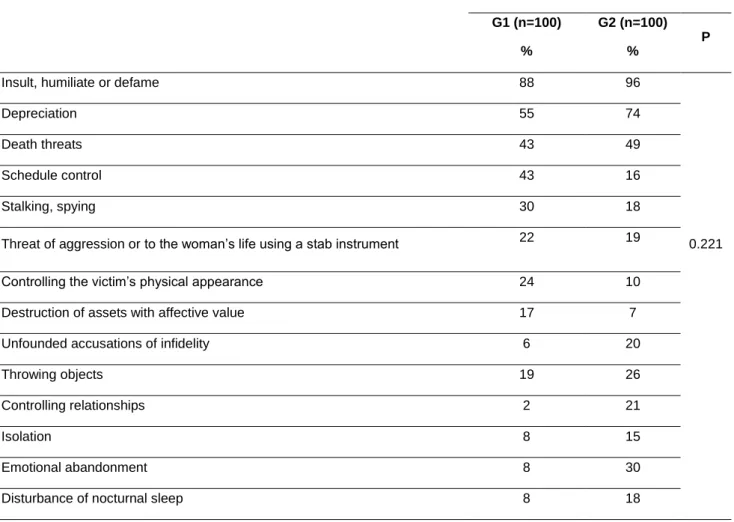
The type of psychological abuse was different in the 2 groups, however without statistical significance (Table I). Insult, humiliation and defamation were referred by most women of all ages (n=184, 92%). In G1 control of schedule and physical appearance, stalking, and destruction of assets with monetary or emotional value prevailed, while in G2 the psychological abuse was mainly emotional abandonment, unfounded accusations of infidelity, and nocturnal sleep disturbance.
The more common specific methods of physical abuse were shared across both groups: pushing, squeezing, hair-pulling, slapping, punching, throwing of objects and attempted chocking; aggression with a blunt object was also common in G2 (Table II).
In the 2 groups, the type of sexual abuse most common was the obligation of submitting to sexual practices which the woman considered “normal” but against her will (11% in G1, and 20% in G2 – p=0.221). Regarding economic exploitation, the most frequent was the control of the money earned by the woman, in both groups (n= 14, 48.3%), besides destruction of assets with economic value and absent collaboration in the everyday expenses in G2 (n=7, 28%). Economic exploitation and sexual abuse were more frequently indicated by G2 women (25% and 26%, respectively), although without statistical significance (p=0.221).
The abuse period in G1 was under a year in 18% of cases, between 1-5 years in 38%, 6-10 in 20%, 11-15 in 8%, 16-20 in 6%, 21-25 in 1%, 26-30 in 2%, 31-35 in 1% and over 35 years in 6%; in G2, under a year in 4% of cases, between 1-5 years in 7%, 6-10 in 6%, 11-15 in 3%, 16-20 in 5%, 21-25 in 3%, 26-30 in 4%, 31-35 in 7% and over 35 years in 60% - p=0.000. Both G1 (53%) and G2 (96%) victims’ reported more than 6 episodes of some kind of abuse during the relationship (p=0.000). Monthly frequency was similar in both groups: 1 episode of physical aggression per month, and more than 15 episodes of psychological violence (p=0.448).
Almost women (97.5%) filed a complaint after a physical violence episode, and the majority did not retract it (82%). Most reported there was neither an increase in frequency (76.5%) or severity (61.5%) of the abuse in the past year; there were no differences between the groups (p=0.876 and p=0.183, respectively).
Concerning the evolution of the abuse frequency in the future, women from G1 expected a decrease (86%), against only 12% from G2, where 35% expected that it remained the same. Women in the G1 also felt more capable of change the course of
11
events (94%), against 59% in G1 – p=0.000. Most victims did not believe that the alleged abuser was capable of kill them (n= 170, 85%).
Regarding the reason given for being subjected to the abuse over time, without filing a complaint, most of the women reported the belief that they could eventually change the abuser’s behavior (n=38, 16.9%) - p=0.870.
Abuse of the couple’s children was more common in G2 (n=28, 28% - p=0.000), and was mainly physical (85.7); in G1, only 6 children were abused (6%), most physically (66.7%) – p=0.000.
The alleged abuser had a firearm in 17 cases (8.5%) and a special knife in 19 (9.5%), the latter being more prevalent in G1, but without statistical significance (p=0.201). There were no reports that the weapons were used against the victim, however.
After the abuse episodes, G2 women sought emergency health services (n=30, 16.7%) and/or a family member (n=40, 22.2%), while G1 women sought the police (n=99, 63.5%) - p=0.000. The G2 group received more medical treatment for injuries sustained (n=27, 16.3%) and psychiatric treatment (n=16, 9.6%), and less temporary shelter (n=26, 15.7%) and legal advice (n=95, 57.2%); G1 received temporary shelter (n=46, 30.7%) and legal advice (n=96, 64%) more often - p=0.003.
5. Characterization of the physical aggression episode that prompted forensic medical examination
The most recent episode of aggression took place - in the majority of cases - in the couple’s home (68% in G1, and 89% in G2). In G1, the episode would also frequently occur on a public space (23%) - p=0.002. In G1, the witnesses were frequently children under 18 years old (46%), or another person not specified (38%); no witnesses were reported in 36% of cases. In G2, there were usually no witnesses (82%); in 9% of cases, children under 18 were the witnesses – p=0.000.
The methods of the aggression that justified the forensic medical examination were varied: punching (n=44, 19.5%), pushing (n=31, 13.7%), squeezing (n=28, 12.4%) and kicking (n=25, 11.1%) in G1, whereas in G2 there was punching (n=50, 17.5%), pushing (n=36, 12.6%) and other (n=64, 22.5%) - p=0.012 (Table II).
The resulting injuries were similar in both groups, with bruises being the most frequent injury (n=97, 48.5%) (Table II). Lack of any injuries was common in the G1 victims (n=47, 32.5%) - p=0.108. Injury locations were also different (p=0.000): upper limb (n=72, 40.2%), face (n=46, 25.7%) and lower limb (n=20, 11.2%) in G1, and upper limb (n=48, 32.4%), face (n=24, 16.2%) and lower limb (n=14, 9.5) in G2. The time considered by forensic examiner for injuries healing vary from 0 to 8 days (n=147,
12
73.5%), in both groups (p=0.000), because all them were mild and of the soft tissues. Most victims did not seek health services (n=132, 66%) - p=0.085.
DISCUSSION
Younger women are more educated, without any illiterate woman in this age group. This difference reflects the change in access to education that took place in the 20th century, such as the implementation of compulsory education. Regarding the professional activity of the subjects, older women were mostly retired (having reached retirement age) or were housewives, while the younger subjects were mostly unemployed. It is worth mentioning that the employed younger women are divided in several professional areas; this does not occur in G2. This fact is explained by better education and modification of the woman’s role in modern society.
Despite the young women’s better education, they tend to be more economically dependent, in a statistically significant number. The women in G2 who did not wish to answer this question may have been attempting to hide their dependency. As the older women are less professionally qualified, it is safe to assume a higher number of dependants in this group. In this survey, economical dependency is not the main factor for remaining in the abusive relationship, as suggested in another study [6].
Older women reported more substance use, which in most cases were prescription drugs. A possible explanation for this fact is the higher prevalence of age-related diseases in older people, who are often over-medicated. Psychiatric therapies also contribute to this prescription drug use. Although drugs in question are medical, there may still be some amount of abuse of these substances, mainly of anxiolytics and analgesics.
Psychiatric illness was more prevalent in G2, however without statistical significance. When these women are subjected to a more prolonged period of abuse, the impact on their mental health may be deeper, with the development of depression and post-traumatic stress disorder. Some of the younger women may already have developed a psychiatric illness, which has yet to be diagnosed. Suicidal ideas were more common in G1; these values are inversely related to the psychiatric illness number, suggesting that the older women have their illness controlled while the younger ones may go undiagnosed.
In this survey, only a minority had physical, incapacitating illness. Therefore, physical dependency on a third party is not a significant reason to remain in an abusive relationship. On the other hand, women with physical handicaps will have a lower ability to move, to report the abuse, and subsequently to attend the assessment.
13
Younger women were found to be more isolated. This difference can reflect the kind of psychological abuse they have suffered (schedule control and stalking), which limits social contact. It indicates that these women are at greater risk of violent relapses and homicide in regards to IPV (1). In older women, lower levels of isolation can be justified by contact with their independent children and their families, and possible attendance of day-centers for elderly people.
Almost all older women have suffered from psychological abuse and have been abused by their father. It is one of the most important predictive factors for re-victimization in adulthood [8], by several mechanisms: easier acceptation of a violent partner, low self-esteem, and belief that “love legitimizes violence” (7). Women with a history of physical or sexual abuse are 2 to 3 times more likely to be subject to IPV (8). Besides their own experience of abuse, women whose mother was abused by the husband – physically or psychologically – are at a higher risk of IPV (9).
The education level of the alleged abuser follows the same pattern as that of the victim – higher in G1. Also in professional activity, the tendency was the same as the victims: younger ones were in most cases unemployed, while older ones were generally retired. Besides the lower number of illiterate persons in G2, there is no academic or professional superiority of the abuser, which would contribute to the power polarization in the relationship. When the woman is employed, the risk of abuse decreases if the abuser is also professionally active; but the risk increases significantly if he is unemployed (12). On the other hand, one of the characteristics of the typical victim of fatal IPV is her own unemployment (14). As regards unemployment – both in victims and abusers – it is more common in G1, with these women being at greater risk of abuse and homicide.
The abuser often uses substances; in most cases alcohol, a substance which was associated to violent behaviors against the victim in a significant way for G1. Violent behaviors associated to the use/abuse of drugs were also more common in G1. There is a higher probability of the younger women being assaulted by abusers under the influence of drugs, which puts them at higher risk (1). According to some studies, violence perpetrated by abusers with alcoholic problems is more severe and more frequent (10).
The younger abusers were found to more often have a history of deviant behavior. This difference between groups may have several possible explanations. In the case of domestic violence, the past episodes may have occurred in another intimate relationship of the abuser, a fact which is less common in the older group, in which people were usually married only once. It is possible that the abuser (older group) engaged in extramarital relationships, but the occurrence of IPV in these
14
particular relationships would be almost impossible to know. Because of changes in modern society, intimate relationships are far more liberal and “open”, so violence (by the abuser) in these past relationships may be known by the woman, through a variety of social avenues.
In most cases, the abuser did not suffer from psychiatric illness; this finding is consistent with studies concerning the same question (11). Concerning the abuser’s exposure to domestic violence in his family of origin, this was more common in the younger group, without significant difference. There were many women who did not know how to answer this question. Even so, the results confirm an intergenerational transmission of violent behaviors against women.
Younger women more commonly had children under 18 years living with the couple. These findings were expected for this age group as the children tend to be very young and therefore dependant. Unfortunately the children who live with the couple can be exposed to violence, and can themselves be abused.
At the time of assessment, there were more separated or divorced women in G1. This means that the younger women are more willing to affect separation. The older women grew up in a society which dictated that a woman’s only function was marriage, a marriage which would last a lifetime. Here we find a limitation of this study – we do not have information on whether women had already tried, or succeeded, in affecting a separation beyond the 12 month period we focused on. It must be noted that the end of the relationship increases the risk of lethal violence for the woman (15). According to a study on fatal IPV, woman’s homicide took place more often in the first year of separation (14). We must conclude then that these women would be under a higher risk of homicide.
Longer relationships were observed in G2, because of the more advanced age, and considering that these relationships began early in the couple’s long life.
Validating other studies (13), the abuse began early in the relationship for both groups. Economic exploitation and sexual abuse were more frequently indicated by older women, although without statistical significance. The presence of sexual abuse is associated to more severe IPV and to a higher probability of being fatal.
The psychological abuse was different in the two groups, however without statistical significance. Younger women are exposed to a more severe abuse and higher risk. The different pattern of psychological abuse in older women can have perhaps two explanations: it was the same from the beginning, or, it changed and evolved from the pattern reported by the younger women in to the current pattern. In the first case, we can assume that these women were never at great risk of abuse and/or homicide. Also, women of their generation who endured an abuse with more
15
control and stalking, succeeded in separation, or became homicide victims would not be represented in this study, by virtue of their situation. In the second case, the question is what led to the changing of the pattern – factors regarding the abuser, the victim (for instance, development of adaptation strategies which enabled the change), or simply life’s ever-changing circumstances.
Physical abuse was the type more frequently found, accordingly to previous studies (17). Aggression with blunt objects was common in G2, which may indicate more severe physical violence against these women.
In both groups there were more than 6 episodes of abuse during the relationship, with a larger number in G2. These differences were significant, and were expected due to the age of the women and duration of the relationship.
In spite of older women being more likely to accept their abuse as normal, there was no difference between the groups concerning the complaints.
Most victims did not believe that the alleged abuser was capable of killing them. This fact may explain why the woman remains in the relationship, and why the younger ones believe in the eventual decrease of the abuse.
Concerning the woman’s expectations of the evolution of the abuse, older women were far less optimistic and less convinced about the prospect of being released. The reason for this, perhaps, is because of the already long duration of the abuse.
Some studies suggest that the prediction of the risk of a new aggressive episode against the victim of IPV is more accurate than the clinical evaluation and the risk assessment instruments (19, 20), due to the victim’s intimate knowledge of the events leading up to an episode. However, the continuous exposure to abuse, with insults, depreciations, and psychological trauma, can also make the victim less likely to properly understand her risk (21, 22). In our survey, younger women, despite being at higher risk, almost all believed in an eventual decrease of abuse, suggesting that they are not an accurate source.
As reason for being subjected to the abuse over time, without filing a complaint, most of the women reported a belief of the eventual change in behavior of the abuser. A great number of victims reported another reason which was not mentioned in the questionnaire. There are still other reasons for these women to subject themselves to abuse, besides the ones mentioned in the questionnaire.
The groups differ in a significant way concerning the abuse of the couple’s children, more common in G2 .The abuse was mainly physical. However, a limitation of this study is the lack of information about the exposure of children to the violent episodes.
16
Older women sought more health services after the aggressions. A possible explanation is that more severe injuries occurred in this group, requiring medical treatment due to both more severe aggressions and higher fragility of the women. Another consideration is that the children, already adults, could rush the victim to the emergency room.
The minor utilization of the temporary shelter by older women may be due to there never having existed such a service during a great part of their lives, or alternatively, it may even indicate a greater reticence to use this service. Older women may not see their problem as IPV, and consequently, do not seek these services provided to victims (18). Legal advice was perhaps not readily available from the beginning of the abusive relationship, on account of less understanding of this problem, and little access to justice services 30 years ago.
The most recent aggression episode in G2 did not have witnesses, as this couple lived alone, without any children. Young children were always the witnesses (if any) of violent episodes in G1, which is consistent with the finding from another study (17). The resulting injuries were similar in the two groups, with ecchymosis/contusion being the most frequent (Table III). Lack of any injury in the older victims shows a less severe aggression in this group. The sites of injuries were consistent with the reported aggression types; injuries on the arms and forearms may be defensive. The short time of malaise suggests less severe aggressions in most cases.
CONCLUSIONS
Younger women are generally characterized by: (a) higher education; (b) being unemployed; (c) living more isolated; (d) being more economically dependent on the alleged abuser; (e) suffering from a more severe psychological abuse; (f) having more suicidal ideas; (g) seeking more temporary shelter; (h) believing in the eventual decrease of abuse and in their ability to change the course of events; (i) being victims of violent behaviors by an abuser under the influence of alcohol and/or drugs. There was also a higher number of separated women in the last 12 months. The couple’s children generally: (a) live with the victim and the abuser; (b) are also abused; (c) witnessed the most recent episode of physical aggression. The abusers generally: (a) are unemployed; (b) have a history of deviant behavior; (c) possess firearms.
Compared to younger women, older women were found to generally: (a) be retired; (b) use more prescription drugs; (c) have more psychiatric illness (not statistically significant); (d) suffered abuse in childhood and/or youth by their father; (e) suffer abuse for a protracted period of time; (f) be more often assaulted with blunt
17
objects; (g) more often use the emergency health services; (h) receive more treatment for injuries and psychiatric treatment; (i) consider the abuse will continue; (j) suffer more economic exploitation and sexual abuse; (l) showed no injuries and had no witnesses in the most recent physical violent episode.
The abuser, in both groups, regularly uses/abuses substances (in most cases, alcohol), was exposed to violence in his family of origin during childhood and/or youth, and does not have a psychiatric illness.
Assessing these results, we may conclude that the younger woman is at higher risk of abuse and homicide. But this is not perceived by the victim, who sometimes even believes in the eventual decrease of violence.
Although the older women are at less risk, we cannot assume with certainty that this fact has remained unchanged during all abusive relationships, or that it has decreased. This group may have already been culled over the years; women of this generation who were under a higher risk may have been killed by their abusive partners, or have broken off the relationship, meaning their numbers were not included in this study. There may also be older women who suffer a more severe abuse, and who are isolated (a common situation in the general population), and/or do not see their situation as being abusive. In these cases, the report may never even be made.
18
ACKNOWLEDGMENTS
To Professor Teresa Magalhães, for her availability to supervise this project, suggestions and invaluable assistance.
To Dr. Dina Almeida for her essential guidance, support, dedication and availability to help in every step of this project.
To Dr. Fernanda Rodrigues, for allowing data collection in the Clinical Forensic services.
To Dr. Diana Garganta, for her support in the statistical analysis of data.
19
REFERENCES
1 – Grams AC, Magalhães T. Violência nas relações de intimidade. Avaliação do risco. Revista Portuguesa do Dano Corporal 2011; 22:75-98.
2 – Magalhães T. Violência e Abuso. Respostas simples para questões complexas. 1st ed. Coimbra: Imprensa da Universidade de Coimbra; 2010
3 – García-Moreno C et al. Who Multi-country Study on Women’s Health and Domestic Violence Against Women: initial results on prevalence, health outcomes and women’s responses. 1st ed. Switzerland: World Health Organization; 2005
4 – Krug EG, Dahlberg LL, Mercy JA, Zwi AB, Lozano R. World Report on Violence and Health. Geneva: World Health Organization; 2002
5 – Campbell, JC. Health consequences of intimate partner violence. Lancet 2002: 359:1331-1336
6 - Berrios D, Grady D. Domestic Violence: Risk Factores and Outcomes. The Western Journal of Medicine, 1991: 155:133 – 135.
7 - Straus MA, Kaufman Kantor GK. Corporal punishment by parents: A risk factor in the epidemiology of depression, suicide, alcohol abuse, child abuse and wife beating. Adolescence 1994: 29:543-561
8 – Hien D, Ruglass L. Interpersonal partner violence and women in the United States: An overview of prevalence rates, psychiatric correlates and consequences and barriers to help seeking. Int J Law Psychiatry 2009: 32(1): 48–55.
9 - Henning K, Leitenberg H, Coffey P, Turner T, Bennett RT. Long-term psychological and social impact of witnessing physical conflict between parents. J Interpersonal Violence 1996: 11:35–51.
10 – Barnett OW, Fagan RW. Alcohol Use in Male Spouse Abusers and Their Female Partners. Journal of Family Violence 1993: 8:1-25.
11 – Manita C. A intervenção em agressores no contexto da violência doméstica em Portugal – estudo preliminar de caracterização. 1ª edição. Lisboa: Comissão para a Igualdade e para os Direitos das Mulheres, 2005
12 - Kruttschnitt C, Gartner R, Ferraro K .Women’s involvement in serious interpersonal violence. Aggression and Violent Behaviour 2002: 7:529–565.
13 – Murphy M, O'Leary KD. Psychological aggression predicts physical aggression in early marriage. Journal of Consulting and Clinical Psychology 1989: 57(5):579-582 14 – Pereira AR, Vieira DN, Magalhães T. Fatal intimate partner violence against women in Portugal: A forensic medical national study. J Forensic Leg Med 2013 Nov; 20(8):1099-107
20
15 - Wilkinson DL, Hamerschlag SJ. Situational determinants in intimate partner violence. Aggression & Violent Behavior 2005: 10:333–361.
16 - Campbell JC, Soeken KL. Forced sex and intimate partner violence:effects on women’s risk and women’s health. Violence against women 1999: 5:1017-35.
17 – Lisboa M, Barroso Z, Marteleira J. O contexto social da violência contra as mulheres detectada nos Institutos de Medicina legal. Lisboa: Comissão para a Igualdade e para os Direitos das Mulheres, 2003
18 – Lundy M, Grossman SF. Domestic Violence Service Users - A Comparison of Older and Younger Victims. J Fam Viol 2009: 24:297-309
19 – Bell ME, Cattaneo LB, Goodman LA, Dutton MA. Assessing the Risk of Future Psychological Abuse: Predicting the Accuracy of Battered Women’s Predictions. J Fam Viol 2008: 23:69–80 doi 10.1007/s10896-007-9128-5
20 – Dutton MA. Battered women’s strategic response to violence: the role of context. In Edleson J, Eisikovitz Z editors. Future Interventions with Battered Women and their Families. 1st ed. Thousand Oaks: Sage,1996. p. 105-124
21 – Campbell JC. Prediction of homicide of and by battered women. In Campbell JC, editor. Assessing Dangerousness: Violence by Sexual Offenders, Batterers and Child Abusers. 1st ed. Thousand Oaks: Sage, 1995. p. 96-113
22 – Dutton MA, Dionne D. Counseling and shelter for battered women. In Steinman M, editor. Woman Battering: Policy Responses.1st ed. Cincinatti: Anderson, 1991. p. 13-130
21
TABLES
Table I – Types of psychological abuse
G1 (n=100) %
G2 (n=100) %
P
Insult, humiliate or defame 88 96
Depreciation 55 74
Death threats 43 49
Schedule control 43 16
Stalking, spying 30 18
Threat of aggression or to the woman’s life using a stab instrument 22 19 0.221
Controlling the victim’s physical appearance 24 10
Destruction of assets with affective value 17 7
Unfounded accusations of infidelity 6 20
Throwing objects 19 26
Controlling relationships 2 21
Isolation 8 15
Emotional abandonment 8 30
22
Table II – Types of physical abuse
G1 (n=100) %
G2 (n=100) %
Past abuse Current episode Past abuse Current episode
Pushing 49 31 73 36 Punching 49 44 63 50 Slapping 51 23 61 2 Squeezing 45 28 50 28 Kicking 42 25 38 18 Hair pulling 37 24 28 19 Throwing objects 19 6 26 2 Choking 18 14 23 14
23
Table III – Types and anatomical distribution of injuries
G1 n (%) G2 n (%) p Type of Injury No injury (pain) 27 (18.2) 47 (32.5) 0.108 Swelling 23 (15.5) 15 (10.4) Bruise 53 (35.8) 44 (30.6) Abrasion 32 (21.6) 19 (13.2) Anatomical distribution Cranium 8 (4.47) 4 (2.7) 0.000 Face 46 (25.7) 24 (16.2) Neck 11 (6.2) 3 (2) Thorax 9 (5.3) 11 (7.4) Abdomen 2 (1.2) 1 (0.6) Upper limb 72 (40.2) 48 (32.4) Lower limb 20 (11.2) 14 (9.5)
24
Anexo – Resumo em português
Introdução
A Violência nas Relações de Intimidade (VRI) inclui actos de agressão física e/ou psicológica, abuso emocional e outros comportamentos controladores perpetrados pelo conjugue actual ou passado da vítima, namorado ou progenitor de descendente em comum, independentemente da idade, género, ligação familiar ou coabitação à altura dos factos.
Os factores de risco para VRI incluem características da vítima, do abusador, de ordem sociocultural, económica e/ou religiosa. Entre as características individuais do abusador, parecem ser particularmente importantes a história de VRI na família de origem e o consumo de álcool; outros factores são idade jovem, doença física e/ou mental, dependência de substâncias, personalidade imatura e impulsiva, baixas habilitações académicas, baixo rendimento, desemprego ou vida profissional muito intensa e antecedentes de comportamentos desviantes. Relativamente à vítima, são relevantes a vulnerabilidade relacionada com a idade e as necessidades, o isolamento social, a experiência de abuso na família de origem, dependência de substâncias, doença física e/ou mental, dependência económica, física e/ou emocional do abusador e baixas habilitações académicas.
Uma série de factores indicam se a vítima está sob perigo imediato e sob risco de recidiva da violência e/ou homicídio: aumento da frequência e/ou severidade das agressões, ameaças de homicídio ou suicídio do abusador, perseguição da vítima, ameaça de uso ou uso recente de armas durante as agressões, isolamento social da vítima, percepção pela vítima de risco de homicídio, separação recente e gravidez.
Mesmo quando entende como errado e abusivo o comportamento a que está sujeita, é frequente a mulher manter-se na relação e submeter-se continuadamente ao abuso. Tal é consequência do medo tanto da concretização das ameaças do abusador, como das possíveis perdas afectivas, económicas e sociais decorrentes da denúncia; da vergonha da falência da relação; e da falta de apoio social e familiar. Na decisão de denunciar o abuso, têm particular importância as dependências emocional e económica.
Até recentemente, as vítimas mais velhas de VRI eram menos estudadas apesar deste tipo de violência existir e constituir um problema neste grupo etário. Com o envelhecimento da população, este grupo de vítimas irá aumentar, e assim mais investigação é necessária dadas as especificidades deste grupo.
25
Material e Métodos
Os critérios de inclusão foram: (a) ser uma alegada vítima de VRI; (b) ter 18 anos ou mais; (c) ser examinada na Delegação Norte do Instituto de Medicina Legal e Ciências Forenses de Portugal; (d) entre 2012-2013.
Foi realizado um estudo retrospectivo, seleccionando 200 casos de vítimas femininas de VRI e comparando dois grupos etários: idade superior a 65 anos (G1 – n=100) e 65 ou mais anos (G2 – n=100). Esta amostra representa 8% do total de vítimas femininas de VRI examinadas no mesmo local e período de tempo (n=2478).
Para a recolha de dados, foi utilizado um questionário constituído por 5 partes, englobando informação relativa à vítima, informação relativa ao alegado agressor, a eventual existência de filhos e caracterização dos episódios de violência. Os processos das vítimas foram a fonte de informação. A fonte secundária de informação foi o relatório da perícia médico-legal, relativa a informação sobre as lesões e dano permanente.
Para a base de dados, foi utilizado o programa informático Excel 2003, e para o tratamento estatístico o SPSS 14 para Windows. Utilizou-se o teste de Mann-Whitney nas comparações de todas as variáveis. Considerou-se um nível de significância de 5% para todas as variáveis.
Resultados e discussão
As mulheres mais jovens têm mais habilitações literárias, sem qualquer analfabeta neste grupo. Esta diferença reflecte as mudanças no acesso à educação que tiveram lugar no século XX, como a implementação da escolaridade obrigatória.
Apesar da educação superior das mulheres mais jovens, estas tendem a ser mais dependentes economicamente, de forma estatisticamente significativa. As mulheres em G2 que não responderam a esta questão podem, eventualmente, estar a ocultar a sua dependência. Dada a menor qualificação profissional destas mulheres, é seguro afirmar que haverá maior número de dependentes em G2.
As mulheres mais velhas reportaram maior consumo de substâncias, à custa de medicamentos. Uma possível explicação é a maior prevalência de doença orgânica desta faixa etária, frequentemente polimedicada. No entanto, também pode haver abuso destas substâncias, nomeadamente de ansiolíticos e analgésicos.
A doença psiquiátrica foi mais prevalente em G2, porém sem significância estatística. O impacto do abuso durante um longo período de tempo tem mais impacto na saúde mental destas mulheres. A ideação suicida foi mais prevalente em G1, sugerindo que poderá haver doença psiquiátrica ainda não diagnosticada nestas vítimas.
26
As vítimas mais jovens estavam mais isoladas, tanto a nível social quanto familiar. Esta diferença pode reflectir o tipo de abuso psicológico que sofrem, que limita o contacto social. Indica que estas mulheres estão sob maior risco de recaídas violentas e homicídio. Nas mais velhas, o menor isolamento pode ser devido ao contacto com os seus filhos independentes e famílias respectivas.
Quase todas as mulheres mais velhas sofreram abuso na infância/adolescência pelo pai; é um dos factores preditivos mais importantes para re-vitimização na idade adulta.
O nível de educação do alegado abusador segue o mesmo padrão do da vítima – maior em G1. Geralmente, os mais jovens estavam desempregados, e os mais velhos reformados.
O abusador frequentemente consome substâncias, especialmente álcool, que se associava a comportamentos violentos contra a vítima em G1 de forma significativa. Também neste grupo eram mais comuns as agressões sob influência de drogas. Estes factos colocam-nas sob maior risco. Havia comummente história de comportamentos desviantes do alegado abusador em G1, bem como de exposição a violência doméstica na família de origem. Não sofria, geralmente, de doença psiquiátrica.
Como seria expectável pela faixa etária a que pertencem, em G1 existiam mais filhos com idade inferior a 18 anos a coabitarem com o casal. O abuso dos filhos era mais comum em G2, sendo geralmente físico.
À data da avaliação, existiam mais mulheres separadas ou divorciadas do suposto abusador em G1. A separação ocorreu por vontade da vítima, nos últimos 12 meses. Ou seja, as mulheres mais jovens estão mais dispostas a darem o passo da separação. As mulheres mais velhas cresceram e foram educadas numa sociedade em que a única realização da mulher se materializava no casamento, que era para toda a vida. O fim da relação aumenta o risco de violência letal para a mulher; o que indica o maior risco de homicídio em G1.
As relações mais longas eram do grupo 2, justificável pela idade mais avançada e assumindo que se tratam de relações iniciadas cedo na vida do casal.
O abuso teve início precoce na relação, de forma idêntica nos dois grupos. A exploração económica e o abuso sexual foram mais frequentemente indicados pelas mulheres mais velhas, embora sem significância. A presença de abuso sexual está associada a VRI mais grave e a maior probabilidade desta ser fatal.
O abuso psicológico difere nos dois grupos, porém sem significância estatística. O insulto, a humilhação e difamação foram indicados pela esmagadora maioria das mulheres de todas as idades. Em G1, houve predomínio do controlo de horários e do arranjo pessoal, perseguição e destruição de bens com valor afectivo,
27
enquanto no grupo 2 havia mais abandono emocional, acusações infundadas de infidelidade e perturbação do sono nocturno. As mulheres mais jovens estão expostas a um abuso mais grave e a um maior risco. O diferente padrão de abuso psicológico das mulheres mais velhas pode ter eventualmente duas explicações: manteve-se desta forma desde o início do abuso, ou sofreu alteração, evoluindo do padrão relatado pelas mulheres mais novas até ao actual.
Em ambos os grupos, a forma de abuso sexual mais prevalente era a obrigação de manter práticas sexuais que a mulher considera normais, mas contra a vontade da própria. O abuso físico foi o tipo de abuso mais frequentemente indicado. A agressão com objecto contundente era comum no grupo 2, podendo indicar uma maior gravidade da violência física nestas mulheres. Na vertente económica do abuso, o mais frequente era o controlo de dinheiro ganho pela mulher em ambos os grupos, para além da destruição de bens económicos e não colaboração nas despesas quotidianas em G2.
Em ambos os grupos, existiam mais de 6 episódios de abuso durante a relação, com um maior número em G2. Estas diferenças foram significativas, e eram expectáveis devido à idade das mulheres e duração da relação.
Apesar de ser mais provável as mulheres mais velhas aceitarem o seu abuso como normal, não houve diferença entre os grupos no que concerne à apresentação de queixa.
Quanto à evolução do abuso, as mulheres mais jovens esperavam uma diminuição, e sentiam-se capazes de alterar o rumo dos acontecimentos. As vítimas de G2, face à longa duração do abuso, tornaram-se menos optimistas e confiantes na sua capacidade de se libertarem do abuso.
A maioria das vítimas não acreditava que o suposto abusador fosse capaz de as matar. Este facto poderá favorecer a permanência na relação, e estar ligado ao facto de as mulheres mais jovens acreditarem na diminuição do abuso.
Após as agressões físicas, as mulheres mais velhas procuravam mais serviços de saúde. Possíveis explicações são a maior gravidade das lesões ou ser uma terceira pessoa a levar a vítima ao serviço de urgência. Por outro lado, utilizavam menos o acolhimento temporário e o aconselhamento legal do que as vítimas de G1.
Como motivo da sujeição ao abuso ao longo do tempo, sem apresentar denúncia, a maioria das mulheres indicou a crença na mudança do suposto abusador. Um grande número de vítimas indicou outro motivo, não enunciado no questionário. Para além dos motivos abrangidos pelo questionário, existem ainda outras razões para se sujeitarem ao abuso.
28
O episódio mais recente de abuso físico em G2 não teve testemunhas, dado o casal viver sozinho, sem filhos. As testemunhas mais frequentes em G1 eram os filhos menores de idade. As lesões resultantes foram semelhantes nos dois grupos, sendo a mais comum a equimose/contusão. A ausência de lesão em G2 revela uma agressão menos grave. Os sítios de lesão são consistentes com os tipos de agressão indicados; lesões nos braços e antebraços podem ser defensivas. O curto período de doença sugere agressões menos graves na maioria dos casos.
Conclusão
As mulheres mais jovens caracterizam-se por: (a) maiores habilitações literárias; (b) estarem desempregadas; (c) estarem mais isoladas; (d) maior dependência económica; (e) sofrerem abuso psicológico mais grave; (f) terem mais ideação suicida; (g) procurarem mais acolhimento temporário; (h) acreditarem na eventual diminuição do abuso e na sua capacidade de alterar o rumo dos acontecimentos; (i) serem vítimas de comportamentos violentos por um alegado abusador sob influência de álcool e/ou drogas ilícitas. Havia também um maior número de mulheres separadas nos últimos 12 meses. Os filhos do casal geralmente: (a) vivem com a vítima e o alegado abusador; (b) são também eles abusados; (c) testemunharam o mais recente episódio de violência física. Os alegados abusadores geralmente: (a) esta desempregados; (b) têm história de comportamentos desviantes; (c) possuem armas de fogo.
Comparativamente às vítimas jovens, as mais velhas geralmente: (a) são reformadas; (b) utilizam mais medicamentos; (c) têm mais doença psiquiátrica (não estatisticamente significativo); (d) foram abusadas pelo pai durante a infância e adolescência; (e) sofreram abuso por períodos de tempo mais longos; (f) são mais frequentemente agredidas com instrumento contundente; (g) recorrem mais aos serviços de urgência; (i) acreditam que o abuso se vai manter; (h) recebem mais tratamento para lesões e psiquiátrico; (j) sofrem mais abuso sexual e exploração económica; (l) não apresentaram lesões e não tiveram testemunhas no episodio mais recente de violência física.
O alegado abusador, em ambos os grupos, consome regularmente substâncias (na maioria dos casos, álcool), foi exposto a violência na família de origem durante a infância e/ou juventude, e não tem doença psiquiátrica.
Concluiu-se que as vítimas mais jovens estão sob maior risco de serem vítimas de recorrências violentas (e possível homicídio) pelo alegado abusador. As mulheres mais velhas estão expostas a um tipo de abuso algo diferente, facto que influencia a abordagem dos seus casos particulares.