Perception of the peripheral arterial occlusive disease in Fontaine
class I or II patients included in a Family Health Program
Percepção da doença arterial obstrutiva periférica por pacientes classe I ou II de Fontaine
de um Programa de Saúde da Família
Juliana Nogueira Diniz1, Regina Coeli Cançado Peixoto Pires2
Abstract
Background: Peripheral arterial occlusive disease (PAOD) is characterized by the impairment of patients’ quality of life when it is associated with high risk of cardiovascular or cerebrovascular events. he Ankle Brachial Pressure Index (ABPI) is a sensitive and speciic diagnostic method, and the control of risk factors is optimized with early detection of PAOD.
Objective: To assess the perception of PAOD in Fontaine stage I and II patients by Family Health Strategy in Pará de Minas (MG), Brazil, through an analysis of the socioeconomic characteristics and life quality determinants.
Methods: After the sample calculation, stratiied by genre and age, 123 individuals diagnosed with Fontaine stage I or II PAOD were given a questionnaire elaborated for the purposes of this study. Aiming at associations, the χ2 and Fisher’s Exact tests were used (p<0.05).
Results: Among the participants who answered the questionnaire, 96 (78%) were women and had low schooling. We observed association between intermittent claudication, the most common symptom, and sensation of pressure on the legs, cramps, foot paresthesia, fatigue, swelling, and tingling. here was no association with smoking, systemic arterial hypertension, diabetes and cholesterol alterations. Among the participants, 76 (61.8%) had never heard about the disease even though they had it. Pain during activities at home or elsewhere was reported by 48 individuals (39%). he practice of physical activities was more recommended by clinicians – mentioned by 18 (14.6%) individuals – and walking, which was the only activity practiced according to the recommended levels, was reported by 102 participants (27.7%).
Conclusion: his population must be better oriented about the clinical and non-pharmacological treatment intended to the control of irreversible chronic manifestations. We emphasize the importance of conveying information about the silent development and the symptomatology of the disease.
Keywords: arteriosclerosis obliterans; intermittent claudication; quality of life.
Resumo
Contexto: A doença arterial obstrutiva periférica (DAOP) se destaca por deteriorar a qualidade de vida dos pacientes, quando associada a elevado risco de eventos cardiovasculares e cerebrovasculares. O diagnóstico clínico é sensível e especíico, por meio do índice tornozelo-braquial (ITB), que, se precocemente detectado, otimiza o controle dos fatores de risco.
Objetivo: Avaliar a percepção da DAOP em pacientes classe I ou II de Fontaine assistidos pela Estratégia de Saúde da Família em Pará de Minas (MG), analisando características socioeconômicas e determinantes da qualidade de vida.
Métodos: Após cálculo amostral estratiicado por gênero e idade, um questionário elaborado para o estudo foi respondido por 123 indivíduos com diagnóstico de DAOP classe I ou II de Fontaine. Para as associações, utilizaram-se testes do c2 e exato de Fisher (p<0,05).
Resultados: Dos indivíduos que responderam o questionário, 96 (78%) eram do gênero feminino e tinham baixa escolaridade. Observou-se associação entre claudicação intermitente, o sintoma mais frequente da doença, e aperto nas pernas, câimbras, adormecimento dos pés, cansaço, inchaço e agulhadas. Não houve associação com tabagismo, hipertensão arterial sistêmica, diabetes e alteração do colesterol. Dos participantes, 76 (61,8%) nunca ouviram falar da doença, apesar de serem portadores. Dor durante execução de tarefas dentro e fora de casa foi relatada por 48 (39%) indivíduos. A prática de atividade física foi mais recomendada por médico clínico geral – mencionada por 18 (14,6%) indivíduos – sendo que a caminhada, única atividade praticada em níveis recomendados, foi relatada por 102 (27,7%).
Conclusão: É necessário esclarecimento para essa população quanto ao tratamento clínico não-farmacológico para controle das manifestações crônicas irreversíveis. Ressalta-se a relevância da veiculação de informações sobre a evolução silenciosa e sintomatologia da doença.
Palavras-chave: arteriosclerose obliterante; claudicação intermitente; qualidade de vida.
Study carried out at UninCor, Campus Betim (MG), Brazil
1 Masters in Health Science at the Universidade Vale do Rio Verde de Três Corações (UninCor), Betim (MG), Brazil 2 PhD in Epidemiology at the Universidade Federal de Minas Gerais (UFMG), Belo Horizonte (MG), Brazil
Introduction
Peripheral arterial occlusive disease (PAOD) is a se-vere degenerative systemic vascular disease resulting from the peripheral artery narrowing and stifening, especially in the lower limbs. It is highly prevalent in the population and causes restrictions, thereby impairing patient’s quality of life. Moreover, PAOD is associated with high risk of fa-tal and nonfafa-tal cardiovascular events such as death, acute myocardial infarction and stroke1,2.
he most common PAOD symptom is intermittent claudication (IC), which manifests as a discomfort in the afected muscles during walking that is relieved by rest3,4.
It is disturbing that PAOD be often underdiagnosed, because the clinical diagnosis is sensitive and very spe-cific, made by the objective and simple Ankle Brachial Pressure Index (ABPI), which is based on the ratio of systolic blood pressure in the ankle and arm of less than 0.9. It is fundamental that the patient evaluation be done with instruments that provide objective and reproduc-ible data, for the peripheral arterial obstruction may be diffuse, with many clinical presentations. The investiga-tion with simple but reliable methods is important es-pecially in regions economically restricted in terms of advanced technological resources. In these regions, it is necessary to detect the large number of asymptomatic patients presenting history of sedentary lifestyle or as-sociated diseases that limit physical activity. These pa-tients often interpret the discomfort in the lower limbs as an age-related factor and do not seek medical advice3,4.
Early diagnosis improves the control of risk factors by medication, changes in eating habits and/or supervised exercises. Clinical management is preferred due to its noninvasive characteristics, presenting low incidence of complications, besides exerting a systemic action on the atherosclerotic disease progression1,5,6.
Practicing regular physical activities under profes-sional orientation makes it possible for PAOD patients to walk longer distances without pain or with less discomfort. In addition, professional supervision assures the correct posture during physical activity, thus avoiding overloads that, at long term, may aggravate the underlying vascular problem.
he current recommendations for PAOD treatment, which emphasizes regular and oriented physical activities, are not properly followed according to clinical observation. he patients are oten instructed by their doctors to practice exercises without professional supervision or are told that
there are contraindications to such activities based on their symptomatology.
Objective
To assess the perception of Fontaine stage I and II PAOD mainly with regard to symptomatology and to treat-ment, starting from the detection of exercise practice, in or-der to determine the inluence of the disease on individuals’ well-being.
Methods
his is a cross-sectional, descriptive and analytical study of a case series conducted in Pará de Minas, Minas Gerais, Brazil.
he studied population was selected based on medi-cal records from Policlínica Municipal, a reference in spe-cialized medical care, and all the patients assisted by the Service of Angiology in January 2008 who had a medical record indicating Fontaine stage I or II PAOD were enrolled for the study.
Using the proportional random sample with a 10% margin of error, a representative sample was calculated and stratiied by genre and age group (30 to 39, 40 to 49, 50 to 59, and 60 to 65 years old).
Partially or entirely illegible medical records were ex-cluded from the study, as well as individuals younger than 30 years or older than 65 years of age in 2007, with medical records indicating conditions such as surgical or endovas-cular surgery therapy for PAOD, limitation or deiciency that restrains regular practice of exercises, wounds in the lower limbs that are under treatment or have been treated, and/or amputation at any level of the lower limbs; patients who were assisted by the private health system before mi-grating to the public health system of Pará de Minas were also selected.
A speciic questionnaire was designed for the study with questions concerning socioeconomic characteris-tics, knowledge of the participants about PAOD and prac-tice of physical activity. It was composed according to the International Physical Activity Questionnaire (IPAQ) aim-ing at the classiication of patients by daily activities.
and the informed consent form. he agents were oriented about the questionnaire application, and the importance of not interfering with the answers was emphasized – includ-ing opinions expressed by other people livinclud-ing in that same address.
Data were analyzed by the sotware Statistical Package for Social Science(SPSS) for Windows® version 13.0. he
descriptive analysis of the variables was expressed in tables of frequency distribution starting from the analysis of cross tables, and valid associations were observed by means of the χ2 and Fisher Exact tests, with signiicance level set at
p<0.05. he analysis of the open questions was carried out by answer categorization.
his study was approved by the Ethics Research Committee of Universidade Vale do Rio Verde de Três
Corações (UninCor) and registered on the SISNEP (in
Portuguese, Sistema Nacional de Informação sobre Ética
em Pesquisa envolvendo Seres Humanos), having an Ethics
Certiicate (CAAE) 0026.0.380.000-08. he participants were instructed and, aterwards, they signed the informed consent form.
Results
he sample gathered 123 medical records of patients diagnosed with Fontaine stage I or II PAOD. We veriied that 96 (78%) participants were women and 27 (22%) were men, with predominance of the age groups from 50 to 59 years old (45 patients; 36.6%) and from 60 to 65 years old (39 patients; 31.7%).
Patients’ schooling was considered low: 79 individuals (64.2%) attended up to the fourth grade of the elementary school. he individual income distribution was concen-trated on the range of up to one minimum wage (59 par-ticipants, 48%), which identiies a population with lower schooling and income, thus preventing the access to spe-cialists at private clinics.
he workday was classiied according to workload and work shits mostly reported by patients: 26 (21.1%) indi-viduals reported working 8-hour shits, and 29 (23.6%) re-ported early-morning or aternoon shit work.
When assessing the presence of four main risk fac-tors on PAOD patients (hypertension, smoking, choles-terol alterations and diabetes mellitus), we observed 61 (49.6%) hypertensive patients and 27 smokers (22.0%), followed by those who declared having serum choles-terol alterations (24 – 19.5%) and diabetes (13 – 10.6%), respectively.
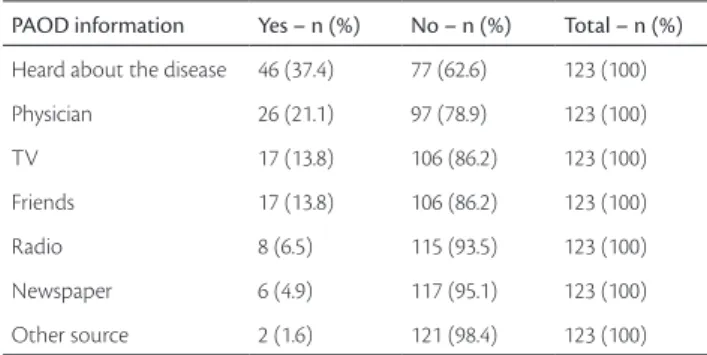
When analyzing the knowledge of the studied pop-ulation about arterial occlusive disease, 46 individuals
(37.4%) had heard about the subject; it is worth empha-sizing that 77 (63.6%) patients who declared not to have heard about the disease, as the medical record indicated (Table 1).
he three most mentioned alternatives of treatment for PAOD (alternative therapies, analgesic/anti-inlammatory and antihypertensive/anti-lipidemia drugs) are indicated in Table 2. he two other options were: regular physical activ-ity and oral hypoglycemiant/anticoagulant drugs. he im-portance of regular exercise must be emphasized, as well as the control of risk factors for the initial conditions of the disease5.
In regard to the interpretation of the exercises prac-ticed by the participants, the objective was to classify the individuals according to their physical effort and to IPAQ7.
he practice of physical activities was reported by 47 participants (38.2%), and 73 (59.3%) of them did not practice any. Regarding the modalities, ive options were
Table 1 – Distribution of individuals with Fontaine stage I and II PAOD according to intermittent claudication and risk factors, Pará de Minas (MG), Brazil, 2009
Intermittent claudication Total – n
(%) Yes – n (%) No – n (%)
Smoking Yes – n (%) 15 (57.7) 11 (42.3) 26 (100.0)
No – n (%) 53 (55.8) 42 (44.2) 95 (100.0)
Diabetes Yes – n (%) 8 (61.5) 5 (38.5) 13 (100.0)
No – n (%) 59 (55.7) 47 (44.3) 106 (100.0)
Cholesterol alterations
Yes – n (%) 15 (62.5) 9 (37.5) 24 (100.0)
No – n (%) 52 (57.1) 39 (42.9) 91 (100.0)
Systemic arterial hypertension
Yes – n (%) 34 (55.7) 27 (44.3) 61 (100.0)
No – n (%) 34 (58.6) 24 (41.4) 58 (100.0)
Table 2 – Distribution of individuals with Fontaine stage I and II PAOD according to PAOD information source, Pará de Minas (MG), Brazil, 2008
PAOD information Yes – n (%) No – n (%) Total – n (%)
Heard about the disease 46 (37.4) 77 (62.6) 123 (100)
Physician 26 (21.1) 97 (78.9) 123 (100)
TV 17 (13.8) 106 (86.2) 123 (100)
Friends 17 (13.8) 106 (86.2) 123 (100)
Radio 8 (6.5) 115 (93.5) 123 (100)
Newspaper 6 (4.9) 117 (95.1) 123 (100)
Other source 2 (1.6) 121 (98.4) 123 (100)
suggested, and walking was practiced by 38 people (30.9%), followed by group gymnastics (13 individuals, 10.6%) per-formed by ESF professionals in sports courts or squares of the city as preventive activities, thus promoting the health of the population (Table 3).
Eighteen participants (14.6%) reported being oriented for the practice of physical activity by their clinicians.
It was observed, however, that practicing any kind of physical activity did not result in IC, because the percentage of individuals with IC was very similar among those who did practice and those who did not practice exercises – 25 (54.3%) and 40 (55.6%) participants, respectively (p=0.524).
he question about walking for at least ten minutes presented alternatives from zero to seven days/week ac-cording to the practice at work, during leisure time and from one place to another. By analyzing the answers based on IPAQ7, the participants who walked four days/week or
less, and those who walked ive days/week or more were grouped. A higher prevalence of individuals walking four days or less in relation to the frequency of those walking ive days/week or more was observed in all options con-sidered (at work, from one place to another, during leisure time) (Table 4).
Pain during exercises at home or somewhere else was considered to be mild by 21 individuals (17.1%), moderate by 23 (18.7%), and severe by 48 individuals (39%).
Identiication of daily activities put 2 individuals (1.6%) in the group of vigorous activities practiced less than tree times/week, and 13 individuals (10.6%) in the group that practiced them from 3 to 7 days/week. Liting and carrying heavy objects, wood sawing, mowing grass and house painting were considered to be vigorous ac-tivities7. As to the practice of moderate activities, 43
par-ticipants (35%) reported a frequency of 5 days/week and 65 (52.8%) reported 5 to 7 days/week. In this group, the following activities were gathered: liting and carrying small objects, standing up, housekeeping activities such as sweeping or cleaning the loor, carrying children, doing the laundry by hand, going up and down the stairs and swimming7.
According to Table 5, 107 (87%) participants airmed that they performed daily activities such as liting and car-rying small objects, standing up and carcar-rying children, and 106 (86.2%) reported housekeeping activities and doing the laundry by hand. his result can be explained by the fact that the studied population consisted predomi-nantly of women: 96 (78%) were females, 39 (31.7%) were housekeepers and 17 (13.8%) airmed that housekeeping was one of their occupations, which is consonant with the activities developed by this portion of the population.
As to symptomatology of peripheral vascular dis-orders, 95 individuals (77.2%) reported fatigue on the legs as most frequent, followed by cramps (75 individu-als, 61%), and burning pain (74 individuindividu-als, 60.2%). The classical PAOD symptomatology was declared by 68 (55.3%) patients, and the swelling on the legs by 67 par-ticipants (54.5%). Itching on the legs was reported by 55 individuals (44.7%); sensation of pressure by 53 (43%); and paresthesia of the toes by 50 (40.6%). Prick pain was the symptom less declared by the studied population (47 individuals, 38.2%).
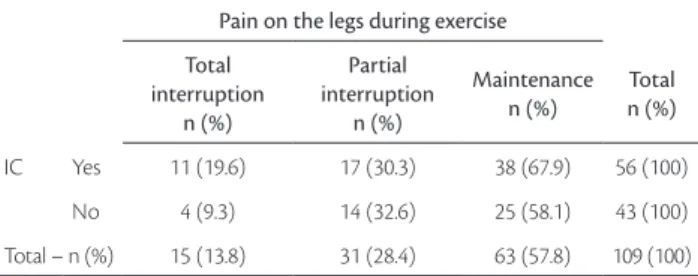
When the participants were asked about the decision they made at the moment they felt pain on the legs during exercise, 64 (52%) airmed that they maintained the activity
Table 3 - Distribution of individuals with Fontaine stage I and II PAOD according to the information received about the disease and to intermittent claudication, Pará de Minas (MG), Brazil, 2009
Intermittent claudication
Total – n (%) Yes – n (%) No – n (%)
Patient had heard about PAOD
Yes – n (%) 27 (58.7) 19 (41.3) 46 (100.0)
No – n (%) 40 (54.1) 34 (45.9) 74 (100.0)
Total – n (%) 67 (55.8) 53 (44.2) 120 (100.0)
PAOD: peripheral arterial occlusive disease.
Table 4 - Distribution of individuals with Fontaine stage I and II PAOD according to practice and type of physical activity, Pará de Minas (MG), Brazil, 2008
Physical activity Yes – n (%) No – n (%) No answer – n (%) Total – n (%)
Practice of physical activity 47 (38.2) 73 (59.3) 3 (2.4) 123 (100)
Walking 38 (30.9) 84 (68.3) 1 (0.8) 123 (100)
Group gymnastics 13 (10.6) 109 (88.6) 1 (0.8) 123 (100)
Cardiovascular Gym 6 (4.9) 116 (94.3) 1 (0.8) 123 (100)
Regular Gym 3 (2.4) 119 (96.7) 1 (0.8) 123 (100)
either way, but reducing the rhythm, 31 (25.2%) stopped the practice until the pain was gone, and 15 (12.2%) de-clared that they completely interrupted the exercises.
Discussion
here was an increasing prevalence of PAOD according to aging, which was also observed by Makdisse et al.8 he
inversion of the genre prevalence is the reality of recently published Brazilian studies on PAOD8,9. Nevertheless, an
association between the socioeconomic condition of a pop-ulation and PAOD has not been documented.
he predominance of hypertensive patients in this study among the analyzed risk factors determines an inde-pendent characteristic of this population, for there are no studies that conirm this inding. he prevalence of smok-ing as one of the main risk factors is conirmed despite the absence of statistical signiicance, probably due to the limi-tations of the sample size.
he association of IC with the main risk factors (Table 6) was not signiicant in this study possibly because of the number of patients analyzed. he statistical test (p=0.522) showed that there was no signiicant association between IC and smoking. he proportion of smokers presenting IC (15 patients; 57.7%) is practically the same as non-smokers individuals (53 patients; 55.8%). It is known that smoking is a risk factor for the disease10, but not for the
symptom. he IC among diabetic (8 individuals; 61.5%) and non-diabetic patients (59 individuals; 55.7%) was not statistically diferent (p=0.462). In this manner, having di-abetes or not was not associated with IC. he proportion of patients with IC was rather similar between the group that reported having cholesterol alterations (62.5%) and the group that reported not having it (57.1%). It is pos-sible to come to the same conclusion with regard to hy-pertension, that is, IC was not associated with hyperten-sion (p=0.447).
The association of PAOD with hypertension and smoking was also observed by Mota et al.10. The smoking
prevalence found by Viebig et al.8 was the same found
in this study (22%), and, when associated with PAOD, it was considered to be an important factor by Gabriel et al.11 because it increases the risk of developing the
dis-ease in 1.17 times; the influence of the smoking habit on the development of atherosclerotic and atherothrom-botic generalized phenomena, especially with regard to the impairment of peripheral arterial circulation, has also been reported. The study by Framingham (1948) showed the direct relation between systemic arterial hy-pertension (SAH) and PAOD9, increasing in 2.5% among
men and in 3.9% among women. Gabriel et al.11 also
confirmed the presence of SAH as an increased risk for PAOD in 1.06.
Considering the prevalence and the clinical corre-lations of the peripheral arterial disease, Gabriel et al.11
pointed diabetes mellitus as an important risk factor for coronary artery disease and PAOD, either asymptomatic or symptomatic, increasing in 1.76 the risk of development of the disease. In our study, we noticed that diabetes mellitus was the less prevalent risk factor, which may be explained by the lack of knowledge of individuals about presenting high glucose levels based on laboratory exams.
Ater analyzing the patients’ knowledge about PAOD and IC, we observed that 27 participants (58.7%) who were
Table 5 - Distribution of individuals with Fontaine stage I and II PAOD according to walking modality, Pará de Minas (MG), Brazil, 2008
Walking 4 times/week n (%)
5 times/week n (%)
Total n (%)
At work 80 (65) 43 (35) 123 (100)
Coming and going 77 (62.6) 46 (37.4) 123 (100)
Leisure time 110 (89.4) 13 (10.6) 123 (100)
Table 6 - Distribution of individuals with Fontaine stage I and II PAOD according to daily activities, Pará de Minas (MG), Brazil, 2008
Vigorous and moderate activities Yes n (%)
No n (%)
No answer n (%)
Total n (%)
Lifting and carrying heavy objects 41 (33.3) 79 (64.2) 3 (2.4) 123 (100)
Wood sawing, mowing grass and house painting 8 (6.5) 112 (91.1) 3 (2.4) 123 (100)
Lifting and carrying small objects, standing up, carrying children 107 (87) 13 (10.6) 3 (2.4) 123 (100)
Housekeeping activities, doing the laundry by hand 106 (86.2) 14 (11.4) 3 (2.4) 123 (100)
Going up stairs 82 (66.7) 38 (30.9) 3 (2.4) 123 (100)
aware of this condition reported having the symptoms, and 40 (54.1%) declared they had never heard about the subject, but presented symptoms (Table 7). However, having infor-mation about the disease does not mean having IC or not. he statistical test pointed out that there is no association between these two variables (p=0.379), and the percentage of individuals with IC is quite similar among those who have heard about the disease (5.7%) and those who have not (54.1%).
he importance of regular exercises must be empha-sized, as well as the control of risk factors for the initial con-ditions of the disease5.
Considering that all participants were assisted by an angiologist in at least one appointment at the specialized public health service, the concern about the orientation of this population is conirmed, because only 6.5% of the sample (8 individuals) reported being oriented by their physicians.
In view of the statistical signiicance of the associa-tion between the most frequent PAOD symptom (IC) and other signs and symptoms listed, we observed that the pa-tient who tends to IC also tends to other symptoms. he sensation of compression on the legs was evident in 37 IC patients (69.8%) in relation to 31 IC patients (45.6%) with-out evidence of compression, considering p=0.006.Cramps were registered in 50 IC patients (66.7%); among those who did not present cramps, 18 had IC (39.1%), and the tests showed that this percentage diference was statistically sig-niicant (p=0.03). he direct association of foot paresthesia and IC (p=0.003) revealed 36 patients (72%) in relation to 32 who did not feel it (45.1%), which reairms the proxim-ity of these two symptoms.
As to the sensation of fatigue, 62 participants (65.3%) that stated to have this symptom also presented pain on the legs during exercise that was relieved by rest (IC), and 6 (23.1%) did not present fatigue but reported IC, which rep-resents a signiicant association of both variables (p=0.000).
he IC also showed to be associated with swelling: 43 participants presenting swelling had IC (64.2%), and 25 did not present swelling (46.3%). he statistical tests classiied this diference as signiicant (p=0.037). here was also a sig-niicant association between IC and prick pain on the legs (p=0.009). Among those who felt prick pain, 33 (70.2%) had IC and 34 (46.6%) did not have the symptom, but re-ported having IC.
Ater analyzing the answers about the decision they made in regard to felling pain during exercise and other symptoms, we observed that 38 (57.6%) presented the clas-sical debilitating symptom of PAOD (pain on the muscles of the legs during exercise that is relieved by rest – IC), also declaring that they maintained the exercises even when feeling pain during walking (Table 8). he maintenance of physical activity despite the painful discomfort, simply re-ducing the rhythm of the exercise, provides gradual expan-sion of the peripheral vascular bed5.
Conclusion
he necessity of orientation for Fontaine stage I or II PAOD patients was observed in the public health service of Pará de Minas, especially in terms of non-pharmacological clinical treatment and supervised physical activity, aiming at controlling the irreversible chronic manifestations such as IC, cramps and paresthesia.
he necessity of sharing information with this popula-tion is emphasized due to their low schooling. he training of community health agents would be an efective way of disseminating the knowledge about PAOD, for they are in direct and constant contact with the families and are part of each community, which facilitates the dialogue.
Bearing in mind the importance of PAOD prevention with regard to cardiovascular diseases, we emphasize that establishing measures for the detection of the disease in a population at risk, such as the implementation of super-vised physical activity programs, become essential.
Acknowledgments
We thank Priscilla for the cooperation, support and friendship. To Neverly, Maria Amália and the professionals
of Policlínica Nossa Senhora da Piedade for helping in the
preparation of this study.
References
1. Kaufman P, Wolosker N. Doença arterial obstrutiva periférica – aspectos atuais. São Paulo: Lemos Editorial; 2007.
Table 7 - Distribution of individuals with Fontaine stage I and II PAOD according to intermittent claudication and pain on the legs during exercise, Pará de Minas (MG), Brazil, 2008
Pain on the legs during exercise
Total interruption
n (%)
Partial interruption
n (%)
Maintenance n (%)
Total n (%)
IC Yes 11 (19.6) 17 (30.3) 38 (67.9) 56 (100)
No 4 (9.3) 14 (32.6) 25 (58.1) 43 (100)
Total – n (%) 15 (13.8) 31 (28.4) 63 (57.8) 109 (100)
2. Makdisse M, Nascimento-Neto R, Chagas ACP, et al. Versão em português, adaptação transcultural e validação do Questionário de Claudicação de Edimburgo. Arq Bras Cardiol. 2007;88:501-6.
3. TASC II – Inter-Society Consensus for the Management of Peripheral Arterial Disease (TASC II). Eur J Vasc Endovasc Surgery. 2007.
4. Câmara LC, Santarem JM, Wolosker N, Dias RMR. Exercícios re-sistidos terapêuticos para indivíduos com doença arterial ob-strutiva periférica: evidências para a prescrição. J Vasc Bras. 2007;6: 247-57.
5. Miranda-Júnior F, Barros-Júnior N. Doença arterial obstrutiva peri-férica. São Paulo: EPM, 2007.
6. Cunha-Filho IT, Pereira DAG, Carvalho AMB, Campedeli L, Soares M, Freitas JS. Coniabilidade de testes de caminhada em pacientes claudicantes: estudo piloto. J Vasc Bras. 2008;7:106-11.
7. Benedetti TRB, Antunes PC, Rodriguez-Añez CR, Mazo GZ, Petroski EL. Reprodutibilidade e validade do Questionário Internacional de Atividade Física (IPAQ) em homens idosos. RevBras MedEsporte. 2007;13:11-6.
8. Viebig RF, Valero MP, Araújo F, Yamada A T, Mansur AJ. Peril de saúde cardiovascular de uma população adulta da região metro-politana de São Paulo. Arq Bras Cardiol. 2006;86:353-60.
9. Makdisse M, Pereira AC, Brasil DP, et al. Prevalência e fatores de risco associados à doença arterial periférica no projeto corações do Brasil. Arq Bras Cardiol. 2008;91:402-1
10. Mota APL, Carvalho MG, Lima LM, et al. Lipoproteína (a) em pa-cientes portadores de doença arterial obstrutiva periférica e/ou diabetes mellitus tipo 2. J Bras Patol Med Lab. 2008;44:89-95.
11. Gabriel SA, Seraim PH, Freitas CEM, et al. Doença arterial obstruti-va periférica e índice tornozelo-braço em pacientes submetidos à angiograia coronariana. Rev Bras Cir Cardiovasc. 2007;2249-59.
Correspondence:
Juliana Nogueira Diniz Praça da Independência, 186 – Centro CEP 35660-007 – Pará de Minas (MG), Brazil E-mail: [email protected]
Authors’ contributions