International Journal for Mathematics in Education
TEACHER PRACTICE IN AN INQUIRY-BASED
MATHEMATICS CLASSROOM
Luís Menezes
Higher School of Education of Viseu and CI&DETS, Portugal, [email protected]
Ana Paula Canavarro
University of Évora and Research Unity of Institute of Education of Univer-sity of Lisbon, Portugal
[email protected] Hélia Oliveira
Institute of Education of University of Lisbon, Portugal
[email protected]
Abstract
This paper presents a framework for an inquiry-based approach to mathematics teaching. It was developed by combining theoretical perspec-tives and case studies of experienced teacher that usually conduct inquiry based teaching of mathematics. This framework describes the actions teach-ers intentionally perform with two identified purposes: to promote the mathematical learning of the students and to manage the students and the class as a whole.
INTRODUCTION
In the last decade, research in mathematics education has consistently pointed out the need to promote student’s learning that goes far beyond the acquisition of mathematical knowledge, but including also the development of mathematical capabilities such as problem solving, reasoning and com-munication (Ponte, 2011). These recommendations have been reflections in mathematics curricula in many countries of the world, as happened in Por-tugal with the new math program for 1-9 classes, which began implementa-tion in 2010 (DGIDC, 2007). Promoting these new goals is not compatible
with a type of traditional classroom, based on the exposition of the teacher, who, as stated Sierpinska (1998), the teacher talks and students listen. In-stead, this new class model implies new roles for the student and, conse-quently, for the teacher. This class is based on a new attitude of the students, working with mathematical tasks and discussion of results and ideas (NCTM, 2000; Ponte, 2005; Sullivan et al, 2006). Naturally, the changing role of students in the mathematics classroom involves from the teacher an inquiry-based approach to teaching, with the realization of other instruc-tional actions. It is precisely here and in this context of change in the mathematics classroom, this study fits through, we aim to offer a detailed characterization of the actions of the mathematics teacher in a classroom-based inquiry, from contact with the teachers that usually conducts such classes.
THEORETICAL PERSPECTIVES
In Portugal, like in many countries, the mathematics lessons that follow the standard of teaching: exposition of the theory (by the teacher) and the resolution of exercises (by the students) have been questioned and gave rise to a pattern in which the students are more "attached" in its learning. Ponte (2011) stresses an alternative mode of work in which “teacher introduces a task for the students to work for some period of time and, in a second mo-ment, the students present their solutions to the whole class and discuss the solutions of their classmates” (p. 250). In same direction, others authors say mathematics lesson in inquiry-based approach is generally organized in three or four phases: the “launch phase”, the “explore phase”, and the “dis-cuss and summarize phase” (Stein, Engle, Smith, & Hughes, 2008). The in-quiry-based approach to mathematics teaching demands from the teacher more than the selection of the rich tasks. The selection of a valuable task is, of course, very important because it creates conditions for learning. But af-ter the task selection, and bearing in mind the objectives of the curriculum, is necessary, to the teacher, think about how to propose the exploration of the task in class, or what kind of activities should lead to promote mathe-matics learning (Stein, Engle, Smith, & Hughes, 2008).
The idea of activity is diffusely defined in the literature. Even e Schwartz (2002) says that activities are chains of events related by the same subject for the same reason. Teachers’ practices in the classroom are a series of complex actions, which have their basis in a certain intentionality, which derives from their professional knowledge (Ponte and Chapman, 2006). While in mathematics classes based on the traditional pattern, these actions
are well described and stabilized, the same does not happen in the mathe-matics classroom lessons in inquiry-based approach.
METHODOLOGY
In this study, to investigate the activities performed by teachers, in a classroom-based inquiry, we choose an interpretative methodological ap-proach, because we wanted to get the perspectives of the participants.
We selected experienced teachers, who usually develop lessons inspired in an inquiry-based approach to mathematics teaching and work in different mathematical topics that were available to participate in this work. At this point, we collected data from a primary school teacher, named Célia,
Data analysis is inspired by the theory and is based on content analysis of data collected through (i) observation of the teacher in two classes (videotaped), and (ii) two interviews (before and after the classes in which Célia explains her intentions and, in the end, reflects on her action). The analysis of the cases of the teachers led us to identify concrete actions that are present in their practices in each phase of the lesson and the intentions that justify them.
DEVELOPING A FRAMEWORK FOR INQUIRY-BASED MATHEMATICS CLASSROOM PRACTICE
In an inquiry-based classroom practice, Célia performs a variety of ac-tions that are based on two purposes. On one hand, promotion of the mathe-matics learning of the students;
“That is the idea, to have confrontation. It is not a presentation, it is a learning moment, therefore it can’t be a presentation, neither a correc-tion, because it’s not that (…) the moment is to confront, to think to-gether about the different resolutions, different representations that have to appear from there, from the presentation… it is a goal.”
And secondly, Management of students work and class as a whole: “So I have to select the presentations they want to explore during the discussion and sort according to a more complex sometimes, (...) and put the pair that did the work to present”
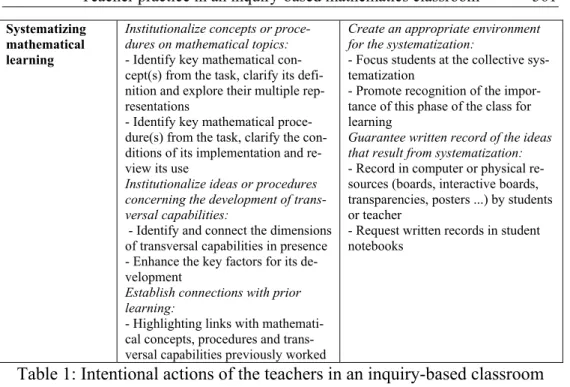
We identify in Célia’s classes four main phases, according different in-tentions: Launching the task to students; Supporting students autonomous work on the task; Orchestrating the discussion of the task; and Systematiz-ing mathematical learnSystematiz-ing. In Table 1 we present our proposal of framework for describing the intentional actions of the teachers in a mathematics in-quiry-based classroom practice.
Promotion of the mathematics
learning Class management
Launching the task to the stu-dents
Guarantee the appropriation of the task:
- Clarify unfamiliar vocabulary - Mobilize and verify prior knowl-edge
- Set goals
Promote adhesion to the task: - Challenge for work - Request an expected result - Establish connections to student prior experiences
Organize students' work:
- Establish time for each phase of the class
- Set forms of work organization (in-dividual, pairs, small groups, whole-class)
- Organize the class materials
Supporting stu-dents autono-mous work on the task
Guarantee the development of the task by the students:
- Focusing on results and ideas - Provide a comparison of ideas - Challenge students to justification - Explain in order to allow students to continue their work
- Suggest representations - Request records
Promote the work of students/groups: - Set interactions between students - Provide materials
Guarantee the production of materi-als for the students presentation: - Provide appropriate materials - Provide specific time to prepare the presentation
Consider the selection and sequenc-ing of the student presentations: - Identify resolutions less or more comprehensive, less or more com-plete
- Identify resolutions less or more formal
- Identify resolutions with common error
Orchestrating the discussion of the task
Promote mathematical quality of the presentations:
- Ask for clear explanations with mathematical evidence
- Ask for justifications of outcomes and representation used
Promote interactions among students in the discussion of mathematical ideas:
- Encourage questioning for the clari-fication of ideas
- Encourage analysis, debate and comparison of ideas
- Identify and make available to dis-cuss questions or errors in the presen-tation
Create favorable environment for presentation and discussion: - Put an end to the autonomous work of students
- Provide the reorganization of the places to focus on a common space (whiteboard, QI, overhead…) - Promote an attitude of respect and genuine interest on different presenta-tions
Manage relationships among stu-dents:
- Set the order of presentations - Justify the reasons for not submit-ting the work of some students (by example, to avoid repetition,...) and ensure rotation of groups in the next task
- Promote and manage the participa-tion of students in the discussion
Systematizing mathematical learning
Institutionalize concepts or proce-dures on mathematical topics: - Identify key mathematical con-cept(s) from the task, clarify its defi-nition and explore their multiple rep-resentations
- Identify key mathematical proce-dure(s) from the task, clarify the con-ditions of its implementation and re-view its use
Institutionalize ideas or procedures concerning the development of trans-versal capabilities:
- Identify and connect the dimensions of transversal capabilities in presence - Enhance the key factors for its de-velopment
Establish connections with prior learning:
- Highlighting links with mathemati-cal concepts, procedures and trans-versal capabilities previously worked
Create an appropriate environment for the systematization:
- Focus students at the collective sys-tematization
- Promote recognition of the impor-tance of this phase of the class for learning
Guarantee written record of the ideas that result from systematization: - Record in computer or physical re-sources (boards, interactive boards, transparencies, posters ...) by students or teacher
- Request written records in student notebooks
Table 1: Intentional actions of the teachers in an inquiry-based classroom practice
This framework is under construction and will be refined through the analysis of other cases of teachers, from other grades and working with dif-ferent mathematical topics.
FINAL CONSIDERATIONS
The framework demonstrates complexity and the demands for mathe-matics teachers to developing an inquiry-based mathemathe-matics teaching prac-tice, a fact which contradicts the idea of a teacher less active compared to a class based on exposition. During an inquiry-based class, the teacher needs to pay attention to several aspects that decisively affect the opportunities for mathematical learning of students. It is our expectation that the process we adopted for the elaboration of this framework provides a broad view of the authentic practice of teachers, and can serve as a resource for teacher devel-opment based on reflection on his teaching of mathematics.
REFERENCES
Even, R., & Schwartz, B. B. (2002). Implications of competing interpreta-tions of practice and research and theory in mathematics education. In Procedings of PME Conference (Vol. 2, pp. 337-344).
DGIDC (2007). Programa de Matemática do ensino básico. Lisboa: DGIDC.
NCTM (2000). Principles and standards for school mathematics. Reston: NCTM.
Ponte, J. P. (2005). Gestão curricular em Matemática. In GTI (Ed.), O professor e o desenvolvimento curricular (pp. 11-34). Lisboa: APM. Ponte, J. P. (2011). Using video episodes to reflect on the role of the teacher
in mathematical discussions. In O. Zaslavsky & P. Sullivan (Eds.), Constructing knowledge for teaching second-dary mathematics: Tasks to enhance prospective and practicing teacher learning (pp. 249-261). New York, NY: Springer.
Sierspinska, A. (1998). Three epistemologies, three views of classroom communication: construtivism, sociocultural approaches, interaccion-ism. In H. Steinbring, M. Bussi & A. Sierpinska (Eds.), Language and communication in the mathematics classroom (pp. 30-62). Reston: NCTM.
Stein, M. K., Engle, R. A., Smith, M. S., & Hughes, E. K. (2008). Orches-trating productive mathematical discussions: Helping teachers learn to better incorporate student thinking. Mathematical Thinking and Learn-ing, 10(4), 313-340.
Sullivan, P., Mousley, J., & Zevenbergen, R. (2006). Teacher actions to maximize mathematics learning opportunities in heterogeneous class-rooms. International Journal of Science and Mathematics Education, 4, 117-143.