Research Articles
1 The Global Digital Divide: Evidence and Drivers;
Frederico Cruz-Jesus, NOVA Information Management School (NOVA IMS), Lisbon, Portugal Tiago Oliveira, NOVA Information Management School (NOVA IMS), Lisbon, Portugal Fernando Bacao, NOVA Information Management School (NOVA IMS), Lisbon, Portugal
27 Building Initial Trust in an Intermediary in B2C Online Marketplaces: The Korean Evidence From Interpark.com;
Ilyoo Barry Hong, College of Business and Economics, Chung-Ang University, Seoul, South Korea
48 A Three Country Study for Understanding Physicians’ Engagement With Electronic Information Resources Pre and Post System Implementation;
Virginia Ilie, School of Management, California Lutheran University, Thousand Oaks, USA Sweta Sneha, Coles College of Business, Kennesaw State University, Kennesaw, USA
74 CIO Competencies From the IT Professional Perspective: Insights From Brazil;
Luiz Antonio Joia, Getulio Vargas Foundation, Rio de Janeiro, Brazil José Carlos P. Correia, Getulio Vargas Foundation, Rio de Janeiro, Brazil
104 Methodological Research for Modular Neural Networks Based on “an Expert With Other Capabilities”;
Pan Wang, Wuhan University of Technology, Wuhan, China
Jiasen Wang, Hithink RoyalFlush Information Network Co., Ltd., Hangzhou, China Jian Zhang, Wuhan University of Technology, Wuhan, China
127 The Theory and Practice of IT Governance Maturity and Strategies Alignment: Evidence From Banking Industry;
Mojtaba Rees Safari, Antai College of Economics and Management, Shanghai Jiaotong University, Shanghai, China Qingquan Jiang, Xiamen University of Technology, Xiamen, China
147 Optimizing Waiting Room Utilization in High Speed Railway Stations Based on an Information Integration Approach;
Feng Niu, China Railway Corporation, Changsha, China & School of Traffic and Transportation Engineering, Central South University, Changsha, China
Dingyou Lei, School of Traffic and Transportation Engineering, Central South University, Changsha, China Yinggui Zhang, School of Traffic and Transportation Engineering, Central South University, Changsha, China Zhe Wang, School of Traffic and Transportation Engineering, Central South University, Changsha, China
163 The Role of Functional Diversity, Collective Team Identification, and Task Cohesion in Influencing Innovation Speed: Evidence From Software Development Teams;
Jin Chen, School of Business, East China University of Science and Technology, Shanghai, China Wei Yang Lim, Deston Precision Engineering Pte Ltd, Singapore
Bernard C.Y. Tan, Department of Information Systems and Analytics, National University of Singapore, Singapore Hong Ling, Department of Information Management and Information Systems, Fudan University, Shanghai, China
193 Technological Innovation: A Case Study of Mobile Internet Information Technology Applications in Community Management;
Wan Su, School of Management, Jilin University, Changchun, China
Xiaobo Xu, School of Business Administration, American University of Sharjah, Sharjah, United Arab Emirates Yangchun Li, Department of Business Administration, University of Granada, Granada, Spain
Francisco J. Martínez-López, Deptartment Business Administration, University of Granada, Granada, Spain & EAE Business School, Barcelona, Spain
Ling Li, Strome College of Business, Old Dominion University, Norfolk, USA
204 When Is Information Quality More Important? The Moderating Effects of Perceived Market Orientation and Shopping Value;
Xina Yuan, Department of Marketing, School of Management, Xiamen University, Xiamen, China Kyounghee Chu, Division of Business, Chosun University, Gwangju, South Korea
Shun Cai, Department of Management Science, School of Management, Xiamen University, Xiamen, China
Copyright
The Journal of Global Information Management (JGIM) (ISSN 1062-7375; eISSN 1533-7995), Copyright © 2018 IGI Global. All rights, including translation into other languages reserved by the publisher. No part of this journal may be reproduced or used in any form or by any means without written permission from the publisher, except for noncommercial, educational use including classroom teaching purposes. Product or company names used in this journal are for identification purposes only. Inclusion of the names of the products or companies does not indicate a claim of ownership by IGI Global of the trademark or registered trademark. The views expressed in this journal are those of the authors but not necessarily of IGI Global.
Volume 26 • Issue 2 • April-June-2018 • ISSN: 1062-7375 • eISSN: 1533-7995
An official publication of the Information Resources Management Association
Journal of Global Information Management
The Journal of Global Information Management is indexed or listed in the following: ABI/Inform; ACM Digital Library; Aluminium Industry Abstracts; Australian Business Deans Council (ABDC); Bacon’s Media Directory; Burrelle’s Media Directory; Cabell’s Directories; Ceramic Abstracts; Compendex (Elsevier Engineering Index); Computer & Information Systems Abstracts; Corrosion Abstracts; CSA Civil Engineering Abstracts; CSA Illumina; CSA Mechanical & Transportation Engineering Abstracts; Current Contents®/Social & Behavioral Sciences; DBLP; DEST Register of Refereed Journals; EBSCOhost’s Business Source; EBSCOhost’s Computer & Applied Sciences Complete; EBSCOhost’s Computer Science Index; EBSCOhost’s Current Abstracts; Electronics & Communications Abstracts; Emerald Abstracts; Engineered Materials Abstracts; Gale Directory of Publications & Broadcast Media; Google Scholar; INSPEC; Internet & Personal Computing Abstracts; ISBIB; JournalTOCs; KnowledgeBoard; Library & Information Science Abstracts (LISA); Library Literature & Information Sciences; Materials Business File - Steels Alerts; MediaFinder; Norwegian Social Science Data Services (NSD); PubList.com; SCOPUS; Solid State & Superconductivity Abstracts; The Index of Information Systems Journals; The Standard Periodical Directory; Ulrich’s Periodicals Directory; Web of Science; Web of Science Science Citation Index Expanded (SCIE); Web of Science Social Sciences Citation Index (SSCI)
DOI: 10.4018/JGIM.2018040101
Copyright©2018,IGIGlobal.CopyingordistributinginprintorelectronicformswithoutwrittenpermissionofIGIGlobalisprohibited.
The Global Digital Divide:
Evidence and Drivers
Frederico Cruz-Jesus, NOVA Information Management School (NOVA IMS), Lisbon, Portugal Tiago Oliveira, NOVA Information Management School (NOVA IMS), Lisbon, Portugal Fernando Bacao, NOVA Information Management School (NOVA IMS), Lisbon, Portugal
ABSTRACT Thisarticlepresentsananalysisoftheglobaldigitaldivide,basedondatacollectedfrom45countries, includingtheonesbelongingtotheEuropeanUnion,OECD,Brazil,Russia,India,andChina(BRIC). TheanalysisshowsthatonefactorcanexplainalargepartofthevariationinthesevenICTvariables usedtomeasurethedigitaldevelopmentofcountries.Thismeasureisthenusedwithadditional variables,whicharehypothesisedasdriversofthedivideforaregressionanalysisusingdatafrom 2015,2013,and2011,whichrevealseconomicandeducationalimbalancesbetweencountries,along withsomeaspectsofgeography,asdriversofthedigitaldivide.Contrarytotheauthors’expectations, theEnglishlanguageisnotadriver. KEywoRDS
BRIC, Digital Development, Digital Divide, European Union, ICT, OECD
1. INTRoDUCTIoN Informationandcommunicationtechnologies(ICT)playanimportantroleintheglobaleconomy (Lee,Gholami,&Tong,2005;WorldBank,2016).ThebeliefthatgreateradoptionanduseofICT mayfostereconomicgrowthanddevelopment,trumpingthepresenteconomicdifficulties,has beensupportedbysomeofthemostimportantnationsandworldorganisations,suchastheUnited Nations(UN)(UnitedNations,2016),theUnitedStatesofAmerica(USA)(e.g.,USDepartment ofCommerce,2000),theOrganisationforEconomicCo-operationandDevelopment(OECD)(e.g., OECD,2011),andtheEuropeanUnion(EU)(e.g.,EuropeanCommission,2010a,2013,2015).These havedevelopedsometypeofstrategyforpromotingdigitaldevelopmentandintensifiedtheuseof ICTtoengendereconomicgrowthanddevelopment.Besidesitseconomicimportance,itiswidely acceptedthatthesetechnologiesalsopositivelyinfluencetheindividual´squalityoflifeandwelfare (Dewan&Riggins,2005;Kim,Lee,&Menon,2009).AttheWorldSummitontheInformationSociety (WSIS),sponsoredbytheUNandInternationalTelecommunicationsUnion(ITU),itwasdeclared thattheglobalchallengeforthenewmillenniumistobuildasociety“…whereeveryonecancreate, access,utilizeandshareinformationandknowledge,enablingindividuals,communitiesandpeoples toachievetheirfullpotentialinpromotingtheirsustainabledevelopmentandimprovingtheirquality oflife…”(WSIS,2003,2005),acommitmentreinforcedsome10yearslater(WSIS,2013,2014).
DespitetherecognisedimportancethatICTmayhaveforeconomicsandwelfare,helpingcountries toachievesustainablegrowth,thefactisthatresearchabouttheseissuesisstill,insomeways,limited. Withinacademia,twomaintypesofstudiesregardingtheglobaldigitaldividecanbedistinguished: somestudiesfocusonmeasuringthedivide,whileothersfocusonexplainingwhatdrivesit(Cruz-Jesus,Vicente,Bacao,&Oliveira,2016).Althoughthisworkcoversbothtypessimultaneously,the authorsareparticularlyinterestedinthesecondtypeofresearch,i.e.,tounderstandthedivide´sdrivers. Theauthorsbelievethatmeasuringtheglobaldigitaldivideisindeedasubjectworthinvestigating. However,toeffectivelydesignanddeployefficientmeasurestonarrowit,somelightmustbeshedon thedivide´scauses.Moreover,consideringthatmostofthestudiesemphasisingthisparticularaspect oftheglobaldigitaldividearemostlyrelatedonlywiththeuseofInternetper se(Billon,Marco,& Lera-Lopez,2009),theauthorsalsointendtoprovideamorecomprehensiveviewofICTadoption anduseacrosscountries.Toaccomplishthisaim,inthispaper,measuresofthedigitaldevelopment ofcountriesotherthanmerelytheInternetusageareconsidered. Anothergapintheliteraturethattheauthorsbelieveisnoticeablewhilesurveyingtheliteratureis thefactthatstudiesregardingthedigitaldivideacrosscountriestendtobelimitedtospecific(groups of)countries,usuallydevelopedordeveloping,and/orinspecificgeographicareas(e.g.,theEuropean Union),probablybecauseofthedifficultyinfindingrelevantandcomprehensivedata.Studieswith asignificantnumberofcountriesaredifficulttoconductbecausemetrics/variablesofICTadoption areoftennotcomparable.Thispaperhelpstofillthesegaps,measuringandunderstandingthedigital asymmetriesacrosscountries,takingasnapshotintermsofdigitaldevelopmentof45countriesin threedistinctyears–2011,2013,and2015.Thesecountrieswereselectedbasedonthetrade-off betweenwidthanddepthoftheanalysis–themorecountriesonetriestoinclude,feweravailable variablesare.Assuch,theauthorsconcentratedtheireffortstoincludeacomprehensive“sample” ofdevelopedanddevelopingcountries,comprisingeverymember-stateoftheinternationalblock that,perhaps,moreattentionpaystotheissueofthedigitaldivide(see,e.g.,EuropeanCommission, 2010a,2010b,2013,2015),everymembercountryoftheOECD,aswellassomeoftheleading developingcountriesforwhichthereisdataavailable:Brazil,Russia,IndiaandChina(BRIC).The authorsexpecttohelppolicymakersdeployefficientmeasuresbyprovidingacomplete-as-possible andup-to-dateanalysisofdigitalasymmetriesbetweendevelopedandrapidlydevelopingcountries, byansweringthefollowingresearchquestions: 1. Whatarethedigitaldevelopmentlevelsofthe45countriesstudied? 2. Whatdrivesasymmetriesinthedigitaldevelopmentofcountries,i.e.,theglobaldigitaldivide? 3. Towhatextenthavethedriversofdigitaldevelopmentofcountrieschangedbetween2011and2015? Inansweringthesequestions,thispaperisorganizedasfollows:ThesecondSectionincludes aliteraturereviewofthedigitaldivide;Thethirdonepresentsthetheoreticalbackgroundandthe conceptualmodelforunderstandingthedigitaldevelopmentofcountriesand,hence,theglobal digitaldivide;ThefourthSectionhasthemethodology;Thefifththeresults;Thesixthsectionhasthe discussion,implications,andthelimitationsoffindings.Finally,Section7presentstheconclusions. 2. LITERATURE REVIEw Inrecentdecades,oneseesanintenseproliferationindevelopmentanduseofICT(Cruz-Jesus, Oliveira,&Bacao,2012).Thesetechnologiesareheretostay,playingadecisiveroleinimproving practicallyeveryaspectofoursocieties(Unesco,2003;WorldBank,2009),suchasthewayindividuals andfirmsinteractandcommunicate,dobusiness,pursueeconomicgrowth,improvewelfare,and eventhewaypoliticsareconducted(H.Zhao,Kim,Suh,&Du,2007).Internetbrowsing,email, blogs,multimediaonlinestreaming,socialnetworking,on-linejobseeking,wiki-sites,accessto
onlinelibraries,e-commerce,andserviceslikee-government,e-health,e-learning,ande-bankingare examplesofnewpossibilitiesthatareshapinganewtypeof(improved)communicationandinteraction betweenindividualsandorganizations(Çilan,Bolat,&Coskun,2009;Facer,2007;Forman,2005; Hajli,2014;Krishnan&Lymm,2016;Mutula&Brakel,2006;Niehaves&Plattfaut,2013;Vicente &Gil-de-Bernabé,2010;Vicente&Lopez,2010b). TheimpactofICTintheeconomicfieldissuchthatthesetechnologiesareclassifiedasgeneral-purposetechnologies(GPT)–definedastechnologicalinnovationsthathavethepotentialtoimprove mostindustriesandsocietysectors(Bresnahan&Trajtenberg,1995;Doong&Ho,2012;European Commission,2013),andhaveinthepastalsorevolutionisedtheeconomysuchas,the19thcentury´s transportationandcommunicationstechnologies,theCorlisssteamengine,theinternalcombustion engine,andtheelectricmotor(Carlsson,2004;Cruz-Jesusetal.,2012;Cuervo&Menéndez,2006). Moreover,ICTappearstohaveanevengreaterimpactoneconomicdevelopmentthanthoseGPT since“…itaffectstheserviceindustries(e.g.,healthcare,government,andfinancialservices)even moreprofoundlythanthegoods-producingindustries,andtheseservicesectorsrepresentover75% ofgrossdomesticproduct…”(Carlsson,2004). JalavaandPohjola(2008)haveempiricallydemonstratedthattheICTcontributiontoFinland’s GDPbetween1990and2004wasthreetimesgreaterthanthecontributionofelectricityfrom1920 to1938.ICThelpstocreatenewindustriesthatgeneratenewemploymentopportunities(Castells, 2007;Castells&Himanen,2002).Shirazietal.(2009)addressedtherelationshipbetweenICTand economicfreedom,andfoundthatICTexpansioninMiddleEastcountrieshas,infact,beeneffective insupportingit,asdemonstratedinthe“ArabSpring”revolution(Sandoval-Almazan&Ramon Gil-Garcia,2014).Eveninpolitics,theInternetandotherICTrelatedtechnologiesareplayingan increasinglyimportantrole,asintheawarenessofindividualstowardthedifferencesintheideologies withinapoliticaldispute(Kimetal.,2009;Wattal,Schuff,Mandviwalla,&Williams,2010).The notionofliteracyhasalsochangedduetoICT,consideringthattheinabilitytousethesetechnologies iscreatinganentirelynewgroupofdisadvantagedpersonswhowereconsidered“literate”inthe past(Unwin&deBastion,2009).AndradeandDoolin(2016)addressedthebenefitsthatICTcould bringtorefugeesandconcludedbyinterviewing53oftheminNewZealand,thatICTcouldbenefit thembyimprovingtheircommunicationwiththesociety,improvingtheirunderstandingofit,and expressingtheirculturalentity,therebybeingmoresociallyconnected. Theadventofinformationtechnologies(IT)–initialisedwiththespreadofpersonalcomputers (PC)andInternet–created,duringthe1980s,the(utopian)ideaofawholenewworldofendless opportunitiesliberatedfromproblematicsocioculturalaspects,suchasgender,age,race,andgeography (Gunkel,2003).However,itsoonbecameclearthataccess(andlater,use)ofICTwaslimitedby specificconstraintsandshouldnotbeassumedbyresearchersandpolicymakerstobeeitheruniversal orinstantaneous.Itwaswithinthiscontextthattheterm“digitaldivide”appeared.Althoughthe literatureandforumsonthesubjectregularlyattributethetermtoLarryIrvingJunior,formerAssistant SecretaryforCommunicationsandInformationoftheUSDepartmentofCommerce,thefactisthat itwasnotauthoredbyhim,ashehimselfadmittedyearslater(Gunkel,2003).The“digitaldivide” termbecamepopularinthethird“FallingThroughtheNet”report,fromtheUSDepartmentof Commerce’sNationalTelecommunicationsandInformationAdministration(NTIA)(USDepartment ofCommerce,1999),whichdefineditas“…thedividebetweenthosewithaccesstonewtechnologies andthosewithout…”Withintheseriesofthesereports(USDepartmentofCommerce,1995,1998, 1999,2000,2002)thedefinitionofdigitaldivideevolvedfromPCownership,totheinclusionof Internetaccess,andlater,totheavailabilityofbroadbandconnections.Todayhowever,thedigital divideshouldbethoughtofintermsofamotherthatis50yearsoldandcannotgetajobbecause shedoesnotknowhowtouseacomputernorknowshowtousetheInternet;astudentthatcannot makehisthesisproperlybecausehedoesnothaveaccesstoon-linelibraries;afirmthathasclosed becauseitwasunabletoreachitscustomersthroughawebsite;oragovernmentthatisnotableto
communicateon-linewithitscitizensbecausemostofthemdonothaveaccesstoICT;amongstso manyotherexamplesofwhattheinabilitytoaccessanduseICTmaycause. Thesefactorsaredrawingstrongdistinctionsandinequalitiesbetweenthosewhohaveaccess toprivilegedinformationandthosewhohavenot(Brooks,Donovan,&Rumble,2005),areason whytheoriginalunderstandingofthisphenomenonevolvedfromthebinaryunderstandingbetween “has”versus“has not”tofocusonthereasonswhydisparitiesinaccessanduseofICTreallyexist. Asaconsequence,itwasdiscoveredthatgeographicareas(urbanvs.rural)wereanimportantfactor indefiningthedividebetweeninformationhavesandhave-nots(USDepartmentofCommerce, 1995).Individualsbelongingtoethnicminorities,orwithlowerincomes,werealsomorevulnerable toasymmetriesintheaccesstodigitaltechnologies(USDepartmentofCommerce,1998).Inother words,theunderstandingofthedigitaldividephenomenonunderwentconsiderableevolutionasthe subjectstartedtobeunderstoodasamultidimensionalissue.Thus,itiswidelyrecognisedtodaythat theinitialbinarydefinitionwasnarrow,sinceotherfactorsneedtobeconsidered(Brandtzæg,Heim, &Karahasanovic,2011).Oneofthemostwidelyaccepteddefinitionsofdigitaldivideisprovided bytheOECD(2001),whichreferstoitas:
The gap between individuals, households, businesses, and geographic areas at different socio-economic levels with regard both to their opportunities to access ICT and to their use of the Internet for a wide variety of activities.
Thedigitaldivideisaphenomenonthatcanoccuratdifferentdimensions/levels.Intermsof adoptionunits,digitalasymmetriesmayexistbetweenindividuals,households,organisations,and countries(Dewan&Riggins,2005).Atanindividuallevel,digitalinequalitiesaremorelikelytoexist betweeneconomicallyandsociologicallydisadvantagedindividuals,i.e.,thosewithlowerincomesor educationlevels,thosewithdisabilities,livinginruralareas,belongingtoethnicminorities,women, andtheelderly(Azari&Pick,2005;Crenshaw&Robison,2006;Ferro,Helbig,&Gil-Garcia,2011; Hilbert,2011;Lengsfeld,2011;Payton,2003;Vicente&Lopez,2006;Vicente&Lopez,2008,2010b, 2010c).Inadditiontothesesociodemographiccharacteristicsofindividuals,VenkateshandSykes (2013)foundthatsocialnetworkaspectsarealsosignificantinexplainingICTuse,andevenvalue. Intermsoforganisationsasadoptionunits,itisusuallyacceptedthatlargerfirms(astheyusually possessmoreresources)tendtobemorepronetoadopttechnologicalinnovations,althoughsome authorsdonotagreewiththisnotionbecauselargerfirmsarealsomorelikelytosufferfrominertia (Dewan&Riggins,2005;Oliveira&Martins,2010;Rogers,2005).Finally,atacountry(global) level–individualsandorganisationsinaggregate–inequalitiesintermsofICTaccessandusemay occurbetweenandwithincountries,whicharenamed,respectively,internationalanddomesticdigital divides.Withrespecttotheinternationaldigitaldivide,researchusuallyindicatesthateconomicwealth andeducationarekeyfactorsinexplainingthedigitaldevelopmentlevelofacountry(Cruz-Jesus, Oliveira,Bacao,&Irani,2016;Cruz-Jesus,Vicente,etal.,2016;James,2011;Shirazi,Gholami, &Higón,2010).However,evenincountriesrecognisedasexamplesofdigitaldevelopment,there isevidencethatdomesticdividesmayexist.IntheNetherlands,forexample,vanDeursenandvan Dijk(2015)foundthatthosewhoareyounger,morehighlyeducated,andwithhigherincomes,are morelikelytohavehigherlevelsofICTadoption. Besidesthetypeofadoptionunit,thedigitaldividemayalsoberelatedtoaccesstoICTorits use,whichmayappeartobethesamebutintrutharenot.Hsiehetal.(2008,2011)showednoticeable differencesinICTaccessandusepatternsbetweenthosewhoareeconomicallyadvantagedandthose whoaredisadvantaged.BesidestheintrinsicmotivationsforaccesstoICT,thesepersonsalsohave verydifferentpost-implementationbehaviourregardingtheuseofthesetechnologies.Hsiehetal. concludedthateconomicallyadvantagedpeoplehavea“…highertendencytorespondtonetwork exposure…”usingICTwithmuchmoreconfidencethanthedisadvantaged.Thesetwotypesof inequalitiesaboutaccesstoanduseofICTareknownasfirst-andsecond-orderdigitaldivides
(Dewan&Riggins,2005).Inthefirst-orderdigitaldividetheinequalitiesregardaccesstoICT,while inthesecond-ordertheproblemispostulatedintermsofdifferentusepatternsandintensityamongst individuals/organisationsthatalreadyhave(verysimilar)accesstoICT(e.g.,usingtheInternet justforweb-browsingoremailvs.usingitfore-learning,social-network,applyingtojobsonline, e-banking,e-health,etc.).AsnotedbyEpsteinetal.(2011),differenttypesofinequalities(first-or second-orders)requiredifferentactionsfromdifferententities.Hence,inequalitiesinICTaccessmay bebridgedthroughthesubsidisationofthesetechnologies,whichgovernmentsandorganisations maywellprovide;whereasforinequalitiesinICTusagepatterns,possiblesolutionsresideinthe handsofeducationalinstitutionsandindividualsthemselves.AsstatedbytheWorldBank(2016), inorderforICT“…tobenefiteveryoneeverywhererequiresclosingtheremainingdigitaldivide, especiallyininternetaccess…”
3. THEoRETICAL BACKGRoUND AND RESEARCH MoDEL
Thefirstresearchquestionofthispapercanbeansweredbymeasuringthedigitaldevelopmentof countries.However,asitisintendedtogobeyondthemeremeasureoftheglobaldigitaldivide (differencesindigitaldevelopmentlevelsacrosscountries),toshedsomelightonwhatdrivesthe divide,itisnecessarytoturntothespecificliteratureaboutwhythereareinequalitiesintermsofICT adoption.Withinthespecialisedliteratureofthesubject,onecanfindseveralaspectsthat,allegedly, contributetothedigitaldivideacrosscountries,suchaseconomic,educational,demographic, geographicfeatures,etc.However,thosesamestudiesareusuallylimitedintermsofwidth(number ofcountries)orintermsofdepth(numberofindicators). Toeffectivelyunderstandthedigitalasymmetriesacrossnationstheauthorsneedtodevelopa conceptualmodelforthedigitaldevelopmentofcountries,sothatitispossibletoempiricallytest it.Thisconceptualmodelisgroundedonthedigitaldivideliteraturetogetherwiththediffusionof innovations(DOI)theory(Rogers,2005),oneofthemostprominentframeworksforunderstanding howandwhyinnovationsdiffuse(Oliveira&Martins,2011;Zhu,Dong,Xu,&Kraemer,2006).In thiscontext,DOIisadaptedtothegeneralICTadoptionatcountry-level(notethatDOIwasoriginally developedforunderstandinginnovations’adoptionatindividual-andfirm-level).Asaresult,the conceptualmodelcomprisesthreecontextsofacountrythattheauthorsbelieveinfluenceitsdigital developmentlevel:economic,educational,andgeo-demographic.Additionally,countriesinwhich Englishisthenativelanguagewerealsomarkedwithabinaryvariable,asthereisevidencethatthis factorcanworkasadriverofdigitaladoption.TheconceptualmodelisshowninFigure1. Thelinkbetweeneconomicdevelopment,especiallygrossdomesticproductpercapita(GDP), andaccesstoICTiswellsupportedintheliterature(see,e.g.,Beilock&Dimitrova,2003;Cruz-Jesus, Oliveira,etal.,2016;Hargittai,1999;Kauffman&Techatassanasoontorn,2005).Consideringthat newertechnologies,usuallywithgreaterperceivedrelativeadvantage,tendtobemoreexpensive thanthosetheysupersede,naturallypresentinghigherrisksforthosewhodecidetoadoptthem,the DOItheory(Rogers,2005)claimsthatwealthierindividualsandfirms-andthuswealthiercountries intheaggregate-aremorelikelytoadopttechnologicalinnovations(asisthecaseofICT).Rogers (2005)positsthatnotonly“…theinitialcostofaninnovationmayaffectitsrateofadoption…”,but alsothatitcertainlyinfluencestheperceivedrelativeadvantage.Moreover,thedigitalrevolutiontook placewithinthewesterndevelopedworld,i.e.,almostallnewproductsandtechnologies,particularly thecaseofICT,originateindevelopedcountries(James,2011).Theseeffectscombinedledthe developedcountriestorapidlyadoptandincreasetheiruseofICTforawidevarietyofactivities (e.g.,individualsstartedusingPCforpersonalpurposesandfirmsforbusiness).Thedeveloping countries,ontheotherhand,didnotpossessthesameresourcestoeffectivelyacquireICT,anddid notbenefitfromitsuseatthesamescaleasdidtherichercountries.DuringtheearlyyearsofICT, thegrowingadoptionratewasunquestionablyseveraltimeshigherinrichercountries(Zhang,2013). Whetherthisisstilloccurringtodayisnotclear.Nevertheless,eventoday,countrieswithstronger
economiesaremorelikelytohavethepossibilitiestouseICT.Moreover,asthesecountriestendto havemoredevelopedeconomies,intermsofinformation-,financial-,andinnovation-basedindustries, thelikelihoodofpresentinghigherlevelsofICTadoptionisalsogreater. Inordertomeasuretheeconomicdevelopmentlevelofacountry,GDPis,perhaps,themost popularandaccuratesingleindicatorofeconomicdevelopment,measuringtheoveralloutputofthe economy(Dewan,Ganley,&Kraemer,2005).Inacademia,GDPhasbeenroutinelytestedasawould-bedriverofdigitaldevelopment.ThishypothesisedrelationshipstartedwiththestudyofHargittai (1999),whichpointedtoeconomicwealthasadriverofthedigitaldivide.Asimilarconclusionwas pointedtobyBeilockandDimitrova(2003),althoughtheseauthorsalsofoundthattherelationship wasnon-linear.Later,Dewanetal.(2005)studiedtheglobaldigitaldivideusingOLSandquantile regressionsforthreedistinctgenerationsofICT–Mainframes,PCs,andtheInternet,findingthat GDPis,indeed,significantinexplainingdigitaldevelopment.Thisfindingisinlinewiththosefrom otherstudies(see,e.g.,Park,Choi,&Hong,2015;Zhang,2013).Oneofthefewexceptionsisthe workofZhao,Collier,andDeng(2014),inwhich,withrelativesurprise,GDPisnotfoundtobea significantdriverofthedigitaldevelopmentofcountries.Nevertheless,fromtheabove,thefollowing hypothesisisdrawn: H1:TheGDPispositivelyassociatedwithdigitaldevelopment. Educationandeconomicsareoftenidentifiedaspredictorsofdigitaldevelopmentofcountries (Cruz-Jesus,Vicente,etal.,2016;Kiiski&Pohjola,2002;Parketal.,2015;Shirazi,Ngwenyama,& Morawczynski,2010).Asitisintendedtounderstanddigitalinequalitiesacrosscountries,thefocus oninternationalsocio-economicasymmetriesisindispensable,especiallyconsideringthatincome andeducationexertthegreatestinfluenceinexplainingICTadoptionversusnon-adoption(Hsiehet al.,2008).Aswiththeincome,onecanfindtheoreticalsupportfromDOIfortherolethateducation hasonICTadoption.Thediffusionofinnovations´theoryclaimsthatcomplexityisamajorobstacle fortechnology(asinthecaseofICT)adoption(Rogers,2005).Thus,theeaseofuseofatechnology isimportanttoitsadoptionrate(Katz&Aspden,1997).Thisfactmakeseducationalaspectsof individualsplayanimportantrole,consideringthatwhenfacingatechnicalchallenge,moreeducated individualsaremorepronetoflexiblyandeffectivelyovercomeICTcomplexity´sconstraints(H. Zhaoetal.,2007).Thus,wheninteractingwithanICT,therelativelyhighereducationalattainment
shouldmakeiteasiertocopewiththecomplexityofthetechnology,thusminimizingtheimpactof thedifficulties(Hsiehetal.,2008).Inthissense,educationfacilitatestheabsorptionandassimilation ofinformation. Itisalsoreasonabletohypothesisethatmoreeducatedindividualsaremorelikelytowork ininformation-intensiveindustries,thususingICTmoreoftenatwork.AsPengetal.(2011) demonstrated,individualswhouseaPCatworkorschoolaremorelikelytoadoptICT.Aconsistent findinghasbeendemonstratedbyTengtrakulandPeha(2013),whoconcludethat“…thehigherthe educationallevelofstudents,thestrongertheincreaseinlikelihoodofahouseholdadoptingICT…” Atacountry-level,someauthorshavefoundevidencethateducation,measuredindifferentways, suchastertiaryeducationrate,compulsoryeducation,averageyearsofschooling,amongothers,isa significantdriverofthedigitaldevelopmentofcountries(see,e.g.,Billon,Marco,etal.,2009;Chinn &Fairlie,2007;Dewanetal.,2005;Oyelaran-Oyeyinka&Lal,2005).Tomeasurehoweducateda countryistheauthorschosethetertiaryenrolmentratio(Educ).Hence: H2:Educationispositivelyassociatedwithdigitaldevelopment. AsthespreadofICT,especiallythroughtheInternet,beganintheUSA,mostwebsitesarein English.ThistrendcontinuesandEnglishisstillthemostcommonlyusedlanguageontheWorldWide Web.Evenfornative-speakersofotherlanguages,Englishisstillthemajorinternationallanguage, thuslinkingpeopleofdifferentareasandcultures.Hence,eventhoseforwhomEnglishisnotthe nativelanguageendupcontributingtoitsspreadiftheirWebcontentisdirectedtoforeigntargets. ThistrendisalsotrueinoperatingsystemsandotherIT(Hargittai,1999).Forthesereasons,some authorspointtoevidencethatEnglish-speakingabilityispositivelyassociatedwithICTaccessand use(Ono&Zavodny,2008).TheauthorsarguethatnativeEnglish-speakingcountries(Eng)are morepronetobedigitallydeveloped,consideringthattheirindividualswillbemorelikelytospeak EnglishandtherebyhaveeasierunderstandingandproficiencyinusingthePCandtheInternet.For thesereasons,itisexpectedthat: H3:Englishispositivelyassociatedwithdigitaldevelopment. Consideringthatpopulation,anditscharacteristicsintermsofdemographicandgeographic distributions,hasaneffectoninformationandknowledgeaboutICT,whichisoftentransmitted throughpersonalcommunications(Billon,Marco,etal.,2009),thesecontextsofcountriesmayalso havesomeinfluenceonthedigitaldevelopment.Theimpactoftheseeffectsis,however,ambiguous (Dewanetal.,2005). Intheliterature,therearesimultaneouslystudiesthatempiricallydemonstratetheeffectof demographicandgeographiccharacteristicsinthedigitaldevelopment,whileothersdonot(Bharati, Zhang,&Chaudhury,2014;Billon,Ezcurra,&Lera-López,2009;Billon,Marco,etal.,2009; Zhang,2013).Theauthorsarguethatdenserandsmallerareasareeasiertoconnectthanthosethat aremoredispersedorlarger.Indenserareas,itismorelikelythatinnovationsspreadfaster(Rogers, 2005),asinnovationsaremoreobservablebyotherpotentialadopters.Thus,thepopulationdensity (Dens)servesasaproxyvariableformeasuringthedegreetowhichICTareobservable.Thisbelief isconsistentwithAgarwaletal.(2009),whofoundapositive,althoughmarginallystatistically significant,moderatedrelationshipbetweenhouseholds´densityandtheprobabilityofadopting InternetintheUSA. Withrespecttocountries´surfacearea(Area),therearecontradictorybeliefsonitsinfluence inICTadoption.Ononehand,someauthorsarguethatlargerareasaremorelikelytoadoptICT becauseoftheadvantageofthesetechnologiesinreplacingotherwaysofcommunication,which areusuallymoreexpensiveasdistanceincreases(Forman,2005).Ontheotherhand,otherauthors
positthatlargerareastendtobemoreheterogeneous,astheyarehardertoconnect(Cruz-Jesusetal., 2012;Emrouznejad,Cabanda,&Gholami,2010).Additionally,theauthorsarguethatcountrieswith greatersurfacestendtoneedlargeramountsofresourcestobeconnectedintermsofinfrastructure coverageofalltheirterritories(e.g.,thepriceofopticfibreissignificantforgreaterdistance).Finally, thereisevidencethatthegreatertheproportionofpersonslivinginurbanareas(Urban),thegreater isthedemandforinformation-intensiveproductsandservices(Billon,Marco,etal.,2009;Chinn& Fairlie,2007;Dewanetal.,2005).Forthesereasons,itisexpectedthat: H4:Densityispositivelyassociatedwithdigitaldevelopment. H5:Areaisnegativelyassociatedwithdigitaldevelopment. H6:Urbanisationispositivelyassociatedwithdigitaldevelopment. 4. METHoDoLoGy
4.1. Data for Measuring the Global Digital Divide
Astheauthorswishtoanalysethedigitaldividebetweendifferentcountries(global/international insteadofintranationaldigitaldivide),therecommendationsoftheOECDwerefollowed,which defendsthatindicatorsforthesestudiesshouldhavetodowiththeaggregatednationalrealityof eachcountryintermsofICTavailabilityanduse.Hence,thedataconsistofsevenvariablesthat werechosenbycombiningtheiravailabilitywiththesupportfromotherrelevantstudiesinthepast. Therationalebehindtheinclusionofeachvariableisasfollows: • OnemajoraspectofthedigitaldevelopmentofacountryisitsICTinfrastructure(Cruz-Jesuset al.,2012).Thus,thepercentageofhouseholdswithcomputer(HsPC)andconnectedtotheInternet (HsInt)isoftenusedintheliteraturetomeasurethedigitaldevelopment/divide,expressinga country´sconnectivitylevelintermsofICTinfrastructureandgeneraladoption; • AstheInternetisconstantlyevolving,inordertotakefulladvantageofit,abroadbandconnection isoftennecessary,sincethemajorityofwebsitescontainbandwidth-intensiveapplicationssuch asaudioandvideostreaming,animatedcontent,orinteractiveapplets(Prieger&Hu,2008). Therefore,thebroadband(BroRt),whichisapre-requisitetoparticipatefullyincyberspace, wasincluded; • Aswithfixed(wired)broadband,mobilewirelessconnectionsarebecomingasignificantand increasinglypopularwaytoaccesstheInternetinplacesotherthanthehouseholdorworkplace (InternationalTelecommunicationUnion,2011).Forthisreason,theauthorsalsoincludedthe mobilebroadbandsubscriptionsper100inhabitants(MobRt)intheanalysis; • AstheInternetspeedisprobablyoneofthemostimportantcharacteristicsofInternetservice (Vicente&Gil-de-Bernabé,2010),theinternationalInternetbandwidthperInternetuser(Speed) wasincluded; • TheInternetsecureservers(Serv)areaspecificICTinfrastructureofe-commerce,allowing secureelectronicbusinesstransactions.Forthisreason,ittooisconsideredinthestudy; • Finally,webbrowsingisprobablythemostgeneralandpopularactionthatindividualscanperform usingICT.Hence,thepercentageofpopulationregularlyusingtheInternetintheanalysis(IntPop), whichisaneffectivewaytoassesstheuseofICTofindividualsforgeneralpurposes,wasused. Asmentioned,thevariableswereextractedfromtheITUandfromTheWorldBank´sdatabases, andarefortheyearsof2015,2013and2011.Thedata,theirsource,andtherespectivetheoretical andempiricalsupportareinTable1.TheseICT-relatedvariableswillbecombinedintoaunique(and stronger)measureofdigitaldevelopment(DigDev)ofcountries.Asymmetriesacrosscountriesinthis measurewillprovideuswiththeevidenceregardingtheextenttowhichthereisaglobaldigitaldivide.
Lookingateachofthevariablesincludedintheanalysisseparately,i.e.,usingunivariateanalysis, theseshowconsiderabledisparitiesacrossthe45countries:inthecountriesbelongingtotheEU80% ofthehouseholds,onaverage,areconnectedtotheInternet,whileinthemembersofOECD,this valueis82%,andintheBRIC50%.Thereis,onaverage,almosttwicethepercentageofindividuals regularlyusingtheInternetintheEUcountriesbelongingtotheEUortheOECDthanintheBRIC. In2011thesevalueswere,respectively,71%,74%,and29%.Individuallyspeaking,inIndiaonly14% ofthehouseholdshaveaPC,whileinIcelandthisvaluestandsat99%.In2011thesetwocountries werealreadytheoneswiththehighestandlowestlevels,with10%and95%respectively.Whilein IndiatherearesevensecureInternetserverspermillioninhabitants,inIcelandtherearemorethan 3,400.Extremeasymmetriesintheoverallprofileofthe45countriesisalsonoticeable.Icelandisthe highestrankedcountryinthreeofthesevenvariablesused,whileIndiaisthepoorestrankedinallof them.Theseunevendistributionstellusagreatdealaboutthedigitaldividesthatexistbetweenthese countries.Nevertheless,withthedimensionalityofthedataused–sevenvariables–combinedwith the45countriesincluded,itbecomesimpossibletoaddressdigitaldivideswithsimpleunivariate statistics.Forthisreason,theauthorsgroundedtheirresearchinamultivariateapproachformeasuring theglobaldigitaldivide.ThedescriptivestatisticsofthevariablesareinTable2. WiththesevenICT-relatedindicatorsforeachofthe45countries,thefirststepoftheanalysis wastomeasurethedigitaldevelopmentofeach.Forthispurpose,factoranalysiswasemployed, whichusesthecorrelationsbetweenthevariablesinordertofindlatentdimension(s)withinthem (Spicer,2005).Thistechniquereducesdata’sdimensionality,transformingthesevenoriginalvariables intoasmallernumberofnewdimensionsthatmaximisestheinformationoriginallypresented.This multivariateapproachentailsseveraladvantagesoverthepopularalternative,whichistouseoneof thepopulardigitaldivideindicesavailable(Bruno,Esposito,Genovese,&Gwebu,2010),suchas eliminationofdataredundancyandweightingeachvariableaccordingtoitsimportance(Vehovar, Sicherl,Husing,&Dolnicar,2006).Althoughthisanalysisisrecognisedasarobusttechnique,without demandingtoomanyassumptions,somestepstoconductitefficientlyarerequired.Astheuseof
Table 1. Acronyms, descriptions, and literature support of variables for measuring DigDev
Code Variable Source Support
HsPC Percentageofhouseholdswithcomputer ITU (Billon,Marco,etal.,2009;Chinn&Fairlie,2007;Cruz-Jesus,Oliveira,etal.,2016;Cuervo&Menéndez,2006) HsInt PercentageofhouseholdswithInternet ITU
(Billon,Marco,etal.,2009;Brandtzægetal.,2011;Chinn &Fairlie,2007;Çilanetal.,2009;Cruz-Jesusetal.,2012; Cruz-Jesus,Oliveira,etal.,2016;Cuervo&Menéndez,2006; Vicente&Lopez,2010a)
BroRt Fixed(wired)-broadbandsubscriptionsper100
inhabitants TWB
(Billon,Marco,etal.,2009;Brandtzægetal.,2011;Çilanet al.,2009;Cruz-Jesusetal.,2012;Cuervo&Menéndez,2006; Dwivedi&Irani,2009;Vicente&Lopez,2010a)
MobRt Mobile(wireless)-broadbandsubscriptionsper100
inhabitants ITU
(Cruz-Jesus,Oliveira,etal.,2016;International
TelecommunicationUnion,2011;ThompsonJr&Garbacz, 2011)
Speed InternationalInternetbandwidth(bit/s)perInternet
user ITU (Billon,Marco,etal.,2009;Vicente&Gil-de-Bernabé,2010)
Serv Numberofsecureserverspermillioninhabitants TWB (Billon,Marco,etal.,2009;Brandtzægetal.,2011;Çilanetal.,2009;Cruz-Jesusetal.,2012;Cuervo&Menéndez,2006) IntPop PercentageofindividualsregularlyusingtheInternet TWB (Billon,Ezcurra,&Lera-López,2008;Billon,Marco,etal.,2009;Çilanetal.,2009;Cruz-Jesusetal.,2012;Cruz-Jesus,
thistechniquedependsonthecorrelationstructurewithintheinputdata,thefirststepistoconfirm thatthiscorrelationexists,otherwisethefactoranalysismayprovideweakresults(Hair,Anderson, Tatham,&Black,1995).Forthispurpose,thecorrelationmatrixwascalculated(seeTable3),which showsthatallthevariablesaresignificantlycorrelated. Aftertheanalysisofthecorrelationmatrix,thesuitabilityofthedataforfactoranalysis,usingthe Kaiser–Mayer–Olkin(KMO)measurewillbeassessed;decidehowmanyfactorsshouldbeextracted, basingthedecisionontheKaiser’s,Pearson’sandScreePlot’smethods;evaluatethereliabilityof theanalysis,inthiscaseusingtheCronbach’sAlpha;andfinally,analysetheresults.
4.2. Data for Explaining the Global Digital Divide
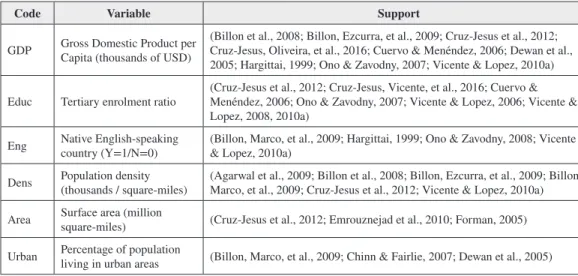
Toempiricallytesttheconceptualmodelforthedigitaldevelopmentofcountries;Table4presents thehypothesisedexplanatoryvariablesincludedinittobetested.Itshouldbekeptinmindthatdata availabilitylimitsthissetofvariables.Thus,itispossiblethatotherpotentiallyimportantdigital divideexplanatoryfactorsarenotincluded.Thedataweregatheredfromthe20thEdition/December 2016oftheITU’sWorldTelecommunication/ICTIndicators(WTI)database(http://www.itu.int/en/ ITU-D/Statistics/Pages/publications/wtid.aspx)andfromTheWorldBank’sdatabase(http://data. worldbank.org/indicator).Theyearsoftheanalysisare2011,2013,and2015. Theanalysisofthedigitaldivide’sdriversstartswiththeunivariateanalysisofthedatapresented aboveforexplainingtheglobaldigitaldivide(pleaseseeTable5).AswiththeICT-relatedvariables usetomeasurethedigitaldivide,theonesusedtoexplainitrevealhighasymmetriesacrosscountries. TheGDPpercapita,forexample,rangesfrom1.60inIndiato101.45inLuxembourg,over63 timesmore.Besidesincomedisparities,thoseregardingeducationarealsonoticeable.Thetertiary
Table 2. Descriptive statistics of the variables used for measuring the digital development
Variable (2015) Mean Std. Dev. Minimum Maximum
HsPC 76.84 15.62 14.08 98.50 HsInt 77.79 15.56 20.00 98.79 BroRT 28.43 9.42 1.34 44.79 MobRt 78.00 27.11 9.36 143.99 Speed 323,709 1,066,316 5,725 7,186,378 Serv 1,023 920 7 3,407 IntPop 77.28 15.12 26.00 98.20
Table 3. Correlation Matrix
Variable HsPC HsInt BroRt MobRt Speed Serv IntPop
HsPC 1 0.94** 0.84** 0.59** 0.25 0.71** 0.93** HsInt 1 0.85** 0.66** 0.24 0.73** 0.93** BroRt 1 0.51** 0.22 0.78** 0.85** MobRt 1 0.04 0.53** 0.63** Speed 1 0.40** 0.26** Serv 1 0.75** IntPop 1
enrolmentratiorangesfrom24.94inIcelandto111.18inJapan.Itisexpectedthatthesekindsof socio-economicdisparitiesacrosscountrieswillleadtodigitaldisparitiesaswell.
Totesttheconceptualmodel,anintegrativeperspectiveisproposedthroughanordinaryleast squares(OLS)modelforeachofthethreeyearsunderanalysis,mathematicallyexpressedasfollows: DigDevi=β0+β1*GDPi+β2*Educi+β3*Engi+β4*Densi+β5*Areai+β6*Urbani+εI (1)
whereβ0istheconstanttermandβ1throughβ6arethecoefficientstobeestimatedbytheOLS,εiis
theerrortermoftheithcountry,GDP
i=thegrossdomesticproductoftheithcountry,Educi=tertiary
enrolmentratiooftheithcountry,Eng
i=1ifthecountryhasEnglishasnativelanguage,and0ifnot,
Densi=thepopulationdensityoftheithcountry,Areai=theareaoftheithcountry,andUrbani=the
percentageofpopulationlivinginurbanareasoftheithcountry.
5. RESULTS
5.1. The Global Digital Divide: Evidence
Thesecondstepwasconfirmingthesuitabilityofthedata,whichisgenerallydoneusingtheKaiser– Mayer–Olkin(KMO)measure.Itsvalueis0.86,whichexpressesaverygoodsuitabilitytoconduct thisanalysis(Sharma,1996).Todecideonthenumberoffactorstoextract,boththecontextofthe
Table 4. Digital divide´s explanatory factors included and their respective support
Code Variable Support
GDP GrossDomesticProductperCapita(thousandsofUSD) (Billonetal.,2008;Billon,Ezcurra,etal.,2009;Cruz-Jesusetal.,2012;Cruz-Jesus,Oliveira,etal.,2016;Cuervo&Menéndez,2006;Dewanetal., 2005;Hargittai,1999;Ono&Zavodny,2007;Vicente&Lopez,2010a) Educ Tertiaryenrolmentratio (Cruz-Jesusetal.,2012;Cruz-Jesus,Vicente,etal.,2016;Cuervo&Menéndez,2006;Ono&Zavodny,2007;Vicente&Lopez,2006;Vicente&
Lopez,2008,2010a)
Eng NativeEnglish-speakingcountry(Y=1/N=0) (Billon,Marco,etal.,2009;Hargittai,1999;Ono&Zavodny,2008;Vicente&Lopez,2010a) Dens Populationdensity(thousands/square-miles) (Agarwaletal.,2009;Billonetal.,2008;Billon,Ezcurra,etal.,2009;Billon,Marco,etal.,2009;Cruz-Jesusetal.,2012;Vicente&Lopez,2010a) Area Surfacearea(millionsquare-miles) (Cruz-Jesusetal.,2012;Emrouznejadetal.,2010;Forman,2005)
Urban Percentageofpopulationlivinginurbanareas (Billon,Marco,etal.,2009;Chinn&Fairlie,2007;Dewanetal.,2005)
Table 5. Descriptive statistics of the digital divide’s explanatory factors
Variable Mean S.D. Minimum Maximum
GDP 31.13 22.02 1.60 101.45
Educ 70.53 18.30 24.94 111.18
Dens 158.56 218.06 2.91 1300.84
Area 1,599.26 3,541.68 0.32 16,376.87
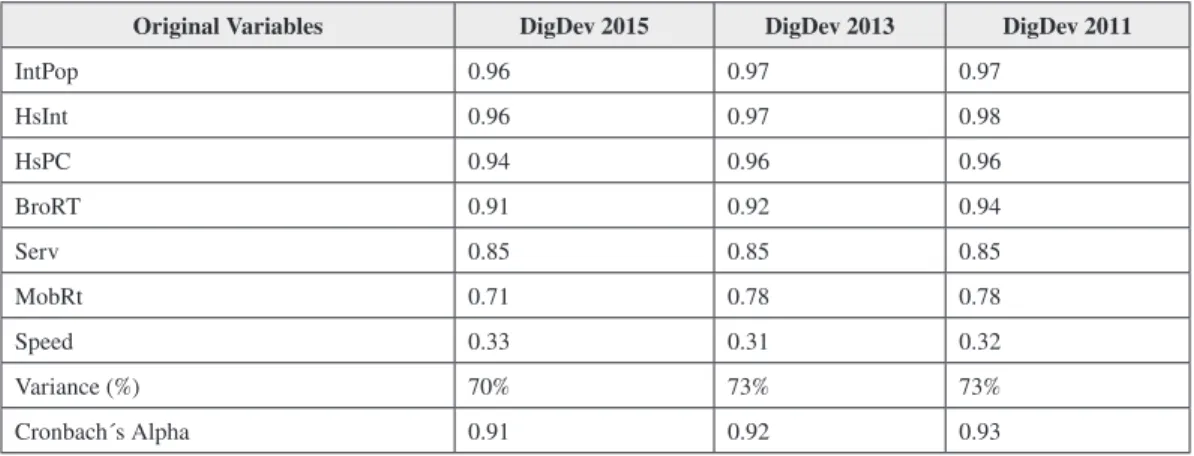
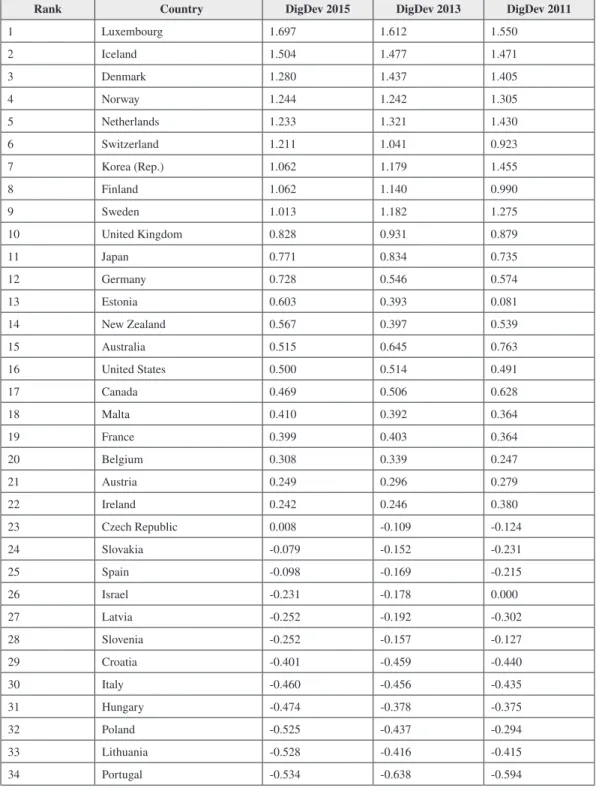
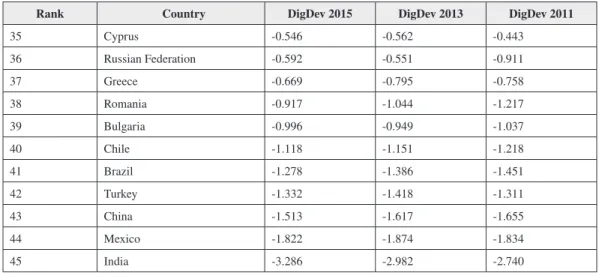
analysisaswellasthestatisticalcriteriawereconsidered.ThePearson’s,Kaiser’s,andtheScree Plotcriteriapointtoaone-factorsolution.Accordingly,thecontextoftheanalysis–inwhichitis intendedtotransformthesevenICT-relatedvariablesintoonenewmetricthatcanproperlyclassify thecountriesintermsofdigitaldevelopment–encouragesthisone-factorsolution.Finally,totest itsreliability,Cronbach’sAlphawascalculated.Itmeasurestheinternalconsistencyofeachfactor withinitself,andavalueover0.7isgenerallyconsideredgood(Nunnaly,1978).Thevaluereturned is0.91,whichconfirmstheextremelyhighreliabilityoftheone-factorsolution.Theresultsofthe factoranalysisareshowninTable6.Asseenthere,thepercentageofvarianceretainedwiththis solutionis70%.Thus,thesevenICT-relatedvariableswerereducedintoasinglenewmeasureof digitaldevelopmentwithaminorlossofinformation. Basedonfactoranalysis,thedigitaldevelopmentscore(DigDev)forallthecountrieswas obtained(seeTable8,inAppendix).Iceland,theNetherlands,Denmark,Sweden,andSouthKorea arethemostdigitallydevelopedcountries.Thesecountriespresentthehighestlevelsinthedigital developmentdimensionextractedfromfactoranalysis.Attheotherendofthespectrum,asthe leastdigitallydevelopedcountries,isIndia,Mexico,China,Brazil,Turkey,andChile.Theresults fromthefactoranalysis–theDigDevscore–allowmeasuringthedigitaldevelopmentofcountries, thusansweringthefirstresearchquestionofthepaper.Asthisstudyalsoincludestheanalysisof thedigitaldevelopmentofcountriesintheyears2013and2011,asimilaranalysisusingthesame variablespertainingtotherespectiveyearswasalsoconducted.Foramatterofspacelimitation andsimplificationtheseresultsarenotdescribedastheywereverysimilartothoseregarding2015.
5.2. The Global Digital Divide: Drivers
Intheprevioussubsection,thedigitaldevelopmentacross45countrieswasmeasured,thereby answeringthefirstresearchquestionofthepaper.However,beingawareofthedifferencesindigital developmentofcountries(i.e.thedigitaldivide),althoughusefulforsomepurposes,doesnotallowto understandwhatdrivesit.Todeterminethistheauthorsneedtotestifthenationalfeaturesofcountries referredtoinSection3andtheorisedaspossibleexplanatoryfactorsofthedigitaldevelopmentof countries,workassuch. TheOLSwasestimatedusingthesoftwareStatisticalAnalysisSystem(SAS®).Asrecommended byNeteretal.(1974).Theauthorsconductedaseriesoftestsinordertoconfirmthesuitabilityofthe OLS,analysingtheresidual´sdistributiontoconfirmitsnormality.Visually,theresidual´snormal distributionassumptionappearstobeverified(seeFigure4,inAppendix).Inordertodemonstratethe normalityassumption,theShapiro-Wilktest(1965)wasperformed,andfora5%significancelevel, theassumptionoftheresidual’snormalityisnotviolated(p>0.10).Thecorrelationsbetweenthe
Table 6. Results of factor analysis and Cronbach’s alpha
Original Variables DigDev 2015 DigDev 2013 DigDev 2011
IntPop 0.96 0.97 0.97 HsInt 0.96 0.97 0.98 HsPC 0.94 0.96 0.96 BroRT 0.91 0.92 0.94 Serv 0.85 0.85 0.85 MobRt 0.71 0.78 0.78 Speed 0.33 0.31 0.32 Variance(%) 70% 73% 73% Cronbach´sAlpha 0.91 0.92 0.93
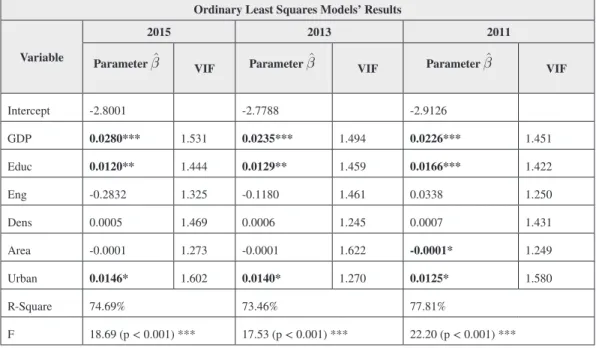
explanatoryvariablesandvaluesforvarianceinflationfactors(VIF)indicatethatmulticollinearity isnotaproblem,consideringthatinthiscasethehighestvalueis1.60,wellbelowthelimitof10 (Belsley,Kuh,&Welsch,1980;Dewanetal.,2005).Withrespecttoapossibleheteroscedasticity probleminthemodel,theWhite´stest(White,1980)wasemployed,whichindicatednopresenceof heteroscedasticity(p>0.10),confirmingthevisualanalysisoftheDigDev´sresiduals(seeFigure 5,inAppendix).Themodelswerealsotestedforendogeneity,whichwasconcludednottoexist.For a1%significancelevel,theoverallmodelissignificant(p<0.01).TheresultsareinTable7.For comparisonpurposes,theOLSestimatedforthepreviousyearsof2013and2011werealsoincluded. Thesemodelsalsofulfilledallsuitabilitycriteriamentionedabove. Lookingattheyearof2015,theGDP(H1: ˆβ1=0.0280,p<0.01),theEduc(H2: ˆβ2=0.0120, p<0.05),andtheUrban(H6: ˆβ6=0.0146,p<0.10)areconfirmedtobestatisticallysignificant driversofthedigitaldevelopmentofcountries.Incontrasttotheauthors’expectations,theEng(H3: ˆ β3=-0.2832,p>0.10),Dens(H4: ˆβ4=0.0005,p>0.10),andArea(H5: ˆβ 5=-0.0001,p>0.10) havenosignificantimpactonthedigitaldevelopmentofcountries.Overall,themodelexplains75% ofthevariation(R-Square)ofDigDev.ThehypothesesH1,H2,andH6appeartobesupported.Itis alsointerestingtoverifythattheAreawas,ashypothesised,aninhibitorofthedigitaldevelopment ofcountries,butonlyintheyearof2011( ˆβ5=-0.0001,p<0.10). 6. DISCUSSIoN Thisstudyanalysedtheglobaldigitaldivideacross45countries,fromdifferentcontextsandrealities, intheyearsof2015,2013,and2011.Todosotheauthorsgroundedthisworkonamultivariate frameworktomeasureandunderstanddigitaldisparitiesacrosscountries.Thefirstaimwasto measurethedigitaldevelopmentofthecountries.TheresultsshowedthatLuxembourg,Iceland, Denmark,Norway,andtheNetherlandsare,respectively,themostdigitallydevelopedcountriesof
Table 7. Results of ordinary least squares models for 2015, 2013, and 2011
Ordinary Least Squares Models’ Results Variable
2015 2013 2011
Parameterβˆ VIF Parameterβˆ VIF Parameterβˆ VIF
Intercept -2.8001 -2.7788 -2.9126 GDP 0.0280*** 1.531 0.0235*** 1.494 0.0226*** 1.451 Educ 0.0120** 1.444 0.0129** 1.459 0.0166*** 1.422 Eng -0.2832 1.325 -0.1180 1.461 0.0338 1.250 Dens 0.0005 1.469 0.0006 1.245 0.0007 1.431 Area -0.0001 1.273 -0.0001 1.622 -0.0001* 1.249 Urban 0.0146* 1.602 0.0140* 1.270 0.0125* 1.580 R-Square 74.69% 73.46% 77.81% F 18.69(p<0.001)*** 17.53(p<0.001)*** 22.20(p<0.001)***
Note: ***Effect is significant at the 0.01 level (2-tailed); ** Effect is significant at the 0.05 level (2-tailed); * Effect is significant at the 0.10 level (2-tailed).
thoseanalysed(seeTable8inAppendix).Attheotherendofthespectrum,withnosurprise,India, Mexico,China,Turkey,andBrazilappearastheleastdigitallydeveloped.Itisinterestingtonotethat theEuropeancountriesaretheonesleadingthedigitaldevelopmentin2015,consideringthatnine ofthetop-tendigitallydevelopedcountriesarefromtheContinent,andthatofthese,sixbelongto theEU.Moreover,itcameassomesurprisethattheeasternEuropeancountriesaredoingrelatively wellinICTincomparisontowhattheauthorshadexpected.Estonia,Slovenia,theCzechRepublic, Slovakia,Latvia,andCroatiapresenthigherdigitaldevelopmentlevelsthanotherolderEUcountries suchasItaly,Portugal,andGreece.PolicymakersofthesecountriesshouldlearnfromtheirEuropean counterpartsthemeasurestoimprovetheirdigitalperformance.TheUSA,thecountrythatoriginated thedigitalrevolutionduringthe1980s,occupiesarelativelymodest16thpositionintherankingin 2015.TheBRICcountriesareallwithinthebottom-tencountriesintermsofDigDev.Russiastands in36thposition,Brazil41st,China43rd,andIndiaoccupiesthe45thposition.Ofthebottom-tendigitally
developedcountriesonlythreebelongtotheEU(Bulgaria,Romania,andGreece).Thisisinline withthefindingsofCruz-Jesusetal.(2012),inwhichthesecountrieswereclassifiedastheleast digitallydevelopedEUcountries. Intheauthors’attempttounderstandwhatdrivestheinternationaldigitaldividetheauthors madeuseofOLSmodels.AsDigDev´sexplanatoryfactorssixcharacteristicsofacountrywere hypothesised.TheOLSconfirmedthreeofthem(GDP,EducandUrban).Contrarytotheauthors’ expectations,althoughtheDensandAreahavesomeinfluenceoverthecountries´DigDev,theseare notstrongenoughtobestatisticallysignificant.TheEng,ontheotherhand,wascompletelyrejected bytheOLSasasignificantdriverofdigitaldevelopment.Accordingtotheauthors’expectations,the GDPpercapita,Education,andpercentageofindividualslivinginUrbanareasexplainthedigital asymmetriesacrosscountries.Theareaofthecountryalsocontributed,butonlyfortheyear2011. Toobtainamorefine-grainedunderstandingoftheimpactofeachdigitaldevelopment´s explanatoryfactors,theauthorsgraphedtheireffects.Foreachstatisticallysignificantexplanatory variable,ineachofthethreeyearsinthestudy,threelevelswerepresented,calculatedasoneequal totheaverage(µ)levelofthevariable;anotheraddinganotherstandarddeviation(σ);andanotherby subtractingonefromtheaverage(seeFigure2).Inotherwords,thestandardisedOLSparameter(β) wasplotted.Allthedigitaldevelopment´sexplanatoryfactors,excepttheArea,showpositiveslopes, pertherespectiveparameter(β).Moreover,therange(andconsequentlytheimpact)ishighestfor theGDP(1.2333),followedbytheEducation(0.4395),andfinallytheUrban(0.4075),following, asexpected,thesameorderasthesignificancelevel(p)oftheOLS.AstheGDPisthevariable thathasthegreatesteffectondigitaldevelopment,itseemsthatdigitalinequalitiesaremainlya directconsequenceofeconomicones.Itisalsoworthmentioningthattheslopesofeachsignificant explanatoryvariablebarelychangeacrossthethreeyearsstudied,therebyreinforcingtherobustness oftheresults.
6.1. Theoretical and Practical Implications
Thetheoreticalimplicationsarethatuptotheyearof2015,twoofthethreepredictorsofthedigital developmentthatprovedtobesignificantweresupportedbythediffusionofinnovations(Rogers, 2005).Hence,althoughtheoriginaldiffusionmodeldatesfrom1962,itseemsthatitstillprovides aneffectiveframeworkforunderstandinginnovations’adoption.Ontheotherhand,fromanICT pointofview,itisinterestingtonotethattheantecedentsofadoptioninthesetechnologiesare,to someextent,similartootherinnovations,givenDOI’sabilitytoidentifythem. Asbroadlymentionedintheliterature,incomedisparitiesstillremainasthemostimportant antecedentofdigitalasymmetriesacrosscountries.Despitetheincreasingaffordabilityintechnology prices, as long as newer ICT applications are considered, countries with different economic outputwillalsohavedifferentlevelsofdigitaldevelopment.Thus,despitethedifferentstrategies topromoteICTadoption,whetherbasedonsubsidisationorprovidingpublicaccess(e.g.,in Internetkiosks,communitycentres,etc.),thefactisthatthosewholiveinpoorercountriesarestill