DOI 10.1007/s10653-008-9147-z
S H O R T C O M M U N I C A T I O N
Evaluation of tests to assess the quality
of mine-contaminated soils
P. Alvarenga · P. Palma · A. P. Gonçalves · R. M. Fernandes · A. de Varennes · G. Vallini · E. Duarte · A. C. Cunha-Queda
Received: 13 October 2006 / Accepted: 18 May 2007 / Published online: 2 February 2008 © Springer Science+Business Media B.V. 2008
Abstract An acid metal-contaminated soil from the Aljustrel mining area (a pyrite mine located in SW Portugal in the Iberian Pyrite Belt) was subjected to chemical characterisation and total metal quanti Wca-tion (Cd, Cr, Cu, Ni, Pb and Zn). Water-soluble met-als were determined and a sequential extraction procedure was used to investigate metal speciation. Two bioavailable metal fractions were determined: a mobile fraction and a mobilisable fraction. Soil eco-toxicity was studied using a battery of bioassays: plant growth test and seed germination with cress (Lepidium sativum L.), earthworm (Eisenia fetida) mortality, E. fetida avoidance behaviour, lumines-cent inhibition of Vibrio Wscheri and Daphnia magna immobilisation. Although the total content of Cu, Zn
and Pb in the soil was large (362, 245 and 1,250 mg/ kg dry matter, respectively), these metals were mostly structurally bound (87% for Cu, 81% for Zn and 89% for Pb) and, therefore, scarcely bioavailable. None-theless, the D. magna immobilization test using soil leachate showed an EC50 (48 h) of 36.3% (v/v), and the luminescent inhibition of V.Wscheri presented an EC20 (15 min) of 45.2% and an EC20 (30 min) of 10.7% (v/v), suggesting a considerable toxic eVect. In the direct exposure bioassays, E. fetida avoided the mine soil at the highest concentrations (50%, 75% and 100% v/v). At the same soil concentrations, cress showed negligible growth. The results suggest the need to use a battery of toxicity tests, in conjunction with chemical methods, in order to assess the quality of mine-contaminated soils correctly.
Keywords Bioassays · Bioavailability · Metal-contaminated soil · Single and sequential extraction procedures
Introduction
Soils are systems in which a dynamic equilibrium exists between the total content of metals, the mobile fraction (soluble, very active and bioavailable) and the mobilisable fraction (potentially bioavailable, leachable and partly active) (Gupta et al. 1996). Over the last 30 years, single and sequential extraction protocols have been designed to predict both the P. Alvarenga (&) · P. Palma · A. P. Gonçalves ·
R. M. Fernandes
Departamento de Ciências do Ambiente, Escola Superior Agrária de Beja, Rua Pedro Soares, Apartado 158, 7801-902 Beja, Portugal
e-mail: [email protected]
A. de Varennes · E. Duarte · A. C. Cunha-Queda
Departamento de Química Agrícola e Ambiental, Instituto Superior de Agronomia, Universidade Técnica de Lisboa (TULisbon), Tapada da Ajuda, 1349-017 Lisboa, Portugal
G. Vallini
Department of Science and Technology, Laboratories of Microbial Biotechnology and Environmental
Microbiology, University of Verona, Strada Le Grazie 15, Ca’ Vignal, 37134 Verona, Italy
retention and release of metals in soils, sediments and sludges and their bioavailability (Tessier et al. 1979; Quevauviller et al. 1996; Kennedy et al. 1997; Rauret et al. 2000; Sahuquillo et al. 2003). However, these methods are empirical and can only estimate the potential availability of elements for plant uptake (Kennedy et al. 1997) or the form of a speciWc metal
in the matrix of interest. Furthermore, the results are highly dependent on the extraction protocol used (Rauret et al. 2000). For these reasons, chemical anal-yses are seldom suited for the evaluation of potential ecological risks, since they do not take into account the possible combined eVects of diVerent contami-nants, as well as their bioavailability. Bioassays, which can overcome these constraints, are therefore recommended for the assessment of ecological risks in soils (van Gestel et al. 2001).
The aims of this study were: (i) to assess the chem-ical and ecotoxicologchem-ical characteristics of a mine-contaminated soil and (ii) to evaluate which bioassays are more reliable indicators of ecotoxicity and conve-nient to use in this type of soil.
Materials and methods
Topsoil (0–20 cm) from a metal-contaminated site in the Aljustrel mining area (a pyrite mine located in SW Portugal in the Iberian Pyrite Belt) was subjected to chemical characterisation and total heavy metal quantiWcation (Cd, Cr, Cu, Ni, Pb and Zn) by atomic absorption spectrometry (AAS) after digestion with aqua regia (ISO 11466 1995). Water-soluble metals were determined according to DIN 38 414-S4 (1984), using a batch test with a single leaching cycle (dis-tilled water in a 1:10 m/v solid-to-liquid ratio, 24 h under constant agitation, room temperature). The Community Bureau of Reference (BCR) sequential extraction procedure, used for heavy metal speciation, was performed as described by Rauret et al. (2000): Wrst step—extraction of soil samples with acetic acid 0.11 mol l¡1 to liberate exchangeable/acid-extractable metals; second step—metals associated with the reducible phases were then solubilised using hydrox-ylamine hydrochloride; third step—the contaminants released by oxidation with hydrogen peroxide were extracted in 0.1 mol l¡1 ammonium acetate, and Wnally the residual metal content was determined by digestion with aqua regia. Bioavailable metal
fractions were determined using two diVerent single step extractions: a mobile fraction (extracted by 0.01 M CaCl2, pH 5.7, without buVer) (Houba et al. 1996; Pueyo et al. 2004) and a mobilisable fraction (extracted by a solution of 0.5 M NH4CH3COO, 0.5 M CH3COOH and 0.01 M EDTA, pH 4.7) (Hammer and Keller 2002). Extractions were performed by 2 h horizontal reciprocate shaking, using a 1:10 (w/v) soil to solution ratio at room temperature. The extract was separated from the solid residue by centrifugation at 3,000g for 10 min. Soil ecotoxicity was studied using a battery of bioassays. Direct toxicity bioassays were performed using the sampled soil and dilutions with an artiWcial soil (1/3 peat:1/3 sand:1/3 perlite, pH 4.5), which was also used as control. The indirect exposure bioassays were performed using leachates, obtained by the method DIN 38 414-S4 (1984), as previously described, and dilutions with distilled water. Direct acute toxicity bioassays were: plant growth test with cress (Lepidium sativum L.) (ISO/ DIS 15799 1999) and earthworm (Eisenia fetida) mortality (ASTM E 1676–97,1997). E. fetida was also used in an avoidance behaviour response bioas-say, in order to evaluate the subchronic toxicity of the soil (ISO/CD 2003). Indirect acute toxicity bioassays, with leachate from the soil, comprised: luminescent inhibition of Vibrio Wscheri (ISO 11348-2 1998), Daphnia magna immobilization (ISO 6341 1996) and seed germination (L. sativum) (Fuentes et al. 2004).
Data were submitted to analysis of variance (ANOVA) and the means compared by the Tukey’s range test (p < 0.05) or the Dunnet’s test for compari-son with a control group (p < 0.05). The EC20 and EC50 values were calculated using the trimmed Spear-man-Karber method (Hamilton et al. 1977).
Results
Metal concentrations
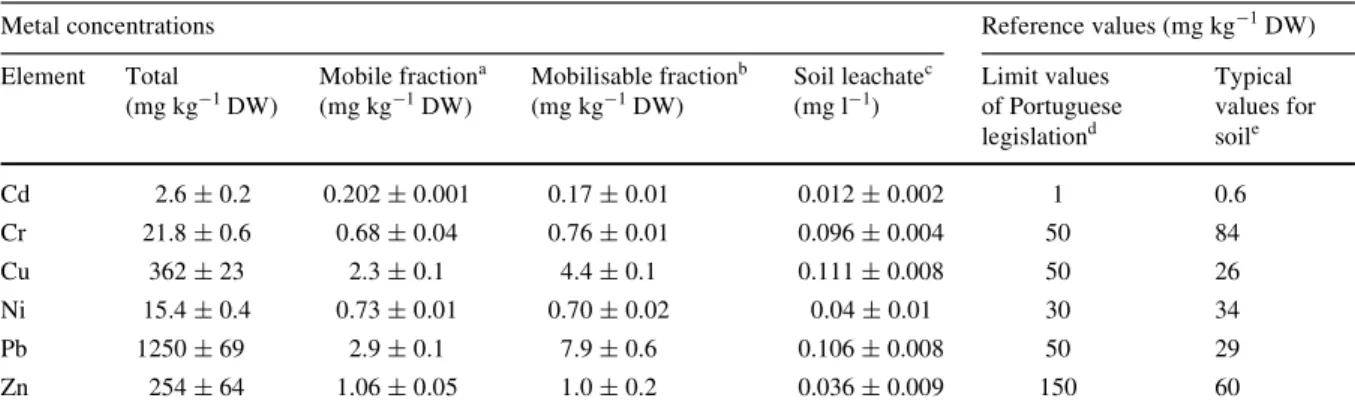
The soil was a sandy loam (704 g kg¡1 sand, 177 g kg¡1 silt and 119 g kg¡1clay), acid (pHH20= 3.6), with low salinity (EC = 0.021 S m¡1), low cation exchange capacity (8.6 cmol kg¡1), poor in organic matter (OM = 0.37%), and in N, P and K (data not shown). The total concentrations for Cu, Pb and Zn (Table1) were high and largely exceeded both the typical concentrations for soils (Salomons and
Förstner 1984) and the limit values for farmed soils allowed by Portuguese legislation. Nonetheless, the bioavailable fraction was very small, both for the mobile fraction and for the mobilisable fraction (Table1). The metal content in the soil leachates was also very low, even smaller than the concentrations obtained using the weak electrolyte solutions. This could be explained by the fact that this soil was heav-ily exposed to weathering processes, which can also be noted on the soil characteristics reported. The soil leachate had a pH of 3.7, an EC of 0.015 S m¡1 (low salinity) and the pH of 0.01 M CaCl2 settled soil suspension was 3.6.
All the metals studied were mainly associated with the residual fraction of the soil (Fig.1). For Cu, Pb and Zn, the most abundant metals in this contami-nated soil, more than 80% of the total metal content was in the residual fraction. The metal extracted by the Wrst step (water-soluble, exchangeable, and weakly bound to OM) was less than 5% of the total content for Cd, Cr, Cu, Pb and Zn, and less than 10% for Ni. The fraction extracted by the Wrst step is con-sidered a relative empirical estimate of metal bio-availability (Kennedy et al. 1997), which is in agreement with the results obtained by the single-step extractions mentioned above. It is important to note that, although the total content for Pb in this soil was large (1,250 mg kg¡1 DW), it was detected in two fractions: associated with Fe–Mn oxides (10% of the
total content, extracted in the second step) and in the residual fraction (89% of the total content), presenting the least bioavailability of the metals studied.
Bioassays
Cress growth was impaired (54% relative growth) at 40% (v/v) soil concentration compared with the control without mine soil, but not for lower concentrations (5%, Table 1 Metal concentrations in the soil, mean § standard deviation (SD, n = 3)
a Extracted by calcium chloride 0.01 M solution
b Extracted by ammonium acetate 0.5 M, acetic acid 0.5 M and EDTA 0.01 M, pH 4.7 solution c
Metal concentrations in the soil leachate obtained according to DIN 38414-S4 (1984)
d
Limit concentrations for metals in farmed soils (pH · 5.5) allowed by the Portuguese legislation (Decreto-Lei no. 118/2006)
e Salomons and Förstner (1984)
DW: Dry weight
Metal concentrations Reference values (mg kg¡1 DW)
Element Total (mg kg¡1 DW) Mobile fractiona (mg kg¡1 DW) Mobilisable fractionb (mg kg¡1 DW) Soil leachatec (mg l¡1) Limit values of Portuguese legislationd Typical values for soile Cd 2.6 § 0.2 0.202 § 0.001 0.17 § 0.01 0.012 § 0.002 1 0.6 Cr 21.8 § 0.6 0.68 § 0.04 0.76 § 0.01 0.096 § 0.004 50 84 Cu 362 § 23 2.3 § 0.1 4.4 § 0.1 0.111 § 0.008 50 26 Ni 15.4 § 0.4 0.73 § 0.01 0.70 § 0.02 0.04 § 0.01 30 34 Pb 1250 § 69 2.9 § 0.1 7.9 § 0.6 0.106 § 0.008 50 29 Zn 254 § 64 1.06 § 0.05 1.0 § 0.2 0.036 § 0.009 150 60
Fig. 1 Metals, as a percentage of the total content, after
frac-tionation through the BCR procedure: Wrst step (exchangeable fraction), second step (reducible fraction), third step (oxidizable fraction) and residual
0 10 20 30 40 50 60 70 80 90 100 Cd Cr Cu Ni Pb Zn Element Extra ction per ce n ta g e
10% and 20%) (Dunnet’s test, p < 0.05). Cress growth above the 50% (v/v) concentration was negligible.
No earthworm mortality was observed after 14 days incubation, but earthworm biomass at the end of the test was smaller for the 100% (v/v) soil concen-tration compared with the control without mine soil (Dunnet’s test, p < 0.05).
The mine soil was avoided by earthworms at concentrations ¸50% (v/v), suggesting an impaired quality according to the deWnition of habitat function (ISO/CD 2003; Loureiro et al. 2005a), i.e. if the per-centage of animals present in the soil is less than 20%, the soil is considered to be toxic or with impaired quality.
There were no signiWcant diVerences between rela-tive seed germination (RSG) and relarela-tive root growth (RRG) of cress after exposure to various concentra-tions of the soil leachate (data not shown).
In the D. magna immobilization bioassay using the soil leachate, an EC50 of 36.3% (v/v) with a conWdence interval (CI) of 34.5–38.3% was found, suggesting a considerable toxic eVect of this soil on this organism.
In the luminescent bacteria bioassay the observed toxic eVect was insuYcient to allow the calculation of an EC50, but EC20 values were estimated: EC20 (15 min) = 45.2% (CI = 45.0–45.5%) and EC20 (30 min) = 10.7% (CI = 10.4–11.0%), all in v/v.
It is important to note that the results obtained in both indirect exposure bioassays were achieved with a pH correction on the soil leachate to 7.0 § 0.2, as speciWed in the respective methods.
Discussion
The results show that, despite the high total metal con-centrations, the bioavailable fractions were very small. This fact was corroborated by the sequential extrac-tion, which showed that all the studied metals were mainly found in the residual fraction of the soil. The only obvious soil constraint was its acidity. Relying only on physicochemical analysis, it could be con-cluded that this soil had low toxicity. However, some of the ecotoxicity bioassays were very sensitive to this type of mine soil and were able to detect soil toxicity.
As expected, results from the bioassays were strongly dependent on the sensitivity of the organism used. Some tests (earthworm mortality and seed germination) were less sensitive to this particular type
of soil contamination, whereas plant growth and D. magna immobilization bioassays were much more sensitive. Chaîneau et al. (2003) reached similar con-clusions when using the same tests to evaluate the bioremediation of a crude-oil-polluted soil. In their case, bacterial luminescence (Microtox) was also con-sidered a very sensitive test. In our study, the low sen-sitivity of this test was probably due to the correction of the leachate to pH 7.0, which is part of the standard method (ISO 11348-2 1998), but masked a major soil constraint.
Loureiro et al. (2005b), using aquatic bioassays to evaluate the toxicity of two mine soils, found that marine bacteria were more sensitive to eluates from the soil with low heavy metal content than to eluates from the soil with high heavy metal content, while D. magna was sensitive to both soil eluates. Consider-ing these facts and our results, we assumed that the D. magna immobilization bioassay would be more sensitive to this type of soil contamination.
As for the direct toxicity bioassays, it was obvious that the mine soil had an impact on plant growth. These eVects were probably due not only to metals present in the soil and its acidity, but also to the lack of proper structure and deWcient porosity. The avoid-ance behaviour bioassay using E. fetida also proved to be a sensitive test to be used in this type of mine soil and was adequate to obtain fast answers with low costs, suggesting it should be used as a screening tool to assess soil contamination or its remediation.
In conclusion, the direct bioassays (plant growth using L. sativum and avoidance behaviour using E. fetida), which test soil habitat function, as well as the aquatic bioassays (D. magna immobilization and luminescence inhibition in V.Wscheri), which test soil retention function, proved to be adequate to assess the quality of these mine-contaminated soils.
Acknowledgement The authors would like to thank “Fun-dação para a Ciência e Tecnologia” for Wnancial support through the Project POCI/AMB/57586/2004, with partial funding from the FEDER.
References
ASTM E 1676–97 (1997). American Society for Testing and Materials. Standard guide for conducting laboratory soil toxicity or bioaccumulation tests with Lumbricid earth-worm Eisenia fetida. In Annual Book of ASTM Standards (pp. 1056–1074). West Conshohoken, PA.
Chaîneau, C. H., Yepremian, C., Vidalie, J. F., Ducreaux, J., & Ballerini, D. (2003). Bioremediation of a crude oil-polluted sol: Biodegradation, leaching and toxicity assessments.
Water, Air and Soil Pollution, 144, 419–440.
Decreto-Lei no. 118/2006, de 21 de Junho. Diário da República no. 118/2006—I Série A. Ministério do Ambiente, do Ordenamento do Território e do Desenvolvimento Regional. Lisboa.
DIN 38 414-S4 (1984). Determination of leachability by water (S4). German standard methods for the examination of water, wastewater and sludge. Sludge and sediments (group S).
Fuentes, A., Lloréns, M., Sáez, J., Aguilar, M. I., Ortuño, J. F., & Meseguer, V. F. (2004). Phytotoxicity & heavy metals speciation of stabilized sewage sludges. Journal of
Haz-ardous Materials, A108, 161–169.
Gupta, S. K., Vollmer, M. K., & Krebs, R. (1996). The impor-tance of mobile, mobilisable and pseudo total heavy metal fractions in soil for three-level risk assessment and risk management. The Science of the Total Environment, 178, 11–20.
Hamilton, M. A., Russo, R. C., & Thurston, R. V. (1977). Trimmed Spearman-Karber method for estimating median lethal concentrations in toxicity bioassays. Environmental
Science and Technology, 11(7), 714–719. Correction
(1978). 12(4), 417.
Hammer, D., & Keller, C. (2002). Changes in the rhizosphere of metal-accumulating plants evidenced by chemical extract-ants. Journal of Environmental Quality, 31, 1561–1569. Houba, V. J. G., Lexmond, T. M., Novozamsky, I., & van der
Lee, J. J. (1996). State of the art and future developments in soil analysis for bioavailability assessment. The Science
of the Total Environment, 178, 21–28.
ISO 6341 (1996). Water quality—Determination of the inhibi-tion of the mobility of Daphnia magna Staus (Cladocera, Crustacea)—acute toxicity test. International Organisation for Standardisation. Geneva, Switzerland.
ISO 11348–2 (1998). Water quality—Determination of the inhibitory eVect of water samples on the light emission of
Vibrio Wscheri (Luminescent bacteria test). Part 2: Method
using liquid-dried bacteria. International Organisation for Standardisation. Geneva, Switzerland.
ISO 11466 (1995). Soil quality—Extraction of trace elements soluble in aqua regia. International Organisation for Stan-dardisation. Geneva, Switzerland.
ISO/CD (2003). Soil Quality—Avoidance test for testing the quality of soils and the toxicity of chemicals—Test with earthworms (Eisenia fetida). ISO 17512. International Organization for Standardization. (p. 26). Geneva, Switzerland.
ISO/DIS 15 799 (1999). Soil Quality—Guidance on the ecotox-icological characterization of soils and soil materials.
Annex A.1.2.2 Determination of the eVects of pollutants on soil Xora—Part 2: EVects of chemicals on the emergence and growth of higher plants. International Organisation for Standardisation. Geneva, Switzerland.
Kennedy, V. H., Sanchez, A. L., Oughton, D. H., & Rowland, A. P. (1997). Use of single and sequential chemical extract-ants to assess radionuclide and heavy metals availability from soils to root uptake. Analyst, 122, 89R–100R. Loureiro, S., Soares, A. M. V. M., & Nogueira, A. J. A. (2005a).
Terrestrial avoidance behaviour tests as screening tool to assess soil contamination. Environmental Pollution, 138, 121–131.
Loureiro, S., Ferreira, A. L. G., Soares, A. M. V. M., & Nogue-ira, A. J. A. (2005b). Evaluation of the toxicity of two soils from Jales Mine (Portugal) using aquatic bioassays.
Chemosphere, 61, 168–177.
Pueyo, M., López-Sanchez, J. F., & Rauret, G. (2004). Assess-ment of CaCl2, NaNO3 and NH4NO3 extraction procedures
for the study of Cd, Cu, Pb and Zn extractability in contam-inated soils. Analytica Chimica Acta, 504, 217–226. Quevauviller, P., van der Sloot, H. A., Ure, A., Muntau, H.,
Gomez, A., & Rauret, G. (1996). Conclusions of the workshop: Harmonization of leaching/extraction tests for environmental risk assessment. The Science of the Total
Environment, 178, 133–139.
Rauret, G., López-Sanchez, J. F., Sahuquillo, A., Barahona, E., Lachica, M., Ure, A. M., Davidson, C. M., Gomez, A., Lück, D., Bacon, J., Yli-Halla, M., Muntau, H., & Que-vauviller, P. (2000). Application of a modiWed BCR sequential extraction (three-step) procedure for the deter-mination of extractable trace metal contents in a sewage sludge amended soil reference material (CRM 483), com-plemented by a three-year study of acetic acid and EDTA extractable metal content. Journal of Environmental
Mon-itoring, 2, 228–233.
Sahuquillo, A., Rigol, A., & Rauret, G. (2003). Overview of the use of leaching/extraction tests for risck assessment of trace metals in contaminated soils and sediments. Trends in
Analytical Chemistry, 22(3), 152–159.
Salomons, W., & Förstner, U. (1984). Metals in the hydrocycle. Berlin: Springer-Verlag.
Tessier, A., Campbell, P. G. C., & Bisson, M. (1979). Sequential extraction procedure for the speciation of particulate trace metals. Analytical Chemistry, 51(7), 844–851.
van Gestel, C. A. M., van der Waarde, J. J., Derksen, J. G. M., van der Hoek, E. E., Veul, M. F. X. W., Bouwens, S., Rusch, B., Kronenburg, R., & Stokman, G. N. M. (2001). The use of acute and chronic bioassays to determine the ecological risk and bioremediation eYciency of oil-polluted soils. Environmental Toxicology and Chemistry,