CARVALHO, Any Raquel Souza; ARAÚJO, Marcos Vinícius; BARROS, Luís Cláudio;
SANTOS, Yuri Miorelli Antunes dos. The Development of Learning Strategies in Individual Instrumental Practice: an exploratory study with organ students in higher music education. Opus, v. 26 n. 1, p. 1-23 jan./abr. 2020. http://dx.doi.org/10.20504/opus2020a2603
Recebido em 16/02/2020, aprovado em 16/03/2020
Abstract: The present research investigates the effectiveness of an instructional protocol of practice strategies for the initial learning stage of a musical piece by three organ students. Seventeen practicing strategies were developed for learning the Prelude in F major (BWV 556) by J. S. Bach. Provided over ten practice sessions, the strategies involved activities before and after contact with the score. Participants were interviewed about the perceived effectiveness of the protocol. The analyses of the verbatim transcribed interviews indicated emerging themes regarding perceived effectiveness of the strategies: acceleration of time for understanding the work, artistic image, technical and self-efficacy aspects for musical practice, and relationship with the final performance. The results suggest that strategies applied at the early stages of organ learning may foster robust strategies in beginning students.
Keywords: Learning strategies. Organ. Beginning students. Higher Education. J.S. Bach O desenvolvimento de estratégias de aprendizagem na prática instrumental individual: um estudo exploratório com alunos de Órgão no Ensino Superior de Música
Resumo: A presente pesquisa investiga a eficácia de um protocolo instrucional de estratégias
de prática para o estágio inicial de aprendizagem de uma peça musical por três estudantes de órgão. Dezessete estratégias de prática foram desenvolvidas para aprendizagem do Prelúdio em Fá Maior (BWV 556) de J. S. Bach. Fornecidas ao longo de dez sessões de prática, as estratégias envolveram atividades antes e depois do contato com a partitura. Os participantes foram entrevistados sobre a efetividade percebida do protocolo. As análises das entrevistas transcritas literalmente indicaram temas emergentes em relação à efetividade percebida das estratégias: aceleração do tempo para a compreensão da obra, imagem artística, aspectos técnicos e de autoeficácia para a prática musical e relação com a performance final. Os resultados sugerem que o desenvolvimento de estratégias a serem aplicadas nos estágios iniciais da aprendizagem de órgão pode contribuir para esclarecer como promover estratégias avançadas de prática musical em alunos iniciantes.
Palavras-chave: Estratégias de aprendizagem. Órgão. Estudantes iniciantes.
Ensino Superior. J. S. Bach.
The development of learning strategies in individual
instrumental practice: an exploratory study with
Organ Students in Higher Music Education
Any Raquel Carvalho
Marcos Vinícius Araújo
(Universidade Federal do Rio Grande do Sul, Porto Alegre-RS)Luís Cláudio Barros
(Universidade do Estado de Santa Catarina, Florianópolis-SC)Yuri Miorelli Antunes dos Santos
(Universidade Federal do Rio Grande do Sul, Porto Alegre-RS)A
nalyzing students’ behaviors in the process of musical learning is important not only for teachers to understand how they tend to develop autonomy and self-sufficiency in practice, but also to devise and test specific learning strategies. Recent research on music learning and teaching has highlighted the importance of individual music practice, a multifaceted phenomenon that occurs away from both the classroom and teacher regulation. Thus, individual practice involves self-instruction, which is dependent on the students’ skills and development and on teacher competence (AUSTIN; BERG, 2006; BARTOLOME, 2009; CHRISTENSEN, 2010; DUKE; SIMMONS; CASH, 2009; JØRGENSEN, 2004, 2008; LEON-GUERRERO, 2008; MCPHERSON; RENWICK, 2011; MCPHERSON; ZIMMERMAN, 2011; MIKSZA, 2007, 2011; NIELSEN, 2001; STGEORGE; HOLBROOK; CANTWELL, 2012; ZHUKOV, 2009).The use of learning strategies has been the object of study in different fields for some decades: sports (BULLARD, 2016; KNOWLES; BORRIE; TELFER, 2005; PETERS; JONES; PETERS, 2008), language acquisition (LEAVER; EHRMAN; SHEKHTMAN, 2005), dance (SICCHIO, 2009), education (RIVEIRO, 2014), to name just a few. In language acquisition, Leaver, Ehrman and Shekhtman (2005) have discussed learning styles and strategies, defining the latter as “the specific actions one takes and/or techniques one uses in order to learn” (LEAVER; EHRMAN; SHEKHTMAN, 2005: 65). The authors have divided learning strategies into three categories: sensory preferences (visual, auditory, and motor modalities), cognitive style (individualized ways of processing information), and personality types (involving affective factors).
Other studies link strategies to previous musical knowledge. Hallam (2001), for example, pointed out that the effective use of learning strategies, in some cases, relates to the level of the individual’s musical development. This data was based on the fact that the application of some strategies was limited, even when the musician was familiar with them, since he/she did not have sufficient musical knowledge. Therefore, Hallam reports that effective practice is related to diverse levels of musical knowledge and the metacognitive abilities of the performer.
Gaps between students’ reported knowledge of strategies and their use of effective learning during practice, suggest the need for application of efficient practice strategies based on previously acquired knowledge (CHRISTENSEN, 2010). Hallam et al. (2012) mentioned that although teachers report delivering specific instructions for home practice, perception and recollection of that information is generally reduced in students, thus demanding constant, supportive feedback. The same was found by Colombo and Antoniette (2017) regarding metacognitive strategies. In their study, although teachers used metacognitive strategies during their teaching practice, students lacked the knowledge to do so. Difficulties in the application of practice strategies by students may influence motivational aspects of practice. A recent systematic review by Varela, Abrami and Upitis (2016) about self-regulation in music pointed out that research up to 2011 displays weak, although positive, relationships with variables such as musical attainment, amount of practice, persistence, practice content, and efficiency. One variable that may need more attention is whether teachers are including learning strategies in their teaching and the nature of those instructions for practice (i.e., practice strategies).
According to Austin and Berg, it is imperative for a music teacher to “explicitly teach students how to engage in strategic practice as well as how to use a greater variety of practice strategies” (AUSTIN; BERG, 2006: 553). Jørgensen discussed the relationship between teachers and students during their lessons, the student’s role while practicing, and the institution’s responsibility in student learning (JØRGENSEN, 2000: 74), all in instrumental higher education. He suggested that instrumental teachers divide their time between teaching and observing student practice, thus enhancing their independence in practicing. Capistran (2017) developed
by 84 teachers in six university music schools in Mexico. The results suggested deficiencies in teaching strategies in the dimension of control of execution and self-evaluation of practice, lack of effective monitoring of their students’ practice behavior, as well as lack of interest to support their practicum on research results.
The available research evidence suggests that enabling students to “learn how to learn” is key to the development of music practice, since it can empower students to be more independent, which in turn, can produce an optimal outcome of how to practice more efficiently. It may be possible that helping students learn how to use strategies to solve issues at an early stage could provide benefits and give them a more solid view of practice tasks, as well as speed up the initial learning process. For example, a recent study by Miksza (2015) investigated the effect of self-regulation instruction comprising videos of narrative descriptions and aural/ visual models of both practice strategies and self-regulation principles on collegiate wind player performance achievement, practice behavior, and self-efficacy. All participants made significant gains in performance achievement. The same was found by Mieder and Bugos (2017). They observed positive effects of a curriculum founded on self-regulated learning practice strategies on 30 high school instrumentalists in terms of performance achievement, self-efficacy, practice behaviors, and self-perceptions of practice behaviors. Together, both studies suggest that offering opportunities to employ a self-regulated application of practice strategies may enhance learning. However, the strategies applied in both protocols were general, providing no strategies involving technical and stylistic features of specific instruments. Regarding stylistic aspects, Ward (2007) explored the gap between music analysis and music performance by developing a toolkit with 12 individual strategies linked to areas like recognition, technique, accuracy, memorization, expression and composition for students of all levels and instruments. Results suggest that the resource is useful for encouraging teachers to incorporate music analysis more systematically within instrumental lessons.
Music practice, then, is a skill that must be learned. Therefore, the teacher should teach how to practice through the application of effective learning strategies, so that the student becomes independent and may continue improving during daily practice. In this sense, it is desirable for students to identify technical and expressive demands of the repertoire so the instructor may provide a series of learning strategies to overcome the challenges. In light of these studies, our aim was to develop learning strategies for the first practice sessions of beginning organ students with little or no organ training.
In Brazil, a higher education music performance program usually requires repertoire with different technical demands and stylistic diversity. Previous research typically investigated the practice strategies of students that play instruments such as piano, brass and other marching band instruments, bowed and plucked strings, as well as singers (MIKSZA, 2011). There is a paucity of studies investigating the pipe organ, an instrument that requires considerable cognitive and physical demands. It is a complex keyboard instrument with many divisions, each of which is accompanied by its own keyboard, along with a pedalboard to be played with the feet. Reading a score may require coordinating three staffs at a time, using both hands and both feet.
In a study with two advanced organ students preparing a complex piece, Nielsen (1999) identified learning strategies through verbal reports expressed during and after practice sessions. Results showed that learning strategies were employed to integrate information selected and organized with previously acquired knowledge. However, this and other studies were developed in countries that have established conservatories that provide a solid music education for students from the early years of elementary school, which is not the case in this study.
Only four Brazilian universities offer a bachelor’s degree in organ performance today; two of them also offer master’s and doctorate degree programs. In the undergraduate program in organ performance in the university where this study was undertaken, students may enter without any prior knowledge of organ technique or practice, however, they are required to have basic piano skills. In this context, organ teachers need to help students learn as quickly as possible and absorb as much as they can in four years (CARVALHO, 2013, 2016).
Two studies regarding learning strategies with organ students have been conducted in Brazil (CARVALHO; KERR, 2015; CARVALHO, 2016). In the pilot study by Carvalho and Kerr (2015), four undergraduate organ students were recorded practicing a short piece in a single session without further instruction. It showed the individualized ways in which each approached a new piece through the observation of their first contact with a piece. The strategies were categorized as playing and non-playing activities. Carvalho (2016) developed an exploratory study, where a student was asked to practice one of his assigned pieces by using melodic, technical and contrapuntal strategies during practice sessions, while learning the remainder of his repertoire in his normal manner. In 10 of his 15 organ lessons during the semester, the student was asked to play the piece (the studied section) during the first 15 minutes. He then reported his difficulties and specific strategies were formulated for practice for the subsequent lesson. Two evaluators heard his semester’s repertoire without prior knowledge that one piece had been studied in a different manner. Results showed that this work was ready for performance before the others even though it was considered the most challenging of all. It was deemed the best performed work at the final examination.
PURPOSE OF THE STUDY
This exploratory study aimed at investigating the relative effectiveness of a pedagogical intervention of specific learning strategies with beginning organ students through the development of a protocol. In this study, beginning organ students are those who have had less than two years of formal lessons in organ, and less than 10 years of general music practice (piano lessons, music theory, etc.).
It was hypothesized that a protocol consisting of specific organ learning strategies such as harmonic, melodic, contrapuntal listening, and technical strategies would be considered more effective by the students. The following questions framed the study: (1) Does the practice of learning strategies in a specific protocol impact the initial learning process of a musical piece? (2) How does the practice of learning strategies in a specific protocol affect the initial learning process of a musical piece? With this research we hope to help beginning students learn how to use strategies to solve issues as early as their first contact with musical works so that they can anticipate a practice approach undertaken by experienced performers. As Ritchie and Stauffer (2000) affirm in the preface of their organ method:
Practice is not performing, and the two should never be confused. Practicing is the learning of a work. It is the mastery of mind over muscle. Performance is the presentation of a work; it is the union of mind and music. For the steady technical progress that leads to polished playing, good practicing habits and economic use of practice time are essential. (RITCHIE; STAUFFER, 2000)
METHOD
Location, participants, material
All organ students in the music department of a Brazilian university received an invitation via email to participate in the present study. Leveling criteria was having played a prelude and/or fugue from the Little Eight Preludes and Fugues by J.S. Bach (BWV 553-556), a collection used by most beginning students. Six students responded and three of these were deemed appropriate for the study, all of them male. One student was a first-year undergraduate student and the other two were enrolled in a course open to the community, at the same university, with the major goal of preparing students for undergraduate entry. All students signed a consent form and answered a questionnaire regarding their musical background.
Student A, age 35, had studied cello and voice for three years each in a conservatory setting as a teenager, as well as nine years of piano. He holds a bachelor’s degree in conducting. Although he had had two years of organ lessons, he commented that he never practiced much because of a full-time job (in another field) and he does not have a keyboard instrument at home. He admits his progress has always been very slow. Student B, age 45, is a professional violist who began musical studies on the violin as a child and then viola as a teenager. He received a degree in viola performance and during this study, he was also pursuing an undergraduate degree in conducting. He never studied piano formally but had studied one year of organ before this study. Student C, 26 years old, took six years of private piano lessons prior to this study. He had just finished his first year of undergraduate organ study.
Beginning organ students were deemed appropriate since the study proposed learning strategies they might find useful and could adopt in future practice to accelerate their initial learning process of a musical piece. In the present study, the initial learning period delineates the period up to the point where students consider that technical demands are not an issue and do not interfere with the musical understanding of the piece.
Materials
One of the Little Eight Preludes and Fugues by J.S. Bach (BWV 553–560), a collection performed by beginning organ students, was chosen to be learned as quickly and efficiently as possible, with little or no help from their teacher. This collection belongs to the earliest period of organ composition by Bach and was “evidently intended for instructive purposes, for, in form and contents they are somewhat sketchy and meagre when compared with his later works” (EDDY, 1917)1. In addition, the Prelude in F major, BWV 556, from this collection was selected
because it presents contrapuntal and homophonic materials that are used “as teaching pieces for beginners” (ARNOLD, 2003: 101). It is in F major and contains 58 measures in 3/8 meter, in ABA’A form, where B is longer and modulatory. There are two main motives used throughout the piece: one in stepwise motion (mm. 1-4) and the other is comprised of triplets in arpeggios (mm. 5-6). Most of the phrases are four measures in length and cadences define the modulations. The organ used for the study is a three-manual Johannus, Opus 30, in a practice room of the graduate music department. A Sony Handycam HDR-CX190 video camera was used
to videotape the weekly sessions and interviews. Musescore was the software employed to formulate the strategies.
Procedure
Development of Organ Learning Strategies Protocol: 17 strategies were elaborated by the
researchers based on the experience of the organ/counterpoint professor, similar to those applied in a prior study (CARVALHO, 2016) whereby each student was introduced to the chosen learning strategies during his weekly organ lesson. Strategies were formulated according to the difficulties that arose during each lesson and the compositional and stylistic features of the work. In the present study, strategies for the Prelude in F major were divided into the following categories: (1) harmonic; (2) melodic; (3) contrapuntal listening strategies; (4) contrapuntal; and (5) technical. They were planned according to the structure and analysis of the Prelude (BWV 556) and distributed among the students before their contact with the original score. The protocol may be found in Appendix 1. The development of the strategies was based both on the experience of the researchers in organ teaching as well as available research regarding specific practice behaviors that elucidate positive significant relationships between strategies and performance achievement. Examples of behaviors, i.e., learning strategies, that tended to be related to the increase in performance achievement in research are: whole-part-whole repetition, slowing down the tempo in practice, skipping to critical sections of the repertoire, chaining bits of music together, among others (BARROS, 2008; GRUSON, 1988; HALLAM; JØRGENSEN; LEHMANN, 1997; JØRGENSEN; HALLAM, 2012; MIKSZA, 2007, 2011). The strategies also considered traditional and modern organ methods (BRANSFORD, 1975; GLEASON; CROZIER, 1996; STAINER; HARKER, 2003).
The pool of strategies was distributed to two experienced music educators and one undergraduate piano major. After careful reading, they provided comments regarding their understanding of the strategies. Since there was no divergence in their statements, elimination of items was not necessary. Each strategy was accompanied by instructions on how to proceed during practice. These instructions were deemed appropriate as a way to ensure that the application of the strategies was the same among the students. The use of strategies was devised so the students could work on short phrases/sections at a time, directing attention to the most difficult spots. Similar sections (often in different keys) were practiced together (contrapuntal with contrapuntal; homophonic with homophonic), when applicable.
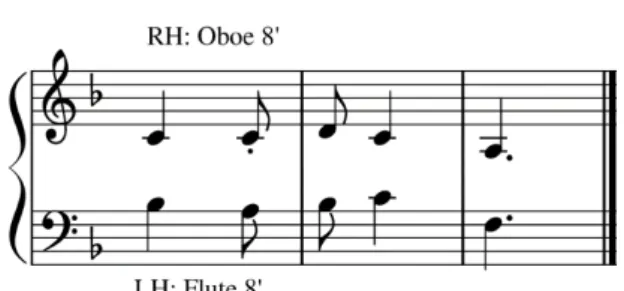
The students were given the learning strategies before seeing the original piece. The original piece was not provided in the first four sessions. Since the strategies were based on analytical/ structural aspects, we wanted to observe whether the instructions before seeing the original score would be perceived as an effective approach by the participants. One of the strategies, for example, is not found in organ methods: contrapuntal listening strategy (CARVALHO, 2016), where an inner voice is played by a loud stop (reed) on one manual, to emphasize the “inner” voice, and an outer voice is played with a soft flute stop on another manual. In the first cadence of the Prelude in F major (mm. 13-14), the two notes in the tenor (Example 1) have been divided between both hands (Example 2) for the strategy. It provides a way to “hear” the upper note of the two tenor notes (since the lower note is doubled by the pedal), so that, when played as written, one can focus on hearing the inner voice.
Example 1: mm. 12-14, original left hand (LH)
Example 2: mm. 12-14, LH divided among both hands
Student Instruction Protocol: The students did not have access to the learning goals, just the instructions (Table 1). They were filmed in each of the 10 weekly sessions. Video recording was used to reduce possible feelings of uneasiness and anxiety they might experience with the presence of the researcher. They were asked not to consult recordings or the score. In practice session 1, they received strategies 1-6, and in sessions 2-4, the remaining 11 strategies were applied (Table 1) with the instructions: “Practice each strategy according to instructions given.” A short interview was conducted after each practice session to verify how they evaluated the session.
In practice session 5 the students received the original score with the following instructions: “During the remaining sessions, continue to practice with the strategies, as well as practicing the entire prelude as you wish.” A short interview was conducted after each filmed session. In sessions 1-4, they were asked to record the strategies with no time limit imposed. In the remaining sessions (5-10), the entire prelude was filmed with no time limit for the session.
Strategy
Number Category Instructions Learning Goal
1,2,10,11 Harmonic Example Strat. 1:
“Play the chords with RH and the double notes with LH. Repeat several times.” (mm.5-11)
Learn the chords and the functions of a passage that has arpeggios in both hands. Memorize the chord progression. 3,4,5,7,12,13 Melodic Example Strat. 5 “Play the passage with the
given fingering. Repeat several times.” (mm.1-5)
Learn the melodic line with the correct fingering
6,8 Contrapuntal listening
Example Strat. 8: “Play hands on separate manuals. Use Flute stop (8’) for RH, Reed (Oboe or Trumpet) for LH. Repeat several times.” (mm. 12-14)
Focus on hearing the inner voice, in this case, the upper note of the 2 notes of tenor voice (Reed). 9,14,15,16, 17 Contrapuntal Example Strat. 17: “Play the pedal following the
pedal indications. Add LH. Play RH+Ped. Cadence. Play all parts. Repeat several times.” (mm. 41-44)
Listen to the pedal (the previous strategy approached hands only of this segment), add the hands one at a time. Hear the cadence. 14,15,16,17 Technical Example 14: “Play RH, then LH with the given
fingering. Both hands. Repeat several times.” (mm. 27-28)
Coordinate hands with the given fingering.
Table 1: Organ Learning Instruction protocol2 RH = Right Hand; LH = Left Hand
Semi-structured interview: the participants answered questions related to their experience in
using the proposed strategies at the end of each session, as well as about the efficacy of the learning strategies received and the difficulties encountered. The interview was based on the following questions: Which strategy did you find the most difficult? Did you enjoy using the strategies? Was the absence of the original score a problem [in the first four sessions]? After the last session, they were also asked: How do you think the strategies influenced your learning process?
Data collection and analysis: The interviews were transcribed literally and analyzed
thematically. The key outcomes were outlined considering the similarities and differences between the students’ comments.
RESULTS
Examination of the transcribed recorded interviews resulted in the categories of comments addressed below.
Sessions 1-4 (without score): Main findings
In sessions 1-4 the students practiced only the offered strategies and without the score. Although practice strategies are mainly related to general learning goals that are not necessarily related to specific musical pieces, the purpose of the study was to develop instructions that promote awareness and embody knowledge of the technical and compositional demands in advance, without any interference from possible mental representations of the whole piece. Thus, the practice directed towards these aspects could contribute to achieve a higher level of understanding and technical facility from the beginning of the learning process. Students A and B said the lack of the original score in the first four sessions did not make them uncomfortable. Student C, however, reported some difficulties:
Not seeing the original score was rather strange. It made me feel a little insecure not having the score at first, a little out of place, but, on the other hand, it made me less anxious at having to prepare an entire piece. (Student C) The difficulties the participant experienced may be due to the absence of an appropriate schemata against which to evaluate progress (HALLAM 1995, 1997). Although students A and B reported not being uncomfortable without the original in the first four sessions, some of their comments expressed a need for specific instructions. Metronome markings were requested by the Students A and B, and Student B used a strategy not included in the provided protocol, the use of rhythmic variants. Student A mentioned that the lack of tempo markings “made it difficult for me to know how fast I should play each exercise” (Sessions 1 and 2). Student B commented “I wanted to use a metronome but didn’t know how fast to set it” (Session 3). “Repetitious” and analytical strategies are defined in studies, the first being the repetition of larger parts of the piece increasing gradually, often using a metronome to assist in this process and the latter, including varying slurs, changing rhythms, creating further exercises, identifying difficulties, gaining an overview, monitoring and evaluation (HALLAM, 1995, 1997. ROWER; POLK, 2006). Although the use of rhythmic variants by Student B may be an analytical strategy as in Hallam (1995) and Rower
and Polk (2006), the lack of metronome indications was decisive for this student, suggesting that analytical strategies may also include the use of metronome.
Sessions 1-4: Reported difficulties with the protocol
In the third session, all three students reported having difficulty with the last strategy (a cadence point), because the pedal was added and there was contrary movement between the hands (hands-pedal coordination). Student A recognized the importance of this strategy in aiding this challenge. They all reported having difficulty when the pedal was added. Cadence points remained an issue for all three students during their initial learning process because of the coordination between hands and pedal, i.e., a motor difficulty. In session 6, Student A remarked that he “needed to practice LH + Pedal more”, while Student B reported still having problems at the cadence points. Student C said he “kept messing up at the cadences” and also said he needed to “work on the transitions from the sixteenth-notes to the triplets and vice-versa and the parts where the materials switch hands” as is the case at cadence points.
Sessions 1-4: Strategies considered effective in the protocol
Regarding specific strategies of the protocol, “hands separately” and “use of block chords” were appreciated by the students. Student C said, “I liked practicing hands separately; I don’t usually practice like that.” As do most organ methods, Davis (1985), in his introduction to studies for manual and pedal playing, advises students to practice the manual and pedal parts separately until each is familiar. In the same manner, Gleason and Crozier (1996: 291) suggest “Play the right hand and pedal; then left hand and pedal. Then play all parts together.” Although it was unexpected to realize that Student C did not practice hands separately on his own, as it is basic to most practicing strategies, his report suggests the learning instruction about how to practice with hands separately may have had a positive influence in his future practice behavior. Moreover, practicing in block chords in a homophonic manner, which in the original score appears as arpeggios, appealed to all three students. Student A commented: “I liked them [block chords] because they made me aware of the harmony in that section." Participant B remarked: “the chord functions in the chordal strategies were very helpful.” Student C said:
The strategies helped me understand the polyphony, melody, structure and harmonic progressions; however, if I had learned this prelude alone, I would not have studied the harmony, nor the polyphony. I wouldn’t have known how. (Student C)
The use of block chords derived from the arpeggiated motive was also used by advanced students in the case study by Nielsen (1999: 286), described as “to minimize patterns of movements to chords”. However, in our case, for beginning students, giving the chord names and functions presents a quick way for them to absorb aspects that may not be easy for them to grasp at first glance.
Sessions 1-4: Self-evaluation of strategies without score
Before receiving the score in their fifth session, the students were asked to evaluate the use of the strategies in their first 4 sessions. Student A said, “I liked all of the strategies; they all seem efficient and interesting. They made it easier to connect the parts [to the whole]." Student B remarked:
I had to add more fingerings because that’s a problem I have because I am pretty new to the keyboard. I wouldn’t have done such a good job with the fingering given! The strategies helped me because they pointed out the block chords and the sequences; the chord indications and functions in the chordal strategies were very helpful. I think I’ll practice with them [even with the original]; I need to practice at a slow tempo. (Student B) The fact that Student B said he “needed to practice at a slow tempo”, added to those aforementioned about the use of metronome, may show a strong need for tempo indications. Regarding strategies without the score, Student C said:
I noticed there weren’t any strategies for a few of the measures. It would be nice to have some for all of the piece…It was really good to practice with them because I wouldn’t have looked at the whole score like that… I recognized many things and parts. I could understand the piece better. It was much different from the way I would look at a score for the first time. (Student C)
Sessions 5-10 (with score): Main findings
Having practiced the main compositional and technical demands in the previous sessions before receiving the score, it was expected that participants would benefit from already having a mental picture (aural/physical image) of the specific compositional features. This, in turn, could contribute to improving the effectiveness in the first study sessions with the score. In session 5, their first with the score, Student A remarked: “It’s much easier now to combine all of the parts [of the piece].” Student B observed, “All of the strategies were great, an interesting experience and really good”, and Student C commented:
I recognized many things, many parts: I saw almost the entire score through the strategies, except for a few measures. It made me understand what was happening and it was easier than just picking up the score for the first time and looking at it. (Student C)
Several studies have highlighted the artistic conceptualizations by expert musicians of pieces to be studied (CHAFFIN; LEMIEUX, 2004). The awareness of “many parts” of the piece and understanding of “what is happening” reported by Student C resemble one of the main characteristics of effective practice (ARAÚJO, 2016). The use of reflexive/metacognitive strategies during practice is recognized through questions such as “in what way should I play this
passage?” or “what strategy should I use to tackle this musical task?” (NIELSEN, 2001). Apparently, the protocol may have anticipated the answers to these questions for this specific musical piece. Emergence of (some) metacognitive thinking was also a main finding. When facing difficulties, the participants developed their own strategies through metacognitive thinking. For instance, Student B mentioned trouble with practicing on a different organ:
I had some trouble because I practice on another organ with different stops [registration] and a different pedalboard. I make mistakes because I use the upper manual there [two-manuals]and here [on this 3-manual organ] I use the lower manual [to get the same sound]. I should practice on this organ. (Student B)
He also reported his posture as a problem:
I noticed a problem in my posture because I start falling forward on the bench. So, I sat a little farther back. I need to work on this. I can manage to play without looking at the pedalboard, but when I look at my hands, I fall forward. (Student B)
A possible strategy that emerges from the verbal responses of Student A and B’s practice includes imagining a pedalboard at home while playing on a digital keyboard. Student A said he even constructed a paper pedalboard approximately the same size as a real pedalboard. In the same way, Student A, aside from practicing LH + Pedal, said he would practice hands separately, then together, RH + Pedal, and all parts. Student B commented: “I need to practice slowly, not making any mistakes.” Student C said he would spend more time perfecting small sections.
Sessions 5-10: Self-evaluation of strategies with the score
In their final session with the score, each student recorded the entire prelude. Afterwards, the students were asked how effective the strategies had been during their learning process. Two main trends seem to stand out from the participants’ verbal reports. First, their understanding of “effective practice” seemed aligned, since the testimonies were about i) shorter practice time; ii) mental representation of the piece; iii) problem-based learning (technical problems):
If I had studied on my own, without the strategies, I would have taken much longer to learn it; ….the strategies;…I was able to overcome the technical difficulties. (Student A)
I understood the overall idea of the piece so I can now play it. It was more than a mere mechanical process of learning the notes and repeating things… I liked the fact that someone had elaborated them for me because if I had made them myself, I would have been limited musically… (Student B) I understood the piece right away; the strategies helped me feel less anxious about the learning process. They helped me understand the structure of the prelude. (...) They helped me learn the piece faster. (Student C)
Another emergent theme was the link between strategies and “secure playing” both in the learning process and in the recording of the final performance:
They [the strategies] made me more secure playing the complete prelude since I now understand it… They helped improve my final performance, making it more musical…I noticed that they increased in difficulty gradually. (Student A)
The strategies helped me feel less anxious about the learning process. (Student C)
Studies about practice strategies do not usually include feelings of anxiety and related consequential behaviors. Thus, the results suggest that beginning and inexperienced students may face uneasiness and anxiety during the initial learning process.
Opinions differed as to which aspects the strategies were efficient during their learning processes. While Students A and B considered that the strategies helped them in forming an overall idea of the piece and in improving the performance, Student C stated the opposite:
However, the strategies did not help me understand the macrostructure, which I came to understand only with the original score…They helped me learn the piece faster but did not help my final performance because they were technical strategies that I couldn’t remember while performing. (Student C)
The lack of understanding of the macrostructure reported by the student C can certainly be explained by his own comment in the first four study sessions:
[...] not seeing the original score was rather strange. It made me feel a little insecure not having the score at first, a little out of place, but, on the other hand, it made me less anxious at having to prepare an entire piece (Student C)
On the other hand, regarding the strategies not contributing to the student’s final performance, it is possible that this may be related to individual differences. Student C may possibly have considered the task of recording the performance in the last session too demanding. As he was not comfortable with his performance recorded on video, the comment may have served as a justification for a performance that he considered below what he acknowledges as an acceptable final performance. If this is the case, future applications of the protocol are likely to take this into account, communicating the purpose of the final recording more precisely to the participants.
DISCUSSION
The present study aimed to examine the relative effectiveness of a pedagogical intervention in the practice behavior (time spent practicing, effectiveness of the practice strategies) of three students from beginning agencies. Drawing on empirical studies and traditional organ methods,
Regarding the sessions without the score, some main trends arose. The difficulties the participants experienced may have been due to the absence of an appropriate schemata against which to evaluate progress (HALLAM, 1995, 1997). Without the score, the participants had not acquired an internalized representation of the sound of the music that they were trying to play, having nothing against which to assess whether they were making errors. Although Students A and B said they did not feel uncomfortable without the score in the first four sessions, the difficulties reported may be connected to its absence in the learning process. Apparently, it is possible that the lack of tempo indications, uncertainty regarding the use of metronome and some of the main difficulties could be attenuated through more detailed and refined instructions, perhaps including the learning goals addressed in Table 1 for the students. This is evident when the participant reports enjoyment in the use of block chords when he knows the goal in advance, i.e., the use of arpeggios in the original and the harmony as an important compositional feature.
As for the sessions with the score, although the responses to the questions assessing relative effectiveness of strategies were not very informative, the results suggest a common understanding of the effectiveness of strategies. All participants reported achieving the learning goals in less time than their usual approach, corroborating the definition of effective practice, whereby one achieves a desired end-product in as short a time as possible (HALLAM, 1997). Along with reduced practice time, the development of an overall artistic image of the piece to be learned was another trend in their comments, suggesting that the relative effectiveness of the protocol may also occur through the promotion of advanced/expert musical practice characteristics in students. These, in turn, may have contributed to fostering feelings of self-efficacy for music learning (RITCHIE; WILLIAMON, 2011), i.e., students’ beliefs in their capability to acquire the skills and knowledge needed to perform the practice strategies, as students A and C reported “secure playing” and feeling “less anxious about the learning process”, respectively.
The emergence of the term anxiety was not expected for the present study because anxiety is usually related to performance situations. Despite possible contributions of the protocol in promoting self-efficacy for music learning, it may be possible that the use of a camera and the relative short time to provide a recording of the piece may explain the feelings of anxiety during the research. In a substantial body of research discussing how to study efficiently and correctly, the subjective aspects of the student’s quality of experience during learning need further investigation. The relationship between states of anxiety and musical practice (instead of performance) could also become a relevant topic for future investigations (i.e., music practice anxiety).
In summary, interview data suggested that the strategies were perceived to be relevant by the participants. The students discussed their own ways of adapting to the protocol, commenting about their main difficulties and impressions regarding their use of the proposed organ learning strategies. This indicates that the protocol was successful in achieving its aim of helping beginning organ students, being prescriptive, but also flexible and adaptable, as sessions 5 to 10 were for practicing the strategies “as they wished.” It is possible that instructions regarding analytical aspects of the piece may contribute to their first four sessions without the original score. A set of strategies applied and modified prior to the whole piece may help students overcome difficulties or implement new strategies in their learning. However, it is prudent to be cautious here and to note that these students might be predisposed to accept the strategies because they are students of the same teacher.
DIRECTIONS FOR FUTURE RESEARCH
The 17 strategies applied to the Prelude in F major (BWV 556) with three organ students may need to be revised in relation to the sessions without a score. An analysis of the work introduced before the practice strategies can be tested in order to increase the effectiveness of the strategies. Organ methods comment on the organ as an instrument, its function, articulation, pedal technique, part-playing, accent, rhythm, registration, and color. They also include how to play with crossing hands and feet, finger substitution, ornaments, among other techniques (DICKINSON, 1922; GLEASON; CROZIER, 1996). Many of the methods demonstrate how to use ornaments, providing specific examples in the organ repertoire, however, most do not present an analysis of the music for the sake of practicing (WARD, 2007).
The use of strategies such as the ones proposed in this study seem to be relevant for beginning students without much access to an organ. Strategies similar to these should be tested and evaluated with a larger number of students. We do not, in any way, exclude the use of other strategies in effective teaching and practicing, such as imagery, use of recordings, etc., but music analysis may also become incorporated in several different ways – the use of learning strategies based on analytical aspects being one of them. Exploring analytical issues through performance may serve as a teaching resource (WARD, 2004).
Limitations in this study suggest opportunities and implications for further research. This study did not consider other variables that could influence the efficacy of the instructional protocol, such as alone practice time between weekly sessions, strategies considering expressive details of the piece such as articulation and registration, among others. However, the main innovation of this investigation was the inclusion of a protocol before the practice of a piece with the purpose of reinforcing the “difficult spots” beforehand with beginning organ students who could benefit from “how to practice” ideas in the initial learning stage of a new piece. More research is needed to verify if learning strategies such as the ones presented here will be adopted and incorporated by students in their regular individual practice. Strategies designed around distinct instrumental frameworks may be useful to help beginning students identify specific elements to improve in their practice. The findings of the current study suggest this is a possible avenue to pursue in future investigations. Teachers should encourage their students to write down and/or to verbalize their subjective feelings regarding the effectiveness of their learning approach. This may promote awareness of strategies that can be adopted to improve practice efficiency in students. A one-on-one lesson is a complex learning environment, but the present protocol may be adjusted to other specific learning environments. Researchers may investigate whether the present protocol can be applied to other learning contexts, i.e., different musical instruments, ensemble practice, rehearsal, pieces from other periods and different styles.
References
ARAÚJO, Marcos Vinícius. Measuring self-regulated practice behaviours in highly skilled musicians. Psychology of Music, v. 44, n. 2, p. 278-292, 2016.
ARNOLD, Corliss Richard. Organ literature: historical survey. Lanham, MD: Scarecrow Press, 2003. AUSTIN, James R.; BERG, Margaret Haefner. Exploring music practice among sixth-grade band
BARROS, Luís Cláudio. A pesquisa empírica sobre o planejamento da execução instrumental: uma reflexão crítica do sujeito de um estudo de caso. Tese (Doutorado em Música). Programa de Pós-Graduação em Música, Universidade Federal do Rio Grande do Sul, Porto Alegre, 2008. BARTOLOME, Sarah J. Naturally emerging self-regulated practice behaviors among highly successful beginning recorder students. Research Studies in Music Education, v. 31, n. 1, p. 37-51, 2009.
BULLARD, JoAnne Barbieri. Academic motivation, learning strategies, and sports anxiety of first-year student-athletes. Journal for the Study of Sports and Athletes in Education, v. 10, n. 2, p. 99-108, 2016.
CAPISTRAN, Raul. ¿Cómo enseñan nuestros maestros de instrumento musical? Situación de la enseñanza de estrategias de práctica efectiva en seis escuelas de música en México. Revista
Electrónica Complutense de Investigación en Educación Musical - RECIEM, v. 14, p. 213-237, 2017.
CARVALHO, Any Raquel. Learning strategies in organ practice: A preliminary investigation as a potential tool in the preparation of a contrapuntal work. Música em Perspectiva, Curitiba, vol. 8, no. 2, 2016. Available at: http://revistas.ufpr.br/musica/article/view/39864. Accessed on: Oct. 17, 2019. CARVALHO, Any Raquel; KERR, Dorotéa. Preliminary approach in the practice of an organ work by undergraduate students: An exploratory study. In: INTERNATIONAL SYMPOSIUM ON PERFORMANCE SCIENCE, 5, 2015, Kyoto, Japan. Abstracts of the International Symposium on
Performance Science 2015. Kyoto: Ryukoku University, 2015. p. 30.
CHAFFIN, Roger; LEMIEUX, A. F. General perspectives on achieving musical excellence. In: WILLIAMON, A. (ed.). Musical excellence: strategies and techniques to enhance performance. New York: Oxford University Press, 2004. p. 19-39.
CHRISTENSEN, Stephanie E. Practicing strategically: The difference between knowledge and action in two eighth-grade students’ independent instrumental practice. Update: Applications of
Research in Music Education, v. 29, n. 1, p. 22-32, 2010.
COLOMBO, Barbara; ANTONIETTI, Alessandro. The role of metacognitive strategies in learning music: A multiple case study. British Journal of Music Education, v. 34, n. 1, p. 95-113, 2017. DICKINSON, Clarence. The technique and art of organ playing. New York: The H. W. Gray Co., 1922. DUKE, Robert A.; SIMMONS, Amy L.; CASH, Carla Davis. It’s not how much, it’s how: characteristics of practice behavior and retention of performance skills. Journal of Research in Music Education, v. 56, n. 4, p. 310-321, 2009.
EDDY, Clarence. A method for pipe organ: a series of one hundred graded lessons in two volumes. v. 2. New York: J. Church, 1917.
GLEASON, Harold; CROZIER, Catharine. Method of organ playing. 8th ed. Upper Saddle River, N.J: Prentice Hall, 1996.
GRUSON, Linda. Rehearsal skill and musical competence: does practice make perfect? In: SLOBODA, J. (ed.). Generative processes in music: the psychology of performance, improvisation, and composition. Oxford, UK: Clarendon Press, 1988. p. 91-112.
HALLAM, Susan. The development of expertise in young musicians: strategy use, knowledge acquisition and individual diversity. Music Education Research, v. 3, n. 1, p. 7-23, 2001.
HALLAM, Susan et al. The development of practising strategies in young people. Psychology of
Music, v. 40, n. 5, p. 652-680, 2012.
HALLAM, Susan; JORGENSEN, Harald; LEHMANN, Andreas C. What do we know about practising? Toward a model synthesising the research literature. In: LEHMANN, A.; JORGENSEN, H.
Does practice make perfect? Current theory and research on instrumental music practice.
Oslo: Norges Musikkhøgskole, 1997. p. 179-231.
JØRGENSEN, Harald. Student learning in higher instrumental education: who is responsible?
British Journal of Music Education, v. 17, n. 1, p. 67-77, 2000.
JØRGENSEN, Harald. Strategies for individual practice. In: WILLIAMON, A. (ed.). Musical excellence: Strategies and techniques to enhance performance. Oxford: Oxford University Press, 2004. p. 85-104.
JØRGENSEN, Harald. Instrumental practice: Quality and quantity. Finnish Journal of Music
Education, v. 11, n. 1-2, p. 8-18, 2008.
JØRGENSEN, Harald; HALLAM, Susan. Practising. Oxford: Oxford University Press, 2012.
KNOWLES, Zoë; BORRIE, Andy; TELFER, Hamish. Towards the reflective sports coach: issues of context, education and application. Ergonomics, v. 48, n. 11-14, p. 1711-1720, 2005.
LEAVER, Betty Lou; EHRMAN, Madeline; SHEKHTMAN, Boris. Achieving success in second language
acquisition. Cambridge: Cambridge University Press, 2005.
LEON-GUERRERO, Amanda. Self-regulation strategies used by student musicians during music practice. Music Education Research, v. 10, n. 1, p. 91-106, 2008.
MCPHERSON, Gary E.; RENWICK, James M. Self-regulation and mastery of musical skills. In: SCHUNK, D. Handbook of self-regulation of learning and performance. New York: Routledge/ Taylor & Francis Group, 2011. p. 234-248.
MCPHERSON, Gary E.; ZIMMERMAN, Barry J. Self-Regulation of Musical Learning. In: COLWELL, R.; WEBSTER, P. (org.). MENC Handbook of Research on Music Learning. Oxford: Oxford University Press, 2011. p. 130-175.
MIKSZA, Peter. Effective practice: An investigation of observed practice behaviors, self-reported practice habits, and the performance achievement of high school wind players. Journal of
MIKSZA, Peter. A review of research on practicing: Summary and synthesis of the extant research with implications for a new theoretical orientation. Bulletin of the Council for Research
in Music Education, n. 190, p. 51-92, 2011.
MIKSZA, Peter. The effect of self-regulation instruction on the performance achievement, musical self-efficacy, and practicing of advanced wind players. Psychology of Music, v. 43, n. 2, p. 219-243, 2015.
NIELSEN, Siw. Self-regulating learning strategies in instrumental music practice. Music Education
Research, v. 3, n. 2, p. 155-167, 2001.
NIELSEN, Siw G. Learning strategies in instrumental music practice. British Journal of Music
Education, v. 16, n. 3, p. 275-291, 1999.
PETERS, Derek; JONES, Gareth; PETERS, John. Preferred ‘learning styles’ in students studying sports-related programmes in higher education in the United Kingdom. Studies in Higher
Education, v. 33, n. 2, p. 155-166, 2008.
RITCHIE, George; STAUFFER, George B. Organ technique: modern and early. New York: Oxford University Press, 2000.
RITCHIE, Laura; WILLIAMON, Aaron. Measuring distinct types of musical self-efficacy. Psychology
of Music, v. 39, n. 3, p. 328-344, 2011.
RIVEIRO, José Manuel Suárez. Optimistic and defensive-pessimist students: Differences in their academic motivation and learning strategies. The Spanish Journal of Psychology, v. 17, p. 1-8, May 2014.
SICCHIO, Kate. Teaching and Learning Strategies for Real-Time Video Projection in Dance Performance. Congress on research in Dance Conference Proceedings, v. 41, n.1, p. 143-150, 2009. STGEORGE, Jennifer Mary; HOLBROOK, Allyson Patricia; CANTWELL, Robert H. Learning patterns in music practice: links between disposition, practice strategies and outcomes. Music Education
Research, v. 14, n. 2, p. 243-263, 2012.
VARELA, Wynnpaul; ABRAMI, Philip C.; UPITIS, Rena. Self-regulation and music learning: A systematic review. Psychology of Music, v. 44, n. 1, p. 55-74, 2016.
WARD, Vicky. The performance teacher as music analyst: a case study. International Journal of
Music Education, v. 22, n. 3, p. 248-265, 2004.
WARD, Vicky. Teaching musical awareness: The development and application of a ‘toolkit’ of strategies for instrumental teachers. British Journal of Music Education, v. 24, n. 1, p. 21-36, 2007. ZHUKOV, Katie. Effective practising: A research perspective. Australian Journal of Music Education, v. 1, p. 3-12, 2009.
APPENDIX 1. ORGAN PRACTICE STRATEGIES
Strategy 1. Harmonic strategy (mm. 5-11)Play the chords in the RH. Play the notes in the LH. Play both hands. The names of the chords and their functions have been given. Repeat as many times as necessary.
Strategy 2. Harmonic strategy (mm. 5-11)
(a) Play the pedal notes with alternating toes; (b) Add the LH; (c) Play the pedal part with RH; (d) Play all parts. Repeat each part as necessary.
Strategy 3. Melodic strategy (mm. 5-11)
Play the triplets with RH. After repeating several times, return to Strategy 1 and play the RH chords.
Strategy 4. Melodic strategy (mm. 5-11)
Strategy 5. Melodic strategy (mm. 1-5)
Play the example with the indicated fingering. Repeat as many times as necessary.
Strategy 6. Contrapuntal listening strategy (mm. 12-14)
Play each voice separately. Now play each voice on a separate manual. Use a soft stop (Flute 8’) for the RH and a loud stop (Oboe, Trumpet or Principal 8’+4’) for the LH. Repeat as many times as necessary.
Strategy 7. Melodic strategy (mm. 52-58)
Play the example with RH as many times as necessary.
Strategy 8. Contrapuntal listening strategy (mm. 12-14)
Play each voice separately on a separate manual. Use a soft stop (Flute 8’) for the RH and a loud stop (Oboe, Trumpet or Principal 8’+4’) for the LH. Repeat as many times as necessary.
Strategy 9. Contrapuntal strategy (mm. 12-14) Play the passage with LH.
Strategy 10. Harmonic strategy (mm. 15-17; 19-21; 23-25; 29-31;35-41)
(a) Play the chords in the LH; Play the RH; (c) Play the first half of the example (mm. 1-9), repeat several times; (d) Play mm. 10-19, repeat several times. The names of the chords and their functions have been given.
Strategy 11. Harmonic strategy (mm. 35-41)
(a) Play the chords in the RH; (b) Play the LH; (c) Play the pedal part with alternating toes; (d) Paly all parts. Repeat each part as necessary.
Strategy 12. Melodic strategy (mm. 15-28) Play with RH. Repeat as necessary.
Strategy 13. Melodic strategy (mm. 15-17; 19-21; 23-25; 29-31)
Strategy 14. Contrapuntal and Technical strategy (mm. 27-28)
Cadence. (a) Play the RH; (b) Play the LH; (c) Play all parts. Use the fingering indicated.
Strategy 15. Contrapuntal and Technical strategy (mm. 33-34)
Strategy 16. Contrapuntal and Technical strategy (mm. 41-44)
Cadence. (a) Play the RH; (b) Play the LH; (c) Play all parts. Use the fingering indicated.
Strategy 17. Contrapuntal and Technical strategy (mm. 41-44)
Cadence. (a) Play the Pedal; (b) Play LH + Pedal; (c) Play RH; + Pedal; (d) Play all parts. Use the fingering indicated.
Any Raquel Carvalho is the first to hold a doctorate degree in organ performance in Brazil, receiving her master’s and doctorate degrees from the University of Georgia (USA) and a bachelor’s degree in organ and piano performance from the Federal University of Rio Grande do Sul-UFRGS in Porto Alegre. She is full professor and academic advisor in the Graduate Program in Music and the Department of Music of the Institute of Arts at UFRGS. As a resesarcher, she has published two books on counterpoint that are widely used in undergraduate music courses, various articles on Brazilian organ muisc and her current research involves practice strategies applied to keyboard instruments. Any Raquel performed several concerts in Brazil, Canada, USA and Germany, while regularly presenting papers in national and international congresses. She is founding member of the Brazilian Association of Organists and the Association of Organists of Rio Grande do Sul. [email protected]
Marcos Vinícius Araújo, PhD. Marcos Vinícius Araújo is currently an adjunct professor of music performance at the Federal University of Rio Grande do Sul (UFRGS), Institute of Arts, Music Department in Porto Alegre, Brazil. His primary research interest lies in the investigation of cognitive-psychological dimensions of musical expertise (e.g. practicing, expertise, performance preparation). He also conducts research on flow state in music, being a member of the European Flow Researchers Network. He has presented papers at national and international research conferences and has articles published in several prominent peer-reviewed journals and publishers, such as the Psychology of Music, International Journal of Music Education, Springer, and Música Hodie. Marcos’s teaching duties include undergraduate and graduate courses with emphases on classical guitar, foundations of guitar pedagogy and research methods. He is currently the coordinator of the extension program of the UFRGS music department. [email protected]
Luís Cláudio Barros is a Piano Professor in the Music Department at the State University of Santa Catarina (UDESC) in Florianópolis, Brazil. He holds a bachelor’s degree in piano from FAMES (Vitória, Brazil), a master’s degree in piano from Eastman School of Music under Nelita True (NY, USA) and a doctorate in piano from the Federal University of Rio Grande do Sul (UFRGS) in Porto Alegre (Brazil), the latter with residence at the Music Psychology Lab of the University of Connecticut (USA) under Dr. Roger Chaffin. He has published articles on piano pedagogy and performance planning, coordinates the project “Excellency in Piano” at UDESC, and has presented papers and lecture-recitals at international congresses in Brazil, Argentina, Portugal and USA. Luís Cláudio has won six first prizes in National Piano Competitions in Brazil. He performs as soloist and as part of the Castelan & Barros Piano Duo in Brazil and abroad. [email protected]
Yuri Miorelli Antunes dos Santos began his musical studies in Erechim, RS, (Brazil) where he accompanied the Youth Municipal Choir of Erechim, the University Choir of the Integrated Regional University (URI) and the Resonare Choir. He holds a bachelor’s degree (music education) in Music from the University of Passo Fundo and a bachelor’s degree in piano performance from the Federal University of Rio Grande do Sul-UFRGS. He studied with Dr. Ney Fialkow and Dr. Catarina Domenici. During this time, he was awarded a scientific initiation scholarship from CNPq/BIC/UFRGS to participate in the research project “Learning Strategies in Contrapuntal Organ Works” coordinated by Dr. Any Raquel Carvalho (UFRGS). Yuri also taught piano in the Extension Course during his undergraduate studies. He is currently teaching piano at a private music school in Porto Alegre. [email protected]