Vol.56, n.2: pp. 171-179, March-April 2013
ISSN 1516-8913 Printed in Brazil BRAZILIAN ARCHIVES OF
BIOLOGY AND TECHNOLOGY
A N I N T E R N A T I O N A L J O U R N A L
Bioethanol Production from Sweet Potato (Ipomoea batatas
L.) Flour using Co-Culture of Trichoderma sp. and
Saccharomyces cerevisiae in Solid-State Fermentation
Manas Ranjan Swain
1*, Jyoti Mishra
2and Hrudayanath Thatoi
11
Department of Biotechnology, College of Engineering and Technology, Biju Patnaik University of Technology, Bhubaneswar-751003, Orissa - India. 2Department of Biotechnology, North Orissa University, Baripada-757003, Orissa - India
ABSTRACT
The aim of this work was to study the optimiation of co-culturing of Trichoderma sp. and Saccharomyces cerevisiae
(1:4 ratio) on sweet potato (Ipomoea batatas L.) flour (SPF) for the production of bio-ethanol in solid-state fermentation (SSF). Maximum ethanol (172 g/kg substrate) was produced in a medium containing 80% moisture, ammonium sulphate 0.2%, pH 5.0, inoculuted with 10% inoculum size and fermented at 30ºC for 72h. .Concomitant with highest ethanol concentration, maximum ethanol productivity (2.8 g/kg substrate/h), microbial biomass
(23×108 CFU/ g substrate), ethanol yield (47 g/100g sugar consumed) and fermentation efficiency (72%) were also
obtained under these conditions. Cell interaction was observed familiar between the viable cells of Trichoderma sp. and S. cerevisiae when co-cultured. Ethanol production ability by the co-culture was 65 % higher than the single culture of S. cerevisiae from un-saccharified SPF.
Key words:Trichoderma sp., Saccharomyces cerevisiae, Sweet potato flour, Solid state fermentation
*Author for correspondence: [email protected]
INTRODUCTION
As demand for the limited global supply of non-renewable energy resources increases, the price of oil and natural gas keep increasing. A new biotechnological approach for the production of ethanol by fermentation from the renewable carbohydrate materials for use as an alternative liquid fuel has been attracting worldwide interest (Ward and Singh 2002). Thus, there is a growing interest to find alternative bioresources other than sugarcane/beet molassess and starchy crops such as cassava, sweet potato, and sweet sourghum for ethanol production.
Sweet potato (Ipomoea batatas L.) represents an important biomass resource for fuel alcohol
Swain, M. R. et al. 172
can be used by the microorganisms in fermentation process.
The production of industrial and fuel ethanol commonly involves three steps: 1) liquefaction of starch by α- amylase, 2) enzymatic
sachharification of liquefied product to produce glucose, and 3) fermentation of glucose to ethanol (Sree et al. 2004). Commercial glucoamylase is used for the saccharification and represents a significant expense in the production process (Neves et al. 2006). Traditionally, the yeast,
Saccharomyces cerevisiae has been used all over the world as the major ethanol producing microorganism (Lin and Shuzo 2006). Among the fermentation condition, SSF is found to more advanced and effective technology for the microbial production ethanol, using different substrates such as mahua flower (Mohanty et al. 2009), sweet sorghum (Kargi et al. 1985; Yu et al. 2008), apple pomace (Ngadi and Correia 1992), rice straw (Roslan et al. 2011), sugarcane bagasse (Shaibani et al. 2011) by S. cerevisiae. In recent years, however, research is focused on processes involving amylolytic mold Trichoderma sp. as coculture with S. cerevisiae, because of several better fermentation attributes as conversion of complex form of carbohydrates in to glucose and then conversion of glucose to ethanol and CO2
(Azevedo et al. 2000).
This study aimed at eliminating the enzymatic saccharification step by using a coculture of
Trichoderma sp. as an amylolytic mold along with
Saccharomyces cerevisiae (strain CET), an efficient and economical method for ethanol production (Manikandan and Viruthagiri 2009).
MATERIALS AND METHODS
Organisms
S. cerevisiae (strain CET) used in alcoholic fermentation factories was adopted as the experimental strain. Soil isolated Trichoderma sp. was a gift from Dr. R.C. Ray, Principal Scientist (Microbiology), Division of Post-harvest Technology, Central Tuber Crops Research Institute (Regional Centre). Bhubaneswar, India. Both the strains were maintained on the potato dextrose agar and stored at 4°C for further use.
Preparation of Starter Culture
S. cerevisiae was grown in 250 ml Erlenmeyer flasks containing 100ml sterilized yeast
extract-nutrient broth medium, (YENB) with sugar concentration of 12% (w/v) and the pH was adjusted to 5.5 by dilute HCl. The Trichoderma sp. was grown in 250 ml Erlenmeyer flasks containing 100ml sterilized Trichoderma specific medium (g/l: MgSO4 0.2, K2HPO4 0.9, KCl, 0.3; NH4NO3,
3.0; glucose, 3.0; chloromophenicol, 0.25; pentachloro nitrobenzene, 0.2; Rose Bengal, 1.5; Captan, 0.2; Metaloxyl, 1.6 and pH adjusted to 5.5) (Swain and Ray 2009). The cultures were grown at 30º C for 24h. Trichoderma sp. and S. cerevisiae cultures were used in 1:4 proportions as starter culture for ethanol production, respectively.
Substrate
Fresh sweet potato was collected from the local market of Bhubaneswar, Capital of Odisha, India during February-March, 2010. It was washed thoroughly to remove the dust and other debris, peeled off and chopped into small pieces. It was then placed in oven at 700C for 24 h till the moisture content reduced to 11-12 % and grinded with mixture grinder (Bajaj, Pvt. Ltd, India) with 200-250 rpm in to flour. The powder was sieved through a steel mesh to get 2-3mm diameter size of sweet potato flour. The sweet potato flour was stored in air tight container for further use.
Fermentation Medium
Fifty grams of sweet potato flour supplemented with 0.2 % NH4Cl was placed in 1000 ml Roux
bottles (132 mm × 275 mm) and moistened with appropriate amount of distilled water in order to contain 70% moisture. The pH of the substrate was adjusted to 6.0 with 1 N NaOH. The content was pressure-cooked at 120°C for 20 min and inoculated with Trichoderma spp. and yeast starter culture [10%, v/w (2 × 10⁹ Colony Forming Unit (CFU)/ ml) and 3 × 10⁹ CFU/ml], respectively at 1:4 ratio. The Roux bottles, in triplicate, were incubated at 30°C under stationary conditions for 120 h.
Study of Fermentation Parameters
(1) Moisture content: A series of Roux bottles containing 50 g SPF were moistened with an appropriate amount of distilled water in order to contain 40, 50, 60, 70, 80 and 90% moisture. The flasks, in triplicate, were inoculated and incubated at 30 °C for 72 h in a BOD incubator (Rami Pvt. Ltd, Mumbai, India).
were inoculated and incubated as mentioned above.
(3) Temperature: The medium (50 g SPF, moisture 70% and pH 6.0) was inoculated for 72 h and incubated at different temperatures (20 to 40 °C). (4) Nitrogen sources: The fermentation medium (50 g SPF, moisture 70% and pH 6.0) was supplemented with different nitrogen sources (Urea, Ammonium molybdate, Ammonium sulphate and Potassium nitrate) at 0.2% and incubated at 300Cfor 72h.
Analytical Techniques
At appropriate time intervals, fermentation bottles were removed and the contents were analyzed. The number of living cells was determined by plate counting S. cerevisiae that was cultivated on YENA medium at 30 °C for 24 h. The fermented mash in each Roux bottle was mixed with 150 ml distilled water (1:3, w/v) and the mixture was shaken on a rotary shaker (Remi Pvt. Ltd., Mumbai, India) at 250 rpm at 30 °C for 30 min in order to extract the ethanol and the whole mash was distilled to collect the ethanol (Swain et al. 2007 ). Ethanol concentration of the fermentation liquid was determined by measuring the specific gravity of the distillate according to Amerine and Ough (1984). The ethanol yield was expressed as g ethanol/ 100 g sugar consumed. Fermentation efficiency was calculated by dividing the sugar consumed during the fermentation by the initial sugars and multiplying the results by 100. The concentrations of the total sugar (glucose, fructose, sucrose and maltose) in the flour and in the fermentation broth were determined as glucose equivalent by Anthrone method (Mahadevan and Sridhar 1999). The other proximate compositions such as starch, crude protein, crude fiber and ash were estimated as per the standard AOAC procedure (1984). The pH was measured by a pH meter (Systronics, Ahmedabad, India) using glass electrode. Fermentation kinetics were studied as per the formulae given by Bailey and Ollis (1986).
Population Count
Yeast population in the fermented mash was calculated by serially diluting the sterile in the distilled water and plating the suitable dilutions (108–109) on YENA solidified medium on Petri plates (18 mm × 150 mm). Data were given as mean of six replicates. Similarly, the Trichoderma
sp. population was calculated on Trichoderma specific medium as mentioned above.
Determination of Moisture of the Substrate
The moisture content of the substrate was analyzed by a Mettler Lp16 Infra-Red analyser.
RESULTS AND DISCUSSION
The production of ethanol from sweet potato flour by co-culture of S. cerevisiae and Trichoderma sp. in SSF is shown in Figure 1. The concentration of ethanol increasedwith the increase of fermentation time and yeast biomass. The maximum ethanol (154 ± 4 g/kg substrate) concentration (95%) was obtained after 72 h of incubation. Apparently the residual sugar was not rapidly and consistently produced during the first 72 h, then it decreased slowly (Fig. 1). The residual sugar concentration behaviour was more or less constant along the fermentation. In a previous study, maximum ethanol concentration of 193 and 205 g/kg flowers were obtained when free and immobilized yeast cells were grown in mahula flower (mahula flower: water, 1:5, w/v), respectively after 96 h in submerged shake-flask fermentation (Swain et al. 2007). Hang et al. (1981, 1986) reported maximum ethanol concentration of 43 g/kg apple pomace and 53.5 g/kg grape pomace for various yeast strains grown in SSF, whereas Roukas (1994) found thatmaximum ethanol (160 ± 3 g/kg dry pods) was obtained when S. cerevisiae was grown on carob pods (Ceratonia siliqua) after 48 h of fermentation. Kiran Sree et al. (1999) reported highest ethanol concentration of 50 g/kg substrate (sweetsorghum and sweet potato) in SSF at 37 °C using a thermotolerant strain of S. cerevisiae. Up-scaling experiments using 1.0 kg cassava starch showed that Stargen (granular starch hydrolyzing enzyme mix with α-amylase and glucoamylase
activities) to starch ratio of 1:100 (w/w) could yield around 558 g ethanol/ kg starch, with a high fermentation efficiency of 98.4% (Shanavas et al. 2011). There were some possible reasons for these differences, including the strain of S. cerevisiae
Swain, M. R. et al. 174 0 30 60 90 120 150 180
24 48 72 96 120
Incubation period (hour)
E th a n o l c o n c e n tr a ti o n ( g /k g s u b s tr a te ) 0 30 60 90 120 150 180 R e s id u a l S u g a r (g /k g s u b s tr a te )
Ethanol concentration Residual Sugar
the inhibitory effect of ethanol on the cells (Ward et al. 2006; Ward and Singh, 2002). Further, the concentration of residual sugars decreased during the fermentation coinciding with an increase in biomass and ethanol production (Fig. 1). The concentration of residual sugars fell rapidly and consistently during the first 72 h of fermentation,
after which it decreased slowly. This was due to rapid increase in biomass and ethanol concentration, observed at the same time. At the time (72 h) when the maximum concentration of ethanol was achieved, 78% of sugar consumed was converted to ethanol.
Figure1 - Role of incubation period on ethanol concentration and sugar consumption by Trichoderma
sp. and Saccharomyces cerevisiae as co-culture in solid-state fermentation using sweet potato flour.
Effect of Moisture Content
Moisture content is one of the important factors that affect the performance of SSF. As shown in Figure 2, the ethanol concentration, ethanol productivity, ethanol yield and fermentation efficiency were increased significantly with the increase in moisture content. The highest value of fermentation parameters were achieved at a moisture level of 80%. Roukas (1994) reported a moisture level of 70% was the best to achieve ethanol concentration (160 ± 3 g/kg) from carob pod in SSF. Similarly, Kargi et al. (1985) and Ngadi and Correia (1992) reported that the maximum ethanol production was obtained from sweet sorghum and apple pomace in SSF at a moisture level of 70 and 85%, respectively. Decreasing the moisture level from 80 to 40% resulted in a decrease in all kinetic parameters (ethanol concentration, ethanol productivity, ethanol yield and fermentation efficiency). This was because an optimum moisture level (80% in the present study) was essential for sustaining the optimum growth of microorganisms and thereby ethanol production. The decrease in the moisture level is to a certain extent advantageous since the
chance of contamination of fermentation is reduced. However, there is a lower limit of moisture content below which microbial cells may not function to produce ethanol (Alan Eddy and Barnett 2007). Likewise, above 70% moisture content in SSF, there was a decrease in ethanol accumulation. This might be due to decrease in the porosity, lower oxygen transfer and poor aeration inside the substrate mass under the stationary fermentation condition (Ray et al. 2008).
Effect of Initial pH
0 40 80 120 160 200
50 60 70 80 90
Moisture holding capacity (%)
E th a n o l c o n c e n tr a ti o n ( g /k g s u b s tr a te ) 0 40 80 120 F e rm n e ta ti o n E ff ic ie n c y ( % )
Ethanol concentration Fermentation Efficiency
0 40 80 120 160
3 4 5 6 7
Medium pH E th a n o l c o n c e n tr a ti o n ( g /k g s u b a tr a te ) 0 20 40 60 80 100 F e rm e n ta ti o n e ff ic ie n c y ( % )
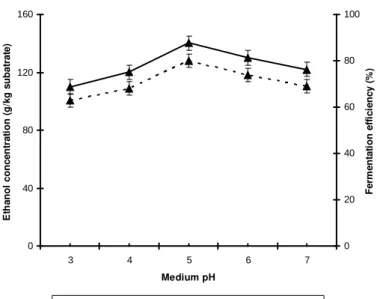
Ethanol concentration Fermentation efficiency grown at pH 5.0. Roukas (1994) studied the effect
of pH on ethanol production from carob pod by S. cerevisiae and found that the maximum ethanol concentration, ethanol yield, and fermentation
efficiency were obtained at pH 4.5. Yeasts have a pH optimum between 4.0 and 6.0, and can grow in a large pH range of 2.5 to 8.5 (Narendranath and Power 2005).
Figure 2 - Effect of moisture content (%) on ethanol concentration and ethanol fermentation efficiency by Trichoderma sp. and Saccharomyces cerevisiae as co-culturein solid-state fermentation of sweet potato flour.
Figure 3 - Effect of initial pH on ethanol concentration and ethanol fermentation efficiency by
Trichoderma sp. and Saccharomyces cerevisiae as co-culture in solid-state fermentation of sweet potato flour
Effect of Temperature
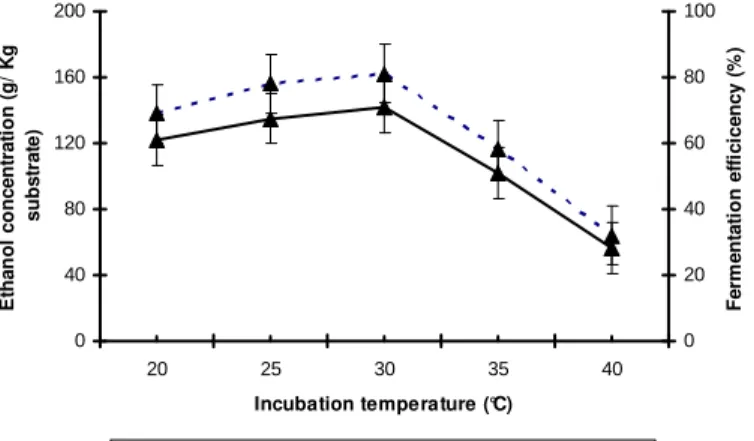
As shown in Figure 4, increasing the fermentation temperature from 20 to 40 °C significantly
Swain, M. R. et al. 176
lower or higher than 25 to 30 °C. The ethanol concentration, ethanol productivity and fermentation efficiency increased with the increase in fermentation temperature from 20 to 30 °C and decreased gradually between 30 and 35 °C and drastically above 35 °C. This was probably due to the decrease in viable cell number above 30 °C.
Temperature in the range of 25 to 30 °C is commonly found optimum for mesophillic S. cerevisiae strain for the production of ethanol in SSF of various substrates, i.e., apple pomace (Hang et al. 1986), carob pod (Roukas 1994), sweet sorghum (Mamma et al. 1996), etc.
Figure 4 - Effect of initial incubation temperature (°C) on ethanol concentration and ethanol fermentation efficiency by Trichoderma sp. and Saccharomyces cerevisiae as co-culture in solid-state fermentation of sweet potato flour.
Effect of Different Nitrogen Sources
Microorganisms utilize nitrogen to metabolize the nitrogenous substances for their growth and activity (Beltran et al. 2007). From Figure 5, it could be concluded that maximum ethanol production was obtained at 0.2% ammonium sulphate (172 g/kg substrate), followed by potassium nitrate. The ethanol production was drastically reduced when urea and ammonium molybdate were taken as the sole nitrogen sources in the fermentation medium. This could be due to the inhibitory activity of the nitrogen sources. Benerji et al. (2010) reported higher ethanol production (13.29%, w/v) in the presence of urea (0.06 %) from mahula flower by using S. cerevisiae. In another study, Laopaiboon et al. (2009) reported higher ethanol production (120.68 ± 0.54 g/ l) in the presence of peptone (5g/l) and yeast extract (3g/l) in sweet sorghum juice. Ammonium sulphate along with vitamins and trace elements increase ethanol productivity up to 57% (Guebel et al. 1992).
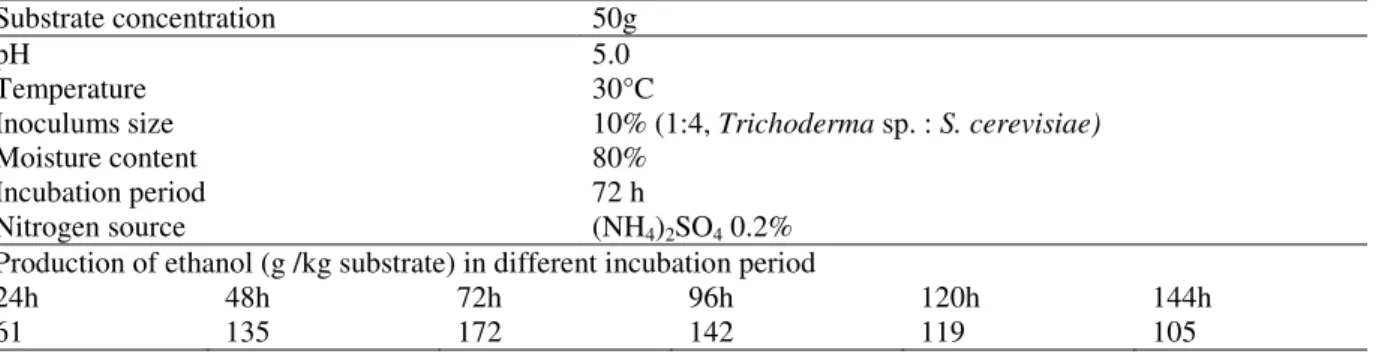
Finally, all the optimized parameters (pH, 5.0; temperature, 30° C; initial moisture content 80%, incubation period, 72h, (NH4)2SO4, 0.2%;
inoculums size, 10%) were taken together for the production of ethanol. As evident from Table 1, the ethanol concentration gradually increased up to 72h (172 g/kg substrate) and decreased gradually thereafter. Maximum ethanol productivity (2.8 g/kg substrate/h), microbial biomass (23×108 CFU/ g substrate), ethanol yield (47 g/100g sugar consumed) and fermentation efficiency (72%) were also obtained at these parametric levels. The average production (m ton/ha) of different bioethanol crops under irrigated condition in India are as follows: sugarcane (8–12), sweet sorghum (2–3), cassava (12–18), and sweet potato (8–10) (Swain et al. 2007; Ward et al. 2006). The sweet potato occupies 24 % among the most suitable substrate for the bioethanol production. The cost (US$1 = INR 44.8 basis) of ethanol production/kg substrate has been estimated for sugar cane (0.27), sweet sorghum (0.29), cassava (0.55) and sweet potato (0.31). In India, total production of sweet potato in the year 2006 was 1, 23,000 m tones (Ward et al. 2006). The sweet potato could serve potential feedstock for bioethanol in tropical countries such as India, Pakistan, Indonesia and Australian continent (Kar et al. 2004).
0 40 80 120 160 200
20 25 30 35 40
Incubation temperature (°C)
E th a n o l c o n c e n tr a ti o n ( g / K g s u b s tr a te ) 0 20 40 60 80 100 F e rm e n ta ti o n e ff ic ic e n c y ( % )
Figure 5 - Effect of nitrogen source (0. 2%) on ethanol concentration by Trichoderma sp. and
Saccharomyces cerevisiae as co-culture in solid-state fermentation of sweet potato flour.
Table 1 - Production of Ethanol concentration with optimal conditions evaluated for the Trichoderma sp. and
Saccharomyces cerevisiae as co-culture.
Substrate concentration 50g
pH 5.0
Temperature 30°C
Inoculums size 10% (1:4, Trichoderma sp. : S. cerevisiae)
Moisture content 80%
Incubation period 72 h
Nitrogen source (NH4)2SO4 0.2%
Production of ethanol (g /kg substrate) in different incubation period
24h 48h 72h 96h 120h 144h
61 135 172 142 119 105
CONCLUSION
Sweet potato flour is available in plenty in the Asia-Pacific regions, including in Orissa (India) but it’s commercial potential for fuel ethanol has not been fully explored. Being a cheap source of fermentable carbohydrate bio-resource, it could be employed for the production of fuel ethanol. In the present investigation, maximum ethanol production from sweet potato flour in SSF was obtained at 72h in co-culture fermentation. Ethanol production ability by the co-culture (S. cerevisiae
and Trichoderma sp.) was 65 % higher than the single culture of S. cerevisiae from un-saccharified sweet potato flour whereas ethanol concentration was almost same in single (S. cerevisiae) culture fermentation from the enzyme saccharified sweet potato flour. This saved considerable time and energy besides ease in operation and recovery process that would be advantageous for overall SSF. However, further studies would be needed to
standardised the protocols and economize the fuel ethanol production from sweet potato in comparison to other substrates such as sugarcane/beet molasses.
ACKNOWLEDGMENTS
The Department of Science and Technology-Govt. of Orissa is gratefully acknowledged for its financial support of this project (Project no.3897/ST, Bhubaneswar dated 07/08/10).
REFERENCES
Alan Eddy A, Barnett JA. A history of research on yeast 11. The study of salt tolerant: the first 90 years, simple and fascinated diffusion. Yeast. 2007; 24: 1023 - 1092.
Swain, M. R. et al. 178
Attaluri S, Janardhan KV, Light A. Sustainable sweet potato production and utilization in Orissa, India. Proceedings of a workshop and training held in Bhubaneswar, Orissa, India, 17-18 Mar 2010. Bhubaneswar, India. International Potato Center (CIP); 2010.
Azevedo AMC, Marco JLD, Felix CR. Characterization of an amylase produced by a Trichoderma harzianum
isolate with antagonistic activity against Crinipellis perniciosa, the caysual agent of witch’ broom of cocoa. Fems Microbial Lett. 2000; 188: 171-175. Bailey JE, Ollis DF. Biochemical engineering
fundamentals. New York: McGraw- Hill, 1986. Beltrn G, Rozas N, Mas A, Guillamom J. Effect of low
temperature fermentation on yeast nitrogen metabolism. World J Microbiol Biotechnol. 2007; 23: 809 - 815.
Benerji DSN, Rajini K, Srinivasa Rao B, Banerjee DRN, Swaroopa Rani K, Rajkumar G, Ayyanna C. Studies on physico-chemical and nutritional parameters for the production of ethanol from mahua flower (Madhuca indica L.) using Saccharomyces cerevisiae - 3090 through submerged fermentation (smf).J Microbial Biochem Technol.2010; 2: 46-50. Chen HZ, Xu J, Li ZH. Temperature cycling to
improve the ethanol production with solid-state simultaneous saccharification and fermentation. Appl
Biochem Microbiol. 2007;43: 57–60.
Guebel DV, Cordenons A, Cascone O, Giulietti, AM, Nudel C. (Influence of the nitrogen source on growth and ethanol production by Pichia stipitis NRRL, Y-7124. Biotechnol Lett. 1992; 14: 1193-1198.
Hang YD, Lee CY, Woodams EE. A solid-state fermentation system for production of ethanol from apple pomace. J Food Sci .1981; 47: 1851–1852. Hang YD, Lee CY, Woodams EE. Solid-state
fermentation of grape pomace for ethanol production.
Biotechnol Lett.1986;8: 53–56.
Henk LL, Linden JC. Solid state production of ethanol from sorghum. Appl Biochem Biotechnol. 1996; 54: 489-501.
Kar S, Chaudhury P, Ray RC. Comparative study of bioethanol production from sweet potato (Ipomoea batatas L.) and cassava (Manihot esculenta Crantz.) by acid enzyme hydrolysis. In: Root and tuber crops: nutrition, food security and sustainable environment, Proceeding of the symposium held on 29–31 October, 2004 at Regional Centre of Central Tuber Crops Research Institute. Bhubaneswar (India); 2004. p. 276–281.
Kargi F, Cureme JA, Sheehan JJ. Solid-state fermentation of sweet sorgum to ethanol. Biotechnol Bioeng. 1985; 27: 34–40.
Kiran Sree N, Sridhar M, Rao LV, Pandey A. Ethanol production in solid substrate fermentation using a thermotolerant yeast. Process Biochem. 1999; 34: 115–119.
Laopaiboon L, Nunpeng S, Srinophakun P, Klanrit P, Laopaiboon P. Ethanol production from sweet sorghum juice using very high gravity technology: Effects of carbon and nitrogen supplementations.
Bioresource Technol. 2009; 18: 4176- 4182.
Lin Y, Tanaka S. Ethanol fermentation from biomass resources: current state and prospects. Appl Microbiol Biotechnol. 2006; 69: 627-642,
Mahadevan A, Sridhar R. Methods in physiological plant pathology. 5th ed. Sivakami Publication, Madras (India), 1999.
Mamma D, Koullas D, Fountoukidis G, Kekos BJ, Koukios E. Bioethanol from sweet sorghum: simultaneous Saccharification and fermentation of carbohydrates by a mixed microbial culture. Process
Biochem. 1996; 31: 377–381.
Manikandan K, Viruthagiri T. Simulteneous saccharification and fermentation of wheat bran flour into ethanol using coculture of amylotic Asperigillus niger and thermotolerant Kluyveromyces marxianus.
Front Chem Eng Chin. 2009; 3: 240-249
Mohanty SK, Behera S, Swain MR, Ray RC. Bioethanol production from Mahula (Madhuca latifolia L.) flowers by solid-state fermentation. Appl Energy. 2009;86: 640-644.
Narendranath NV, Power R. Relationship between pH and medium dissolved solids in term of growth and metabolism of lactobacilli and Saccharomyces cerevisiae during ethanol production. Appl Environ. Microbiol. 2005;l71: 2239–2243.
Neves MAD, Kimura Shimizu N. Production of alcohol by simultaneous saccharification and fermentation of low grade wheat flour. Braz. Arch. Biol. Technol. 2006;49: 489-490.
Ngadi MO, Correia LR. Solid-state ethanol fermentation of apple pomace as affected by moisture and bioreactor mixture speed. J. Food Sci. 1992; 57: 667–670.
Ray RC, Sahoo AK, Asano K, Tomita F. Microbial processing of agricultural residues for production of food feed and food, additives. In-Microbial biotechnology in agriculture and aquaculture, ed.
R.C. Ray, Enfield New Hampshire: Science Publishers. vol. 2. 2008. p. 551–562.
Roukas T. Solid-state fermentation of carob pods for ethanol production. Appl. Microbiol. Biotechnol. 1994; 41: 296–301.
Roslan AM, Yee PL, Shah UKM, Aziz SA, Hassan MA. Production of bioethanol from rice straw using cellulase by local Aspergillus sp. Int. J. Agri. Res. 2011;6:188-193.
Shanavas S, Padmaja G, Moorthy SN, Sajeev MS, Sheriff JT. Process optimization for bioethanol production from cassava starch using novel eco-friendly enzymes. Biomass Bioenerg. 2011; 35: 901-909.
Sree NK, Sridhar M, Suresh K, Bannat IM, Rao LV. High alcohol production by repeated batch fermentation using an immobilized osmotolerant
Saccharomyces cerevisiae. J. Ind. Microbiol. 2004; 24: 222-226
Swain MR, Kar S, Sahoo AK, Ray RC. Ethanol fermentation of mahula (Madhuca latifolia L.) flowers using free and immobilized yeast
Saccharomyces cerevisiae. Microbiol. Res. 2007;
162: 93–98.
Swain, M.R. and Ray, R. C. Biocontrol and other beneficial activities of Bacillus subtilis isolated from owdung microflora. Microbiol. Res. 2009; 164: 121-130.
Tian SJ, Rickard JE, Blanshard JMV. Physicochemical properties of sweet potato starch. J. Sci. Food Agri.
1991;57: 459 – 491.
Ward OP, Singh A. Bioethanol technology: developments and perspectives. Adv. Appl. Microbiol.
2002; 51: 53–80.
Ward OP, Singh A, Ray RC. Production of renewable energy from agricultural and horticultural substrates and wastes. In: Ray RC, Ward OP, editors. Microbial biotechnology in horticulture. Enfield New Hampshire: Science Publishers; 2006, vol.1. p. 517– 558.
Woolfe JA. "Sweetpotato: an untapped food resource", Cambridge Univ. Press and the International Potato Center (CIP). Cambridge, UK, 1992.
Yu J, Zhang X, Tan T. Ethanol production by solid state fermentation of sweet sorghum using thermotolerant yeast strain. Fuel Processing Technol. 2008; 89:
1056–1059.