Dr Igea Troiani 1; Dr Tonia Carless 2
1 B.App.Sc., B.Arch. (Hons), PhD, Registered Architect ARB (Aust) Senior Lecturer, School of Architecture, Design and Environment 2 PhD, Dip Arch, BA (Hons)
Senior Lecturer, School of Architecture, Design and Environment
Architectural Design Research through Cinematic Collage
Abstract
This essay argues that cinematic representation can, and must, be understood as a method of developing a form of critical architectural enquiry and thinking in the same manner as text - a textual analysis and a communication means for practice-based research. The proposition is that cinematic architectural drawing and the discourse of occupied space are inseparable and that the limits of both are products of specific ideological and cultural practices. In this essay, two different bodies of iterative cinematic collage research practice are considered. Both sets of representations present new rigorously created architectural design knowledge and refer to the contention by Claude Lévis-Strauss (1966/1962:16-17) that the practice of the bricoleur, understood here as architect-bricoleur, is in marked contrast to the measurable output of the scientist, or architectural design scientist.
The Bricoleur and Animated Architectural Representation
In “The Science of the Concrete” in La Pensée Sauvage Claude Lévis-Strauss (1966/1962: 9) proposes that scientific practice, while tolerant of “uncertainty and frustration”, “must never tolerate […] disorder. The whole aim of theoretical science is to carry to the highest possible and conscious degree the perceptual reduction of chaos […].” This, for Lévis-Strauss (1966/1962: 16-17), puts the scientist in sharp contrast to the bricoleur - “someone who works with his[/her] hands and uses devious means compared with those of a craftsman”. The bricoleur is multi-talented, multi-disciplinary, “adept at performing a large number of diverse tasks; but, unlike the engineer, he [or she] does not subordinate each of them to the availability of raw materials and tools conceived and procured for the purpose of the project” (Lévis-Strauss, 1966/1962: 17). The bricoleur, understood here as the creative practitioner, does not define their means through the limitations of either their tools or the final project. According to Lévis-Strauss (1966/1962: 21), the bricoleur “’speaks’ not only with things […] but also through the medium of things”. There is a clear link between intellectual and mythical thought and its relationship to the practice of the bricoleur such that for Lévis-Strauss (1966/1962: 30) collage is “the transposition of bricolage into the realms of contemplation”. Through the practice of bricolage and collage new knowledge can emerge, knowledge premised on embracing a ‘disorderly’, open and creative research practice.
In this paper, we propose a new kind of Lévis-Straussian architectural researcher imaged as an architect-bricoleur. Operating in a combined disciplined-‘undisciplined’ manner (Marshall & Bleecker in Rodgers & Smyth eds. 2010: 218), the architectural design research presented here uses contemporary available materials and tools so as undertake architectural design research from a qualitative rather than quantitative approach. In Digital Blur: Creative Practice at the Boundaries of Architecture, Design and Art, Paul Rodgers and Michael Smyth (2010) argue that because of the rapid changes in digital technology the very nature of design is transforming as is the methods by which design through new technology can emerge.
The introduction of, and easy access to, computational tools and software has allowed architects to feverishly absorb digital drawing into their disciplinary practice, not only in the production of orthographic drawings, perspectives or shop drawings but also in video animation used typically for communication and selling design. Because practitioners are busy simply practicing they are not always critical of how the tools and techniques they employ can be used beyond pragmatically (AUTHOR A and Ewing, 2014). Architectural commentators are more reflective of the role that
animation and filmmaking can play in architectural design and research. In “Towards an Animated Architecture against Architectural Animation,” Neil Spiller (2001: 85) challenges architecture students, their tutors and practitioners to rethink how they use animation software and writes; “my problem with architectural animations […] is the fact that they often divert their creator from their primary task of creating architectural space”. In “Formalizing Architectural Practice: The Eclipse of Technique,” Amy Kulper (2011: 201) argues that, “Architecture is following a path similar to filmmaking”. Kulper (2011: 201) claims that architects like filmmakers, through experimenting with “digital cameras, advanced CGI, and now next generation 3D has led to an over saturation of technology-based films” rather than films that create “meaningful cultural shift[s]” and laments “a time in American filmmaking when filmmakers experimented with “what film can do” through a cultural lens rather than a technological one”. With consensus brewing over the inadequacies of a purely digital drawn, technologically-driven mode of architectural design because it can lead to negligence in the creation of space or meaningful architecture and because we want to explore video beyond qualitative research (Suchman and Trigg in Greenbaum and Kyng eds.), how might animation be reconsidered, redefined and practiced differently and for what other ends beyond those of visual representation (Alexander, 2008) or the “use of film as part of the design process” (Clear, 2005: 105)?
This essay argues that cinematic representation – a phrase we prefer to use that encapsulates animation, video, filmmaking and moving image drawing – and more specifically, cinematic collage, can, and must also be understood as a method of developing a form of critical architectural enquiry and thinking in the same manner as text – a textual analysis. The proposition, only made possible if we reconsider cinematic collage as practice-based research, is that cinematic architectural drawing and the discourse of occupied space are inseparable and that the limits of both are products of specific ideological and cultural practices. The cinematic collage is a site of intellectual investigation and when combined with other more conventional methods of textual written research can provide an innovative platform upon which to create new knowledge in architectural design research. It is the fact that architecture is defined by actions and events that makes cinematic collage a mode of communication potentially rich for a practice-based research. Cinematic discourse analysis questions the culture of architectural research in relation to the functions and knowledge of conventional architectural representations. In order to do this the epistemology of architectural research culture must be redefined so that “the persistent uncertainty about the role of creative practice in relation to the requirement for making a contribution to knowledge within research” (Niedderer and
Roworth-Stokes, 2007: 1) is taken into consideration. We propose achieving this by referring to Lévis-Strauss’s contemplations on the practice of the bricoleur versus the engineer-scientist.
Unlike other arts practitioners such as painters whose site of production is the final artwork itself, architecture is characterized by a distance between drawing and building because “architects do not make buildings, they make drawings of buildings” (Evans in Blau and Kaufman eds, 1989: 369). For the scientist, like the painter, the site of practice-based scientific research is also the final product i.e. for the scientist, the scientific experiment. In the case of architecture, Stan Allen (2009: xvii), citing Evans, argues that the practice of architecture, architectural drawing and research, is therefore “marked by this promiscuous mix of the real and the abstract”, a design research space hovering between fact and fiction. Since orthographic architectural drawings, perspectives and axonometric drawings (even drawn on the computer) are not animate, it is assumed that animated architectural drawings or cinematic representations will be a closer bridge to real built architectural space, depending on the expertise of the architectural designer-draftsperson. The point made here is not about the use of cinematic drawing to establish a realistic representation or method of design of space but rather that because the nature of all architectural drawings are fictional, that a space of creative research opportunity exists between drawing and building. In the case of cinematic collage that in-between zone of possibility is not solely dimensional, material or compositional but also a space of critical audio-visual and spatial research enquiry.
Two modes of iterative cinematic architectural research collage are considered here to show how cinematic drawing is a method of critical textual analysis. One, “Oshii’s House” uses video as a way to critique conventional filmmaking narrative practice and adopts a cut and paste strategy of found movie footage, perspectival set design, storyboarding and phenomenology as architectural design generators of everyday events in a house in Hong Kong. Its research project is to explore the reality and spiritual spatial experience in a movie screen centred and robotically mechanized future world. The other, ‘Kidlington Pageant’ uses video of historical and site analytical footage within which to create zoological pageant architecture in suburbia. Its research project is a critical commentary of British suburbia. Both sets of research-led design representations examine the space of practice between architect-bricoleur and filmmaker thereby arguing that by positioning their projects as a bricolage of found and new anime/sci-fi film/documentary/art house/architecture-filmmaking the conventional architectural design research process is radically challenged. In order to do this, and inspired by the films each studies, both sets of research-led design
representations employ fictional narrative as a method of critical architectural analysis where written prose and visual images are treated equally as text, used to frame each respective argument through film. The original contribution of these cinematic architectural representations is that they present the scientific and architectural community with new knowledge through the moving collage drawing process enabled through an interdisciplinary “third space in which to interact without hierarchy, a space or position outside both, a place that doesn't’ yet exist” (Grosz, 2001: xv).
That analysis of spatial discourse is made possible through “institutional interdisciplinarity in theory and practice” (Kristeva in Coles and Defert). What is original about the two modes of iterative cinematic architectural research is their transformational experience of interdisciplinary work produces a potentially destabilizing engagement with dominant architectural drawing epistemology allowing the emergence of new and often uncertain forms of knowledge.1 In terms of the two works discussed here, AUTHOR A supervised Kealty’s led design project, ‘Oshii’s House’ and AUTHOR B supervised Preece’s research-led design project, ‘Kidlington Pageant’. Both projects set out to examine how reality, unreality, historical memory and escapism from reality can be merged through architectural design research.
Research on Merging Realities
Merging Realities: Filmmaking as Architectural Design is a research project that aims “to investigate architectural practice from the viewport of the film director, and how this changes the perceptions of spatial inhabitation” (Kealty, 2012: 4). Kealty researches spatial ‘experience’ and action architecture by studying what constitutes a
1 The opportunity to experiment is made possible through the structure of a pedagogically challenging mode of teaching called Research-led Design, a post-graduate design studio where students of architecture have the unique opportunity to undertake an original and self-determined research-led design project into any aspect of architecture or the built environment that they see as critical to their understanding of the subject and/or for their future direction as a practicing architect or other kind of design practitioner. They develop textual academic research presented in the form of a written dissertation to define a topic and design research question and develop practice-based research methods so as to execute their research and produce a design of a medium to large-scale architectural design project. The range of subject areas and the methods of investigation are deliberately left open although students are encouraged to use conventional research and architectural design methodologies and/ or unconventional, interdisciplinary research methods.
sense of reality and how the user’s reality can be manipulated in the physical built world. In order to do this he researches cinematic architectural non-reality, inspired by the speculative future world vision found in science fiction films. A growing field of inspiration for architectural theorists and designers, Kealty research of architectural writings on science fiction (Fontin, 2011) looks specifically at how science fiction has affected the nature of the home, corrupting its purpose in a technological society. Philosophical theory on the semiotic nature of reality found in Jean Baudrillard’s (1985) analysis of ‘the virtual’ in Simulacra and Simulation and the concept of ‘hyperreality’ in a visual consumer driven society informs Kealty’s knowledge of the ‘hyper real’ experience of home and is later used to develop ‘Oshii’s Home’ as a research-led design project.
The Architecture of Image: Existential Space in Cinema (Pallasmaa, 2007) intersects a study of phenomenological experience and cinema and bridges Kealty’s study of Western and Eastern moviemakers. In order to explore the relationship between reality and identity, the cinema of Russian director, Andrei Tarkovsky (1972, 1979, 1983) is researched in-depth. Tarkovsky’s films deal with issues of identity and belonging. In Sculpting in Time Tarkovsky (1989) likens his method of filmmaking to the nature of haiku, a form of Japanese poetry. “Haiku’s creation stems from the philosophy of Shinto and the concept of ‘satori’ [… or] enlightenment” (Kealty, 2012: 9). Tarkovsky’s films are a profound mix of the director’s own, and protagonist character/s, search for ‘satori’ expressed through moody, cinematic interior and exterior atmospheres.
The presence of ‘satori’ in Japanese filmmaking and its associated cultural and spiritual practices are fundamental to the research. The studies on Bushido by samurai, Yamomoto Tsunetomo (1979), particularly Hagakure and Oscar Ratti and Adele Westbrook’s (1970) on the martial arts practices and teachings of Japanese aikido instructor, Yasuo Ohara provide a cross-cultural foundation to challenge the notion of architectural design so as to create spaces of peace to find harmony with one’s body and mind.
Mamoru Oshiii’s 1995 Japanese science-fiction cyberpunk film, Ghost in the Shell – which examines philosophical concepts of identity told through an existential architectural narrative – and sequel film, Ghost in the Shell: Innocence (Oshii, 2004) – which focuses on the ambiguous nature of identity in a complex technological world – question how humanity is represented in the bodily form. Used as a case study, Ghost in the Shell (Oshii, 1995) explores metaphysical concepts of identity – gendered, sexual and self-identity - through anime film. What Kealty finds fascinating is Oshii’s idea that although we evolve physically it is our ability to evolve mentally that causes
us to depart from our natural bodies. Oshii (2004) considers “that people are definitely losing their human forms. Animals have always stayed the same, and continue to do so in the years to come, but humans are always changing, and they need to change, with the development of technology.” Oshii therefore argues that the nature of human identity must be resolved through an external body that can reflect the human spirit. He states; “I’ve always felt that in order to portray humans, you should not be shooting humans; you should be shooting something else. And what I’ve used is animals, which are very important in my films” (Oshii, 2004). In Ghost in the Shell: Innocence (2004), the main character, Batou has an overwhelming love of his dog, despite the hassle caring for it creates in his busy life. Oshii uses pets as symbols of humans finding their own humanity, without which they would be ‘inhuman’. Another important symbol that Kealty uncovers in his research is the use of Hans Bellmer style dolls in Ghost in the Shell: Innocence. Daniel Cavallaro (2006: 205) suggests that the perturbing nature of the doll comes from doubt of “whether a creature that certainly appears to be alive, really is. Alternatively, is the doubt that a lifeless object might be alive. That’s why dolls haunt us. They are modelled on humans. They are, in fact, nothing but human”.
Preece’s (2014) study Elephants weren’t the Only Thing to Pass by the Bungalow investigates how history and dreams engage residents in developing and maintaining culture in a suburban context. She cites her interest as being an examination into the potential of history and its precise cultural context as a possible interruption to the unrelenting, anonymous public space associated with globalization and corporate redevelopment and its future constructions of public space. Similar to Kealty she develops a critique of hyperreality and its corresponding notion of heritage as a thematic construction of space to set against the history of social action or the actual occupation of space.
Cinematic Collage as a method of Architectural Design Research
Bricolage or collage as a design process creates spaces that allow for the development of architectural and urban critique. In “Collision City and the Politics of ‘Bricolage” Colin Rowe and Fred Koetter (1978: 102) refer to the theories of Lévis-Strauss when arguing Le Corbusier’s designs are the product of a “’bricoleur’ disguised as engineer”. For the designs discussed here, we argue that cinematic collage or bricolage provides the opportunity for both Kealty and Preece to provide a critical architectural commentary of reality.
FIG 1: Screenshots from ‘Morning Waterfalls’ © Daniel Kealty, 2012. ‘Morning Waterfalls” begins by collaging a segment of Ghost in the Shell footage of Kusanagi awakening in her apartment, the urban vastness of Hong Kong visible in the panoramic window that frames her. She moves to a space in which she can be bathed with water that resembles rain. A behind the scenes view of the bathing chamber concludes the cinematic representation. A robotic, mechanized system moving the rainwater through the house is collaged with footage of Hans Belmer inspired Surrealist doll/mannequins from Ghost in the Shell:
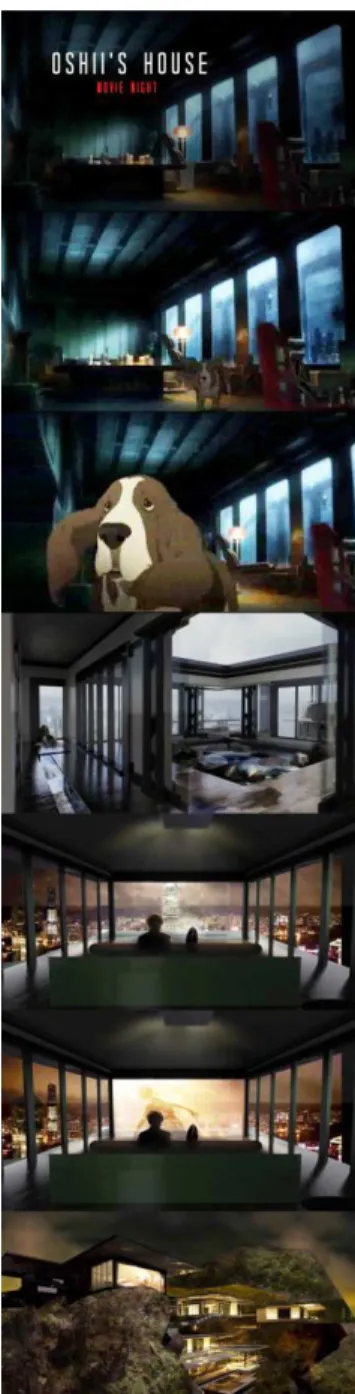
FIG 2: Screenshots from ‘Movie Night’ © Daniel Kealty, 2012.‘Movie Night’ visualizes Gabriel in Oshii’s study, then cuts to the screen room, an immersive private cinema where Oshii and Gabriel watch Oshii’s films with the backdrop of Hong Kong in the skyline. The cinematic collage zooms out from the immersive cinema to look back at Oshii’s house, assembled from the fragmentary animations of each space.
Kealty uses the digital tool of filmmaking to examine an individual’s reality so as to use that knowledge gained in filmmaking research to implement new architectural knowledge to the design of domestic space. Kealty’s studies of philosophies found in Japanese culture of ritual space and his desire to employ this knowledge into his design research leads him to use narrative and cinematic collage to achieve a state of architectural ‘satori’.
Design is the core research method used but the design is done by cutting and pasting found anime footage with newly designed architectural animation. In this way, cinematic collage is the drawing technique through which to develop the design as well as new knowledge. Like Spiller and Kulper, Kealty (2012: 8) is critical of the use of animation today writing:
The architecture of today is fixated on the aesthetic of ‘the image’, in which a project is created by producing a drawing or a render, failing to design anything that can be truly ‘experienced’. Designing architecture through the eyes of a director has a specific purpose, to design space through narrative structure and specifically address the inhabitation of the structure. The ‘experience’ of the space comes from the events and the actions that occur within it, and whilst the architecture profession acknowledges this, its impact on the overall design is underwhelming.
The writings of art theoretician, Stephen Jacobs (2007) contribute to Kealty’s formation of a cinematic design methodology. Jacobs presents the argument that Alfred Hitchcock was also an architect and that Hitchcock’s directorial strategies operated around his formulations of constructing architectural experience. A thorough study of Hitchcock’s films was undertaken so as to “investigate the nature of architectural domesticity, and the use of montaging to convert the filmic entity of a city into an architectural proposition” (Kealty, 2012: 9).
“Oshii’s House” applies Tarkovsky and Oshii’s (less so Hitchcock’s) spatial directorial techniques and uses bricolage from Tarkovsky and Oshii’s movies to the process of designing a house for the director himself. Kealty collages Oshii’s films and characters into the architecture by firstly designing architectural spaces within the imaginary house that create a sense of filmic non-reality so as to develop a spiritual flow around the inhabitant, reaffirming the sense of identity within the home. The audio-visual research-led design methodology used to produce ‘Oshii’s House’ involves making a series of short collage animations of fragments of the house. These cinematic representations centre on Oshii and his dog’s experience within the house. Oshii’s
Bassett hound, Gabriel is not only a character that appears in Oshii’s films but also his real-life domestic companion. Kealty creates cinematic representations of domestic spaces including ‘Morning Waterfalls’ [Figure 1] and ‘Movie Night’ [Figure 2] as a method through which to design Oshii’s House. The animations are inspired by the dreamy ambiance of Tarkovsky’s science fiction films, which look as if they are taking place today but in fact are set in a future, fictitious world. Inherited from Tarkovsky are “moments within water” found in Stalker (1979) and Nostalghia (1983) that “incorporate abstracted scenes of water that allow the protagonist to experience something outside of reality, like a spirit that guides […] [the] characters through an unintentional pilgrimage” (Kealty, 2012: 44). The cinematic spatial visualization in Tarkovsky’s films and Kealty’s design create scenes where protagonists reach philosophical and spiritual realization about themselves through rain pouring over them and pools of water filling the ground plane.
The futuristic world image presented in the Ghost in the Shell movies is important because Oshii’s dog is collaged out of Oshii’s anime film straight into Oshii’s house. The architectural and narrative experience of space created by moviemakers rather than architects becomes the dominant methodology through which Kealty operates. Interestingly too is that by working through cinematic collage, committed to responding to the domestic ritual requirements of Oshii and his dog, rather than use conventional architectural design methodology from ‘client’ brief to architectural design, the form of the house emerges as a consequence of the fragmentary engagement of lived, performative space in relation to the site context rather than as a prioritized initiator.
After creating cinematic representations, a secondary design research methodology is used, one set out by Jacob’s in The Wrong House. In order to argue that Hitchcock is an architect as well as a filmmaker, Jacobs produces a series of plans and sections of Hitchcock’s sets from reverse engineering the perspectival shots in Hitchcock’s films, thereby arguing that the quality of architecture that Hitchcock produced did not originate from a traditional architectural design and representation methodology. The reverse methodology of drawing perspective views of architectural propositions and then creating plan fragments is also used by Stephen Holl in his early competitions and both these drawing design methodologies underpin Kealty’s formation of a final architectural design.
FIG 3: Screenshots from ‘After the Pageant Leaves Town’© Louisa Preece, 2014.
The Zoo and its animals are reintroduced into the current landscape of Kidlington. Setting free the bears by the Co-op, historical footage before the Co-op, demolition of the silo (a week long process changing the view of the suburb as it loses its agricultural landmark) and a daydream of the pageant and its structures, the owl net brings night birds to the suburbs.
FIG 4: Screenshots from ‘After the Pageant Leaves Town’ © Louisa Preece, 2014.
The demolition rubble from the silo makes a desert like sand dune. Views of posters for the coming summer fair prefiguring its architectures and occupations. Bison wandering in the newly laid prairies of the high street and shops, structures to hold the pageant architectures in place. After the pageant leaves town and the wilding of Kidlington has begun
Preece also uses cinematic collage to both construct representations of the space under consideration - Kidlington, a suburb of Oxford - and as a method through which to analyse and project social change. In ‘After the Pageant Leaves Town’ [Figure 3 and 4] Preece uses different types of film footage to draw analysis of the local space. Her influence has been the fictional documentaries made by the architect-filmmaker Patrick Kieller (1997), notably Robinson in Space, which is used as a precedent for constructing her own documentary film of the demolition of a local landmark, agricultural silo building. She also uses her family archive of super 8 cine film from the 1960s and early 1970s which she collages into her own filmic and narrative constructions of the space. The intention of this bricolage process is that a critique might be developed through considerations of historical occupation of the suburban realm set against both the contemporary and projected future reconstructions of the space. As well as film Preece uses a form of collage text with the still images from the film as a third reading of the spaces under investigation, establishing an interdisciplinary discourse across the multiple media. She uses text to draw definitions and analyses of the spatial conditions of the Kidlington suburbs positing analyses of historical constructions of, for example, notions of community. This is a reading of the conditions of dwelling in Kidlington, the demise and demolition of the silo taken as indicative of a changing global economy but also of embracing the change and its future potential for another kind of space and occupation.
Like Keiller in Robinson in Space, Preece weaves a fictional narrative, in this instance of the pageant. This she poses as a possible reconstructive event space. She draws upon the sites and actions from real documentary for this, historical events that she posits as adjacent but supplementary to the fictional narrative and, like Keiller through his film, she develops a discursive space between the two strands. Preece uses the notions of non-place developed by Marc Auge (2008), as well as conceptions of the suburban posed by Henri Lefebvre (in During ed.: 2007) and spatial planner Alan Mace (2013). She deploys film as a critical tool in the generation of ‘new space’ (Kieller 1997) that is on the outskirts or the edges of cities. The notion is that new space is being made where occupants attempt to re-construct their culture through framing their identity. She uses her own filmmaking to resurrect specific histories of non-places, using Kieller’s (2013: 145) approach that “through films one can explore the spaces of the past, in order to better anticipate the spaces of the future”. Preece undertakes an almost forensic study of the streetscapes of Kidlington inspired by Joe Moran’s (2005: 128) critique of non-place in order to raise the “necessarily political questions about how they are organised and inhabited”. Preece’s (2014: 31) own description of her film is that:
It reveals a world of speed, one shot of a street looks much like another, yet taking a closer look at the occupation of space, such as in the front gardens, reveals more about the individual nature of the residents and their will to engage with the world around them.
In an attempt to both design incursions into the space and to map the current architectural and other spaces of the site of Kidlington, Preece employs multiple filmic overlays as a series of film collage works which act as a method of architectural research of interrogating appearances. The film collage works as a form of analysis but also as a series of poetic exchanges. The cinematic collages begin to suggest a number of possibilities for an architectural communication medium. The use of the retrieved archive of found home cine film of the family living in Kidlington enables an examination of the real and recent historic space of Kidlington. It is also intended that this process, embedded with memories has allowed the researcher to make a particular connection with that space. The historical footage also becomes a cluster of possibilities. These representations of the space have been cut into, remade and repositioned as part of the investigation of the space itself.
Preece’s research employs both cinematic and still collage to reinstate a series of events as proposals and a pageant for the Oxford suburb of Kidlington with the notion that these in turn will generate new forms of temporary public space. The zoological gardens and its animals form a significant social reconstruction of the space. The architecture itself becomes a fragmented construction of temporary anchors and stanchions, nets and scaffolding which roll out potential occupied spaces across a newly formed de-territorialised landscape. Preece uses fragments of retrieved plans from the zoo, as well as other historical functions of the suburb, layering and collaging onto the current context. The corner of the elephant house is overlaid onto the current site of Kidlington police station. The arterial traffic routes designed for the efficient flow of traffic are disrupted by the pageant and the reintroduction of a new landscape of pleasure.
Through this process Preece understands that the films and images cannot be architecture but merely represent things about architecture, not images of but more constructions to comment upon it through analogous structures. The process of cinematic collage here has the capacity to excite surfaces and spaces, as a method of engagement with the practice of making space.
Preece grafts on surfaces, which indicate different architectures and forms as an interrogation of appearances. Questions about the space and its actual surfaces can
be explored through the cinematic representation itself. The project is not one that proposes a fantasy or which develops an unconscious interpretation (although this is another collage possibility) but a set of anthropological, social, historical and material readings that allow for architectural design.
A key precursor for this collage film process is Terence Davis’ (2008) film Of Time and The City, where historical footage, poetic text, soundtrack and contemporary film are overlaid to produce a new reading of the city space. Davis has selected a handful of historical photographs of Liverpool, the city in question, showing the docks, working class housing, the Catholic cathedral, and other significant landmarks that are positioned centrally to the film narrative. His poetic readings and film footage of the city are framed by these still images. His personal account and film constructs a sense of belonging to the city. Preece uses a similar approach to her film analysis, selecting comparable, significant images, recent historic photographs, which might be considered to be representative of the suburb and its history, the zoological gardens, the silo, the cinema, newly built suburban streets and the airport, to rework and montage onto the film representation so that the space might be re-imagined as a future construction, in Kieller’s words, through “films one can explore the spaces of the past, in order to better anticipate the spaces of the future” (2013:145)
While film is the mode of representation under consideration here as the design methodology it is also important to detail how this plastic nature of the space under consideration develops into an architecture of the pageant, a critique of the desire to escape reality. Preece cites this pageantry as the possibility for the suspension of daily life [that] enables the occupation of these non-places as event space for the community. It is also a critique on spectacular space, whereby the pageant becomes the pursuit of pleasure for the residents of the suburb, recreating notions of previous pleasurable pursuits. The daydream is used as a mode of creating the exotic versus the banal, such as the animals reinstated from the zoological gardens as a menagerie, or the exotic escapism of the cinematic, or foreign travel (the airport). Ritual is drawn into the film to give cultural meaning and the pageant itself is a transient construction of public space to capture and celebrate new forms of social life. Kealty similarly uses filmic representation to develop his design for ritual space through narrative, both researcher/practitioners developing a discursive cultural reading of the spaces under investigation, whilst simultaneously generating new forms of space through textual research and cinematic collage.
Reflecting on Cinematic Collage as Architectural Design Research
In ‘Drawing the Line of Thought’ in Cinematic Architecture Pascal Schöning, Julian Löffler and Rubens Azevedo reiterate Stan Allen’s (2009: xvii) argument that the practice of architecture, and thereby architectural drawing, is “marked by this promiscuous mix of the real and the abstract”, or for Schöning, Löffler and Azevedo (2009: 32) “between concept and obsession, between so-called normality and madness (obsession) transformed into creativity, the artist still stands on the border between the troubled fields of rationality and irrationality.” Unlike Allen, and Evans before him, who are speaking of the space of possibility for the architectural drawing, Schöning, Löffler and Azevedo are discussing the productive architectural design drawing of the architect-art filmmaker. In line with the criticisms being flung at the use of animation in contemporary architectural design based on creating architecture that is technologically driven but deficient of cultural critique, as Spiller and Kulper opened this paper, we argue that cinematic architectural drawing, understood here as cinematic collage, can be pushed beyond architectural representation and architectural design to be used as a tool of critical architectural design research practice. While we accept the argument presented inThe Construction of Drawing and Movies: Models for Architectural Design and Analysis by Thomas Forget (2013: ix) that there are parallels between linear perspective and cinema due to the composition of videos shots requiring the same kind of understanding of architectural perspectival drawing, cinematic drawing technique can offer even more when used as an architectural design research tool incorporating conventional textual academic research and in this paper, cinematic collage, a merging of analog and digital techniques. The slippages go beyond practicing as painter, architect, draughtsperson, or filmmaker to include Lévis-Strauss’s bricoleur-researcher and critical contributor to knowledge, not only to visual culture but also to entertainment and design.
Unlike the bricoleur, scientific research has a history of detaching itself from creative activity. We are still in the early phases of understanding the potential methodologies for architectural design research such that drawing as the site of practice-based research, let alone cinematic collage, is contentious. In order to dismiss “a persistent uncertainty about the role of creative practice in relation to the requirement for making a contribution to knowledge within research” (Niedderer and Roworth-Stokes, 2007: 1) we argue here that we need to embrace both “rationality and irrationality” (Schöning, Löffler and Azevedo, 2009: 32) within research practice. By that we mean that rational thinking needs to be intertwined with irrational-creative thinking and rational representation – usually textual in research, less commonly architectural
design – needs to be explored reflexively with irrational or undisciplined representation and design methodologies. We argue that this would require reconsideration of some of the “essential criteria for the rigorous conduct and dissemination of research” (Niedderer and Roworth-Stokes, 2007: 11) that include objectivity, reliability and validity.
If we accept Niedderer and Roworth-Stokes’ (2007: 11) definition of “Objectivity […] [as] the attempt to be as far as possible explicit about any underlying assumptions and (personal) bias of the research, and which should enable the replicability of any study, its process and results through other researchers” then Kealty and Preece’s work offers an important challenge and that is their personal connection to the subject matter of their research. In
Kealty’s instance he has practiced Aikido since a child and his grandfather is an Aikido master. His objective to create a future vision of ritual, spiritual domestic architecture through cinematic architectural representation is also driven by his love of science fiction film also, from childhood. Preece has a similar personal connection to her topic of research, since she is working with existing family footage and she and her family live/d in Kidlington. Still, the fact both Kealty and Preece have a personal connection to their research subject material can not be seen as a weakness in art based practice-led-research which by its very nature holds a seminal place for the artefact created and the artefact’s maker since the practice of the ‘artist scholar’ (Daichendt, 2012) differs markedly to that of the ‘scientific scholar’. This intimate practice relationship may not allow for ‘replicability of any study’ but we do not see this as problematic as it may still be developed within a broader field, (or across sets of fields if interdisciplinary). Unlike scientific research that argues that a repeated methodological experiment needs to be conducted to ensure consistent research results, arts, humanities and design-based research do not require repetitive consensus because design is a unique and individual practice. The research does however, as is shown by the two cases analysed here, need to be embedded within existing theories and developed as critical architectural and spatial discourse.
Following this argument about the notion of intimate or subjective practice the research methodology here may also offer the space to critique other different but comparable architectures. There is an oppositional argument that offers the estranged occupation of a space whereby the researcher may be disconnected and alien to the surrounding, but yet may have developed a heightened sensitivity through this alienation. Both of the research projects here deploy the practice of collage or montage that has itself been used in fine art practice from the early twentieth century, developed by the surrealists who expanded upon the aesthetic and
political ground of collage to achieve an effect of alienation. The argument is then that such visual and representational research strategies may also be used very deliberately to develop an architecture of the unfamiliar or unknown terrain, like the description given by the surrealist novelist Max Ernst, in his definition of collage as being “the systematic exploitation of the coincidental or artificially induced encounter of two or more unrelated realities on an apparently inappropriate plane- and the spark of poetry that leaps across the gaps between them” (in Klanten,Helliger and Gallagher, 2011:15). This approach may then be seen to offer expanding ground for study rather than only rely upon the intimate connections proposed through the two bodies of research work cited here.
A key realm for the researchers here is the notion of architecture in the fourth dimension, one as experiential and action architecture and the other as a temporary, event architecture. Both research projects investigate and create spatial change, one of historical and cultural change, the change of reality in Oshii’s house, the other, of Kidlington. Cinematic collage here as a mode of architectural representation has a two-fold strategy of drawing in spatial occupation. The first strategy is through the medium of film itself, because it necessarily incorporates spatial use over time and the second is the use of the collage process itself. The implication is that bringing one reality to another, one image to another sets up a dialogue between the two fragments. The collage itself then offers itself up as a time-based medium. So while this is a technique that has also now developed through cut and paste and sampling technologies of digital representation it moves beyond the technical and into the realm of cultural analysis with the generation of an internal discourse between the dual or multiple found and new images and knowledge.
Reliability of Kealty and Preece’s research, understood as “the consistency of a research process and whether it is “reasonably stable over time and across researchers and methods” (Miles and Huberman, 1994: 278) […] [and] linked to the quality of research results” (Niedderer and Roworth-Stokes, 2007: 11) can be argued to be achievable, to a degree, if cinematic collage is used by more architectural design practitioners. We argue the work presented here by Kealty and Preece is evidence of an emerging methodological research practice that could evolve into a commonly used mode of design research and cinematic architectural representation as research could be further supplemented by a myriad of other types of architectural-filmic methodological approaches.
We argue that the research produced by Kealty and Preece that uses cinematic collage does display ‘validity’ or “credibility as does any research study” which refers “to the internal coherence of [that] research” (Niedderer and Roworth-Stokes, 2007:
11). The production of a masters level dissertation grounded in knowledge gained from multiple disciplines including architecture and film studies is done in a mostly conventional way but substantiates a valid architectural design research process, played out through both academic writing and cinematic architectural design by the architect-bricoleur. The intersection of tacit with conventional knowledge does not undermine the design research outputs. That factual and fictional research frameworks are employed does not diminish the quality of research undertaken but rather presents “fiction as a promising new approach to design research” (Knutz, Markussen and Christensen, 2013: 1). In line with the ““Design Fiction” method toolbox” presented by Swiss researchers, Simon Grand and Martin Wiedmer (2010: unpaginated), Kealty and Preece’s work “creates and constructs possible future worlds”, “materializes those possible future worlds”, presents “plurality of different perspective and approaches”, “represents, visualizes, documents the experimentation process” and “experiments through generating experimental systems”. When considering the question of what kinds of modes of communication and notation should be deemed adequate to the scientific community the cinematic architectural representations here are posed as a significant and original contribution. The approach to film, the urban and the suburban in these research projects has taken a cinematic collage approach, with a thorough investigation of sites and sights of the space through the multiple overlaid media. It is important to frame this process as being a collage study. According to Molly Peacock (2012: 5) Mary Delany, the seventeenth century paper cutter, considered to be one of the first recorded collage artists:
Entered a mezmerized state induced by close observation. If you have ever looked at a word so long that it becomes unfamiliar, you have crossed into a similar state, seizing on detail, then seizing up because that very focus blurs the context of meaning. This is the mental ambiance in which the ghost of something can appear. A Memory. An atmosphere of a time in life long gone but now present and almost palpable to the touch.
This can be cited as a clear link to the conceptions of spatial ‘experience’ and action architecture in the two case studies outlined in this paper. They are examining what constitutes a sense of reality and how the user’s reality can be manipulated in the physical built world.
Despite Delany’s approach to botanical collage appearing to be a purely visual project, of first dissecting the plant specimen and then building up multiple layers of coloured
paper to represent the plant her studies are still used and recognised as having significant value within contemporary scientific and botanical analyses. This is important in relation to the main question here on how valid such a visual study or approach to designing space might be within scientific analysis and research.
The filmic process of cinematic representation employed by both of the architectural researchers analysed here has this comparable, detailed and painstaking reconstruction of the subject under investigation, where fragments of the subject become repositioned as part of the bricolage or collage process. Both Kealty and Preece embrace fictional narratives as part of their filmmaking, construction and re-construction of the spaces. They conjure other realities to overlay onto the existing and establish a discursive practice of questioning fact with fiction. As Lefebvre (2003: 144) notes “The science of the urban phenomenon ‘constitutes itself slowly, making use of theoretical hypotheses and practical experience as well as established concepts. But it cannot exist without imagination’.” It is the imaginative potential attached to the practice of Lévis -Strauss’s creative, multi-talented bricoleur that is a fundamental facilitator.
Acknowledgments
We thank Daniel Kealty and Louisa Preece for giving permission to use images of their cinematic works in this article.
References:
Allen, Stan (2009) Practice: Architecture, Technique and Representation, New York: Routledge.
Alexander, Kaye (2 October 2008) “Animate your Architecture,” Architects’ Journal, 228, 12: 36-38.
Auge, Marc (2008) Non-places. An Introduction to Supermodernity, New York: Verso. Baudrillard, Jean (1985) Simulacra and Simulation, Michigan: University of Michigan Press.
Clear, Neil (July-August 2005) “Concept Planning Process Realisation: The Methodologies of Architecture and Film,” Architectural Design, 75, 4: 104-109.
Cavallaro, Daniel (2006) The Cinema of Mamoru Oshii: Fantasy, Technology and Politics, London: McFarland.
Daichendt, G. James (2012) Artist Scholar: Reflections on Writing and Research. Bristol, Chicago: intellect.
Evans, Robin “Architectural Projection,” in Eve Blau and Edward Kaufman eds. (1989) Architecture and its Image: Four Centuries of Architectural Representation: Works from the Collection of the Canadian Centre for Architecture, Montreal, QC, Canada: Canadian Centre for Architecture.
Ernst, Max (1978, 1934). Une Semaine de Bonte: A Surrealistic Novel in Collage London: Dover.
Forget, Thomas (2013) The Construction of Drawings and Movies: Models for Architectural Design and Analysis, London and New York: Routledge.
Fontin, David (2011) Architecture and Science Fiction Film: Philip K. Dick and the Spectacle of the Home, Surrey: Ashgate.
Grand, Simon and Martin Wiedmer (2010) “Design Fiction: A Method Toolbox for Design Research in a Complex World”. In Proceedings of the DRS 2010 Conference: Design and Complexity. Montreal.
Grosz, Elizabeth (2001) Architecture from the Outside: Essays on Virtual and Real Space. Cambridge, Massachusetts: The MIT Press.
Hayden, Ruth. (1980) Mrs Delany: Her life and her flowers. London: British Museum Pubs. Ltd.
Rotterdam: 010 Publishers.
Kealty, Daniel (2012) Merging Realities: Filmmaking as Architectural Design, unpublished Master’s dissertation, Oxford Brookes University, School of Architecture. Keiller, Patrick (2013) The View from The Train London, New York, Verso.
Klanten, Robert, Helliger, Hendrik and Gallagher, J. (2011) Cutting Edges Contemporary Collage. Berlin: Gestalten.
Knutz, Eva, and Thomas Markussen and Poul Rind Christensen (2013) “The Role of Fiction in Experiments within Design, Art & Architecture”. Paper presented at Nordes, Copenhagen, Denmark.
Kristeva, Julia. “Institutional Interdisciplinarity in Theory and Practice: An Interview,” in Coles, Alex and Defert, Alexia eds. (1997) The Anxiety of Interdisciplinarity, De-, Dis-, Ex-, 2, London: Black Dog: 3-21.
Kulper, Amy ed. (Fall 2011) _Discipline Disciplining Disciplined: Architectural Habits of Mind and Modalities of Practice, Taubman College of Architecture + Urban Planning. Lefebrvre, Henri (2003) The Urban Revolution, trans. Bonnono, R. First Edition 1970, Minneapolis. University of Minnesota Press.
Lefebvre, Henri “Notes on the New Town”, in: S. During, ed. (2007) The Cultural Studies Reader, third edition. London, New York: Routledge: 147-155
Lévis-Strauss, Claude (1966/1962) La Pensée Sauvage. Paris. English translation as The Savage Mind, University of Chicago Press.
Mace, Alan (2013) City Suburbs: Placing Suburbia in a Post Suburban World. New York: Routledge
Marshall, John & Julian Bleecker “Undisciplinarity” in Paul Rodgers & Michael Smyth eds. (2010) Digital Blur: Creative Practice as the Boundaries of Architecture, Design and Art. Farringdon, Oxfordshire: Libra Publishing.
Moran, J. (2005) Reading the Everyday Oxon, New York: Routledge.
Pallasma, Juhani (2007) The Architecture of Image: Existential Space in Cinema, Helsinki: Rakennustieto.
Peacock, Molly (2012) The Paper Garden: An Artist Begins her Life’s Work at 72, London: Bloomsbury Publishing PLC.
Preece, Louisa (2014) Elephants Weren’t the Only Thing to Pass by the Bungalow, unpublished Masters dissertation, Oxford Brookes University School of Architecture.
Spiller, Neil (March-April 2001) “Towards an Animated Architecture against Architectural Animation,” Architectural Design, 71, 2: 82-85.
Niedderer, Kristina and Roworth-Stokes, Seymour (2007) “The Role and Use of Creative Practice in Research and its Contribution to Knowledge” in IASDR International Conference.
Ratti, Oscar and Westbrook, Adele (1970/2001) Aikido and the Dynamic Sphere: An Illustrated Introduction, Tuttle Publishing
Rowe, Colin and Fred Koetter (1978) Collage City. Cambridge, Massuchusetts and London: The MIT Press.
Schöning, Pascal and Julian Löffler and Rubens Azevedo (2009) Cinematic Architecture, London: AA Publications.
Suchman, Lucy A. and Randall H. Trigg, “Understanding Practice: Video as a Medium for Reflection and Design” in Joan Greenbaum and Morten Kyng eds. (1991) Design at Work: Cooperative Design of Computer Systems. New Jersey, London: Lawrence Erlbaum Associates, Publishers, pp. 65-90.
Tarkovsky, Andrei (1989) Sculpting in Time: Tarkovsky the Great Russian Filmmaker discusses his Art, Texas: University of Texas Press.
Troiani, Igea and Ewing, Suzanne (July 2014) “Inside Architecture from the Outside: Architecture’s Disciplinary Practices,” Architecture and Culture, 2, 2: In press.
Tsnunetomo, Yamamoto (1979) Hagakure (Hidden by the Leaves), Tokyo: Kadansha.
Filmography
Davies, Terence (2008) Of Time and The City, BFI Video [DVD] Kieller, Patrick (1997) Robinson in Space, BBC Koninck Studios [DVD] Oshii, Mamoru (1995) Ghost in the Shell, Japan: Manga Entertainment [DVD]
Oshii, Mamoru (2004) Ghost in the Shell: Innocence, Japan: Manga Entertainment [DVD]
Tarkovsky, Andrei (1972) Solaris, Russia: Artificial Eye [DVD] Tarkovsky, Andrei (1979) Stalker, Russia: Artificial Eye [DVD] Tarkovsky, Andrei (1983) Nostalghia, Russia, Artificial Eye [DVD]