145 NONTHEME ORIGINAL INVESTIGATION
Does Warm-Up Have a Beneficial Effect
on 100-m Freestyle?
Henrique P. Neiva, Mario C. Marques, Ricardo J. Fernandes, João L. Viana, Tiago M. Barbosa, and Daniel A. Marinho
Purpose: To investigate the effect of warm-up on 100-m swimming performance. Methods: Twenty competitive
swimmers (with a training frequency of 8.0 ± 1.0 sessions/wk) performed 2 maximal 100-m freestyle trials on separate days, with and without prior warm-up, in a counterbalanced and randomized design. The warm-up distance totaled 1000 m and replicated the swimmers’ usual precompetition warm-up strategy. Performance (time), physiological (capillary blood lactate concentrations), psychophysiological (perceived exertion), and biomechanical variables (distance per stroke, stroke frequency, and stroke index) were assessed on both trials.
Results: Performance in the 100-m was fastest in the warm-up condition (67.15 ± 5.60 vs 68.10 ± 5.14 s; P
= .01), although 3 swimmers swam faster without warm-up. Critical to this was the 1st 50-m lap (32.10 ± 2.59 vs 32.78 ± 2.33 s; P < .01), where the swimmers presented higher distance per stroke (2.06 ± 0.19 vs. 1.98 ± 0.16 m; P = .04) and swimming efficiency compared with the no-warm-up condition (stroke index 3.46 ± 0.53 vs 3.14 ± 0.44 m2 · c–1 · s–1; P < .01). Notwithstanding this better stroke-kinematic pattern, blood
lactate concentrations and perceived exertion were similar between trials. Conclusions: These results sug-gest that swimmers’ usual warm-up routines lead to faster 100-m freestyle swimming performance, a factor that appears to be related to better swimming efficiency in the 1st lap of the race. This study highlights the importance of performing swimming drills (for higher distance per stroke) before a maximal 100-m freestyle effort in similar groups of swimmers.
Keywords: preexercise, performance, kinetics, efficiency, lactate
Neiva, Marques, Viana, and Marinho are with the Dept of Sport Sciences, University of Beira Interior, Covilhã, Portugal. Fernandes is with the Faculty of Sport, University of Porto, Porto, Portugal. Barbosa is with the National Inst of Education, Nanyang Technological University, Singapore.
Although there is a lack of conclusive scientific evidence, the use of warm-up to enhance performance seems to be a matter of common belief and practice among coaches and athletes. In fact, the different physi-cal exercises performed during warm-up aim to increase muscle and core temperature and, through the body’s underlying mechanisms, improve performance.1–4 The
hyperthermia resulting from physical activity increases vasodilatation and muscle blood flow, stimulating the increased aerobic energy contribution during a sub-sequent task.3,5 In addition, it increases the muscle
glycogenolysis, glycolysis, and high-energy phosphate degradation during exercise.6 The literature also claims
that warming up via physical activity might have effects additional to the increase in temperature, particularly an elevation of baseline of oxygen consumption (VO2)
and of the amplitude of the primary VO2 response in
the subsequent exercise.7 Nevertheless, although these
metabolic responses appear to indicate a positive effect
of warm-up on athletic performance, current evidence is still inconclusive.1,2
Specifically in swimming, different physiological changes and conflicting benefits to performance have been reported. Houmard et al8 described increments
in distance per stroke (DPS) during an intensely paced 368.5-m swim and decreased postexercise blood lac-tate concentrations ([La–]) with warm-up. Conversely,
others9 found that warm-up procedures did not change
performance and led to higher [La–] after a 2-minute
high-intensity swimming trial (13.66 ± 2.66 vs 9.53 ± 2.22 mmol/L). Regarding a shorter-distance swimming performance, studies have shown that proper warm-up was effective in reducing 100-yd time trial by 0.4410
and 0.75 seconds11 compared with a bout without prior
warm-up, but Bobo12 failed to find significant differences
in 100-yd performance between 3 conditions (warm-up exercises in water and on dry land and without warm-up).
More recent research has focused on even shorter distances (50 yd and 50 m), but results are inconclusive; no favorable effects of warm-up on 50-m front-crawl performance, either in the [La–] or perceived exertion
(RPE), were observed by Neiva et al,13 but Balilionis
et al14 reported better performances on 50-yd freestyle
after a warm-up (~0.2 s), although no effects on RPE and stroke frequency (SF) were detected.
Given the lack of consistent evidence about the effects of warm-up on swimming performance, the purpose of the current study was to investigate if usual warm-up procedures are beneficial to 100-m freestyle swimming performance. Performance (time), biome-chanical (SF, DPS, and stroke index [SI]), physiological ([La–]), and psychophysiological (RPE) variables were
assessed. Usual warm-up was hypothesized to positively contribute to the swimmers’ response to maximal 100-m freestyle performance.
Methods
Subjects
Twenty competitive swimmers (10 male and 10 female: age 16.0 ± 0.6 and 16.2 ± 1.14 y, height 173 ± 5.07 and 161 ± 7.04 cm, body mass 62.3 ± 3.9 and 55.9 ± 6.3 kg, respectively) volunteered to participate in this study. The swimmers had been engaged in competitive swim-ming during the last 7.11 ± 1.29 years and had a training frequency of 8.0 ± 1.0 (16.0 ± 1.5 h) sessions per week, with a training volume of 34,000 ± 5400 m/wk during the current season. Personal-best time in the 100-m freestyle event was 64.71 ± 5.43 seconds, which corresponds to 456.70 ± 85.91 FINA 2011 points scoring. Before the experiments, swimmers were informed about the study design and procedures, and an informed consent was signed. Institutional review board approval was granted, in the spirit of the Helsinki declaration.
Experimental Design
All experiments were conducted 1 week after the main com-petition of the season in a 50-m indoor swimming pool with water temperature at 27.5°C. The swimmers performed two 100-m freestyle time trials at maximum velocity with (WU) and without (NWU) prior warm-up, with a counterbalanced order of treatments and random assignment to order. Trials were separated by 24 hours. Each swimmer performed the 100-m as an individual time trial to prevent pacing or tactic effects. Swimmers were asked to wear the swimsuits they normally wore during competitions.
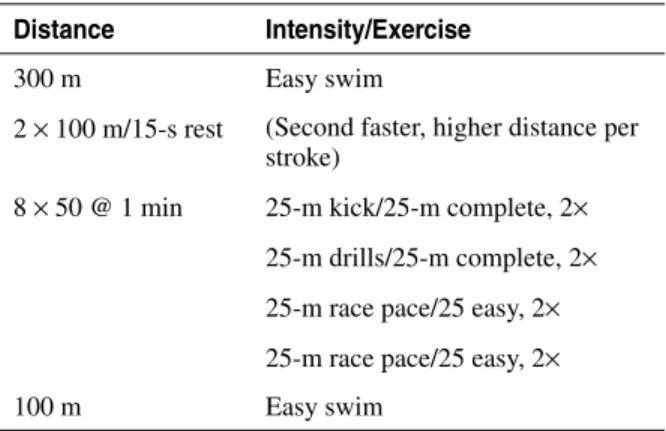
In the WU trial, swimmers performed their usual precompetition warm-up (Table 1), comprising 1000 m of aquatic drills, pull and kick exercises, and specific sets. After 10 minutes of passive rest, they performed the 100-m freestyle time trial. In the NWU trial, no physi-cal activity was allowed previous to the 100-m freestyle time trial.
Methodology
In both the WU and NWU conditions, in-water starts were used, and 100-m times for each swimmer were registered by 2 experienced coaches using stopwatches (Golfinho Sports MC 815, Aveiro, Portugal). The mean value of the 2 times was recorded for analysis. Coaches were blind as to the warm-up conditions of the swimmers.
Swimming velocity was determined in the middle 15 m of the swimming pool (marks were set at 20 and 35 m). The distance covered by a swimmer was divided by the time spent to cover such distance. SF was measured with a chronofrequency meter (Golfinho Sports MC 815, Aveiro, Portugal) from 3 consecutive stroke cycles within the same 15 m where swimming velocity was assessed. Afterward, SF was converted to International System units (Hz). The velocity and SF were assessed by 2 different and experienced researchers, who were also blind to the swimmers’ testing condition. Intraclass correlation coefficient was determined for the time, velocity, and SF, to ensure the accuracy of the measurement. The mean value was used for analysis. DPS was estimated as the division between the velocity obtained during the 15-m and the SF.15 The SI was computed as the product of the
velo-city of the swimmer during the 15-m recorded and the corresponding DPS.16
Capillary blood samples for [La–] assessment
(Accutrend LactateRoche, Germany) were collected from the fingertip after each maximal trial (at the first and third minutes of recovery) to determine its higher value. RPEs were registered after each test using Borg’s 6- to 20-point scale.17
Statistical Analysis
Standard statistical methods were used for calculation of mean and SD for all variables. The normality of all distributions was verified using Shapiro-Wilk tests, and parametric statistical analysis was adopted. To compare data obtained in the 2 trials, Student paired t tests were used. Limits of agreement between the performance measured in WU and NWU were derived according to the literature.18 Statistical procedures were performed
using SPSS 19.0 for Windows (Chicago, IL, USA). Post hoc analysis of power (1 – β) and the values of Cohen d effect size for repeated measures (ES) were accomplished using G-Power 3.1.3 for Windows (University of Kiel, Germany). The level of statistical significance was set at P ≤ .05.
Table 1 Usual Warm-Up Protocol
Distance Intensity/Exercise
300 m Easy swim
2 × 100 m/15-s rest (Second faster, higher distance per stroke)
8 × 50 @ 1 min 25-m kick/25-m complete, 2× 25-m drills/25-m complete, 2× 25-m race pace/25 easy, 2× 25-m race pace/25 easy, 2× 100 m Easy swim
Results
Table 2 presents a comparison between the 100-m free-style performance, the respective lap times, and the values of [La–], RPE, SF, DPS, and SI recorded in the first and
second 50 m in the WU and NWU conditions. In the 100-m WU trial, the swimmers were 1.48% ± 2.06% faster, with medium magnitudes of differences (ES > 0.5) resulting from the large ES (>0.8) noted in the first 50-m lap.
It is also possible to observe [La–] higher than 10
mmol/L and hard to very hard effort (RPE >16) in both testing conditions. The differences verified in the second 50-m SF, in the first 50-m and second 50-m DPS, and in the first 50-m SI between the WU and NWU conditions ranged from a medium (.5 < d < .8) to a large (d > .8) magnitude of the effect.
The individual differences between WU and NWU on the first and second 50-m laps and for the 100-m total performance are presented in Figure 1, evidencing some individual positive responses after NWU in figure parts A, B, and C (10%, 25%, and 15%, respectively), although the mean value is positioned below zero.
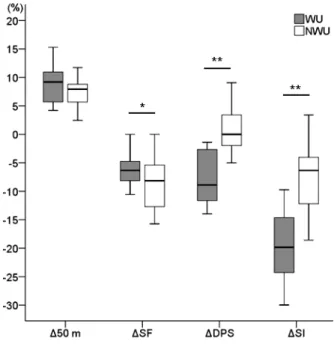
Figure 2 presents the variation of the biomechanical variables between the 50-m laps of the 100-m maximal effort for WU and NWU. It should be noted that the lower the value presented, the more inferior were the values obtained in the second 50-m lap. Differences were observed in the patterns of SF, DPS, and SI when maximal 100-m freestyle was preceded by WU or NWU.
Discussion
The purpose of the current study was to investigate the effects of warm-up on maximal 100-m freestyle swim-ming performance. The faster times observed in the
WU trial suggest that the swimmers’ usual warm-up procedures have a beneficial effect on their subsequent swimming performance. Warming up led to significant improvements in the stroke mechanics, yet the assessed physiological and psychophysiological variables did not seem to be influenced. These findings evidence the posi-tive influence that usual warm-up may have on swimming performance, which appears to be mostly related to the swimmers’ technical pattern.
Warming up before the competition is a usual prac-tice in swimming. Its positive effect was first presented by De Vries,10 but recent literature focusing specifically
on short swimming distances demonstrated that priming exercises could impair swimming performance.9,12,13 It
should be noted that in most swimming competitions, there is a considerable time lapse between the in-water warm-up and the competitive event, which can negate the warm-up’s possible beneficial effects. Nevertheless, swimmers still compete at their maximum effort. These findings and considerations highlight the relevance of better understanding the warm-up phenomenon.
The lack of previous research assessing the effects of warm-up on maximal 100-m swimming limits com-parisons with the current study results. In-water start and the lack of competitive context during the tests might explain the slightly higher final times compared with swimmers’ personal bests (~2.43 s) and with the litera-ture.19,20 As the 2 experimental tests were performed in
the same competitive environment, these effects could be disregarded. Furthermore, the RPE values obtained were similar to those in previous studies that assessed all-out swimming performances,13,14,21 which could ensure the
reliability of the results obtained.
Concerning the main aim of the current study, faster 100-m performances were achieved in the WU condition,
Table 2 Results for Tested Parameters in the 100-m Trial, N = 20
Condition, Mean ± SD P ES 1 – β Warm-up No warm-up 100-m time (s)** 67.15 ± 5.60 68.10 ± 5.14 .01 0.69 .99 First 50-m time (s)** 32.10 ± 2.59 32.78 ± 2.33 <.01 0.89 1.00 Second 50-m time (s) 35.00 ± 3.27 35.37 ± 2.98 .07 0.44 .76 Blood lactate concentration (mmol/L) 10.91 ± 1.75 10.28 ± 2.20 .22 0.32 .41 100-m rating of perceived exertion 16.90 ± 1.80 16.10 ± 1.55 .08 0.41 .71 Stroke frequency, first 50 m (Hz) 0.81 ± 0.07 0.80 ± 0.06 .25 0.28 .37 Stroke frequency, second 50 m (Hz)** 0.77 ± 0.60 0.72 ± 0.06 <.01 1.09 1.00 Distance per stroke, first 50 m (m)* 2.06 ± 0.19 1.98 ± 0.16 .04 0.53 .88 Distance per stroke, second 50 m (m)** 1.90 ± 0.18 1.99 ± 0.18 .01 0.66 .97 Stroke index, first 50 m (m2 · c–1 · s–1)** 3.46 ± 0.53 3.14 ± 0.44 <.01 0.87 1.00
Stroke index, second 50 m (m2 · c–1 · s–1) 2.81 ± 0.46 2.89 ± 0.45 .22 0.29 .42
*P ≤ .05. **P ≤ .01.
Figure 2 — Comparison between the variations of the time
(Δ50 m), stroke frequency (ΔSF), distance per stroke (ΔDPS), and stroke index (ΔSI) assessed in the first and second 50-m laps of the 100-m (Δ = second – first), with warm-up (WU) and without warm-up (NWU). *P ≤ .05, **P ≤ .01, N = 20
Figure 1 — Bland-Altman plots representing (A) the first
50-m-lap time, (B) the second 50-m-lap time, and (C) 100-m total time in the 2 trial conditions, with warm-up (WU) and without warm-up (NWU). Average difference (solid line) and 95% CI (dashed lines) are indicated (N = 20).
those differences being mainly achieved in the first lap. According to Balilionis et al,14 it is expected that
swim-mers will be faster in the 50-yd freestyle when using a regular warm-up (~1300 yd) than when using a shorter warm-up (100 yd) or when no warm-up is used (24.95 ± 1.53, 25.26 ± 1.61, and 25.19 ± 1.54 s). The differences between the 2 conditions disappeared in the second 50-m lap, even though the observed medium effect size requires further investigation under this topic.
The results presented in Table 2 are confirmed in Figure 1 since the average difference line is farther away from zero in figure parts A and C than in part B. However, the figure also illustrates individual cases in which the difference was positive, evidencing that these swimmers reacted favorably to the nonexistence of prior exercises (2 in the first 50 m, 5 in the second 50 m, and 3 in the total 100 m). This illustrates the individuality of swim-ming, as there is no clear zone in which the swimmers can be placed. Therefore swimmer individuality should be respected, and coaches should take that into account when defining their training process and determining competitive procedures.
During a 100-m swimming event the anaerobic metabolism is a substantial source of energy, leading to [La–] higher than 10 mmol/L,22 as observed in our data.
Warm-up has been proposed to maintain the acid–base balance at an appropriate level by stimulating the buffer-ing capacity,23 which was evidenced after maximal 200-m
swimming: net [La–] of 8.7 ± 0.9 versus 10.9 ± 0.5 mmol/L
(P < .05), with and without warm-up, respectively.24
However, in the current study, [La–] levels were similar
in the WU and NWU conditions, which is consistent with recent findings for short-distance swimming.13,25 Possibly,
different physiological variables (eg, VO2) are influenced
to a greater extent by warm-up procedures. As 100-m swimming performance also relies on the aerobic energy system,26 the warm-up could allow enhancement of the
swimmers’ aerobic system more than their anaerobic one. Swimmers in general believe that warm-up is essen-tial to attain a good performance,27 so psychological
beliefs could influence the perception of effort exerted. However, the observed RPE values were similar in WU and NWU conditions, as reported before.8,13,14,25 The RPE
is assumed to be influenced by fatigue perception mainly due to the accumulation of hydrogen ions in the active muscles as the result of the dissociation of lactic acid.28
Hence, given that [La–] values did not change between
WU and NWU, it was somewhat expected that RPE would also be similar between conditions.
The faster initial meters of the 100-m freestyle in the WU condition reflected the higher DPS and, conse-quently, greater swimmer efficiency (evidenced by SI). Therefore, in the NWU condition it is expected that the swimmers would not be effective in the arm pull and were technically compromised,20 lowering their DPS in
the first 50-m lap. However, in the second 50-m lap, and once the velocity is related to SF and DPS,29 the higher
DPS and lower SF with NWU dissipated the differences in the time performed between conditions. In NWU, the swimmers were able to maintain the DPS in the second 50 m, maybe as a consequence of the lower energy cost and velocity of the first meters, but the SF experienced a further reduction as the fatigue increased.
The variations of SF, DPS, and SI throughout the 100-m freestyle in the WU and NWU conditions could reflect the development of fatigue. According to Barbosa et al,29 swimmers are able to manipulate their DPS and SF to
achieve a given velocity with the lowest energy cost. Thus, the swimmers used different kinematic patterns in the 2 experimental conditions to accomplish the total distance at maximum intensity according to their energetic needs.
Practical Applications
The usual warm-up performed by the swimmers was effective in optimizing 100-m freestyle swimming perfor-mance. Perhaps the greater swimming efficiency verified in the first meters suggests that incorporating technical drills during warm-up could be beneficial to similar groups of swimmers, specifically regarding their DPS. Some posi-tive responses to NWU revealed the swimmers’ individu-ality, and this confirms the idea that warm-up procedures should be considered as an individualized approach to optimizing swimmer performance.14 Thus, there is no
single model that should be copied and adopted by all swimmers. It is fundamental to consider their biological individualities, and group procedures should be handled with caution at the risk of compromising optimal per-formances. Possibly, swimmers and coaches need to test over several occasions to establish consistent responses to
different warm-up procedures and thereby establish their own optimal warm-up. The unknown value of the varia-tion in performance day to day or test to test limited the understanding of the magnitude of the effects of warm-up. However, the results are clear in demonstrating a positive effect, and future research is needed to better understand the ideal structure of warm-up procedures.
Conclusion
The swimmers were significantly faster in the first 50-m lap of the WU trial, which led to an improvement in overall 100-m performance. Different biomechanical patterns were observed in response to the WU and NWU conditions, suggesting that warm-up significantly influ-ences the stroke patterns of a short swimming event. The individuality of the swimmers was also shown, enhancing the importance of an individualized approach to optimiz-ing swimmoptimiz-ing performance.
Acknowledgments
The authors would like to acknowledge the help of the swim-mers who participated in the current study, and also that of the Varzim Lazer EEM in making available the swimming-pool facilities. The Portuguese government supported this work by way of a grant of the Science and Technology Foundation (SFRH/BD/74950/2010). This work was also supported by University of Beira Interior and Santander Totta Bank (UBI/ FCSH/Santander/2010).
References
1. Bishop D. Warm up I: potential mechanisms and the effects of passive warm up on exercise performance. Sports Med. 2003a;33(6):439–454. PubMed doi:10.2165/00007256-200333060-00005
2. Bishop D. Warm up II: performance changes fol-lowing active warm up and how to structure the warm up. Sports Med. 2003b;33(7):483–498. PubMed doi:10.2165/00007256-200333070-00002
3. Gray S, Nimmo M. Effects of active, passive or no warm-up on metabolism and performance during high-intensity exercise. J Sports Sci. 2001;19(9):693–700. PubMed doi:10.1080/02640410152475829
4. Wright V, Johns RJ. Quantitative and qualitative analysis of joint stiffness in normal subjects and in patients with con-nective tissue diseases. Ann Rheum Dis. 1961;20(1):36–46.
PubMeddoi:10.1136/ard.20.1.36
5. Pearson J, Low DA, Stöhr E, et al. Hemodynamic responses to heat stress in the resting and exercising human leg: insight into the effect of temperature on skel-etal muscle blood flow. Am J Physiol Regul Integr Comp
Physiol. 2011;300(3):R663–R673. PubMeddoi:10.1152/ ajpregu.00662.2010
6. Febbraio MA, Carey MF, Snow RJ, Stathis CG, Hargreaves M. Influence of elevated muscle temperature on metabo-lism during intense, dynamic exercise. Am J Physiol. 1996;271(5 Pt 2):R1251–R1255. PubMed
7. Burnley M, Davison G, Baker JR. Effects of priming exer-cise on VO2 kinetics and the power–duration relationship.
Med Sci Sports Exerc. 2011;43(11):2171–2179. PubMed doi:10.1249/MSS.0b013e31821ff26d
8. Houmard JA, Johns RA, Smith LL, Wells JM, Kobe RW, McGoogan SA. The effect of warm-up on responses to intense exercise. Int J Sports Med. 1991;12(5):480–483.
PubMeddoi:10.1055/s-2007-1024717
9. Mitchell JB, Huston JS. The effect of high- and low-intensity warm-up on the physiological responses to a standardised swim and tethered swimming perfor-mance. J Sports Sci. 1993;11(2):159–165. PubMed doi:10.1080/02640419308729979
10. De Vries HA. Effects of various warm-up procedures on 100-yard times of competitive swimmers. Res Q. 1959;30:11–22.
11. Romney NC, Nethery VM. The effects of swimming and dryland warm-ups on 100-yard freestyle performance in collegiate swimmers. J Swim Res. 1993;9:5–9.
12. Bobo M. The effect of selected types of warm-up on swim-ming performance. Int Sports J. 1999;3(2):37–43. 13. Neiva HP, Morouço PG, Pereira FM, Marinho DA. The
effect of warm-up in 50 m swimming performance. Rev
Mot. 2012;8(S1):13–18.
14. Balilionis G, Nepocatych S, Ellis CM, Richardson MT, Neggers YH, Bishop PA. Effects of different types of warm-up on swimming performance, reaction time, and dive distance. J Strength Cond Res. 2012;26(12):3297– 3303. PubMeddoi:10.1519/JSC.0b013e318248ad40
15. Craig AB, Pendergast DR. Relationships of stroke rate, distance per stroke, and velocity in competitive swimming.
Med Sci Sports. 1979;11(3):278–283. PubMed
16. Costill DL, Kovaleski J, Porter D, Fielding R, King D. Energy expenditure during front crawl swimming: predict-ing success in middle-distance events. Int J Sports Med. 1985;6:266–270. PubMeddoi:10.1055/s-2008-1025849
17. Borg G, ed. Borg’s Perceived Exertion and Pain Scales. Champaign, IL: Human Kinetics; 1998.
18. Bland JM, Altman DG. Applying the right statistics: analy-ses of measurement studies. Ultrasound Obstet Gynecol. 2003;22(1):85–93. PubMeddoi:10.1002/uog.122
19. Stirn I, Jarm T, Kapus V, Strojnik V. Evaluation of muscle fatigue during 100-m front crawl. Eur J Appl Physiol. 2011;111(1):101–113. PubMed doi:10.1007/s00421-010-1624-2
20. Toussaint HM, Beek PJ. Biomechanics of competitive front crawl swimming. Sports Med. 1992;13(1):8–24. PubMed doi:10.2165/00007256-199213010-00002
21. Zochowski T, Johnson E, Sleivert GG. Effects of varying post-warm-up recovery time on 200-m time-trial swim performance. Int J Sports Physiol Perform. 2007;2(2):201– 211. PubMed
22. Bonifazi M, Marteli G, Marugo L, Sardella F, Cari G. Blood lactate accumulation in top level swimmers following competition. J Sports Med Phys Fitness. 1993;33(1):13–18. PubMed
23. Beedle BB, Mann CL. A comparison of two warm-ups on joint range of motion. J Strength Cond Res. 2007;21(3):776–779. PubMed
24. Robergs RA, Costill DL, Fink WJ, et al. Effects of warm-up on blood gases, lactate and acid-base status during sprint swimming. Int J Sports Med. 1990;11(4):273–278.
PubMeddoi:10.1055/s-2007-1024806
25. Neiva H, Morouço P, Silva AJ, Marques MC, Marinho DA. The effect of warm up on tethered front crawl swimming forces. J Hum Kinet. 2011;(Spec Iss):113–119.
26. Capelli C, Pendergast D, Termin B. Energetics of swimming at maximal speeds in humans. Eur J Appl Physiol Occup Physiol. 1998;78:385–393. PubMeddoi:10.1007/s004210050435
27. De Bruyn-Prevost P. The effects of various warming up intensities and durations upon some physiological vari-ables during an exercise corresponding to the WC170.
Eur J Appl Physiol Occup Physiol. 1980;43(2):93–100.
PubMeddoi:10.1007/BF00422439
28. Robertson RJ, Falkel JE, Drash AL, et al. Effect of blood pH on peripheral and central signals of perceived exer-tion. Med Sci Sports Exerc. 1986;18(1):114–122. PubMed doi:10.1249/00005768-198602000-00019
29. Barbosa TM, Fernandes RJ, Keskinen KL, Vilas-Boas JP. The influence of stroke mechanics into energy cost of elite swimmers. Eur J Appl Physiol. 2008;103(2):139–149.
PubMeddoi:10.1007/s00421-008-0676-z
![Table 2 presents a comparison between the 100-m free- free-style performance, the respective lap times, and the values of [La – ], RPE, SF, DPS, and SI recorded in the first and second 50 m in the WU and NWU conditions](https://thumb-eu.123doks.com/thumbv2/123dok_br/18194357.875622/3.918.111.811.737.1058/table-presents-comparison-performance-respective-values-recorded-conditions.webp)