Repositório ISCTE-IUL
Deposited in Repositório ISCTE-IUL: 2018-07-04Deposited version: Post-print
Peer-review status of attached file: Peer-reviewed
Citation for published item:
Ferraz, D. P., Lopes, I. T. & Kopliku, A. (2018). Can board diversity and choice of auditor enhance profitability?. International Journal of Business Performance Management. 19 (3), 289-306
Further information on publisher's website: 10.1504/IJBPM.2018.10011847
Publisher's copyright statement:
This is the peer reviewed version of the following article: Ferraz, D. P., Lopes, I. T. & Kopliku, A. (2018). Can board diversity and choice of auditor enhance profitability?. International Journal of Business Performance Management. 19 (3), 289-306, which has been published in final form at https://dx.doi.org/10.1504/IJBPM.2018.10011847. This article may be used for non-commercial purposes in accordance with the Publisher's Terms and Conditions for self-archiving.
Use policy
Creative Commons CC BY 4.0
The full-text may be used and/or reproduced, and given to third parties in any format or medium, without prior permission or charge, for personal research or study, educational, or not-for-profit purposes provided that:
• a full bibliographic reference is made to the original source • a link is made to the metadata record in the Repository • the full-text is not changed in any way
The full-text must not be sold in any format or medium without the formal permission of the copyright holders.
Serviços de Informação e Documentação, Instituto Universitário de Lisboa (ISCTE-IUL) Av. das Forças Armadas, Edifício II, 1649-026 Lisboa Portugal
Phone: +(351) 217 903 024 | e-mail: [email protected] https://repositorio.iscte-iul.pt
Can Board Diversity and Choice of Auditor Enhance
Profitability?
Duarte Pitta Ferraz
Universidade Nova de Lisboa – NOVA School of Business and Economics, Lisbon Campus de Campolide, 1099-032 Lisbon, Portugal
Ilídio Tomás Lopes
Instituto Universitário de Lisboa (ISCTE-IUL), Business Research Unit (BRU-IUL) Av. das Forças Armadas, 1649-026, Lisbon, Portugal
Telef. +351 915706935 / +351 217903475, [email protected]
Ardit Kopliku
Universidade Nova de Lisboa – NOVA School of Business and Economics, Lisbon Campus de Campolide, 1099-032 Lisbon, Portugal
Can Board Diversity and Choice of Auditor Enhance
Profitability?
Abstract
The research examines how board diversity and choice of auditing firm, as mechanisms of corporate governance, affect the profitability of Iberian companies. Using information from an adjusted sample of 93 non-financial companies listed on the Iberian stock exchanges, a theoretical model was regressed. Profit Margin (PM) and Return on Equity (ROE), as two of the more frequently used profitability measures, capture, at a moderately acceptable level, the impact derived from board diversity and choice of auditing firm among Iberian companies. Most variables cited are not equally distributed across Iberia, in line with Hofstede’s cultural dimensions model. The evidence, while inconclusive, provides valuable insight into how governance mechanisms affect performance. In addition, the research provides value to the literature by introducing new proxies on board characteristics, and its impact on dynamic profitability.
Keywords: board diversity; auditing firms; profitability; assets turnover; Iberia; Portugal;
1. Introduction and research objective
The research around Corporate Governance (CG) has developed over the last decades, largely by adopting two basic assumptions: first, that the orientation of companies is managed towards performance, efficiency, growth, with efficient structures built on transparent relations with stakeholders; and second, that management is focused on rules and regulations that influence corporate activity (Shleifer and Vishny 1997; Coles et al. 2001; Dahya and McConnell 2007; Vintila and Gherghina 2012; Shank et al. 2013; Yaacob and Basiuni 2014; Mishra and Mohanty 2014; Mouselli et al. 2014; BIS 2010, 2014; Klettner et al. 2014; OECD 2015). As a driver of performance and profitability (Sachdeva 2014; Mizutani and Nakamura 2012), CG relates to how risk between ownership, management, and control, can be mitigated (Fama and Jensen 1983; Ahrens and Khalifa 2013). Good corporate governance practices can curb failure due to fraudulent activity, collusion, and mismanagement (Yaacob and Basiuni 2014) as well as driving sustainability (Lattemann 2014).
Broadly, CG is the framework within which companies conduct their business and by which they are controlled. It encompasses guidelines for best practice (Cadbury 1992; Higgs 2003), which sets out the relationship between management, the board, shareholders, and stakeholders; specifically, the rights, roles, and responsibilities of all personnel to establish how authority and responsibility are allocated and how decisions are taken (BIS 2015; OECD 2015). More precisely, corporate governance assures stakeholders in a company return on investment (ROI) (Klettner et al. 2014; Mishra and Mohanty 2014; Mouselli et al. 2014). This framework, separating ownership and management, usually means that investors benefit from good corporate governance mechanisms. Company stockholders elect directors, and they have the power to appoint and supervise management (FRC 2011; Pierce 2012). Sometimes conflict between management and shareholders arises due to contradictory personal financial interests, which can affect company performance. This, the result of an asymmetry of information, is usually due to managers having access to more information than shareholders (Gjesdal 2007), although Almazan et al. (2008) suggest that independent investment advisors and managers of investment companies that are in a position to monitor management are at an advantage. Fama and Jensen (1983) refer to this as agency costs, when the performance of a company is hindered by internal conflicts between the principal and the agent. Other research in this field has shown a stronger relationship between financial performance and board governance. Most of the research on elements of the board, i.e. independence, composition, frequency of meetings and board size, and gender and ethnic diversity, has focused on United States companies (Fama
and Jensen 1983; Shleifer and Vishny 1997; Hillman and Dalziel 2003; Nicholson and Kiel 2007; Carter et al. 2010; Boulouta 2013). Carter et al. (2010) argue that there is no significant relationship between the financial performance of major US companies, and ethnic and gender diversity on boards. Erhardt et al. (2003) measured diversity by the percentage of minorities (e.g. women) on the boards of 127 US companies and concluded that board diversity positively correlates with company performance indicators. On the other hand, empirical evidence from India demonstrates that a large number of independent directors have a negative impact on company performance, in contrast to board size, which positively correlates with performance (Chugh et al. 2011). Corporate governance is also instrumental in the way a company sets out its objectives, the mechanisms for maintenance of those objectives, and how it supervises performance (OECD 2015).
Empirical research demonstrates that companies with inefficient CG tend to deliver inferior returns to shareholders (Von Nandelstadh and Rosenberg 2003). Bhagat and Black (2008) advocate that boards can improve performance by increasing sensitivity to risk and embedding risk-aversion into organisational processes (Yaacob and Basiuni 2014). Effective CG deals not only with assuring ROI for investors (Shleifer and Vishny 1997; Lopes and Ferraz 2016), but also creates a system that directs and controls companies (Sheikh et al. 2013).
The aim of the current research is to identify whether board diversity and the type of auditing firm the company chooses can be used as predictors of company performance. It looks at whether CG indicators, i.e. board size and composition, the number of women, proportion of non-executive members, and members participating in other internal and external committees, differ between Portugal and Spain.
2. Literature Review
2.1.Governance and diversity on boards
The board of directors (BoD) usually has a dual function of monitoring/controlling and takes a consultative role within management (Jensen 1993). Various theories support each of the board’s functions: Daily et al. (2003) show how the monitoring/controlling role is accentuated by agency theory, while the consultative role is emphasised by resource dependence theory (Zahra and Pearce 1989; Johnson et al. 1996; Daily et al. 2003). Both theories suggest that certain board characteristics can affect the monitoring and advisory role of it (Rodriguez-Fernandez et al. 2013; Bianco et al. 2015), and hence affect performance. Agency theory
stresses how the segregation of management from ownership leads to self-centred behaviour by managers and information asymmetry (Gjesdal 2007), increasing agency costs as well as conflicts within the company. Research has found that in order to reduce agency costs and assure effective control and monitoring, board members are chosen as an internal ruling body (Park and Shin 2004) to define the objectives of the company and monitor its performance (BIS 2015), although monitoring is not restricted to financial measures (Galbreath 2012). Consequently, the board is responsible for applying effective corporate governance practices and is liable for the functioning, financial performance, and effective allocation of authority and responsibility within the company (BIS 2015). In addition, international portfolio investments incentivise good corporate governance practices worldwide (Aggarwal et al. 2011), with institutional investors playing a role in monitoring management (Almazan et al. 2008), although action to apply efficacious practices may depend on board characteristics (Bozec 2005; Dahya et al. 2009). Diversity on boards is defined by a number of characteristics (Lopes and Ferraz 2016); the requirement to disclose non-financial information (European Parliament and the Council 2014; OECD 2015) includes reporting on board diversity and policy. In the current research, analyses of facets of the board include gender diversity, size, proportion of non-nationals, background of its members, and interlocking directors. In order to test the relationship between board diversity and company performance the following hypotheses have been formulated:
• Gender diversity: previous studies that considered gender and ethnic diversity to have the same impact on company performance have merged the two characteristics into the same variable. Here, the suggestion of Carter et al. (2010), who find significant differences between ethnic-minority directors and women directors, based on human capital theory, is followed, and the gender difference of the board indicates the proportion of women out of the total number of directors. Gender studies worldwide link women with qualities such as empathy, affection, and promotion of community values (Eagly et al. 1995; Boulouta 2013), hence they suggest that women can indirectly improve company performance. Consistent with this logic, several studies pose that female board members boost company returns (Erhardt et al. 2003; Francoeur et al. 2008; Adams and Ferreira 2009). Other research finds that gender diversity negatively affects performance (Shrader and Blackburn 1997); and some report no impact at all or show inconclusive results (Daily et al. 1999; Carter et al. 2003; Adams et al. 2009).
• Board size: here, this represents the number of directors on the board. According to Limpton and Jay (1992), limiting board size to seven or eight members results in better co-ordination, communication, and compliance in decision-making, hence increasing board performance. Taking a similar line, Jensen (1993) states that smaller boards can boost company performance, because there is likely to be wider participation by all members in the monitoring and evaluation process of management. However, other studies based on resource dependence theory argue that larger boards have greater collective information in their possession, leading to better performance (Zahra and Pearce 1989; Guest 2009). Another advantage of larger board size is seen in greater support to management through better counselling, as the larger the board the more likely it is to have members from diverse industry sectors and backgrounds to offer expertise (Dalton et al. 1999).
• Auditor: auditing provides a control and bonding mechanism to minimise the agency costs provoked by asymmetric information between parties (Jensen and Meckling 1976; Watts and Zimmerman 1983). Here, the company’s choice of auditing firm has been considered as a board characteristic; more specifically, whether the board has contracted one of the Big 4 to act as auditor. Based on the Taiwanese market, Lee and Lee (2013) showed that equity book value and earnings audited by one of the Big 4 firms tended to justify more comprehensively the variations in stock returns than other firms of auditors. Lee and Lee’s results fall in favour of the Big 4 due to their financial reporting, which allows the value of the company to be ascertained and, therefore, more accurately project the future value of the company.
• Board composition: here, board composition refers to the diversity of nationalities on the board, hence the number of non-nationals sitting on it. Other researchers have analysed the impact of foreign directors on boards in relation to company performance. Oxelheim and Randoy (2003), in accordance with resource dependence theory, confirm that participation of foreign directors on boards improves company performance. This is due not only to their experience in foreign markets but also enhanced cultural knowledge, particularly as non-nationals on boards is shown to increase the networking capacity and the international exposure of the company. Contrary evidence from Switzerland shows that a high number of diverse nationalities on boards can complicate integration and impede communication among board members, and that his leads to conflict, which can affect the decision-making processes of the board and its
performance (Ruigrok et al. 2007). In general, empirical studies show a positive relationship between company performance and “non-national” directors. Evidence from the Korean market also confirms that international diversity among board members positively effects performance (Choi et al. 2007).
• Interlocking directorate: is a common phenomenon that arises when one or more board members sits on the board of another company (Mizruchi 1996); here, measured as the ratio of board members who sit on external boards. It has been reported that publicly traded companies disclosed relevant enhancement in operating performance when at least three outside directors were appointed to the board (Dahya and McConnell 2007). Brickley and James (1987) noted that a relevant number of external directors tended towards better control and lowered management benefits and perks. Conversely, a US-focused study showed a negative relationship between company performance and outside directors (Agrawal and Knoeber 1996). In addition, it has been observed that a high number of outside directors on the board negatively influence company performance in terms of the price‒earnings ratio, the return on assets (Ehikioya 2009), and added market value (Coles et al. 2001). Nevertheless, many other studies report inconclusive results of the link between company performance and the number of outside directors (Mehran 1995; Hermalin and Weisbach 2003; Bhagat and Black 2008). Evidence from the South Korean market also found no correlation between the aforementioned variables (Black et al. 2006).
Overall, the literature supports the connection between good corporate governance mechanisms and positive company performance and profitability (Klettner et al. 2014; Shank et al. 2013; Mishra and Mohanty 2014; Mouselli et al. 2014). Investors usually prefer to deal with companies with better governance practices, which can raise funds for investment at lower cost, and thereby strengthen financial performance and profitability. On the other hand, governance practices also have a significant impact on regulatory bodies in their efforts to enhance the quality of corporate reporting.
2.2.National cultural dimensions
Differences between countries are usually based on Hofstede’s cultural model (Hofstede et al. 2010). Here it is argued that these differences have four dimensions: “power distance”, avoidance of uncertainty, individualism versus collectivism, and masculinity versus femininity, adding subsequently two further dimensions: long-term versus short-term
orientation and indulgence. Power distance expresses the extent to which less powerful members of an organisation accept that power is unequally distributed, while avoidance of uncertainty embodies the extent to which people feel threatened by ambiguous situations and create beliefs and institutions in an attempt to avoid them. The fundamental issue is how society deals with the fact that the future cannot be known. Individualism embodies the degree to which individuals are integrated into groups. Masculinity, on the other hand, refers to the distribution of emotional attributes between the genders, which is another fundamental issue for any society where a range of solutions are sought; and long-term orientation promotes pragmatic virtues oriented towards future rewards, in particular thrift, persistence, and adapting to change. Finally, indulgence distinguishes a society that allows relatively free gratification of basic and natural human drives related to leisure. Restraint indicates a society that suppresses the gratification of need, and regulates it, by means of strict social norms. Portugal and Spain are characterised by strong uncertainty avoidance and power distance. However, differences among the dimensions can be observed, specifically in terms of individualism, masculinity, long-term orientation, and indulgence (Hofstede 2010). These four dimensions are stronger in Spain than they are in Portugal, probably also reflecting the scale effects. Thus, complementary to the research of Rodriguez-Fernandez et al. (2013), the objective of the current approach is to identify and underline the convergent and divergent issues that mark the contrast between Portugal and Spain in relation to both board diversity and choice of auditing firm, and the impact of these on company performance and profitability.
3. Methodology
3.1.Data and sample selection
The data on which the current paper is based has been extracted from publicly listed companies on the Portuguese and Spanish stock markets (180 companies). Companies operating in the financial industry were excluded from the data set, because they undergo different governance regulations compared to other companies (Klein 1998). Furthermore, this research does not include companies with different taxation periods (reference: civil year) or companies with missing values. Data relevant to the attributes of the independent variables were taken from the 2013 annual corporate governance reports of selected companies, while the data relating to company profitability measures were extracted from DataStream for the financial year 2014. After excluding these companies, a sample of 97 companies (including potential outliers) was fixed in the preliminary empirical step.
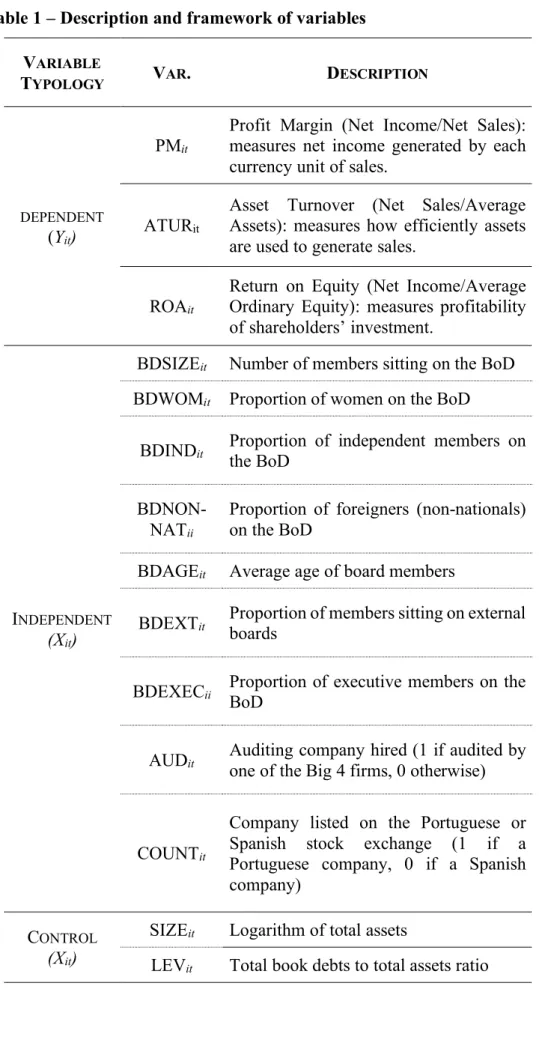
As mentioned, this research aims to analyse the effect of board diversity and choice of auditor on company profitability. Thus, while other research has used several accounting-based measures in order to analyse the same impact (i.e. Profit Margin, Asset Turnover, Return on Assets (ROA), Return on Equity (ROE), Earnings Per Share (EPS), Price Earnings Ratio (P-E), Pay-out Ratio, among others (Zahra and Pearce 1989; Shleifer and Vishny 1997; Von Nandelstadh and Rosenberg 2003; Bhagat and Black 2008; Guest 2009; Sachdeva 2014; Mizutani and Nakamura 2012; Rodriguez-Fernandez et al. 2013; Klettner et al. 2014; Mishra and Mohanty 2014; Mouselli et al. 2014; Bianco et al. 2015; Lopes and Ferraz, 2016), the current research selects only three of them (Profit Margin, Return on Equity, and Asset Turnover) as suggested by Weygandt et al. (2012). Independent variables were identified and selected from the relevant literature (Jensen and Meckling 1976; Watts and Zimmerman 1983; Limpton and Jay 1992; Eagle et al. 1995; Shrader and Blackburn 1997; Coles et al. 2001; Jensen 1993; Oxlheim and Randoy 2003; Bozec 2005; Dahya et al. 2009; Carter et al. 2010; Boulouta 2013; Lee and Lee 2013; Lopes and Ferraz 2016).The variable Size (measured as the logarithm of total assets) and Leverage (measured as total debts to total assets) of the selected firms were entered into the model as control variables. A positive signal is expected for the variable SIZE while a negative signal is predicted for the variable LEV. Hence, the theoretical construct is based on the variables identified in Table 1 below.
Table 1 ‒ Description and framework of variables VARIABLE TYPOLOGY VAR. DESCRIPTION DEPENDENT (Yit) PMit
Profit Margin (Net Income/Net Sales): measures net income generated by each currency unit of sales.
ATURit
Asset Turnover (Net Sales/Average Assets): measures how efficiently assets are used to generate sales.
ROAit
Return on Equity (Net Income/Average Ordinary Equity): measures profitability of shareholders’ investment.
INDEPENDENT
(Xit)
BDSIZEit Number of members sitting on the BoD BDWOMit Proportion of women on the BoD
BDINDit Proportion of independent members on the BoD
BDNON-NATii
Proportion of foreigners (non-nationals) on the BoD
BDAGEit Average age of board members
BDEXTit Proportion of members sitting on external boards
BDEXECii Proportion of executive members on the BoD
AUDit Auditing company hired (1 if audited by one of the Big 4 firms, 0 otherwise)
COUNTit
Company listed on the Portuguese or Spanish stock exchange (1 if a Portuguese company, 0 if a Spanish company)
CONTROL
(Xit)
SIZEit Logarithm of total assets
Based on the variables identified, it is expected that board characteristics, the type of auditing firm chosen, leverage, and size of the firm can all act as good indicators of a firm’s profitability. Thus, the general theoretical equation can be structured as follows:
Yit = β0 + β1BDSIZEit + β2BDWOMit + β3BDINDit + β4BDNON-NATit + β5BDAGEit +
β6BDEXTit + β7BDEXECit +β8AUDit + β9COUNTit + β10SIZEit + Β11LEVit + εit
(i = 1,….,n ; t = 1,….,m) Before conducting the empirical analysis, it was necessary to ensure that the available sample was eligible for application of a multiple regression (Cohen et al. 2003). The Durbin-Watson statistic assured the independence of observations, evidencing that no correlation exists in the research sample. It was confirmed that the residuals are normally distributed and that they fit the normal distribution line. The data has also been tested for homoscedasticity to ensure that the variances remain similar when moving along the line of residuals. In addition, further checks were made, to ensure that the independent variables are not highly correlated with each other, and this is verifiable by observing the Variance Inflation Factor (VIF) values. Being that the independent variables have a VIF value of between 1.069 and 2.903 (not close to 10), we can conclude that there is no multicollinearity. Finally, three other tools were used to eliminate significant outliers, high leverage and influential points, which could otherwise reduce the significance and the predictive accuracy of the model. The respective measures were set as follows: Mahalanobis Distance < 16.919; Centred Leverage Value < 0.295; Cook’s Distance < 1. After eliminating all of the outliers and running the necessary tests, a final adjusted sample of 93 companies (Portugal 35; Spain 58) was available for the empirical model.
4. Results and Interpretation
4.1. Descriptive and correlation measures
Companies used for the purposes of this study operated in nine different business sectors. The
Industrials sector represents 25.3% of the total sample, including transportation, electronic,
aerospace and defence, construction and materials, electronics and electrical equipment.
Consumer Goods represents 19.8% of the sample, including food and beverage producers,
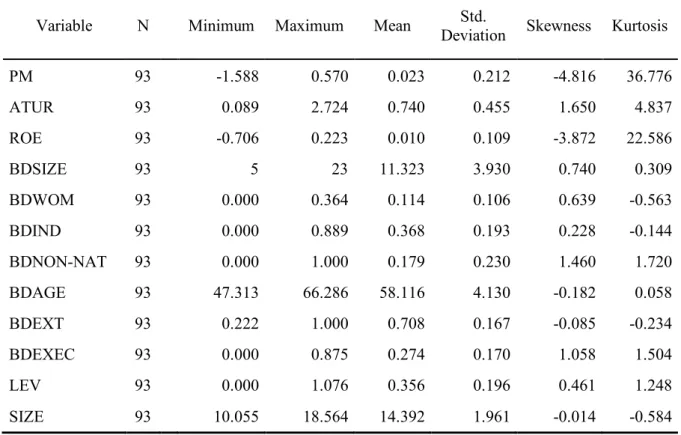
leisure goods, tobacco, home construction, and automobiles. With regard to the AUD variable, 84.9% of companies contracted one of the Big 4 auditing firms, with only 14 (15.1%) audited by a non-Big 4 firm. The descriptive statistics are shown in Table 2, below.
Table 2 – Descriptive Measures
Variable N Minimum Maximum Mean Deviation Std. Skewness Kurtosis
PM 93 -1.588 0.570 0.023 0.212 -4.816 36.776 ATUR 93 0.089 2.724 0.740 0.455 1.650 4.837 ROE 93 -0.706 0.223 0.010 0.109 -3.872 22.586 BDSIZE 93 5 23 11.323 3.930 0.740 0.309 BDWOM 93 0.000 0.364 0.114 0.106 0.639 -0.563 BDIND 93 0.000 0.889 0.368 0.193 0.228 -0.144 BDNON-NAT 93 0.000 1.000 0.179 0.230 1.460 1.720 BDAGE 93 47.313 66.286 58.116 4.130 -0.182 0.058 BDEXT 93 0.222 1.000 0.708 0.167 -0.085 -0.234 BDEXEC 93 0.000 0.875 0.274 0.170 1.058 1.504 LEV 93 0.000 1.076 0.356 0.196 0.461 1.248 SIZE 93 10.055 18.564 14.392 1.961 -0.014 -0.584
Based on several bivariate measures (÷2; V-Cramer; Pearson’s Coefficient, etc.) between board
characteristics, type of auditing firm, and independent variables, we found no significant association (p>0). The results provide preliminary evidence that board diversity and choice of auditing firm do not affect, at any statistically significant level, company profitability. This result does not corroborate most of the outcomes provided, namely in Zahra and Pearce (1989), Choi et al. (2007), Guest (2009), Oxelheim and Randoy (2003), Rodriguez-Fernandez (2013), Shank et al. (2013), Klettner et al. (2014), Mishra and Mohanty (2014), Mouselli et al. (2014), and Bianco et al. (2015). However, the preliminary insights of the research do align with evidence provided by Black et al. (2006) and Carter et al. (2010). Thus, for Iberian firms, there is no significant relationship between profitability and board diversity. However, our results do align with the literature in relation to control variables. SIZE and LEV are statistically significant and observe the expected predictive signals. Based on Pearson’s correlation matrix (Table 3 below), we underline the negative association between some board characteristics: BDSIZE and BDEXEC (r=-0.208; p=0.045); BDWOM and BDAGE (r=-0.219; p=0.035); BDIND and BDEXT (r=-0.370; p=0.000); and BDIND and BDEXEC (r=-0.410; p=0.000.
Table 3 – Matrix of Person’s Coefficients
VAR. PM ATUR ROE BDSIZE BDWOM BDIND BDNON
-NAT BDAGE BDEXT BDEXEC AUD COUNT SIZE LEV
PM 1 ATUR -0.068 1 0.518 ROE 0.911*** 0.101 1 0.000 0.337 BDSIZE -0.023 -0.160 -0.026 1 0.830 0.125 0.801 BDWOM 0.064 -0.093 0.058 0.043 1 0.541 0.374 0.582 0.683 BDIND 0.032 -0.015 0.048 -0.012 0.043 1 0.760 0.886 0.650 0.912 0.682 BDNON -NAT 0.054 -0.024 0.065 -0.027 0.012 0.017 1 0.606 0.820 0.533 0.800 0.906 0.869 BDAGE 0.062 -0.063 0.056 0.116 -0.219** 0.148 0.038 1 0.552 0.546 0.594 0.268 0.035 0.158 0.718 BDEXT 0.049 0.065 0.084 -0.078 0.153 -0.370 *** 0.158 -0.077 1 0.639 0.536 0.423 0.456 0.143 0.000 0.130 0.463 BDEXEC -0.003 0.044 0.000 -0.208** -0.036 -0.410*** -0.127 -0.103 0.367*** 1 0.979 0.676 0.996 0.045 0.731 0.000 0.223 0.326 0.000 AUD 0.034 0.063 0.008 0.127 0.009 0.117 0.004 0.261** -0.205** -0.057 1 0.745 0.548 0.940 0.225 0.931 0.262 0.973 0.012 0.049 0.591 COUNT 0.011 0.920 -0.011 -0.005 0.914 0.960 -0.093 0.378 -0.142 -0.2950.174 0.004 *** 0.034 0.747 -0.169 0.3640.105 0.000 *** 0.6090.000 *** -0.2940.004 *** 1 SIZE 0.115 -0.246** 0.118 0.672*** 0.140 0.275*** 0.211** 0.210** -0.213** .0.328*** -0.205** -0.294*** 1 0.271 0.017 0.262 0.000 0.181 0.008 0.042 0.043 0.041 0.001 0.049 0.004 LEV -0.390*** -0.342*** 0.528*** 0.135 0.047 -0.139 -0.098 -0.087 -0.045 0.042 -0.004 0.088 0.122 1 0.000 0.001 0.000 0.198 0.652 0.184 0.351 0.408 0.667 0.692 0.967 0.402 0.245 ***p<0.01; **p<0.05
4.2. The regression model
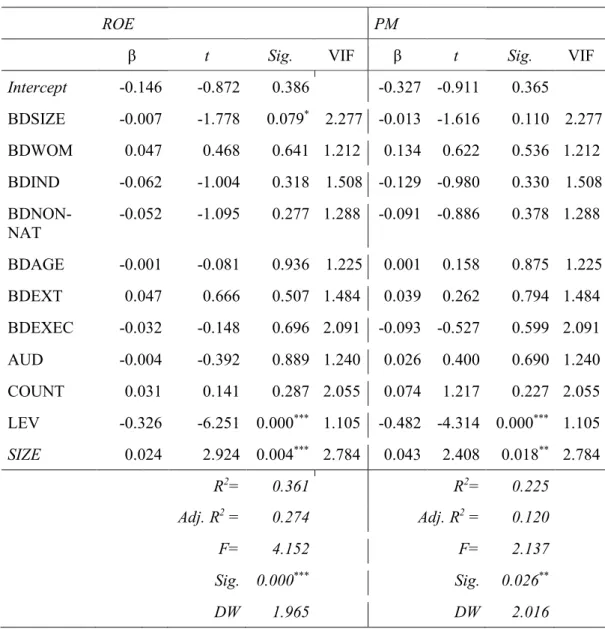
A hierarchical ordinary least square regression has been conducted to study the impact of independent variables on company profitability. As mentioned, several accounting-based measures have been considered as dependent variables (Profit Margin, ROE, and Asset Turnover), but only the model using Profit Margin and ROE could be globally validated. In relation to the dependent variable ATUR, the current research does not seem to fit well with the model, because when regressed with measures of board diversity and type of auditing firm contracted, the latter failed to explain any variance in performance (Adj. R2=0.099; F=1.817; p=0.067). Table 4, below, presents the results of the regression model conducted, which can only be applied to predict company Profit Margin and Return on Equity. In relation to ROE, we found an Adjusted R Square value of 27.4% (F=4.152; p=0.000), confirming that board characteristics and the type of auditing firm are not predictors of the likely profitability of Iberian firms. The results achieved by using PM as a dependent variable do align with previous evidence (Adj. R2=0.120; F=2.137; p=0.026). However, the evidence does not corroborate with the conclusions stated in other research, for example in Zahra and Pearce (1989), Choi et al. (2007), Guest (2009), Oxelheim and Randoy (2003), Rodriguez-Fernandez (2013), Shank et al. (2013), Klettner et al. (2014), Mishra and Mohanty (2014), Mouselli et al. (2014), and Bianco et al. (2015). These insights can probably be explained by cultural differences (Hofstede et al. 2010) and scale effects between both countries under analysis.
Table 4 – Regression Model Equations (PM and ROE)
ROE PM
β t Sig. VIF β t Sig. VIF
Intercept -0.146 -0.872 0.386 -0.327 -0.911 0.365 BDSIZE -0.007 -1.778 0.079* 2.277 -0.013 -1.616 0.110 2.277 BDWOM 0.047 0.468 0.641 1.212 0.134 0.622 0.536 1.212 BDIND -0.062 -1.004 0.318 1.508 -0.129 -0.980 0.330 1.508 BDNON-NAT -0.052 -1.095 0.277 1.288 -0.091 -0.886 0.378 1.288 BDAGE -0.001 -0.081 0.936 1.225 0.001 0.158 0.875 1.225 BDEXT 0.047 0.666 0.507 1.484 0.039 0.262 0.794 1.484 BDEXEC -0.032 -0.148 0.696 2.091 -0.093 -0.527 0.599 2.091 AUD -0.004 -0.392 0.889 1.240 0.026 0.400 0.690 1.240 COUNT 0.031 0.141 0.287 2.055 0.074 1.217 0.227 2.055 LEV -0.326 -6.251 0.000*** 1.105 -0.482 -4.314 0.000*** 1.105 SIZE 0.024 2.924 0.004*** 2.784 0.043 2.408 0.018** 2.784 R2= 0.361 R2= 0.225 Adj. R2 = 0.274 Adj. R2 = 0.120 F= 4.152 F= 2.137 Sig. 0.000*** Sig. 0.026** DW 1.965 DW 2.016 ***p<0.01; **p<0.05; *p<0.1
Broadly, board diversity and the type of auditing firm contracted do not influence the profitability indicators of non-financial Iberian companies (although a statistical global adherence of both models, p value of all variables is above the accepted level, except for control variables (leverage and size).
BDSIZE is negatively statistically correlated with ROE, however, at a 10% significance (r=-0.007; p=0,079). This evidence aligns with Jensen (1993), however, obtained at a low significance level. In relation to the participation of women on boards, there is no evidence to support the hypothesis that the relation between the proportion of women (BDWOM) on the board, and company profitability, is statistically significant (ROE: t=0.408; p=0.684; PM:
r=0,622; p=0.536). These results suggest a positive impact (ROE: r=0,047; PM: r=0.134), which corroborates the economic signals evidenced in Eagly et al. (1995), Erhardt et al. (2003), and Boulouta (2013). The positive impact supports the idea that women embody qualities as stated (empathy, affection, and promotion of community values) and that this has a positive impact on company profitability and performance. Other insights that corroborate with this positive effect can be found in Francoeur et al. (2008) and in Adams and Ferreira (2009). These authors emphasize that the higher proportion of women on boards boosts company profitability. Broadly, our results are consistent with those of Carter et al. (2003) and Adams et al. (2009), who reported inconclusive or not even statistically significant results.
In the current research, we have also put forward the hypothesis that company profitability is affected by the type of auditing firm the company selects for certification of the accounts. This assumption is not supported by our theoretical model, however, which evidences a mixed effect that is not statistically significant: AUD is negatively correlated with ROE (r=-0.004; t= -0.392; p=0,889) and positively correlated with PM (r=0.026; t=0.400; p=0,690). Contrary to the results achieved by Lee and Lee (2013), showing equity book value and earnings audited by the Big 4 firms justify the variations in stock returns more than those by other auditing firms, the results of the current research appear to be inconclusive.
Focusing on the participation of foreign board members, this research has found that greater participation of non-national directors negatively correlates with profitability (ROE: r=-0.052; p=0.277; PM: r=-0.091; p=0.378). This evidence does not corroborate the study of Choi et al. (2007), based on the Korean market, which confirmed that diversity of nationality on boards positively affects profitability and performance. However, these findings do align with one piece of research carried out among Swiss companies, where there is evidence that a greater national diversity on boards can create conflict and affect the decision-making process, hence negatively affecting profitability (Ruigrok et al. 2007).
With regard to interlocking directorates, the current study has tested whether the expertise of outside directors to the board positively affects profitability. This assumption is partially confirmed, because the relationship between outside directors (BDEXT), ROE, and PM is positive, although not statistically significant (ROE: r=0.047; t=0.666; p=0.507/PM: r=0.039; t=0.262;p=0.794). These results do not confirm the findings of Dahya and McConnell (2007) and Brickley and James (1987), both of which point out that a relevant number of external
directors tends to increase profitability overall. Nonetheless, much of the other research in this area reports similar inconclusive results concerning the link between company profitability and the ratio of external directors (Mehran 1995; Hermalin and Weisbach 2003; Bhagat and Black 2008). Surprisingly, the number of executive members is negatively correlated with profitability, although not statistically significant (ROE: 0.032; t=-0.148; p=0.696/PM: r=-0.093; t=-0.527;p=0.599). As expected, the control variables (SIZE and LEV) are statistically significant in both models.
With respect to the robustness of the models, we ran the multicollinearity diagnosis, the residual analysis, and the heteroscedasticity tests. We found that none of the independent variables of the current research has a VIF value close to 10, concluding that the analysis does not observe a severe problem of multicollinearity. In analysis of the independence of residuals, we used the Durbin-Watson (DW) test. Based on these statistics, we noted that a null hypothesis is not rejected, meaning that residuals describe a normal distribution, and confirming that those errors are not auto-correlated. In relation to heteroscedasticity, we used the White Test in not rejecting the null hypothesis (p>0.05). Thus, the evidence provided by the current econometric model can serve as an important contribution to both theory and practice.
4.3. Comparison between Portugal and Spain
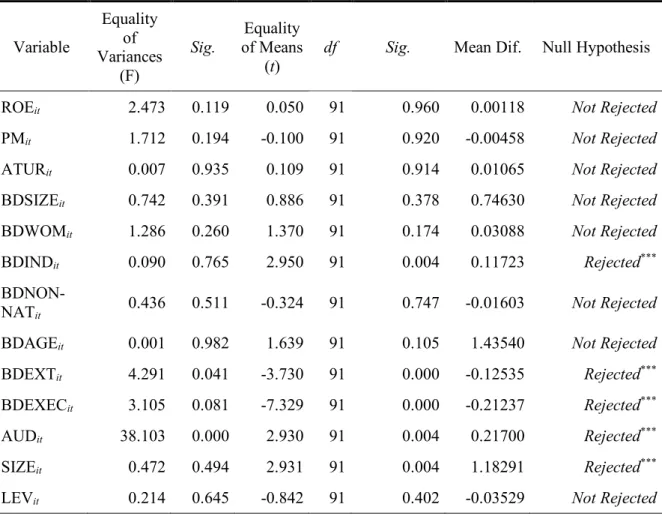
The current study has analysed the differences between Portugal and Spain in terms of whether the distribution of variances and means of the dependent and independent variables are the same for companies in both Iberian countries. As shown in Table 5, below, two tests were performed, Levene’s Test for equality of variances and the T-Test for equality of means. In this analysis, the null hypothesis states that the variance and the mean of the variables are equally distributed across both countries.
Table 5 – Comparison between Iberian countries Variable Equality of Variances (F) Sig. Equality of Means (t)
df Sig. Mean Dif. Null Hypothesis
ROEit 2.473 0.119 0.050 91 0.960 0.00118 Not Rejected
PMit 1.712 0.194 -0.100 91 0.920 -0.00458 Not Rejected
ATURit 0.007 0.935 0.109 91 0.914 0.01065 Not Rejected
BDSIZEit 0.742 0.391 0.886 91 0.378 0.74630 Not Rejected
BDWOMit 1.286 0.260 1.370 91 0.174 0.03088 Not Rejected
BDINDit 0.090 0.765 2.950 91 0.004 0.11723 Rejected***
BDNON-NATit 0.436 0.511 -0.324 91 0.747 -0.01603 Not Rejected
BDAGEit 0.001 0.982 1.639 91 0.105 1.43540 Not Rejected
BDEXTit 4.291 0.041 -3.730 91 0.000 -0.12535 Rejected***
BDEXECit 3.105 0.081 -7.329 91 0.000 -0.21237 Rejected***
AUDit 38.103 0.000 2.930 91 0.004 0.21700 Rejected***
SIZEit 0.472 0.494 2.931 91 0.004 1.18291 Rejected***
LEVit 0.214 0.645 -0.842 91 0.402 -0.03529 Not Rejected
***p<0.01
The null hypothesis is rejected only for BDIND, BDEXT, BDEXEC, AUD, and SIZE, to show that board characteristics differ across the two countries. The explanation behind these differences could be supported by the different corporate governance frameworks that apply in Portugal and Spain, as well as by cultural differences (Hofstede et al. 2010). As mentioned above in the theoretical framework, despite the convergence between Portugal and Spain in relation to avoidance of uncertainty and power distance in terms of individualism, masculinity, long-term orientation, and indulgence, there are real differences between the countries. That these four dimensions are stronger in Spain than in Portugal is probably a reflection of the scale effects, which is also supported by the control variable SIZE. Nevertheless, the null hypothesis cannot be rejected for BDSIZE, BDWOM, BDNON-NAT, BDAGE, and LEV, meaning that these board characteristics are similar between the two countries. This might be explained by the cultural similarities between the countries, but also by the fact that companies in both
countries are obliged to comply with rules similar to those of the financial markets that are regulated by European laws and procedures.
5. Conclusions and Final Remarks
The efficacy of corporate governance frameworks has received substantial attention by researchers, academics, and governmental institutions. Companies should comply with corporate governance frameworks, as these introduce a set of internal and external mechanisms that can affect the overall profitability of the company either positively or negatively depending on how they are implemented.
The current research analyses the relationship between board characteristics and profitability of the company, measured by the Profit Margin (PM) and Return on Equity (ROE) of 93 non-financial companies listed on the Portuguese and Spanish stock exchanges. Other profitability measures have been used, including ROA (Return on Assets), ROS (Return on Sales), Asset Turnover, Net Income, and Earnings Per Share (Weygandt et al. 2012). Taking a broad view, board characteristics, and choice of auditing firm are not reliable predictors of the profitability of Iberian firms, as the research did not provide significant results according to the level of variance explained (Adj. R-Square) and F-Test (p>0.1). The mixed results provided by the literature concerning statistical significant impacts and signals, induce us to report inconclusive results; however, the results obtained can be plausibly explained by both cultural and scale differences between the countries under analysis. When comparing Portugal and Spain, significant differences were found relating to the proportion of independent members, external members, and executive members on the board. These differences can be supported by scale effects, and can be measured through the control variable “firm size”. We underline, like other researchers, some practical limitations that could be addressed in the future: first, the current research has focused on Iberian-listed non-financial companies; second, the data used for analysis covers a single year, despite the stable variance in board characteristics and auditing firms over time. Therefore, we suggest that future research extends the timeline, the range of companies, and the number of countries, and employs other profitability measures and applies other statistical models, in order to achieve a more comprehensive view of the corporate governance phenomenon. By a process of elimination such as the current research provides a snap shot of both the stable and emerging nature of the phenomenon is achieved. This research helps verify which elements of corporate governance have a direct effect on company
profitability and sustainability, which when tracked, may yield statistically relevant results in the future.
References
Adams, R., & Ferreira, D. (2009). Women in the boardroom and their impact on governance and performance, Journal of Financial Economics, 94(1), 291‒309.
Adams, S., Gupta, M. A., & Leeth, J. D. (2009). Are female executives over-represented in precarious leadership positions?, British Journal of Management, 20(1), 1‒12.
Aggarwal, R., Erel, I., Ferreira, M., & Matos, P. (2011). Does governance travel around the world? Evidence from institutional investors, Journal of Financial Economics, 100(1), 154–181.
Agrawal, A., & Knoeber, C. (1996). Firm performance and mechanisms to control agency problems between managers and shareholders, Journal of Financial and Quantitative
Analysis, 31(1), 377‒397.
Ahrens, T., & Khalifa, R. (2013). Researching the lived experience of corporate governance,
Qualitative Research in Accounting & Management, 10(1), 4‒30.
Almazan, A., Hartzell, J.C., & Starks,L.T. (2005). Active Institutional Shareholders and Costs of Monitoring: Evidence from Executive Compensation, Financial Management, 34(4), 5–34.
Bhagat, S., & Black. B. (2008). The non-correlation between board independence and long-term firm performance, Journal of Corporate Law, 27(1), 231‒274.
Bianco, M., Ciavarella, A., & Signoretti, R. (2015). Women on Corporate Boards in Italy: The Role of Family Connections, Corporate Governance: An International Review, Vol. 23(2), 129-144.
BIS (2010). Principles for Enhancing Corporate Governance, Bank of International Settlements – Basel Committee on Banking Supervision, available at http://www.bis.org (accessed 5/8/2016).
BIS (2014). Guidelines Corporate Governance Principles for Banks, Bank of International Settlements – Monetary and Financial Stability – Basel Committee on Banking Supervision, available at http://www.bis.org (accessed 5/8/2016).
BIS (2015). Fit and Proper Principles, Bank of International Settlements – Committees at the Bank for International Settlement, available at http://ifci.ch/143630.htm (accessed 6/8/2016).
Black, B., Jang, H., & Kim, W. (2006). Does corporate governance affect firms’ market values? Evidence from Korea, Journal of Law, Economics and Organization, 22(1), 366‒413. Boulouta, I. (2013). Hidden connections: The link between board gender diversity and
corporate social performance, Journal of Business Ethics, 113(2), 185‒197.
Bozec, R. (2005). Board of directors, market discipline and firm performance, Journal of
Business, Finance and Accounting, 32(9/10), 1921‒1960.
Brickley, J. A., & James, C. M. (1987). The takeover market, corporate board composition, and ownership structure: The case of banking, Journal of Law and Economics, 30(1), 161‒180.
Bryman, A., & Cramer, D. (1997). Quantitative data analysis with SPSS for Windows. London: Routledge.
Cadbury, A. (1992). Report of the Committee on the Financial Aspects of Corporate
Governance. London: Professional Publishing Ltd.
Carter, D. A., Simkins, B. J., & Simpson, W. G. (2003). Corporate governance, board diversity and firm value, Financial Review, 38(1), 33‒53.
Carter, D., D’Souza, F., Simkins, B., & Simpson, W. (2010). The gender and ethnic diversity of US boards and board committees and firm financial performance, Corporate
Governance: An International Review, 18(5), 396‒414.
Choi, J. J., Park, S. W., & Yoo, S. S. (2007). The value of outside directors: Evidence from corporate governance reform in Korea, Journal of Financial and Quantitative Analysis, 42(1), 941‒962.
Chugh, L. C., Meador, J. W., & Kumar, A. S. (2011). Corporate governance and firm performance: Evidence from India, Journal of Finance and Accountancy, 7(1), 1‒10.
Cohen, J., Cohen, P., West, S., & Aiken, L. (2003). Applied multiple regression/correlation
analysis for the behavioral sciences. London: Lawrence Erlbaum Associates.
Coles, J. W., McWilliams, V. B., & Sen, N. (2001). An examination of the relationship of governance mechanisms to performance, Journal of Management, 27(1), 23‒50. Dahya, J., & McConnell, J. J. (2007). Board composition, corporate performance and the
Cadbury committee recommendation, Journal of Finance and Quantitative Analysis, 42(3), 535‒564.
Daily, C. M., Dalton, D. R., & Cannella, A. A. (2003). Corporate Governance: Decades of dialogue and data, Academy of Management Review, 28(3), 371‒382.
Daily, C. M., Trevis, C. S., & Dalton, D. R. (1999). A decade of corporate women: Some progress in the boardroom, none in the executive suite, Strategic Management Journal, 20(1), 93‒99.
Dalton, D. R., Daily, C. M., Johnson, J. L., & Ellstrand, A. E. (1998). Number of directors and financial performance: A meta-analysis, Academy of Management Journal, 2(1), 269‒ 290.
Eagly, A. H., Karau, S. J., & Makhijani, M. G. (1995). Gender and the effectiveness of leaders: A meta-analysis, Psychological Bulletin, 117(1), 125‒145.
Ehikioya, K. (2009). Corporate governance structure and firm performance in developing economies: Evidence from Nigeria, Corporate Governance, 9(3), 231‒243.
Erhardt, N. L., Werbel, J. D., & Shrader, C. B. (2003). Board of director diversity and firm financial performance, Corporate Governance: An International Review, 11(2), 102‒ 111.
European Parliament and the Council (2014). Directive 2014/95/EU of the European Parliament and of the Council, dated 22 October 2014 on disclosure of non-financial and diversity information, Official Journal of the European Union, L 330/1), available at
http://eur-lex.europa.eu/legal-content/EN/TXT/?uri=CELEX:32014L0095 (accessed
27/7/2016).
Fama, E, & Jensen, M. C. (1983). Separation of ownership and control, Journal of Law and
FRC (2011). Guidance on Board Effectiveness, available at https://www.frc.org.uk (accessed 12/7/2016).
Francoeur, C., Labelle, R., & Sinclair-Desgagné, B. (2008). Gender diversity in corporate governance and top management, Journal of Business Ethics, 81(1), 83‒95.
Galbreath, J. (2012). Are boards on board? A model of corporate board influence on sustainability performance, Journal of Management & Organization, 18(4), 445–460. Gjesdal, F. (2007). Moral Hazard with Hidden Information, in R. Antle, F. Gjesdal, and P. J.
Liang (eds), Essays in Accounting Theory in Honour of Joel S. Demski. New York: Springer Science+Business Media, LLC, 97‒122.
Guest, P. M. (2009). The impact of board size and firm performance: Evidence from the UK,
The European Journal of Finance, 15(4), 385‒404.
Hermalin, B., & Weisbach, M. (2003). Board of directors as an endogenously determined institution: A survey of the economic literature, Economic Policy Review, 9(1), 7‒26. Higgs, D. (2003). Review of the role and effectiveness of non-executive directors. London:
The Department of Trade and Industry.
Hillman, A., & Dalziel, T. (2003). Boards of directors and firm performance: Integrating agency and resource dependency perspectives, Academy of Management Review, 28(1), 383‒396.
Hofstede, G., Hofstede, G. J., & Minkov, M. (2010). Cultures & organizations ‒ Software of
the mind: Intercultural cooperation and its importance for survival, 3rd edition. New
York: McGraw-Hill.
Jensen, M. C. (1993). The modern industrial revolution, exit, and failure of internal control systems, Journal of Finance, 48(3), 831‒880.
Jensen, M., & Meckling, W. (1976). Theory of the firm: Managerial behaviour, agency costs, and ownership structure, Journal of Financial Economics, 3(4), 305‒360.
Johnson, L. J., Ellstrand, A. E., & Daily, C. M. (1996). Boards of directors: A review and research agenda, Journal of Management, 22(3), 409‒438.
Klein, A. (1998). Firm performance and board committee structure, Journal of Law &
Klettner A., Clarke, T., & Boersma, M. (2014). The Governance of Corporate Sustainability: Empirical Insights into the Development, Leadership and Implementation of Responsible Business Strategy. Journal of Business Ethics, 122(1), 145‒165.
Lattemann, C. (2014). On the convergence of corporate governance practices in emerging markets, International Journal of Emerging Markets, 9(2), 316‒332.
Lee, H., & Lee, H. (2013). Do Big 4 audit firms improve the value relevance of earnings and equity?, Managerial Auditing Journal, 28(7), 628‒646.
Limpton, M., & Jay, W. (1992). A modest proposal for improved corporate governance,
Journal of Business Law, 48(1), 59‒77.
Lopes, I. T., & Ferraz, D. P. (2016). The value of intangibles and diversity on boards looking towards economic future returns: Evidence from non-financial Iberian business organisations, Int. J. Business Excellence, 10(3), 392‒417.
Mehran, H. (1995). Executive compensation structure, ownership and firm performance,
Journal of Financial Economics, 38(1), 163‒184.
Mishra, S., & Mohanty, P. (2014). Corporate Governance as a value driver for firm performance: Evidence from India, Corporate Governance, 14(2), 265‒280.
Mizruchi, M. S. (1996). What do interlocks do? An analysis, critique, and assessment of research on interlocking directorates, Annual Review of Sociology, 22(1), 271‒289. Mouselli, S., Abdoulraouf, R., & Jaafar, A. (2014). Corporate governance, accruals quality and
stock returns: Evidence from the UK, Corporate Governance, 14(1), 32‒44.
Mizutani, F., & Nakamura, E. (2014). Managerial incentive, organizational slack, and performance: empirical analysis of Japanese firms’ behaviour, Journal of Management
and Governance, 18(1), 245‒284.
Nicholson, G. J., & Kiel, G. C. (2007). Can directors impact performance: A case based test of three theories of corporate governance, Corporate Governance: An International
Review, 15(1), 585‒608.
OECD (2015). Principles of Corporate Governance, OECD Report to G20 Finance Ministers and Central Bank Governors, available at www.oecd.org/daf/ca (accessed 5/8/2016).
Oxelheim, L., & Clarkson, K. (2015). Cronyism and the Determinants of Chairman Compensation. Journal of Business Ethics, 131, 69‒87.
Park, Y. W., & Shin, H. H. (2004). Board composition and earnings management in Canada,
Journal of Corporate Finance, 10(3), 431‒457.
Pierce, C. (2012). Corporate Governance in the European Union. London: Global Governance Services Ltd.
Rodriguez-Fernandez, M., Fernandez-Alonso, S., & Rodriguez-Rodriguez, J. (2013). Board characteristics and firm performance in Spain, Corporate Governance, 14(4), 485‒503. Ruigrok, W., Peck, S., & Tacheva, S. (2007). Nationality and gender diversity on Swiss
corporate boards, Corporate Governance: An international Review, 15(4), 546‒557. Sachdeva, G. (2014). Corporate Governance, Concepts and Practices: A Survey, The
International Journal of Business & Management, 2(2), 51‒60.
Shank, T, Hill, R. P., & Stang, J. (2013). Do investors benefit from good corporate governance?, Corporate Governance, 13(4), 384‒396.
Sheikh, N. A., Wang, Z., & Khan, S. (2013). The impact of internal attributes of corporate governance on firm performance: Evidence from Pakistan, International Journal of
Commerce and Management, 23(1), 38‒55.
Shleifer, N. A., & Vishny, R. W. (1997). A survey of corporate governance, Journal of
Finance, 52(2), 737‒783.
Shrader, C. B., & Blackburn, V. B. (1997). Women in management and firm financial performance: An exploratory study, Journal of Managerial Issues, 9(3), 355‒372. Vintila, G., & Gherghina, C. (2012). An Empirical Examination of the Relationship between
Corporate Governance Ratings and Listed Companies’ Performance, International
Journal of Business and Management, 7(22), 46‒61.
Von Nandelstadh, A., & Rosenberg, M. (2003). Corporate governance mechanisms and firm performance: Evidence from Finland, Working Papers 497, Helsinki: Hanken School of Economics.
Watts, R. L., & Zimmerman, J. L. (1983). Agency problems, auditing, and the theory of the firm: Some evidence, Journal of Law and Economics, 26(1), 613‒634.
Weygandt, J. J., Kimmel, P. D., & Kieso, D. E. (2012). Financial Accounting IFRS Edition, 2nd Edition, New Jersey: John Wiley & Sons.
Yaacob, H., & Basiuni, J. (2014). Corporate governance model of a state-owned enterprise: Evidence from an Asian emerging market, Corporate Governance, 14(4), 504‒514. Yermack, D. (1996). Higher market valuation of companies with a small board of directors,
Journal of Finance and Economics, 40(2), 185‒211.
Zahra, S. A., & Pearce, J. A. (1989). Boards of directors and corporate financial performance: A review and integrative model, Journal of Management, 15(2), 291‒334.