R E S E A R C H
Open Access
Efficacy of sertraline against
Trypanosoma
cruzi
: an in vitro and in silico study
Daiane Dias Ferreira
1, Juliana Tonini Mesquita
1, Thais Alves da Costa Silva
1, Maiara Maria Romanelli
1,
Denise da Gama Jaen Batista
2, Cristiane França da Silva
2, Aline Nefertiti Silva da Gama
2, Bruno Junior Neves
3,
Cleber Camilo Melo-Filho
3, Maria de Nazare Correia Soeiro
2, Carolina Horta Andrade
3and Andre Gustavo Tempone
1*Abstract
Background:Drug repurposing has been an interesting and cost-effective approach, especially for neglected diseases, such as Chagas disease.
Methods:In this work, we studied the activity of the antidepressant drug sertraline againstTrypanosoma cruzi
trypomastigotes and intracellular amastigotes of the Y and Tulahuen strains, and investigated its action mode using cell biology and in silico approaches.
Results:Sertraline demonstrated in vitro efficacy against intracellular amastigotes of bothT. cruzistrains inside different host cells, including cardiomyocytes, with IC50values between 1 to 10μM, and activity against
bloodstream trypomastigotes, with IC50of 14μM. Considering the mammalian cytotoxicity, the drug resulted in a selectivity index of 17.8. Sertraline induced a change in the mitochondrial integrity ofT. cruzi, resulting in a decrease in ATP levels, but not affecting reactive oxygen levels or plasma membrane permeability. In silico approaches using chemogenomic target fishing, homology modeling and molecular docking suggested the enzyme isocitrate dehydrogenase 2 ofT. cruzi(TcIDH2) as a potential target for sertraline.
Conclusions:The present study demonstrated that sertraline had a lethal effect on different forms and strains ofT. cruzi, by affecting the bioenergetic metabolism of the parasite. These findings provide a starting point for future experimental assays and may contribute to the development of new compounds.
Keywords:Trypanosoma cruzi, Drug, Treatment, Sertraline, Drug repurposing, Drug repositioning
Background
Chagas disease is a neglected tropical protozoan disease that affects 8 million people, mainly in South and Cen-tral America [1]; however, cases have also been reported in North America, Europe and some other Western countries [2]. The current treatment of Chagas disease is an alarming issue. A recent clinical study re-evaluated the efficacy of benznidazole (BZ), the only available treatment in Brazil; despite a reduction in parasitemia, the study revealed that BZ induced no significant im-provements in cardiac clinical outcomes during chronic-phase Chagas disease [3]. According to the
non-profit organization Drugs for Neglected Diseases initiative (DNDi), in the next 5 years, 200,000 people liv-ing with Chagas disease will die from heart disease and related complications. DNDi also highlighted the urgent need to find better treatments [4]. Additionally, the drug safety of the available treatment is inadequate; BZ is im-plicated in serious systemic side effects, including an-orexia, vomiting, peripheral polyneuropathy, depression of bone marrow, and allergic dermopathy. As a conse-quence of these adverse reactions, treatment has to be discontinued [5].
The discovery of new therapeutic agents is expensive and may take many years. Several strategies have been implemented in order to reduce the costs and time of the drug discovery process. Drug repositioning has emerged as a promising strategy for drug discovery for
* Correspondence:[email protected];[email protected]
1Instituto Adolfo Lutz, Centre for Parasitology and Mycology, Avenida Dr.
Arnaldo 351, 8° andar, sala 9, CEP, São Paulo, SP 01246-000, Brazil Full list of author information is available at the end of the article
Neglected Tropical Diseases (NTDs). Also referred to as drug repurposing, this strategy consists of finding novel indications for approved drugs [6]. Sertraline (SERT), a serotonin reuptake inhibitor, is widely used in the treat-ment of patients with depression and severe anxiety dis-orders [7], and has exhibited antifungal [8], antimicrobial [9], and anticancer activities [10]. The drug has shown promising activity against the protozoan
Leishmania donovani; it reduced the parasite burden of
animals by 72% at doses of 10 mg/kg for 30 days [11]. In the present work, we evaluated the activity of SERT againstT. cruzitrypomastigotes and intracellular
amasti-gotes of the Y and Tulahuen strains and investigated its mode of action using cell biology and in silico chemoge-nomic approaches.
Methods
Additional file 1 shows a Flowchart of the global methodology.
Animals
BALB/c mice were supplied by the animal breeding facility at the Adolfo Lutz Institute of São Paulo whereas Swiss mice were obtained from the Fundação Oswaldo Cruz (FIOCRUZ) Rio de Janeiro. The mice were maintained in sterilized cages under a controlled environment and re-ceived water and food ad libitum. Animal procedures were performed with the approval of the Research Ethics Com-mission, in agreement with the Guidelines for the Care and Use of Laboratory Animals from the National Acad-emy of Sciences. All procedures carried out at Institute Adolfo Lutz were approved by the Committee for Ethics in the Use of Animals (CEUA 04/2016). All procedures performed at FIOCRUZ were in accordance with the guidelines established by the FIOCRUZ Committee for Ethics in the Use of Animals (CEUA LW16/14).
Drugs and chemicals
Resazurin, Roswell Park Memorial Institute medium (RPMI 1640) without phenol red, and Hanks’ Balanced Salt Solution (HBSS), were purchased from Sigma-Aldrich. Sytox Green® and H2CDFDA (2 ‘, 7′-dichlorodihydrofluorescein diacetate) were purchased from Molecular Probes ® (Invitrogen ™). Fetal Bovine
Serum (FBS) was obtained from Gibco and gentamicin sulfate from Hipolabor Pharmaceuticals. Benznidazole (BZ) and sertraline (SERT) were purchased from Sigma-Aldrich. All other reagents not mentioned were purchased from Sigma-Aldrich.
Parasites and mammalian host cells T. cruzi (Y strain - culture trypomastigotes)
Trypomastigotes were maintained in LLC-MK2 cells with RPMI-1640 medium supplemented with 2% fetal
bovine serum (FBS) at 37 °C and 5% CO2 in a
humidi-fied incubator.
T. cruzi (Y strain - bloodstream trypomastigotes - BT) Trypomastigotes were obtained from the blood samples of infected albino Swiss mice at the peak of parasitemia. The purified parasites were resuspended in Dulbecco’s Modified Eagle Medium (DMEM) supplemented with 10% FBS as reported previously [12].
Macrophages
Macrophages used in the intracellular amastigote assays were collected from the peritoneal cavity of BALB/c mice by washing with RPMI-1640 medium supple-mented with 10% FBS and maintained at 37 °C in an at-mosphere of 5% CO2in a humidified incubator.
Cardiac cell cultures (CC)
Cardiac cells were used in the cytotoxicity and intracel-lular amastigote assays. Primary cultures of embryonic cardiac cells were obtained from Swiss mice as previ-ously reported [12]. Briefly, after purification, the CC were seeded at a density of (0.2 × 10⁶ cell/well) into
24-well microplates containing gelatin-coated cover slips as previously described. The cardiac cultures were then sustained at 37 °C in DMEM supplemented with 10% horse serum, 5% fetal bovine serum, 2.5 mM CaCl2,
1 mM L-glutamine and 2% chicken embryo extract.
NCTC cells-clone L929
NCTC cells were maintained in medium M-199 supple-mented with 10% FBS and were maintained at 37 °C under 5% CO2in a humidified incubator.
Determination of the Anti-T. cruziactivity Culture trypomastigotes
To determine the 50% inhibitory concentration (IC50)
againstT. cruzi, trypomastigotes were counted in a
Neu-bauer hemocytometer and seeded at (1 × 10⁶cells/well) in
96-well microplates. The drug was dissolved in dimethyl sulfoxide (DMSO), diluted with RPMI-1640 medium at different concentrations for 24 h at 37 °C and placed in a 5% CO2humidified incubator. The parasite viability was
determined using the colorimetric resazurin assay [13]. Benznidazole was used as the standard drug. The optical density was read at 570 nm (FilterMax F5 Multi-Mode Microplate Reader, Molecular Devices). DMSO was used at a maximal concentration of 0.5% in all assays and was incubated with cells as an internal control.
Bloodstream trypomastigotes (BT)
The trypomastigotes (5 × 10⁶/mL) were incubated for
24 h of incubation, the parasite death rate was deter-mined by light microscopy through direct quantification of the number of living parasites using a Neubauer chamber, and the IC50was then calculated.
Determination of cytotoxicity Cytotoxicity against mammalian cells
NCTC cells 929 (6 × 10⁴ cells/well) in 96-well
micro-plates were incubated with the drug for 48 h at 37 °C in a 5% CO2incubator. The selectivity index (SI) was
deter-mined using the following formula: CC50 against
mam-malian cells/ IC50against parasites. The cell viability was
determined using the colorimetric resazurin assay [13]. The obtained data represent the mean of two independ-ent experimindepend-ents performed in duplicate.
Cytotoxicity against CC
Cardiac cells were incubated at 37 °C for different pe-riods of time (24–48 h) with increasing concentrations of the drug and were diluted in DMEM (without phenol red). The mammalian cell morphology and spontaneous contractibility were evaluated by light microscopy, whereas the cellular viability was determined by the col-orimetric resazurin assay. After incubation for 24 h, the absorbance was determined at 570 nm [14]. The ob-tained data represent the mean of two independent ex-periments performed in duplicate.
Intracellular amastigotes ofT. cruziin peritoneal macrophages
After the mammalian cytotoxicity studies, the effect of ser-traline was investigated against intracellular amastigotes. Peritoneal macrophages (1 × 10⁵cells/well) were dispensed
in 16-well chamber slides (NUNC, Thermo, USA) and maintained for 24 h in the same medium at 37 °C in a 5% CO2 humidified incubator for attachment. Non-adherent
cells were removed by two-step washings with medium. After 24 h, these cells were infected with (1 × 10⁶culture
trypomastigote) forms for 4 h (parasite-to-macrophage ra-tio 10:1). Subsequently, infected cells were incubated with the drug for 48 h. Finally, the slides were fixed with methanol, stained with Giemsa, and observed via light mi-croscopy. The parasite load was defined by counting 400 macrophages/well by evaluating the number of infected macrophages. Benznidazole was used as the standard drug. The obtained data represent the mean of two inde-pendent experiments performed in duplicate.
Intracellular amastigotes of cardiac cell cultures
For analysis of the effect against intracellular amastigotes from the Y strain, after 24 h of parasite-host cell inter-action, the infected cardiac cell cultures were washed to remove free parasites and were then incubated for an-other 48 h with increasing concentrations of the drug.
Cardiac cell cultures were maintained at 37 °C in an at-mosphere of 5% CO2 and air, and the medium was
re-placed every 24 h. Then, untreated and treated infected cardiac cell cultures were fixed and stained with Giemsa solution, and the mean number of infected host cells and mean number of parasites per infected cell were scored. Only characteristic T. cruzi nuclei and
kineto-plasts were counted as living parasites since irregular structures may indicate parasites undergoing death. The compound activity was estimated by calculating the in-fection index (II - percentage of infected cells times the average number of intracellular amastigotes per infected host cell) [15]. The obtained data represent the mean of two independent experiments performed in duplicate.
Intracellular amastigotes inside L929 cell lines
The effect against intracellular forms was also investi-gated in L929 cell lineages infected with tissue culture-derived trypomastigotes (Tulahuen strain ex-pressing the Escherichia coli β-galactosidase gene), employing a parasite-to-host-cell ratio of 10:1. After in-cubation with the drug for 96 h, the viability of parasites was determined colorimetrically as previously reported [14]. The obtained data represent the mean of two inde-pendent experiments performed in duplicate.
Mode of action studies of SERT inT. cruzi
Spectrofluorimetric detection of the permeability of the cell membrane
Culture trypomastigotes were washed with PBS (phos-phate buffered saline), deposited on a microplate (2 × 10⁶ cells/well) and incubated with SYTOX Green®
(1μM) for 15 min at 24 °C [16]. Sertraline was added at the IC50 value (2 μM), and the fluorescence was
mea-sured after 20, 40 and 60 min. The maximum permeabil-ity was observed with 0.1% Triton X-100 (positive control). The fluorescence intensity was determined using a plate spectrofluorimeter (FilterMax F5 Multi-Mode MicroplateReader-Molecular Devices) with excitation and emission wavelengths of 485 and 520 nm, respectively. Untreated trypomastigotes and 0.5% (v/v)
DMSO-treated parasites were used in all assays as nega-tive controls. The obtained data represent the mean of two independent experiments performed in triplicate.
Effect of sertraline on the mitochondrial integrity
Culture trypomastigotes were washed with PBS, depos-ited on a microplate (2 × 10⁶ cells/well) and incubated
with sertraline at the IC50 value (2 μM) for 60 min at
37 °C. MitoTracker Red CM-H2XROS (500 nM) was
Multi-Mode Microplate Reader-Molecular Devices) with excitation and emission wavelengths of 540 and 595 nm, respectively [17]. Carbonyl cyanide 4-(trifluoromethoxy)-phenylhydrazone (FCCP; 10 μM) was used as a positive control [18]. The obtained data represent the mean of two independent experiments performed in triplicate.
Analysis of reactive oxygen species (ROS)
Culture trypomastigotes (2 × 10⁶cells/well) were washed
in HBSS (Hanks’Balanced Salt Solution) and incubated with sertraline at the IC50 value (2 μM) for 60 min at
37 °C. H2DCF-DA (5μM) was added, and the cells were
incubated for 15 min. The fluorescence intensity was de-tected using a plate spectrofluorimeter (FilterMax F5 Multi-ModeMicroplate Reader-Molecular Devices) at 485 and 520 nm for excitation and emission, respectively [19]. The obtained data represent the mean of two inde-pendent experiments performed in triplicate.
Measurement of cellular ATP content
The intracellular adenosine triphosphate (ATP) content was measured by a luciferin–luciferase bioluminescence assay using a specific kit (Life Technologies, USA) ac-cording to the manufacturer’s instructions. ATP concen-trations were calculated using the ATP standard curve kit. Culture trypomastigotes were washed twice with PBS, seeded at (2 × 10⁶ cells/well) and incubated at the
IC50 value (2 μM) of sertraline in the presence or
ab-sence (control) of 0.1% Triton X-100 for 1 h. The ATP level was rapidly measured by a coupled luciferin-luciferase reaction [20]. The obtained data rep-resent the mean of two independent experiments per-formed in triplicate.
In silico studies
Prediction of sertraline targets using publicly available databases
We carried out a literature search using PubMed, Pub-Chem Bioassay, ChEMBL and BindingDB in order to identify all possible SERT targets for all organisms. Our definition of a“sertraline target”embraces in vitro assays of SERT against any enzyme, receptor or channel with inhibition ≤40 μM. Then, individual information for each SERT target (primary amino acid sequence in FASTA format, target name and organism) was obtained from the UNIPROT database and was subsequently allo-cated into a single Excel file (Additional file2).
Pairwise protein alignment
Superimposed structures allow a comparison of function-ally relevant features, conserved residues necessary for ca-talysis, and residues critical for ligand binding. Therefore, SERT targets were aligned with allT. cruziproteins using
pairwise BLAST. We considered theT. cruzitarget to be
druggable if it has ≥80% overlap of the corresponding SERT target and an expected value (E-value)≤10−20. The E-value represents the number of hits with an alignment score “Z” equal to or greater than the“Z” that would be expected by chance when searching a database, which is the expected number of times a homology will occur at random from a given set of trials.
Comparison of functional regions
The ConSurf server [21] is a bioinformatics tool for esti-mating the evolutionary conservation of amino-acid posi-tions in a protein based on the phylogenetic relaposi-tions between homologous sequences. We used ConSurf for an additional characterization of the functional regions (active site conservation) inT. cruzitargets. Therefore, the degree
of conservation of the amino acids from the active site was estimated using 150 homologue proteins with similar sequences retrieved from the UNIPROT database and was identified by the PSI–BLAST method (E-value cutoff ≤1−10) [22]. The sequences were clustered, and highly simi-lar (> 95%) sequences were removed using CD-HIT [23]. A multiple sequence alignment (MSA) of the homologous se-quences was constructed using MAFFT-L-INS-I [23]. Sub-sequently, the MSA was employed to construct a phylogenetic tree using the neighbor-joining algorithm [24]. Position-specific conservation scores were analyzed using the empirical Bayesian method. Subsequently, functional regions were visually compared with corresponding SERT targets and were classified as conserved (≥ 70%) or non-conserved (< 70%). The obtained results are described in Additional files3,4,5and6.
Homology modeling and molecular docking
In the absence of available experimental data, a hom-ology model of T. cruzi isocitrate dehydrogenase 2
(TcIDH2) was constructed using homology modeling by
comparing the sequence of this target protein with se-quences of other proteins (template) for which experi-mental structures are available. The TcIDH2 sequence
was obtained from the TriTrypDB database (Accession: Tc00.1047053506925.319). A BLAST search was carried out with the Protein Data Bank for the identification of a template structure. Three IDH crystal structures were found: human (HsIDH2), Sus scrofaand Mycobacterium tuberculosis (PDB IDs: 4JA8, 1LWD, 4HCX,
respect-ively). Based on the resolution, the crystal structure of
HsIDH2 bound to the allosteric inhibitor AGI-6780
(PDB ID 4JA8) [25], was chosen as a template for hom-ology modeling, which presented 66.5% of sequence identity in relation toTcIDH2. SWISS-MODEL program
[26] was used for generation of the homology model of
TcIDH2. The quality of the model was assessed using
Molecular docking studies were performed to investigate the intermolecular interactions between SERT and the amino-acid residues of TcIDH2 as well as to predict the
binding affinity. The generated homology model ofTcIDH2
was imported into Maestro v. 10.0 [29] and was prepared using the Protein Preparation Wizard workflow as follows: hydrogen atoms were added according to Epik v. 2.7 (pH 7.4 ± 1.0) and minimized using the OPLS-2005 force field. Next, the structure of SERT was imported from the ChemSpider database and 300 conformations were gener-ated using OMEGA v. 2.5.1.4 [30]. Subsequently, the con-formers had their most favorable ionization state calculated at pH 7.4 using the ‘fixpka’ function, and AM1-BCC charges were added using QUACPAC v.1.6.3.1 [29]. Before the docking studies, two different grids were defined to in-clude the catalytic site and one allosteric site of TcIDH2.
The catalytic site grid was built with the dimensions of 26.3 Å × 15.8 Å × 27.9 Å (x, y and z) and a volume of
11,645 Å3. The allosteric site grid had the dimensions of
16.3 Å × 20.3 Å × 19.7 Å and a volume of 6531 Å3. Finally,
molecular docking of SERT withTcIDH2 was investigated
using the software FRED, which is available in OEDocking suite v. 3.0.1 [31] using the high-resolution precision and ChemGauss 4 scoring function.
Statistical analysis
The obtained data represent the mean of three inde-pendent experiments performed in duplicate. The IC50
and CC50 values were calculated using sigmoid
dose-response curves generated by the software Graph-Pad Prism version 5.0 (GraphGraph-Pad Software, San Diego, CA, USA). The ANOVA test was performed to evaluate the significance (p< 0.05) of data.
Results
Antiparasitic activity and mammalian cytotoxicity of sertraline
The anti-trypanosomal activity of SERT in cell culture-derived trypomastigotes (Y strain) was deter-mined colorimetrically by resazurin. After 24 h, 100% of the parasites were eliminated, resulting in an IC50value
of 1.8 μM (± 0.8). Using blood-derived trypomastigotes, SERT showed an IC50value of 14.2μM (± 5.5) (Table1).
The drug was also effective against the intracellular amastigotes in peritoneal macrophages, resulting in an IC50 value of 1.4 (± 0.6) μM; using intracellular
amastigotes in cardiac cell cultures, the IC50 value was
6.6 μM (± 1.4). The intracellular amastigotes of the / a Tulahuen strain inside fibroblasts (L929 cells) were also susceptible, resulting in an IC50value of 10.0μM (± 1.7)
(Table 1). The mammalian cytotoxicity was determined in L929 cells and cardiac cell cultures, and resulted in respective CC50values of 11.5μM (± 2.48) and 25.0μM
(± 13.2). Benznidazole was used as the standard and re-sulted in IC50 values of 17.7 μM (± 1.9) against
trypo-mastigotes (Y strain) and 5 μM (± 1.5) against intracellular amastigotes (Y strain) (Table1).
Action mode studies of SERT inT. cruzi Permeability of plasma membrane
To evaluate the possible effect of SERT on the plasma membrane permeability of culture trypomastigotes ofT. cruzi, SERT was incubated for 60 min with
trypomasti-gotes at the corresponding IC50 value, after which the
permeability of the membrane was evaluated fluorimetri-cally using the vital dye SYTOX Green®. The data dem-onstrated no increase in the fluorescence levels, suggesting that sertraline did not interfere with the plasma membrane permeability of the parasite. Triton X-100 was used as a positive control (data not shown).
Effects on mitochondrial integrity and ATP production The mitochondrial integrity of trypomastigotes was inves-tigated in the presence of SERT at the IC50value using the
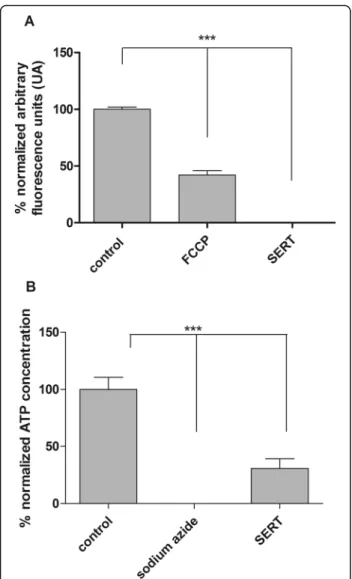
fluorescent probe Mitotracker Red®. After 60 min of incu-bation, SERT induced an intense and significant depolarization (p< 0.05), with the fluorescence intensity
decreasing by 100% when compared to untreated trypo-mastigotes (control) (Fig.1a). FCCP was used as a positive control and reduced the fluorescence levels by approxi-mately 54% compared to untreated parasites. The produc-tion of ATP by trypomastigotes was investigated in the presence of SERT using a luminescent assay with luciferase (ATP kit - Thermo). At 60 min of incubation, an intense decrease in ATP levels of approximately 70% was observed compared to untreated parasites (p< 0.05) (Fig. 1b).
So-dium azide was used as a positive control and resulted in a 100% decrease in the ATP levels of trypomastigotes.
Reactive oxygen species (ROS) production
Considering the interference of SERT in mitochondrial metabolism, the ROS production by trypomastigotes was
Table 1Antiparasitic activity and mammalian cytotoxicity of sertraline
T. cruziIC50μM (±SD) CC50μM (±SD)
Drugs Trypomastigote (Y) Trypomastigote BT (Y) Amastigote L929 (Tulahuen) Amastigote CC (Y) Amastigote MØ (Y) L929 CC
SERT 1.8 ± 0.8 14.2 ± 5.5 10.0 ± 1.7 6.6 ± 1.4 1.4 ± 0.6 11.5 ± 2.4 25.0 ± 13.2
BZ 17.7 ± 1.9 11.5 ± 1.0 2.5 ± 0.9 3.6 ± 1.0 5.0 ± 1.5 190.6 ± 13.4 > 200
IC5050% inhibitory concentration,CC5050% cytotoxic concentration,CCcardiac cells,SERTsertraline,BZbenznidazole,SDstandard deviation,BTbloodstream,MØ
evaluated using the fluorescent probe H2DCf-DA in the
presence of the drug. The results indicated no alterations in ROS levels after 60 or 120 min compared to untreated parasites. Oligomycin was used as a positive control, and it upregulated ROS levels in trypomastigotes, as indicated by increased fluorescence intensity (data not shown).
In silico studies
To identify SERT targets that were experimentally deter-mined in other organisms, we performed a literature search in PubMed, PubChem Bioassay, BindingDB and ChEMBL. Using a chemogenomic target fishing strategy,
we identified 15 similar targets in T. cruzi (Additional
file 2). Following these conditions, we identified three potential targets of SERT inT. cruzi(Table2).
Homology modeling and molecular docking
To build the homology model ofTcIDH2, the following
criteria were used for template selection: the template should have high coverage, good sequence identity and good X-ray crystallography resolution (< 2.0 Å). There-fore, the selected template,HsIDH2 (PDB ID: 4JA8),
pre-sented 66.5% sequence identity with TcIDH2, coverage
of 0.99 and a resolution of 1.5 Å. The stereochemical quality of theTcIDH2 model was evaluated using
PRO-CHECK. This analysis revealed that 91.7% of residues were within most favored regions, 8.2% of residues were in additional allowed regions, and only 0.1% of residues were in disallowed regions of the Ramachandran plot, demonstrating the good quality of the generated model (Fig.2).
Additionally, the quality of the homology model was evaluated using VERIFY 3D, through which theTcIDH2
model presented a score of 92.6%. An overall quality fac-tor of 86.6% was obtained from the analysis on ERRAT. The homology model ofTcIDH2 had a satisfactory
qual-ity and could be used in molecular docking studies. Fig-ure 3ashows the generated 3D structure of theTcIDH2
homology model. Docking studies were performed at two different binding sites of TcIDH2, the catalytic site,
i.e., the binding site of the substrate isocitrate, and in the allosteric site, which is located in the interface between the two chains of the homodimeric protein. The pre-dicted binding affinities of SERT in the catalytic and allosteric sites were - 5.5 kcal/mol and - 12.2 kcal/mol, respectively. The remarkable difference in binding affin-ities indicates that SERT may be an allosteric inhibitor ofTcIDH2.
Moreover, docking results showed that the predicted binding mode of SERT at theTcIDH2 allosteric site is in agreement with the experimental X-ray binding mode of the co-crystalized ligand onHsIDH2. In particular, SERT
can establish a hydrogen bond between its secondary amine hydrogen and the amino acid residue Gln276A. Additional hydrophobic interactions were observed be-tween the SERT aromatic ring and residues Trp266B, Trp124B and Leu120B (Fig. 3b). The presence of a hydrophobic pocket represented by Leu120A, Leu120B, Trp124B, Ile128B, Ile130B and Trp266B can provide hints for the structural optimization of SERT, thus enab-ling the design of new inhibitors ofTcIDH2.
Discussion
Drug repurposing is a successful approach with numer-ous advantages, including reduced time and costs in the drug discovery process. Sertraline, an FDA-approved Fig. 1Evaluation of the bioenergetic parameters ofT. cruzi.a
drug, belongs to the class of antidepressant agents known as selective serotonin-reuptake inhibitors (SSRIs). The literature reports several attempts to repurpose the drug SERT towards a range of microorganisms [32,33].
Considering the broad range of biological activities of SERT, our work investigated the in vitro anti-T. cruzi ef-ficacy against trypomastigotes and intracellular amasti-gotes. Based on the 50% Inhibitory Concentration (IC50),
SERT demonstrated similar in vitro efficacy to the stand-ard drug (BZ) against trypomastigotes and intracellular amastigotes (Y strain). The drug effectively eliminated the intracellular amastigotes of different strains and DTUs of T. crui [34]. It was active against the Y strain
(DTU II) in macrophages and cardiac cells at micromo-lar concentrations. Sertraline was also effective against intracellular amastigotes of the Tulahuen strain (DTU VI), an important feature for a hit compound. Also, it is important to note that the difference between these DTUs may vary in activity and therefore should be taken into account in the testing of new drugs [35]. The Y strain was approximately 7-fold more susceptible to SERT than the Tulahuen strain. In addition to its
intracellular activity against amastigotes, SERT has been valued as a hit candidate for presenting activity against the trypomastigote forms. Katsuno and co-workers [36] stated that drugs that only target the replicating stages of the parasite may leave non-replicating forms, such as trypomastigotes, capable of maintaining infections long after the end of the treatment; i.e., they are a clinical form responsible for relapses.
One of the advantages of repositioning FDA-approved drugs is the existing medical data on the drug, including dosing, side-effects, tolerance profiles and the pharma-cokinetic and pharmacodynamics parameters (PKPD). Although sertraline demonstrated in vitro activity and selectivity againstT. cruziin our study, one should con-sider that for in vivo efficacy, adequate tissue distribu-tion and serum levels must be achieved to eliminate the parasite. In the literature, SERT administered in humans resulted in serum levels of approximately 58 nM [37], a considerably smaller value than those needed to elimin-ate T. cruzi intracellular amastigotes (or bloodstream trypomastigotes) in our in vitro assays. Future experi-mental association studies should be performed to assess
Table 2List of potential sertraline targets inT. cruzi
SERT target T. cruzitarget Biological process E-value Overlap Active Site Conservation (%)
Isocitrate dehydrogenase 1 Isocitrate dehydrogenase 2 isocitrate metabolism 0 100% High conservation (97%)
Ubiquitin-conjugating enzyme E2 N
Ubiquitin-conjugating enzyme E2, purative
ubiquitin cycle 1−68 96% High conservation (76%)
Cyclin-dependent kinase 1 CDC2-related protein kinase 1, putative
protein phosphorylation 2−113 95% High conservation (78%)
Fig. 33D structure ofTcIDH2 homology model.aRegions in blue represent Chain A and regions in yellow represent Chain B. The Ca2+ions are
sertraline and benznidazole; if synergic combinations are found, reduced doses may be required to treat T. cruzi
infected animals. Our data also suggest that sertraline may be a useful candidate for both acute and chronic phases of the disease, as the drug is effective against bloodstream trypomastigotes and intracellular amasti-gotes. However, considering that sertraline is metabo-lized to desmethylsertraline in the liver, the in vivo
efficacy of the drug may be evaluated in the future using both mouse models (acute and chronic).
Considering the promising in vitro efficacy of SERT in
T. cruzi parasites, we investigated the possible mode of
action using different approaches, including cell biology techniques and in silico approaches. Using short-time in-cubations to evaluate initial cellular damage inT. cruzi,
SERT induced a change in the mitochondrial integrity of trypomastigotes, resulting in a significant decrease in ATP levels within 1 h without affecting plasma mem-brane permeability. The depletion of ATP is an early event in mitochondrial dysfunction, which generates ir-reversible damage and cell death [38].
Trypanosomatids display a single mitochondrion with several peculiar features, such as the presence of differ-ent energetic and antioxidant enzymes and a specific ar-rangement of mitochondrial DNA (kinetoplast DNA) [39]. Due to mitochondrial differences between mam-mals and trypanosomatids, this organelle is a favorable candidate for drug intervention. Multiple mechanisms and targets are often involved in drug- or xenobiotic-associated mitochondrial impairment [40].
In protozoan parasites such asL. donovani, the action
mode of sertraline was attributed to the decreased cyto-plasmic ATP levels and oxygen consumption rate in pro-mastigotes, suggesting an apoptosis-like death in treated parasites [11]. Previous studies have suggested that the decrease in oxygen consumption and reduction in cyto-plasmic ATP levels, resulting from the inhibition of the respiratory chain, are essential events at the beginning of apoptosis inL. donovani[41–44]. The effect of sertraline
in mitochondria was also demonstrated in hepatocytes. According to Li and co-workers [45], SERT began to de-crease ATP levels in as early as 30 min in rat primary hepatocytes, targeting complexes I and V in the mito-chondria. These data also corroborate a previous study of SERT that resulted in concentration-dependent mito-chondrial swelling in hepatocytes [45]. In our study, SERT also seems to affect the mitochondria of T. cruzi. Whereas SERT disturbs the bioenergetic system of eukaryotic cells, including Leishmania, the standard drug benznidazole demonstrates a different action mode inT. cruzi. It is important to note that the action mode of BZ is apparently related to the formation of free radi-cals and electrophilic metabolites that are generated when its nitro-group is reduced to an amino group by
the action of nitroreductases [46,47]. Thus, it is hypoth-esized that the trypanocidal effect of BZ is caused by the covalent attachment of its reduced metabolites to mac-romolecules of the parasite [48].
Currently, several in silico chemogenomic strategies have been applied to drug repositioning against parasitic diseases. The main goal of the chemogenomic approach is to identify new therapeutic targets and drugs. To achieve that goal, various public drug databases that in-tegrate information about gene/protein–drug–disease interactions, such as the Therapeutic Target Database (TTD), DrugBank and STITCH, are valuable resources to develop these strategies. Based on the concept that
“similar targets have similar ligands”, homology-based inverse virtual screening allowed the prediction of po-tential targets of SERT inT. cruzi[49].
To identify SERT targets that were experimentally de-termined in other organisms, we performed a target fish-ing approach usfish-ing a literature search in PubMed, PubChem Bioassay, BindingDB and ChEMBL. Using this chemogenomic strategy, we identified 15 similar targets in T. cruzi(Additional file 2). Most target databases are
only starting to emerge, and the predicted T. cruzi
tar-gets are not yet scored for druggability. The druggability concept adds a structural dimension and evaluates the likelihood that small drug-like molecules can bind a given target with sufficient potency to alter its activity [50]. Therefore, the predictedT. cruzitargets were
con-sidered druggable if they presented an overlap ≥80% of the SERT target, an E-value≤10−20and conservation of the functional regions. Thus, overlap sequences and con-served functional regions analysis of positions among SERT targets and T. cruzi targets revealed the
import-ance of each position for protein function and also the possible preservation of affinity for SERT.
Among the predicted targets, isocitrate dehydrogenase 2 (IDH2; Accession: Tc00.1047053506925.319), an en-zyme that catalyzes the oxidative decarboxylation of iso-citrate to produce 2-oxoglutarate, CO2 and NADPH
[51], was suggested. A search of the T. cruzi genome
database (http://www.genedb.org/Homepage) showed the presence of two IDHs, namely IDH1 and IDH2. Both IDHs exhibited remarkable relatedness (> 65% identity) and revealed an equivalent degree of similarity compared to the NADP-linked mammalian counterparts, such as human IDH1. In T. cruzi, IDH1 is restricted to the
significantly increased in amastigotes and trypomasti-gotes compared to epimastitrypomasti-gotes. Conversely, IDH1 ap-pears to be more abundant in the insect stage ofT. cruzi
[51]. Therefore, our in silico study suggests that SERT is able to inhibit T. cruzi IDH2, a homologue of human
IDH1, with higher overlap and conservation of the active site than the other predicted targets.
In addition to the targets highlighted above, 15 other
T. cruzitargets were similar to the SERT targets in other
organisms. In all cases, we considered the numerical pa-rameters (overlap, conserved functional regions, and E-value) for target homology to be sufficiently significant to infer the predicted target with a high degree of confi-dence. They were not discussed in detail due to their low druggability profile. For example, T. cruzi
mitogen-activated protein kinase (E-value = 5−91;
over-lap = 95%) has low conservation of functional regions (61% of predicted residues are conserved), which is in-sufficient to infer the predicted target with a satisfactory degree of confidence.
Conclusions
Our studies demonstrated that SERT has a rapid and le-thal effect on different forms and strains of T. cruzi, af-fecting the bioenergetic metabolism of the parasite. The depletion of ATP levels in trypomastigotes and the change in mitochondrial integrity may be initial effects of the drug, contributing to the death of T. cruzi.
How-ever, considering the multi-target characteristic of SERT, our in silico studies also suggested that sertraline affects the parasite TcIDH2, a parasitic enzyme possibly
in-volved in the mechanisms of resistance to oxidative stress. Due to the high homology between the TcIDH1
and TcIDH2, SERT may affect both enzymes. Therefore,
further in vitro enzymatic studies involving the predicted enzymes are required to confirm the potential inhibitory effect of SERT. Considering our in vitro experimental studies and the homology-based inverse virtual ap-proach, sertraline should be considered a new hit com-pound for T. cruzi. These findings provide a starting
point for future experimental assays and may contribute to the development of new compounds.
Additional files
Additional file 1:Flowchart of the global methodology (PNG 147 kb)
Additional file 2:List of compiled and predictedT. cruzitargets (XLSX 166 kb)
Additional file 3:Alignment and functional region analysis of theT. cruziIDH2, purative (Sbjct) and human IDH1 (Query) (PNG 312 kb) Additional file 4:Alignment and functional region analysis of theT. cruziubiquitin-conjugating enzyme E2, putative (Sbjct) and human ubiquitin-conjugating enzyme E2 N (Query) (PNG 143 kb)
Additional file 5:Alignment and functional region analysis of theT. cruziCRK1 (Sbjct) and human cyclin-dependent kinase 1(Query) (PNG 238 kb)
Additional file 6:Alignment and functional region analysis of theT. cruziactivated protein kinase (Sbjct) and human mitogen-activated protein kinase 1 (Query) (PNG 277 kb)
Abbreviations
ATP:Adenosine triphosphate; BT: Bloodstream trypomastigotes; BZ: Benznidazole; CC: Cardiac cell; CC50: 50% cytotoxic concentration;
DMSO: Dimethyl sulfoxide; DNDi: Drugs for Neglected Diseases Initiative; FBS: Fetal bovine serum; FCCP: Carbonyl cyanide
4-(trifluoromethoxy)phenylhydrazone; FIOCRUZ: Fundação Oswaldo Cruz; HBSS: Hanks’Balanced Salt Solution; IC50: 50% inhibitory concentration;
NTDs: Neglected Tropical Diseases; PBS: Phosphate-buffered saline; ROS: Reactive oxygen species; RPMI: Roswell Park Memorial Institute Medium; SERT: Sertraline; TTD: Therapeutic Target Database
Acknowledgements
We thank Ms. Matilia Ana do Nascimento and Mr. Vicente Duarte for laboratory assistance. We are also grateful to OpenEye Scientific Software, Inc., for providing academic licenses for their software to us.
Funding
The authors thank São Paulo Research Foundation (FAPESP) for financial support (grant 2015/23403–9 for AGT); Conselho Nacional de
Desenvolvimento Científico e Tecnológico (CNPq) for scientific awards to AGT, CHA, MNCS; and Coordenação de Aperfeiçoamento de Pessoal de Nível Superior (CAPES) and Fundação de Amparo à Pesquisa do Estado de Goiás(FAPEG) for financial support and fellowships. The authors are also grateful to FAPERJ and Fiocruz. MNCS is Cientista do Nosso Estado (CNE–
FAPERJ). This publication was supported by the Coordination for the Improvement of Higher Education Personnel (CAPES) through Programa Editoração CAPES–Edital No. 13/2016, No. do Auxílio 0722/2017, No. do Processo 88881.142062/2017–01 and from the National Council for Scientific and Technological Development (CNPq) Programa Editorial CNPq/CAPES process No. 26/2017, Proc. No. 440954/2017–7.
Availability of data and materials
Available by request to the corresponding author.
Authors’contributions
DDF a PhD student, developed the all experimental work; MMR developed part of the in vitro action mechanism studies; JTM developed part of the in vitro action mechanism studies, TADC-S developed part of the in vitro action mechanism studies; DDGJB developed part of the in vitro studies, CFDS; ANSDG developed part of the in vitro studies; BJN developed the in silico studies, CCM-F developed the in silico studies, MDNCS developed and ana-lyzed the in vitro studies, CHA developed and anaana-lyzed the in silico studies and AGT is responsible for the design and general ideation of the work and also analyzed the in vitro studies. All authors read and approved the final manuscript.
Ethics approval and consent to participate
Animal procedures were performed with the approval of the Research Ethics Commission, in agreement with the Guidelines for the Care and Use of Laboratory Animals from the National Academy of Sciences. All procedures carried out at Institute Adolfo Lutz were approved by the Committee for Ethics in the Use of Animals (CEUA 04/2016). All procedures performed at Fiocruz were in accordance with the guidelines established by the Fiocruz Committee for Ethics in the Use of Animals (CEUA LW16/14).
Consent for publication
Not applicable.
Competing interests
Publisher’s Note
Springer Nature remains neutral with regard to jurisdictional claims in published maps and institutional affiliations.
Author details
1Instituto Adolfo Lutz, Centre for Parasitology and Mycology, Avenida Dr.
Arnaldo 351, 8° andar, sala 9, CEP, São Paulo, SP 01246-000, Brazil.2Fundação Oswaldo Cruz, Laboratório de Biologia Celular do Instituto Oswaldo Cruz, Av. Brasil, 4365 Manguinhos, CEP, Rio de Janeiro, RJ 21040-360, Brazil.3Faculdade de Farmácia, Universidade Federal de Goiás, Rua 240 Setor Leste
Universitário, Goiânia, GO 74605170, Brazil.
Received: 3 May 2018 Accepted: 5 October 2018
References
1. Pereira PCM, Navarro EC. Challenges and perspectives of Chagas disease: a review. J Venom Anim Toxins incl Trop Dis. 2013;19(1):34.https://doi.org/10. 1186/1678-9199-19-34.
2. Gascon J, Bern C, Pinazo MJ. Chagas disease in Spain, the United States and other non-endemic countries. Acta Trop. 2010;115(1–2):22–7.
3. Morillo CA, Marin-Neto JA, Avezum A, Sosa-Estani S, Rassi A Jr, Rosas F, et al. Randomized trial of benznidazole for chronic chagas’cardiomyopathy. N Engl J Med. 2015;373(14):1295–306.
4. Pecoul B, Batista C, Stobbaerts E, Ribeiro I, Vilasanjuan R, Gascon J, et al. The BENEFIT trial: where do we go from here? PLoS Negl Trop Dis. 2016;10(2): e0004343.
5. Tempone AG, Sartorelli P, Mady C, Fernandes F. Natural products to anti-trypanosomal drugs: an overview of new drug prototypes for American trypanosomiasis. Cardiovasc Hematol Agents Med Chem. 2007;5(3):222–35. 6. Berman J. Miltefosine, an FDA-approved drug for the“orphan disease”,
leishmaniasis. Expert Opin Orphan Drugs. 2015;3(6):727–35. 7. Duan W, Peng Q, Masuda N, Ford E, Tryggestad E, Ladenheim B, et al.
Sertraline slows disease progression and increases neurogenesis in N171-82Q mouse model of Huntington's disease. Neurobiol Dis. 2008;30(3):312–22. 8. Zhai B, Wu C, Wang L, Sachs MS, Lin X. The antidepressant sertraline
provides a promising therapeutic option for neurotropic cryptococcal infections. Antimicrob Agents Chemother. 2012;56(7):3758–66.
9. Munoz-Bellido J, Munoz-Criado S, Garc̀ıa-Rodr̀ıguez JA. Antimicrobial activity
of psychotropic drugs: selective serotonin reuptake inhibitors. Int J Antimicrob Agents. 2000;14(3):177–80.
10. Tuynder M, Fiucci G, Prieur S, Lespagnol A, Géant A, Beaucourt S, et al. Translationally controlled tumor protein is a target of tumor reversion. Proc Natl Acad Sci U S A. 2004;101(43):15364–9.
11. Palit P, Ali N. Oral therapy with sertraline, a selective serotonin reuptake inhibitor, shows activity againstLeishmania donovani. J Antimicrob Chemother. 2008;61(5):1120–4.
12. Meirelles MN, de Araujo-Jorge TC, Miranda CF, de Souza W, Barbosa HS. Interaction ofTrypanosoma cruziwith heart muscle cells: ultrastructural and cytochemical analysis of endocytic vacuole formation and effect upon myogenesis in vitro. Eur J Cell Biol. 1986;41(2):198–206.
13. Martins LF, Mesquita JT, Pinto EG, Costa-Silva TA, Borborema SE, Galisteo Junior AJ, et al. Analogues of marine guanidine alkaloids are in vitro effective againstTrypanosoma cruziand selectively eliminateLeishmania(L.) infantumintracellular amastigotes. J Nat Prod. 2016;79(9):2202–10. 14. Romanha AJ, Castro SL, Soeiro Mde N, Lannes-Vieira J, Ribeiro I, Talvani A, et al.
In vitro and in vivo experimental models for drug screening and development for Chagas disease. Mem Inst Oswaldo Cruz. 2010;105(2):233–8.
15. da Silva CF, Batista Dda G, Oliveira GM, de Souza EM, Hammer ER, da Silva PB, et al. In vitro and in vivo investigation of the efficacy of arylimidamide DB1831 and its mesylated salt form--DB1965--againstTrypanosoma cruzi infection. PLoS One. 2012;7(1):e30356.
16. Mesquita JT, da Costa-Silva TA, Borborema SET, Tempone AG. Activity of imidazole compounds onLeishmania(L.)infantum chagasi: reactive oxygen species induced by econazole. Mol Cell Biochem. 2014;389(1–2):293–300. 17. Williams RAM, Smith TK, Cull B, Mottram JC, Coombs GH. ATG5 is essential
for ATG8-dependent autophagy and mitochondrial homeostasis in Leishmania major. PLoS Pathog. 2012;8(5):e1002695.
18. Chen L, Liu T, Tran A, Lu X, Tomilov AA, Davies V, et al. OPA1 mutation and late-onset cardiomyopathy: mitochondrial dysfunction and mtDNA instability. J Am Heart Assoc. 2012;1(5):e003012.
19. Ribeiro GA, Cunha-Júnior EF, Pinheiro RO, da-Silva SA, Canto-Cavalheiro MM, da Silva AJ, et al. LQB-118, an orally active pterocarpanquinone, induces selective oxidative stress and apoptosis inLeishmania amazonensis. J Antimicrob Chemother. 2013;68(4):789–99.
20. Villa-Bellosta R, Wang X, Millán JL, Dubyak GR, O’Neill WC. Extracellular pyrophosphate metabolism and calcification in vascular smooth muscle. Am J Physiol Heart Circ Physiol. 2011;301(1):H61–8.
21. Ashkenazy H, Erez E, Martz E, Pupko T, Ben-Tal N. ConSurf 2010: calculating evolutionary conservation in sequence and structure of proteins and nucleic acids. Nucleic Acids Res. 2010;38:W529–33.
22. Biegert A, Söding J. Sequence context-specific profiles for homology searching. Proc Natl Acad Sci U S A. 2009;106(10):3770–5.
23. Li W, Godzik A. Cd-hit: a fast program for clustering and comparing large sets of protein or nucleotide sequences. Bioinformatics. 2006;22(13):1658–9. 24. Pupko T, Bell RE, Mayrose I, Glaser F, Ben-Tal N. Rate4Site: an algorithmic
tool for the identification of functional regions in proteins by surface mapping of evolutionary determinants within their homologues. Bioinformatics. 2002;18(Suppl 1):S71–7.
25. Wang F, Travins J, DeLaBarre B, Penard-Lacronique V, Schalm S, Hansen E, et al. Targeted inhibition of mutant IDH2 in leukemia cells induces cellular differentiation. Science. 2013;340(6132):622–6.
26. Biasini M, Bienert S, Waterhouse A, Arnold K, Studer G, Schmidt T, et al. SWISS-MODEL: modelling protein tertiary and quaternary structure using evolutionary information. Nucleic Acids Res. 2014;42:W252–8. 27. Laskowski RA, MacArthur MW, Moss DS, Thornton JM. PROCHECK: a
program to check the stereochemical quality of protein structures. J Appl Crystallogr. 1993;26:283–91.
28. Bowie JU, Lüthy R, Eisenberg D. A method to identify protein sequences that fold into a known three-dimensional stucture. Science. 1991;253(5016): 164–70.
29. Zhu K, Day T, Warshaviak D, Murrett C, Friesner R, Pearlman D. Antibody structure determination using a combination of homology modeling, energy-based refinement, and loop prediction. Proteins. 2014;82(8):1646–55. 30. OMEGA, v2.5.1.4.https://docs.eyesopen.com/omega/citation.html. Accessed
26 July 2017.
31. McGann M. FRED pose prediction and virtual screening accuracy. J Chem Inf Model. 2011;51(3):578–96.
32. Weeks JC, Roberts WM, Leasure C, Suzuki BM, Robinson KJ, Currey H, et al. Sertraline, paroxetine, and chlorpromazine are rapidly acting anthelmintic drugs capable of clinical repurposing. Sci Rep. 2018;8(1):975.
33. Ren J, Zhao Y, Fry EE, Stuart DI. Target identification and mode of action of four chemically divergent drugs against ebolavirus infection. J Med Chem. 2018;61(3):724–33.
34. Zingales B, Andrade SG, Briones MR, Campbell DA, Chiari E, Fernandes O, et al. A new consensus forTrypanosoma cruziintraspecific nomenclature: second revision meeting recommends TcI to TcVI. Mem Inst Oswaldo Cruz. 2009;104(7):1051–4.
35. Zingales B, Miles MA, Moraes CB, Luquetti A, Guhl F, Schijman AG, et al. Drug discovery for Chagas disease should considerTrypanosoma cruzistrain diversity. Mem Inst Oswaldo Cruz. 2014;109(6):828–33.
36. Katsuno K, Burrows JN, Duncan K, Hooft van Huijsduijnen R, Kaneko T, Kita K, et al. Hit and lead criteria in drug discovery for infectious diseases of the developing world. Nat Rev Drug Discov. 2015;14(11):751–8.
37. Reis M, Aamo T, Ahlner J, Druid H. Reference concentrations of
antidepressants. A compilation of postmortem and therapeutic levels. J Anal Toxicol. 2007;31(5):254–64.
38. Vercesi AE, Hoffmann ME, Bernardes CF, Docampo R. ATP and Ca2+ homeostasis inTrypanosoma cruzi. Braz J Med Biol Res. 1993;26(4):355–63. 39. Menna-Barreto RFS, de Castro SL. The double-edged sword in pathogenic trypanosomatids: the pivotal role of mitochondria in oxidative stress and bioenergetics. Biomed Res Int. 2014;2014:614014.
40. Labbe G, Pessayre D, Fromenty B. Drug-induced liver injury through mitochondrial dysfunction: mechanisms and detection during preclinical safety studies. Fundam Clin Pharmacol. 2008;22(4):335–53.
41. Bermúdez R, Dagger F, D'Aquino JA, Benaim G, Dawidowicz K.
Characterization of mitochondrial electron-transfer inLeishmania mexicana. Mol Biochem Parasitol. 1997;90(1):43–54.
43. Mehata A, Shaha C. Apoptotic death inLeishmania donovanipromastigotes in response to respiratory chain inhibition: complex II inhibition results in increased pentamidine cytotoxicity. J Biol Chem. 2004;279(12):11798–813. 44. Sen N, Das BB, Ganguly A, Mukherjee T, Bandyopadhyay S, Majumder HK.
Camptothecin-induced imbalance in intracellular cation homeostasis regulates programmed cell death in unicellular hemoflagellateLeishmania donovani. J Biol Chem. 2004;279(50):52366–75.
45. Li Y, Couch L, Higuchi M, Fang JL, Guo L. Mitochondrial dysfunction induced by sertraline, an antidepressant agent. Toxicol Sci. 2012;127(2):582–91. 46. Maya JD, Cassels BK, Iturriaga-Vásquez P, Ferreira J, Faúndez M, Galanti N,
et al. Mode of action of natural and synthetic drugs againstTrypanosoma cruziand their interaction with the mammalian host. Comp Biochem Physiol A Mol Integr Physiol. 2007;146(4):601–20.
47. Wilkinson SR, Taylor MC, Horn D, Kelly JM, Cheeseman I. A mechanism for cross-resistance to nifurtimox and benznidazole in trypanosomes. Proc Natl Acad Sci U S A. 2008;105(13):5022–7.
48. Maya JD, Rodríguez A, Pino L, Pabón A, Ferreira J, Pavani M, et al. Effects of buthionine sulfoximine nifurtimox and benznidazole upon trypanothione and metallothionein proteins inTrypanosoma cruzi. Biol Res. 2004;37(1):61–9. 49. Rognan D. Chemogenomic approaches to rational drug design. Br J
Pharmacol. 2007;152(1):38–52.
50. Neves BJ, Braga RC, Bezerra JCB, Cravo PVL, Andrade CH. In silico repositioning-chemogenomics strategy identifies new drugs with potential activity against multiple life stages ofSchistosoma mansoni. PLoS Negl Trop Dis. 2015;9(1):e3435.
51. Leroux AE, Maugeri DA, Cazzulo JJ, Nowicki C. Functional characterization of NADP-dependent isocitrate dehydrogenase isozymes fromTrypanosoma cruzi. Mol Biochem Parasitol. 2011;177(1):61–4.