Proceedings of the International Congress on Interdisciplinarity in Social and Human Sciences
11th - 12th May 2017
Book of Proceedings
ii international congress on interdisciplinarity in
social and Human sciences
TECHNICAL INFORMATION
Proceedings of the II International Congress on Interdisciplinarity in Social and Human Sciences 11th - 12th May 2017
University of Algarve, Faro, Portugal
Editors: Saul Neves de Jesus and Patrícia Pinto
Publisher:
CIEO – Research Centre for Spatial and Organizational Dynamics University of Algarve
Gambelas Campus, Faculty of Economics, Building 9 8005-139, Faro
[email protected] www.cieo.pt
Editing, Page Layout and Cover: Marlene Fernandes
CIEO Secretariat
Organizing Commission:
Saul Neves de Jesus, University of Algarve (Chair) Patrícia Pinto, University of Algarve
Alexandra Gomes, University of Algarve Joana Santos, University of Algarve João Viseu, University of Algarve Julieta Rosa, University of Algarve Marlene Fernandes, University of Algarve
NOTE:
Please take in consideration that the articles language published in this issue correspond to the original version submitted by the authors.
Proceedings of the International Congress on Interdisciplinarity in Social and Human Sciences
EduCATION TOdAY: 12 + 5 < 4 – LEssONs OF EduCATIONAL REFORMs IN
pORTugAL ANd bEYONd
Igor Khmelinskii
Faculty of Science and Technology, Department of Chemistry and Pharmacy; CIQA, University of Algarve ([email protected])
Custódia Fonseca
Faculty of Science and Technology, Department of Chemistry and Pharmacy, University of Algarve ([email protected])
Peter Stallingac
Faculty of Science and Technology, Department of Electronic Engineering and Informatics, University of Algarve ([email protected])
AbsTRACT
Since the adoption of the ‘Lei de Bases…’ of 1984, the quality of education in Portugal is declining, undermined by ‘critical, creative and independent thinking’, implemented by neglecting memorization as a learning tool, as supposedly students should understand things without knowing them. As a consequence, vast majority of students can’t retain any abstract knowledge. They prepare from scratch for their tests and forget everything afterwards. The students never acquire essential primary-school skills such as capacity to do mental calculations, hence the title of this report, comparing contemporary school + university education to pre-1984 primary school of 4 years.
The quality of education is further degraded by ‘evaluation’ of teachers at school and university, judged by academic success and degree of satisfaction of their students. With the students objectively incapable to learn, understand or remember, the teachers have a dilemma of either letting such students pass without retained knowledge, skills and competences, or else have their own ‘evaluation’ suffer. As the generations change, students who were ‘passed’ become teachers themselves, still with no retained knowledge and thus no moral authority to fail their own students. Thus, the level of requirements monotonously degrades, with the educational fraud perpetuated in the new generations.
Keywords: Higher Education, Primary Education, Memory Development, Creative Thinking. JEL Classification: I21, I23
1. INTROduCTION: pORTuguEsE sCHOOL REFORMEd
The concept of learning-by-doing schools was introduced in Portugal in the mid ‘80s, following the US lead along with other European countries1. In Portugal it was introduced following the adoption of the Lei de Bases in 1984, with the
objective of introducing universal secondary education and expanding higher education (Lei de Bases, 1984; Fig. 1 shows the rapid expansion of the higher education over the last 25 years). This concept emphasises the development of critical, creative and independent thinking of the students, starting already in the first year of primary school, in stark contrast with the previously used model of formal school, which gave a lot of attention to memory and memorization. I. K. studied in the Soviet school system from 1964 till 1974, where his education was also largely based on memorization. Coming to Portugal in 1993, he still found students who were preparing to retake their final exams in Mathematics according to the pre-reform curriculum, and needed to know the formulas of trigonometry, logarithms etc., same as the students in the Soviet school.
Officially, the learning-by-doing school does not require knowing anything by heart. Instead, the student should understand how the respective formulas and results may be obtained, and what their consequences are2. This approach is
strictly followed from the first year of the primary school; for example, it is unnecessary to know the multiplication table by heart, as a result, only very few students do. Similarly, no poems are learned by heart, while they do study the poetry of Camões in the secondary school. Some time ago a TV program interviewed students at the entrance of the Instituto Superior Técnico (IST) in Lisbon, one of the pre-eminent schools of engineering in the country. One student, when asked the result of multiplication of six by seven, replied: “I’m not a mathematician”. Note that this competence had been routinely acquired in the primary school, whereas now it is not required even at a university.
Figure 1. Expansion of higher education in portugal over the last quarter century; left panel: annual number of graduates of all degrees and both sexes, right panel: annual number of graduates in science and technology courses
Source: Instituto Nacional de Estatística, 2017, https://www.ine.pt/
Naturally, with an access to a calculator, the students will be able to do the calculations even without knowing the multiplication table. However, being unable to make approximate mental calculations, they can’t evaluate the validity of the results obtained and detect errors that would be clearly evident otherwise. Another group of difficulties comes from not knowing the basic rules of mathematics, such as priority of multiplication and division with respect to addition and subtraction – which were not learned by heart – therefore, calculating an expression on the calculator, they are unable to correctly introduce the implicit parentheses. For example, in an expression like this:
in order to avoid errors in the calculator usage, the students copy the intermediate results to their notes, and then key them in again, before doing another operation. The re-entering of numbers increases the (already large) probability of error and makes it difficult to check the results. Rounding off is apparently also very difficult, as the students don’t recall the rules of significant digits and decimal places, using doubtful recipes instead, like always rounding off to the hundredths. Frequently no rounding whatsoever is done and the result of the calculation is just copied entirely. Rounding-off to the hundredths used by higher-education graduates working at the National Institute of Statistics sometimes produces largely meaningless results by discarding the information contained in the digits that were rounded off (Instituto Nacional de Estística, 2017; look for data represented by decimal fractions).
Identical phenomena are observed in the majority of other EU countries, followed by Russia and other FSU countries that also adopted the concept of the learning-by-doing school, with emphasis on the development of critical thinking3. The
first and very obvious symptom is the students being unable to recall any formulas, and unable to choose between one of possible expressions in the rare cases they are able to recall something, for not remembering the measurement units of the quantities involved.
2. THE sYMpTOMs OF dECAY: NO RETAINEd KNOWLEdgE
Here we describe the most the most serious problems generated by the learning-by-doing school that is depriving students of any retained abstract knowledge.
2.1 Memorizing by heart and permanent memory
The failure to know the multiplication table by heart, apart from disabling approximate mental calculations, has even more serious consequences. This is because our long-term memory works as an associative database, that is, elements of information, when memorized, get associated to others, according to the relations apparent at the moment when we get to know them4. Therefore, in order to form the knowledge base in a specific subject area like mathematics, first of all we need
to learn by heart some information related to mathematics. A piece of information that we have just been in contact with will be transferred from our short-term memory to our long-term memory, provided that within a short time span (a few days) we shall encounter it repeatedly, and preferentially in varied circumstances, multiplying the number of useful associations. However, if we have no knowledge of mathematics in our permanent memory, the new elements we are memorizing will
3 The experience of I. K. in the international educational projects indicates that not requiring the multiplication table to be known by heart is an excellent indicator of a learning-by-doing (degraded)
system of education. The majority of European countries fall into this category, in addition to all of the FSU countries. Russia in particular entered this category around the year 2000.
4 Those who have ever learned a poem or a song by heart know that after reciting the first line, the second one immediately comes up, etc. This is an example of associative memorization. All of
Proceedings of the International Congress on Interdisciplinarity in Social and Human Sciences
get associated to something irrelevant for mathematics – such as the personality of the teacher, the latest football game, etc. Obviously the memorization without any references to other knowledge in mathematics will not advance the student in any useful way – given that the associations do not belong to this study area, the students will not be able to recall much knowledge of mathematics when need arises, apart from a vague notion that they should have heard something about the subject. The missing associations are provided to such students by different hints – those embedded into the test, formulas from the list of formulas, results of calculations, cheat sheets, copying from a colleague, etc. However, none of these hints exist out of the classroom, leaving the graduates helpless in real-life situations, without any retained knowledge that might be applicable to their current situation or problems either directly or as a starting point for reasoning5.
2.2 diagnosis of the portuguese educational system: the empty-head syndrome
Recently the PMAT project, organised by the Portuguese Society of Mathematics (SPM), has evaluated whether the preparation acquired by students at the secondary school is sufficient to study mathematics at the university (Pires, 2012). Thus, a diagnostic test was given to 1398 first-year students of two leading national technical universities, who passed the Mathematics A (the most advanced curriculum in Mathematics) exam at school and were to study 2 disciplines in Mathematics during the first semester of their studies, Analysis I and Linear algebra. The average higher-education entrance grade of these students was 15.7 on the scale of 0 a 20, which is a very good (although not an excellent) grade. They had to answer 30 multiple-choice questions on the scholar curriculum in Mathematics, choosing one unique correct answer from three suggested possibilities. The students were not allowed to use calculators or any other auxiliary material. The exact same test was administered two times, before the start and after the end of the first semester. The researchers found a strong correlation between the academic achievement at the secondary school and at the university: those students who had their entrance average over 15, passed both disciplines in Mathematics in their first semester, while those with the average below 13 failed one or both. However, the average grade for the first diagnostic test was 0 on the scale of 0 a 20 – on average the students gave 10 correct answers out of 30. Choosing from three possible answers, 10 hits out of 30 are scored by random choice, requiring no knowledge whatsoever. The best student in this group of 1398 got the grade of 12 on the scale of 0 to 20 (22 correct answers). The zero average of the group is explained by the (positive) knowledge of the best students being compensated by the negative knowledge of the remainder, who chose wrong answers more frequently than a completely random choice would imply. The average grade for the second test was 2 points on the 0 to 20 scale (12 correct answers), while the best student got 16 points this time (26 correct answers). The students improved their results only as regards functions and derivatives, studied during the first semester in Analysis I. Some of the students were also interviewed (the best 20% and the worst 20%), and asked to compare the two tests – quite surprisingly, none of them perceived that they were asked to do the same test twice, having completely forgotten everything about it in 5 months. Repeating the same test in a couple more months, we would surely discover that the short-term memory of the students has completely purged itself, with the results returning to the starting point of zero average knowledge. In fact, we should expect very similar results in all disciplines of the scholar curriculum, as the teaching methods are uniformly based on the identical refusal to develop and use memorization in the educational process.
The absence of specific knowledge memorized by heart, in either mathematics or any other study area, results in the vast majority of students being unable to form knowledge bases in their respective memories in any single discipline of the scholar curriculum, which manifests itself as the empty-head syndrome. Having some hints, these students frequently manage to recall the information they need – the hints providing the associations that the student missed. Naturally their teachers try to build sufficient hints into the tests and exams, so that they can give good grades and approve a significant proportion of students, independently of their real level of knowledge, because the teachers’ performance is evaluated based on the academic success of their students (see below).
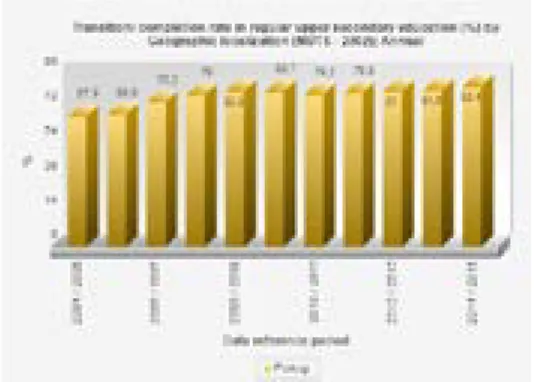
Figure 2. Year transition rates in the portuguese secondary school; note the marked growth starting from the academic year 2005/2006, since the new curricula were introduced
We should recall that during almost a decade the average grades for the national exams in Mathematics and Sciences were around 7-8 points (Júri Nacional, 20056), while the average grades as evaluated by current control in these disciplines were
around 12 points7.
The difference may be explained by the students predominantly using their short-term memory, being unable as they are to use their long-term (permanent) memory. This short-term memory can accommodate a limited amount of information and for a short time only, hardly exceeding several days. Thus, the short-term memory is more efficiently used in the current control, usually done by tests – a reduced amount of information can be memorized in 2 or 3 days that students typically use to get ready for a test. On the other hand, the amount of information is much larger when students prepare for a final exam, whereas short intervals between exams do not allow a proportionally larger period of time for preparation, resulting in a lower preparation quality. Also, by the end of a prolonged study period, the temporary memory starts losing the information acquired in the beginning. Therefore, necessarily and inevitably, the exam grades must be lower.
In practice, the ministry of education, under cross-fire by all of the stake-holders, adjusted the difficulty and grading criteria of the exams by introducing new school curricula starting from the academic year 2005/2006 (FENPROF, 2006). This had a short-term effect of increasing the approval rates, as the students prepared under the previous (more stringent) criteria were evaluated by the new, more lax criteria, so that the average exam grades increased by 5 points, coinciding for some years with the average of the current control grades and increasing the number of students that passed to next year of studies or graduated (see Fig. 2). Thus, the universities were opening their doors to the students whose level of competences and knowledge is so low that previously they were squarely rejected as inapt8. Several years later, the student preparation levels
have relaxed back towards the new lower requirements, with the difference going back to about 3 points in Mathematics and Portuguese and up to 5 points in Sciences, though with higher averages (Juri Nacional, 20096).
2.3 Memorization and abstract thinking
An international independent commission that recently evaluated the Portuguese system of higher education noted a general and recurrent complaint of the university professors: the students are unable to think creatively and logically (Blättler et al., 2013). Thus, the learning-by-doing school paradigm has failed its principal declared objective and its reason for existence, used as the pretext for the destruction of the formal school – the independent, creative and critical thinking is not being cultivated in students. This directly results from the absence of knowledge specific to the respective disciplines of the scholar curriculum, retained by students permanently and in a form allowing its recovery and usage. Namely, abstract thinking requires memorized definitions, theories, formulas, dates and other elements that form the foundations of the knowledge base in any specific study area. Missing these elements in their permanent memory, the students are incapable of abstract thinking in the respective area – as each of these has its own set of notions and ideas, its specific language, which we must learn by heart before we can even dream of abstract thinking. The same effect is notable in language studies of either the mother tongue or a foreign language: enlarging their active vocabulary, the students gradually obtain the capacity to discuss problems of ever growing depth and complexity. However, apart from the vocabulary, we also need the capacity of abstract thinking and the knowledge of logics9. In the existing school system, the vast majority of students is deprived
of these capacities, and has neither conditions nor motivation for their development. The latter is the consequence of the faulty study habits and evaluation methods that do not require or test the retained knowledge, with the students needing the short-term memory only. This is the least-resistance approach, taking only 2 or 3 days to prepare for a test or an exam – while precluding acquisition of permanent knowledge – something that students never needed to pass a discipline in the first place. Thus, the students prepare for the exams using their short-term memory, then pass – using every available hint, starting from those deliberately introduced by their teachers into the test papers, to copying and cheating in every possible way and without the least of scruples10, and next forget everything they just learned as fast as they can.
2.4 Critical thinking in primary school
All attempts of the learning-by-doing school to develop and use critical, creative and independent thinking in primary schools will necessarily fail, because such capacities do not exist in children of that age, at the neuropsychological level11.
They arise from biologic necessity at puberty, when suddenly adolescents start having their very own ideas about everything, irritating both their parents and teachers. Still the primary school children are very well able to imitate the critical thinking capacity, using their inherent ability to perceive and interpret any and all clues, transmitted unconsciously or otherwise in many different forms by their teachers, who are also interested in obtaining good results of student evaluation. Thus, any evidence of critical thinking by primary-school students is generated, on one hand, by students cheating (even unconsciously), and on the other hand – by the self-hypnosis of their teachers, whereas the time used in tasks for its development – is time uselessly wasted, harming other components of the study curriculum. Indeed, instead of critical thinking we are promoting
6 The exams are graded using the more detailed 0 to 200 point scale, while the 0 to 20 scale is normally used in secondary school and university education in Portugal.
7 Regarding the national exams in Portuguese Language and Mathematics A (the highest-difficulty version), the approval rates are now usually around 50%, which seems to be socially acceptable.
Before 2005 the exams required more retained knowledge, with only 10% approval rates, which generated social protest and stimulated the Ministry of Education to revise the standards down.
8 Being sufficiently insistent, such weak students eventually graduate, still with no retained knowledge, as they can’t be failed indefinitely for reasons already mentioned, although never acquiring
any knowledge.
9 Contrary to the ancient Rome, today the knowledge of logics is not considered a necessary competence of an educated person – the only place logics is ever mentioned is the discipline of
Mathematics A, with some calculations in formal logics, completely disconnected from reasoning. Is this the progress of humanity?
10 The students have learned to leave their morality outside the classroom in the exercises of critical thinking in the primary school – v. infra. The teachers have to be immoral as well, approving
students who know nothing for keeping their own job. Apparently the theory of religious morals taught to everyone does not stand up to the realities of the education system.
11 Sufficient proof is given by the ease of religious indoctrination of children, as compared to adults, and the consequent desire of all churches to work with children starting from the youngest
Proceedings of the International Congress on Interdisciplinarity in Social and Human Sciences
exactly the opposite, rewarding servility and desire to please the superiors, and subverting student morality on the way without noticing 10.
2.5 Memorisation as survival necessity
During millennia, and in the absence of writing, the most important knowledge had been transmitted from generation to generation by oral tradition, which naturally requires long-term memorization. However, the presence of memorized knowledge may still be the decisive factor between life and death, even in the modern civilized world with all the current development of informatics and telecommunications. Just recall the experiences of the British schoolgirl Tilly Smith and of the indigenous tribes of the Andaman and Nikobar islands, persons whose knowledge had saved their lives during the Indonesian tsunami of 200412 (Wikipedia, 2004). At the same time, entire crowds of the learning-by-doing school graduates
armed with ‘critical thinking’ and internet-capable smartphones were unable to perceive that there are no second chances in the real life, and had been washed away into the open sea ... Obviously one can’t learn to survive tsunamis by doing.
2.6 global or visual method of teaching to read
The capacity to study is inevitably determined by the capacities to read and complement one’s active vocabulary. These get blocked when the primary-school teachers focus on the global method of teaching to read. This method requires the students recognizing entire words by their graphics, without identifying letters or syllables. This method may be successfully used to memorize the alphabet, associating pictures to the first letters of the words that identify the depicted objects. However, if the teacher tries to use this method beyond the alphabet, the students are left with a very limited vocabulary, never exceeding several hundreds of words, and unable to enlarge it, as they can’t read any unknown words or look them up in a dictionary. Such students, reading an unknown text, are only reading the known words, trying to extract some meaning out of them. Frequently, the very existence of a problem with reading is discovered by the end of the primary school, implying a complete waste of four years of schooling (and of the life of the student), accompanied by a complete loss of motivation for academic success and of interest in studies13.
2.7 What may be done to develop permanent memorization?
We should stimulate the students to learn by heart the multiplication table, the definitions, the formulas, the poems, the geographic names and the historic dates, and all of the other elements that were traditionally learned by heart at school. We should not simplify the tests and exams to the point when the student who learned by heart an entire chapter, without understanding a thing, can get a passing grade by using the hints contained in the test and the auxiliary material. We should stimulate the students to write lecture notes by hand in the classroom, and additionally work with these notes and the textbooks, both before and after the new material is presented in the class, etc. The objective of all this work is to create the foundations of the knowledge bases, which will allow to create associations between new knowledge and the respective specific area of knowledge (and/or its adjacent areas), and as a consequence – develop the students’ abstract thinking abilities. An added value of hand-written lecture notes is that by ordering the information on paper we also organize it in our head, helping in its assimilation, retention, perception and usage.
3. sECONdARY FACTORs CONdITIONINg THE HIgHER EduCATION QuALITY
Here we describe the mechanisms whereby the educational fraud of learning-by-doing is sustained at school and in higher education, compelling academics to approve students with no retained knowledge.3.1 Teacher perception and performance assessment
Contemporary education is perceived as part of the economy, and therefore has to produce profits and be economically efficient (Stallinga et al., 2017). Keeping students at school (or university) to repeat the study years is economically wasteful, producing losses. Thus, the contemporary European knowledge-based economy, under the pretext of ensuring high quality of education and apparently oblivious of the fact that good grades are being obtained with zero retained knowledge, has created a Quality Assessment mechanism in higher education, and teacher performance evaluation at school, such as those existing in Portugal (Netprof, 2009; Pinto et al., 2005). The assessment requirements may sometimes take grotesque forms, for instance in one of Russian universities professors are effectively required to produce between 12 and 20 publications each year, in pursuit of better university ranking (Criteria, 2016; Informer, 2017). The assessment criteria at the University of the Algarve (UAlg) require publication of at least 5 to 8 papers in 3 years for an excellent grade in research, dependent on the position. The assessment of educational activities includes the Teacher Perception reports provided by the students each semester as part of the Quality Assessment (QA) process. Similarly, British higher education uses the National Student Survey (NSS) as a tool to rank the national universities, with one of the objectives to provide additional public financing to
against teachers, and of the weak universities becoming still weaker, while the strong universities becoming stronger. In a few years, the universities have learned to play the game of the NSS, by making the students understand that good evaluation they give to the university may improve their own professional prospects, and employing other psychological tricks like pre-surveys used as a means to divert the eventual negative opinions away from the “real” questionnaire (Agrawal et al., 2014). As a result, all of the British universities appear very similar to each other in the student appreciation as evaluated by NSS. All of these factors recently led both students and teachers to call for a boycott of the NSS (NUS, 2017; UCU, 2017).
Both the QA procedures and the teacher performance assessment create pressure to increase student grades. “A focus on (student) satisfaction can lead to an intellectual race to the bottom as lecturers are put under pressure to cut reading lists and shorten assessments. If students do not like reading whole books, then perhaps extracts will do. If they find essay-writing difficult, then lecturers should guide them step-by-step through what to write and how, rather than leaving them to work it out for themselves. If students do not like exams, then maybe a poster would suffice.” (Williams, 2015). We do observe these same tendencies in our own work place. Indeed, those of our colleagues who choose the easy way of letting pass at least half of their students (while admitting that these students are completely unprepared, have incorrect learning habits and are unable to learn), are evaluated as excellent teachers, while those who try to make the students demonstrate some retained knowledge are urged to improve their approval rates by lowering the learning targets and making it easier to the student. The same tendencies were confirmed in a recent survey in UK, where half of the academics reported they were under pressure to give more generous grades to their students (Ratcliffe and Shaw, 2015).
3.2 Learning outcomes and student evaluation
According to the Bologna ideas, we should define the learning outcomes, including knowledge, skills and competences for each course and discipline, and ensure that these are in fact acquired by the students. As we already found here, average students are unable to acquire any retained knowledge, therefore we may only evaluate their skills and competences. Some of the skills are specific to the disciplines studied and the course attended, whereas the competences are by definition transversal, most of them common for any course. Thus, student evaluation done by poster/presentation evaluates only the competences, having nothing to do with the specific discipline that is being graded. Even the evaluation by exam includes a large proportion of competences, including those of meaninglessly memorising huge amounts of material (as explained, unable to use their long-term memory, students have to rely on their short-term memory), of picking up the leads and hints provided by the professor in the test, and of course copying and cheating to the largest extent possible. Thus the system of education rewards reprehensible behaviour, instead of cultivating high moral standards10. As we already noted, lip service to
the religious morality is unable to stop the moral auto-corruption dictated by the imperative to get a passing grade.
3.3 Conceptual complexity and prestige of disciplines
Traditionally, the higher-ranked academics prefer to teach the more specialized disciplines of the advanced years of the course, as these typically have lower student numbers, with the student profile also shifted towards stronger students as some of the weaker ones already quit their studies by then. Frequently, there are no existing textbooks or training exercises for such advanced disciplines, therefore the tests are built by compiling questions from a previously known list, or else such disciplines are evaluated by presentations or essays, none of which can test the retained knowledge. The students are perfectly capable to fill their short-term memory with answers to a couple of hundred questions, and reproduce the answers in the classroom. This does not require any retained knowledge or understanding or being capable to relate the knowledge to the specific issue.
However, the largest facilitator of the advanced disciplines is the lower conceptual complexity accompanied by the same number of ECTS credits and amount of student work. To compare the conceptual complexity of an advanced discipline with that of a first-year introductory discipline, let’s look at the discipline of Photochemistry and compare it to General Chemistry. Photochemistry is concerned with the behaviour of the excited states, and imports the concepts of general chemistry and quantum chemistry, then expanding on organic and inorganic reactions taking place in the excited states caused by absorption of photons, with not many concepts of its own not appearing elsewhere.14 On the other hand, lectures
on General Chemistry (Atkins et al., 2017) apart from being twice as large, contain the fundamental concepts of at least half a dozen more specialized disciplines, such as thermodynamics, chemical kinetics and organic chemistry, all requiring retained knowledge for understanding and application. It is easy to see that a discipline of general chemistry, due to its conceptual complexity, requires considerably more student work than a discipline of photochemistry, although they may have the same number of ECTS credits in the course curriculum.
However – the day only has 24 hours – the students are physically unable to achieve the learning outcomes in the fundamental disciplines of the first year to the same extent as they can for the more advanced disciplines of the following years. Naturally they express their lack of satisfaction in their teacher perception, blaming their professor for the lack of academic success generated by the ambitions of his superiors. Meanwhile the higher-ranked academics enjoy high student satisfaction rates, thereby confirming their intellectual supremacy and high teaching skills, while generating direct incentive for extensive facilitation in the fundamental disciplines, leaving students without the essential retained knowledge. Meanwhile, any specialized knowledge contained in the advanced disciplines is more prone to change, due to continuing development, and has lower probability of practical application, as the graduate may get to work in an adjacent area that does not require this specialized knowledge. Thus it is a lose-lose situation for the students – they can learn comparatively well what is irrelevant for them, and learn only very superficially what is relevant for their professional activity and life-long learning.
14 This does not mean we can’t produce a large textbook on Photochemistry (Balzani et al., 2014), as the number of pages may be increased by repeating the material of other areas of physics and
chemistry, and introducing a lot of specific photochemical properties of different classes of compounds, which brings in a lot of specific facts, accompanied by very few generalizing theories and concepts that require retained knowledge for understanding and application.
Proceedings of the International Congress on Interdisciplinarity in Social and Human Sciences
4. CONCLusIONs: WHAT CAN WE dO TO IMpROvE?
We need to restore the exercises for memory development and memorization, as the obligatory component of the curricula of every discipline at every level of studies, starting at the primary school and ending with universities, enabling formation of the knowledge bases of the respective study areas in the students’ memory. We should exclude the exercises for the development of critical independent thinking from the primary school curricula, introducing them gradually and much later, when the respective capacities become enabled by the development of the central nervous system that accompanies growth and development of children and adolescents. The systems of education of the EU and FSU countries, in their presently existing form, produce entire generations of illiterate, innumerate and ignorant young people, incapable of abstract thinking and intellectual self-advancement. The only exception is the extremely small number of students15 who either
have better memorization capacities, or are being adequately motivated and stimulated by their parents or teachers – these students are always able to achieve excellent academic results, independently of any vicissitudes of the educational reforms. Changes will also be welcome by the academics, who in the current educational environment are subject to bullying by their superiors and colleagues (Shaw and Ratcliffe, 2014), with ensuing problems in mental health due to excess workload and stress at the workplace (Shaw, 2014).
ACKNOWLEDGEMENTS
The paper was prepared with partial support of the project QUADRIGA, 517123-TEMPUS-1-2011-1-DE-TEMPUS-SMHES, financed by the EU, to I.K., who also thanks Prof. S. Chernyshenko (University of Koblenz-Landau) for encouragement.
REFERENCES
Agrawal, A., Buckley-Irvine, N. and Clewlow, E. (2014). Is the national student survey fit for the purpose? The Guardian, 2014, https://www.theguardian.com/higher-education-network/blog/2014/aug/12/do-we-still-need-national-student-survey-university, accessed in March 30, 2017.
Atkins, P., Jones, L., Laverman, L. (2016). Chemical Principles: The Quest for Insight, Macmillan learning, 1200 pp., ISBN-13: 978-1-4641-2467-9, http://www.macmillanlearning.com/Catalog/product/chemicalprinciples-seventhedition-atkins/ tableofcontents#tab, accessed in March 30, 2017.
Balzani, V., Ceroni, P., Juris, A. (2014). Photochemistry and Photophysics: Concepts, Research, Applications, Wiley, ISBN: 978-3-527-33479-7, 504 pp. http://eu.wiley.com/WileyCDA/WileyTitle/productCd-3527334793.html, accessed in March 30, 2017.
Blättler A., Rapp J.-M., Solà C., Davies H., Teixeira P. (2013). Portuguese Higher Education - A view from the outside, (Independent expert report sponsored by CRUP and EUA), 52 pp, see p. 35; Description: http://www.eua.be/news/13-02-21/New_report_Portuguese_Higher_Education_-_A_view_from_the_outside.aspx, short URL: http://goo.gl/ CCa6sY, text: http://www.eua.be/Libraries/publication/CRUP_final_pdf.pdf?sfvrsn=0, accessed in March 30, 2017. Criteria for ranking of employees at Krym Federal University. (2016). http://cfuv.ru/wp-content/uploads/2016/10/1231.
pdf (in Russian), accessed in March 30, 2017; considering the table on pp. 19-22, note that the targets were set at 200 to 500 points in function of the academic position.
Fazackerley, A. (2016). Universities and NUS plan boycott of flagship teaching rankings, The Guardian, https://www. theguardian.com/education/2016/nov/22/universities-nus-boycott-teaching-excellence-framework-tuition-fees, accessed in March 30, 2017.
FENPROF. (2006). ME: política e práticas - balanço do ano lectivo 2005/2006. (on the new curricula for Portuguese school), http://www.fenprof.pt/?aba=27&mid=115&cat=95&doc=1630, Accessed in March 30, 2017.
Informer. (2017). Is the rector of the Crimean university paid for doing nothing? (in Russian), InFormer, the Crimean online journal, http://ruinformer.com/page/ne-zrja-li-rektor-krymskogo-universiteta-est-svoj-hlebr, accessed in March 30, 2017.
Instituto Nacional de Estatística. (2017). https://www.ine.pt/, accessed in March 30, 2017.
Juri Nacional de Exames. (2005). Exames nacionais dos ensinos básico e secundário, Relatório final, see p. 76, Quadro 10, CIF-CE (difference between the current evaluation and evaluation by exam in the 12th grade final exams) for 2004 and 2005; the most difficult disciplines include Geology, German, Mathematics, English, Descriptive Geometry A, Biology and Physics. http://dge.mec.pt/sites/default/files/JNE/2005_relatorioanual.pdf, accessed in March 30, 2017.
Geology, German, Mathematics A, Mathematics B, (newly) Portuguese, and Mathematics applied to social sciences. http://dge.mec.pt/sites/default/files/JNE/2009_relatorioanual.pdf, accessed in March 30, 2017.
Juri Nacional de Exames. (2013). “Exames nacionais do ensino básico e secundário, Relatório final”, 2013, see the histogram on p. 66. http://dge.mec.pt/sites/default/files/JNE/2013_relatorioanual.pdf, accessed in March 30, 2017.
Lei de Bases do Sistema Educativo. (1984). https://pt.wikipedia.org/wiki/Lei_de_Bases_do_Sistema_Educativo, accessed in March 30, 2017.
Netprof. (2009). Avaliação do desempenho, http://www.netprof.pt/netprof/servlet/getDocumento?TemaID=NPL0144&id_ versao=18624, accessed in March 30, 2017
NUS. (2017). Boycott NSS, https://www.nus.org.uk/en/take-action/education/boycott-the-national-student-survey/, accesses in March 30, 2017.
Pinto, J. P., Oliveira, E. R. (2005). Métodos de Avaliação do Desempenho dos Docentes Universitários, http://www.snesup. pt/htmls/EEZyulpyyyzMMnYSpK.shtml, accessed in March 30, 2017.
Pires M. (2012). Does school prepare students to the university? Presentation at the TEMPUS/DEQUE EU project conference at University of the Algarve, Faro, Portugal in Feb. 2012.
See also: Afonso, M. J. (2013). Curriculum Vitae, 21 pp, references therein on the results of the PMAT project, http://www. psicologia.ulisboa.pt/docentesmodule/docente_cv/id/77/, short URL: http://goo.gl/kTfeMD, accessed in November 10, 2014.
Ratcliffe R. and Shaw C. (2015) Academics under pressure to bump up student grades, Guardian survey shows, The Guardian, https://www.theguardian.com/higher-education-network/2015/may/18/academics-under-pressure-to-bump-up-student-grades-guardian-survey-shows, accessed in March 30, 2017.
Shaw C. (2014). Overworked and isolated - work pressure fuels mental illness in academia, The Guardian, https://www. theguardian.com/higher-education-network/blog/2014/may/08/work-pressure-fuels-academic-mental-illness-guardian-study-health, accessed in March 30, 2017.
Shaw C. and Ratcliffe R. (2014). Struggle for top research grades fuels bullying among university staff, The Guardian, https:// www.theguardian.com/higher-education-network/2014/dec/16/research-excellence-framework-bullying-university-staff, accessed in March 30, 2017.
Stallinga P., Fonseca C.S.C., Khmelinskii I. (2017). Knowledge-based economy, 2017, II International Congress “Interdisciplinarity in Social and Human Sciences”, 11th - 12th May 2017, University of the Algarve, Faro, Portugal, submitted to the Journal of Spatial and Organizational Dynamics.
UCU. (2017). Support the NSS boycott,https://www.ucu.org.uk/boycott-the-nss, accessed in March 30, 2017. Wikipedia. (2004) Tilly Smith, https://en.wikipedia.org/wiki/Tilly_Smith, accessed in March 30, 2017.
Williams J. (2015). The National Student Survey should be abolished before it does any more harm, The Guardian, https:// www.theguardian.com/higher-education-network/2015/aug/13/the-national-student-survey-should-be-abolished-before-it-does-any-more-harm, accessed in March 30, 2017.