http://dx.doi.org/10.1590/1516-635x160225-30
Laying Hens
Author(s)
Domingues C H de FI
Sgavioli SI
Praes M F F MI
Castiblanco D M CI
Marchizeli P C AI
Pereira A AI
Duarte K FI
Junqueira O MI
I Universidade Estadual Paulista Júlio de
Mesquita Filho, Jaboticabal, SP.
Mail Adress
Corresponding author e-mail address Carla Heloisa de Faria Domingues
Rua Emidio Afonso, 52, Vila Borsari, 14883-277. Jaboticabal, SP, Brasil E-mail: [email protected]
Keywords
Food restriction, performance, egg quality, morphometry.
Submitted: July/2013 Approved: February/2014
ABSTRACT
An experiment was carried out to evaluate the performance, egg quality and morphometry of the reproductive tract, liver, pancreas and tongue of laying hens submitted to different molting methods. Two hundred and eighty eight 72-week-old Isa brown layers were distributed according to a completely randomized design with six treatments (molting methods) and six replicates of eight birds each. Layers were fed diets containing 3000 ppm zinc oxide, 60 ppm or 120 ppm nicarbazin, 30 ppm or 60 ppm salinomycin, or were submitted to feed fasting. D
ata were submitted to analysis of variance and
means were compared by the test of Tukey at 5% probability
level.
Molting methods alternative to feed fasting were effective toinduce molting in layer and provided good performance results in the second laying cycle.
INTRODUCTION
Modern layer strains have high genetic potential for egg production and may produce eggs for more than one laying cycle by inducing molting. Forced molting is defined as a set of management practices to promote stress, inducing birds to stop producing eggs and the partial molting of the feathers (Roland & Brake, 1982). The objective of forced molting is to rest the reproductive system of layers for some time in order to recover their production capacity and to increase the longevity of layers for further 25 to 30 weeks, as well as to improve egg quality, reducing losses caused by poor eggshell quality (Berry, 2003).
Alternative molting techniques, except for the supply of zinc-rich diets, have shown to be as effective to discontinue egg production as feed restriction. Layers fed diets with nicarbazin reduce egg production and egg weight (Chapman, 1994), as nicarbazin may prevent ovule maturation (Baker et al., 1957). High doses of ionophore antibiotics,
such as salinomycin, may cause severe cell function and morphological disorders in poultry (Novilla, 1992), and anorexia is one of the most frequent clinical signs (Schweitzer et al., 1984).
Similarly to mammals, poultry also have taste buds (Kare et al., 1976) and are capable of differentiating the flavor of different chemical solutions, although behavioral effects are not evident (Denbow, 1985). Changes in diet composition, such as drug inclusion and excessive mineral content, could result in changes in the taste buds, and therefore directly influence poultry intake activities (Denbow, 1985).
MATERIALS AND METHODS
The experimental period included the phases of molting, resting, and second laying cycle (four periods of 28 days each). Hens were selected according to body weight and egg production. In the trial, 288 commercial Isa Brown layers with 72 weeks of age were distributed, according to a completely randomized experimental design into six treatments with six replicates of eight birds each, totaling 36 experimental units.
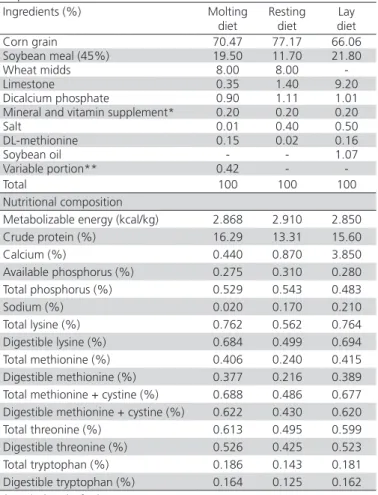
Feeds supplied during the experimental periods were formulated according to Rostagno (2011), as shown in Table 1. The molting diet contained 16.29% crude protein, 0.44% calcium, 0.275% available phosphorus, and 0.02% sodium.
The following treatments were applied for 14 days to induce molting: feed fasting and the dietary inclusion of 3000 ppm zinc oxide, 60 or 120 ppm nicarbazin, or 30 or 60 ppm salinomycin.
Table 1 – Ingredients and nutritional composition of the experimental diets.
Ingredients (%) Molting diet
Resting diet
Lay diet Corn grain 70.47 77.17 66.06 Soybean meal (45%) 19.50 11.70 21.80 Wheat midds 8.00 8.00 -Limestone 0.35 1.40 9.20 Dicalcium phosphate 0.90 1.11 1.01 Mineral and vitamin supplement* 0.20 0.20 0.20
Salt 0.01 0.40 0.50
DL-methionine 0.15 0.02 0.16
Soybean oil - - 1.07
Variable portion** 0.42 -
-Total 100 100 100
Nutritional composition
Metabolizable energy (kcal/kg) 2.868 2.910 2.850 Crude protein (%) 16.29 13.31 15.60 Calcium (%) 0.440 0.870 3.850 Available phosphorus (%) 0.275 0.310 0.280 Total phosphorus (%) 0.529 0.543 0.483 Sodium (%) 0.020 0.170 0.210 Total lysine (%) 0.762 0.562 0.764 Digestible lysine (%) 0.684 0.499 0.694 Total methionine (%) 0.406 0.240 0.415 Digestible methionine (%) 0.377 0.216 0.389 Total methionine + cystine (%) 0.688 0.486 0.677 Digestible methionine + cystine (%) 0.622 0.430 0.620 Total threonine (%) 0.613 0.495 0.599 Digestible threonine (%) 0.526 0.425 0.523 Total tryptophan (%) 0.186 0.143 0.181 Digestible tryptophan (%) 0.164 0.125 0.162
*Supplied per kg feed: 8,000 IU vitamin A, 1,800 IU vitamin D3, 12 mg vitamin E, 2 mg vitamin K3, 1 mg vitamin B1, 4 mg vitamin B2, 1 mg vitamin B6, 10 mcg vitamin B12, 0.40 mg folic acid, 0.04 mg biotin, 28 mg niacin, 11 mg calcium pantothenate, 6 mg Cu, 0.10 mg Co, 1 mg I, 50 mg Fe, 65 mg Mn, 45 mg Zn, 0.21 mg Se, 500 mg choline chloride 50%, 1400 mg methionine, 125 mg antioxidant.
Variable portion** The variable portion consisted of finely-ground rice hulls and/or zinc oxide and/or each of the anticoccidial agents.
During molting, the following performance parameters were evaluated: days until laying ceased, feed intake, egg production, body weight lost between 7 and 14 days.
During the resting period, feed intake, egg production, days to return to lay (50 – 60% egg production), days to lay of the first and the tenth egg, body weight recovery, feed conversion ratio (kg feed/ dozen eggs), and livability were evaluated.
During the second laying cycle, the following performance parameters were evaluated at the end of each period: feed intake (feed offer minus feed residue), egg production (average number of eggs laid per experimental unit), feed conversion ratio (kg of feed per kg of eggs and per dozen eggs produced), average egg weight (total egg weight/number of eggs laid per experimental unit), and egg mass (egg production % x average egg weight). The following egg quality parameters were evaluated: Haugh units, calculated as 100 log (h + 7.57 - 1.7 W0.37), where H =
albumen height in mm, W = egg weight in g; eggshell percentage and thickness, and egg specific gravity. Egg specific gravity was determined immersing the eggs in graded NaCl solutions (1.065 to 1.100 g/cm3, in 0.005
gradients).
Birds were sacrificed at the end of the molting period and of the resting period. Hens were sacrificed by neck dislocation after feed fasting for eight hours. Birds were previously fasted for eight hours and weighed immediately before sacrifice to allow subsequent calculation of ovary, oviduct, liver, and pancreas weights relative to body weight.
Taste bud number, area, and diameter were determined at 40x magnification using a light microscope (Olympus®) , which was coupled to a
digital image analyzing system (Leica, Digital Image Processing And Analysis Software For Professional Microscopy- Qwin V3) together with Optimus 4.0 software program.
The obtained data were submitted to analysis of variance using the General Linear Model (GLM) procedure of SAS statistical package (SAS Institute, 2002). Means were compared by the test of Tukey at 5% probability level.
RESULTS AND DISCUSSION
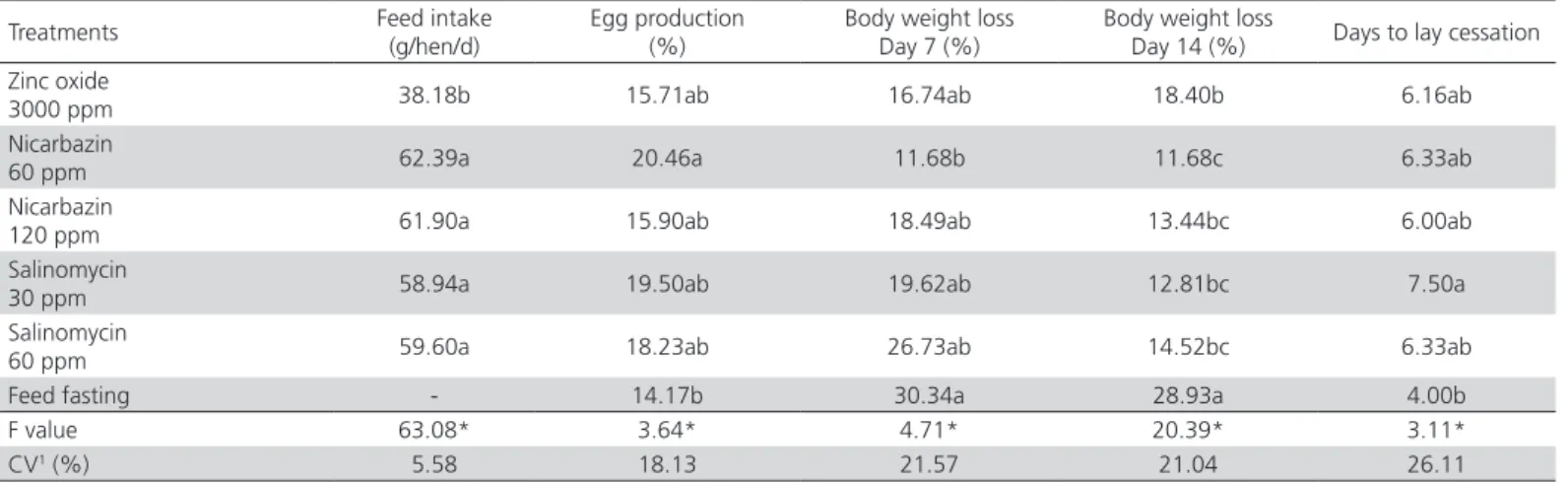
The applied treatments significantly influenced the evaluated performance parameters (Table 2).
The feed intake of the hens fed the diet containing 3000 zinc oxide was significantly lower compared to the other treatments (p < 0.05). This is consistent with the results of Shippee et al. (1979), who observed
that layers fed 1% zinc as zinc oxide or zinc acetate presented feed intake of 22 and 16g/bird , respectively, during the second week of the induced molting period, when hens also presented 0% egg production. This may due to reduced appetite (Bar et al. 2003)
or palatability (Fok, 1989). It was also reported that feed intake may be reduced because zinc cation (Zn2+)
induces follicle atresia, interrupting egg production (Johnson & Brake, 1992). Therefore, it is possible that the efficiency of the treatment with the diet with high zinc levels is directly related with feed intake.
Layers fed 60 ppm nicarbazin produced more eggs than those submitted to feed fasting. This result is different from the findings of Park et al. (2004), who
did not observe any differences in egg production among different induced-molting methods (fasting and dietary inclusion of zinc acetate or zinc propionate).
Layers submitted to feed fasting during the induced-molting period presented higher weight loss on day 7 compared with those fed 60 ppm nicarbazin, but not with those submitted to the other treatments. On day 14 of induced molting, hens in the feed fasting treatment lost the most body weight during this period and those fed 60 ppm nicarbazin and 3000 ppm zinc oxide lost the least body weight. Body weight loss contributes for molting as it affects reproduction and body fat reserves (Park et al. 2004). According
to Alodan & Mashaly (1999), the regression of the reproductive tract is proportional to body weight loss, which rejuvenates the reproductive tract and reduces body fat, thereby enhancing tissue efficiency.
The fed-fasted hen required less days to cease egg laying compared with those fed the 30 ppm zinc diet, but were not different from those submitted to the other treatments. According to North & Bell (1990) and Bell (2003), the sooner the hens cease laying eggs, the sooner they will start producing eggs during the resting period, and the peak of egg production in the second cycle occurs sooner.
During the resting period, feed intake significantly increased (p<0.05) when hens were fed 3000 ppm zinc during the molting period relative to those fed 60 ppm nicarbazin, but was not different compared with the other treatments. This is probably due to the low feed intake of the hens fed 3000 ppm zinc oxide during the molting period. On the other hand, Hassanabadi & Kermanshahi (2007) did not find any reduction in the feed intake of layers fed 20,000 ppm zinc oxide during the molting period.
Table 2 – Average performance parameters obtained during the molting period.
Treatments Feed intake (g/hen/d)
Egg production (%)
Body weight loss Day 7 (%)
Body weight loss
Day 14 (%) Days to lay cessation Zinc oxide
3000 ppm 38.18b 15.71ab 16.74ab 18.40b 6.16ab
Nicarbazin
60 ppm 62.39a 20.46a 11.68b 11.68c 6.33ab
Nicarbazin
120 ppm 61.90a 15.90ab 18.49ab 13.44bc 6.00ab
Salinomycin
30 ppm 58.94a 19.50ab 19.62ab 12.81bc 7.50a
Salinomycin
60 ppm 59.60a 18.23ab 26.73ab 14.52bc 6.33ab
Feed fasting - 14.17b 30.34a 28.93a 4.00b
F value 63.08* 3.64* 4.71* 20.39* 3.11*
CV1 (%) 5.58 18.13 21.57 21.04 26.11
Layers fed 60 and 120 ppm nicarbazin needed fewer days to lay the 1st and 10th egg during the resting
period, suggesting a direct relationship between the beginning of lay in the resting period and body weight
loss during molting. This was also observed by Sgavioli
et al. (2011), who obtained lower body weight loss and
shorter interval to lay the first egg during the resting period in layers fed alfalfa to induce molting.
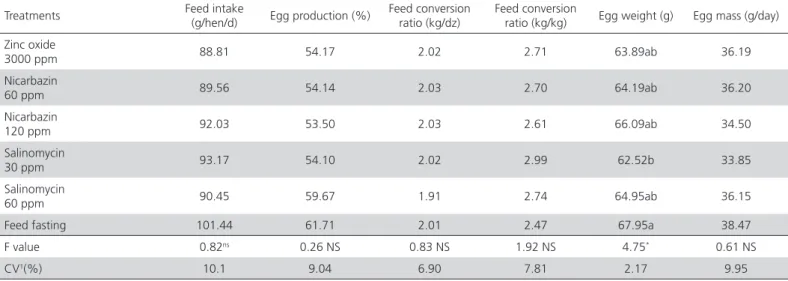
During the second laying cycle, performance was significant influenced (p < 0.05) by the treatments (Table 4).
Layers fed 30 ppm salinomycin laid significantly lighter eggs compared to those submitted to feed fasting. However, egg weight was not different among treatments with zinc oxide, nicarbazin at both concentrations, and 60 ppm salinomycin. This result may be explained by the greater body weight loss
of those hens during molting, which directly affects reproductive tract rejuvenation and fat reserve loss (Alodan & Mashaly, 1999).
There was no influence of treatments on the other evaluated parameters (p>0.05).
Although fed-fasted layers laid heavier eggs during the second laying cycle (Table 4), no changes in eggshell quality were observed.
Table 3 – Average performance parameters obtained during the resting period.
Treatments Feed intake (g/hen/d)
Egg production (%/hen/d)
Return to lay (days)
1st egg laid
(days)
10th egg laid
(days)
Feed conversion ratio (kg/dz)
Livability (%) Zinc oxide
3000 ppm 103.80a 31.42 9.16 8.16ab 12.66ab 4.22 88.19 Nicarbazin
60 ppm 91.00b 22.83 7.00 2.66c 8.66c 4.31 91.66
Nicarbazin
120 ppm 99.61ab 30.93 7.66 4.16c 8.5c 3.71 91.36 Salinomycin
30 ppm 95.72ab 25.90 13.66 5.00bc 10.83bc 3.44 91.36 Salinomycin
60 ppm 94.17ab 23.05 11.33 5.33bc 10.33bc 5.16 91.36 Feed fasting 97.55ab 25.74 16.00 10.66a 15.33a 4.84 93.75 F value 2.48* 1.28ns 2.41 ns 15.62* 17.42* 1.73ns 0.31ns
CV1 (%) 7.13 30.40 51.66 30.07 13.48 26.34 8.58
ns = not significant *Significant at 5% probability level. a,b Means followed by different letters are statistically different. 1 Coefficient of variation.
Table 4 – Average performance parameters of layers during the second laying cycle.
Treatments Feed intake
(g/hen/d) Egg production (%)
Feed conversion ratio (kg/dz)
Feed conversion
ratio (kg/kg) Egg weight (g) Egg mass (g/day) Zinc oxide
3000 ppm 88.81 54.17 2.02 2.71 63.89ab 36.19
Nicarbazin
60 ppm 89.56 54.14 2.03 2.70 64.19ab 36.20
Nicarbazin
120 ppm 92.03 53.50 2.03 2.61 66.09ab 34.50
Salinomycin
30 ppm 93.17 54.10 2.02 2.99 62.52b 33.85
Salinomycin
60 ppm 90.45 59.67 1.91 2.74 64.95ab 36.15
Feed fasting 101.44 61.71 2.01 2.47 67.95a 38.47 F value 0.82ns 0.26 NS 0.83 NS 1.92 NS 4.75* 0.61 NS
CV1(%) 10.1 9.04 6.90 7.81 2.17 9.95
The different methods applied to induce molting did not affect internal and external egg quality parameters evaluated during their second laying cycle (Table 5). McCormick & Cunningham (1987) also did not report any effect of treatments on egg quality.
Table 5 – Average egg quality parameters determined during the second laying cycle.
Treatments Haugh units
Eggshell (%)
Eggshell thickness
(mm)
Egg specific gravity (g/cm3)
Zinc oxide 3000 ppm 94.81 9.70 0.392 1.088 Nicarbazin 60 ppm 94.36 9.66 0.394 1.087 Nicarbazin 120 ppm 94.78 9.84 0.401 1.088 Salinomycin 30 ppm 94.77 9.65 0.390 1.088 Salinomycin 60ppm 95.83 9.52 0.393 1.087 Feed fasting 96.17 9.59 0.401 1.089 F value 0.26 ns 0.28 ns 0.37 ns 0.61ns
CV1(%) 2.52 3.79 2.89 0.16
ns = not significant. 1 Coefficient of variation.
Layers submitted to induced molting by feed fasting and dietary inclusions of 3000ppm zinc oxide and 30ppm salinomycin presented lower ovary weight relative to body weight, indicating more faster ovary regression when compared with the other treatments. According to Brake (1993), ovary weight loss is simultaneous to body weight loss, and this process is directly linked to the recovery of the hen’s reproductive tract during the molting period. Berry (2003) also reported that the ovary completely regressed when layers lost 25% of their body weight. In the present study, although layers fed zinc oxide and 30ppm salinomycin lost less weight during molting, they showed similar ovary regression at the end of molting period, indicating that the lack of correlation between body weight loss during molting and ovary regression.
The applied treatments significantly affected organ relative weights, except for oviduct weight, as evaluated at the end of the molting period (Table 6).
Table 6 – Average relative organ weights of layers sacrificed at the end of the molting period.
Treatments Ovary (%)
Oviduct (%)
Liver (%)
Pancreas (%) Zinc oxide 3000 ppm 0.35b 1.21 1.77ab 0.15ab Nicarbazin 60 ppm 1.07ab 2.5 1.63ab 0.20ab Nicarbazin 120 ppm 1.62a 2.32 2.15a 0.19ab Salinomycin 30 ppm 0.38b 2.41 1.64ab 0.23a Salinomycin 60 ppm 1.57a 2.72 1.87ab 0.20ab Feed fasting 0.27b 1.33 1.36b 0.15b F value 9.62* 3.00 ns 3.58* 3.21*
CV5 (%) 45.00 35.60 16.20 19.35
ns = not significant *Significant at 5% probability level. a,b Means followed by different
letters are statistically different. 1 Coefficient of variation.
The lack of effect of induced-molting methods on relative weight of the oviduct (p < 0.05) was also observed by Araújo et al. (2007), who evaluated
different molting methods (California method, diet with high zinc, low calcium or low sodium diets) and did not detect any influence of the treatments on this parameter.
On the other hand, Sgavioli et al. (2013) evaluated different molting methods (dietary inclusion of 90, 70, or 50% alfalfa, of 2800 ppm zinc oxide or feed fasting) and obtained higher oviduct weights when layers were fed diets including alfalfa relative to zinc oxide.
Layers submitted to feed fasting presented lower liver relative weight (1.36%) compared with those fed 120 ppm salinomycin, but it was not statistically different relative to the other treatments.
Pancreas relative weight was statistically lower in feed-fasted layers compared with those fed 30 ppm salinomycin.
The results of the present experiment are consistent with the finding of Domingues et al. (2012), who used
3000 ppm zinc oxide to induce molting, and obtained similar ovary, oviduct, liver, and pancreas weight values after molting.
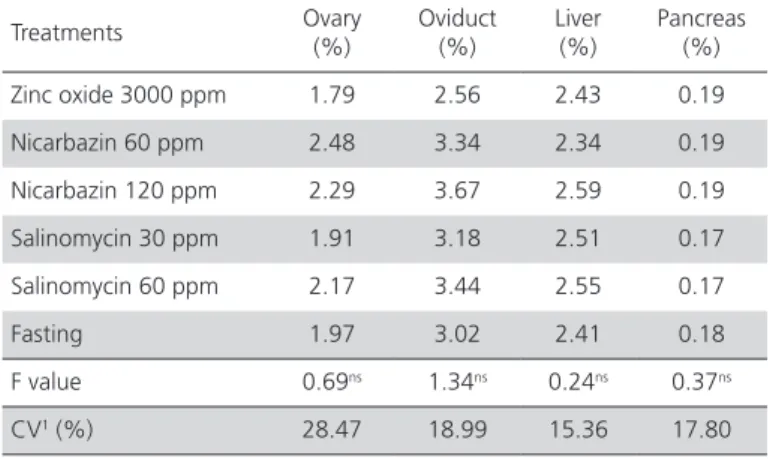
After the period of resting, no differences (p > 0.05) were observed in the relative weight of the evaluated organs (Table 7).
Table 7 – Average relative organ weights of layers sacrificed at the end of the resting period.
Treatments Ovary (%)
Oviduct (%)
Liver (%)
Pancreas (%) Zinc oxide 3000 ppm 1.79 2.56 2.43 0.19 Nicarbazin 60 ppm 2.48 3.34 2.34 0.19 Nicarbazin 120 ppm 2.29 3.67 2.59 0.19 Salinomycin 30 ppm 1.91 3.18 2.51 0.17 Salinomycin 60 ppm 2.17 3.44 2.55 0.17 Fasting 1.97 3.02 2.41 0.18 F value 0.69ns 1.34ns 0.24ns 0.37ns
CV1 (%) 28.47 18.99 15.36 17.80
ns = not significant. 1 Coefficient of variation.
The results indicate that, during resting, layers submitted to the different molting treatments presented similar organ recovery. Therefore, the effects observed during molting did not persist after resting.
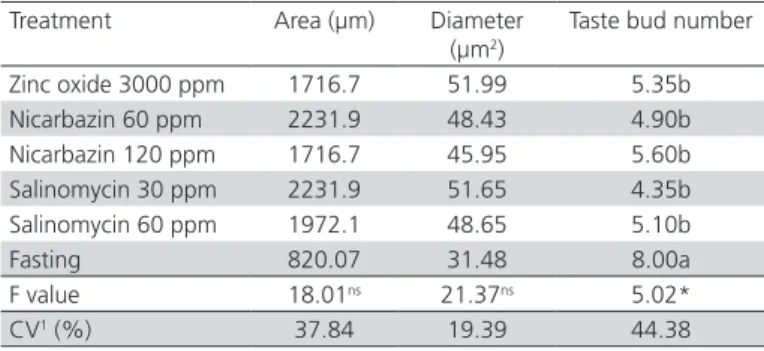
Table 8 – Average values of tongue morphometric parameters evaluated after molting.
Treatment Area (µm) Diameter (µm2)
Taste bud number
Zinc oxide 3000 ppm 1716.7 51.99 5.35b Nicarbazin 60 ppm 2231.9 48.43 4.90b Nicarbazin 120 ppm 1716.7 45.95 5.60b Salinomycin 30 ppm 2231.9 51.65 4.35b Salinomycin 60 ppm 1972.1 48.65 5.10b Fasting 820.07 31.48 8.00a F value 18.01ns 21.37ns 5.02*
CV1 (%) 37.84 19.39 44.38
ns = not significant *Significant at 5% probability level. a,b Means followed by different
letters are statistically different. 1 Coefficient of variation.
Layers fed diets containing zinc oxide, nicarbazin and salinomycin presented less taste buds compared to those submitted to feed fasting during molting.
According to Gonzáles (2002), feed palatability is perceived by the taste buds, which act as sensors and may be affected by chemical substances. Shosberg
et al. (1986) mentioned that those agents, due to
their toxicity when added at high levels, may reduce the number of taste buds, and consequently, feed palatability.
CONCLUSIONS
Based on the results obtained in the present study, it was concluded that methods alternative to feed fasting were efficient to induce feather molting in layers. Relative to the main performance parameters, only the diet with 30 ppm salinomycin caused lower egg weight. Therefore, it may be inferred that methods other than feed fasting can be safely applied to induce molting in layers, promoting adequate performance in the second laying cycle.
REFERENCES
Alodan MA, Mashaly MM. Effect of induced molting in laying hens on production and immune parameters. Poultry Science 1999;78:171–177. Araújo CSS, Artoni SMB, Araújo LF, Junqueira OM, Barbosa LCGS, Lima
CG. Morfometria do oviduto de poedeiras comerciais semipesadas submetidas a diferentes métodos de muda. Ciência Rural 2007;37(1):241-246.
Baker M, Brake J, Mc Daniel GR. The relationship between body weight loss during an induced molt and postmolt egg production, egg weight, and shell quality in caged layers. Poultry Science 1983; 62:409–413. Bar A, Razaphkovsky V, Shinder D, Vax E. Alternative procedures for molt
induction: Practical aspects. Poultry Science 2003;82:543–550.
Bell DD. Historical and current molting practices in the U.S. table egg industry. Poultry Science, 2003;82: 965–970.
Berry WD. The physiology of induced molting. Poultry Science, 2003;82:971–980.
Brake J. Recents advances in induced molting. Poultry Science 1993;72:929-931.
Chapman HD. A review of the biological activity of the anticoccidial drug nicarbazin and its application for the control of coccidiosis in poultry. Poultry Science Review, 1994;3:231-243.
Denbow DM. Food intake control in birds. Neuroscience & Biobehavioral Reviews 1985; 9:223–232.
Domingues CHF, Sgavioli S, Praes MFFM, Duarte KF, Castiblanco DMC, Santos ET, Alva J CR, Junqueira O M. Lysine and methionine + cystine for laying hens during the post-molting phase. Brazilian Journal of Poultry Science 2012;14(3):187-192.
Fox MRS. Zinc excess. In: Mills CF, editor. Zinc in human biology. New York: Springer-Verlag; 1989. p. 365–370.
Gonzales E. Ingestão de alimentos: mecanismos regulatórios. In: Macari M, Furlan RL, Gonzáles E, editor. Fisiologia aviária aplicada a frangos de corte. Jaboticabal: Funep; 2002. p.187-199.
Hassanabadi A, Kermanshahi H. Effect of force molting on postmolt performance of laying hens. Journal of Poultry Science 2007;6:630-633. Johnson AL, Brake J. Zinc-induced molt: Evidence for a direct inhibitory effect in granulose cell steroidogenesis. Poultry Science 1992;71:161–167. Kare MR, Rogers JG. Sense organs. In: Sturkie PD, editor. Avian physiology.
New York: Springer Verlag; 1976.
McCornicky CC, Cunningham DL. Performance and physiological profiles of high dietary zinc and fasting as methods of inducing a forced rest: a direct comparision. Poultry Science 1987;66:1007–1013.
North MO, Bell DD. Commercial Chicken Production manual. 4th ed. New
York: Chapman and Hall; 1990. p.433–452.
Novilla MN. The veterinary importance of toxic syndrome induced by ionophores. Veterinary and Human Toxicology 1992;34:66-70. Park SY, Birhold SG, Kubena LF, Nisbet, DJ, Ricke, SC. Effects of high zinc
diets using zinc propionate on molt induction, organs and postmolt egg production and quality in laying hens. Poultry Science 2004;83:24–33. Roland DA, Brake JH. Influence of premolt production on postmolt
performance with explanation for improvement in egg production due to force molting. Poultry Science 1982; 61(12):2473-2481.
Rostagno HS, Albino LFT, Donzele JL. Tabelas brasileiras para aves e suínos: Composição de alimentos e exigências nutricionais. 3ª ed. Viçosa: Universidade Federal de Viçosa; 2011. 120p.
SAS Institute. SAS user’s guide:statistics. Cary; 2002. 466p.
Shippee RL, Stake PE, Koehn U, Lambert JL, Simmons RW. High dietary zinc or magnesuim as forced-resting agensts for laying hens. Poultry Science 1979;58:949–954.
Shlosberg A, Perl S, Yakobson B, Klopfer U, Egyed MN, Nobel TA. 1986. Chronic case of probable monensin toxicosis in cattle. Veterinary and Human Toxicology. 1986;28:230-233.
Sgavioli S, Filardi RS, Praes MFFM, Assuena V, Pileggi J, Andrade PC, Boleli IC, Junqueira OM. Performance of layers submitted to different forced-molting methods and different temperatures. Brazilian Journal of Poultry science, 2011;13(3):207-210.
Sgavioli S, Filardi RS, Praes MFFM, Domingues CHF, Andrade PC, Pileggi J, Boleli IC, Junqueira OM. Effect of forced-molting methods and rearing temperatures on the performance and organ biometrics of laying hens. Brazilian Journal of Poultry Science, 2013;15(3):239-245.