Fernando Jorge Marques Alexandre
Licenciado em Engenharia InformáticaMulti-GPU Support on the Marrow Algorithmic
Skeleton Framework
Dissertação para obtenção do Grau de Mestre em Engenharia Informática
Orientador :
Hervé Paulino, Professor Auxiliar,
Faculdade de Ciências e Tecnologia da Universidade
Nova de Lisboa
Júri:
Presidente: Doutora Teresa Romão (FCT-UNL)
Arguente: Doutor Pedro Tomás (IST-TU)
iii
Multi-GPU Support on the Marrow Algorithmic Skeleton Framework
Copyright © Fernando Jorge Marques Alexandre, Faculdade de Ciências e Tecnologia, Universidade Nova de Lisboa
Acknowledgements
I would firstly like to thank my adviser Hervé Paulino, whose unwavering support and patience helped me immensely with this thesis. Furthermore I would like FCT/UNL for allowing the creation of this thesis with an excellent working environment. I would like to thank the projects PTDC/EIA-EIA/102579/2008 and PTDC/EIA-EIA/111518/2009 for providing the equipment used for the development of this thesis.
I would like to thank Prof. Pedro Medeiros and Flávio Martins for the patience when the development machines would mysteriously stop working and required their inter-vention.
I thank all who frequent the ASC laboratory for providing such a good and amusing work environment, where friendly support is a desk away.
I would like to thank all my friends, specially Filipe Rodriges, Carlos Correia, Paulo Ferreira and Eduardo Duarte who put up with me and my frustrations.
I thank and bow to my family, for allowing me to focus on my work while supporting me wholeheartedly.
Finally, I would like to thank Margarida Mendes, for being with me, and supporting me through all times.
Abstract
With the proliferation of general purpose GPUs, workload parallelization and data-transfer optimization became an increasing concern. The natural evolution from using a single GPU, is multiplying the amount of available processors, presenting new chal-lenges, as tuning the workload decompositions and load balancing, when dealing with heterogeneous systems.
Higher-level programming is a very important asset in a multi-GPU environment, due to the complexity inherent to the currently used GPGPU APIs (OpenCL and CUDA), because of their low-level and code overhead. This can be obtained by introducing an abstraction layer, which has the advantage of enabling implicit optimizations and or-chestrations such as transparent load balancing mechanism and reduced explicit code overhead.
Algorithmic Skeletons, previously used in cluster environments, have recently been adapted to the GPGPU context. Skeletons abstract most sources of code overhead, by defining computation patterns of commonly used algorithms. The Marrow algorithmic skeleton library is one of these, taking advantage of the abstractions to automate the orchestration needed for an efficient GPU execution.
This thesis proposes the extension of Marrow to leverage the use of algorithmic skele-tons in the modular and efficient programming of multiple heterogeneous GPUs, within a single machine.
We were able to achieve a good balance between simplicity of the programming model and performance, obtaining good scalability when using multiple GPUs, with an efficient load distribution, although at the price of some overhead when using a single-GPU.
Resumo
Com a proliferação de placas gráficas (GPUs), tornou-se fulcral a paralelização de trabalho e a otimização da transferência de dados. A evolução natural de um GPU é a sua replicação, criando novos desafios, como por exemplo, a afinação automática das partições de trabalho e o seu balanceamento quando se lida com sistemas heterogéneos.
Programação de alto nível é um ativo muito importante em programação com vários GPUs, devido à complexidade inerente às APIs de GPGPU correntes (OpenCL e CUDA), pois estes são de baixo nível e têm alta verbosidade no código necessário para iniciali-zação do sistema, tal como a comunicação entre CPU e GPUs. Pode-se obter este nível de programação introduzindo uma nova camada de abstração, que tem a vantagem de abstrair otimizações e orquestrações implícitas, tais como balanceamento de carga trans-parente e menos verbosidade no código necessário para inicialização.
Os esqueletos algorítmicos, originalmente utilizados emclusters, foram recentemente
adaptados para GPGPU. Estes abstraem código fonte factorizável, definindo padrões de computação amplamente utilizados. A biblioteca de esqueletos algorítmicos Marrow, por exemplo, utiliza abstrações para automatizar a orquestração necessária para a execução eficiente em GPU.
Esta tese propõe a extensão do Marrow para aplicar o uso de esqueletos algorítmicos para uma programação modular e eficiente sobre múltiplos GPUs heterogéneos, numa única máquina.
Conseguimos um bom equilíbrio entre simplicidade do modelo de programação e performance, obtendo uma escalabilidade boa com múltiplos GPUs, com uma distribui-ção de trabalho eficiente e uma reduzida penalizadistribui-ção no desempenho quando só se usa um GPU.
Contents
1 Introduction 1
1.1 Motivation . . . 1
1.2 Problem . . . 2
1.3 Proposal . . . 4
1.4 Contributions . . . 5
1.5 Document Structure . . . 5
2 State of the Art 7 2.1 GPU Architecture . . . 7
2.2 OpenCL . . . 9
2.2.1 Architecture . . . 9
2.2.2 Programming . . . 10
2.3 Taxonomy of GPU-Accelerated Computer Systems. . . 12
2.4 Algorithmic Skeletons . . . 14
2.4.1 Algorithmic Skeletons for GPGPU . . . 15
2.4.2 Other Approaches . . . 21
2.4.3 Critical Analysis of Algorithmic Skeletons for GPGPU . . . 22
2.5 Auto-Tuning . . . 22
2.6 Work-load Distribution for Multi-GPUs . . . 24
2.6.1 Static Scheduling . . . 24
2.6.2 Dynamic Scheduling . . . 25
2.7 Final Remarks . . . 28
3 Marrow 29 3.1 Architecture . . . 29
3.2 Execution Model . . . 31
3.3 Skeleton Nesting . . . 31
3.4 Supported Skeletons . . . 31
xiv CONTENTS
4 Multi-GPU Support 37
4.1 General Overview. . . 37
4.1.1 Architecture . . . 39
4.2 Programming Example of Multi-GPU Marrow . . . 40
4.3 Skeleton Library. . . 41
4.3.1 Skeleton Interface . . . 42
4.3.2 Executable Interface . . . 42
4.3.3 Skeletons. . . 43
4.3.4 Definition of Computational Arguments . . . 47
4.3.5 Example . . . 49
4.4 Runtime . . . 50
4.4.1 Scheduler . . . 52
4.4.2 Task Launcher. . . 53
4.4.3 Auto-Tuner . . . 53
4.4.4 Execution Platform . . . 56
4.4.5 KernelBuilder . . . 58
4.5 Final Remarks . . . 58
5 Evaluation 61 5.1 Case-Studies . . . 61
5.2 Systems. . . 63
5.3 Metrics . . . 63
5.4 Methodology . . . 64
5.5 Overhead against OpenCL . . . 65
5.5.1 Single-GPU Overhead . . . 65
5.5.2 Multi-GPU Overhead . . . 66
5.6 Comparison against Original Marrow . . . 68
5.7 Multi-GPU Performance . . . 69
5.7.1 Impact of Communication and Computation Overlap . . . 72
5.8 Work Distribution . . . 76
5.9 Productivity . . . 77
5.10 Final Remarks . . . 78
6 Conclusion 81 6.1 Goals and Results . . . 81
6.2 Future Work . . . 82
List of Figures
2.1 The Fermi architecture, showing a detailed streaming multiprocessor (edited
from [NVI09]). . . 8
2.2 OpenCL device architecture, Host is not shown (taken from [Khr12]). . . . 10
2.3 Vector distributions supported by SkelCL (taken from [SKG12]). . . 16
3.1 Marrow’s architecture (taken from [Mar12]). . . 30
3.2 Marrow’s execution model (taken from [Mar12]).. . . 31
3.3 A computation in Marrow. Rectangle skeletons can be nested while others cannot. . . 32
3.4 An example of a computation tree in Marrow.. . . 32
3.5 N-staged pipeline (taken from [Mar12]). . . 32
3.6 The Loop skeleton (taken from [Mar12]).. . . 33
3.7 The Stream skeleton (taken from [Mar12]). . . 33
3.8 MapReduce skeleton (taken from [Mar12]). . . 34
4.1 Computation tree replication for decompositions. . . 38
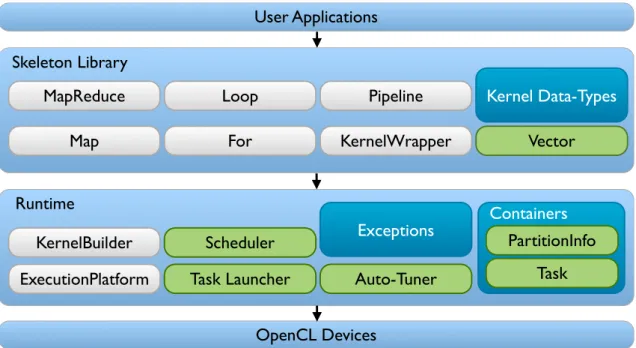
4.2 Architecture of Multi-GPU Marrow. . . 39
4.3 TheMapskeleton with implicit decomposition. . . 44
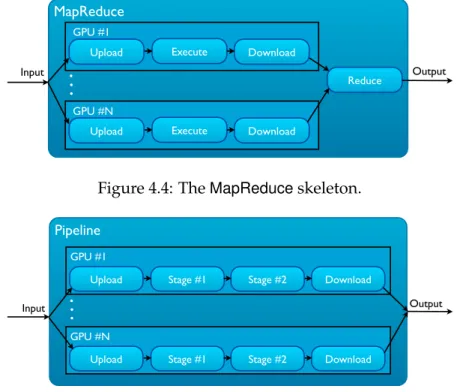
4.4 TheMapReduceskeleton. . . 45
4.5 ThePipelineskeleton. . . 45
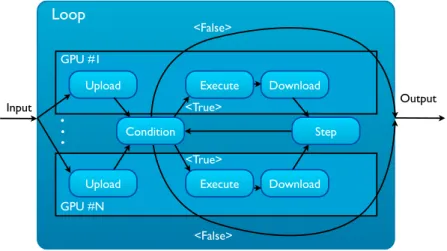
4.6 TheLoopskeleton, with parallelstepcomputation. . . 46
4.7 TheLoopskeleton, with a globally synchronizedstepcomputation and con-dition. . . 46
4.8 Buffer transfer withCopymode.. . . 48
4.9 Buffer transfer withPartitionablemode. . . 48
4.10 Initialization of a Marrow skeleton. . . 50
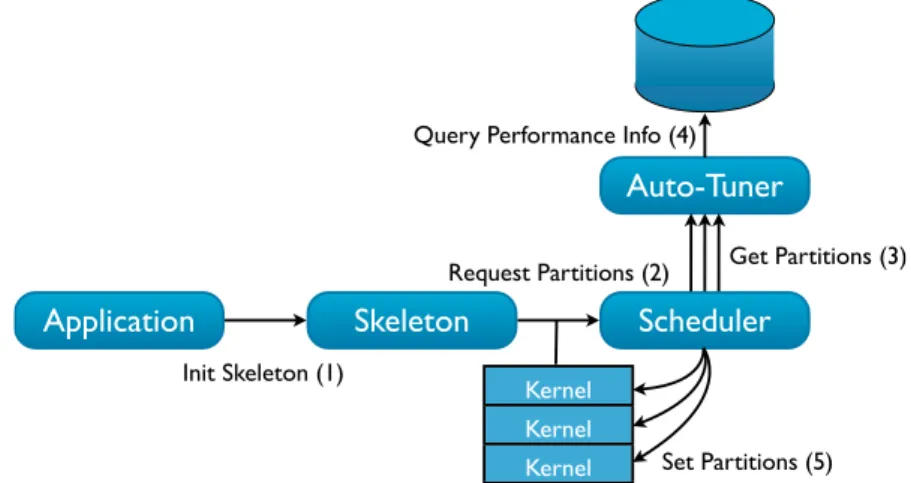
4.11 Execution request in Multi-GPU Marrow. . . 51
4.12 Auto-tuner work-space partitioning and overlap partitions. . . 56
xvi LIST OF FIGURES
4.14 Using a context per GPU, containing multiple command queues. . . 57 4.15 Multiple contexts per GPU, each with a command queue. . . 57
5.1 Single-GPU Overhead of Filter Pipeline, FFT and N-body inS1 (top) and S2(bottom). . . 67
5.2 Single-GPU Overhead of Saxpy and Segmentation inS1 (top) andS2 (bot-tom). . . 67 5.3 Multi-GPU Saxpy overhead inS1(left) andS2(right). . . 68
5.4 Single-GPU Speedup versus original Marrow of Filter Pipeline, FFT and N-body inS1(top) andS2(bottom). . . 70
5.5 Single-GPU Speedup versus original Marrow of Saxpy and Segmentation inS1(top) andS2(bottom). . . 70 5.6 Multi-GPU scalability versus Single-GPU of Filter Pipe, FFT and N-Body
inS1(top) andS2(bottom). . . 73
5.7 Multi-GPU scalability versus Single-GPU of Saxpy, Segmentation and Hys-teresis inS1(top) andS2(bottom). . . 73
5.8 Overlap behavior with Filter Pipeline, FFT and N-Body inS1(top) andS2
(bottom). . . 75 5.9 Overlap behavior with Saxpy, Segmentation and Hysteresis inS1(top) and
S2(bottom). . . 75 5.10 Filter Pipe, Hysteresis and Segmentation execution times within each GPU
List of Tables
2.1 Memory allocation and accessibility by Host and Kernel (adapted from [Khr12]) 9
2.2 Categories of GPU system architectures. . . 12
5.1 Systems used for the evaluation of Multi-GPU Marrow. . . 63
5.2 Multi-GPU Saxpy code size in OpenCL and Marrow. . . 77
A.1 Single-GPU OpenCL execution times in milliseconds. . . 94
A.2 Multi-GPU Saxpy OpenCL execution times in milliseconds. . . 94
A.3 Original Marrow execution times in milliseconds. . . 95
A.4 Multi-GPU Marrow execution times in milliseconds using a single GPU (best overlap results). . . 96
Listings
3.1 Saxpy in Marrow . . . 35
4.1 Buffer default decomposition. . . 40
4.2 Saxpy in multi-GPU Marrow. . . 41
4.3 TheISkeletoninterface. . . 43
4.4 TheIExecutableinterface.. . . 44
4.5 SFINAE example using the sum operator. . . 49
1
Introduction
1.1
Motivation
Graphic Processing Units (GPUs) have become an ubiquitous component in computer systems, being responsible for all graphical-related operations. These specialized units were adopted because the limitations of common CPU architectural design do not scale well with graphics, as graphical operations are commonly parallel pixel-wise compu-tations, entailing long iterations between frames, due to the low number of concurrent threads available. The GPU overcomes the need for long iterations by adopting an ar-chitecture which is comprised of many streaming processors. These are relatively weak, currently with frequencies close to 1GHz, in comparison to their CPU counterpart, which boasts of frequencies above 2-3GHz. The AMD 7970 GPU1, for example, contains 2048
stream processors, each at a frequency of 925MHz, 128 texture units and 128 stencil units as well as 3GB GDDR5 on-board RAM memory.
The GPGPU (General Purpose Computation on Graphics Processing Units) concept was first formally proposed by Harris et al. as an approach to general computations using GPUs. The untapped potential of the GPUs was initially recognized by the graphics pro-cessing community, the audience of GPGPU’s initial presentation [Lue+05], in 2005, and later the supercomputer community, where the first work regarding GPGPU was pub-lished [Lue+06], in 2006. Consequently, the hardware evolved to support these needs, and is considered an important asset for the resolution of computationally-heavy prob-lems.
More recently, with the proliferation of GPGPU, the need for additional computation
1. INTRODUCTION 1.2. Problem
power evolved the system architectures, enabling the concurrent operation of several GPU devices within a single system, as well as clustered solutions where nodes can be GPU-accelerated with one or more GPU devices. In this work, we are interested in the first of these two architectures, as there has been recent work [Hua+06;Pot+12;LBB11] being developed in this hardware infrastructure, with good performance results. Addi-tionally, this type of architecture has been increasingly popular as a base platform for GPU-accelerated clusters. An evidence of such claim is the growing use of the GPU po-tential in supercomputers, as the 17 from the 100 fastest supercomputer clusters [Meu+st] (including the fastest), such as the Titan and the TH-1A, are GPU-accelerated, some of which also present exceptional power-efficiency [Comst]. From these, two already adopt the latest architecture development, boasting of multiple GPUs per node, such as the Tsubame 2.0 (three per node) and Ha-Pacs (four per node).
1.2
Problem
The most popular GPGPU API developed with native GPU support was CUDA [NVI08], where GPU computations are defined using a C-like programming language, subse-quently compile to generate a binary for the GPU’s architecture. As the GPU compu-tations (kernels) are defined through a subset of the C language (with some extra
key-words), and the main program can be written in C++ or other languages (such as Fortran and Python) using bindings, the learning curve associated with GPGPU is lessened, sim-plifying the creation of GPU-accelerated applications. As CUDA is a proprietary technol-ogy, locked to NVIDIA GPUs, the need for an open standard emerged and a conglom-erate of hardware developers such as Intel, AMD and NVIDIA, collaborated to create OpenCL [Khr12]. Inspired by CUDA, OpenCL also uses a subset of the C language to define kernels. A unified architecture is exposed to the programmer, hiding heteroge-neous details of OpenCL-enabled devices, such as CPUs and GPUs. The main usage of GPGPU APIs is scientific simulation, as these commonly require a high-degree of par-allelism to process large volumes of data, which GPUs excel at, by taking advantage of their on-board memory and high number of streaming processors.
The challenges entailing the usage of these APIs arise from the large responsibility delegated to the programmer, as well as from their low-level nature. All computations must be explicitly launched and managed (a particularly complex task when the compu-tation requires the execution of multiple kernels), and there is no automated GPU mem-ory management, delegating all allocations and deallocations, as well as its optimizations (by picking the most suited memory type and appropriate transfer timing) to the pro-grammer. This not only requires an in-depth knowledge of the architecture exposed by the API, but also of the underlying GPU hardware, as each architecture’s performance differs. This is shown by Spafford et al. [SMV10] where the best execution configuration (work-group size and buffer chunk size) widely varies from GPU to GPU.
1. INTRODUCTION 1.2. Problem
scheduling and auto-tuning, akin to the more mature distributed CPU architecture, which also requires communication for a cooperative execution. Even though the currently available GPGPU APIs enable the multi-GPU execution, they do not address these is-sues [SK09]. These components tend to become more complex to develop in multi-GPU systems, due to the limited nature of the APIs, such as the lack of profiling tools and the limited feedback provided by the GPU executions. To address these issues several lan-guages have been incrementally adapted, to interface with the GPGPU APIs implicitly, such as, StreamIt [TKA02], Lime [Dub+12] and Chapel [Sid+12]. These are not main-stream programming languages, and therefore their impact is somehow limited, as it is a known fact that library based approaches are usually more effective to convey a given feature to a wider audience. In this context, algorithmic skeleton frameworks are playing an important role.
Algorithmic skeletons [Col91] are common-pattern abstractions, whose initial focus was on clusters (from which T4P [Dar+93] andP3L[Bac+95] are examples). This concept
created a shift in the programming paradigm at the time, enabling a higher-level pro-gramming, as most of the synchronization and communications are predefined, reducing the number possible errors as well as reducing amount of knowledge required from the programmer. Skeletons are an important asset in the multi-GPU context, as CUDA and OpenCL do not support an efficient multi-GPU execution natively. As skeletons abstract well-known patterns, these can be also used to reduce the code overhead present in the GPGPU APIs regarding computation initialization and communication. This layer also allows transparent optimizations such as load balancing mechanisms.
Applications using multi-GPU architectures are dominated by data-parallelism, as it is the simplest approach to take advantage of the degree of parallel threads available in GPU devices, at the expense of computation flexibility as these can only have very lim-ited dependencies. Current skeleton frameworks only offer premature support for this type of execution, by limiting the computation type as well as limited auto-tuning and scheduling techniques, as these frameworks are still under active development. Frame-works, such as SkelCL [SKG11], SkePU [EK10] and Muesli [CK10] (detailed in Subsec-tion2.4.1), provide support for multi-GPU execution, by providing parameterizable al-gorithms, such as the Map and Scan, requiring only the data-set in a predefined structure as well as the functions that will be applied at each stage (for example a split and merge function in the Map model).
There are, however, other classes of applications that, although still data-parallel, commonly using Map pattern [SO11;CA12] models, start to incorporate some task-parallelism. These hybrids commonly combine coarse-grained task-parallelism with fine-grained data-parallelism, which present other programming models such as data-flow processing (as presented by Boulos et al. [Bou+12]) and stream processing (as presented by Repplinger et al. [RS11] and Dubach et al. [Dub+12]). These applications can normally be factorized into basic constructs, such as pipelines, loops and stencils.
1. INTRODUCTION 1.3. Proposal
these concerns using a single GPU architecture. The goal of this thesis is to adapt Marrow into an architecture with a single machine containing multiple, and possibly, heteroge-neous GPUs.
1.3
Proposal
Marrow is a framework for the construction and execution of complex computations in GPUs (OpenCL enabled devices) while addressing modularity and performance con-cerns. Modularity is achieved by using skeleton nesting, a novel approach in the GPGPU skeletons context, which allows the composition of basic constructs to create complex and structured computations. This feature enables a higher degree of control from Mar-row, by abstracting individual skeleton execution from the programmer and enabling the library to integrate optimizations transparently.
The computations in Marrow are represented in a tree structure, where the intermedi-ary nodes are skeletons, and leaves are computational kernels. This structure is obtained using skeleton nesting, which gives the programmer an opaque vision of the compu-tation, only exposing the result. This allows Marrow to take complete control of the communication as well as computation orchestrations.
The currently supported skeletons are: Loop (and its specialization For), Pipeline, Stream and MapReduce. The Loop andPipeline skeletons are specially useful for com-monly used for GPU-accelerated applications, such as, simulations and image process-ing algorithms, as they give the programmer easy access to iterative and sequential stage constructs. The Streamskeleton introduces the communication and computation over-lap, by using a task-parallel model internally. This feature, allows two-way data-transfers while there is ongoing computation on the GPU device. Tasks are internally submitted over time to the GPU device, enabling the orchestration of the overlap. TheMapReduce skeleton gives Marrow support for the Map-Reduce data-parallel programming model. Marrow is detailed in Chapter3.
This thesis intends to adapt the Marrow framework to address the aforementioned problems regarding multiple, possibly heterogeneous, GPUs, computations as well as the complexity these entail. Additionally, this adaptation introduces new constructs to the multi-GPU context such as theLoopandPipeline, as well as new techniques to this context such as skeleton computation trees for complex and structured computations. Our multi-GPU execution entails a new challenge, which is the efficient mapping of com-putations into a set of variable-performance GPUs. Following the algorithmic skeleton paradigm, this mapping should be as seamless as possible, as to abstract the underlying platform from the programmer, being another goal of this thesis. The multi-GPU support is detailed Chapter4.
1. INTRODUCTION 1.4. Contributions
1.4
Contributions
The contributions of this thesis are:
• The exhaustive performance evaluation of the original, single-GPU Marrow to ob-tain a baseline for comparison. This contribution helped in the creation of a pa-per [Mar+13] published at EuroPar 2013;
• Adaptation of the Marrow algorithmic skeleton library to an architecture containing a single node with multiple GPUs, with a particular focus in task-parallel skeletons. Given that Marrow is the first to feature these skeletons, their systematic orchestra-tion in a multi-GPU context is a contribuorchestra-tion to the community. This contribuorchestra-tion has been published [AMP13] at INForum 2013;
• The adaptation of skeleton computation trees for the multi-GPU context, for the creation of complex and structured computations. Given that Marrow is the first to introduce this feature in the GPGPU context, the efficient distribution of these computation trees to multiple GPUs is also a contribution to the community.
• The evaluation of the previously presented contributions, by measuring: 1) over-head versus OpenCL implementations and the original, single-GPU Marrow, 2) our work’s multi-GPU scalability, 3) work distribution efficiency and 4) an attempt to evaluate the productivity gains associated with Marrow’s usage in the multi-GPU context.
1.5
Document Structure
This document has the following structure:
Chapter 2 In this chapter the state of the art is presented, relating to GPU and OpenCL
architectures, multi-GPU execution frameworks (with special focus on algorithmic skele-tons), approaches to auto-tuning and workload scheduling in heterogeneous multi-GPU environments.
Chapter 3 The original Marrow algorithmic skeleton framework is detailed, before the
integration of our contributions.
Chapter 4 This chapter details the implementation of Marrow’s multi-GPU support.
Chapter 5 Our contributions are validated in this chapter, using several metrics, such
as: 1) comparison with case-studies in OpenCL, 2) in the original, single-GPU, Marrow, 3) multi-GPU scalability as well as 4) a decomposition quality evaluation.
2
State of the Art
As the work we propose involves algorithmic skeleton programming in a multi-GPU execution environment, we overview in detail the state of the art regarding algorithmic skeleton libraries and languages which take advantage of multi-GPU architectures. See-ing that we are handlSee-ing heterogeneous GPU devices, an overview is presented, detailSee-ing the current approaches to auto-tuning and workload scheduling (which is further catego-rized to static and dynamic), specifically in the multi-GPU context, as these already take into account the limitations present in the GPGPU environment. Finally, the last section of this chapter presents the final remarks relating to the state of the art, highlighting the tendencies of the studied topics.
Before diving into these more advance topics, however, it is necessary to present a base platform of knowledge to allow the reader to comprehend the technical terms and implications more easily. This platform comprises of a general overview of the GPU architecture, a detailed presentation of OpenCL’s architecture and programming model, as it will be used for this work’s implementation, as well as a taxonomy definition, where several categories of GPU-accelerated systems are defined, with a brief overview of the state of the art in each one, to simplify the categorization of systems in the remainder of this document.
2.1
GPU Architecture
2. STATE OF THEART 2.1. GPU Architecture
Figure 2.1: The Fermi architecture, showing a detailed streaming multiprocessor (edited from [NVI09]).
function units (SFUs) as well as load-store units. The SPs are responsible for integer and floating-pointer operations. The SFUs are responsible for transcendental functions such as sin, cosine and square root. The load-store units allows the implicit translation of memory addresses (cache or DRAM) for each thread within each SP group. All memory (cache and DRAM) is manually allocable and controllable by the programmer, enabling better optimized applications, in exchange of programming complexity.
The SMs operate using a SIMT (Single Instruction Multiple Threads) model, contain-ing two warp schedulers within each SM. Each warp scheduler is in charge of a group of 16 SPs. A warp (or wavefront in AMD’s documentation) is the indivisible schedul-ing unit (where each warp can contain multiple instructions), executed in groups of 32 threads in the Fermi architecture. Each single-precision float and integer operations are issued twice over one group of 16 SPs (to create the illusion of a 32-thread warp), double-precision operations are issued over two groups of 16 stream processors, occupying a full SM, temporarily suspending the execution of the other warp scheduler. The four shared SFUs, imply an 1
8 throughput as the 32 operations (size of the warp) must be issued
us-ing only four units per cycle. Some considerations should be taken into close account regarding warps, when programming with GPU devices, as it is possible for these to di-verge. This commonly happens due to conditionals present in the computation which implies that some threads are executing different operations of varying complexity. This incurs longer execution times as not all streaming processors might be used at each cycle, lowering the throughput.
2. STATE OF THEART 2.2. OpenCL
transactions (32-, 64-, or 128-bytes), that must have their first address aligned to a multi-ple of its size. This entails that useless information is transfered if memory accesses that are not a multiple of these transaction sizes. Ideally, each warp should use all the data acquired by the implicit memory transactions in an ordered way (for example, thread one uses the first element, thread two the second element, and so on) to avoid unnecessary transfer overheads. Thus the programmer is responsible for parallelizing the computa-tions in a way that takes advantage of coalesced accesses.
2.2
OpenCL
There are two main APIs for general programming on GPUs, the NVIDIA’s CUDA [NVI08] and OpenCL [Khr12]. Brook [BH03] was the first framework of its kind to be created in 2003, demonstrating the potential of GPGPU in GPUs, using Cg [Mar+03], a C-like pro-gramming language which compiles to OpenGL shaders for GPU execution. CUDA was released in 2007, after the widespread of the GPGPU concept from Brook’s creators and others. CUDA is limited to NVIDIA GPUs which created a need for an open standard. OpenCL was developed in 2008 by the Khronos Group to be a general computation stan-dard for many heterogeneous devices, such as CPUs, GPUs and DSPs (Digital Signal Pro-cessors). A significant portion of hardware developers dedicated to computation adhere to the OpenCL standard as a unified access to processing resources. These developers include NVIDIA (where OpenCL is translated into CUDA), AMD and Intel.
2.2.1 Architecture
OpenCL serves as an abstraction to heterogeneous devices, thus exposing a similar ar-chitecture for any computing device. As seen in Figure2.2each computational device is comprised of an arbitrary number ofwork-groups(shown ascompute units). Each
work-group contains a set ofwork-items(shown as processing elements), and each is translated
into single core with fastprivate memory. Each work-group haslocal memory, an internal
memory shared by all elements within the group. Several work-groups can be used to for the computation of a single kernel which makes the management of the memory an important concern. OpenCL does not enforce any type of behavior in regards to global and constant memory cache, as well as does not provide a API to modify the underlying device’s behavior (due to varying cache policies).
Table 2.1: Memory allocation and accessibility by Host and Kernel (adapted from [Khr12])
Global Constant Local Private
Host Dynamic (Read/Write) Dynamic (Read/Write) Dynamic (No Access) No Allocation (No Access) Kernel No Allocation
2. STATE OF THEART 2.2. OpenCL
Figure 2.2: OpenCL device architecture, Host is not shown (taken from [Khr12]).
There are two categories of globally-accessible memory within OpenCL devices:global
andconstant. Constant memory cannot be changed, within a kernel execution, once set.
The amount of available memory in any of these categories vary depending on the un-derlying hardware. All memory types can be explicitly managed by either the Host or the Kernel as shown in Table 2.1. To create efficient implementations in OpenCL, the programmer should manage these different memory types to optimize the locality of the data. The devices cannot access host memory (cache nor RAM) directly due to hardware limitations (although when using the CPU as a OpenCL device, it technically has access to host memory), which influenced OpenCL’s design to treat each device as autonomous. OpenCL has a relaxed memory model where the state of memory is not guaranteed to always be consistent over all the work-items. Private memory within a work-item has load and store consistency as it is the only one reaching it. Local memory is consistent across work-groups (and their work-items) when there is work-group barrier. Global memory is only consistent across the work-items of a single work-group at a work-group barrier, but there are no guarantees among different work-groups while executing a ker-nel.
2.2.2 Programming
A OpenCL program has two components:kernelsthat are executed in one or more OpenCL-enabled devices and ahost programwhich triggers and manages the execution of the
2. STATE OF THEART 2.2. OpenCL
(such as__kernelfor the definition of a kernel function) and some limitations, such as be-ing unable to allocate anarraywhose a size cannot be determined in compilation-time. As presented in the previous subsection in the architecture, each work-group is comprised of a variable amount of work-items. These are assigned anindex space(which can have multiple dimensions), within a single kernel execution, creating a unique identifier by combining a work-group and work-item identifiers. When a kernel is executed the pro-grammer can use these to create a disjoint work distribution among all the work-items with ease.
The host program interacts with the device using acommand-queue, which can
sched-ule the asynchronous execution of the kernels. There are three command categories: ker-nel triggeringcommands (to start execution),memorycommands (which are used for
al-location and transfer of data) andsynchronization commands (which define constraints
to the execution order of the enqueued commands). There are two execution orders: in-order, and out-of-order. In-order execution launches enqueued commands in the order
they are submitted, but only one command can be executing at a time. Out-of-order execution does not wait for a command to finish execution and the programmer must enforce any order constraints using explicit synchronization.
OpenCL supports the following programming models: data-parallel,task-paralleland hybrids of the two. The data-parallel model is the most commonly used, where com-putation is defined using a sequence of comcom-putations over a data-set and there is an instance of each kernel per work-item. Using the aforementioned identifications, the work-items apply these computations to their assigned elements in parallel. It is possible for the programmer to specify the total number of work-items needed for an execution as well as how many work-items are grouped into a single work-group. Alternatively, the programmer can only specify the total amount of work-items needed and OpenCL can automatically infer the amount of work-items per work-group. The task-parallel model executes a single instance of the kernel independently of an index-space. Paral-lelism in this model is expressed by either using the vector data types implemented by the OpenCL device; queuing multiple tasks or by queuing native OpenCL kernels. This programming model is logically equivalent to executing a kernel using a single compute unit with a work-group containing one work-item.
GPUs support bi-directional communication while there is computations being exe-cuted in the device. This feature is commonly referred as computation and communica-tion overlap. Programmers can take advantage of this feature by manually orchestrating the communication to and from the device, using carefully planned kernel execution commands with a technique known asdouble-buffering. Komoda et al. [KMN12] detail a
2. STATE OF THEART 2.3. Taxonomy of GPU-Accelerated Computer Systems
2.3
Taxonomy of GPU-Accelerated Computer Systems
The unending need for scalability evolved the initial architecture, containing a single computer with one GPU, into clustered solutions as well as more recently the integration of multiple GPUs in a single computer. Several architectures emerged from this evolu-tion, which motivates the creation of this taxonomy, for their categorizations while taking into account common features. The architectures of GPU-accelerated systems can be cat-egorized according to two dimensions: 1) the number of physical nodes composing the system and 2) the number of GPUs within a node. The Table2.2defines the taxonomy of GPU-accelerated architectures, including clustered solutions.
Table 2.2: Categories of GPU system architectures. One GPU Multiple GPUs
One Node SNSG SNMG
Multiple Nodes MNSG MNMG
The SNSG architecture is the initial GPU accelerated architecture, containing a single machine and a single GPU device. It is the simplest GPU-accelerated architecture, being commonly the first framework development step, before its generalization to a clustered and/or multi-GPU solution. Stone et al. [Sto+07] use a SNSG architecture to accelerate the simulation of molecules by partitioning the simulation space among all the streaming processors in the GPU, obtaining a ×40 better speedup than the best CPU
implementa-tion. Elsen et al. [Els+07] present a GPU-accelerated N-Body simulation which simulates the effects of a force law to a set of mass particles in a space. This implementation had a
×25improved speedup over a SSE-optimized CPU implementation. A dense linear
alge-bra solver was implemented by Tomov et al. [Tom+10] using the MAGMA math library which enables several factorizations such as Choleski, LU and QR in a SNSG environ-ment. An auto-tuning component is used to create a static schedule of the tasks between the CPU and the GPU. Mousazadeh et al. [Mou+11] presents a CUDA implementation of a deformed image registration algorithm, which uses a reference image and a deformed image to calculate the forces involved, which caused the deforming. This algorithm re-quires a significant amount of sparse matrix operations, thus making it a good candidate for GPU execution. This work can be applied to medical resonance images (MRI), to help the diagnose of illnesses.
2. STATE OF THEART 2.3. Taxonomy of GPU-Accelerated Computer Systems
inter-process communication, in a SNMG architecture. This work is integrated into MVA-PICH2 [Hua+06] (an implementation of MPI for InfiniBand and other high-performance networks). Two types of communication are defined: Two- and One-way. Two-way com-munication entails synchronization between messages akin to send/receive primitives in distributed communication, while one-way communication is asynchronous and re-quires explicit synchronization. The work is compared to MPI using CPU interaction and results show a79%latency improvement in two-way communication, and a74% im-provement in one-way communication. This paper is presented as a SNMG architecture instead of MNMG (as it uses MPI, commonly used in distributed computation) as the whole paper, as well as the evaluation presented was done using a single node. Lalami et al. [LBB11] developed a SNMG implementation of the Simplex method, commonly used in linear programming. The simplex method is represented using the matrix notation, which is partitioned equally among the GPUs. Test results using two GPUs show an85%
better performance versus single GPU execution.
Multi-node architectures presented below, rely on communication APIs, such as Mes-sage Passing Interface(MPI) and Java-basedRemote Method Invocation(RMI) as a
founda-tion for distributed computafounda-tion. The main advantage of these architectures, is the higher scalability potential due to unbound number of nodes. However, there are some concerns inherent to this approach, mainly related to reliability, since latency, error detection and correction are not a trivial issue in a networked environment.
MNSG architectures are commonly used as trade-off between scalability and imple-mentation simplicity, while maintaining unbound potential for scalability (at the expense of budget), as new nodes can always be added. Fan et al. [Fan+04] present an overview of the MNSG architecture and its advantages, such as cost-efficiency, in comparison to pure CPU clusters, as well as possible applications, for example, an airflow simulation in Times Square. When using 32 nodes, each equipped with a GeForce FX 5800 Ul-tra, presents an improved speedup of about ×5 versus a CPU cluster, translating into
about 80% of the (best) linear scalability. It should be noted that at the time of this paper, multi-GPU execution was not yet being studied and was still very premature at a hardware level (as SLI and CrossFire technologies were announced at the end of 2004). Several supercomputers have adopted the MNSG, some of which show excep-tional power efficiency, as three of the top five most power-efficient supercomputers are GPU-enabled [Comst]. Sanam sits in the fourth place, with 2,351 MFLOPs/W, comprised of 420 nodes in a MNSG architecture with a AMD FirePro S10000 per node and is the 52nd fastest supercomputer [Meu+st]. The 29th most power-efficient supercomputer is the Ti-tan, with 2,142 MFLOPs/W, made up of 18.688 nodes where each node has an NVIDIA Tesla K20 and is on the second place of the ladder as of the writing of this document.
2. STATE OF THEART 2.4. Algorithmic Skeletons
of optimization required, one at the network layer and another intra-node, for the load balanced distribution among GPU devices. This complexity entail that most works us-ing this architecture use straight-forward data partitionus-ing on both layers. Danner et al. [Dan+12] present MNMG architecture with 32 nodes connected using MPI, equipped with six NVIDIA Fermi M2070 GPUs each. They use this architecture to accelerate the creation of a digital elevation model using a model similar to Map-Reduce. This work resulted in a ×25 speedup over the pure CPU cluster. Babich et al. [BCJ10] adapt a
li-brary with several sparse matrix linear solvers for MNNG architecture by using data-parallelism over the whole cluster. The cluster contains 16 nodes containing two GPUs (NVIDIA GTX 285) each, connected by InfiniBand. The results show a strong scaling, improving about×10sustained GFLOPs using 32 GPUs versus two. Additionally there
two highly regarded supercomputers (aforementioned in the motivation), which take ad-vantage of this architecture, namely the Tsubame 2.0 and the Ha-Pacs. The Tsubame 2.0 is 21st fastest supercomputer, as well as the 91st most power-efficient, comprised of 1408 nodes, where each node has three NVIDIA M2050s. The Ha-Pacs is the 62st fastest super-computer, 48th most power-efficient, comprised of 1300 nodes, containing four NVIDIA M2090s per node.
2.4
Algorithmic Skeletons
Parallel execution is commonly obtained by explicitly coordinating threads and synchro-nizing access to shared resources. TheParallel paradigmis naturally more complex than
the sequential counterpart and tends to be notoriously error-prone [Yan+12] due to un-predicted interactions among processing entities over shared resources.
To this extent, the identification of patterns that embed known structures and behav-iors in this area provide an effective added value. Recurrent steps common to many algorithms can be optimized unitedly.
Algorithmic Skeletonsare algorithm patterns for parallel executions which abstract the
underlying structure of the execution environment [Col91], providing predefined mem-ory synchronization and communication. The higher-level capabilities of skeletons en-able the programmer to focus on the algorithmic problem instead of the concerns intrinsic to its parallel decomposition.
Skeletons can be combined in two ways: sequential(of which SkelCL [SKG11] is an
example) and nested (of which Calcium [CL07], Skandium [LP10], Muesli [CK10] and
Marrow [Mar12] are examples).
Combining sequentially exposes the explicit execution of one skeleton at a time. The algorithms code explicitly defines the sequence of steps and has access to all intermediate results. This approach gives high control to the programmer in exchange to the lack of execution orchestration from the frameworks. Thus, the programmer is responsible for inter-skeleton execution optimization, making efficient programming complex.
2. STATE OF THEART 2.4. Algorithmic Skeletons
structures [Col04], creating the illusion that all skeletons are running concurrently, much like processes in an operating system. This illusion allows higher level orchestration of the independent skeletons, because the runtime execution is defined early and delegated to the library.
The systematic usage of skeletons is important as it separates program behavior from intrinsic parallel details [GVL10]. The separation enables performance gains, by taking advantage of the available infrastructure from pattern optimization present on the Skele-tons.
Skeleton libraries were initially developed for cluster environments [CL07;ADT03]. In this context there was a need for communication technologies over a network between computation nodes. Among these technologies the most used are RMI (Remote Method Invocation) in the Java context and MPI (Message Passing Interface) standard in sev-eral other languages. These technologies provide communication support for distributed computing over a network.
With the development and proliferation of multi-core architectures, new Skeleton frameworks were specially tailored or adapted for these environments, such as Skandium [LP10] and Muesli [CK10]. These typically take advantage of intra-node parallelism by resorting to OpenMP for example.
More recently with the growing popularity of GPGPU, several Skeleton frameworks were proposed to exploit this untapped resource such as SkelCL [SKG11] and SkePU [EK10] which take advantage of parallelism within multiple GPUs. Since our work revolves around this research, we will provide a more in-depth description of such libraries, as well as other approaches, in the remainder of this section.
2.4.1 Algorithmic Skeletons for GPGPU
SkelCL
SkelCL [SKG11] is a C++ library for GPGPU built on top of OpenCL. Its main objective is to provide performance gains in highly parallel tasks using GPU devices.
The main concept of this library is theVector. This data-structure was created to
by-pass a significant portion of code-overhead present on GPGPU APIs.
All data transfer between host (CPU accessible) memory and device (GPU accessible) memory are optimized by the Vector. This feature includes lazy copying which delays memory transfer to host memory until explicitly invoked, or all computation depending on it ends, enabling a Skeleton to use results from a previous one without redundant transfers to host memory.
The instantiation of the skeletons with computation is performed by supplying C++ functions as plain strings.
2. STATE OF THEART 2.4. Algorithmic Skeletons
enables the sequential composition of skeletons, in the sense that the output of one may be passed directly as the input vector of another.
Map applies a programmer-defined function to all elements of a given Vector. For type-preservations sake, the map function must take an element of a certain type T and produce an element of the same type.
Ziptakes a programmer-defined binary operator, which is applied index-wise to a pair of input Vectors of the same length, and returns a single output Vector with the results of the combination.
Reduceapplies a binary operation to every pair of input elements recursively until it obtains a single scalar value. For parallel execution of this Skeleton, the binary operation must be associative so it can be applied to arbitrarily sized subranges in parallel. It is the programmer’s responsibility to provide an associative operator as SkelCL does not test this property. Intermediate reduce results are saved in fast, local device memory (cache). Scan applies a binary operation recursively to all previous elements of the element being calculated. It is similar to a reduce with the input Vector containing all the previous elements, including the one being calculated. This Skeleton is optimized to make use of local memory and avoid memory access conflicts.
Some algorithms might require a variable number of arguments on the customizing function (such as Map). In SkelCL, the Arguments object allows an arbitrary number
of input arguments, by wrapping them like a container which enables implicit memory management between host and device memories.
One premise of OpenCL is portability across several device types, such as CPUs and GPUs. To that extent, it is necessary to compile the kernels at runtime by the device at least once. To avoid unnecessary compilation overhead, SkelCL provides the option of saving the compiled kernels in persistent memory for posterior use.
Multi-GPU Support
More recent work on SkelCL [SKG12] added multi-GPU support by defining the distribu-tion of input Vector over several devices. The distribudistribu-tion and access to each data secdistribu-tion is automatically managed by the library.
The Vector concept remains the same. Internally however, it was adapted to sup-port distributions among different devices while maintaining the memory operations in a transparent fashion.
2. STATE OF THEART 2.4. Algorithmic Skeletons
Currently there are three possible ways to distribute work amongst multiple GPUs:
Single,BlockandCopy(Figure2.3). Single transfers the whole vector to a single device.
Block splits the input vector equally among all target devices. Copy duplicates the entire input to the all devices, being the output merged at the end of the skeleton execution by a programmer-defined function. If such function is not specified, then the first result from a copy received will be accepted and all others will be discarded.
A Vector’s distribution can be modified at runtime either by the system or by the programmer explicitly. This operation is, however, constrained to the execution states, when there is no computation taking place in the GPU devices. All necessary memory transfers will be done by SkelCL implicitly. These are done lazily, only transferring if they are actually needed for the next computation. This reduces communication overhead but forces computations to block until the data-set partition is completely transferred.
The default Vector distribution depends on its role in the Skeleton computation. When it is a main input, the skeleton defines the defaults. On the other hand, if it is an additional input, the default distribution must be defined by the programmer using a customization function.
The developed Multi-GPU support imposed unavoidable adaptations to the imple-mentation of the previously available Skeletons.
MapandZipsuffered similar modifications to take advantage of data-parallelization in a GPU device level. Zip, in particular, has an extra requirements: both input vectors must have the same distribution and if the distribution is set tosingleboth vectors must
be in the same device. Otherwise, the system will automatically change the distribution toblock.
The ReduceSkeleton implicitly performs all orchestration required to perform a re-duction on multiple GPUs. Each device performs a partial rere-duction locally. Afterwards the intermediate results are transferred to the CPU where they are further reduced to a single scalar.
2. STATE OF THEART 2.4. Algorithmic Skeletons
SkePU
SkePU [EK10] is a C++ Skeleton template library that supports the compilation to multi-ple back-ends such as OpenMP, CUDA and OpenCL.
To hide the verbose memory operations required by both CUDA and OpenCL pro-gramming, SkePU uses theVectorconcept. The Vector is similar in all aspects to the one
presented in SkelCL. This mechanism does not take explicit advantage of communication and computation overlap that CUDA streams support as the communication is delayed until it is needed by the host.
Skeleton parametrization is expressed through C++ macros which delimit the types of supported behaviors. These are translated to a structure with all the information needed for skeleton execution. The macro list offers: overlap, arrayand the elementary macros unary,binary andternary, all with a constant variant that does not allow data reassign-ment.
The skeletons supported by SkePU are: Map, Reduce, MapReduce,MapOverlapand MapArray. These are accessible as a C++ function and use the cited macros as arguments. Map and Reduceare similar their SkelCL counterpart. The particular case of Map allows the use of aternaryfunction, enabling the use of three input vectors.
MapReduceis a conjunction of bothMapandReduceSkeletons that are used to sim-plify code considering it is a very common programming pattern. It takes bothMapand Reducefunction structures as arguments on initialization.
MapOverlapis a variant ofMapwhere the computation of each position of the result Vector depends on a range of elements of the input vector. An useful example of this Skeleton is the convolution algorithm, commonly used for image filters.
MapArrayapplies a binary function with two input vectors. Each element of the re-sulting Vector depends on the element of the second input vector at the same position, and an arbitrary number of elements of the first input vector.
Multi-GPU Support
Multi-GPU support in SkePU was developed by dividing the work load among the exist-ing devices as well as auto-tunexist-ing of the distribution dimension parameters to take full advantage of heterogeneous environments with acceptable performance.
To implement these new features the execution plan [EDK10; DEK11] feature was created. It enables the dynamic specification of which back-end to use considering the actual problem size, as well as provide the default parameters for each back-end. All skeletons include this feature and support their manual parametrization.
2. STATE OF THEART 2.4. Algorithmic Skeletons
back-end. The estimation of different devices capabilities available that are mainly ob-tained on installation using micro-benchmarking. The data gathered by both these stages are combined to create an execution plan prepared to run the Skeletons in any back-end with default values to each.
The heuristic algorithm attempts to find the best parameter values for a certain back-end. These vary from each back-end, such as “Number of threads” in OpenMP, “Block Size” as well as “Grid Size” for OpenCL or CUDA. Initially there is a predefined set of initial configurations from which the algorithm will benchmark, to try to deduce the best configuration. At each configuration entry, the benchmarking kernels are executed to evaluate the configuration’s quality. This algorithm ends when all the configurations have been exhausted. To reduce the overhead this approach entails, there is a threshold parameter which stops the algorithm when it reaches a certain degree of optimality.
The Micro-Benchmarking is twofold: measurements are taken during installation and the same measurements are taken after an interesting real-world kernel execution to im-prove future estimates. Depending on the back-end, different parameters are saved. The values of interest for GPUs are: data transfer time from host to GPU and vice-versa; ker-nel execution time, and total execution time (which should be about the sum of the previ-ous, excluding possible architectural overhead). A formula is used to identify repetitive and fixed time. Repetitive time is measured by executing a skeleton over vectors present in host memory, as to include the data transfer overhead. Fixed time is measured by ex-ecuting a skeleton over the same vector, present in GPU device memory, avoiding data transfer overhead.
Recent work over the SkePU [Kes+12] built an integration with StarPU [Aug+09], a library that simplifies parallel execution by automating the runtime load balancing. This library is presented in detail in Section2.6.
Muesli
Muesli [CK10] is a C++ template library that takes advantage of distributed and multi-core environments. Message Passing Interface (MPI) is used for inter-node paralleliza-tion, OpenMP and CUDA take advantage of intra-node parallelization.
Muesli handles all distributed data-structures implicitly. These structures synchro-nize automatically (using MPI) when non-local data is needed, enabling a higher-level programming experience. These structures are built akin to Sparse Matrices and can be distributed in diverse ways (for example Block and Round-Robin [CPK09]).
The skeletons supported by the library are: Pipeline,Farm, DivideAndConquer, Bran-dAndBound,Fold,Map,ScanandZip. From this set, onlyFold,Map,ScanandZipsupport GPU execution.
2. STATE OF THEART 2.4. Algorithmic Skeletons
The OAL provides cleaner code in regards to the reduced macro usage and management. To take advantage of the GPGPU environment Muesli uses CUDA. A data-structure akin to SkelCL’s Vector, the Device Vector (DevVector) abstracts the memory operations between the host (CPU) and the device (GPUs) that CUDA entails. DevVectorhandles all memory transfers as well as their optimization transparently using lazy copying. The Device Vector inherits the communication and computation overlap optimizations pro-vided by CUDA streams but there is no explicit mechanism to enable the programmer to control such feature.
To provide multi-GPU [EK12], each device vector contains a set of execution plans structure, which contains all the pointers to the data-set of each skeleton instance. Data partitioning is done manually by the programmer and assigned to each execution plan entry on the skeleton. It is impossible to obtain additional information, due to the lack of architecture and implementation information in either the published papers or the source-code available (which lacks GPU execution altogether).
Source-To-Source Compilers
Source-to-source compilers in the GPGPU context are used to translate programmer-annotated, single-threaded code into a multi-threaded environment. In this context, the PGI compiler [The10] of the OpenACC [CAP] is the most noticeable work. Our discus-sion, however, focuses on the use of algorithmic skeletons to convert single-threaded algorithms to known multi-threaded structures. Even though the programmer has to an-notate the code while taking into account the desired parallelism, he does not have to be aware of the parallelizing library (such as OpenCL or CUDA).
MultiSkel [Le+12] compiles annotated C++ code into a CUDA-compliant source code (containing both host and device sources) for multi-GPU execution. The workload is split evenly by all GPUs, as the supported skeletons are mainly data-parallel. The supported elementary skeletons are: Map, Reduce, Scan andZipWith. MapReduceand ZipWithRe-duce are also implemented as a Skeleton even though they are combinations of the el-ementary skeletons. Map, Reduce, Scan andZipWith are analogous with the skeletons presented in SkelCL previously, whereZipWithis equal to SkelCL’sZip. Skeleton nesting is not supported.
2. STATE OF THEART 2.4. Algorithmic Skeletons
border’s width is defined by the programmer, considerably increasing the system’s flex-ibility. To uphold an appropriate distribution of work, the compiler resorts to a perfor-mance prediction model associated to each operation class, to decide which architecture should be used for the computation. The system is statically defined, as the analysis of each operation is done manually by the creators of the framework, taking into account the data-access patterns to predict the complexity. Skeleton nesting is not supported.
2.4.2 Other Approaches
There are other approaches to the abstraction of multi-GPU computation apart from al-gorithmic skeletons, such ascodelets,dataflow processingandstream processing.
Codelets are abstractions which break the code functionality into smaller fragments [Zuc+11]. There are some restrictions that should be followed when implementing an execution
model using codelets: these should not block or run indefinitely; they should be indivis-ible and atomic; they must explicitly define the data that will be accessed and modified and should have low-overhead when hiding long-latency operations (passing results di-rectly to another codelet). StarPU [Aug+09] takes advantage of this abstraction to create functions that might contain several different versions targeting different architectures while maintaining the same functionality. This library is presented in detail in Section2.6 due to its load balancing capabilities on multi-GPU systems.
Dataflow Processing [LM87] is based on a computational graph abstraction, where the nodes are computation kernels calledfiltersand the directed edges are a pipelined de-scription of the data path. Transforming the graph for parallel execution can be twofold: 1) partitioning the graph into relevant groups to minimize the memory transfer overhead and 2) data parallelization within a single filter. Boulos et al. [Bou+12] present a dataflow programming model which allows the specification of the architecture graph where the program will be executed. The programmer can then specify a data flow program by defining the filters and the computational graph in a textual form. Each filter can be manually assigned to each device described in the architecture graph without concerns for the underlying architecture.
2. STATE OF THEART 2.5. Auto-Tuning
connect operator (=>) enables stream processing of an arbitrary number of filters. Fil-ters are automatically optimized, where the compiler attempts to find kernel-level data-parallelism. As GPU has several types of memory, the memory assignments in Java suffer a transformation where the compiler identifies several types of memory and maps them to the GPU memory hierarchy (e.g. private arrays will be assigned to fast, private mem-ory). Lime does not support multi-GPU execution, however, it is a cornerstone of stream processing, as such, we felt that it should be present in this overview.
2.4.3 Critical Analysis of Algorithmic Skeletons for GPGPU
Skeleton libraries are relevant for the multi-GPU context as they enable the programmer to acquire predefined, parameterizable structures using a familiar language. These struc-tures have the same degree as expressiveness as Lime’s connect (=>) operator, without the need to learn a new language and its quirks, by enabling the submission of user-defined operations and data-sets.
Although the benefits of algorithmic skeleton libraries are evident, the multi-GPU li-braries available are all still under active development, as it is a novel research topic. The computations offered to the programmers are severely limited in all systems, only offer-ing data-parallel skeletons. SkelCL enables a very accessible approach for GPGPU, due to its Vector concept and well-defined Skeletons, at the expense of very limited programmer adaptability of the underlying system. The multi-GPU support is not suitable for hetero-geneous devices, as the data-set partitions are blindly set, lacking an auto-tuning com-ponent. SkePU defines a programmer interface using a strict number of macros, which limit the number of arguments the programmer can pass to a skeleton. Multi-GPU exe-cution, is able to support heterogeneous devices efficiently as it takes advantage StarPU (detailed in Section2.6.2), which uses several variations of work-stealing techniques.
2.5
Auto-Tuning
Auto-tuning [EAH77] is the automated optimization of parameters which influence per-formance. In the multi-GPU context, auto-tuning is an important component because of the wide variety of GPU architectures and the compatibility between them. Multi-GPU systems can easily integrate heterogeneous devices on the same system, which inherently brings imbalanced work distributions when no tuning is taken into account. There are two main approaches for GPU tuning: 1) benchmarking, relying heavily on empirical data and 2) mathematical performance models, that rely on describing the architecture using equations and use minimal empirical data.
2. STATE OF THEART 2.5. Auto-Tuning
each hardware architecture will behave, auto-tuning systems using benchmarks, typi-cally have two development stages.
Initially the manual tuning of a specific algorithm is used to survey the possible per-formance gains. The survey involves running a relevant set of execution configurations and manually identifying the best. Volkov and Demmel [VD08] present the optimiza-tion of several dense linear algebra factorizaoptimiza-tions such as LU, QR and Cholesky using this methodology. The GPU computations, implemented in CUDA, were developed taking into very close account the specifications of the target NVIDIA GPU hardware. This approach reports a 80–90% improvement of the peak FLOPs in large data-sets. Gu et al. [GLS10] present a CUDA multi-GPU 2D/3D FFT implementation using empirical tuning. The development, like in the previous example, very close attention to the target hardware’s specifications, such as shared memory size within a work-group and coa-lesced memory access. Additionally, fine-tuning the amount of concurrent kernels is an important exercise, to avoid too many accesses to slow, global memory, while attempting to fit all the relevant work-set inside the shared work-group memory. The work is com-pared with NVIDIA’s FFT implementation, CUFFT. The reported results show a ×2.8
speedup in 2D FFT calculations and a×22.7in 3D calculations relative to CUFFT.
The second development stage is the generalization to an automated system, which adapts the workloads while taking into account the devices capabilities. The Rodinia [Che+09; Che+10] benchmark suite targets multi-core CPUs and GPUs alike, using a wide range of algorithms with distinct data access patterns. This suite focuses in evaluating the im-pact of subtle architectural decisions made on hardware development by allowing each benchmark to have multiple implementations. Danalis et al. [Dan+10] created the SHOC Benchmark suite that provides predefined benchmarks to evaluate raw device capabili-ties and quantify the performance of reworld applications, using several popular al-gorithms such as Fast Fourier Transformation, Reduction and Scan. SkePU, presented in Section2.4, uses a component that runs micro-benchmarks at installation-time, to deter-mine a set of default values posteriorly used to create workload configurations for later executions.
Another approach to auto-tuning is the prediction of the device’s performance, using mathematical models. It uses a minimal amount of benchmark information, to predict an approximate performance value of a device with a certain data-set size. The aforemen-tioned works do not use this approach as they do not try to create a mathematical model which describes the relations between components and their impact, instead, they tend to focus mainly on the GPU’s raw performance. Schaa and Kaeli [SK09] present a math-ematical model which takes into account several variables such as: transfers speeds be-tween CPU and GPU, RAM access speed, disk throughput and times spend on CPU and GPU executions. CPU and GPU execution times are inducted by extrapolating the time spent on a single item to the size of the data-set. The presented prediction framework shows an11%average deviation from real performance values. Zhong et al. [ZRL12]
2. STATE OF THEART 2.6. Work-load Distribution for Multi-GPUs
with data-set partitioning. This formulation is more relaxed as the functions do take into account more empirical information to modulate the performance functions. The perfor-mance model is used to assign adequate workloads to both CPU and GPUs by taking into account their performance, the problem size and communication overhead (while taking into account communication and computation overlap). The overlap results show a 30%improvement in operation speed (measured in GFLOPs) using a single NVIDIA GTX 680.
Auto-tuning is closely coupled to static scheduling, detailed in the next section, by
providing a device-aware work distribution. It can also be used withdynamic schedule, by
helping the runtime algorithm to decide how much work can a device handle and thus enable it to distribute adequate amounts of work to each processor, lowering the overall execution time.
2.6
Work-load Distribution for Multi-GPUs
2.6.1 Static Scheduling
Static scheduling [CK88] deterministically schedules tasks over a completely known ar-chitecture. This scheduling type is mainly applied on purely data-parallel programming models where the framework has complete knowledge of the data-set and the compu-tations that will be executed. SNMG frameworks tend to take advantage of this type of scheduling as the architecture is known. Together with auto-tuning, static scheduling becomes capable of assigning tasks to the devices with the most adequate capabilities. If the auto-tuning adapts the scheduling over time with empirical data, the scheduling is calledadaptive static scheduling. Maestro [SMV10] uses this adaptive scheduling and will
be presented in detail below.
SkelCL [SKG12], detailed in Section2.4, applies a static partitioning strategy without any kind of tuning, offering only predetermined distributions such as transferring the whole data-set to a single device, partitioning the data-set equally to all devices and replicating the data-set to all devices. This is a very simple implementation for strictly data-parallel executions, though not appropriate for heterogeneous systems.
StreamIt, presented in Subsection2.4.2is a streaming language with support for SNMG architectures. Multi-GPU support resorts to static scheduling with auto-tuning, using benchmarks in the compiler. The auto-tuning defines a heuristic based on the capabili-ties of the GPU devices, specifying the number of parallel stream executions, the number of computing threads within each stream and the number of memory threads used to prefetch global memory, minimizing the access overhead. The stream graph, represent-ing a StreamIt computation, is partitioned for coarse-grained parallel execution and each partition mapped to each GPU with a coarsening-uncoarsening algorithm which mini-mizes communication among devices.
2. STATE OF THEART 2.6. Work-load Distribution for Multi-GPUs
and GPU hybrid applications using a single, architecture independent source-code. It uses a compiler to convert this code into TBB (Thread Building Blocks) and CUDA, and automatically map it over the processors. This mapping uses a database which keeps track of the empirical performance values of every run. When a program is ran for the first time, a training run is triggered and the data-set is partitioned evenly between the CPU and the GPU. It is then partitioned further within both to create enough elementary computation runs to create an average of the duration. Using these averages, Qilin uses a mathematical model to infer a performance curve which will be used to predict the best mapping given a different data-set size on the next run.
Maestro
Maestro [SMV10] is a library that eases OpenCL usage and specializes in the automatic fine-tuning of application. For that purpose, it resorts to static scheduling and auto-tuning to obtain the best data-set partition for a given environment.
To auto-tune the OpenCL kernel execution, Maestro uses two components: measure-ments taken during the installation process and runtime profiling information.
The measurements taken during installation, attempt to define the best initial group size, buffering chunk size and workload partitioning for the current environment. The SHOC Benchmark Suite [Dan+10] is used to obtain initial performance values of the de-vices such as peak FLOPs as well as device memory bandwidth and then translate these values to an initial configuration.
Every time a kernel is run, whether at install-time or at normal runtime, there is a weighted average associated to each combination ofdeviceandkernelwhich measures the
rate at work is done. This weighted average is used to adapt the workload partitioning over time with the aim of improving the framework’s overall performance.
Maestro takes advantage of the overlap of communication and computation to opti-mize the usage of the bus and miniopti-mize the data-transfer overhead. The results from the overlap tend to depend heavily on the algorithm used as well as on the hardware. In the vector outer product test, it improved the execution time40%to60%less time to execute
when using large chunks.
The multi-GPU execution on Maestro shows a load balanced work distribution which shows an improved speedup between×1.6and×1.8against its imbalanced counterpart.
2.6.2 Dynamic Scheduling
Dynamic scheduling [CK88] is useful when the system architecture and processor as-signed to a certain data block is not known before-hand. Scheduling is usually dis-tributed by the multiple participating processors, which coordinate to acquire actively work from one another, instead of work being delegated to them by the framework.
Load-balancingis closely related to dynamic scheduling, creating evener workload among
![Figure 2.1: The Fermi architecture, showing a detailed streaming multiprocessor (edited from [NVI09]).](https://thumb-eu.123doks.com/thumbv2/123dok_br/16521074.735653/28.892.110.744.132.486/figure-fermi-architecture-showing-detailed-streaming-multiprocessor-edited.webp)
![Figure 2.2: OpenCL device architecture, Host is not shown (taken from [Khr12]).](https://thumb-eu.123doks.com/thumbv2/123dok_br/16521074.735653/30.892.187.655.137.475/figure-opencl-device-architecture-host-shown-taken-khr.webp)
![Figure 3.1: Marrow’s architecture (taken from [Mar12]).](https://thumb-eu.123doks.com/thumbv2/123dok_br/16521074.735653/50.892.206.645.136.441/figure-marrow-s-architecture-taken-from-mar.webp)
![Figure 3.6: The Loop skeleton (taken from [Mar12]).](https://thumb-eu.123doks.com/thumbv2/123dok_br/16521074.735653/53.892.246.692.134.326/figure-the-loop-skeleton-taken-from-mar.webp)